




Abstract

An essential component of the artificial pancreas in the treatment of diabetes involves the prediction of blood glucose levels as function of insulin dose, meal intake, and other perturbations under natural living conditions. Closed-loop control algorithms need to account for these perturbations and adapt to changes in individual subject’s physiological parameters related to these perturbations. 1
Using the authors’ patient-specific linear time-varying (LTV) model 2 for glucose dynamics consisting of both insulin and carbohydrate inputs, this study developed a model predictive control (MPC), exploring the impact of real-time identification of patient-specific insulin and meal-associated model coefficients. The resulting MPC was evaluated using an FDA-approved UVa/Padova simulator with 10 virtual patients. The target glucose value was set to be 140 mg/dL, and an insulin pump shutoff feature was implemented on top of the MPC algorithm.
Figure 1a shows simulation results obtained using plasma blood glucose (BG) in modeling and the MPC control (referred to as MPC-LTV). Across subjects, MPC-LTV has mean BG of 145.95 ± 11.92 mg/dL, 0.18 ± 0.192 for LBGI and 3.52 ± 1.55 for HBGI. Compared to an ad hoc basal-bolus (ad hoc BB) algorithm, MPC-LTV has 68% lower LBGI (P = .064). Compared to an MPC designed based on an LTV model without carbohydrate input (MPC-NoCarbLTV), MPC-LTV has 20% lower mean BG (P = .005), 65% lower BGRI (P = .01), and 47% higher percentage of BG within 70 mg/dL-180 mg/dL (P < .001). An MPC based on a physiological model 3 (MPC-PhysioModel) shows 20% higher mean BG, 140% higher HBGI, but 72% lower LBGI than MPC-LTV (with P < .001, P = .002, and P = .235 respectively). Figure 1a also shows that by adding meal bolus insulin to the insulin given by MPC-NoCarbLTV for each subject, MPC-NoCarbLTV+MealBolus can achieve close performance to ad hoc BB, indicating the effectiveness of MPC-NoCarbLTV at the (fast) conditions in absence of meal intake.
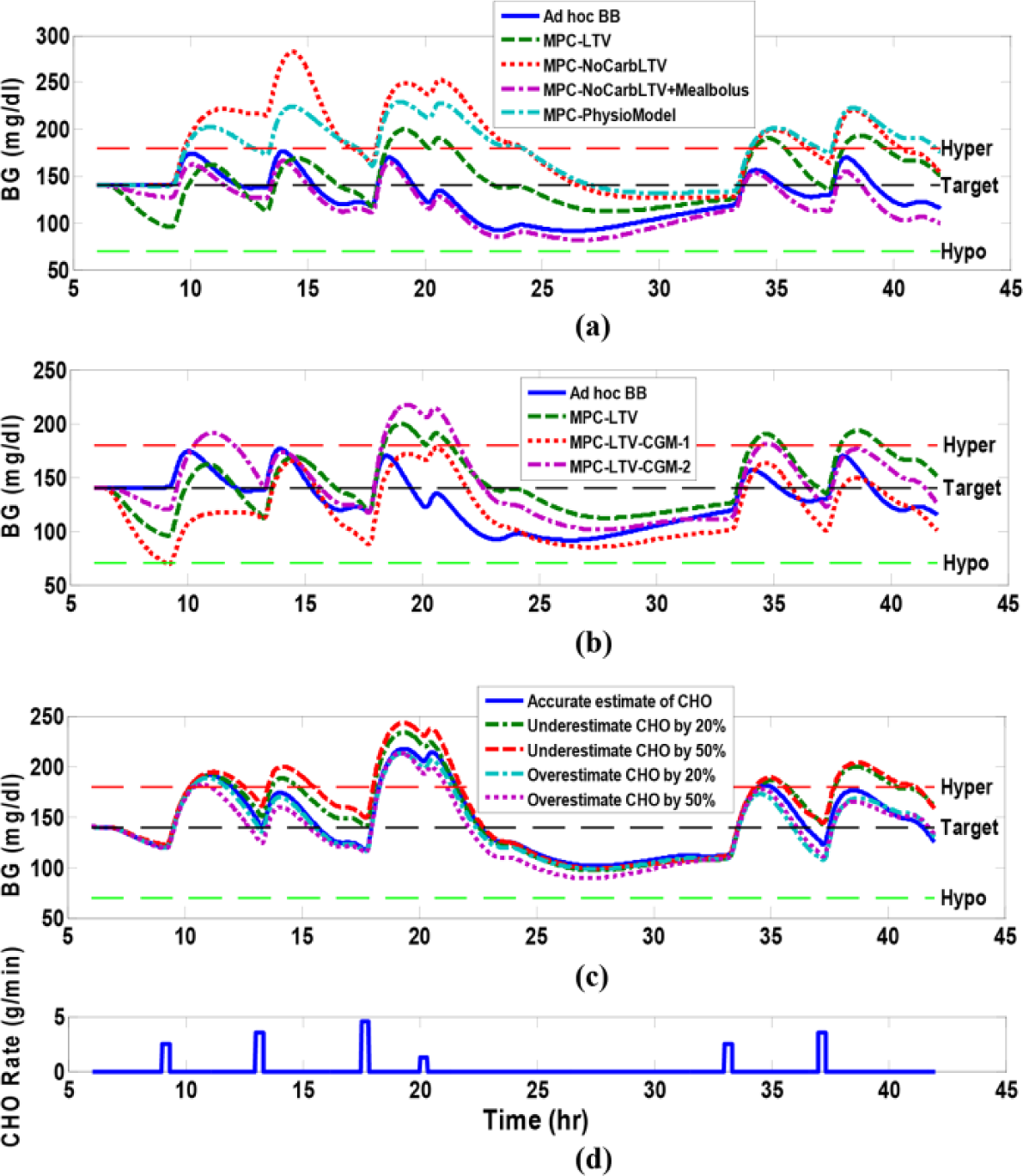
Trajectory of mean plasma blood glucose computed across all subjects excluding adult 9 (an outlier in the comparison study), starting from 6
Figure 1b shows simulation results obtained using CGM data in modeling and control, where the real-time (insulin- and meal-associated) model parameter identification in MPC-LTV-CGM-1 started from the same initial values as MPC-LTV, while the initial model parameters of MPC-LTV-CGM-2 were obtained from pretraining. 4 Note that for MPC-LTV-CGM-1, hypoglycemia occurs at the initial simulation stage before the adaptation of the model coefficients converges, resulting in pump shutoff and degraded performance in both model identification and control. In comparison, MPC-LTV-CGM-2 achieves acceptable performance, indicating that model estimation should start from a better initial condition when CGM data are used.
Figure 1c shows evaluation of MPC-LTV-CGM-2 subject to over- and underestimation for CHO. From underestimating CHO by 50% to overestimation by 50%, MPC-LTV-CGM-2 has 10% reduction in mean value of mean BG, 40% increase in mean LBGI, and 50% reduction in mean HBGI.
This study has demonstrated that the developed MPC is able to regulate BG close to the target range, and it is important to explicitly include the meal input in the time-series model, which is often lacking in existing time-series model-based MPC tools.
Footnotes
Acknowledgements
The services provided by the General Clinical Research Center of Pennsylvania State University are appreciated, as is the study coordination of Joanna Lyons and the study subjects.
Abbreviations
AP, artificial pancreas; BG, blood glucose; BGRI, blood glucose risk index; CGM, continuous glucose monitoring; CHO, carbohydrate; HBGI, high blood glucose index; LBGI, low blood glucose index; LTV, linear time-varying; MPC, model predictive control.
Declaration of Conflicting Interests
The author(s) declared no potential conflicts of interest with respect to the research, authorship, and/or publication of this article.
Funding
The author(s) disclosed receipt of the following financial support for the research, authorship, and/or publication of this article: This project was supported in part by NSF grants 1200838 and 1157220.