




Abstract
Keywords
Intensifying treatment is a cornerstone of achieving glycemic goals and often requires insulin. 1 Insulin delivery vehicles such as prefilled syringes (eg, pens) and pumps have attempted to improve ease of use, allow more control, and provide a more physiologic approach to insulin administration.2,3 V-Go® is a nonelectronic basal-bolus disposable insulin delivery device that uses rapid-acting insulin and has preset basal rates of 20, 30, and 40, units a day, and can deliver 2 units of manual bolus on demand. 4 In this retrospective study, we describe practice patterns and report outcomes for patients with type 2 diabetes initiating this new basal-bolus disposable insulin delivery device, the V-Go.
Electronic medical records from a community-based endocrinology practice identified adults with type II diabetes, using V-Go, who had at least 2 HbA1c levels. The primary outcome was the mean ± standard deviation (SD) change in HbA1c from baseline (most recent HbA1c at or before V-Go initiation) to follow-up (within 2-4 months after on V-Go).
There were 60 adults with a mean (SD) baseline HbA1c of 9.1% (1.7) (76 mmol/mol) (Table 1). Few were naïve to long-acting insulin (8.3%), but 26.7% were naïve to rapid-acting insulin. The mean (SD) HbA1c change from baseline to follow-up was -0.9 (1.3). Large HbA1c reductions (ie, ≥1.5) were seen in 30% of patients (18/60). At follow-up, 21.7% (13/60) of patients achieved the American Diabetes Association (ADA) recommended target of <7% (<53 mmol/mol). 5 In addition, 89.1% discontinued a longer-acting insulin, 42.9% discontinued a non-insulin-injectable agent and 6.7% discontinued an oral agent. There was a mean (SD) gain at follow-up of 4.1 (14.6) pounds and 0.5 (1.29) BMI.
Demographics and Clinical Characteristics of Patients with Type 2 Diabetes initiated on V-Go (n = 60).
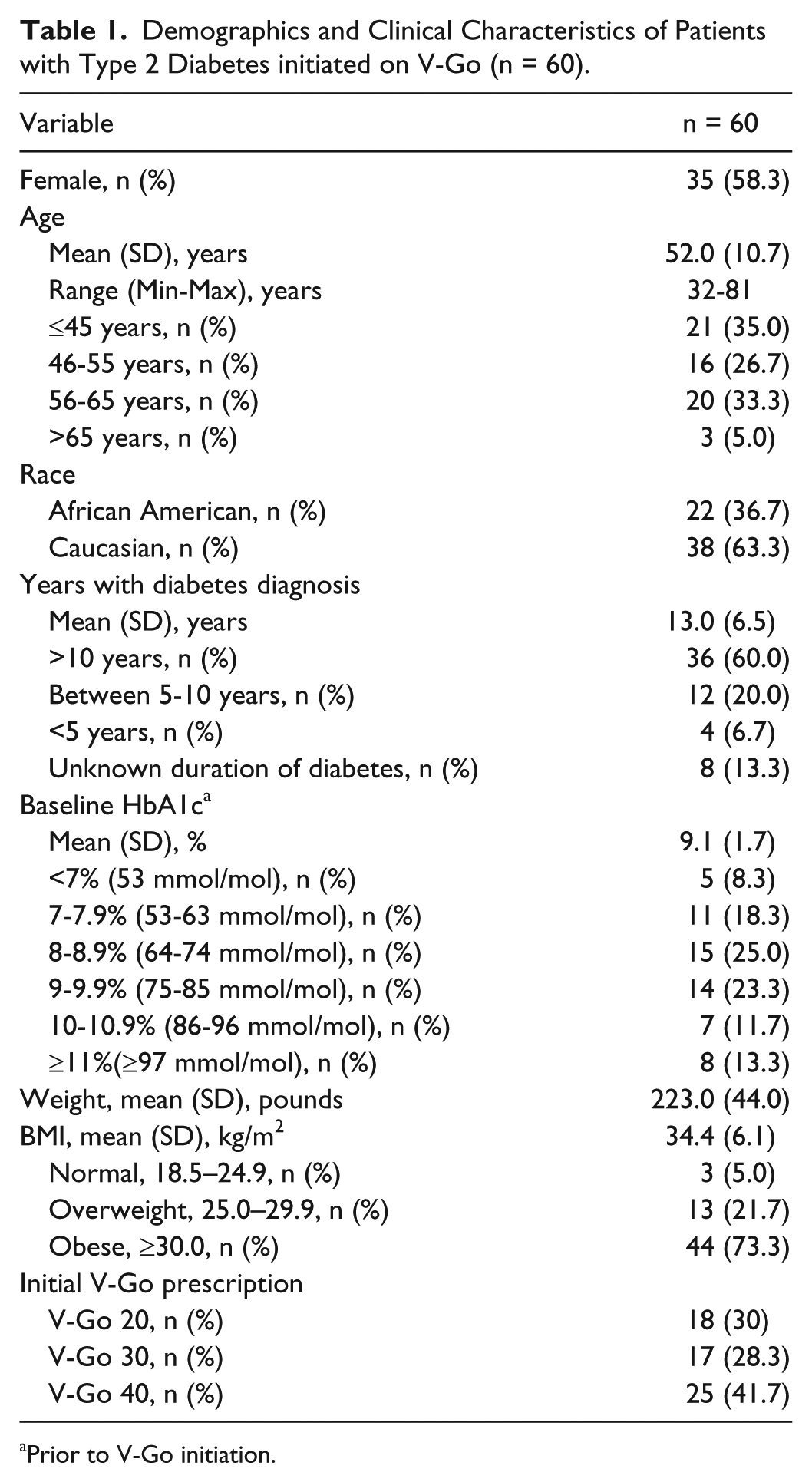
Prior to V-Go initiation.
There were 55 patients on insulin prior to V-Go, with 5 patients having baseline HbA1c <7% (53 mmol/mol). For these 5 patients, the mean (SD) insulin dose for the initial V-Go prescription was 75% ± 15% (median 73%) of the baseline total insulin dose. For the remaining 50 patients on insulin prior to V-Go with HbA1c ≥ 7% (≥53 mmol/mol), 80% had improved HbA1c, while 20% did not. Mean (SD) insulin doses for the initial V-Go prescription were 110% ± 49% (median 98%) and 96% ± 42% (median 92%) of the baseline total insulin dose, respectively, for the improved and nonimproved HbA1c groups.
We found that clinicians were prescribing V-Go to intensify insulin therapy for patients with uncontrolled diabetes who were on basal insulin. The manufacturer’s recommendations for “discontinuing prior insulin therapy, unless deemed necessary” and dosing (ie, prescribe 70-75% of total insulin dose when initiating V-Go) 4 for patients with HbA1c levels at goal were being followed. Higher insulin doses were prescribed for patients with uncontrolled HbA1c levels.
After V-Go initiation, there was a 0.9% point reduction in HbA1c at follow-up and more than double the number of patients achieving the ADA glycemic target of <7% (<53 mmol/mol). Another retrospective study in 23 patients found similar HbA1c reduction after 12 weeks on V-Go (8.8% to 7.6%; P = .005) (73 mmol/mol to 60 mmol/mol). 6 V-Go provides clinicians with another option for tailoring insulin delivery to achieve glycemic goals.
Footnotes
Abbreviations
ADA, American Diabetes Association; BMI, body mass index; HbA1c, glycated hemoglobin.
Declaration of Conflicting Interests
The author(s) declared the following potential conflicts of interest with respect to the research, authorship, and/or publication of this article: BRJ has received consulting fees from Medtronic, Inc and Sanofi and speaker honoraria from Amarin Pharmaceuticals, GlaxoSmithKline, and Novo Nordisk. JHS has received consulting fees from Dexcom, Sanofi, and Valeritas and speaker honoraria from Abbott/Abbvie, Boehringer Ingelheim, and Valeritas, Inc. CEC has received consulting fees from Novartis and Novo Nordisk and received grant support from Bristol-Myers Squibb, Gilead Sciences, Inc, Novartis, and Valeritas, Inc.
Funding
The author(s) disclosed receipt of the following financial support for the research, authorship, and/or publication of this article: This research project was supported by Valeritas, Inc.