




Abstract

Although an imbalance in cardiac autonomic function is a known cause of cardiovascular diseases such as myocardial infarction and stroke,
1
methods for monitoring heart rate variability (HRV) that reflect autonomic nervous system activity2-3 in real life have not been devised. We observed the diurnal fluctuations of HRV, in real time, by monitoring healthy volunteers in an attempt to determine the normal patterns of HRV. Sixty-one young, healthy clerical workers (age range, 22-45 years) without a significant history of disease or medication were asked to wear the continuous ambulatory HRV monitor for 24 to 48 hours. The volunteers were fitted with a long-term R-R interval (RRI) MOCA (Monitor and Care; Taewoong Medical, Gyeonggi do, Korea) recorder and a customized electrocardiography electrode attached to a suitable body site below the heart. The mean body mass index of the volunteers was 21.8 kg/m2. The study participants were clerical employees who arrived at work between 8 and 9
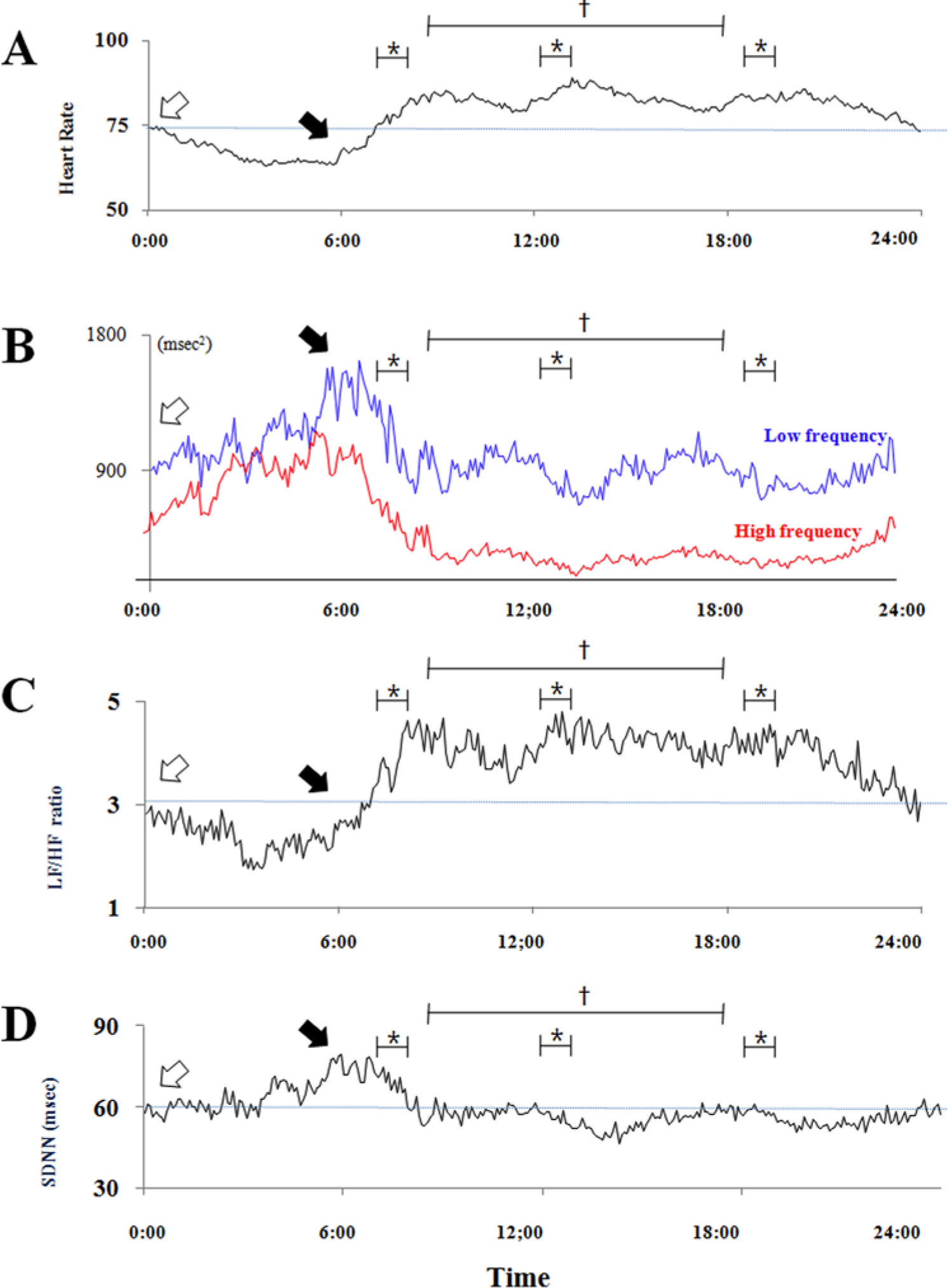
Diurnal fluctuations in heart rate variability. (A) HR, (B) LF and HF, (C) LF/HF ratio, and (D) SDNN. White arrows indicate the general time that the subjects went to sleep; black arrows indicate the wake-up time; asterisks indicate breakfast, lunch, and dinner times; daggers indicate the general work time. HF, high frequency; HR, heart rate; LF, low frequency; SDNN, standard deviation of all normal R-R intervals in the entire 24-hour recording.
The estimation of HRV by ambulatory monitoring offers prognostic information beyond that provided by the evaluation of traditional cardiovascular disease risk factors. Cardiovascular events occur most often during the morning hours and may be associated with the dramatic increase in sympathetic tone upon waking. 4 The assessment of daily and weekly HRV variations as a function of daily activities may be a way of studying the possible health effects of events such as long commute times and extensive overtime work. Some studies have reported an association between reduced HRV and the risk for all-cause mortality among elderly subjects. 5 Reduced HRV has also been associated with diabetes, acute myocardial infarctions, and hypertension. 6 We showed that HRV can be easily measured using a simple and comfortable device. By quantifying the diurnal patterns of HRV, this automatic monitoring and analysis system can provide information relevant to various kinds of chronic diseases. Investigating how diurnal HRV fluctuations aggravate a patient’s condition may help to determine new, more effective management solutions for these diseases and their complications. Ultimately, we hope to manage chronic disease effectively by using biofeedback programs that directly affect HRV, thereby improving the quality of patient care at a national level.
Footnotes
Acknowledgements
The systems and devices used in this research have been provided by the Taewoong Medical. The opinions expressed in this article are those of the authors and do not necessarily represent those of the Taewoong Medical. The final version was approved by all authors.
Abbreviations
HF, high frequency; HR, heart rate; HRV, heart rate variability; LF, low frequency; SDNN, standard deviation of N-N interval.
Declaration of Conflicting Interests
The author(s) declared no potential conflicts of interest with respect to the research, authorship, and/or publication of this article.
Funding
The author(s) received no financial support for the research, authorship, and/or publication of this article.