




Abstract

This letter serves as an update to the work performed in 2009 by Burton et al 1 in determining the accessibility of available insulin pumps with a specific emphasis placed on the performance of the displays for individuals with low vision.
Methods
Four of the 5 insulin pumps available on the U.S. market in 2012 were acquired and tested for display performance in the AFB Tech Optics Lab. The available pumps on the market that were evaluated include the Medtronic Minimed Paradigm (Northridge, CA), Insulet Corporation OmniPod (Bedford, MA), Animas Corp OneTouch Ping (West Chester, PA), and Disetronic Medical Systems Accu-Chek Spirit (Fishers, IN). The contrast, font size, and reflection properties of these devices were measured using established protocols for small displays.2,3 The results of the study are presented in Table 1.
Contrast and Font Size Measurements of the Measured Insulin Pump Displays.
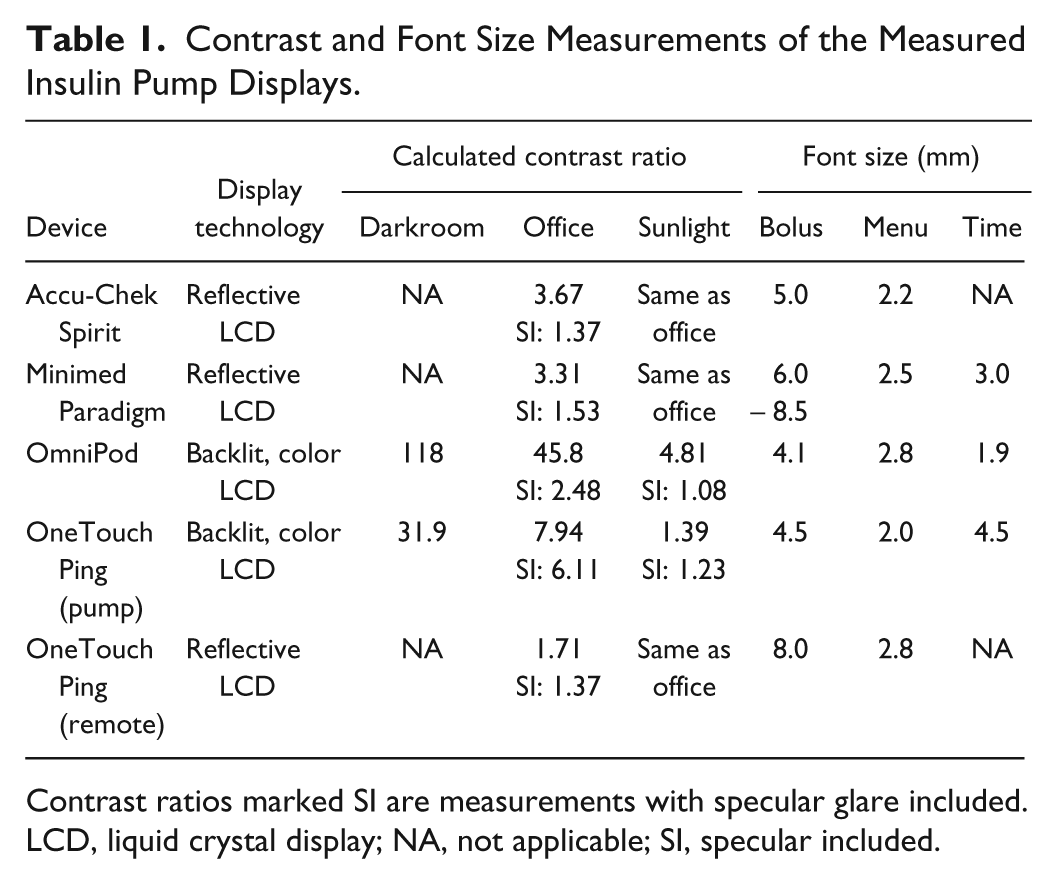
Contrast ratios marked SI are measurements with specular glare included. LCD, liquid crystal display; NA, not applicable; SI, specular included.
Discussion
None of the meters examined exhibit good low vision accessibility across all factors that were considered. The Accu-Chek Spirit and Minimed Paradigm utilized low contrast, reflective displays. These displays their contrast ratio even in bright sunlight, but this baseline contrast is not very high. The OmniPod and OneTouch Ping Pump displays are high contrast, emissive displays. These devices have much higher contrast in dark room and office lighting when compared to the reflective displays, but as ambient light increases or specular reflections are introduced, the contrast drops dramatically. This results in these displays becoming very difficult, if not impossible, to read in the sunlight.
All of the displays utilize small fonts. The Minimed Paradigm uses the largest font for the bolus volume at 8.5 mm for the most significant digit, but the rest of the fonts on the device are small. The American Printing House for the Blind recommends at least 18 point (approx 6.35 mm) fonts for best low-vision accessibility in print, 4 which is also a good benchmark for on screen text.
The OmniPod was the only system with a significant display improvement from 2009. This new version of the OmniPod remote uses a color LCD screen as opposed to the reflective, monochrome type found on the 2008 model. A remote system like the one used in the OmniPod and OneTouch Ping systems allows for much greater flexibility in the device’s design. Instead of integrating all of the functionality into a single device, a user interacts with a remote to wirelessly control the pump, which simplifies the pump hardware and could reduce the bulkiness of the pump.
Although there has only been small progress since 2009 toward an accessible insulin pump for individuals with vision loss, the continued development of a remote and pump pair makes the likelihood of a totally accessible insulin pump more likely. Unfortunately, there is still no insulin pump with speech output which is required for usage by an individual with severe vision loss. While manufacturers should use the highest contrast and largest fonts possible, more research needs to be performed to develop threshold levels for accessibility that manufacturers can adhere to. Without setting standards based on significant research, manufacturers and regulatory bodies are unlikely to make changes to ensure that these devices are accessible to people with vision loss.
Footnotes
Abbreviations
LCD, liquid crystal display; SI, specular included.
Declaration of Conflicting Interests
The author(s) declared no potential conflicts of interest with respect to the research, authorship, and/or publication of this article.
Funding
The author(s) disclosed receipt of the following financial support for the research, authorship, and/or publication of this article: Funding for this project was provided by the Jessie Ball duPont Fund. Funding for the optics lab development was provided by the National Institute for Disabilities and Rehabilitation Research (NIDRR) and other grants.