



Abstract
Primarily undergraduate institutions (PUI) often struggle to provide authentic research opportunities that culminate in peer-reviewed publications due to “recipe-driven” lab courses and the comprehensive body of work necessary for traditional scientific publication. However, the advent of short-form, single-figure “micropublications” has created novel opportunities for early-career scientists to make and publish authentic scientific contributions on a scale and in a timespan compatible with their training periods. The purpose of this qualitative case study is to explore the benefits accrued by eight undergraduate and master's students who participated in authentic, small-scale research projects and disseminated their work as coauthors of peer-reviewed micropublications at a PUI. In these interviews, students reported that through the process of conducting and publishing their research, they developed specific competencies: reading scientific literature, proposing experiments, and collecting/interpreting publication-worthy data. Further, they reported this process enabled them to identify as contributing members of the greater scientific community.
Every piece of data is important, but before micropublications, it was hard to get some of those smaller bits of data published…however, micropublications place emphasis on every piece of data. Every piece of data can help someone else in the scientific community.
Advanced academic curriculum is designed to promote talent development through the exploration of rigorous content, development of key process skills, and production of high-quality products (Olszewkei-Kubilius et al., 2018). Throughout students’ careers, their educational experiences must evolve to emphasize and develop domain-specific abilities. At higher levels of this developmental process, students need to participate in authentic tasks, guided by an expert in the field of study and designed for authentic engagement (Kettler, 2016). While the tenets of advanced curriculum are clear, implementing them in higher education institutions can be challenging, given large class sizes as well as limited time and resources. Thus, this paper chronicles the efforts of faculty at a primarily undergraduate institution (PUI) as they strive to develop talent by placing students in the role of a practicing professional and supporting the development of students’ science identities.
Developing Science Identities
A science identity is built upon the dynamic interaction among personal characteristics (e.g., beliefs, self-efficacy) within specific social contexts (Aschbacher et al., 2010; Carlone & Johnson, 2007). As individuals develop identities, they are more likely to behave in ways that align with their identity. In turn, those behaviors strengthen their identities, forming an iterative interaction among social outcomes, personal identity beliefs, and competency development (Bucholtz et al., 2012; Gazley et al., 2014). Students with strong science identities believe themselves to be scientists belonging within the broader science community. Such students express high levels of science interest and increased intentions to pursue advanced science studies in college or graduate school (Carlone & Johnson, 2007; Merolla & Serpe, 2013; Merolla et al., 2012). Further, students with strong science identities are more likely to be employed within the science field after graduation (Stets et al., 2017). Even after controlling for alternative explanations (e.g., GPA, self-efficacy, and goal theory), researchers determined a strong science identity increases the likelihood of minority students entering the science workforce (Stets et al., 2017).
Given the positive outcomes associated with building a strong science identity, determining how to best build students’ science identity is an important pursuit. Research has examined interventions that address multiple entry points to building science identities (e.g., high school science programs; Stets et al., 2017) and identified potential constructs associated with science identities (e.g., performance, competence, and recognition; Carlone & Johnson, 2007). The current case study builds upon that work by exploring the effects of conducting authentic research coupled with coauthoring short-form, peer-reviewed micropublications on biology undergraduate and master's students’ science identities.
Historically, providing opportunities for undergraduates and master's students to engage in authentic research resulting in recognition from the broader scientific community has been challenging, even though this broader recognition could be key to building positive science identities. Traditional cellular biology journals require articles to make substantial advances to the field, which are often the accumulation of countless experiments, across multiple years. Thus, institutions that primarily serve undergraduates (PUIs) as well as those serving students completing terminal master's degrees are often unable to provide research students the opportunity to see their work integrated into a publication during their time in the lab. Whether a student is still a lab member when their work is published is highly dependent upon the research project's phase at the time they enter the lab, which is typically out of the student's control. While students may be authors on peer-reviewed papers, by the time these papers have been published, many of these students will have already entered their next career phase. Such publications mostly benefit the principal investigators, the institutions, and the broader scientific community, without supporting the science identity development of the students.
Recently, a new journal generated a potential solution to this problem; microPublication Biology is a peer-reviewed, indexed journal that provides space for smaller biological stories (Raciti et al., 2018). The aim and scope of the journal is to “publish single, validated findings that may be novel, reproduced, negative, lack a broader scientific narrative, or perceived to lack high impact.” This journal requires articles to be peer-reviewed and adhere to standards for scientific rigor and reproducibility. While originally only publishing studies on certain model organisms, by 2019, the journal expanded to include our studies in yeast, and by 2023, it now welcomes experiments from all areas of life sciences. This expansion is exciting, as it will provide additional publishing opportunities for all types of biological studies.
Specifically, microPublication Biology provides a unique opportunity for undergraduate and master's students (whose time in a research lab is limited) to publish their work while they are still in the lab. This opportunity could provide increased recognition of their scientific contributions, enhancing their science identities, which in turn, could positively influence their future career decisions. Therefore, the purpose of this qualitative case study is to present an assessment of (a) how we developed a system to promote undergraduate and master's students’ opportunity to conduct and publish authentic scientific research and (b) how we leveraged that system to create a community of scientists. Collectively, this system was designed to support the development of students’ science identities by first, increasing their competencies through participation in authentic/relevant experiences and second, demonstrating how they can contribute to the broader field through micropublications.
We anchored our definition of science identity on Bernard's (2020) synthesis of five empirical articles’ definitions and approaches (Aschbacher et al., 2010; Bucholtz et al., 2012; Carlone & Johnson, 2007; Gazley et al., 2014; Vincent-Ruz & Schunn, 2018), proposing a science identity is: …how an individual seeks to be a scientist, which is constructed through iterative interactions with scientific social and material contexts. A person with a strong science identity would exhibit a sense of community and affiliation built by consistent extrinsic and intrinsic attitudinal factors. This sense of identity can be built by participating in relevant activities followed by categorizing oneself as a member in the scientific community.
Designing and Providing Relevant Research Experiences
To build a science identity, students must recognize they are participating in research experiences as actual scientists. However, many undergraduate science laboratory courses still rely on “recipe-driven” experiments with pre-determined, known outcomes that students strive to replicate. While these experiences support student skill development (e.g., pipetting), they do not necessarily enhance students’ deeper understanding of how actual scientific contributions are made or provide the opportunity to make such contributions (Delventhal & Steinhauer, 2020). Those lab experiences do not allow students to test original hypotheses, generate novel data, and, especially, publish their findings for the broader scientific community (Burnette & Wessler, 2013; Knutson et al., 2010).
Recently, leaders in undergraduate science education have advocated to embed authentic science learning opportunities into all students’ undergraduate lab-based courses, and many programs have heeded that call, leading to successful outcomes (e.g., D’Costa & Shepherd, 2009; Delventhal & Steinhauer, 2020; Lau & Robinson, 2009). Providing students with more authentic laboratory experiences has the potential to increase student retention in STEM, motivation, and promote science identities, better preparing and inspiring students to pursue future STEM careers (American Association for the Advancement of Science, 2011). Two main approaches can provide these experiences: (a) Course-Based Undergraduate Research Experiences (CUREs) and (b) experiences within independent Principal Investigator's Research Labs (PIRLs). Often these experiences are considered separate opportunities; however, we conceptualized how research conducted in both CUREs and PIRLs could be integrated to create more opportunities for undergraduate and master's students to coauthor peer-reviewed micropublications.
Course-Based Undergraduate Research Experiences (CUREs)
First, CUREs are laboratory courses that encourage students to craft and address original research questions. Implementing CUREs in undergraduate curriculum can expand access to research experiences and more broadly expose students to authentic science (Bangara & Brownell, 2014; Esparza et al., 2020; Sun et al., 2020). Unlike a traditional protocol-driven laboratory experience, the experimental outcomes of CURE laboratories are typically unknown. Students are guided through a process that involves drafting a testable hypothesis and designing experiments to answer relevant scientific questions. While no two CUREs are the same (e.g., investigations of zebrafish development; D’Costa & Shephard, 2009; structure-function analysis of glyceraldehyde-3-phosphate dehydrogenase; Lau & Robinson, 2009), involving students in a more authentic scientific experience benefits both students and faculty. Students report a higher ability to both think and communicate like a scientist after participating in a CURE (Brownell & Kloser, 2015). Further, students who participated in a CURE experience better outcomes in areas related to self-efficacy, self-determination, and problem-solving when compared to students who did not participate in a CURE (Olimpo et al., 2016). Faculty who teach CUREs report additional benefits, including the opportunity to connect teaching to research, positive contributions to promotion and tenure, and the opportunity to publish data collected in a CURE (Shortlidge et al., 2016). Prior to the advent of micropublications, however, data derived from a single CURE would typically constitute only a small fraction of a larger published research project, if published at all.
Experiences in Independent, Principal Investigator's Research Labs (PIRLs)
While CUREs provide widespread access to authentic science experiences, PIRLs provide in-depth mentorship to a smaller number of students. These experiences are high-quality and time-intensive but limited in number. Like CUREs, PIRLs allow students to be immersed in an authentic research process and teach students how to think and work like scientists. The benefits of PIRLs are well-characterized; undergraduate researchers are more likely to pursue graduate degrees, and they report increased understanding, confidence, and awareness of science (Russell et al., 2007). These experiences are important in helping students clarify STEM career interest, as early exposure to undergraduate research was an important factor in retaining STEM students (Graham et al., 2013; Xu, 2015).
Professional success of faculty overseeing PIRLs often depends on peer-reviewed publication of PIRL-generated data. Such publications typically comprise a substantial amount of data generated over the course of multiple years. Unless undergraduate or master's students contributed near a project's conclusion, by the time such work is published, it is likely these early-career scientists will have moved on to different programs or positions, thereby missing out on professional advantages conferred by authorship. Micropublications provide opportunities for students with shorter laboratory residency to see their work published on an abridged timescale.
Combining CUREs and PIRLs
While both CUREs and PIRLs provide authentic experiences, they are often conceptualized as separate opportunities for students with different benefits and drawbacks. CUREs are more inclusive, providing all students in the course with authentic, limited experience, whereas PIRLs are afforded to fewer students, but those experiences are in great depth and often sustained across semesters. Within our case study, we built a hybrid model, connecting CUREs with PIRLs, leveraging existing resources to produce novel, important experimental results (see Figure 1). Data initially collected in CUREs were subsequently validated in independent labs belonging to faculty researchers with similar interests (PIRLs). This workflow has the potential to systematically involve a greater proportion of STEM students in authentic scientific discovery, leading to regular micropublications.
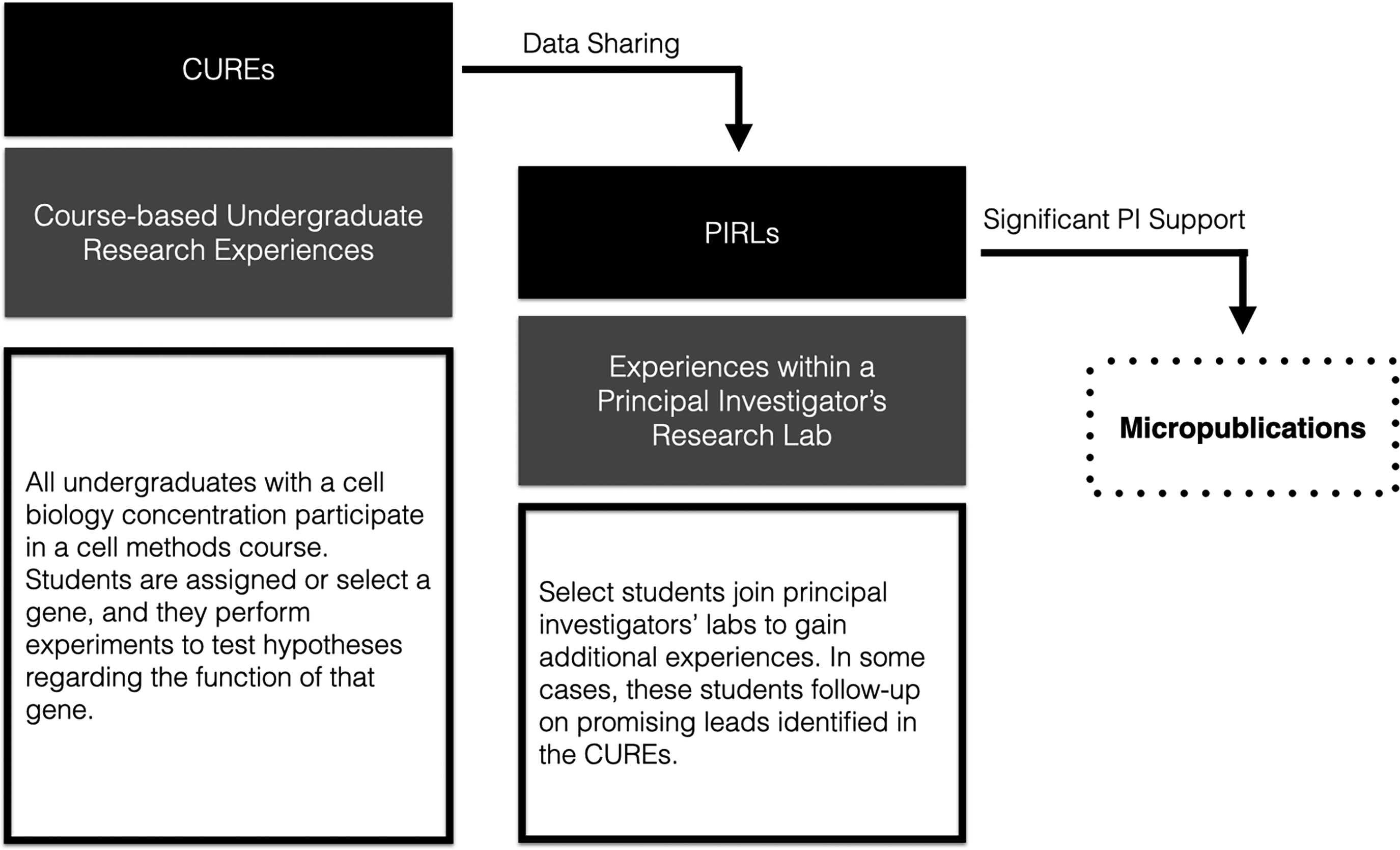
Developing a research system: the CURE-to-PIRL workflow.
Building Authentic Scientific Communities
In addition to providing authentic research experiences, building a science identity requires students to develop a sense of belonging within the science community, which can be developed using multiple methods (e.g., increasing representation in featured speakers and faculty). However, there is a difference between believing you can be a scientist and believing you are a scientist. Specifically, scientists contribute to the broader community in many ways, including sharing their findings through publications and at conferences. However, those contributions – particularly publications – are often outside undergraduate and master's students’ experiences.
When dissected, “scientific publication” is the process by which researchers disseminate experimental results to a broader academic community; the process is rigorous, typically involving multiple rounds of peer review and revisions before acceptance. To early-career science students (who have been known to complain when asked to submit a second draft of their work), this process is a complete mystery. However, providing opportunities to publish has the potential to provide multiple benefits, including enhanced student motivation and career preparedness (Cooper & Brownell, 2018; Corwin et al., 2018; Sun et al., 2020). Further, students who were immersed in research, including authoring journal papers, experienced more positive outcomes from their research (Russell et al., 2007).
Providing undergraduate students with more opportunities to publish has the potential to improve retention rates and outcomes for STEM students. Further, many graduate school admission committees and industry hiring personnel prioritize students with research experience; inclusion of a publication on a CV and being able discuss it in interviews provides an advantage to students. Publishing may allow students to see themselves not just as members of the scientific community but as active contributors. However, given the limited time undergraduate and master's students spend in the lab, obtaining publications in a timely manner is challenging. With micropublications, however, students can publish their single-finding scientific stories rather than wait until a much larger, multi-figure paper is ready. These smaller publications allow students to have more ownership (autonomy) and to develop competence, providing a mutually beneficial opportunity for the lab PI, which may increase a sense of collective relatedness as they work together to accomplish a common goal.
Case Study Purpose
The current case study explores student authors’ perspectives as they participated in a research system, resulting in at least one micropublication. Understanding their experiences illuminates the extent to which these experiences support their science identity development. Further, understanding these students’ experiences can help professors refine the system, design longitudinal studies, and provide baseline information for other institutions seeking to implement a similar lab science program. The overarching research question of this work is: How did students’ science identities evolve through participation in authentic research experiences and publication of their findings?
Method
Researcher Description and Participant Relationships
Practitioners from two fields (i.e., Biology and Educational Psychology) merged to produce this study, and members of each team were authors on this study. The Biology Team (Eric, Philip, Kelsey, and James) designed the CURE-to-PIRL workflow, found/guided the micropublication process, and approached the Educational Psychology Team to understand how students perceived these opportunities. Then, the Educational Psychology Team (April and Lisa) worked to develop the semi-structured interview protocol and collect/analyze data. Each member of the Biology Team reviewed and edited this paper; however, none of them were responsible for collecting, analyzing, or writing the results of the data. This was a purposeful effort to restrict personal bias from the Biology Team from affecting the research design and findings. Even with that separation, the Biology Team members enter this work with specific understandings and values.
Collectively, all three Biology professors (Eric, Philip, and James) believe in undergraduate and master's students’ ability to become scientists and contribute to the scientific literature in a guided, heavily scaffolded environment. They were at various stages of their careers when these interviews occurred: James had been teaching for 22 years at this university, Eric for 8 years, and Philip for 4 years. In an initial discussion, the Biology Team mentioned that they thought students were motivated after introducing the CURE-to-PIRL workflow and the micropublication opportunities, which influenced the Educational Psychology Team to select the self-determination theory to anchor the interview protocol and initial analyses.
The Educational Psychology Team designed the qualitative case study, developed the interview protocol, and collected/analyzed the data. Because the Biology Team knew and was still involved with many of the students, the data needed to be collected from an unknown interviewer, who would contact participants, assure participants all the data would be anonymized, conduct the interviews and during the transcription process, and, finally, remove all names and personal information. The anonymized process included changing not only the participants’ names to pseudonyms but also changing any mentors’ names, any lab mates’ names, and any other information that would compromise the participants’ identity. Because Lisa had pre-existing relationships with the biologists and students, April was brought onto the project to fulfill this role. April was a graduate student in School Psychology and did not know the biologists or the participants. Further, April and Lisa were in separate Educational Psychology programs, so there was no concern about Lisa grading or evaluating April directly.
In terms of their background beliefs, both Educational Psychology Team members value education and providing the necessary support for all students to reach their potential. Lisa has been in the Gifted Education field for 20 years and is passionate about giving students opportunities to become practicing practitioners in the classroom and to tackle the fields’ unanswered questions. Because both April and Lisa believe in the importance of the program being studied, they intentionally examined the negative sides of the students’ experiences and carefully presented them in the limitations.
Participants
This study examined the perceptions of students from a public university located in the midwestern region of the United States. The university has an approximate enrollment of 13,900 undergraduates and 5,400 graduate students and is considered a PUI. Within the Department of Biology, approximately 120 bachelor's and 18 master's degrees are awarded annually. As of Summer 2020, 8 undergraduate (n = 2) and master's (n = 6) students were authors of at least one micropublication. All were contacted, and all agreed to participate in a semi-structured interview (see Appendix A for protocol). Of these students, 2 identified as male and 6 as female. All were white, and, currently (as of June 2023), all remain involved in science (4 are employed as scientists in pharmaceutical or biotechnology companies, and 4 are enrolled in biomedical graduate or professional academic programs). Graduate students interviewed in this study pursued a terminal master's degree in Biology (i.e., the master's degree was not an intermediate stage of a broader doctoral program). Students in the Biology master's program complete graduate courses and independent research in a faculty member's research lab.
Research Design
To understand how students developed science identities through participating in authentic research leading to publications, we employed a qualitative case study design. A key feature of case studies is their bounded nature (Patton, 2014; Yin, 2014). Our case study is bounded by shared physical context (i.e., biology labs within a PUI), shared experiences (i.e., being published as a student author), and time (i.e., published 2020 or earlier). In general, the goal of case study research is to present the inherent complexity occurring within this bounded system (Yin, 2014). Within the current study, we use this approach to determine how students evaluate and interpret their research experiences within this specific system.
Data Collection Process
Prior to any data collection, our university's Institution Review Board (IRB) reviewed and approved our study (Project Approval #1604061). During the summer of 2020, April contacted all biology student authors (n = 8) with information regarding participating in this case study. The participants had no previous interactions with April and were not offered any incentives for participation. During the consent process, potential participants were emailed and informed that all interview data would be transcribed and anonymized (i.e., their names, their mentors’ and their lab mates’ names would be changed to pseudonyms as well as any other information that would compromise their identity). All student authors agreed to participate and submitted consent forms prior to the interview.
Prior to hosting interviews, April, the graduate student interviewer, had formal classes on providing one-on-one assessments, consultations, and counselling sessions. Then, she was specifically trained on this project's semi-structured interview protocol, including the importance of asking the questions on the protocol and prompting for more explanation or details when warranted. April scheduled and hosted all interviews on Zoom using the semi-structured interview protocol in Appendix A. She recorded and transcribed all interviews, yielding approximately 700 lines of codable data. These interviews ranged in length, from 3,981 words spoken to 10,727 words spoken (M = 6,131.5, Mdn = 6,214), which using the average rate of speech, translates to approximately 31 min to 85 min in length (M = 49 min, Mdn = 49.5 min). All quotes are from personal interviews conducted during the Summer of 2020.
Data Analysis
All transcripts were organized within Microsoft Excel files. Each conversation turn was placed in its own cell. In other words, when the speaker changed from the interviewer to the interviewee (or reversed), the text was placed in a new cell within the spreadsheet. This allowed Lisa and April to broadly identify code-able units. The Educational Psychology Team served as the primary coding team, using Saldaña's (2021) cyclical coding methods to code all interview data. During the first cycle of coding, Lisa and April organized the data using structural codes developed from a self-determination theory lens (i.e., autonomy, competence, and relatedness). Simultaneously, we also recorded initial thoughts and noted participants’ high-impact phrases (i.e., in-vivo coding) within this first cycle.
As the coding progressed, we realized that the self-determination theory did not fit the data best, but rather the concept of a science identity more succinctly encompassed the data. Self-determination theory emphasizes autonomy and promotes motivation, which was present in these students’ interviews; however, students more strongly emphasized how they developed as scientists and how they could contribute to the broader field. This caused a shift in the theoretical framework to examine how students were developing their science identities.
Lisa and April then revisited the data with this new lens to identify how these identities were constructed, including how they were growing (competencies) and what they did to feel a part of the community (belongingness). First, the science competencies were coded using process codes (i.e., codes that identify actions; Saldaña, 2021). We highlighted and recorded every verb in relation to their time in the lab. Examples of these codes include: “replicate experiment”, “write proposals”, “talk about data”, “asking questions”, “writing protocols”, “troubleshooting”. A non-example would be when the sentence subject was not the participant, like “she encouraged me,” or if it was about their personal history before attending this university.
In addition to process codes, we also used value codes to identify belongingness. Value codes identify values, attitudes, and beliefs (Saldaña, 2021), and, specifically, we used this type of code to identify when they felt belongingness. We defined this as the feeling of acceptance or becoming a member of the team/community. We coded this when participants vocalized professional pride, connectedness, and/or feeling safe in scientific environments. For example, we identified this statement: “If you are interested and they are interested, you seem to fit in pretty well,” as an example of a belongingness, and then, we noted what caused that belief. In this case, it was attending a conference.
After all the moments of competencies and belongingness were identified, then, we used the transitional coding method (i.e., coding the codes), to synthesize and streamline the language across participants. During the second cycle of coding, we used focused coding to ensure the codes could be applied throughout the data set without needing further adaptations. The final synthesis of codes is presented in Figure 2 and discussed in the results.
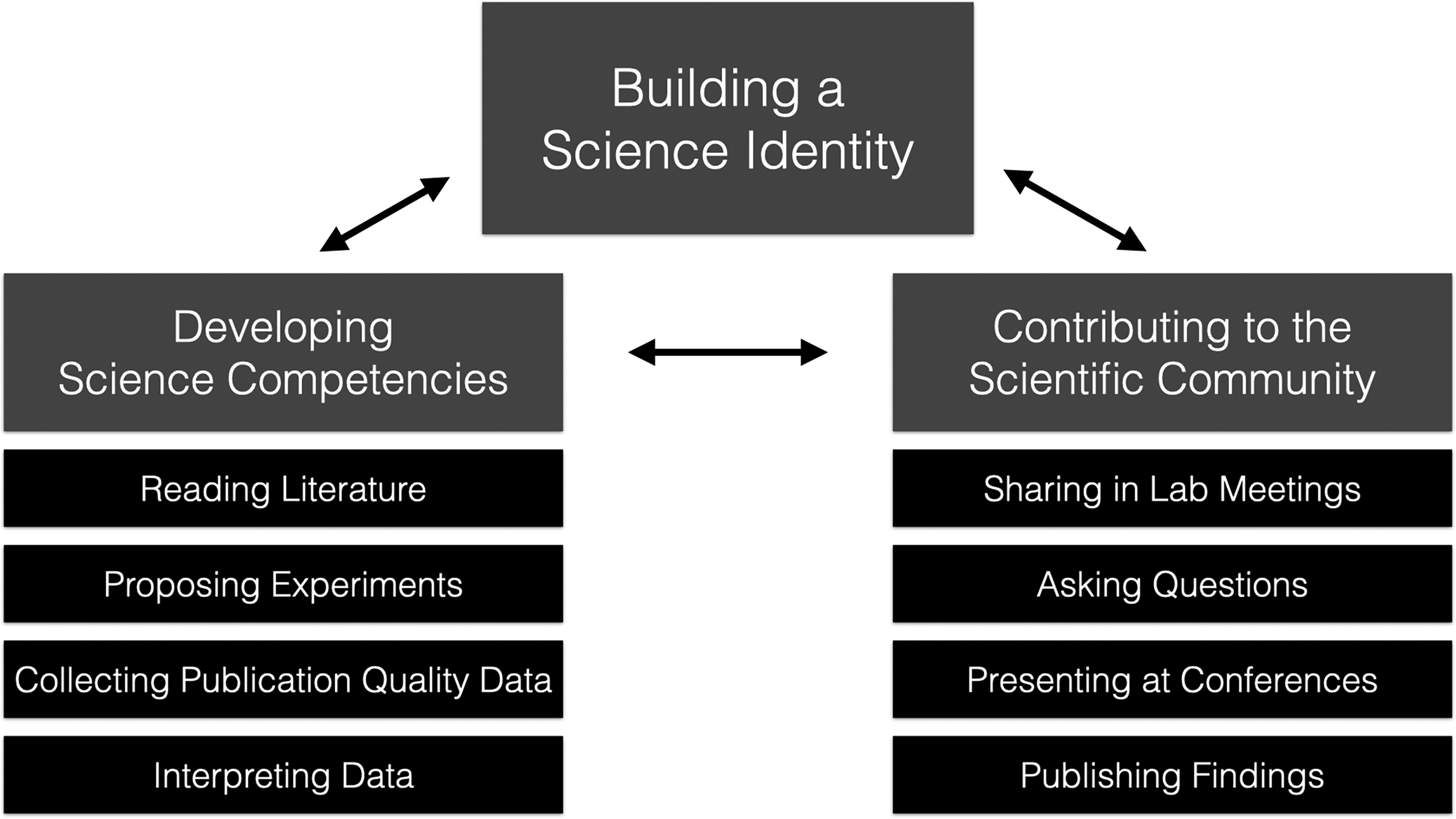
Emergent findings: developing a science identity.
Establishing Trustworthiness
Establishing trustworthiness of qualitative research is an essential study component; however, the terminology of this venture has been disputed. We selected Merriam and Tisdell's (2015) approach of using “validity” (internal and external) and “reliability”, as both biologists and educational psychologists understand the language. To ensure internal validity of analysis, both Lisa and April coded the data separately, and then met together to ensure the identification of the same codes; we repeated as the codes shifted into themes. When there was disagreement, we conversed until we reached a collective understanding. This process illustrated triangulation among coders. We also triangulated across participants, as the overarching findings presented within this paper were consistent across participants, even if the specifics differed, which demonstrated both internal validity and reliability.
To determine external validity, we piloted different coding methods to better understand how our data fits within the broader field. We also kept an audit trail of our coding decisions to provide additional support for determining the context in which these results were found. Importantly, all findings are supported by participants’ quotes, using rich and thick descriptions to give the reader more information to determine the extent to which these findings can be generalized. Finally, as aforementioned, we identified a team member, April, who had the least personal bias with the project and participants, to complete all interviews and transcriptions.
Results
As this case study evolved, we began to see these authentic research experiences culminating in micropublications as more than a mechanism to increase student motivation, but rather as an approach to support students’ science identity development. The overarching findings align with Bernard's (2020) definition and demonstrate the importance of (a) engaging in relevant activities and (b) joining as well as contributing to the broader scientific community. Each explored further below.
Finding #1: Engaging in Relevant Activities Supported Science Identity Development
Our first finding can be summarized as: Engaging in relevant activities (i.e., understanding scientific literature, proposing research questions/experiments, collecting publication-quality data, and interpreting data) were important learning experiences for developing students’ science identities. Specifically, building a science identity requires students to participate in authentic science; however, authentic science experiences are not often presented within undergraduate education. Archer et al. (2010) describes this as the misalignment between school science and real science. Students know when they are simply replicating old (“recipe-driven”) experiments with known, correct answers. However, engaging in authentic science is challenging given the vastness of the field; it is first necessary to acquire new language, understand complex content, and develop experimental techniques before engaging in authentic science. Within this research-to-micropublication workflow, students were scaffolded into authentic science experiences in a smaller, contained project, positioning students to develop authentic language and research skills, albeit in a narrow sphere.
Understanding Scientific Literature
To make meaningful scientific contributions, students needed to understand the state of the field. While textbooks provide a conceptual summary, reading contemporary research is necessary to understand both current discoveries and experimental methods leading to specific conclusions. Several students discussed the difference between reading science textbooks and reading scientific research articles, noting scientific research articles include specialized vocabulary and notations that were initially foreign to them. Beyond language complexity in primary literature, students also described challenges with understanding why scientists did a certain experiment, how that experiment yielded the data, and how the data was used to derive specific conclusions. Jessica summarized how she initially experienced these challenges, but, how, through engaging in microprojects and contributing to micropublications, she developed these competencies: I definitely understood my course content. I did very well in my classes. But that's very different than going into a research lab and understanding what they're trying to study. When I first started in the lab, I felt like I knew nothing because even though I had taken two and a half years of college classes, being able to read a research article on what we were studying was nearly impossible. They use different jargon. Then, looking at their data and trying to figure out how they got those data from the experiment they did, I couldn't understand what experiments they were performing. I felt like I knew nothing when I started. It was very much a slow process to start to understand how to read an article and how to understand what they did, why they did it, and understanding the foundation of our research. But now I feel very, very confident reading articles. I can look at the data critically, and I can understand what they did and understand the controls that they used. But that definitely was not something that I felt confident in at first … If you can write an article and if you can proofread one, you can totally read and understand one.
Proposing Research Questions and Experiments
Being able to read and understand existing literature positioned students to be able to propose new experiments. One of the eight students independently developed the primary initial research question leading to a micropublication. Several other students proposed follow-up experiments for projects leading to micropublications that addressed research questions. All students were developing questions about optimizing their own experiments.
First, Josh proposed the primary research question leading to a micropublication after he connected knowledge from external publications with another lab student's project. Josh brought this connection to the PI, who encouraged him to test it. Josh reflected upon the experience, “That led me down my own path of doing my own experiments to see if this pathway has any correlation with what we're working on. It turns out it didn't, but it was still when I began questioning things.”
While most students were not responsible for the primary question, many students assumed more responsibility for proposing the next experiment. For example, Jessica described: Usually, we'd get a piece of data, and we'd consider 10 experiments that we needed to do. And the PI would ask: “where do you think we should go?” I would say, “I think the first experiment we need to do is this one, because that will tell us this, and then, we wouldn’t even need to do this one.”
Collecting Publication-Quality Data
For micropublication-scale projects, collecting publication-quality data to address research questions and follow-up experiments is an important objective from the project's genesis. Generally, some data collection competencies can be developed without the end goal of a publication, and within any lab experience, a certain amount of troubleshooting is necessary. Grace provided an example of how she needed to troubleshoot to ensure a successful experiment: I was doing this experiment where I had to grow some yeast in liquid media. I was measuring their growth rate over time in a certain drug. I noticed the drug was automatically killing them [when added in a later step], so I suggested an adjustment: growing them in the drug first, before starting the experiment.
Jessica specifically described the relationship between protocol specificity and replicability needed for publications. In [previous] classroom labs, I learned a little bit about how to pipette and how to read a protocol and follow steps, just like a recipe. But being able to be so consistent that if I ran an experiment this week, I could replicate it again next week and get the same result, that definitely took work to get there. It was a lot of training and understanding the techniques. Is this a step that has to be done in a very specific way in order for it to work? What needs to be…considered when you're looking at a protocol? Every step of the protocol is important, but there are some [ambiguous] steps. [For example,] “add four things.” Do you have to add them in a specific order for it to work? So definitely over time, that ability improves significantly to understand how to do a protocol in a really effective way … a way that is able to be replicated and give you really strong data.
Interpreting Data
After optimizing protocols and replicating results, students needed to be able to translate data into new understanding about cellular processes, and that translation required practice. Elizabeth described the “aha moment” where she was able to understand the “cellular mechanisms behind the physical data.” Similarly, Brianne described in more detail a specific instance when she realized she was able to use data to understand a cellular process: One moment is when we saw an unusual result in my experiments. And instead of [the PI] telling me what he thought was happening, he asked me what I thought was happening. I told him, and it was exactly what he was thinking! Before that, I would have never been able to think about the cellular level and what was going on and why we were getting this result. But in that moment, I was able to work through my experiment, the problems we were having, and actually connect the two, to connect the results to what was going on in the cell. …being in an actual lab, you have more of an opportunity to do things on your own, and you kind of get things done faster too, because you're not relying on a group or like a professor to teach you something … It's easier to learn things on your own and see data for yourself. And you kind of feel more accomplished because it's the data that you produced on your own instead of like, your group is progressing through like a recipe protocol and seeing the data at the end.
Finding #2: Joining the Scientific Community to Develop Science Identities
Our second finding can be summarized as: Joining the scientific community was important across levels of influence, including sharing their scientific voice within the PIRL, presenting to a broader field (e.g., conferences), and publishing with a scientific journal (i.e., micropublications). In addition to engaging in authentic science, building a science identity requires seeing oneself as a member of the in-group. Students within these labs identified multiple experiences that helped them feel like they belonged, both at the level of the individual research lab and within the broader scientific community through their micropublications.
Sharing their Scientific Voice within the PIRL
Many students initially felt hesitant to ask questions or suggest potential solutions because they were uncertain of how the group would perceive them. However, being able to use one's voice is a key aspect of being a part of the scientific community, and within these labs, students were able to find their scientific voice over time due to deliberate encouragement from the PIs. Brianne described how she was able to find her voice in one-on-one mentorship meetings with the PI: We would have weekly meetings with [the PI] in which I would talk about my experiments and what was going wrong and what was going well. In those meetings, it was easy to talk about problems we were seeing. [The PI] would suggest things and then ask me if I had any ideas, and sometimes I didn't, but sometimes I did. It really helped that [the PI] was willing to hear what I was saying, and it made me feel comfortable speaking up. At the beginning of the lab, I probably wasn't comfortable speaking up and suggesting things, but as I got more comfortable, I was able to look at my experiments and think of new ideas for it. And it was definitely a space in which we were encouraged to come up with ideas and suggest things. I feel like I can express my ideas really freely…it's a bit of the culture that [the PI] has, where questions are seen as the curiosity, that they are not something to be embarrassed about…[the PI] makes it okay to ask questions, no matter what they are.
Presenting to the Broader Field
In addition to contributing to the local lab community through questions and ideas, these students also recognized and valued the opportunity to contribute to the broader field. Specifically, they practiced communicating their findings in both formal and informal settings, including lab meetings, conferences, theses, and, eventually, micropublications. Collectively, these experiences helped them develop fundamental scientific competencies and enhanced their confidence in their own abilities to contribute to the broader field. When interviewed, they emphasized their growth in scientific communication and recognized the importance of communicating complex results in a way that others could understand. For example, when Grace was asked how she has grown as a scientist, she described how she became more comfortable presenting: …So [previously] I gave a one-hour presentation, and I got so nervous. I could not speak at all. Now, while presenting my thesis, I spoke without hesitating. I knew exactly what was going on, and I just felt so much more confident in myself, in what I was saying and how I was expressing my data. When I first started in the lab, I felt less confident speaking up … but working on my thesis, I had to be able to write and talk about things in a way that would make sense to someone who isn’t a biologist, so knowing that I both understood what I was talking about and was able to explain it to someone who might have no idea, in a way that they could also understand, really showed me that I grew. …when you go to conferences, I think that's the best place to see where you fit. … If you go in and you're talking to people, even if it's a whole different topic, … if you're interested and they're interested, you seem to fit in pretty well because everyone's there to learn.
Publishing in a Scientific Journal
Finally, students also grew to appreciate overarching science communication principles, including the variety of methods and formats employed in their field and the importance of conciseness, all of which help readers better understand their work. Participating in both the initial development process and the subsequent revise-and-resubmit process enhanced students’ ability to communicate and enabled them to gain an improved understanding of the publishing process. Grace reflected: …it's made me realize how hard the writing can be. It's not like you write it and that's what you publish. You have to write it and edit it, like six times, before it actually can get published and approved. … There's just a lot more that goes into publishing than I expected. The people that review your manuscript are very picky. They know the field well, so you have to make sure you know what you're talking about too. …there should be a standardization of stuff that [reviewers] should not ask and stuff that doesn't need to be done … like rules to cover when basic statistics aren't necessary or what types of labels are necessary, or other little details. That should be just general across the board. I think that would make a lot of people's lives easier.
While not all the micropublications required such significant revisions, the other students were aware of the challenges associated with this project, even if their own projects were being published with greater ease. Thus, being exposed to everyone's experiences helped all students see the nuance in the publishing process. Elizabeth described that the publication process taught her: …that's not the only way to do it … I always thought of [scientific writing] as one cookie-cutter mold. And the truth is that there's a lot of different ways. Even individual journals may request different sections that I never knew existed… [I also learned] how to properly word things in a way that is most helpful to the reader. I have never been confident in myself and what I do, so to see my work published by a scientific journal was really, really cool. And it gave me this confidence boost, like “you do know what you're talking about sometimes.” That was definitely reassuring. It's really very validating to know that a reviewer or a journal thought that your data and your research was important enough to show to the world. And that they thought you wrote well enough and concisely enough and clearly enough to convey the data in a way the general scientific community would understand.
Collectively, across the two primary findings, we identified the specific skills and moments that helped students feel like they were scientists, that they belonged in the science field. Previous undergraduate approaches to lab science would not have provided the same opportunities to develop these skills and feelings of belongingness. Whether a student fails or succeeds at a recipe-driven experiment has no true consequence for the scientific community; however, using this CURE-to-PIRL workflow culminating in micropublications ensures all successes and failures can have a purpose and move the field forward.
Discussion
This study explored the impacts of engaging undergraduate and master's student scientists in small-scale research projects leading to micropublications. Participant reflections indicate these activities enabled students to assume the role of practicing professional and supported the development of their science identities, providing a domain-specific example of advanced academic curriculum development at the college level. Further, the CURE-to-PIRL workflow addressed a common issue within PUIs, specifically that there are typically not enough spaces in authentic research labs for all students to have opportunities to meaningfully engage in the research process. Collectively, this project provides one replicable example by which advanced curriculum may be implemented in institutions of higher education, including PUIs.
While students discussed specific moments throughout their lab experiences, their experiences must be considered as a sustained interaction with the scientific community. Most of these students participated in CUREs, followed up on data from other CUREs, and joined PIRLs for at least two years. Building a science identity is not likely to be the result of a single moment; rather, these identities are developed through continuous engagement with the iterative nature of science.
Figure 2 provides a succinct summary of our findings while illustrating an embedded cyclical relationship. Both competencies and belongingness can directly affect a student's science identity. These relationships were illustrated with the results from our study; however, developing competencies can also directly affect the extent to which students feel as though they belong. Reciprocally, when students feel as if they belong, they are likely to develop additional competencies. This iterative process could continue throughout a scientist's career. All participating students went on to work for pharmaceutical companies or attend graduate school, which are settings that promote ongoing development of competencies to contribute to the scientific field.
Our findings are supported by previous work. Specifically, Carlone and Johnson (2007) proposed a science identity model for Black women scientists through a series of interviews. The Carlone and Johnson (2007) model included competence, performance, and recognition; the recognition component was dissected into three types of science identities: altruistic, research, or disrupted. Further, they conceptualized the effect of other identities (e.g., race, gender) on participants’ science identities, which is further discussed in our limitations section.
Our findings identify several key competencies and contributions that could lead to a generic, early science identity framework. We combined Carlone and Johnson's (2007) “recognition” and “performance” components into “contributing to the scientific community.” Then, we provided specific competencies the undergraduate and master's students identified. In this way, our work delineates the specific objectives and opportunities that science programs should prioritize to build students’ science identities to support educators in developing objectives, assessments, and learning experiences to teach competencies students found valuable.
Taken together, our results demonstrate that engagement in research projects that culminate in peer-reviewed micropublications (along with other dissemination opportunities) facilitates scientific identity development for undergraduate- and master's-level trainees. Our work strongly suggests that participating in a large-scale, multi-year project is not necessary to realize desirable psychosocial benefits for early-career scientists. Further, because projects leading to micropublication are by their nature smaller in scope than traditional research projects, faculty mentors with limited time or resources may be empowered to provide authentic research experiences culminating in peer-reviewed micropublication for trainees. Such micropublications may reasonably be completed during early-career trainees’ limited research lab residency, providing positive personal and professional outcomes while they are most beneficial. Moreover, faculty at a range of institution types and on a spectrum of funding levels may find the CURE-to-PIRL workflow for piloting, validating, and publishing meaningful scientific results a useful model for meeting or enhancing their teaching, mentoring, and research objectives.
Limitations and Future Research
While this case study demonstrated how combining authentic research with publication opportunities can enhance students’ competencies and promote belonginess, it represents just the beginning of a more robust research agenda. A gap in this work is the lack of racial diversity. Importantly, since data collection (all data were personal interviews conducted in Summer 2020), an additional emphasis has been placed on recruiting and retaining students of color, resulting in 4 students of color becoming authors on micropublications. In addition to increasing sample diversity, future studies could build upon this work by adding a quantitative science identity instrument for pre/post testing or even expanding this work to high school students. Further, we identified several, more specific limitations that could provide inspiration for future studies.
Development of Narrow Technical Knowledge
Interviewed students recognized that most of their growth was in a specific area of biology, using specific techniques on a specific model organism (i.e., within these labs, all experiments were performed using yeast). For example, Grace described, “my knowledge is less broad. Coming from a yeast lab, I was focusing on one particular area of cellular processes. My knowledge is deeper, but it's more focused on a specific area instead of broad topics.” Several students also wanted more information and experience working with other organisms and techniques, as Brianne stated: The main thing I didn't learn in the lab that could help me is mammalian cell culture. We just worked with yeast, which I learned a lot about, but I definitely want to learn more about mammalian and human cell culture for my career … it would be good experience to have.
Narrow Integration of CURE Students into this Work
All interviewed student authors were members of PIRLs and worked with a limited number of faculty. In addition to the students interviewed for this report, numerous undergraduate students (n = 185) participated in CUREs to complete authentic pilot research studies leading to subsequent investigations to be conducted in PIRLs for inclusion in micropublications (as included in Table 1). These CURE projects were authentic research projects that generated novel findings that were refined and replicated in a PIRL. However, CURE students did not always see the final paper or participate in the subsequent steps.
Undergraduate and Master's-Level Student Involvement in Micropublications.
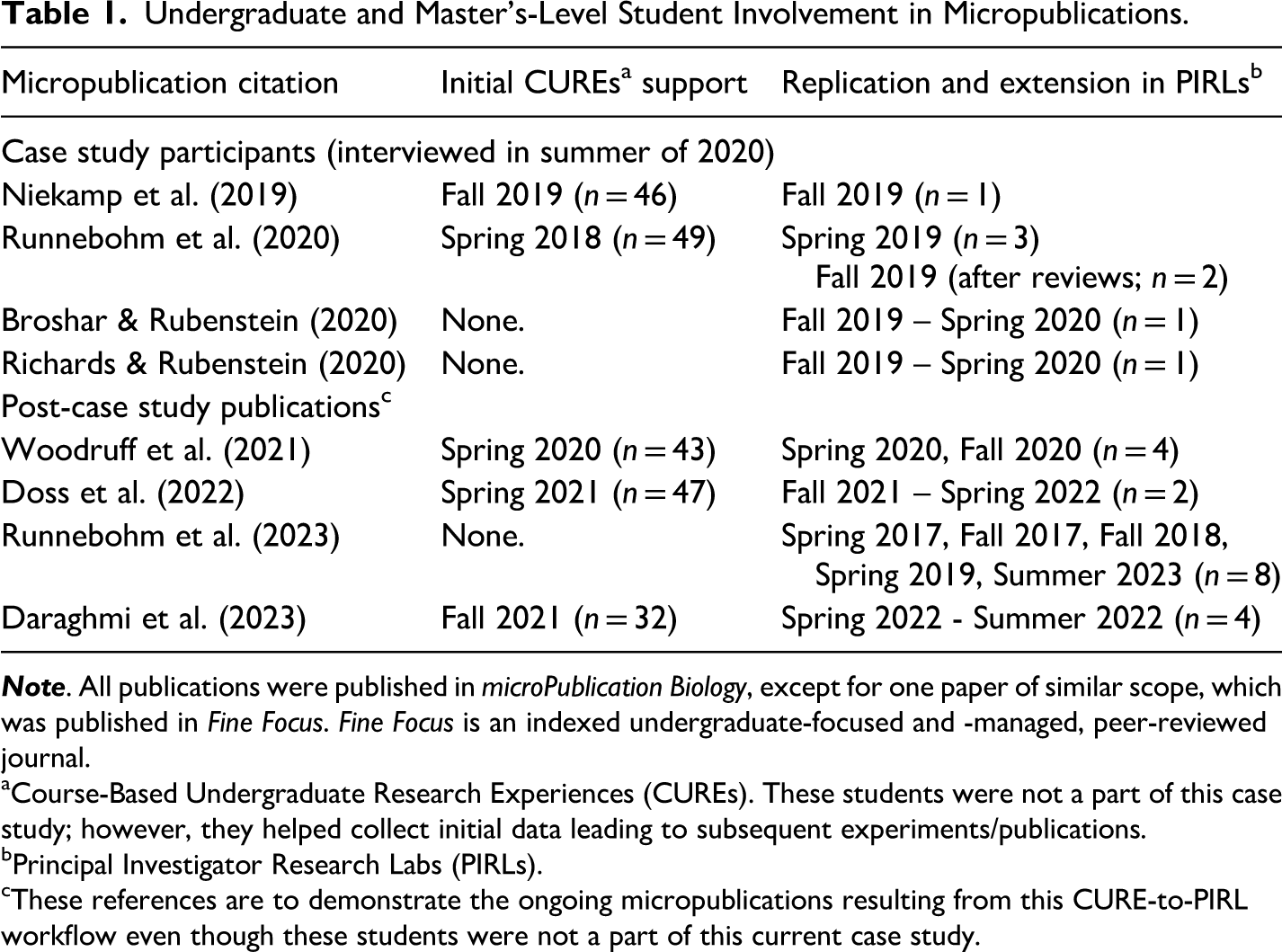
Course-Based Undergraduate Research Experiences (CUREs). These students were not a part of this case study; however, they helped collect initial data leading to subsequent experiments/publications.
Principal Investigator Research Labs (PIRLs).
These references are to demonstrate the ongoing micropublications resulting from this CURE-to-PIRL workflow even though these students were not a part of this current case study.
These students could be integrated in multiple ways. First, CURE projects could serve as a “talent spotting” opportunity within a talent development model (Olszewki-Kubilius et al., 2018). Talent developmental models’ key tenets include recognizing that talent is both domain-specific and malleable. Correspondingly, identification of talent is an ongoing process within a domain, through demonstration of performance and contextual psychosocial skills. Students in CUREs are given a domain-specific opportunity, provided direct instruction (demonstrating the malleability of competencies), and can demonstrate specific behaviors and cognition that leads to becoming a successful scientist. By codifying this approach to talent identification, PIs may be better able to recruit talented students from underrepresented populations who might not otherwise be aware of how to acquire these opportunities.
While using CUREs as talent identification opportunities to diversify participation in PIRLs, the challenge remains that there are not enough spots in PIRLs for all qualified and potentially interested students. Therefore, future work should conceptualize how to integrate CURE students into the publication process or at least heighten their awareness of their role in the workflow. As disseminating research as micropublications becomes more common, it will be important to evaluate the experiences of student coauthors in a range of research labs and at multiple institutions. After completing and analyzing interviews for this study, students in at least two other research labs at our institution have contributed to micropublications. Indeed, one objective of the current study is to share the benefits of and provide a roadmap for other investigators to disseminate early-career trainee work through micropublications.
Consideration of Multiple Identities
One final, significant limitation is the singular focus on science identity, rather than considering how all students’ identities interact, as Carlone and Johnson's (2007) work discussed. In the future, it will be important to purposefully recruit and longitudinally study students with diverse identities to determine how their other identities influence and interact with science identities. Many identity formation models either (a) account for the interaction of specific multiple identities (e.g., racialized science identity; Morton & Parsons, 2018; White et al., 2019) or (b) provide a broad system to explain multiple identities (Bronfenbrenner, 1979; Spencer et al., 1997). Both model types could provide a strong theoretical foundation for future work.
One seminal theory, Bronfenbrenner's (1979) Ecological Systems Theory, delineates the influence of the broader, interconnected intra- and interpersonal systems using a series of concentric circles with the individual at the center. Each circle represents an additional system influencing the development of the individual, from microsystems (e.g., parents, teachers) to macrosystems (e.g., cultural values). Although this model organizes the factors that influence identity development, it does not propose a mechanism to explain how they function. More recently, the Phenomenological Variant of Ecological Systems Theory (PVEST; Spencer et al., 1997) proposed how these systems interact to influence identity development.
PVEST could be used to anchor future research into how science identities develop while conceptualizing it within multiple other identities. This model acknowledges individuals have certain vulnerabilities because of the interaction between personal characteristics and their environment, including their race, (dis)ability status, gender, SES, among others. These vulnerabilities are accompanied by both societal risks (e.g., profiling, stereotyping) and protective factors (e.g., strong community identity). The vulnerabilities influence the stressors students’ face, including both challenges (e.g., daily hassles) and supports (e.g., trained teachers; Anderson et al., 2022). To address these stressors, students develop specific coping mechanisms, including those that are both maladaptive and adaptive. These coping mechanisms over time lead to individuals’ identity formation, including negative and positive identities, resulting in a variety of unproductive and productive outcomes, like career choices, academic performance, and self-concept. This is a comprehensive identity development model, accounting for both external influences and internal responses (Cunningham et al., 2023), and future work could explore these variables’ influences on the development of science identities alongside the development of cultural, gender, disability, and religious identities.
Despite these limitations and future opportunities, this current case study illustrates the potential of a CURE-to-PIRL workflow to produce high-quality, rigorous micropublications, demonstrating to students that their work is “important enough to show the world.”
Footnotes
Declaration of Conflicting Interests
The authors declared no potential conflicts of interest with respect to the research, authorship, and/or publication of this article.
Funding
The authors disclosed receipt of the following financial support for the research, authorship, and/or publication of this article: This work was supported by the National Institutes of Health and Ball State University (grant number AG067291, CA252996, GM111713, Sponsored Projects Administration Award, Summer Scholarship).

About the Authors
Appendix A.
Semi-Structured Student Interview Protocol
First, tell me a little about what made you want to pursue a science degree. Tell me a little about your course lab experiences. How did you find the [the PI's] Lab? What made you want to join? Tell me a little about your initial impressions working in the [the PI's] Lab. How did your impressions evolve over your time in the [the PI's] Lab? What was the most memorable moment in the [the PI's] Lab? How was your time in the [the PI's] Lab different from your course lab experiences? Do you ever make suggestions regarding your experiments, either adaptations to protocols or how to troubleshoot problems? If yes, can you provide an example? To what extent did you contribute to your publication? How much did you write? To what extent do you feel free to express your ideas in the lab or lab meetings? How have your skills as a scientist changed throughout your time in the lab? Can you provide a specific example of an area in which you grew? How has your content knowledge changed? What grade would you give your scientific writing? Has it changed across the time you have been in the lab? What grade would you give your scientific thinking? Has it changed across the time you have been in the lab? What was it like to work on a micropublication? How did you feel when you found out it was published? Is there anything you wish you had learned? Or something you still want to develop? How connected to you feel to the other members of the lab? How would you describe your relationship with [the PI]? How connected do you feel with other scientists outside the lab? Do you fit in with the broader scientific community? Why do you think that? Have you attended any conferences? How would you describe your experiences at these conferences? What would you change about your lab experiences? Where do you think you will go from here? What are your career aspirations? Did your lab experiences influence your thoughts about the future? Can you explain? As a non-biologist, I may have missed some important aspects of your biology experiences. What questions should I have asked that would have captured these important experiences?