



Abstract
In 2020, the sports world shut down for months due to the COVID-19 pandemic. Many local television sports broadcasters found themselves having to adapt to not having games to cover or athletes and coaches to interview. Changes in their workplace roles, or a reassessment of their interest in their current job, created a scenario in which the social identities of these journalists were disturbed, causing some to leave their profession. Less than 5 years later, local television sports broadcasters who left the industry listed four main reasons relating to COVID-19 that led to their career change: a shift in their job duties, the economics of local television post-COVID-19, a shift in life priorities, and new work possibilities.
In late 2020, the International Journal of Sport Communication published a special issue examining the impact the COVID-19 pandemic was having on the world of sports. The editors noted that the sports world “came to a screeching halt” due to the pandemic, with fans not allowed in stadiums, journalists banned from locker rooms, and, ultimately, the sports world shutting down with the postponement or cancelation of hundreds of games and events (Ruihley & Li, 2020, p. 289). Included in that issue was an article focusing on the plight of local television sports broadcasters in the United States during that time (Hull & Romney, 2020). The researchers surveyed 10 sportscasters approximately 1 month into the shutdown and asked how their job had changed due to the pandemic. The sports broadcasters discussed how they needed to be creative producing content due to sporting events being postponed, how their jobs had changed significantly without being able to go to games and interview coaches in-person due to social distancing precautions, and how they feared an uncertain future for their employment. Most significantly, all were anxious to get back to normalcy and return to their jobs as they remembered them before the pandemic (Hull & Romney, 2020).
However, as of mid-2024, approximately 4 years after that study was completed, five of those 10 surveyed no longer work as local television sports broadcasters, with four out of the broadcasting industry entirely and one now employed as a news reporter. This exodus can be seen throughout local television newsrooms, as management is experiencing difficulties keeping both on-camera and behind-the-scenes employees, with the COVID-19 pandemic seemingly accelerating that trend. Nearly 18% of local television station management reported having less newsroom staffers than they did before the pandemic (Papper & Henderson, 2022). Sports departments at local television stations are already typically small, so any additional departures would likely impact the media coverage of sporting events in that viewing area (Hull & Romney, 2021). Using survey methods, the purpose of this study is to examine the impact of COVID-19 on numerous local television sports broadcasters’ decisions to leave the industry since the start of the pandemic.
Literature Review
Sports in Local Television News Prepandemic
While this research focuses on the impact that COVID-19 had on some local television sports broadcasters deciding to leave the industry, it should be noted that the state of the field was far from perfect prepandemic. Research as far back as 2007 noted that some television stations had eliminated sports from certain newscasts, and that television stations in larger cities seemed to have less interest in the sports segment than those in smaller cities (Schultz & Sheffer, 2007). A year later, the same researchers noted that “the traditional position of local sports television…is endangered” and that the local sports segment was “dying” (Schultz & Sheffer, 2008, p. 180, 192). A long-time sports anchor in Tennessee recalled that his sportscast had been reduced from 6 minutes to just two (Likes, 2012). In the years since, not only have the segments become shorter, but the number of people working in the sports department has shrunk as well. In a survey conducted just before the pandemic began, 67.1% of local sports broadcasters said they had just two people doing everything in their department (Hull & Romney, 2021).
With fewer sportscasters working at television stations, those employees who were still working soon found themselves with more daily tasks, including updating websites, posting on social media accounts, and shooting and editing their own video (Hull, 2022; Mirabito et al., 2022). This increase in workload has led to some burnout among sportscasters, represented by emotional exhaustion among those employees (Maslach & Jackson, 1981). Research published in 2012 found that the majority of sportscasters surveyed were not experiencing burnout (Reinardy, 2012), but less than a decade later, as the amount of work responsibilities increased, the majority of those just starting out in the field were already showing signs of exhaustion (Hull & Romney, 2021).
COVID-19 and the Sports Media
In early March 2020, the sports media witnessed their first work-related impact of the emerging COVID-19 pandemic when the NBA, NHL, MLB, and MLS all closed media access to the players’ locker room (Bieler & Bogage, 2020). For decades, sports journalists had entered locker rooms during designated times to speak directly to the athletes, but the leagues stated the new policy was for everyone's safety. While many journalists balked at the new rules (Glasspiegel, 2020), the lack of locker room access was about to be the least of anyone's concerns.
Following the postponement of an NBA game on March 11, 2020, due to a player's positive COVID-19 test (Young, 2020), the entire sports world soon went into shutdown mode. Within weeks, hundreds of sporting events were canceled or postponed, including the professional sports leagues in the United States, college sports, high school sports, and major international events such as The Masters golf tournament and the Olympics (ESPN News Services, 2020; Los Angeles Times, 2020). The result was the biggest global sports shutdown since World War II (Epstein, 2020; Tovar, 2020). With these postponements, sports media members suddenly found their entire profession in a state of uncertainty. The primary job of sports reporters and broadcasters is to cover games and events—and almost overnight there were suddenly no games or events on the schedule.
As the shutdown dragged on, months passed without sports journalists reporting in person on the professional and college teams and leagues they were employed to cover (Curtis, 2020). In California, high school sports, a popular staple in local television sports coverage (Smizik, 2004), were out of action for 11 months due to a statewide shutdown (Sondhiemer, 2021). With no sporting events seemingly on the horizon, media companies began to reassess the need for employing so many sports journalists. Between April and June, the website The Athletic laid off 8% of its staff, the owners of Sports Illustrated instituted staff-wide pay cuts, and the sports website SB Nation furloughed dozens of its workers (Draper, 2020). Those who work on live game broadcasts are typically paid by the game, so with no games, they found their income slashed to levels for which they had not fully prepared (Dellinger, 2020). As one baseball writer said, “my livelihood is predicated on baseball existing” (Curtis, 2020, para. 3).
Local Television Sports Broadcasters and COVID-19
While all sports media members were impacted professionally by COVID-19, this study focuses specifically on local television sports broadcasters. A local television sports broadcaster is someone who traditionally works for a local affiliate for an ABC, CBS, Fox, or NBC station throughout the United States. These sportscasters report on events occurring almost exclusively within that local viewing area, with their stories appearing on the evening news broadcast (Hull, 2022). While national networks could replay old games to fill the void of the postponements (Shapiro, 2020), local sports broadcasters did not have that option. They were still expected to produce new content for television and the website. However, with the cancelation and postponement of all levels of sporting events, these local sports broadcasters found themselves scrambling for content.
In the research in which local sports broadcasters were surveyed during the early days of the sports shutdown (Hull & Romney, 2020), the participants wrote about the changes in their daily responsibility and their fears about how those changes might impact their careers in the long term. Interviews with athletes and coaches were taking place over video teleconferencing platforms, while nearly half of the participants said they either worked entirely from home or mostly from home—including anchoring the evening sportscast from there. An Atlanta sportscaster was provided lights, tripods, microphones, and a phone to turn her home office into a home television studio. For some, working from home provided unexpected benefits: “I feel like I get more breaks, because I am home I can easily stop to take my dog out, grab a snack, etc. so I actually like that aspect” (Hull & Romney, 2020, p. 499).
While being away from the newsroom had its advantages, changes to the job itself had some worried about the future (Hull & Romney, 2020). Hours were reduced, shifts were changed, and, most prominently, many found themselves no longer solely acting as a sportscaster. Of the 10 sports broadcasters surveyed in the early days of the pandemic, four said they were being assigned news stories by management in addition to their sports reporting responsibilities, while two said they were not doing sports at all and were now exclusively news reporters (Hull & Romney, 2020).
COVID-19 and Local Television News
While this research focuses on sports broadcasters at local television stations, it should be noted that the entire local television news industry had economic concerns before, during, and since the COVID-19 pandemic (Barthel et al., 2020; Knight Foundation, 2018; Lipka & Shearer, 2023). Before the pandemic, observers of the local news industry noted that audiences were shrinking, leading the Knight Foundation, a nonprofit foundation aimed at funding journalism projects, to ask “Is there a future for local news?” (Knight Foundation, 2018).
During the height of the pandemic, advertising revenue dropped dramatically (Barthel et al., 2020). From the second quarter of 2019 to the second quarter of 2020, advertising revenue was down 24% at local television stations. Despite some of that money still being made up from retransmission fees that cable companies paid local television stations, ownership groups still were conscious of the impact of the loss of the advertising revenue and made related financial changes (Barthel et al., 2020). For example, television ownership group Tegna issued a 1-week furlough to news staffers, while newsroom management received a pay reduction (Tompkins, 2020).
In late 2021, nearly 70% of local television news directors said that, a year after it began, COVID-19 was still having a major impact on their newsrooms. Those changes could be seen through changes to the newsroom, staff still working remotely, budget cutbacks, or having fewer newsroom workers compared to prepandemic days (Papper & Henderson, 2022). As ownership groups continued to recover from the impact COVID-19 had on their financial bottom line, pay remained low at many smaller television stations, as one industry expert commented that typical newsroom salaries were less than a living wage (Barr, 2023). By 2023, more than two-thirds of all news directors surveyed said that they were seeing more evidence of burnout among newsroom employees than in the past, causing one media recruiter to state that local television news was in the middle of “the great resignation” (Carver, 2021; Papper & Henderson, 2023). In addition, many news reporters found themselves considering leaving the industry due to the stress caused by the pandemic and the impact it was having on their jobs (Roman & Beasley, 2024).
Theoretical Framework: Social Identity Disturbance
Social identity theory states that part of a person's self-concept comes from their membership in specific social groups (Tajfel & Turner, 1979). Ultimately, being in these groups creates a feeling of self-belonging and happiness for the individual (Tajfel, 1978). These social groups could consist of something present at birth, such as ethnic identity (“I am Hispanic”), or something people assign to themselves, such as sports team fandom (“I am a Giants fan”). For some, their identity can be defined by their job. In 2019, Harvard Business Review asked, “What happens when your career becomes your whole identity?” The author discussed how people in certain high-pressure professions, such as doctor and lawyer, have a social identity that is primarily their chosen job. One lawyer featured in the piece had “built his entire idea of himself around his career” (Koretz, 2019, para. 3).
While there has been research on the professional identity of journalists (Deuze, 2005; Grubenmann & Meckel, 2017; Sherwood & O’Donnell, 2018), less attention has been paid to the social identity of those in the industry. Kreiss (2019) has one of the few commentaries that attempting to fill this gap in the literature. He stated that journalists are in a high-status social group because they traditionally are highly educated, from urban areas, and wealthier than their average audience member. Therefore, he wrote that journalists are more likely to be able to survive a situation in which they are financially challenged and should have “safe passage through the tumult in the global economy” (p. 28). A survey of journalists found that nearly 75% of those in the field were proud of the work they do, demonstrating the importance the job has to their self-worth (Gottfried et al., 2022). Others have observed that being a journalist was a major part of one's personal and social identity, more so than many other professions (Yan, 2021). One study found that 36% of journalists who changed careers to something else still identified as journalists in their social and professional identities (Reinardy & Zion, 2019).
Yet, as Godinic et al. (2020) established, many people underwent a social identity disturbance during the COVID-19 pandemic. The authors defined identity disturbance as “the lack of continuity in self-image, confusion about oneself, uncertainty about aspirations, values, choices and long-term goals, including career plans” (Godinic et al., 2020, p. 67). This concept is similar to that of Erikson's (1968) research on identity crisis. He noted that these periods are typical and are part of the normal growth of a person's identity. During these times, individuals may question what they had previously thought about themselves and, in turn, temporarily embrace a different identity. In some cases, as noted by Erikson, those identities become permanent, and the individual original social identity is replaced. Erikson would clarify that an identity crisis is not necessarily a crisis, but simply a moment that was “a necessary turning point, a crucial moment, when development must move one way or another” (Erikson, 1968, p. 16). Additional researchers have noted the identity disturbances that groups underwent during the COVID-19 pandemic (Daneš-Brozek, 2021; Szostak & Sułkowski, 2021). While journalists may be better equipped for financial challenges, the pandemic put that theory to the test. Hours were cut, overtime eliminated, and, in some cases, layoff occurred in newsrooms across the United States (Papper & Henderson, 2022).
For sports broadcasters, this social identity disturbance in relation to their work was perhaps more pronounced than what other journalists faced. While news reporters found themselves focused almost exclusively on COVID-19-related stories, they were still reporting on news, their primary job task. For sports broadcasters, their entire profession was centered around informing viewers about the latest sporting events and sporting news. With COVID-19 postponing or canceling nearly every sporting event, the sportscasters were no longer spending their worknights at games or interviewing coaches after practices. Instead, sportscasters were doing videoconferencing interviews from their homes or, in many cases, being shifted off sports entirely and serving as news reporters.
The social identity model of identity change states that when individuals have life changes, they must decide between keeping existing identity memberships or acquiring new ones (Haslam et al., 2008; Jetten et al., 2009). This social identity change can cause an increased amount of stress on an individual due to the uncertainty surrounding a possible life adjustment. For example, those retiring from their job face a transition from being identified as an employee at a certain job to existing outside of that vocation (Haslam et al., 2019).
Research Question
In the 2020 research paper examining the early days of the pandemic for local television sports broadcasters, it was noted that, just a month into the pandemic, many of those surveyed were energized by the opportunity to try different news gathering and delivery methods. Despite that, one participant said she would be “probably sad and tired” if she was still doing news packages and Zoom interviews several months later, a fate that many in the profession ultimately found themselves a part of (Hull & Romney, 2020, p. 501). The authors recommended that the study be revisited in the future to see the long-term impacts of the pandemic on local television sports broadcasters. Therefore, this research attempts to answer that call with the following research question:
Method
This research topic emerged from a broader study involving local television sports broadcasters leaving the jobs (Hull, 2024). Sportscasters who no longer worked in local television were surveyed and, based on the number who mentioned COVID-19 as a factor in their departure, this second paper was developed. Institutional Review Board (IRB) approval was acquired before the questions were sent to former sports broadcasters across the United States. Those surveyed were located through the researcher's own industry connections, online news articles that reported on the sports broadcaster leaving their position, and snowball sampling in which participants were asked in the final question of the survey if they recommended anyone to be contacted for the study (Goodman, 1961).
Current email addresses for potential participants were located through an online search or by contacting them directly through the job-focused social media platform LinkedIn. Contact information was collected for 48 former local television sports broadcasters, and all 48 were emailed the survey housed on the website Qualtrics. After confirming they were a former local television sports broadcaster, participants were asked open-ended questions in the survey about their career path and their favorite and least favorite parts of the job. In a question about what made them start to consider leaving the broadcasting business, several mentioned COVID-19, and those answers were the foundation for this research. In addition, participant answers to questions about their current position also led to information about how the pandemic impacted their job and life priorities. In total, there were 20 questions in the survey and participants had the opportunity to skip any they wished not to answer.
This research study used a thematic analysis to determine the impact COVID-19 had on the career decisions of local television sports broadcasters. Analysis was done by one coder who had no formal coding scheme at the beginning of the study (Braun & Clarke, 2019, 2021). The research then followed Leavy's (2017) phases of analysis and interpretation: (1) data preparation and organization, (2) initial immersion, (3) coding, (4) categorizing and theming, and (5) interpretation. The open-ended responses were read through, and preliminary codes and themes were created. After initial coding, themes were revisited, with some category combinations and eliminations, before the final list of themes was determined.
Sample Description
Of the 48 former local television sports broadcasters contacted for this research, 38 started and completed the survey. Two of the broadcasters left their jobs before 2020, so they were not included in this study about the impact of COVID-19 on their departure. Therefore, 36 responses were analyzed. A 2022 meta-analysis of over 1,000 online surveys in published research found that the average response rate for all online surveys was 44.1%, while studies with less than 100 participants had an average of a 72.7% response rate (Wu et al., 2022). With 36 eligible participants, response rate for this study was 75%, putting it above both published averages.
Of the 36 participants, 22 were women (61.1%) and 14 were men (38.9%). Of those who listed their race, most wrote that they were White or Caucasian (32), while the remaining participants self-identified as Black (2) or Filipino (1). Examinations of the racial breakdowns of local television sports broadcasters demonstrate that those working in the profession are overwhelmingly White, so the percentages found in this study are common in the field (Lapchick, 2021). Of the 32 who provided their age, the average was 32.88, with a range of 26 to 52 (SD = 7.29). The questions about their career path revealed that the average number of years the 36 participants spent as a local television sports broadcaster was 8.28 years, with the longest tenure coming in at 30 years and the shortest at 2 years (SD = 6.77). In addition, the 36 participants had worked at an average of 2.36 different television stations during their tenure (range 1–7, SD = 1.2). Table 1 provides a description of each respondent, along with a participant ID number based on the order in which they submitted the survey.
Participant Table.
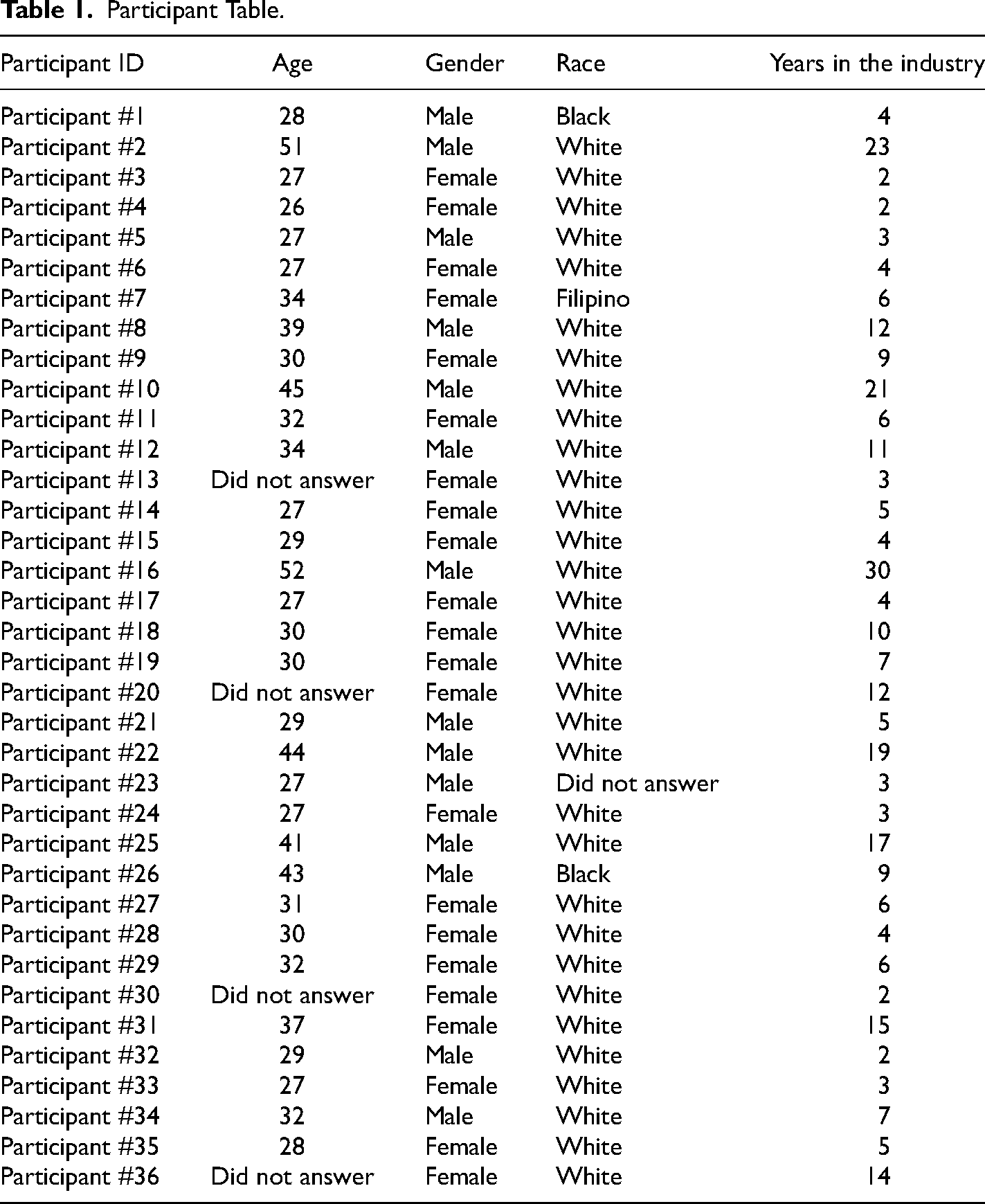
Of the 36 participants who left their jobs as local television sports broadcasters since 2020, 14 specifically mentioned COVID-19 as a factor for their leaving. Several more did not reference it directly but did discuss issues that were related to the pandemic. When examining the answers of the participants, four themes emerged for how COVID-19 helped accelerate their departure from their jobs as local television sports broadcasters: (a) a shift in their job duties, (b) the economics of local television post-COVID-19, (c) a shift in life priorities, and (d) new work possibilities.
Results
A Shift in Job Duties: “That was My Breaking Point”
The participants in this research demonstrated that, despite being hired as sports reporters/anchors, several were finding themselves covering news stories in the early days of the sports shutdown. Participant #1 wrote: “In the second half of 2020, I didn't cover any sports really because I was ‘needed’ on the news side to help cover protests and COVID.”
However, much to their dismay, a few discovered that as the sporting events returned following the months-long shutdown, their job duties remained the same. Responses to the question “When did you start thinking about leaving the industry?” included: “they didn't want to allow me to go back to covering sports” (Participant #12) and “my sports director did not let me go back to full-time sports. I was stuck as a news/sports hybrid” (Participant #7). Participant #36 said that, for her, this job shift to news was the final straw before the end of her broadcasting career: With no sports at the time, the station stopped doing sportscasts entirely I was dispatched to report news. I hated it. Eventually, when sports started to return in fall 2020, I was still reporting news because of the lack of reporters. That was my breaking point.
For many, their social and professional identity consisted of being a sportscaster and having that change to a news reporter led to a disturbance in their identity. Participant #3 wrote that being a sports broadcaster “was exactly the job I wanted since middle school,” but when the job duties shifted, she stated, “I knew what I signed up for and this job wasn't that.”
The Economics of Local Television Post-COVID-19: “I Could Barely Survive”
As with many industries, the business of local television stations was impacted by COVID-19. Television newsrooms faced budget cutbacks, and the sports department was not spared from the financial struggles. Participant #24 wrote that she had to “beg for overtime” so that she could cover the various events occurring throughout the weekend. However, at many television stations, that overtime pay was a casualty of the pandemic. For the local sports broadcasters used to that money, it was a shock to their paycheck. Participant #12 said that at his station “overtime was slashed to zero. I lost tens of thousands of dollars, money I had counted on over my seven years of employment.” Similarly, Participant #13 wrote: “I usually made about an extra $20,000 in overtime. With no sports to cover, I could barely survive.”
Some believed that, due to financial constraints, money had perhaps become a more important factor in decision making in the daily running of a newsroom than it was previously. Participant #25 was told he was in danger of losing his job and asked why he was on the chopping block: “My news director at the time looked me dead in the eye and said, ‘some people make more than others.’ So that was it, they made the decision simply based on a number.”
Others were finding out that leaving their station for another was not going to solve their money problems. One wrote about how he had a job lined up in a bigger city, but the offer represented a pay cut from what he was already making. Another broadcaster (participant #15) had hopes of going elsewhere, but those plans were quickly dashed once she received new contract offers: My agent at the time called me up with low-ball offers to return to the industry in small markets, sometimes in news rather than sports. I remember him being shocked that I kept telling him no, even as he reasoned with me that if I didn't take *something* I would never be able to work in TV again. So be it, I told him.
Those who stated they “loved” their identity as a sports broadcaster found that the lack of salary opportunities post-COVID were too much to overcome. Participant #34 wrote of his decision to leave: “Trust me…I loved my job as a sportscaster. For me, it came down to money.”
A Shift in Life Priorities: “COVID Showed Me What was Possible”
While some cited the impact COVID-19 had on their job responsibilities or the television industry itself as the reason for their departure, others said the pandemic forced them to rethink their priorities and identity. Instead of putting in, as one sports broadcaster wrote, “50–60 h a week,” several began to rethink the time spent in the office and at various sporting events: COVID turned my mindset. When sports left the world and we watched marble racing, it kind of hit me that we didn't *need* sports as much as I thought we did. I also got married and the schedule sucked so bad that I knew one thing would suffer, work or personal, and I was tired of choosing my career every single time in the past so I made the switch. (Participant #8)
Others wrote: “COVID showed me what was possible,” and “I felt super burnt out after COVID.” Participant #6 wrote that the pandemic shutdown was the final straw that made her reprioritize what was important in her life and how her job no longer needed to define her: I realized how much I was missing out on, not living closer to home or being available on weekends. I realized I had no hobbies and my friendships were completely through a phone far before COVID. My now-husband also opened my eyes to a work-life balance that didn't involve not working extremely hard. He showed me I can still work hard but have that balance of family, friends, and fun. But I realized because of the nature of the work, that would never be a reality as a sports broadcaster.
Similarly, another participant (#31) wrote: “For a long time, I put my job first. Now it's time to put my friends and family first.”
New Work Possibilities: “I Like Being Able to Work From Home”
Along with the life reflection, the opportunity to do their job differently had emerged during the pandemic. As with many professions, local television sports broadcasters were based out of their homes during much of March and April 2020. However, once games returned and restrictions were lifted, the sportscasters were expected to return to the newsroom after several months away. For some, that initial time at home opened their eyes to an entirely new work experience that they were not willing to give up.
Several of those who had left the television industry remarked that the opportunity to work from home was an especially appealing part of their new job. When asked what they liked about their new job, the remote opportunities were mentioned by several: “I like being able to work from home sometimes,” “I’m remote three days a week,” and “I get flexible work-from-home options when needed” (participants #25, #12, #18). When discussing their new career, two (participants #28 and #3) specifically cited the at-home aspects of their new businesses they started, one as a wedding videographer (“I edit from my home”) and the other as a baker (“I run a cottage-licensed bakery out of my home!”).
The long hours previously mentioned that local television sports broadcasters worked also meant they had little time for vacations. Many in the survey cited missing family and milestone events because they had to work as reasons they were getting out of the industry. For some, the opportunity to work from home meant they could make up for lost time: I love the remote aspect of the job. It's given me freedom to work from a lot of different places and at pretty much any time I want. I have the ability to travel to see family and friends with my laptop and still get the job done. (Participant #4)
Many of the sports broadcasters implied in their responses that they had primarily identified as journalists in their personal and professional life, but that being at home with family forced them to reassess what was important. Participant #20 wrote: “I wasn't ready to give up the piece of my life that had been such a huge part of my identity,” but after working from home and spending more hours with her daughter, “the thought of leaving became louder in my brain.”
Discussion
Social Identity Disturbance
While reflecting on his career, a former Ohio local television sports broadcaster said: “I lived my dream as a sports reporter” (Kiesewetter, 2022, para. 9). That “dream job” remains a goal for many, with newsroom management stating they get more applications for sports-related openings than nearly any other position (Hull, 2022). Once a journalist gets the job, going to games, interviewing coaches, and reporting the latest developments to the audience can become a major part of their social identity, resulting in the sportscasters becoming, as a Sports Illustrated writer noted, “more recognized around town than most of the athletes” (Wertheim, 2023, para. 3). However, based on the response from the participants in this research, that social identity was greatly disturbed upon the COVID-19 pandemic.
Primarily, it appeared from the responses of the participants that the disturbance made many realize that, for them, there should be more to life than just working at a television station. Those who were shifted to the news department during the pandemic, with no return to sports in sight, found themselves less interested in staying in the profession. Others may have enjoyed the job, but began to question if the low pay was worth the amount of work they were performing. The pandemic also forced many people to reassess the importance of their job and what working scenarios would make them happier. For the local television sports broadcasters, those surveyed stated that they wanted to spend more time with family, and that included taking advantage of a new career that would allow them to work from home. This social identity disturbance, where sportscasters had to reassess their lives and career with no sports to report, seemingly caused some to determine that a career as a local television sports broadcaster was no longer something that was appealing to them.
While social identity theory has primarily been studied with the idea that people belong in these groups for life, this study expands upon the established research by demonstrating what can happen when there is a social identity disturbance. Tajfel and Turner (1979) posited that being a part of a social group can provide self-worth and self-meaning, but this research extends the theory by demonstrating that, in some cases, getting out of that social group can be just effective for increasing self-worth. While the participants in this study were proud to call themselves sports broadcasters, with one going as far as saying the job was “such a huge part of my identity,” many were seemingly happy to have left that social group behind.
The social identity model of identity change demonstrates that a life change, positive or negative, requires people to change how they self-define. Their existing group memberships may be altered, or as demonstrated by those in this study, lost entirely. This study demonstrated that the former broadcasters found new social groups, whether that be through new employment, new hobbies, or a recommitment to family. In addition, all the participants said that, despite the loss of social identity, their new identity had a positive effect on their wellbeing.
Workplace Implications
In the 2020 study about local television sports broadcasters from the early days of the pandemic, it was suggested that, by quickly adapting and demonstrating that they could still produce content in that environment, the sportscaster might actually be causing more problems for themselves down the road. The authors wrote “the strong performance might also suggest to management that fewer resources, higher expectations, less travel, and smaller departments may not impact viewership numbers” (Hull & Romney, 2020, p. 501). In some cases, that appears to have been exactly what has played out. Responses from the sports broadcasters demonstrated that many sports departments were not returned to their prepandemic staffing levels as sportscasters were kept as news reporters, salaries were frozen, and overtime was cut or eliminated. In the years since, local television sports departments throughout the United States have been forced to do more with less, with some being eliminated entirely (Finn, 2023; Lindquist, 2023; Wertheim, 2023).
One question that must ultimately be answered is: “How long will COVID-19 impact local television stations?” With the financial constraints that remain years later, the sports department often figures to be the first to impacted. Research has demonstrated that the sports segment is the least watched of the newscast, so news directors will likely make cuts there first since that will seemingly have the least impact on the overall product (Lindquist, 2023; Mathewson, 2020).
Limitations and Future Research
While all members of this study fit the criteria of the research, the sample is not without some limitations. A more diverse group in both gender and race may have added additional insights on the impact of COVID-19 on local sports broadcasters. In addition, the sample only included individuals from the United States, so an examination in other parts of the world may have led to different results.
In addition, a possible limitation of this research is that while the local sports broadcasters seemingly placed much of the blame on management for post-COVID workplace struggles, newsroom leaders were not surveyed for their vantagepoint. There has been little attention to how television station management views their sports coverage following the pandemic. Future research may wish to get direct answers from news directors and station ownership about where sports coverage can fit in the newscast and the newsroom moving forward. In addition, future research may wish to expand this study to other professions in the newsroom, such as anchors, reporters, producers, and meteorologists, and ask questions that are specifically geared towards the effect of COVID-19 shutdowns on their profession.
Future research may also wish to survey those newsroom employees who elected to stay working in the profession. These responses could produce answers would update what, if anything, has changed in local television news in the long term since the early days of COVID-19. In addition, the answers of current employees can be compared to those who left the field to provide information on what higher education programs should be teaching future journalists in a post-COVID news gathering environment. This can include discussions regarding navigating self-identity. For example, when asked what advice she would give to students looking to enter the business, participant #33 wrote: I would tell them you have to decide if you want your career to be your main priority in life. If they do want their career to be their main priority, then I would encourage them to go for it. If they didn't desire for their life to revolve around a career, I would advise them against going into the industry.
Finally, while the low salaries of broadcasters have been discussed in previous research studies, the number of respondents who specifically mentioned the importance of overtime pay was perhaps surprising. Future research studies may address the pay schedule and opportunities for those working in local television and how those journalists can perhaps be enticed financially to stay in the industry.
Conclusion
It might seem trivial to discuss the COVID-19 pandemic in the context of sports and the sports media. However, it is impossible to ignore the role it played, and continues to play, in local television news. As salaries were cut, job descriptions were changed, and working from home became the norm, many local television sports broadcasters began to reassess their futures in the industry. As this research demonstrates, the self-identity of being a journalist was disrupted by the pandemic, and soon after, those impacted were considering careers outside of the newsroom.
Footnotes
Declaration of Conflicting Interests
The author declared no potential conflicts of interest with respect to the research, authorship, and/or publication of this article.
Funding
The author received no financial support for the research, authorship, and/or publication of this article.
