



Abstract
This study examines Twitter “resistance” discourse leading up to the 2018 U.S. midterm elections, which was widely viewed as a response to the 2016 presidential election then President Donald J. Trump won a majority of electoral college votes while Hillary Clinton won the popular vote. When analyzing randomly selected tweets with the term “resistance” social networks emerged discussing multiple associated terms with “resistance.” Once mapping these networks, the conversation frames that drove discourse across the virtual communities included the most used frame, the #MeToo frame, along with intersectionality and community-building frames. The results of the 2016 presidential election, and Trump's victory, enabled by explicit appeals to race and gender stereotypes, prompted a wave of civic activism, included in the social media conversations outlined in this study.
Introduction
Since President Donald Trump's election in November 2016, Twitter emerged as the primary online space where he disseminated his ideology and influenced public conversations. At the same time, a resistance movement rose on Twitter using the platform for the exact same purposes as Trump's campaign: to influence mainstream news frames around issues of importance to their groups.
This study builds on previous related research connected to social networks and race and gender. In one case, LaPoe (2018) analyzed the #MeToo hashtag, examining conversations about sexual assault and solidarity. Within 24 hours of the #MeToo hashtag appearing, 4.7 million individuals interacted with stories connected to it (CBS News, 2017). Much like this preliminary social network analysis (SNA) on #MeToo, which led us to search for an additional term “resist,” this study also found intersectional, diverse racial as well as LGBTQIA+ groups, and elite groups such as politicians setting policy and entertainers setting a vocal tone on social media, as major groups elevating this hashtag (LaPoe, 2018).
To unpack discourse around resistance, gender, and identity, we begin with the discussion that the evolving ideas of gender identity and the various titles people can claim as their gender identity may complicate online conversations around gender and its impact on online political debates. The World Health Organization defines gender as, “the characteristics of women and men that are socially constructed, while sex refers to those that are biologically determined. People are born female or male but learn to be girls and boys who grow into women and men” (WHO, 2002, para. 1).
Traditional conversations surrounding gender highlighted binaries, locking people into two potential gender boxes: “man” or “woman” (Rushton et al., 2019; Siebler, 2012); transgender people were defined as people transitioning from one gender to the second potential gender in an either/or conversation rather than discussing “trans” as people transcending gendered dichotomies and moving outside of the rigid dichotomous system (Siebler, 2012, pp. 75–76). These essentializing ideas of gender have dominated social areas as diverse as workplace hierarchies (Place, 2015), pre- and post-disaster marginalization and exclusion for gender minorities (Rushton et al., 2019), and secondary students’ conceptions of gender fluidity and identity and how the traditional binary dominated their definitions of themselves and others (Ingrey, 2013). Current conversations have moved to a proliferating number of identities crossing and combining the dichotomous barriers into a broad category of identities generally categorized as “non-binary,” a concept including transgender, genderfluid, genderqueer, and other categories allowing a person to fall outside the binary altogether, including asexuality and non-binary, without being transgender (Thomas & Andrews, 2019, para.13).
Studies of gender lexicons on social media platforms reveal a hodge-podge of regressive uses of gender binaries and replications of legacy media's gendered inequalities and abuses (Herring & Kapidzic, 2015; Litchfield et al., 2018). While Herring and Kapidzic (2015) note early social media sites replicated gender binaries, more recently multiple social media sites have expanded gender self-definition identifiers for users as just one way to break the binary. For example, in 2014, Facebook expanded its gender identity options to 58 (Goldman, 2014), and those options have not changed since. Other platforms, such as Twitter, side-stepped the gender question altogether by dropping gender identification fields (Bivens & Haimson, 2016). These changes and social media's role within the overall social ecosystem gave the platforms “the capacity to enact culture by managing and shaping the construction and meaning of identity categories like gender” (Bivens & Haimson, 2016, para. 35).
This article foregrounds gendered framing and stretches the social implications of gendered framing through an analysis of Twitter posts scraped around the U.S. 2018 midterm elections. We then discuss why framing theory is particularly useful for understanding the often invisible but still powerful gendered underpinnings of public policy creation in the U.S.; this discussion precedes our primary source research and establishes a platform for discussing invisible gendered frames driving political conversations on Twitter. Through this discussion, we highlight gendered framing and the ways it is always operating to reinforce a range of inequalities. Gendered framing drove conversations about several critical issues in 2018. Understanding how and why people used social media to discover information on public policies and applying the lens of gender as a dominant and yet invisible frame renders the frames visible, and therefore, able to be changed.
Literature Review
Gendered framing theory aims to foreground previously invisible gender norms driving economic and public policy decisions in multiple countries. “The notion of a ‘gendered political economy’ reminds us that gender is everywhere and that no economic value is ever innocent or gender neutral, i.e., devoid of social, political, and other implications. A gender analysis helps us to understand that all socio-economic processes and the global political economy as a whole are gendered” (Hirtenfelder, 2015, p. 25). Gendered framing builds off the broader concept of framing theory, which posits the language media and others use to describe an issue determines how it is perceived by audiences (Goffman, 1974; Jacobsen & Kristiansen, 2014). Professor Heidi Hudson identified three approaches to gendered framing: the integrationist, “which incorporates women's experiences into existing neoliberal frameworks”; the agenda-setting model, which “entails a focus on the participation, presence, and empowerment of disadvantaged/marginalized groups (usually women) via consultation with civil society organizations”; and the transformative approach, which “seeks to transform existing legislative and institutional frameworks to reflect a gender perspective, indicative of both men and women's experiences” (Hirtenfelder, 2015, pp. 31–32). This overview of gender frames and how they operate in public policy decisions shows the frames are both rendered invisible, as in the assimilationist approach, and how frames can be used to create social changes, as in the transformative approach.
Social media hashtags impose gendered frames on social conversations. Hemphill and colleagues (2013) found politicians carefully selected hashtags to frame issues, which, in turn, directly influenced their constituents’ and online audiences’ behavior and reactions toward issues. A few high-profile hashtag activism movements, including #BlackLivesMatter and #MeToo, showed an effective hashtag can move not just online groups to change but also push people to take to the streets for protests and organized in-person actions (LaPoe, 2018; LaPoe et al., 2022). In addition, hashtag framing shows how online networks are feeding pre-framed ideas and stories to mainstream media outlets. Hashtags frame community conversations, for better or for worse. Mainstream media picks up the frames that proliferate online conversations and hashtags to broader audiences (Freelon et al., 2017). While hashtagging allows users to show support, it is a low-risk model. Researchers note that following up with in-person advocacy is the best way to motivate resistance through hashtags (Guttenberg, 2021).
Hashtag activism emphasizes transformation of the public sphere, or the communication spaces where conversations driving democratic elections and public policy happen. Thomas and colleagues (2004) identified resistance as it relates to gender and feminist theory within the context of workplace resistance. The authors wrote: Resistance can be understood as part of wider concerns with issues of agency that form a core to feminist analysis of gendered relations as durable but not inevitable and unchanging. […] A detailed debate has thus built up within feminist theory on forms of resistance and issues of political adequacy partly in reaction to the early overly deterministic analysis of patriarchal oppression in first-wave feminism (Thomas et al., 2004, p. 4).
Donald Trump's Twitter-distributed transphobic remarks and policies, in particular the 2018 push to officially redefine gender as a binary, brought a hashtag from the trans community allowing individuals to frame themselves and their community in an empowering way (Human Rights Campaign, 2022). The hashtag #WontBeErased was used to organize in-person rallies, explain the policy and its ramifications to the LGBTQ+ community and beyond, and provide steps to becoming an ally of the community (Mervosh & Hauser, 2018). After the leaked memo became public, information shot across Twitter, both accurate and inaccurate, sometimes creating confusion among the public about what was actually said in the memo. However, “despite its cesspool-iness, Twitter undeniably acts as a vital TL;DR [Too Long; Didn’t Read] guide to navigating this new policy, and the #WontBeErased hashtag is a crucial artery connecting activists to civilians and voters” (Ustik, 2018, para. 13). Pictures of the public demonstrations were tweeted under the hashtag, joining the thousands of other tweets from people who could not attend on-the-street protest. As Georgina Ustik (2018) noted in a post on The Next Web, “For those can’t join a protest IRL [In Real Life], look no further than social media for your angry crowd” (para. 15).
Perhaps the most effective and well-known gender hashtag since Trump's electoral college victory has been the #MeToo movement, which encouraged survivors of sexual assault and harassment to erase the shame and silence surrounding the issue by sharing their stories. However, eliding race and ethnicity from the #MeToo movement in turn erased the voices of the minority racially- and ethnically identified women. The movement was started in 2006 offline by Black woman activist Tarana Burke who “wanted to find a way to connect with the black and brown girls in the program I ran” (Burke, 2017, para. 3). However, in 2017, a tweet by Alyssa Milano encouraged women to tweet out their experiences with assault and harassment, and the #MeToo hashtag went viral. Nevertheless, the virality of the tweet and the visibility of Milano as a white woman leader of the movement's virality meant the framing of #MeToo as a movement for black and brown girls was lost. Burke (2017) wrote, “What history has shown us time and again is that if marginalized voices—those of people of color, queer people, disabled people, poor people—aren’t centered in our movements then they tend to become no more than a footnote” (para. 11). The hashtag reached survivors in other countries, although Burke doubted its efficacy at reaching black and brown women in America. French women tweeted under #BalanceTonPorc, meaning “rat out your pig,” and women across the Arabic world began tweeting under the hashtag #Ana_kaman, which translates as #MeToo (Nicolaou & Smith, 2019, para. 14).
Going viral reframed #MeToo from a local movement headed by Burke to create a safe space for women and girls at her community center to an international conversation allowing women to challenge sexism, assault, and harassment. The #MeToo movement website notes the hashtag's virality showed “a vital conversation about sexual violence …thrust into the national dialogue.” 1 The hashtag's on-going popularity has encouraged movement leaders to think beyond the on-going conversation about sexual harassment and assault in cis-gender communities. In fact, the website notes, “our goal is also to reframe and expand the global conversation around sexual violence to speak to the needs of a broader spectrum of survivors. Young people, queer, trans, and disabled folks, Black women and girls, and all communities of color. We want perpetrators to be held accountable and we want strategies implemented to sustain long term, systemic change.” 2 The movement leaders see hashtag framing of the conversation as a way to challenge and change broader conversations and activism. They also see it as a way to make the conversation more inclusive.
The power of hashtag framing here is it can challenge policy makers and the broader public at the same time by engaging both groups in a conversation involving previously elided gender and racial communities. This parallels the ways social media users across groups are seemingly using hashtags as a reclamation of agency and a method of self-advocacy at an individual, or micro-political, level. This “bottom up” strategy in turn influences broader groups and, as a result, may inspire action or dialogue at a collective level. Considering the ways Twitter has been used to resist dominant deleterious gender discourses in mainstream discourses, the researchers approached gender resistance networks with the following questions:
Research Question 1: What shared interest virtual communities formed and tweeted about Resistance connected to the 2018 midterm elections?
Research Question 2: What themes of communication emerged in these Resistance networks?
Research Question 3: What conversation frames drove Resistance discourse across the shared interest virtual communities?
Method
For all of our research questions, we did the following steps: collecting tweets and mapping conversations. We had to do this to see what groups were forming, interacting, and to analyze what these groups talked about and to what degree. We approached analyzing millions of Tweets associated with the term “resistance” by utilizing five steps. The steps included collecting the tweets; mapping the tweets to find where groups were formed; visualizing graphically the tweets to see conversation clusters; examining specific Twitter accounts within each of these groups; and lastly, using qualitative software, listing what words emerged in the overall data set and how they were connected.
Collecting Tweets
To begin, we used the social media data scraping tool Netlytic and collected Twitter data from the beginning of June to the end of November, 2018. Netlytic is a cloud-based social media data tool using Twitter's Application Programming Interface (API). Netlytic scrapes data every 15 minutes, with a maximum of 1,000 records per scrape. Data was collected searching for the keyword “Resistance,” which pulled also terms connected to “resist,” as outlined in our findings, including any terms related to intersectionality movements associated with the word “resistance.” A new data set is created when 100,000 records are collected. For this study, the search yielded 2,198,982 records.
Mapping Social Media Conversations
To investigate connected resistance discourse groups on Twitter for this study, our second step in our research included conducting a SNA. SNA is a theoretical and methodological framework for mapping social media networks and analyzing network relationships (Scott, 2017). SNA is a particularly strong conceptual framework for identifying influential individuals and connected groups within a network. SNA analyzes and maps nodes, individuals within a network, and their relationships with other nodes in the network measured by the interactions between accounts, edges (Scott, 2017). Centrality, closeness, degree, eigenvector centrality, and authority are key SNA metrics analyzing network influence and group clustering within social media networks (Salah et al., 2013).
Media Framing and Analysis
SNA is able to identify nodes, strength of relationships between nodes, and groups within a network but unable, by itself, to categorize how users in a network interpret social media communications (Lycarião & Santos, 2017). To answer Research Question 3, this study couples a content analysis with the SNA to establish network connections’ communications.
Extensive bodies of media theory scholarship about mediated framing and connected theories about how the media drive public agendas by directing audience attention and how repeated themes may prime audiences to conceive topics in hegemonic ways show communication content (written, projected, and spoken) is an important variable in political discourses (Althaus &Tewksbury, 2002; Caliendo & McIlwain, 2006; Detenber et al., 2007; McCombs & Shaw, 1972; Mendelberg, 2017; Sevenans et al., 2016). Mapping campaign Twitter accounts and analyzing these variables provides increased understanding for future research provided social media platforms like Twitter continue emerging as significant contributors to political discourse (LaPoe et al., 2022).
Graphically Visualizing Discourse Groups
The collected data was exported from Netlytic and analyzed using Gephi, the third step in our research, which is a cloud-based visualization and network metric analysis software. Gephi does more than network visualization. It measures networks’ previously mentioned metrics. Using different algorithms, Gephi can visualize a network by examining relationships between the nodes differently, depending on what researchers are interested in studying about the network. For example, Gephi recommends the Open Nord layout for researchers interested in divisions within a network. Following Gephi's recommendations for research interested in connected groups embedded within a network, we used the Radial Axis Layout. As directed by Gephi to maximize the combination of algorithms, we first grouped the nodes by degree, then grouped the nodes by modularity class and ordered the nodes by degree. We then selected the “draw spar/axis as spiral” option that better showed links inside connected groups. Finally, we selected the “ascending order” option that also showed the links between connected groups more intensely. The Radial Axis Layout and the contributing metrics is a particularly strong layout to study network homophily and detecting connected groups resulting from nodes gravitating toward each other based on the number of interactions within networks.
Identifying Accounts
After Gephi provided the map (Figure 1), we were able to identify and randomly sample ten percent of each groups’ members and observe their reported Twitter presence. We analyzed their bios, pictures, and recent posts to label group connections. Troll accounts (defined as not being Twitter verified, not having a photo in their bio, and not having actual names) were discarded for this analysis as, at this stage, their presence isn’t significant enough for this study to impact the identity of a group (Kerr & Lee, 2021).
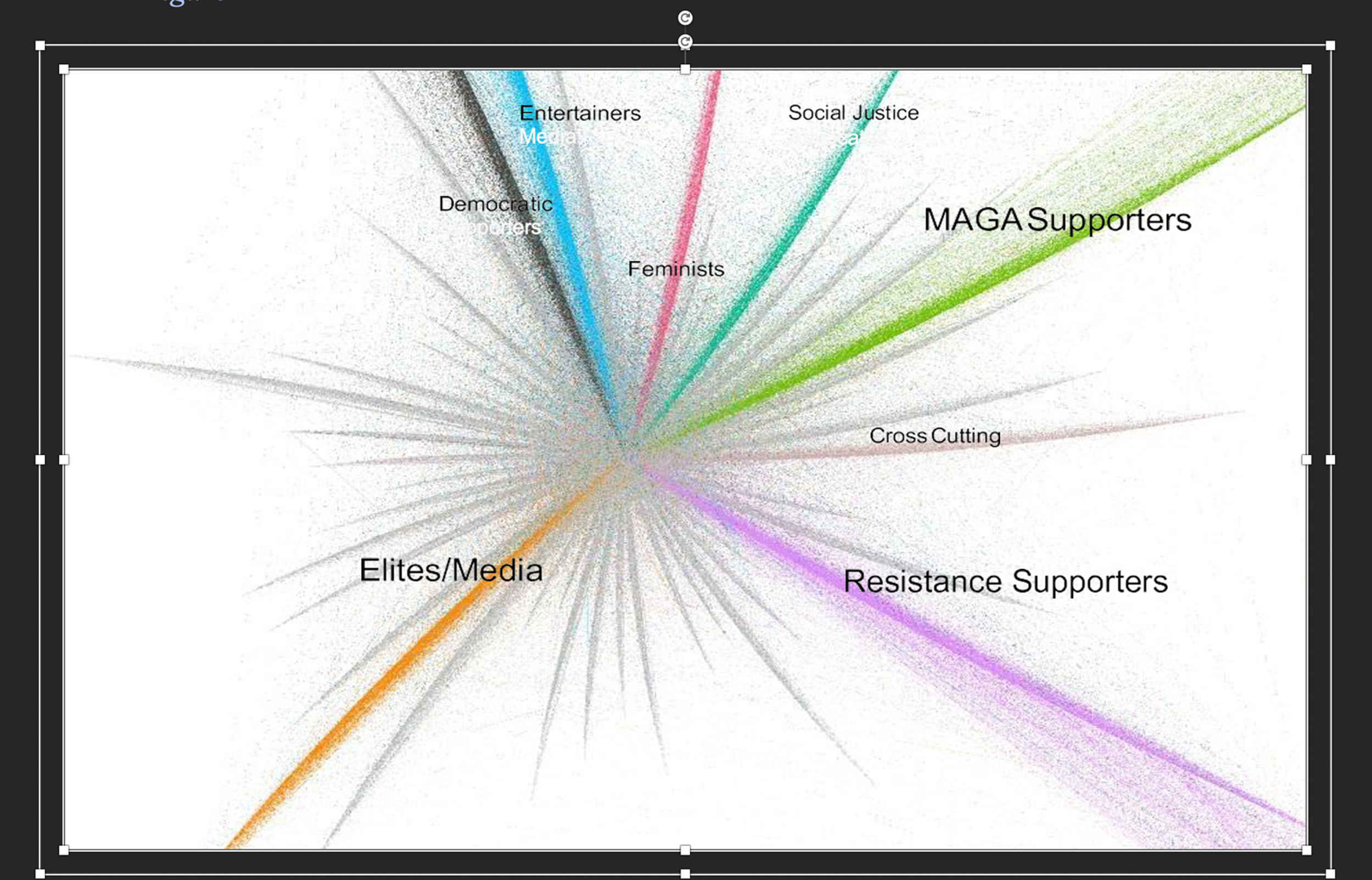
A visualization of the mapped virtual communities by connections.
Lastly, for Research Question 3, we used a qualitative data analysis computer software, NVivo, for the content analysis. We randomized and sorted for key terms, manually removing technical words connected to Twitter such as http, .com, images, etc. Finally, we used NVivo to create a Word Tree (example in Appendix) to examine context of each tweeted word. Seven words rose to the top in terms of frequency, when weighting the percentage relative to all the words within the dataset. These analyses complement the network analysis in identifying trends and message tone.
Findings
Research Question 1: What shared interest virtual communities formed and tweeted about Resistance connected to the 2018 midterm elections?
We identified eight tightly clustered groups in the network of Twitter users discussing the term “Resistance” leading up to the 2018 midterms (see Figure). The “Resistance Supporters’ community” consists of a diversity of individuals in terms of reported ethnicity, gender, religion, education level, profession, and ideology. The community label here is not intended to imply the community is monolithic; they are not, of course. The label here is meant to convey the sampled accounts in this analysis supported the Resistance movement, in a variety of ways. The “Make America Great Again (MAGA) supporters’ community” consists primarily of accounts that appeared to be associated with white users, who explicitly listed MAGA in their bio or posting recent comments with #MAGA, or other variations supporting Trump. These accounts did not support movements such as Black Lives Matter, #MeToo or other inclusive movements. The “Elites/Media community” consisted of journalists, news pundits, academics, and thought leaders. The “Entertainers/Media community” consisted of some journalists as well, but this community contained mostly entertainers and journalists who served more in this area versus on the frontlines of chronicling history, most supporting the Resistance Movement. The “Democratic Supporters community” consisted of individuals who all either listed themselves as Democratic candidates, representatives, or supporters of Democratic representatives.
The “Feminists community” were advocates supporting feminism. The “Social Justice Advocates community” consisted of individuals advocating for a variety of issues typically identified as occupying liberal spaces in the ideological spectrum (ranging from climate change to advancing LGBTQ+ rights). The “Cross-Cutting community” consisted of many individuals who could have been connected to the other communities but was the only community consisting of an even balance of MAGA Supporters or members from the other communities. In the random sample 42% of the individuals were MAGA supporters. The other 58% did not identify as MAGA supporters. Fifty percent of the sample was composed of individuals whose reported identity and ideology aligned with one of the other communities. Eight percent of this community did not explicitly state whether they were pro- or anti-Trump or if they were pro- or anti-Resistance.
Research Question 2: What themes of communication emerged in these Resistance networks?
Using NVivo, a qualitative content data analysis computer software, we located key terms used on Twitter. The Word Trees created by this software compile branches representing the different ways the discourse materialized. Nine terms emerged as the most frequent, when examining the randomized data sheets. While percentages may seem low, considering all the words and conversations associated with this research, it is interesting the exact terms that rose to the top of the data set. The percentages below are reported weighted percentages, which means the percentages are relative to all the other words within the data set. We did not specifically code for things like gender, as not to bias the sample. We relied on NVivo software's analysis of content and when specific accounts appeared to be representative of what NVivo was showing us, we did examine those accounts to see if they had more than one tweet and any indication in user profile and images for intersectionality, such as support for or indication of being in the LGBTQ+ community.
Resist
The term “resist” was used in the data 46.30% of the time. Although there were several ways the term “resist” was used on Twitter, related to politics, the software grouped related terms. An example of tweets grouped together are “Military. Resist to support ICE,” “Resist to move America forward,” “Resist to support Law Enforcement,” “Resist to support our borders,” and “Resist to support our Military.” A common tweet that shows resistance against the president is below: @realDonaldTrump Resist! https://t.co/0w7RcBKWHs.a
Trump
Donald Trump was mentioned 10.75% of the time when it came to the topic of resistance. In the Word Tree it connected the word “vote” to the president. In the category of vote there were several different narratives used on Twitter including “#resist resistance” if you voted for Trump, “no respect” for women who voted for Trump, and “piece of shit” for anyone who voted for Trump.
Trump supporters attempted to fight the blue wave by creating their own hashtag “#ResistFBR.” Below is a tweet that was used by many Twitter users to stand up and take action related to resistance: Together, we can harness the collective power of the people to resist the impact of a Trump presidency and to continue to make progress in our communities. Get educated. Get organized. Take action. https://t.co/ntJIanYo4s.
3
Resistance and #TheResistance
The word “resistance” or “#theresistance” was seen 7.33% of the time in the data collected. The NVivo Word Tree was able to categorize words related to resistance. Hashtags under resistance were categorized together as “#BlueTsumani2018,” “#impeachtrump,” “#NotMyPresident,” “#MeToo,” and “#TimesUp.” Although there were many tweets related to “resistance,” one tweet kept appearing telling fellow Twitter users to respect certain account holders’ decision to hide their identity. A common tweet used: Please don’t judge those of us who use an alias. You do not know our reasons. I was using my own picture until I was stalked and harassed by a supposed ‘resister’. I still resist the same as you. And I can still prove my resistance to my grandchildren. Let us not create division. https://t.co/htz6R38cOa.
4
“#FBR [Follow Back Resistance],” was tweeted about 5.75% of the time. The hashtag allowed activists on Twitter to connect while also fighting the current administration. The word tree created by using NVivo software was able to compile branches that represented the different ways the hashtag occurred on Twitter. The data allowed us to find recurring words people on Twitter were using. The most common word following “#FBR” was “party” that represents “#FBRparty” but the hashtags also included “#Resist,” “#BlueTsunami2018,” and “#DemsStandUnited.” Even the “100” emoji was used to represent 100% follow back by fellow activists. Below is an example of the way the #FBR hashtag was used by users. Are you in The Resistance Are you prepared to PUSH Back against trump and the GOP at the Ballot Box? Are you gonna bring Friends! We need EVERYONE November 6, 2018 nn#TheResistanceVotes #TheResistance #resist #FBR.
5
Vote
The data showed Twitter users are talking about voting 4.06% of the time. The Word Tree took the data from “Vote” and created the “Blue” category. Tweets categorized in this area shared common themes including “please make them understand.” Common hashtags were “#Blue,” “#November6th2018,” “#Bluewave,” and “#Register.” An example of the conversations that are on Twitter related to the term vote is below.
What's worse than a bigot MAGAer that shows up to the voting polls? A Bluewaver that doesn’t. Every vote counts this November. Take your country back. Please RT & commit to VOTE! #BlueWave2018 #BlueWaveComing #BlueTsunami #resist #TheResistance. 6
MAGA
“MAGA” was used by Twitter users 3.58% of the time in the data used for this study. NVivo Word Tree allowed MAGA conversations on Twitter to be grouped by common themes. There were very different narratives used on both sides of the political spectrum. One tweet reads “Resist! Your president is a racist! #Fmaga,” while the other end had the hashtag “#ResistTheResistance.” Below is an example of someone using both MAGA and “#resist” on Twitter. Pro-Tip for old white guys in MAGA hats—not every old white man is on your side—as in, don’t nod at me familiarly in the grocery store like we’re buddies joined by our whiteness. We’re not. You’re a #MAGAt; I #resist. End of lesson.
7
America/American
Twitter users were actively speaking about “America”; 3.41% of the time it was driving the conversation. There was a range of information discussed but using NVivo's Word Tree allowed the filtering of data. The word tree showed users tweeting “#Resist GOP” as well as “#Trump is damaging America.” Common hashtags used behind the term America were “#TrumpRussia,” “#resisttrump,” and “#impeachtrump.” For example: @realDonaldTrump You truly think you are a king that can make anyone do what you say. News Flash we live in the United States of America and do not have to follow a dictator's rule of law. Sorry that you were Putin's puppet this week but stop trying to make problems where there are none. #resist.
8
#FBRparty
The hashtag “#FBRparty” accounted for 3.34% of the data collected. “#FBRparty” stands for “follow back resist party,” which was a way to allow followers of the “blue wave” to follow and support each other on Twitter. The NVivo Word Tree was able to categorize similar topics into groups. Within “#FBRparty,” FBR was categorized as a call to action, referenced by a morning talk show on MSNBC, as well as some of their talent such as Joe Scarborough: @MorningJoe @JoeNBC, @morningmika, and @KatyTurNBC; then used with the hashtags “#TheResistance,” “#BlueWave,” “#TrumpRussia,” and “#ImpeachTrump.” For example: I want to connect with my other blue waves. This is my #FBRParty #FollowBackResistance I'll follow you. Please choose any of the following.
1. Like
2. Retweet
3. Follow
4. Reply
5. Copy this tweet to your own.
#VoteThemOut, #BlueTsunami, #FBRParty. #RESISTANCE.#Resist. 9
Love
The term “love” was used 3.3% of the time in the data. “Love” did not appear connected to any specific icon, but instead appeared as to support overall society, to stop hate, to stop trolling, and to stop negativity online and instead was associated with highlighting love first. For example: I love the Constitution and I despise @realDonaldTrump ! So, I guess it's time for myfirst #FBRParty Let's do this. Can’t wait to connect with more of you! #BlueWave2018 #Resist #FBR Please…
1. Favorite
2. Retweet
3. Respond
4. Follow
I will Follow Back. 10
Research Question 3: What conversation frames drove Resistance discourse across the shared interest virtual communities?
Network Cluster Frames
Following the analysis of hashtag and accompanying account prominence, we analyzed the coalition of accounts within cluster frames by graphing them in Gephi. From this we found themes or frames that emerged within these cluster groups. Using framing theory to understand the ways social media networks cluster their conversations reveals three primary frames driving the conversations across eight groups identified through the analysis. These frames overlap with the themes of gender, sexual and gender parity.
Intersectionality, Community Building and #MeToo frames emerge.
Recognition of people's individual humanity runs across the Resistance tweets, even those that use #MAGA. The three are distinct, however. They include an intersectionality frame, a community-building frame, and the frame that was the most used across the three, a “#MeToo” frame. The frames below, while each unique, illustrate the role of gender conversations on social media: they are fluid pulling in support—or to put in better terms resisting inequality—for other groups such as LGBTQIA+ communities, which forms intersectional communities of its own; at the same time, gender equality is also a societal discussion from entertainers to politicians ; events make great discussion times on social media and as communities felt compelled to join gender related conversations, “#MeToo” allowed an entry point for many to discuss a tangible issue connected to resisting inequality and unlawful behavior toward gender. We better understand discussions toward gender at the end of our analysis as a pillar of conversation that intersectional and powerful groups feel needs to be vocalized.
Intersectionality Frame
The SNA identified two large groups emerging within the network of Twitter users discussing the term “Resistance” prior to the 2018 midterm elections. While these two ideologically opposed communities represented a significant portion of the network, they were not the only communities. A broad coalition of communities formed during the discourse. The SNA and content analysis showed gender was a significant element in resisting the Trump administration. Many of the gender-based conversations, though, were framed through an intersectional lens, like this tweet, which mentions the many different groups Trump insulted: Trump has mocked a POW, a disabled person, a Gold Star family and now a woman who was sexually assaulted. Had enough yet ???
11
The groups mentioned here cross-political ideological boundaries. This includes people who support the military, a stance frequently assumed to be more conservative as older military veterans tend to skew toward the Republican party more than the general population (Newport, 2009). Margulies and Blankshain (2022) find, when examining individual-level variables for trust in the military over time (from Vietnam to post-91), is partisanship and age, skewing to older generations and Republicans. However, they did note that “formative experiences, such as those that define generations or stretch partisan divides, may create a strong foundation for how individuals assess the military over the lifetime” (p. 269). These experiences may include familial, geographic and/or other emotional/personal ties to the armed forces.
The “intersectionality frame” also consists of groups advocating for disability rights—a polarized issue with liberals leaning toward supporting the disability communities in the 2016 battle between Hillary Clinton and Donald Trump (Graham, 2016)—and feminist groups, which have been almost universally classed as liberal, neoliberal, or radical (McAfee & Howard, 2018). By including this variety of groups, the author was trying to draw across political lines and show how gender issues intersect across a range of political issues and ideologies.
This intersectional framing ran across a range of political ideas and identity groups, with all of them linking issues back to gender equality. This author, which appeared within the “Cross-Cutting,” within the conversation trajectory of “Resistance Supporters,” when cross-referencing our diagram of users, drew lines across sexuality, gender identity, racial and ethnic identity, and political parties to try and draw people into conversation: @alicetweet @jeremyhobson @NPR @hereandnow @JamalSimmons To all RESISTERS: Use the ‘mob mentality’ and FIGHT LIKE HELL for women's rights, gay rights, rights for people of color, immigrant rights, etc. Because Alice Stewart @alicetweet doesn't give a flying F. about you. #BLM #RESIST #BelieveSurvivors.
12
“Resist” and “Re-Sisters” are terms specifically used by those who identify as women who take a stand on issues; these two terms aren’t as specific to event-based movements such as Black Lives Matter or #MeToo, however, the two terms did appear along with hashtags associated with these movements. As the above tweet shows, hashtags used concurrently show how feminist thinkers are trying to use social media to show the intersectionality of gender with other oppressed groups. “#BLM” refers to the “Black Lives Matter movement”; the hashtag “#BelieveSurvivors” refers to the “#MeToo movement's” work in pushing back against the widely dispersed belief that sexual assault survivors lie about assaults.
The reference to racial and ethnic minorities within the gender-framed tweets also extended to promoting political candidates whose ideologies and personal attributes reached across identity lines: List Of Black Women Running For Office In 2018 https://t.co/hEBRo5qNLM #DonaldTrump #Resist #TheResistance #MeToo #RoseArmy #BlueWave2018 #HappyBlueYear #WhyIAmRunning.
13
This tweet indicates the so-called “#BlueWave2018” could be led by Black women running for office, and using social media boosted the signal for those candidates and allowed them to connect across the Resistance Movement.
LGBTQ+ communities, in particular, are visible within the “Resistance Movement’ tweets, and they use the global hashtags for the movement to make sure they were part of the on-going conversations about identity. As noted earlier, these conversations were particularly important as the Trump administration was trying to oppress rights for transgender people in the military and beyond and as online platforms and in-person organizations debated whether to expand or contract the different ways institutions would or would not recognize individual identification of genders. Denial of biology reinforces dysmorphia.
#Desist #Detrans #DropTheT #LGB #LGBT #PeakTrans #Pride #Resist #Shame #Trans
#TransCult #Transgender #BiologyDenial #Dysmorphia https://t.co/m2QL0O0dFv. 14
We will not Stand for this! #dontAssumeMyGender #BoycottYahoo #Resist https://t.co/OoeWiPw30r. 15
Whether intersecting with racial and ethnic groups, LGBTQ+ communities, religious minorities, or others, all of the intersectionality frames reached across ideological lines to try to create community, which leads to the next frame revealed through network analysis.
Community-Building Frame
While advocacy for gender equality has been shown to be a significant layer to the “Resistance Movement's” Twitter presence, it is not the only one. The emergence of journalist, entertainment, Democratic supporters, and MAGA supporters represents a broad coalition of groups invested in discussing the ideological discourse permeating the modern U.S. political climate. The content analysis showed this as well as gender was not the only emergent frame. Significant in the content analysis of gender framing is the prevalence of community building—“follow back,” for example. I have been angry since the 2016 election, but now that Kavanaugh has been elected to the SC/I'm terrified.
#FBRParty
#FollowBackResistance. 16
Other tweets directly told followers to retweet and disseminate ideas: #Retweet To Help Encourage Continuous Exposé of #Trump-Kavanaugh Network of Sexual Predators #FBR #MeToo #Dems #UniteBlue #FlipItBlue #ReSister #ReSisters #Resist #KavanaughLies #StopKavanaugh #NoKavaugh #KavaNo #KavaNope #VoteThemOut #VoteHimOut #VoteBlue https://t.co/BWZ2zwhhej.
17
This particular tweet plays to gender framing by trying to create a hashtag connection among the Resistance Network, particularly the “ReSisters.” This small change to the “Resist” hashtag specifically calls out people who identify with the female gender, excluding males through two simple hashtags: #ReSister and #ReSisters. When examining the clever change to the word “resist” to form “ReSister,” it appears as an international term for what a twitter account, “ReSisters,” defines as women who refused to be silenced. 18 At the top of this account's page are two copies of the symbol often used for women, a circle with a plus sign on the bottom. The symbols are leaning in toward the center; in one circle there appears to be a white person's hand and in the other a Brown or Black person's hand. This level of intersectionality within this one account is interesting, as it also supports the cross-cultural discussion of community building that we note within this analysis.
The “Community-Building frame” brought people together around issues and asked them to amplify those issues across networks. There was a strong emphasis on seeing the Republican party as anti-women's rights, and a call to expose the administration and some of the men nominated to political posts by Trump as sexual predators who could be and would be denounced by Twitter communities.
#MeToo Frame
The emphasis of the gender-based community-building frames on calling out sexual predators and misconducts reveals the final major gender frame shown through these clusters of conversation. Much of the conversation in the “Resistance Movement” was framed within the on- going “#MeToo” conversation and movement. The “#MeToo movement” leaders saw the potential of the on-going conversations as a way to solidify intersectional communities, including LGBTQ+ and racial and ethnic minority communities affected by sexual violence. Some of those tweets specifically called out men to support women and women's rights. Other tweets referenced news headlines and the ideas that came out of “#MeToo movement,” as this below tweet notes from the “Resistant Supporters” community cluster: If a man calls a woman difficult or crazy to you; ask him “What bad thing(s) did you do to her?!!!” #MeToo #MenHaveATendency #TimesUp #NeverSettle #Resist #Resistance https://t.co/byjWmMLMxN.
19
Many of the tweets calling out men relied on globalizing male behavior in the same way the previous tweet notes that women's behaviors had been stereotyped for so many years in ways that silenced them. This tweeter calls out men who are afraid of women for various reasons, a “common pathology”: Donald Trump, a billionaire, President of the United States, and wielder of nuclear weapons—exemplifies a common pathology in too many men. He feels threatened by strong women.
Know this. Emasculate him. Take away his power.
#MeToo #Resist #CountryOverParty #SpeakTruthToPower. 20
These authors don’t use “#MeToo” to refer to sexual violence. Instead, they use the conversation to highlight gender stereotypes and flip the conversation from stereotypes alleging women are unfit for power to stereotypes portraying men as incapable of leadership roles. This tweet also demonstrates community-building frame across party lines. The hashtag “#CountryOverParty” speaks to those who might support Donald Trump as a Republican but encourages them to vote democrat for the sake of the country. If they really cared about the United States, the hashtag claims, they’d revoke Trump's power. Many of the “#MeToo tweets” also either hashtagged “#BelieveAllWomen,” or they made specific calls to encourage the public to believe survivors over the accused.
Did you know that men have a 0.0000002% chance of being falsely accused of rape, but women have a 52% chance of being raped?? #metoo #BelieveAllWomen #BelieveSurvivors #MenAreTrash #LiterallyHitler #LiterallyShaking #weliveinasociety #greylivesmatter #ResistTrump #resist. 21
This tweet shows the author's emotions particularly in the hashtag “#LiterallyShaking,” which could indicate an excess of anger, fear, sadness, or another emotion. The author, also, however, calls out men with “#MenAreTrash” and Trump with “#ResistTrump” in ways that connect the issue of sexual assault with Trump's leadership and masculinity in America.
Conclusion
This study found extremely nuanced and layered communal discussions resisting the ideology projected from the Trump administration leading up the 2018 midterms elections. Gender was a prominent theme in the resistance networks and was also a solidarity agent in the intersectional coalition. Gender identity is being coupled with resistance as it is constructed in online spaces during conversations surrounding national issues and resistance efforts. This demonstrates a political association with gender throughout the various groups associated with resistance and shows how social media users associate their political beliefs and advocacy efforts with their gender. Our research supports arguments positing ideology should be placed on spectrums rather than linear polemics. The findings show many individuals participated in conversations both within their communities and outside of echo chambers on Twitter leading up to the 2018 midterm elections to voice perspectives on national ideological arguments. These conversations used both gender and resistance as means of connecting with other social media users to form communities and engage in discourse surrounding national issues.
As officials have carefully produced hashtags for awareness and support on social media, this study found groups within the resistance network took on the same task. It appeared users were following trends to weave a conversation of support through these connecting avenues. The hashtags themselves served as frames, elevating the salience of issues within the “Resistance Movement,” and quickly cueing, considering Twitter's character limit, the individual's stance on the issue, supporting dialogue across the social media platform.
The tweets created social media groups as they were shared, forming conversation clusters. Resistance supporters to MAGA supporters to elites to entertainers to Democratic supporters to feminists to the intriguing “Cross-Cutting community” (the only community split evenly with MAGA and non-MAGA supporters) emerged as those forming specific conversations related to the movement. When evaluating what people were talking about, the emerging themes included a balance of advocacy and political specific terms, such as “#FBR,” “#Trump,” “#American,” “#Vote,” and even “#Love.” While limited in characters, the passion toward the movement was clear by the emotion intertwined with political words soaring to the top of the Word Tree analysis.
Future research should continue examining the prominent barriers gender presents for aspiring representatives and their constituents and how gender factors into social media usage and presence. It should also continue making gendered frames visible within the associated social and public policies limiting gendered and sexual freedoms to see how this may have changed with self-quarantine during the pandemic. Some pundits and scholars undertake extreme intellectual acrobatics to dismiss gender as a significant barrier for many (see opinions in the news on why Elizabeth Warren never gained much traction in the primaries (Kurtzleben, 2020)). There is an abundance of data connected to social media and this topic.
Finally, future research should consider additional mix-methods to understand motivation and effects. Researchers may want to consider the hashtag #timesup and the complex on-going social media conversations steeped in #MeToo solutions. In addition, a possible future research limitation—like that which appears in this article—may be who controls the space to allow this sort of academic research. There is a present limitation for this study in relation to the role of “bots” on social media. Because bots are a relatively new phenomenon, future research should examine the role of social media bots in these conversations and the ways that they may impact discourse and communication in online spaces. Additional research may also take on a more strategic communication lens, analyzing how brands enter these conversations.
Footnotes
Declaration of Conflicting Interests
The authors declared no potential conflicts of interest with respect to the research, authorship, and/or publication of this article.
Funding
The authors received no financial support for the research, authorship, and/or publication of this article.
Notes
Author Biographies
Appendix
Word Tree Example from Data Set