




Abstract
Importance
Advancements in medical education have led to the adoption of virtual learning. Certain medical fields, including Otolaryngology—Head and Neck Surgery (OHNS), are underrepresented in undergraduate medical education curricula. LearnENT, an OHNS educational app, addresses this gap and has gained a global user base through its active social media presence.
Objectives
To investigate the efficacy of the LearnENT social media team in disseminating OHNS educational resources and engaging users.
Design
A longitudinal observational study with data collection conducted over an 8 month period surrounding the implementation of the social media team.
Setting
The study utilized 2 platforms: Instagram Business tools and the LearnENT application dashboard.
Participants
Instagram followers and LearnENT app users globally, with data segmented by demographics and professional backgrounds.
Exposures or Intervention
Analysis of Instagram Business data, including trends in followers, accounts reached, accounts engaged, impressions, and activity on the LearnENT application dashboard.
Main Outcome Measures
Follower demographics, audience activity patterns, account interactions, and app usage trends.
Results
The Instagram account achieved a 49.7% increase in followers (900 total) over 8 months. Engagement metrics showed an 87% rise in accounts reached and a 70% increase in impressions. App usage increased by 12%, reaching a total of 8257 users across 36 countries. Key content types, such as “Question of the Week,” received the highest engagement rates.
Conclusion
The LearnENT social media team has effectively disseminated OHNS educational resources and engaged learners, as evidenced by a 49.7% increase in followers and 12% increase app users.
Relevance
The global reach and diversity of the LearnENT Instagram community highlight its potential to connect individuals worldwide. Strategies to further enhance engagement include creating visually-appealing graphics, addressing audience preferences, and collaborating with other OHNS-related accounts.

Key Messages
Strategic Social Media Engagement Enhances Educational Outreach: The implementation of a social media team and targeted strategies, including visually-appealing content and interactive posts, markedly increased engagement and awareness of LearnENT, highlighting the potential of social media as a powerful tool for medical education.
Global Reach and Diverse Community: LearnENT has built a geographically-diverse community spanning North America, Europe, and Asia, showcasing the potential of social media platforms to connect learners and medical professionals worldwide, particularly in underrepresented specialties like Otolaryngology—Head and Neck Surgery.
Insights for Future Development of Medical Education Platforms: The study provides valuable methodologies and insights for developing and refining social media-driven medical education platforms, offering a scalable model for leveraging digital tools to address educational gaps in underrepresented specialties.
Introduction
Medical education has adopted transformative strategies to equip graduates with the necessary competencies expected of today’s health care professionals.1,2 One of such strategies is virtual learning, which has proven to have countless benefits for both students and staff.3-7 In recent years, with a push from the COVID-19 pandemic, there has been a remarkable shift in medical education toward online platforms.3,5 The increasing integration of digital tools and “e-learning” platforms has facilitated connectivity among students and educators, transcending geographical limitations.8,9
Given that implementing extensive curriculum changes can be time-consuming, 10 online medical education resources have emerged as valuable supplements.5,6,11 LearnENT, the official Learning App of the Canadian Society of Otolaryngology (CSO), is one such resource. Under the supervision of otolaryngologists, medical trainees at the University of Ottawa first developed LearnENT as an iOS application in 2012, to fulfill the mandate of the CSO of national competency-based learning objectives.12,13 The LearnENT app now features a virtual clinic with 45 interactive cases covering various Otolaryngology—Head and Neck Surgery (OHNS) subspecialties, along with summarized learning objectives, anatomy summaries, and flash cards. 14 With over 8000 users worldwide, LearnENT’s community includes individuals from Canada, the United States, and over 36 countries outside of North America. 13 LearnENT is also integrating into formal UME curricula in Canada, with 2 Canadian medical schools assigning self-guided modules from the app to supplement learning during OHNS blocks and surgical clerkships. Beyond the application, LearnENT has a student-led ambassador program with medical students across Canada who promote the app and host OHNS-related events. 15 Additionally, LearnENT has a website (http://learnent.ca/) and has successfully built a robust social media presence to supplement its growth, with communities on Twitter (@LearnENT) since 2012 and on Instagram (@learn_ent) since 2022. LearnENT’s presence on social media has expanded considerably in recent years, resulting in remarkable growth in both app users and the LearnENT community as a whole.
Despite the current widespread use of social media in the medical field for the purpose of communication and patient education,16-18 its specific role in spreading awareness of OHNS medical education resources and fostering nationwide engagement within the OHNS community remains largely unexplored. The objective of this study was to investigate the effectiveness of Instagram as an educational tool in medical training and analyze its potential for disseminating OHNS educational resources, fostering collaboration, and enhancing learner engagement. Further, this study will discuss methodology to develop a social media presence for OHNS and medical education accounts, allowing others to learn and adapt from our experiences.
Methods
LearnENT implemented a social media team mid-way through the study period, with the goal of revamping the theme of the Instagram account and increasing user engagement. Posts were uploaded on a regularly-scheduled basis, allowing for more consistency. To maximize user engagement and raise awareness, the LearnENT team employed a strategic approach to content creation and dissemination. Content was selected based on trending topics in OHNS. Four main content categories were prioritized:
Clinical Pearls: Highlighting key OHNS concepts in concise, visually-appealing formats.
Question of the Week: Interactive multiple-choice questions to encourage user participation and test knowledge.
Event Promotions: Announcements of LearnENT-hosted events and initiatives, such as Canadian Residency Matching Service (CaRMS) interview preparation sessions.
Did You Know? Quick facts designed to engage users with interesting, lesser known OHNS information.
A “3 × 3” visual grid format was implemented on Instagram to create a visually-consistent and appealing aesthetic, alternating between light and dark themes (Figure 1). Additionally, posting schedules were standardized to ensure consistent engagement.
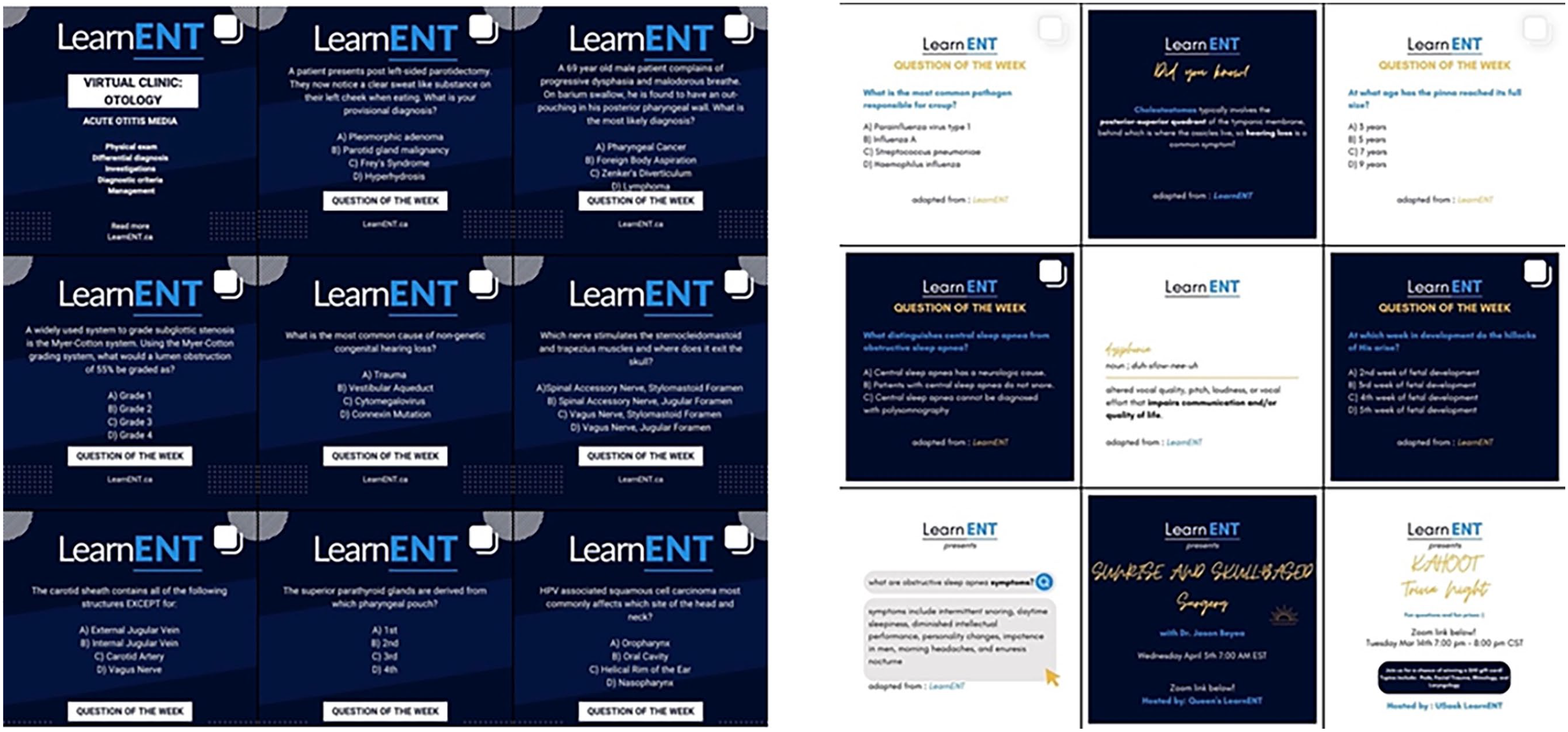
Comparison between the old theme (left) and the current theme (right) of the LearnENT Instagram account.
Instagram Business tools was used to collect data for this study. This software is specifically designed to provide comprehensive insights and analytics for Instagram accounts with a business profile—an optional feature for all accounts. 19 By utilizing the functionalities of this software, a detailed overview of the LearnENT Instagram account’s performance was collected. Data were collected monthly over an 8 month period from October 2022 to June 2023, surrounding the implementation of the social media team, to identify meaningful trends. Three categories of metrics were collected, including follower demographics, audience activity patterns, and account interactions. Follower demographics included the age, gender, and geographical distribution of followers. Audience activity patterns revealed the specific days and times when followers were most active on Instagram, which allowed the social media team to upload posts during peak audience activity periods. Account interactions, including accounts reached and engaged, and follower impressions provided an indication of the overall visibility and exposure of the Instagram posts to a broader audience. These metrics are defined by Instagram 19 as follows:
Followers: User who follow your account and are able to see, like, and comment on any media you post to your profile.
Accounts reached: Number of unique accounts that have seen your content on screen at least once.
Accounts engaged: Number of unique accounts that have interacted with your content, that is, likes, comments, shares, or replies.
Impressions: The number of times content, whether a post or a story, was shown to users.
Data were separately collected from the LearnENT mobile application administrative dashboard on a monthly basis. Collected data included total users and top users by profession. Twitter data were excluded from this study because the platform lacks comprehensive data tracking features, necessitating the use of third-party tools for data collection. Data collection was followed by a descriptive analysis to identify trends in the growth of the LearnENT community and the utilization of its mobile application. This study received approval from the University of Saskatchewan Behavioural Research Ethics Board (ID#4242).
Results
Demographics
The LearnENT Instagram account has more than 900 followers, follows 728 users, and has made 67 posts in total. LearnENT’s followers represent a diverse user base in terms of demographics and geographical locations. Key cities represented include Montreal (5.6%), Toronto (2.3%), Bogota (2%), and Edmonton (1.7%). Canada leads in user representation with 27.4%, followed by the United States (19.1%), India (6.5%), and Spain (4.6%). Most users fall within the age range of 25 to 34 years (55.6%), followed by 35 to 44 years (20.3%), 18 to 24 years (12.5%), and 45 to 54 years (6.6%). Women account for 53.3% of the LearnENT Instagram audience, while men make up 46.7%. Audience activity peaks between 12:00 PM and 3:00 PM Atlantic Daylight Time and remains consistent across the days of the week. Users of the LearnENT application include medical students (52.6%), residents (19.3%), attending physicians (8.5%), and other allied health professions (19.7%).
Trends Over Time
During the study period from October 2022 to June 2023, the LearnENT Instagram account experienced noteworthy growth in terms of followers, accounts reached, accounts engaged, and total impressions (Figure 2). The account’s follower base reached a total of 900, indicating a 49.7% increase over the 8 month period. The reach expanded to 5205 accounts, with a mean of 651/30 day period, reflecting a 32.8% increase during the latter half of the period. Accounts engaged followed a similar trend, with a total of 541 engaged accounts and a mean of 67. Additionally, the total impressions amounted to 25,155, with a mean of 2894. As the LearnENT Instagram account continued to grow, so did the App’s user base. By the end of the study period, the total number of app users reached 8257, representing an absolute increase of 12% and a more than 3-fold increase since 2021 (Figure 2).
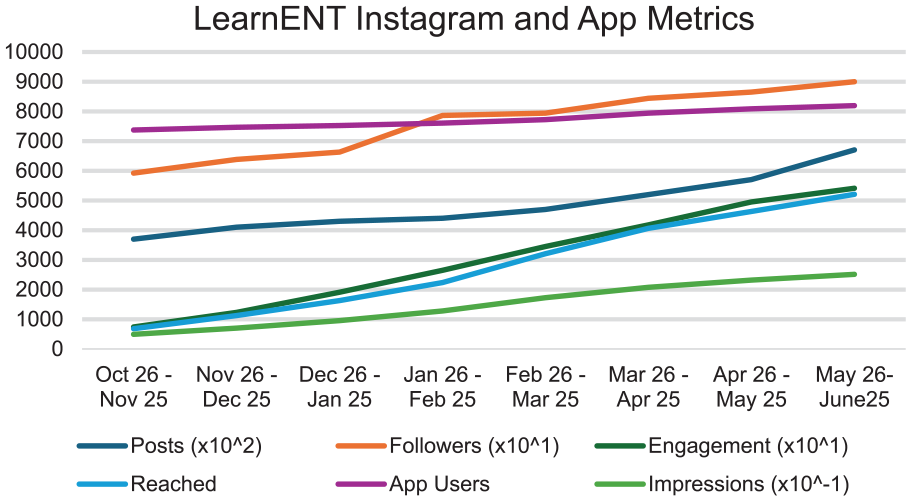
Trends in LearnENT Instagram metrics and LearnENT app users from October 26, 2022, to June 25, 2023. Cumulative values have been used to highlight total impact and growth over the study period.
Instagram metrics and app users both showed a steep rise in January. However, the greatest growth occurred during the period from February 26 to March 25. During this period, all metrics showed a considerable increase compared with the mean increase per month over the study period (Figure 3), including Accounts Reached (49.2%), Accounts Engaged (18.3%), Impressions (45.1%), and most notably, App Users (91.7%).

Growth in the LearnENT Instagram and app metrics from February 26 to March 25.
Discussions
The purpose of the LearnENT Instagram account is to disseminate OHNS educational resources, foster collaboration, and enhance learner engagement. The LearnENT Instagram account demonstrated notable growth in terms of follower base and post interactions, indicating that active engagement on social media platforms can lead to improved visibility and audience reach. These findings underscore the efficacy of implementing a social media team in disseminating OHNS educational resources and engaging learners in a dynamic and interactive manner.
Demographic analysis of the LearnENT Instagram audience revealed the account’s wide reach, with a community that extends far beyond North America. The broad reach and geographical diversity achieved through social media showcases the platform’s ability to connect individuals from various locations and deliver educational content on a global scale. This aligns with other studies that have found Instagram to be an effective tool in promoting medical education and advocacy across several medical specialties.20,21 While Instagram is often perceived as most beneficial for visually-rich fields of medicine such as radiology22-24 and dermatology, 25 its utility extends to various other specialties, including otolaryngology,26-29 nuclear medicine, 30 cardiology, 31 ultrasonography, 32 and more.33,34 Instagram users across these fields have collectively agreed that the picture-sharing platform facilitates quick and easy content sharing for the purposes of medical education, research, networking, and advocacy.20,22,23,25,26,30,32-34
Several changes were implemented by the social media team with the goal of raising awareness and growing our online community. Such changes included the visually-appealing theme of posts, regularly-scheduled posts, and diversified content, which correlated with an increase in user engagement and contributed to the overall success of the platform. Similar trends have been observed in other studies, with user engagement varying with the content and visual appearance of posts.24,35-37 This highlights the importance of strategic content planning and visual aesthetics in capturing and retaining the attention of social media users. Furthermore, in order to raise awareness for LearnENT as an educational resource, the LearnENT community members share the LearnENT Instagram account’s posts on their personal accounts to expand its reach and grow our audience.
By employing strategies utilized by other medical education accounts, LearnENT can further enhance its growth and impact in the online OHNS education realm. The LearnENT Instagram account has only been active for slightly over a year, and thus holds the potential for community-building and expanding online education in the field of OHNS in the future. Strategies for increasing engagement on Instagram include but are not limited to using hashtags, creating interactive polls to gauge audience preferences, promptly replying to comments and direct messages, engaging with other OHNS-based accounts, creating visually-appealing graphics, and posting during high activity periods.24,31,35,37,38 Furthermore, the LearnENT Instagram community’s geographical diversity holds the potential to provide high-quality medical education in low-income and middle-income countries.39-41
The increased activity on the LearnENT Instagram and LearnENT app between February 26 to March 25 aligns with the period leading to the CaRMS match. Just prior to this, LearnENT ambassadors hosted a “CaRMS Interview Session” with OHNS residents from the University of Toronto to support its community members preparing for the 2023 match. The rise in activity surrounding this important period exemplifies LearnENT’s prominent role in networking and fostering a sense of community, as seen with the many residency programs who have created Instagram accounts in recent years.42-45 Additionally, the sharp rise in user engagement during this period emphasizes the potential of leveraging time-sensitive, audience-relevant events to foster community growth. This further supports social media’s role as a valuable tool in promoting collaboration between medical professionals and learners in the field of OHNS.11,31,44
This study provides an in-depth analysis of the growth of a novel social media and medical student outreach campaign for a virtual medical education platform. While the strategies implemented in this study were effective in raising awareness and building an online following, this study is limited by the inability to directly attribute user growth to specific strategies. The absence of detailed user feedback mechanisms, such as surveys or in-app prompts asking how users discovered LearnENT, restricts our ability to establish clear causal relationships between promotional activities and audience expansion. Future initiatives will prioritize the integration of robust data collection tools to capture these insights, enabling a more precise evaluation of the impact of individual strategies. Leveraging these data will allow for the refinement of engagement approaches and further optimization of outreach efforts. With these enhancements, LearnENT is well-positioned to expand its reach and serve as a scalable model for other medical education platforms seeking to leverage social media for growth and community building.
Conclusion
This study demonstrated the effectiveness of the LearnENT social media team in disseminating OHNS educational resources, fostering collaboration, and enhancing learner engagement. The account exhibited remarkable growth in terms of followers and post interactions, indicating the positive impact of active engagement on social media platforms. LearnENT plays an important role in networking and fostering community among OHNS medical professionals and learners. LearnENT’s Instagram community is geographically diverse, showcasing the ability of social media to connect individuals from various locations and deliver OHNS educational content on a global scale. Furthermore, the implementation of a social media team and visual transformation of the account played key roles in its success. Further growth and engagement can be achieved with the use of interactive posts, engaging graphics, seeking audience preferences, engaging with other OHNS accounts, and more.
Footnotes
Acknowledgements
Not applicable.
Author Contributions
G.F.: interpreting results, drafting manuscript, revising manuscript. Y.O.: data collection, revising manuscript. A.M.: study design, revising manuscript. K.H., D.M.: study conception, revising manuscript. E.G., T.P.: study conception, revising manuscript, supervision.
Declaration of Conflicting Interests
The author(s) declared no potential conflicts of interest with respect to the research, authorship, and/or publication of this article.
Funding
The author(s) received no financial support for the research, authorship, and/or publication of this article.
Ethical Approval and Informed Consent Statements
Not applicable.
