




Abstract
This study examines the transformation of the cultural and political mythology surrounding Ivan Mazepa, a historical figure whose legacy is interpreted in fundamentally different ways by Ukraine and Russia. In Russian imperial narratives, Mazepa is characterized as a symbol of treachery, while in Ukrainian nationalist discourse, he embodies ideals of freedom and sovereignty. His persona also achieved international prominence in 18th- and 19th-century Europe, notably through Romantic literature and music, launching the phenomenon referred to as Mazepiana. The article outlines the evolution of Mazepa’s “artistic shadow” in the European cultural tradition before analyzing his “political shadow” relative to Ukraine and Russia. Particular attention is given to the resurgence of Mazepa’s image in Ukrainian public consciousness after 1991, with an emphasis on key events such as the 2009 tricentennial of the Battle of Poltava, Russia’s annexation of Crimea in 2014, and the 2022 full-scale invasion. Mazepa is positioned not merely as a symbolic figure, but as an active force in shaping the enduring historical dynamics of disintegration and integration in the Russia-Ukraine relationship. His influence continuously informs political narratives, national memory, and cultural identity, acting as a unifying symbol for Ukrainian sovereignty while remaining a focus of strong Russian criticism. As a figure whose significance endures across generations, Mazepa’s role highlights the persistent influence of myth in shaping post-Soviet identities.
Introduction
A progressive Ukrainian media outlet (Euromaidan Press, 2022) reported that, in the aftermath of Russia’s full-scale invasion of Ukraine in 2022, the Russian military police compiled a list of prohibited Ukrainian historical figures. Among those listed are Symon Petliura, the inaugural president of the Ukrainian People’s Republic; Stepan Bandera, head of the Organization of Ukrainian Nationalists (OUN); Roman Shukhevych, commander of the Ukrainian Insurgent Army (UPA), noted for his organization’s alliances with Nazi forces; and Vyacheslav Chornovil, a pivotal leader in the national-democratic independence movement during the 1980s and 1990s. Also included is Hetman Ivan Mazepa, who, in the early 18th century, attempted to achieve independence for the Ukrainian Cossack Hetmanate from Russian control. 1
With the exception of Mazepa, all the individuals referenced are modern historical figures who significantly influenced Ukraine’s twentieth-century quest for independence. Mazepa, by contrast, is widely acknowledged as an antecedent to the persistent aspiration for sovereignty. At first glance, referencing a figure from three centuries ago during a twenty-first-century conflict may appear historically distant. Nevertheless, the continual “war of history” or “memory war” between Russia and Ukraine—in which Mazepa has attained a prominent symbolic status—challenges this presumption. Since the 2014 annexation of Crimea by Russia and the progression to full-scale war in 2022, Mazepa’s name has come to symbolize the profound historical and political tensions that persistently characterize relations between these two countries.
Following the 1654 Treaty of Pereyaslav, Ukraine was effectively subordinated to the expanding Russian Empire. In the early 18th century, Hetman Ivan Mazepa attempted to alter this trajectory by seeking an alliance with Charles XII of Sweden. These efforts ended with defeat at the Battle of Poltava in 1709, after which Mazepa died in exile in Moldavia. Within Russian imperial narratives, Mazepa was consistently depicted as a traitor, whereas Ukrainian national memory recast him as an icon of defiance and self-determination. After the Euromaidan Revolution of 2013–14 and the annexation of Crimea, the Ukrainian state increasingly rehabilitated Mazepa, presenting him as a representative of national identity grounded in the Cossack heritage and its political values. The designation mazepist, originally a Russian derogatory for Ukrainian nationalists, continues to exist as a linguistic testament to this disputed history (Bovgyria, 2010).
This article explores how a historical personality from three centuries earlier retains symbolic relevance in the context of the 2022 Russo-Ukrainian war. It aims to elucidate, even if only partially, the underlying irrationality and brutality of the conflict through the enduring “shadow of Mazepa” that hangs over both Russia and Ukraine.
Importantly, the myth and countermyth of Mazepa have exerted influence across not just Russia and Ukraine, but also nineteenth-century Europe, twentieth-century South Africa, and even contemporary South Korea. Prior to Ukraine’s post-Soviet reclamation of Mazepa’s legacy, Europe was the principal arena for the assembly and dissemination of his legend.
Mazepiana from Europe to Korea
The compelling life of the Ukrainian Cossack Hetman Ivan Mazepa (1639–1709) became a significant source of inspiration not only in Russia and Ukraine but also among nineteenth-century Romantic poets, composers, and painters throughout Europe. This observation highlights the commonly held notion that literature and the arts have frequently played a more profound role in shaping collective imagination than traditional historiographical accounts. According to Prymak (2014), Mazepa’s case serves as a clear example of this process. The fact that a thorough academic re-examination of Pushkin’s representation of Mazepa as a rebel against imperial authority has only recently commenced further supports this conclusion (Prymak, 2022).
By the late 17th century, Ukrainian writers had already begun featuring the character of Mazepa in their literary works. However, during the Soviet era, many novels, plays, and epic poems focusing on Mazepa faced censorship, being either banned or only published abroad (Smyrniw, 2018). After the collapse of the USSR, these works became available in official Ukrainian publications, and contemporary Ukrainian artists have increasingly utilized stage and screen to reinterpret Mazepa in innovative and critical ways. Among these reinterpretations are two notable works: the art-house film A Prayer for Hetman Mazepa (2001) 2 by Soviet/Ukrainian filmmaker Yuri Ilyenko (1936–2010), and the video piece The Battle Over Mazepa (2023) by Berlin-based Ukrainian artist Mykola Ridnyi (b. 1985). Ilyenko’s experimental film connects Mazepa’s personal suffering to Ukraine’s historical exploitation, using this relationship to investigate themes of national trauma and Ukraine’s uncertain future. Ridnyi presents a dialogue between Byron’s Mazeppa and Pushkin’s Poltava, aiming to critically challenge and deconstruct dualistic narratives within the Mazepa myth.
Divergent interpretations have also emerged in 21-century stage presentations of Tchaikovsky’s opera Mazepa. In 2017, the Kharkiv State Academic Opera and Ballet Theatre restaged the opera as an allegory for Ukraine’s prolonged pursuit of sovereignty, performing it in Ukrainian and visibly incorporating references to the victims of Euromaidan. The production opens and closes with the Ukrainian folk song The Black Field is Plowed. In contrast, the Bolshoi Theatre’s 2021 staging maintains the depiction of Mazepa as a traitor, broadening the opera’s setting from Poltava to include the Russian Civil War, World War II, and present-day Donbas. With visuals of burned buses and the bodies of fallen soldiers, this production suggests that Ukraine’s ongoing suffering is a consequence of Mazepism—a rebellious, separatist inclination purported to be innate among Ukrainians (Kuplevatska, 2024).
The Romantic narrative poem Mazeppa (1819) by Lord Byron significantly influenced the dissemination of the Mazepa myth throughout nineteenth-century Europe. Based on a semi-legendary account in Voltaire’s History of Charles XII, the poem details the punishment of a young Mazepa, who, after engaging in a forbidden relationship at the Polish court, is tied to a wild horse and abandoned in the wilderness, ultimately saved in a remarkable rescue by fellow Cossacks. Byron’s interpretation transformed Mazepa into an emblem of heroic endurance in the face of oppressive power and a metaphor for the persistent human quest for liberty. Victor Hugo further developed this Romantic archetype in 1828, which was adapted within Russian literature in works such as Kondratiy Ryleev’s narrative poem Voinarovsky (1825), Alexander Pushkin’s narrative poem Poltava (1828), and Faddei Bulgarin’s historical novel Mazepa (1838). The Mazepa motif also resonated within the literatures of the Netherlands, Germany, Poland, Czechia, Sweden, and Moldova, establishing his status in the broader canon of European literature.
Mazepa also became a frequent subject in nineteenth-century art. At least sixteen documented paintings were inspired by the legend, including works by prominent French artists such as Louis Boulanger (1806–1867), Théodore Géricault (1793–1824), and Eugène Delacroix (1798–1863), each reinterpreting Byronic elements in their distinct styles (Babinski, 1975; Chukhlib, 2004). Rather than adhering closely to Mazepa’s personal narrative, these artists often reworked classical themes—notably Titian’s The Rape of Europa—by substituting the female figure and bull with a young man and a horse. In this way, they advanced the established European symbolism of “man and horse” into innovative Romantic and allegorical dimensions (Sibona, 1998). The exotic connotations of terms like “Ukraine,” “Cossack,” and “Hetman” amplified the myth’s fascination. Musical interpretations—for example, Franz Liszt’s Mazeppa and Pyotr Tchaikovsky’s opera of the same title—deepened Mazepa’s cultural significance, helping to establish what is now referred to as the “Mazepa cult.”
The impact of Mazepa’s legend reached well beyond European borders. On the east coast of South Africa lies a location named “Mazeppa Bay,” after a schooner constructed in the United States that anchored near the Natal coast during the First Anglo-Boer War in 1842. In 1930, South African poet Roy Campbell (1901–1957) composed a poem titled Mazepa, reinforcing Mazepa’s image as a “Romantic Phaethon” and as a symbol of resistance to colonial domination and the aspiration for liberation under colonial rule (Voss, 2012).
In 2024, a Korean poetry collection entitled Mazeppa—notably presented in its Latin transliteration—was released. The opening poem, which shares the title, significantly departs from the conventional European Romantic hero narrative that influenced nineteenth- and twentieth-century depictions of the character. Having presumably first encountered Mazepa by listening to Liszt’s composition, 3 the poet Kim Ahn (b. 1977) became indirectly familiar with the historical figure who struggled for Ukraine’s independence and ultimately met a tragic fate. However, the poet refrains from recounting the exploits of a Cossack leader from three centuries prior. The poem makes no explicit mention of Mazepa’s name. Instead, he is reimagined as a vulnerable modern individual—unable to protect either his homeland or himself—thus reflecting the poet’s own status as a contemporary person attempting to persist through the act of writing “poetry” amid daunting circumstances. Within this tragic character, the poet perceives a mirror of himself: not as a conquering hero, but as one doomed to fail and yet driven to continue: “I fail,// I march forward,// Because this is my lot” (Kim, 2024, p. 9).
Although never directly stated, the poetry conveys a sense of solidarity with present-day Ukrainians enduring the hardships of war. For the poet, documenting the suffering of the oppressed becomes both a moral obligation and an inherited poetic duty. This sense of kinship with “the defeated,” together with the ethical responsibility to testify to human suffering, constitutes the central theme of the collection.
Commencing with Byron, the image of Mazepa traveled through the artistic consciousness of nineteenth-century Europe, inspired anti-colonial sentiment in twentieth-century South Africa, and appeared in the compassionate reflection of twenty-first-century Korea, ultimately becoming a global cultural symbol. After reviewing this “artistic” legacy that spans regions and eras, the next section addresses his “political” shadow as it is constructed in the contested historical interpretations of Russia and Ukraine.
Mazepism in Ukraine and Russia
Shift from Khmelnitsky to Mazepa
Plokhy (2021) introduces the concept of the “Ghosts of Pereyaslav” to clarify the patterns of division and reconstitution in Russian-Ukrainian relations. Given the missing original treaty document, it is understandable that both countries maintain fundamentally conflicting views regarding the meaning of “reunification.” Plokhy maintains that the Pereyaslav Agreement should be regarded as a “historical myth,” highlighting that this “legend” was first brought into historical discussion by Ukrainian historian and political theorist Viacheslav Lypynsky in 1920.
It is well established that the Pereyaslav Agreement, concluded in 1654 between the Ukrainian Hetman Bohdan Khmelnytsky and Tsar Aleksei of Muscovy, has long served as a focal point for historical interpretation. Russia frequently invokes the agreement as historical support for the assertion that Ukraine has always constituted an essential part of Russian civilization, thereby sustaining a narrative of justified incorporation. 4 By contrast, Ukraine regards the agreement as an episode of lost sovereignty and as a formative event underpinning its modern anti-imperial identity (Plokhy, 2010).
Numerous scholars have noted that a principal element in Ukraine’s nation-building project—parallel to the trajectories pursued by other post-Soviet republics—has involved both the recovery and reinterpretation of national traditions. To distance itself from the pervasive influence of Russian and Soviet models, Ukraine has intentionally foregrounded its orientation toward the West. This shift is informed not only by geopolitical imperatives but also by a civilizational decision rooted in a historical identity that predates the emergence of both the Russian Empire and the Soviet Union. The large-scale military conflict that began on Ukrainian territory in 2022 has been interpreted by many observers as a contest between a post-Soviet state seeking NATO integration and a former imperial authority intent on blocking such a development.
John Mearsheimer’s foundational analysis, which attributes the origins of the conflict primarily to Western expansion and offers a critique of NATO’s eastward movement, reflects the prevailing strategic realities at the war’s onset. However, independent of Russia’s insistence on maintaining a buffer zone or Western doubts over Ukraine’s suitability for NATO membership, Ukraine’s continued pursuit of NATO membership should be understood as a reaffirmation of its longstanding European orientation—an identity developing over centuries, not only as a reaction to the end of the Cold War. This pursuit is significant not solely as a security policy but also as a symbolic assertion of autonomy in opposition to the “Greater Russia” concept.
Following the dissolution of the USSR, Russia has increasingly substituted communist ideology with a discourse centered on civilizational unity—emphasizing shared Slavic and Orthodox identities and positioning Ukraine as an intrinsic component of a broader pan-Russian cultural sphere. Within this ideological construction, Ukraine’s departure from the so-called “triune East Slavic people” (Russia–Belarus–Ukraine) is represented as an act of disloyalty. This growing divergence in national identity culminated in the open conflict sparked by the Euromaidan Revolution in 2013, followed by Russia’s annexation of Crimea in 2014, signaling a definitive break from Russia’s imperial sphere.
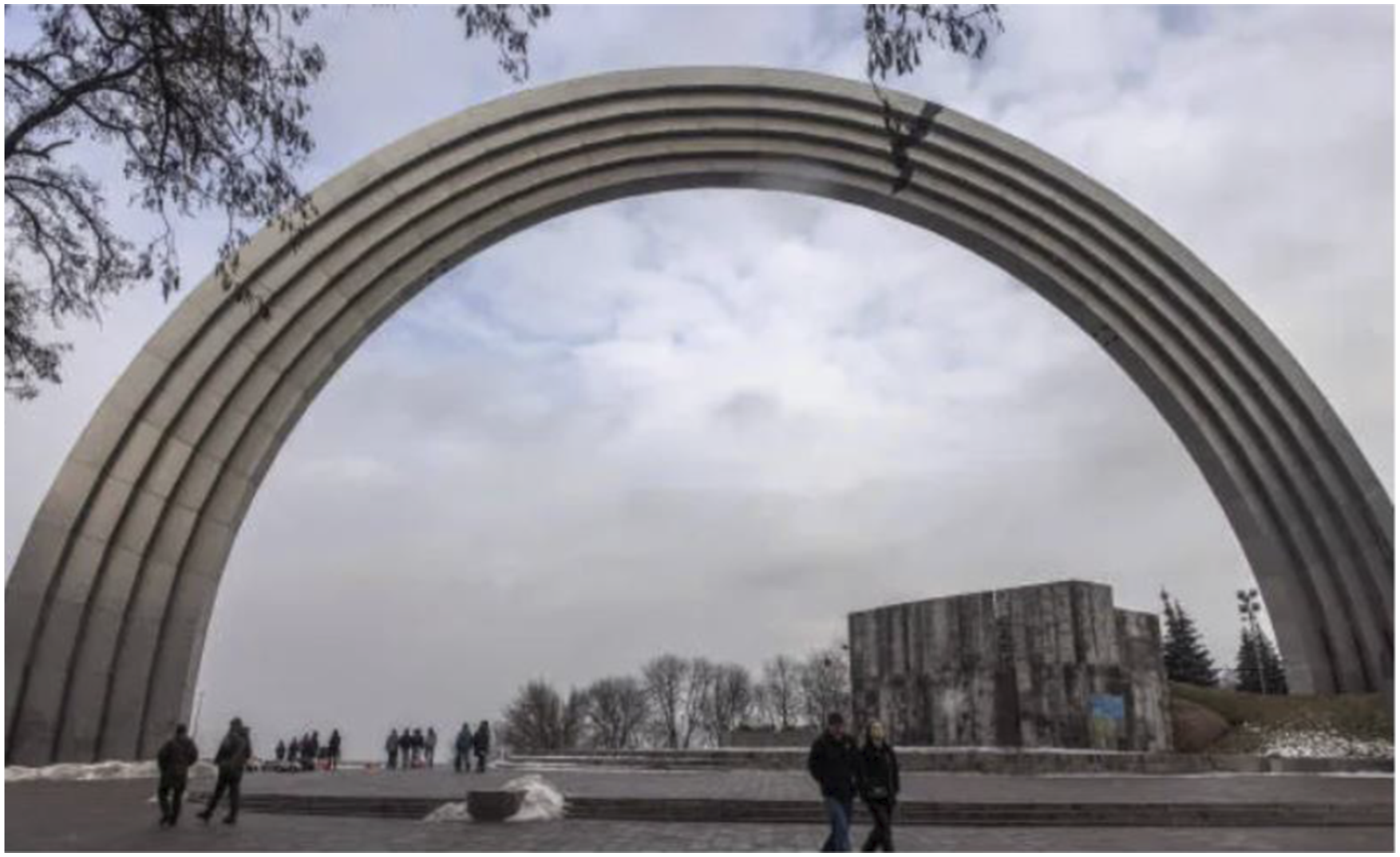
Ukraine’s geographical position introduces an additional dimension of complexity to this geopolitical rivalry. The nation exemplifies a distinct “frontier identity,” often figuratively referred to as “the Gate of Europe” (Plokhy, 2015). Since its independence, Ukraine’s deliberate pivot towards Europe—rather than aligning with Islam or Russia—has spurred deliberate measures to confront the “Ghosts of Pereyaslav,” a metaphor for historical challenges that have shaped post-Soviet political, historical, and cultural narratives in both countries. One emblematic action was the removal of the People’s Friendship Arch in Kyiv, a massive Soviet monument erected in 1982 to commemorate the 1,500th anniversary of Kyiv and the 60th anniversary of the USSR. This arch was adorned with a bronze statue symbolizing Russo-Ukrainian friendship and a granite sculptural composition interpreting the 1654 agreement between Hetman Khmelnytsky and Muscovite envoy Buturlin. Following Russia’s invasion in 2022, Ukraine’s Ministry of Culture dismantled the monument as a part of the nation’s wider “decommunization process,” citing the historic inaccuracy of the so-called “reunification of brotherly nations.” The structure was renamed the “Arch of Freedom of the Ukrainian People,” and in April 2024, the 6–7 ton granite sculpture commemorating the Pereyaslav Agreement was also removed, leaving only the arch intact (Kyiv Independent, 2024). (Figure 1).
In a related development, Ukrainian human rights advocates and artists installed a work titled The Crack of Friendship in 2018, demonstrating solidarity with Oleg Sentsov and other Ukrainian political prisoners held in Russia—individuals they referred to as “hostages of the Kremlin” (visitukraine.today, 2024). (Figure 2).
Although Ukraine has worked to strip the Pereyaslav Agreement of its symbolic representation of unity, Russia—especially after the annexation of Crimea—has intensified efforts to reinforce its own vision of historical togetherness. For example, in August 2014, a statue of Khmelnytsky was installed on “Khmelnytsky Street” in Belgorod,
5
a Russian city near the Ukrainian border city of Kharkiv, as a conspicuous declaration in favor of a renewed “reunion” narrative. Local legend claims that Khmelnytsky once planted an oak tree in a nearby village, deepening the cultural resonance of the 1654 treaty (Rossiiskaya Gazeta, 2014). Before the Demolition of the Monuments. Source: https://novayagazeta.eu/articles/2022/05/14/peoples-friendship-arch-in-kyiv-renamed-arch-of-freedom-of-the-ukrainian-people-news After the Demolition with “the Crack of Friendship”. Source: https://kyivindependent.com/culture-ministry-removes-historical-status-of-kyivs-peoples-friendship-arch-allows-for-dismantling/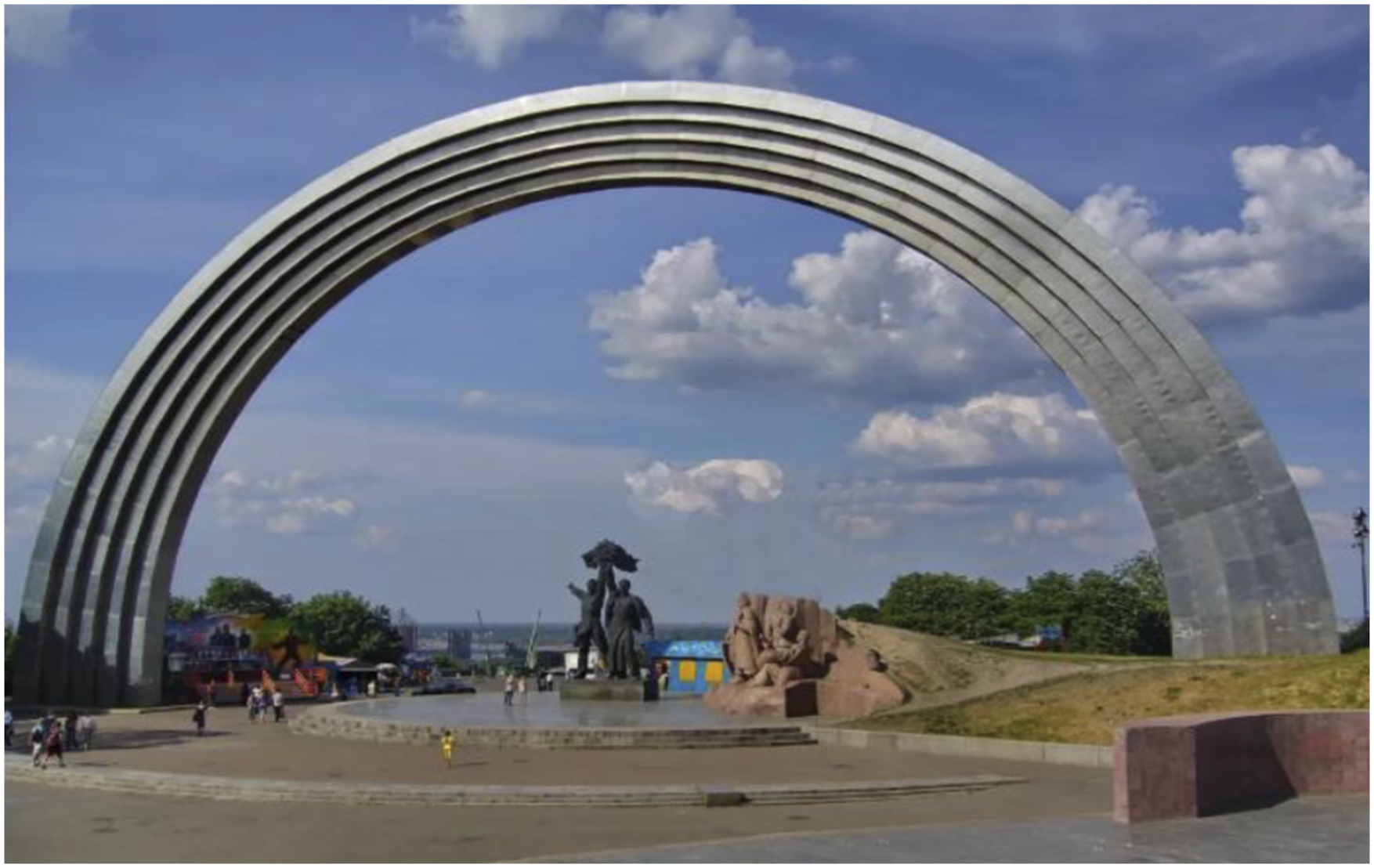
This symbolic contrast—Russia’s persistent promotion of historical reunification and Ukraine’s efforts to assert sovereignty through the “Revolution of Dignity” and earlier color revolutions—has shaped the understanding that the present conflict is rooted in long-standing historical tensions and underlying structural factors that have diminished prospects for peaceful resolution.
Within this larger ideological transformation, Ukraine’s conscious distancing from Bohdan Khmelnytsky—and from his historical association with Russo-Ukrainian unity—has opened both cultural and political avenues for the renewed prominence of another national figure: Ivan Mazepa. Of the available candidates, Mazepa most clearly embodies Ukraine’s European orientation. He was educated in Western Europe and served at the Polish royal court before eventually attaining the position of Hetman, where he contributed significantly to Ukraine’s cultural development. The descriptors “Mazepa Baroque” and “Mazepa Renaissance” effectively summarize both the breadth of his patronage in the arts and the lasting symbolic resonance his legacy holds.
“Obsessions with Mazepa” in Ukraine and Russia
Koznarsky (2009–2010) observes that by the 19th century, Mazepa had already become a persistent subject of fascination for Ukrainian intellectuals—serving as “the alpha and omega of their identity, the ultimate mirror, the ‘other,’ as nemesis, stigma, and temptation” (p. 569).
The formation of the Mazepa myth commenced during his own era. Following the Battle of Poltava, Mazepa was ‘anathematized’ by the Russian Orthodox Church at Peter I’s direction, 6 —a sentence that condemned him as a traitor and subjected him to ecclesiastical curse. This anathema persisted until it was formally lifted by the Ukrainian Orthodox Church in 1992 (The Washington Post, 2002). Alongside this betrayal narrative, an alternative myth grew in Ukraine—that of Mazepa as a champion of Orthodoxy and Cossack rights. Within the Russian Empire, any positive interpretation of Mazepa was strictly forbidden. Historians operated under restrictive ideologies that suppressed more nuanced perspectives, and the Soviet era further entrenched this vilification. The 1971 Soviet Ukrainian historical encyclopedia offers a clear example: “Ukrainian bourgeois nationalists in the past and today try in every way to hush up Mazepa’s treasonous intentions to give Ukraine to the Poland of the gentry and against historical fact create around him the aura of a fighter for Ukraine’s freedom... Ukrainian Soviet historians have fully exposed Mazepa’s treason in contrast to the bourgeois nationalist falsifiers” (von Hagen, 2014, p. 274).
More balanced interpretations became possible only among the diaspora, where historians outside Ukraine had the freedom to reconsider Mazepa’s legacy. One such account asserts: “Mazepa’s brilliant name remains in the Ukrainian national tradition as a symbol of a great patriot and statesman” (von Hagen, p. 275).
During the 1980s and 1990s, the strict dichotomy of traitor versus hero began to shift. Orest Subtelny, a Ukrainian historian educated at Harvard, contended that Mazepa should be viewed not simply as a villain or national symbol, but as a representative eighteenth-century autonomist seeking to safeguard the interests of local elites in the face of increasing absolutism (von Hagen, p. 275).
Following the collapse of the Soviet Union and the subsequent opening of archival materials, historians began to produce more evidence-based reinterpretations of Mazepa’s legacy. In 2007, a biography was published in Russia within the Lives of Remarkable People (ZhZL) series. Russian historian Tatiana Tairova-Yakovleva authored the work, depicting Mazepa as a passionate but pragmatic statesman. She contended that Mazepa was loyal to Peter the Great as long as circumstances allowed, turning to Sweden only after exhausting all feasible means to safeguard Ukrainian autonomy. Tairova-Yakovleva also challenged Peter’s claim that Mazepa had plotted to deliver Ukraine to Poland, using archival records to show that this accusation was a product of political manipulation (Tairova-Yakovleva, 2020, pp. 23, 258, 302).
Accordingly, it can be concluded that source-based, systematic reassessments of Mazepa commenced only in the late 20th century. In the twenty-first century, Mazepa’s image has been increasingly reconstructed as that of a defender of Ukrainian autonomy rather than a traitor (Prymak, 2022).
Efforts in independent Ukraine to rehabilitate Mazepa accelerated significantly in 2009, marking the three 100th anniversary of the Battle of Poltava. President Viktor Yushchenko that year established the Ivan Mazepa Award, intended to honor significant contributions to Ukrainian culture. Prominent organizations—including the national daily Den’ (The Day, 2008) and the National Museum of the History of Ukraine—declared 2009 as the “Year of Ivan Mazepa,” synchronized with the 370th anniversary of his birth. The campaign attracted substantial backing from both Ukrainian academics and cultural leaders (Kyiv Post, 2010). President Putin suggested that Russia and Ukraine commemorate the 300th anniversary of the Battle of Poltava together, but President Yushchenko declined. Instead, he marked the 300th anniversary of the Ukraine-Sweden military alliance 7 and publicly revealed intentions to install a monument to Mazepa (Hausmann, 2009-2010, p. 662). The Russian Ministry of Foreign Affairs reacted strongly, comparing the proposed monument to “erecting a Hitler monument in Stalingrad” (Kappeler, 2014, p. 113). Subsequently, Yushchenko reduced the scale of the planned commemorations.
Amid ongoing controversy, the city of Poltava organized a series of commemorative and cultural activities from June 24 to 27, 2009, under the banners “Mazepa-Fest 2009” and “Poltava-2009,” culminating in an extensive theatrical reenactment of the battle. The Poltava mayor described the city as a “symbol of peace and unity in a new Europe,” urging residents to host visitors with a “European attitude” (Hausmann, p. 661; Focus, 2009), thereby reaffirming Ukraine’s pro-European stance.
These commemorations not only reignited longstanding historical tensions between Ukraine and Russia but also represented a significant transformation in the politics of memory, positioning Mazepa as a pivotal and contested figure. As political tensions mounted, Ukrainian scholars notably increased their attention to Mazepa’s legacy. Between 2008 and 2009, academic conferences convened in Kyiv, Lviv, Poltava, and the United States greatly broadened scholarly inquiry into Mazepa and the Battle of Poltava, demonstrating a concerted effort to critically reevaluate his significance in Ukrainian historical narratives. 8
The plan to erect a Mazepa monument in Poltava, initially advocated by President Yushchenko, faced repeated delays due to persistent controversy and was completed only in 2016 during President Poroshenko’s administration. The first Ukrainian monument honoring Mazepa had been erected privately in 1994 in Mazepyntsi—his presumed birthplace—while another appeared in 2009 in Chernihiv, also under challenging circumstances. Due to concerns about possible interference from pro-Russian groups, the Chernihiv unveiling was conducted without official recognition. During the event, Yushchenko denounced Russia’s persistent depiction of Mazepa’s so-called “betrayal” as a fabricated myth resulting from “prolonged hysteria,” highlighting Mazepa’s pursuit of Ukrainian nationhood and his leadership of a cultural revival rooted in European values (Naspravdi, 2009). On the same day, about one hundred individuals protested the unveiling in Simferopol (Vzglyad, 2009). Additionally, in 2009, Baturyn—the former Hetmanate capital under Mazepa—hosted the unveiling of a monument entitled Hetmans: Prayer for Ukraine, featuring sculptures of five Cossack leaders, including Mazepa.
The full-figure monument established in Poltava in 2016 holds particular symbolic resonance. In contrast to the previous monuments in Mazepyntsi and Chernihiv—which were either privately funded or lacked official approval—the Poltava monument marked the first state-sponsored dedication to Mazepa (Menon & Rumer, 2015, p. 175). Importantly, it was installed at the site of a previously dismantled Lenin statue, thus deliberately supplanting the memory of Soviet imperialism with an assertion of Ukrainian sovereignty, independence, and resistance to imperial rule. In this way, the monument reflects Ukraine’s broader “memory war” and “identity war”, representing a crucial shift in the country’s post-Soviet commemorative context (Klymenko, 2020). At the unveiling, President Poroshenko remarked that the “Mazepa idea” had matured over two centuries, affirming: “Free Ukraine has finally freed itself from externally imposed stereotypes” (Gazeta, 2016).
Following Russia’s 2022 invasion, Ukraine’s pro-European stance and anti-Russian sentiment intensified further. In June 2022, the National Museum of Ukrainian History opened an exhibition entitled European Ukraine: Mazepa Times, featuring Mazepa as a central figure in Ukraine’s enduring pursuit of a European identity. The exhibition also highlighted that many Mazepa-related artifacts were seized by the Russian Empire and are now housed in Russian museums or private collections (Kyiv Post, 2022).
In June and July 2023, to mark the 336th anniversary of Mazepa’s election as Hetman, memorial services were conducted in his honor at the Kyiv Pechersk Lavra. 9 For centuries, the Ukrainian Orthodox Church had been unable to officially commemorate Mazepa, primarily due to the 1686 transfer of ecclesiastical authority over the Kyiv Metropolis from the Ecumenical Patriarchate of Constantinople to the Moscow Patriarchate. Following the Ecumenical Patriarchate’s recognition of the Orthodox Church of Ukraine’s autocephaly in 2019, such commemorations have become institutionally feasible (Khotin, 2023).
These memorial services have considerable political implications. The Kyiv Pechersk Lavra was long administered under the jurisdiction of the Ukrainian Orthodox Church of the Moscow Patriarchate (UOC-MP), and the Russian Orthodox Church has historically considered it a spiritual anchor of the so-called “Russian World” (Russkiy mir). In March 2023, the Ukrainian government terminated the UOC-MP’s lease on sections of the Lavra and reassigned partial control to the Orthodox Church of Ukraine (OCU), leading to tensions and physical confrontations between clergy and law enforcement (Apostrophe, 2023; Palikot, 2023). Legal conflicts over the complex’s ownership and function persist, and in March 2025, Ukrainian security forces forcibly sealed sections of the monastic site (Izvestiya, 2025).
Within this context, the summer 2023 memorial services at the Kyiv Pechersk Lavra acquired greater symbolic importance. Metropolitan Abraham of the Lavra commented: “In our thoughts, we return to the times of Hetman Ivan Mazepa, who governed the state with wisdom—he wanted the state to be independent and worked toward that goal. But, as always, the Russian empire of evil destroyed those who opposed it. And now we are seeing it again” (Khotin, 2023).
Thus, the signifier “Mazepa” has increasingly come to represent not only Ukraine’s European identity and political independence from Russia but also its religious autonomy. As of September 2024, this religious independence has been formally recognized by law: the Ukrainian Parliament enacted legislation prohibiting the activities of the Ukrainian Orthodox Church of the Moscow Patriarchate (UOC-MP), thereby definitively ending its legal existence in Ukraine (Pravda, 2024; Foreign Policy, 2024). Within this framework, the ongoing Russo–Ukraine war has frequently been characterized as “the first religious war of the 21st century” (Leustean, 2022).
In conclusion, this analysis has shown how the image of Mazepa has been reconstructed in Ukraine as an influential emblem for expressing national identity, political aims, and cultural tenacity. The cultivation of the Mazepa myth has enabled Ukraine to project its contemporary historical challenges—especially its efforts for sovereignty and orientation toward Europe—onto a historical figure whose life story reflects these very concerns.
Russia, by contrast, has continually opposed this symbolic transformation. Throughout the imperial, Soviet, and post-Soviet eras, Russian narratives have repeatedly invoked Mazepa as a symbol of betrayal and separatism, with the strategic purpose of undermining Ukrainian autonomy. This persistent narrative, known as Mazepism, has developed further in the twenty-first century into what is termed neo-Mazepism—a reactive discourse designed to contest Ukraine’s cultural and political separateness (Kappeler, p. 113).
In 2016, during escalating post-2014 hostility, a significant development to neo-Mazepism surfaced within Russia. Sergey Belyakov’s book In Mazepa’s Shadow: The Ukrainian Nation in the Age of Gogol, written by a recipient of the Big Book Award, provoked debate among Russians who regarded Ukraine as a fictitious state created by Lenin. Assuming the perspective of a historian committed to impartiality, Belyakov incorporates literary works, historical records, and memoirs to argue that Russian and Ukrainian national identities are fundamentally separate.
Chapter I of the book, “Geography of a Nation: Borderlands and Territories. Where Does Ukraine Begin?” features Belyakov’s reference to the 1830 travel writings of Nikolai Polevoi:
“Go south from Moscow, and you will see that after crossing the Desna and Semy, you have entered a land inhabited by a people completely different from us pure Russians. Language, dress, facial features, dwellings, opinions, beliefs—all are not ours!” (Belyakov, 2020, p. 5). Polevoi additionally remarked on the unique Ukrainian character:
“The Little Russian is silent, not talkative, does not bow like a Russian peasant, and makes no grand promises; but he is cunning and intelligent. He values his word and keeps it” (Belyakov, p. 45).
At the same time, Belyakov acknowledges occasions where the two nations benefited mutually through cultural contact. The literary contributions of Gogol and Shevchenko exemplify this cultural engagement. Yet, in the book’s conclusion, Belyakov contends that “Mazepa’s shadow eternally separates the two nations” 10 (Belyakov, p. 675). He argues that the separation of Russians and Ukrainians is the logical result of their unique historical and cultural paths. Citing the Persian proverb popularized by Lev Gumilev—“Two swords cannot fit into one sheath”—he concludes that even nations with close ties cannot share a unified historical consciousness, maintaining that Russia and Ukraine will inevitably develop disparate interpretations of their shared past (Belyakov, p. 697).
Although Belyakov had earlier aimed for neutrality, his final statement about “Mazepa’s shadow” appears to affirm, rather than challenge, persistent stereotypes. This prompts an urgent question: can the centuries-old myths and established images tied to Mazepa—which have shaped perceptions in both nations for over three hundred years—ever be set aside, allowing for a more nuanced understanding of the current conflict?
The Russia-Ukraine Break in the Framework of the “Mirror Image”
After the Euromaidan Revolution and the 2014 annexation of Crimea, the Ukrainian government—supported by right-wing activists and nationalist historians—began a deliberate implementation of strict post-imperial and decommunization measures in memory politics. Prior to this, the Ukrainian Institute of National Memory (UINM), created in 2006, had already been dedicated to removing Soviet perspectives from both Ukrainian historiography and public memory. The UINM, established by President Yushchenko, acted as an agency under the Cabinet of Ministers of Ukraine, regulating collective memory related to various historical periods, including World War II. In 2015, the UINM enacted a set of “decommunization laws” that were signed into law by President Poroshenko (Zhurzhenko, 2022, pp. 110–112). Nevertheless, since the onset of the war in 2022, the Ministry of Culture and Information Policy (MCIP) has assumed a leading role, signifying a transition to a more centralized, state-driven process of decommunization.
As a result, in 2022 alone, 9,859 Soviet- or Russia-related toponyms were renamed across Ukraine, 145 monuments, including statues of Pushkin, were dismantled, and Soviet/Russian literature was removed from public libraries (Latysh, 2023, pp. 41–44). Ukraine is now advancing its agenda beyond simply erasing Soviet or imperial memories; the focus has shifted to eliminating markers of colonization itself. In July 2023, the law “Condemnation and Prohibition of Propaganda of Russian Imperial Policy in Ukraine and Decolonisation of Toponymy” was enacted, requiring modifications in textbooks to explicitly acknowledge Ukraine’s colonial subjugation by the Russian Empire and the USSR since the 19th century (Latysh, p. 43; Radio Svoboda, 2020).
Viewed in this context, it is evident that since 2014 and especially after 2022, the narrative of decolonization has increasingly overshadowed decommunization in public discussions in Ukraine. The national project is now increasingly conceptualized as emancipation from a colonial-imperial framework, transcending the former focus on liberation from communism alone. Ukraine’s efforts now emphasize rejecting imposed identities such as “Little Russia” and derogatory epithets like “khokhol.” Consequently, the nation’s redefinition positions it as a postcolonial actor within postwar Europe, rather than solely as a post-communist state of the former Eastern Bloc (Betlii, 2022). Accordingly, scholars now propose that Ukrainian Studies be integrated into European Studies rather than remaining within Eurasian or East European Studies (Ukrainer, 2025).
Amidst this shift, Mazepa’s legacy has become increasingly significant as a powerful symbol. Postcolonial theory asserts that the endurance of any empire is predicated upon the successful incorporation of colonized populations. Mazepa historically served as both a trusted advisor and a key ally to the Tsar, playing a substantial role in the formative years of the empire. Furthermore, Ukrainian elites who internalized European values contributed to Peter the Great’s pro-Western initiatives. During Mazepa’s period in power, reform-minded elements among Ukrainian clergy were prominent within the Holy Synod. Mazepa’s later decision to break allegiance and side with Sweden has, therefore, been reconceptualized as a pivotal and deliberate act of rebellion—a purposeful rupture following prolonged subjugation (Yurchuk, 2013, p. 149; Koznarsky, 2009, pp. 596–600).
By interpreting the multifaceted historical relationship between Russia and Ukraine primarily through the colonizer-colonized binary—a framework grounded in an interpretive language that only gained prominence in the late 20th century—there is a risk of oversimplifying the current context as a mere legacy of imperial domination. This reductionist lens may limit critical exploration of present-day power structures and hinder the capacity to imagine possible alternative political trajectories. 11 (Dzenovska, 2024; Yurchuk) As a result, this study adopts the “mirror image” framework to foster a more nuanced and balanced analysis of the enduring impasse between the two nations.
The concept of the “mirror image” was first introduced by Bronfenbrenner (1961), who observed that during the Cold War, the United States and the Soviet Union saw each other in comparably distorted ways. The distorted Soviet perception of America mirrored the image of America as seen in a reflection. Since then, this concept has been broadly utilized in international relations to assess adversarial dynamics. Following the annexation of Crimea in 2014, Smith (2018) applied this framework to the emerging Cold War between the West and Russia, further illustrating its analytical relevance. Considering the history of inter-Korean relations, which have also been characterized by mirror imaging since the Cold War, we suggest that this framework can be effectively employed to analyze the Russia-Ukraine conflict. Although the inter-Korean and Ukraine–Russia cases diverge in historical background, ideology, and institutional evolution, both are influenced by mutual perceptions rooted in a strict moral dichotomy—each side seeing itself as virtuous and the other as immoral, thereby perpetuating entrenched mistrust and antagonism. As analysts have speculated that Russia might implement a “Korean scenario” to divide Ukraine (Euromaidan Press, 2023; The Guardian, 2022), the Korean precedent offers valuable perspectives on the current impasse.
Since the partition of the Korean Peninsula in 1945, the two Koreas have sustained a hostile yet interdependent relationship, deeply impacting their respective political systems and daily existence. Russia and Ukraine, although separate nations, share an East Slavic lineage and experienced a similar process of Sovietization, which also shaped their institutional and societal frameworks. As a result, their mutual misunderstandings reflect the five cardinal features of the mirror image as defined by Bronfenbrenner: (1) They are the aggressor; (2) Their government exploits and deceives the people; (3) The majority of their population does not genuinely support the regime; (4) They cannot be trusted; and (5) Their policies verge on madeness.
Above all, both countries exhibit marked similarities in their mutual demonization. Russia has justified its 2022 invasion as a “denazification” effort, assigning the Nazi identity to Ukraine. It has also depicted the conflict as a “holy war,” which further entrenches its demonizing rhetoric (OSW, 2024). Conversely, Ukraine has developed the term “Ruscism” to characterize Russia as a fascist regime (Gazeta, 2023). In the aftermath of the Islamic terrorist attack at a concert hall in Krasnogorsk on March 23, 2024, Russian media accused Ukraine of involvement, whereas Ukrainian media labeled the incident a false flag operation orchestrated by Russia to justify mobilization (AP News, 2024; BBC, 2024).
Amid an environment characterized by near-constant military conflict, both countries exhibit strong propensities toward nationalism and militarism. On March 18, 2022, a large rally took place at Moscow’s Luzhniki Stadium under the slogan “Zа Россию” (“For Russia”), marking the eighth anniversary of the annexation of Crimea. The following year, Luzhniki Stadium again hosted a concert entitled “Glory to the Defenders of the Fatherland” on February 22, 2023. While this event was officially promoted as a celebration of “Defender of the Fatherland Day,” which is observed the next day, it also served as a de facto commemoration of the first anniversary of the Russia–Ukraine war.
Before the main program commenced, following the introductory remarks, actor Vladimir Mashkov—who currently serves as the director of O. Tabakov’s Moscow Theater—addressed the audience with a speech that placed Russia’s current standoff with the West in a long-term historical context. As Mashkov stated, “A new era in Russia has always begun with a war against the West: in the early 17th century, a war with the Polish–Lithuanian Commonwealth; in the early 18th century, the Northern War with Sweden under Peter the Great; in the early 19th century, the Patriotic War; and in the early 20th century, the two World Wars.” He further asserted that “in the early 21st century, we are once again in opposition to the West, standing up for our own people, and once more signaling to the world not to fight against the Russians.” Since 2014, Russia has actively engaged in the construction of new Soviet-style war memorials. Among these, the expansive Patriot Park—opened in 2016—competes with the most significant Soviet monuments of the twentieth century. Additionally, Russia’s state media has made substantial investments in promoting state-approved historical narratives via cultural events. In November 2022, a playwriting competition titled “New Era, New Heroes,” organized by the Russian Theatre Union, sought submissions addressing topics like “bravery in defense of the homeland,” “patriotism,” and “moral order,” thereby further advancing nationalist ideologies (Rossiiskaya Gazeta, 2022).
Ukraine, for its part, has actively sought to diminish the influence of the shared legacy of the “Great Patriotic War” through coordinated institutional initiatives led by the Ukrainian Institute of National Memory (UINM) and the Ministry of Culture and Information Policy (MCIP), while concurrently rehabilitating nationalist figures such as Stepan Bandera. In December 2022, the Zelensky administration enacted “the law On the Basic Principles of State Policy in the Sphere of Establishing Ukrainian National and Civil Identity,” which identified the commemoration of struggles for national self-determination, statehood, and territorial integrity as a principal objective of national policy (Verkhovna Rada of Ukraine, 2022). Based on this legislation, the Ministry of Youth and Sports launched “the National Programme for Building Ukrainian National and Civil Identity” in July 2024 (GOV.UA, 2024). This program prioritizes national-patriotic and military-patriotic education, incorporates the training of specialists, and aims to improve media literacy to counteract Russian disinformation. 12 Memorialization practices have become more comprehensive in recent years. Several new monuments have been established: in Kharkiv, commemorating children killed by Russian attacks; in Bucha and Kyiv, as walls of remembrance; and in Lviv, a memorial fountain dedicated to war hero Dmytro Kotsiubailo and volunteer soldiers. Significantly, the Soviet hammer-and-sickle emblem on Kyiv’s monumental 1981 Motherland statue was replaced with Ukraine’s trident symbol. These developments indicate that, despite ongoing efforts to separate from its Soviet heritage, Ukraine continues to retain elements of commemorative paradigms derived from the Soviet era.
The 2015 Nobel Prize in Literature laureate Svetlana Alexievich once characterized the Soviet era as a period when people were “enchanted by death” (Alexievich, 1994):
“Half of the books in the school library were about war... We probably never lived any other way, and perhaps we don’t know how. We can’t even imagine living differently—one day we’ll have to spend a long time learning how... We wrote essays about how we would like to die for a cause… We dreamed about it…” (Alexievich, 2021, p. 8)
Media censorship in both Russia and Ukraine demonstrates notable similarities. In Russia, authorities enacted legislation that criminalizes the distribution of “false information” about the military just 1 week following the 2022 invasion of Ukraine. This law was rapidly approved by all governmental branches within a single day, expanding the reach of the 2019 “Fake News Laws.” Roskomnadzor, the main state regulatory agency, has overseen implementation and enforcement of these provisions. Since 2022, thousands of individuals—including politicians, artists, celebrities, and online personalities—have faced legal action. Human rights NGO OVD-Info reported that by the end of 2022, over 4,000 people were formally charged in connection with these statutes (Weir, 2022). In September 2024, Kremlin spokesperson Dmitry Peskov justified these limitations, asserting that while freedom of information is a democratic principle, “in wartime, restrictions and even censorship are justified” (RBC, 2024).
In Ukraine, similar strategies were adopted soon after the onset of the full-scale invasion on February 24, 2022. The government established the United News Telemarathon to standardize and oversee nationwide information dissemination. This initiative, broadcast continuously by a rotation of major public and private television networks, initially garnered widespread public support. Nevertheless, by late 2024, approval ratings for the Telemarathon fell below 10%, and it faced growing criticism as an instrument of governmental propaganda. Media organizations identified with the opposition gradually distanced themselves, intensifying public suspicion that the project reflected underlying wartime censorship (Lyushnevskaya, 2022; Euromaidan Press, 2024). The U.S. State Department, in its 2023 annual human rights report, listed the Telemarathon as a potential violation of media freedom (TEXTY.ORG.UA, 2024).
These analogous censorship frameworks have fostered a heightened atmosphere of distrust between state authorities and their respective populations. In each country, there is an increasing perception that the government manipulates information flows, which, in turn, has accelerated declining confidence in official institutions.
These developments highlight the persistent influence of the “mirror image” paradigm in Russo-Ukrainian relations. Both parties attribute their own negative traits to the opposing side, consistently interpreting each other’s actions through accusatory and moralistic frameworks. This persistent distortion—relying on projected images rather than actual conditions—impedes meaningful comprehension and sustains the ongoing conflict. A fundamental weakness of this conceptual model is its tendency to block critical analysis of complex and evolving political realities. Genuine mutual understanding will only be possible when both sides strive to recognize each other as concrete, historically specific actors, rather than relying on distorted perceptions.
Conclusion
The persistent conflict between Russia and Ukraine—evident in repeated cycles of unity and separation since the era of Ivan Mazepa—has intensified markedly in recent years. Ukraine has frequently invoked Mazepa’s legacy at the intersection of historical memory, culture, and politics, while Russia has reacted by increasing both suppression and symbolic measures. This repetitive confrontation currently shows little promise of abating.
In historical context, the Battle of Poltava in 1709 constituted a pivotal event. It led to the dissolution of the Ukrainian Hetmanate, elevated the Russian Empire of Peter the Great in the European geopolitical landscape, and initiated Sweden’s decline as a major power in Northern Europe. The comprehensive military invasion of Ukraine by Russia in 2022 now seems poised to become a similarly momentous development—one that could prompt significant reconfigurations in regional and global affairs.
The trajectory of empires commonly follows identifiable historical patterns. In contrast to the protracted and often violent falls of the Roman, Ottoman, or Habsburg empires, the apparent peaceful dissolution of the Soviet Union in 1991 surprised the international community. However, subsequent analysis suggests that 1991 did not truly signal the conclusion of the imperial project. Russia’s military interventions in former Soviet territories, the 2014 annexation of Crimea, and the current war in Ukraine all point to Russia confronting unresolved consequences of imperial collapse. As Plokhy contends, this conflict signifies “a convulsion of a dying empire,” and although its length and ultimate outcomes are not yet clear, it may mark the closing stage of the Soviet-Russian imperial era (Higgins, 2023). Ironically—and contrary to Moscow’s original aims—the conflict has raised Ukraine’s international profile, establishing it as an independent actor on the world stage.
As both countries seek to construct new historical narratives in the aftermath of conflict—narratives that may ultimately emerge from under the enduring influence of Mazepa—it is fitting to conclude with a period of cultural reflection. In 2022, Ukraine’s Minister of Culture, who had previously urged the international community to boycott Russian culture, still described the nineteenth-century writer Nikolai Gogol—whom he stated had been “stolen” by Russian propaganda—as belonging to the “global store of cultural heritage” (Hunder, 2022; Tickle, 2021; Tkachenko, 2022). Gogol, a Russian-language author of Ukrainian heritage, wrote in 1844 about the connection between Russia and “Little Russia.” This contemplation may be regarded as a symbolic epilogue for the present era—defined by turmoil, reassessment of history, and political transformation:
“Let me tell you one thing regarding the question of whether my soul is khokhlatskaya or Russian, because, as I gather from your letter, this has at one time been a subject of your reflections and debates with others. To this I will say: I myself do not know whether my soul is khokhlatskaya or Russian. I only know that I would never give preference to a Little Russian over a Russian, nor to a Russian over a Little Russian. Both natures have been too generously endowed by God, and it seems that each, separately, contains something the other lacks—a clear sign that they are meant to complement one another. To this end, even the histories of their past lives have been given to them as different, so that separate qualities of their characters might be cultivated in isolation, in order that, when merged together, they might form something more perfect within humanity” (Gogol, 1952, pp. 418-9).
Footnotes

Funding
The authors disclosed receipt of the following financial support for the research, authorship, and/or publication of this article: This work was supported by the Ministry of Education of the Republic of Korea and the National Research Foundation of Korea (NRF-2023S1A5B5A16076435).
Declaration of Conflicting Interests
The authors declared no potential conflicts of interest with respect to the research, authorship, and/or publication of this article.