




Abstract
From the second half of the 19th century, emigration was part of the daily life of almost all Eastern Europeans. According to Lithuanian census data from 1923, the Jewish community accounted for 150,000 (7%) of Lithuania’s total population of 2 million people (excluding the Vilnius region). During the period 1928–1938, Jews made up about 34% of all Lithuanian emigrants. The aim of this article is to explore the relationship between Jewish emigrants and the Lithuanian government from 1918 to 1940. The article will attempt to show how those who have already emigrated are connected to Lithuania, both at a governmental and personal level. Correspondence between the Lithuanian Ministry of Foreign Affairs and Lithuanian Jewish communities shows connections related to economic, cultural, and political networks. In addition, the Lithuanian government sought to strengthen ties with the Lithuanian Jewish diaspora, but personal perspective of emigrants does not reflect this tendency. By combining the personal and governmental perspectives, it becomes clear whether these different viewpoints provide similar or different answers to the research questions, and allows us to see the Jewish emigration process in its entirety.
Introduction
“I go where they go” captures the topic of the article. Rephrased from an interview with Mr Benjamin Rod in 1980, the quote reflects why he and many others left Lithuania throughout the interwar period. He said, “On account of my friend that I told you about, he decided to go to Argentina, to Buenos Aires, he had the papers ready but when he came, he got the papers from South Africa, from Worcester, so I said I must go with him wherever he goes, so he brought me here” (Benjamin Rod interview, 1985). Mr Rod’s case is typical of many Lithuanian emigration stories. During this period, emigration was often an easy decision to make. It was a natural and sometimes spontaneous process throughout the first half of the 20th century. It is clear that well-established networks with communities abroad further encouraged emigration from Lithuania.
From the second half of the 19th century, emigration was processes closely related Eastern Europe. Although Lithuania became an independent country in 1918, emigration from Lithuania revived shortly after the end of World War I. This population loss became one of the largest socio-economic challenges to the new Lithuanian state. According to Lithuanian census data from 1923, the Jewish community accounted for 150,000 (7%) of Lithuania’s total population of 2 million people (excluding the Vilnius region). (Vaskela, 2003). Concurrently, during the period 1928–1938, Jews made up about 34% of all Lithuanian emigrants. (Eidintas, 1993, p. 66). These figures are considerable when the relatively small size of Lithuania’s Jewish community is considered.
The
Previous historical studies have already shown that most Jewish migration from Eastern Europe during the interwar period was the product of chain-migration and migration networks theories (Dekel-Chen, 2014). Defined by Douglas Massey (1993), migrant networks are sets of social ties connecting migrants, former migrants, and non-migrants in the origin countries and destination areas through bonds of kinship, friendship, and shared community origin. This construct of network theory allows to conclude that migration was a common experience based on various connections in the everyday lives of people.
Since this study will assess governmental aspects of the Jewish migration process, it is crucial to understand the diaspora politics of Lithuania from 1918 to 1940. Lithuanian diaspora studies suggest that Lithuanian emigrants played a key role in securing international recognition for Lithuania after World War I and into the interwar years (Aleksanravičius, 2013). However, it remains unclear if this statement includes Lithuanian Jewish emigrants. According to the Temporary Lithuanian Constitution of 1919, Jews and other ethnic minorities were viewed as equal citizens. Emigration studies in Lithuania related to 19th and 20th century migration and exile only became popular in 1991. The topic of 20th century Jewish emigration is presented in the research of Alfonsas Eidintas (1993, 2022), Egidijus Aleksandravičius (2013), Vitalija Kasperavičiūtė (2011), Ėglė Bendikaitė (2006) and Karina Simonson (2018). Moreover, in Lithuanian historiography, Jewish migration is understood as two separate processes related to Zionist emigration to, Mandatory Palestine, and economic emigration to South Africa (Aleksandravičius, 2013). Excluded from these analyses is Jewish emigration to other popular destinations during that period such as to the United States, South America, Latvia etc. The Jewish newspaper of 1935 Apžvalga [The Review], printed in Lithuanian, noted: “… As far as Jewish emigration is concerned, emigration to Palestine and South Africa can be considered as purely Jewish, while emigration to other countries is half Jewish.” (Apžvalga, 1936, No 6). This newspaper statement is not entirely accurate but close to the truth. It will be further discussed in the article, along with statistics on Jewish emigration.
This gap in the historiography is not due to Lithuanian historians’ lack of understanding of Jews who were also emigrating to these countries. Instead, it is the result of how these countries were the primary destinations of all Lithuanian citizens who emigrated, and thus the experiences of the Jewish community have yet to be specifically identified and studied. Since the Union of South Africa and Palestine were popular only among the Lithuanian Jewish community, this emigration was examined separately. However, this conceptual separation is changing. In the last five years, historical migration study has become more interdisciplinary related to art history, sociology, etc. Likewise, the migration of Litvaks—Jewish Lithuanians—is becoming a popular topic in Lithuanian cultural and political strategy. There are multiple scientific popularization projects from exhibitions to television shows related to famous Litvaks who left Lithuania in the 19th and early 20th century. Some of these featured emigrants are perceived as very important figures in today’s Lithuanian culture, even though it remains unclear if some of them actually had personal connections to Lithuania. Regardless, the topic concerning interwar Lithuanian government and Jewish emigrant connection remains unanswered.
This research seeks to combine the personal and governmental spheres to understand migration from 1918 to 1940. Thus, this paper investigated Lithuanian governmental correspondence related to emigree communities and emigration processes of Lithuanian Jewish communities in various countries (U.S., South America, Union of South Africa, and Palestine). A crucial element of this research is the combination of diplomatic correspondence with other source material. The connections between emigrants and the Lithuanian state become apparent when we relate the vague nature of diplomatic material to ego-documents, oral histories, letters, and formal complaints to the government, as well as newspapers “Pasaulio lietuvis” [Lithuanian of the World] and Lithuanian Jewish newspaper “Apžvalga” [Review]. The sources used are stored in the Lithuanian Central State Archives (hereinafter—LCVA). To understand the emigrant’s perspective, the Oral history collection of the Kaplan Jewish History Study Center (Republic of South Africa), the United States Holocaust Memorial Museum oral history collection, documents found in the Central Zionist archive in Israel and the Anu Museum of Jewish people (Tel Aviv) will be referred to.
Statistical data related to Lithuanian emigration will also be discussed. It will explain why the U.S., Union of South Africa, Palestine, and South American countries were chosen for the study and how the Jewish diaspora connections with Lithuania differ in each country. The network with Jewish emigrants and Lithuania is discussed in terms of economic, cultural, and political connections. This discussion is in response to questions about diaspora politics during the period of 1918–1940.
Statistics related to emigration from Lithuania (1918–1940)
This paper discusses connections among networks of Jewish emigrants and the Lithuanian government. First, it is important to note that during the interwar period, the Lithuanian government never restricted migration—Lithuanian or Jewish (Eidintas, 1985). The situation was different in Poland or Czechoslovakia where, during certain periods, there were enforced restrictive emigration politics (Zahra, 2016). When the Lithuanian government understood how large-scale a problem emigration was, they concentrated on strengthening ties with those who left or were in the process of leaving by establishing Lithuanian governmental organizations abroad. These organizations offered Lithuanian language courses, history lessons, and excursions to Lithuania (Uždavinys, 1935, pp. 360–362).
The main destination countries for Lithuanian and Jewish emigration were the U.S., Brazil, Argentina, Canada, Uruguay, South Africa, and Palestine. Historical studies of this period tend to state that after the U.S. 1924 Quota Act, immigration to America from Eastern Europe decreased (Brinkmann, 2013). However, in Lithuania, the U.S. remained a primary destination for emigration. We have to take in mind it is true that the U.S. continued to draw migrants from Eastern Europe, but it is nonetheless also true that the numbers of such migrants admitted to the U.S. plummeted to much lower levels after 1924. According to the Lithuanian State statistic yearbook, between 1922 and 1939, 30,869 Lithuanian citizens immigrated to the U.S. Half of these emigrants were Lithuanian Jews (Eidintas, 1985). Interesting fact, that emigrants began returning to Lithuania from the U.S. after Lithuania became an independent state in 1918. According to Lithuanian migration historian Alfonsas Eidintas (2022, pp .70–92), in 1922 around 20,000 emigrants returned to Lithuania, of which 20% were Lithuanian Jews. After earning money and creating networks in the U.S. they hoped to establish businesses, or at the very least, stable livelihoods back in Lithuania. However, Lithuanian laws regarding purchasing real estate were restrictive. People who did not own Lithuanian real estate before World War I faced restrictive policies making it difficult to purchase land throughout the interwar period. Furthermore, the wealth people had accumulated in U.S. dollars was depleted when they had to exchange the American currency to the Ostmark, which at the time was worthless (Eidintas, 2022, pp. 70–92). Thus, after a few years almost all who returned to Lithuania left once again for the U.S. This included many Lithuanian Jews. The 1924 Quota Act allowed 300 Lithuanians to emigrate to the U.S. However, the actual emigration numbers were five times bigger, not including illegal immigration. Moreover, family members and dependents were allowed to join their family members who were already permitted to settle in the U.S. This is observed in statistical information from 1929 to 1939. During that time, 762 Jewish women and 562 Jewish men emigrated to the U.S. (Lithuanian Statistic Annual, 1929–1939). These numbers reveal chain migration tendencies not only between Jewish migration, but also for Lithuanians. During this period, 964 Lithuanian women and only 412 Lithuanian men immigrated to the “Golden Land”—the United States (Lithuanian Statistic Annual, 1940).
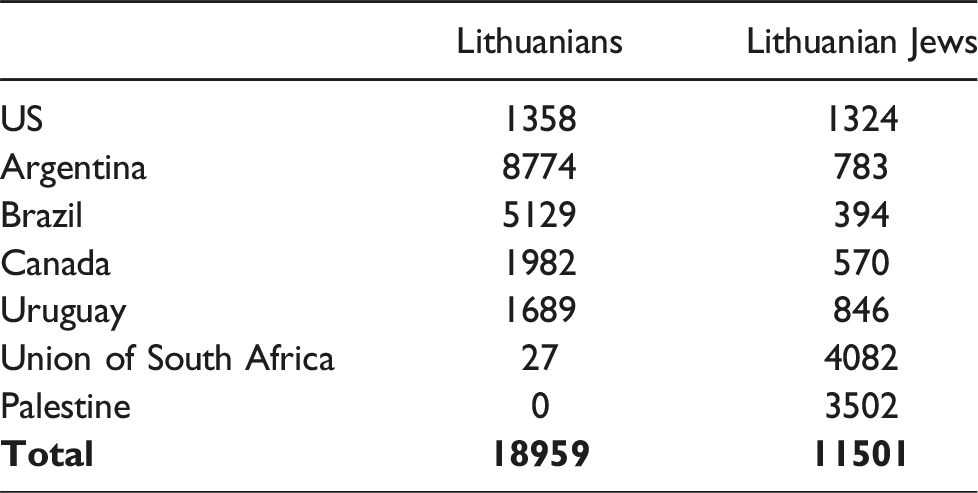
For example, between 1928 and 1939, 1,358 Jewish people and 1,3724 Lithuanians emigrated to the U.S. 1,689 Lithuanians and 846 Jews emigrated to Uruguay. This proves that Jewish migration to countries beyond South Africa and Palestine was popular. Once again, we must bear in mind that Jews were far more likely to emigrate than their non-Jewish peers—Jews constituting 34% of all emigrants from Lithuania even though they were only 7% of the country’s population. During the interwar years, additional countries that attracted Lithuanian migration including Brazil and Argentina—Lithuanian Jews represented 20% of all Lithuanian emigration to South American countries. South Africa- 4,002, and Palestine- 3,502 (Lithuanian Statistic Annual, 1940). In the same period of 1929–1939, around 27 ethnic Lithuanians emigrated to the Union of South Africa and none to Palestine.
Why do emigration statistics matter when discussing connections between Lithuanian Jewish emigration and the Lithuanian government? The size of Lithuanian Jewish emigration is clearly related to the Lithuanian government’s intention to create connections and networks to foster better relations with communities abroad. It was in the government’s interest for these new emigration populations to maintain and never lose their “Lithuanian identity.” That is why the government directed their focus to the new emigration populations outside of Lithuania or Lithuanian communities that moved away during the 19th century.
Were there diaspora politics in Lithuania between 1918 and 1940?
State-diaspora policy is a targeted activity in various areas of state management, including interests of specific diaspora groups, their satisfaction, and their alignment with the country’s priorities. Researcher Vida Bagdonavičienė (2012, p. 5) stated that diaspora policy in Lithuania was re-started after 1990. However, the diaspora policy of the post-Soviet Lithuanian state and its relations with compatriots living abroad was not a new phenomenon. Instead, it has deep historical origins formed from the 1918–1940 emigration period. Diaspora policy, like other sectors of the country’s development, was created spontaneously in response to emerging situations, not through intentional planning.
The concept of diaspora policy did not exist during the interwar period. Instead, it is only now being conceptualized as a branch of foreign policy in Lithuania. It is important to note opposite diaspora policy process related to immigrant into host-countries. According Gabriel Sheffer (2003) until the late 20th century, wherever possible, and particularly when physical appearance, basic mores, innate habits, and linguistic proficiency permitted, many members of such emigrant groups tried hard to conceal their ethno-national origins. Furthermore, they were inclined to minimize the importance of their contacts with their countries of origin (usually, and hereafter, termed homelands), and they did not publicize their membership in organizations serving their groups and their homelands. Researching the interwar emigration process creates an opportunity to raise the question: what principles did the interwar diplomatic institutions implement to address Lithuanians and Lithuanian Jewish people abroad? After conducting qualitative research, the dimensions of diaspora policy can be separated into the following categories: economic connections—representations of Lithuanians’ economic interests; cultural networks—promotion of cultural ties; political connections—organization of political influence.
Several key dates distinguish the use of these connections in Lithuanian and Jewish emigration processes. An important factor was the founding of the Ministry of Jewish Affairs of the Republic of Lithuania in 1919, and establishment of Jewish national autonomy in 1920 (Zalkin, 2012). These formations provided greater opportunities for political action during the interwar period for the Lithuanian Jewish community in Lithuania and abroad. Shortly after 1926 when authoritarian rule was introduced and Jewish national autonomy was abolished in 1925, Lithuanian Jews and Lithuanians abroad began distancing themselves from the Lithuanian state and political circles (Aleksandravičius, 2013). Indeed the abolition of the network of Jewish schools, Ministry of Jewish Affairs and national autonomy further motivated Jewish communities to leave Lithuania. In the context of international Lithuanization, compulsory teaching of the Lithuanian language to ethnic minorities in Lithuania is understood to have had a very negative impact on connections between Lithuanians and Jews (Casper, 2019). Circling back to the questions of this research—how did these changing policies affect the relationship between Lithuanian Jewish communities abroad and the Lithuanian government?
As citizens of the same country, Lithuanians and Lithuanian Jews formed separate communities abroad by creating their own rich cultural heritage through community centers. Once the Lithuanian government realized the importance of emigrants in the 1930s, diplomatic institutions such as embassies and other diplomatic missions were established. The activities of diplomatic missions aimed at both Lithuanian and Lithuanian-Jewish citizens of the diaspora should have been the same on a theoretical and even practical level. But it is difficult to establish this because research on the migration of Lithuanians and Lithuanian Jews remains thematically divided. Examinations of diplomatic sources instead reveal that the Lithuanian government tried to make connections with Lithuanian Jews. It is difficult to determine from the personal accounts of oral histories whether they interacted with, or were involved in, these state activities. However, that is an added benefit when researching different personal documents. It sheds light on whether these government networks were authentically received and used by Lithuanian Jewish emigrés or whether these attempted networks were the product of one-sided governmental intentions and interventions.
Economic connections
Previous historiographical analysis has investigated the economic support the Lithuanian state accumulated from nineteenth-century Lithuanian Diaspora policy (Eidintas, 1993). Sociologists Fiona B Adamson and Gerasimos Tsourapas (2018) argues that in some cases, the state may have institutionalized diaspora engagement policies in order to promote home country economic development and attract more investment. As for the interwar Lithuanian Jewish emigrants, various diaspora organizations were established for this purpose.
In 1933 the Consul of Lithuania stationed in South Africa, Karolis Račkauskas Vairas, sent a report to the Minister for Foreign Affairs, D. Zaunius. He stated that, “there are two organizations of emigrants from Lithuania, which are of Lithuanian origin and have a similar title.” It can be identified that two views of two different organizations were emerging. The Lithuanian Society of South Africa did not receive much attention as it was not very active (LCVA f. 383, ap. 7 b. 1274, l. 6). A completely different viewpoint emerged towards the Lithuanian Association of South Africa. Furthermore, most of the involvement and members of the Lithuanian Association were Lithuanian Jews. The Consul recognizes the organization’s positive impact both intellectually and financially. The letter from the Consul describes and praises the organization’s establishment of trade relations with Lithuanian companies such as “Grybas” [Mushroom].
It is notable that in this case, the Consul perceived Lithuanian Jewish emigrants as more Lithuanian than Lithuanians themselves. This is typical when addressing Lithuanian Jewish emigrants living in South Africa and can be attributed to the small number of ethnic Lithuanians living in South Africa at the time. In this case, it was useful for Lithuanian diplomatic institutions to establish relations with Lithuanian Jews living in South Africa. These Jews were establishing beneficial social positions (Skirius, 2012). The Jewish community in Lithuania had many members who were involved in trade between South Africa and Lithuania. This is evident from the economic value and interest that these connections provided. For example, in 1939 the South African Lithuanian Culture Society was created. Although the name of the society suggests that it is a cultural society, its main goal was the opposite: “By supporting Lithuania, [the society] would contribute to the establishment of commercial relations between South Africa and Lithuania, (Pasaulio lietuvis, 1939, Nr.14).” The society was initiated by Lithuanian general Vladislovos Nagius–Nagevičius. According to his travel memoirs and official paperwork, the vast majority of the society’s members were Jewish. Oral history testimonies, such as the one given by Osher Ruttenberg in 1980 to the KSC, reveal that many people in the Lithuanian Jewish community knew someone who was involved in this trading business. Italian diaspora researcher Mark I. Choate (2008) identified impact of Italian emigration, asserting that each community of Italian immigrants in foreign lands formed an island where the Italian government, through its consuls and other less formal channels, sought to promote Italian nationalism, culture, and language and strengthen economics. Some similarities can be indicated in the Lithuanian Jewish emigration case, but it is related more to those emigrants who show intentions to connect with the Lithuania as a homeland.
As for South American countries, there is no significant activity of diplomatic missions interested in the foreign economic activity of Lithuanian Jews. The annual report of the Consul in São Paulo in 1933 describes the economic situation of Lithuanian citizens as follows: “absolutely no one has died of hunger and is not dying” (LCVA F. 383 ap. 7 b. 1420). Overall, the report concluded that if there was an opportunity to return to Lithuania, not a single Lithuanian would use the opportunity. It reads, “There are many people who want to buy land here and engage in agriculture, but among them there are many bright hopes for the future, but… they don’t have money” (LCVA F. 383 ap. 7 b. 1420). Most economic migrants that relocated to South American countries were poorly educated and the collective goal was to earn money. As a result, there was a tendency within the government to expect economic benefits from Lithuanian communities who came from a higher social stratum. Since the Lithuanian state did not have high economic expectations for Lithuanian communities throughout the 1920s–30s, it was also not expected from Lithuanian Jews in South America.
The features of Lithuania’s policy regarding economic relations with Lithuanian citizens in the United States is observed in the activities of Lithuanian delegations and representatives. Lithuanian diplomat K. Balutis led the initiative to establish contacts with all emigrants in the U.S.—Lithuanian and Jewish alike. For example, he noted in a letter to both the Prime Minister and the Ministry of Foreign Affairs that he attended a conference of the Lithuanian Jewish Federation in 1928. During his visit he met with Lithuanian Jewish emigrants, some of whom were wealthy and had influential acquaintances among U.S. politicians. One of them was E.M. Chase who in 1928 donated $100,000 to the education of Lithuanian Jewish youth. However, after the conference, Chase donated an additional $25,000 to Jewish schools in Lithuania (MS-2, Box 11, Folder 5). Balutis also hinted that he would try to maintain closer relations with E.M. Chase and with other affluent members of the Jewish community.
Various personal documents indicate the importance of these economic networks on a personal level. Letters to the Lithuanian Consulate in the U.S. reveal many applications from Lithuanian Jews asking for economic help to help them establish businesses in the U.S. For example, one businessman from Prienai, (Lithuania) applied to the Consul to the US to export midus (mead) from Lithuania. He stated that many emigrant Jews would enjoy this drink which referred to the old Lithuania times of the Vilna Gaon. (MS-2, Box 11, Folder 5). The Jewish community in Lithuania also wanted to connect to emigrant communities across the U.S. to establish various businesses. It is crucial to mention the re-migration process once again to Lithuania. Short re-migration processes were popular among Lithuanian Jews which also acted as international business trips. One woman recounted how her father came back to Lithuania after World War I to visit his family while making new connections for his business in the U.S. (LCVA 1230, ap. 1. b. 3).
There are various economic reasons related to re-migration. For example, one man returned from the U.S. because his father had died in Lithuania and left his property to the woman he was living with. The story recounts a dramatic episode as the father never divorced the man’s mother, who at that time was living in the U.S. His son therefore returned to Lithuania to look for justice and claim his father’s real estate, resulting in him remaining in Lithuania for two years. (LCVA 1230, ap. 1. b. 7). There are many similar accounts, albeit not as scandalous, in applications to extend a visa to stay in Lithuania. Oral history testimonies and foreign passport files identify that people also returned to Lithuania for business ventures from South Africa and Australia. Thus, their connections were mostly related to pre-established Jewish communities throughout Lithuania and not with government-established connections in the new host-countries.
Economic connections related to Lithuanian Jewish communities in Palestine were very active at that time. By 1935, approximately 18,000 Lithuanian Jews had already emigrated to Palestine and were living there (Atamukas, pp. 63–64) The number also includes Lithuanian emigrés from the 19th century. Many Lithuanian Jewish emigrés also pursued establishing economic relations with Palestine. The 1935 Lithuanian Consul report stated that there were so many Lithuanian Jewish businesses in Palestine that it was possible to communicate in Lithuanian. Indeed, a number of Lithuanian products were exported to Palestine from agricultural “Pienocentas” [Milk Centre], “Maistas” [Food], and “Lietūkis” [Lithfarm] companies. Low import taxes on agricultural products to Palestine additionally encouraged the selling and exportation of Lithuanian goods to Palestine (LCVA. F. 3283. Ap. 7. B. 1659. L. 6). This is witnessed in foreign passport files issued to Jewish people who were visiting Palestine frequently for two-to-three-month periods. In their passports, these visits were recorded in the applications as “for business purposes” (LCVA, 377, ap. 2 b. 84). In the education/occupation section of the passport, it stated that the persons were traders or merchants. Trade relations between emigrants and Lithuania are additionally validated by the establishment of the Bank of Lithuanian Emigrants in Tel-Aviv in 1935 (Apžvalga, 1935). The purpose of the bank was to support trade relations between Lithuania and Palestine. Oral history sources also show a trend of many individuals pursuing and continuing to travel to Palestine for trade matters (Shemshihu Spivack interview, 1995). For example, the Peis brothers, who immigrated to Palestine from Lithuania in 1934, were offered within a year to be “Pieno centras” [Milk Centre] representatives in Palestine. Furthermore, in a letter to the Ministry of Foreign Affairs, the Consul General stated: “when introducing our butter to the market, the consulate received very active support from Lithuanian Jews, who, as if in an organized way, each demanded Lithuanian butter from their grocer in Palestine.” (LCVA f. 383 ap 7 b. 1659). There are many more examples of economic connections between Lithuania and the emigrant Jewish community that further reveal the existence of reciprocal trade exports and imports between Palestine and Lithuania.
Cultural connections
Migration diplomacy, which often relies on state-diaspora networks, is a common tool implemented by states to achieve specific goals such as strengthening their economic interests through soft power. Referring back to Vida Bagdonavičienė’s research (2012) on the formation of diaspora policy in Lithuania, she hypothesizes that Lithuania’s development of diaspora policy post-1990 stems from interwar Lithuania. In accordance with diaspora policy, this meant strengthening national identity, providing care and support to those who left, prioritizing Lithuanian education, and organizing cultural and sporting events abroad.
The goal of interwar diplomatic institutions was to implement national identity initiatives by establishing schools and organizing excursions to Lithuania. The goals of the Society for Lithuanians Abroad, established in 1935, reflect the importance of fostering Lithuanian culture in the new host-countries (Pasaulio lietuvis, 1937). “Cultivation of culture,” written in the society’s goals, mostly refers to ethnic Lithuanians. Correspondence of Minister P. Aukštuolis stated that: “The biggest concern of the [Lithuanian] union is to awaken the feelings of the homeland, to instill love of the homeland and to raise our young generation to be good Lithuanians…” For instance, Lithuanian organizations established in Brazil were primarily Catholic. The memoirs of Aukštuolis state that: “… Lithuanian Jews living there, we with my wife were very welcomed at their house” (LCVA f. 383, ap. 7, b. 1646, 1935). Because documents related to the Jewish community in South America have yet to be discovered, it can be concluded for now that most intentions to strengthen cultural ties with emigrant Lithuanians had no intentions to connect or involve Jewish communities. This is observed through the inclusion of Catholicism as a core signifier of Lithuanian culture. It is worth to mention Mark Choate study (2008) again where he argues the Catholic Church, which was hostile to the Italian state, actively sought to preserve Italian identity among emigrants. The similar case with ethnic Lithuanians. In terms of Lithuanian Jewish emigrants, the community in South America was smaller than in USA or Union of South Africa and definitely not connected with the Catholicism. That’s way Lithuanian diaspora policy was not active on Jewish community in South America. On the other hand, a striking example is the emigration of the artist Lasar Segal to Argentina in 1927. During the trip, he recorded the good experiences of emigrating together with Lithuanian friends (Petrauskaitė, 2018). Examining the historiography and sources, it is possible to identify that interwar cultural relations between Jewish emigrants from Lithuania and the state were not widely fostered. However, there were some individual relations that developed in South American countries. All this is closely related to the fact that the ethnic Lithuanian diaspora itself was divided politically. The lack of connections is also reinforced by the reality that many interwar Jewish emigrants to South America were from small shtetls. Accordingly, many did not even know the Lithuanian language, and thus there was no need to connect or interact with Lithuania.
However, Lithuanian emigrants in the United States possessed more individuality in their cultural life and expression. This can be explained in two ways. First, Lithuanian emigrants to the U.S. during 1918–1940 were more highly educated. Secondly, the Lithuanian diaspora in the U.S. had already been established by the interwar period from 19th century emigration. This differs from emigration to South America, which only began in the 20th century. In the interwar period, Lithuanians in the U.S. also faced different challenges. In an article titled “Lithuanians, don’t get out of the way”, J. Sališkis stated that “it is necessary to stop the assimilation of Lithuanians, because people are too used to living the American life, this nation may disappear” (Pasaulio lietuvis, 1939, pp. 289–290). Additionally, Consul Balutis mentioned in a report the necessity for planned excursions and trips to Lithuania from the U.S. The report articulates: “This year, as I have heard, many Lithuanians are preparing to go to Lithuania. We should take advantage of this opportunity by organizing public concerts and entertaining excursions for them because they, having come from Lithuania full of romanticism to the materialistic America, are spreading the national idea among their own” (LCVA f. 656, ap. 1, b. 593, 1935). Indeed, a number of excursions were organized to Lithuania, not only from the U.S., but also from Palestine and other European countries. Oral history testimonies record that emigrants would return to Lithuania for holidays even from South Africa. Some also visited Lithuania to find spouses. For example, in 1905 Lewis Fridlander returned to Lithuania to marry Sara Karabelnik and take her back with him to South Africa (ANU, 1909, No. 14767). Many Jewish Lithuanians applied for visas to Lithuania to spend time with families, go on holiday to Lithuania resorts, etc. In oral history one interviewee recounted, “The first year I got married I went home to see my family, my father and my mother and one sister not married yet. We first went to England for six weeks before we went to Lithuania” (Oral history of M. Emdin, KSC, ZA UCT BC949_B_A333, 1980). This quote once again illustrates that these vacations to Europe were common. For example, in 1937 two excursions were organized to Lithuania from the U.S. Participants were Lithuanians and members of the Jewish community. During the excursions, compatriots were even welcomed back by President A. Smetona. The articles mentioning the excursions detail a propagandistic initiative to provide the visitors with an idealized Lithuania, focusing on its nature, history, and culture (LCVA f. 383, ap. 7. B. 1517).
The cultural connection between Lithuanian Jews and the Lithuanian government in the U.S. varied over time. In a report to the Minister for Foreign Affairs in 1921, a Lithuanian representative in the U.S. contended: “Jewish groups began to take roots all over America: there are Kelmė, Šeduva, Kaunas etc. Communities from Lithuania. However, they did not dare to call themselves Lithuanian Jews”. The diplomat continued his observation of the Jewish emigrés by articulating their attitudes towards Lithuania. He wrote, “there are quite a few likable passionate idealists who would like to help Lithuania as a state” (Letter too Ministry of Foreign Affairs, f. 656, ap. 5, b. 3, 1921). It was also stated that there are a considerable number of emigrants with socialist views. However, certain sources show a particularly favorable attitude towards Lithuanian Jews who nurture Lithuanian traditions. In the article “With Lithuanian Jews in North America,” Journalist V. Uždavinys mentioned: “It was big news that organized Jews from Lithuania started showing up at Lithuanian picnics in Chicago.” (Pasaulio lietuvis, 1938). In 1928, the “Federation of Lithuanian Jews in America” was founded. The Federation aimed to represent Lithuanian Jews to the Lithuanian Government. Their documents contained several correspondences between the President of the Federation and Minister K. Balutis (LCVA f 656, ap. 1, b. 593, l). The positive tone of these correspondences with the Ministry of Foreign Affairs suggests that Lithuanian Jews in the U.S. were evaluated positively. In one letter to the Ministry of Foreign Affairs, K. Baltutis mentioned: “From private conversations, I take away that there are many among them, so to speak, that are more Lithuanian than the ethnic Lithuanians themselves” (656, ap. 1, b. 593. L. 1). However, this could be an idealized perspective. None of the personal documents from Jewish emigrants indicated cultural connections between the Lithuanian state and those who emigrated. From the memoirs, one can just see the idealized nature of Lithuania, reminiscences of the shtetls, rich Yiddish culture, and its preservation in different communities. The personal accounts are related to remembering Lithuania, not creating cultural connections with the state.
In terms of cultural connections in Palestine, personal and government levels can be identified. For example, on February 16, 1933 the solemn event “Lithuanian emigrants’ evening” was organized, where Jews who emigrated from Lithuania celebrated the 15th anniversary of Lithuania’s independence. In a 1935 report to the Ministry of Foreign Affairs, Consul Rachmelovičius wrote: “The Lithuanian diaspora in Palestine is increasing and it would be wrong to think that the Jews who left for Palestine will forget Lithuania. Here we have to notice a very interesting phenomenon: people who did not feel any connection with their homeland in Lithuania, when they settled in Palestine, they just feel that they are more Lithuanian than ever” (LCVA f. 383. ap. 7, b.1386., l. 7). The extent to which the Jewish community that emigrated to Palestine identified itself through cultural ties is complicated. It can be seen from oral histories that Jewish community from Lithuania did not identify themselves as Lithuanians in Palestine. However, it is a logical assumption that many began to identify themselves with Lithuania only after immigrating because of the different backgrounds of immigrated communities. Over the years, an extremely large flow of people immigrated to the country not only from Eastern European countries but also from African countries. According to official figures, 367,845 Jews and 33,304 non-Jews immigrated legally between 1920 and 1945 to Palestine (Palestine:1946. p. 185.). Therefore, communities were looking for identity, a stable position and confirmation that they could associate with their homeland.
Political connections
The identification of Lithuanian Jews living in the U.S. is extremely important in the case of the Vilnius region. From 1920 to 1939 Vilnius was part of Poland. In the aforementioned V. Uždavinys “With Lithuanian Jews in North America,” recorded: “Showing their support for Lithuania, American Jews organized themselves into the Lithuanian Jewish Society in America. I had to participate in their big meeting, where a lot of beautiful sympathies for Lithuania were expressed” (Pasaulio lietuvis, 1938). A Jewish member of the Lithuanian Jewish Society from the Vilnius region also recorded his disappointment regarding the Polish occupation. They wrote that it is impossible to compare life in occupied Vilnius with what it was in “Free Lithuania.” Many similar sentiments can be found in the LCVA file “Reports on the situation of Jews in Lithuania and the Vilnius region” (LCVA F. 656, ap. 5, b. 3. L. 1.12).
The file contains various correspondences between diplomats K. Balutis, P. Aukštuolis and Lithuanian Jews residing in America about the situation of Jews in the Vilnius region. It can be concluded that diplomatic institutions sought international attention and political benefits by identifying Jewish Lithuanians abroad. Diaspora can be a force/power representing international political interests of the country (Čiubrinskas, Kuznecovienė, 2008). In this case, the negative opinion of Lithuanian Jews living in the United States regarding the Polish occupation of the Vilnius region was useful for Lithuanian diplomatic institutions. They could use this problem of the Vilnius region to garner attention in the international arena.
Regarding a previously mentioned letter to the Ministry of Foreign Affairs, K. Balutis wrote: “This new organization [Federation of Lithuanian Jews in America], in my opinion, will be able to do a lot of useful things … and the most important thing, it seems to me, is that it will be possible to prevent anti-Lithuanian propaganda, which now appears from time to time” (LCVA F. 656, ap. 1, b. 593. L. 1). In one of the documents to the Ministry of Foreign Affairs in 1933, K. Balutis pointed out the importance of Lithuanian Jews living in the U.S. They helped with recognizing Lithuanian statehood in 1918. For instance, the work of one Lithuanian Jewish employee at the White House led to a quicker legitimization of Lithuanian statehood on an international scale.
Support on the issue of emigration was important within the Lithuanian Jewish emigré community. For example in 1935, the Haschara Organization in Lithuania and the American Zionist Organization resolved the complaint of emigrant Johan B. Wise, who lived in New York. According to Wise, people who participated in a kibbutz in Lithuania were fed pork and forced to work on Shabbat. Other Lithuanian Jews reported similar experiences, such as a rabbi whose niece also witnessed this before they were able to bring her to the U.S. (CZA, 1935). The complaint also reached Lithuanian state institutions. International political connections can also be seen from the perspective of the Zionist organizations in 1933 (LCVA F. 656, ap. 5, b. 3. L. 1.12). The Ministry of Foreign Affairs of Lithuania received at least three appeals from organizations (with hundreds of signatures from the community) drawing attention to the British policy on immigration to Palestine (LCVA F. 656, ap. 5, b. 3. L. 1.12). The applicants were unhappy that the quotas for immigrants to Palestine had been reduced. The Lithuanian government also received letters from the Lithuanian Jewish Federation in 1937. These letters detail the issue of the Palestinian territory and “advise” what position Lithuania should take on this issue. Oral history sources from Lithuanian Jews who emigrated to the U.S., Union of South Africa or Palestine expressed sentiments of disappointment towards Lithuania and the country’s failure to manifest into something successful or economically stable. People were also disappointed about anti-Semitic tendencies in Lithuania. Such thoughts were expressed in almost every person’s memoir. It should be noted that most of these oral history testimonies were collected in the 1980s. As a result, the collective trauma of the Holocaust inevitably shaped the perceptions and memories many Lithuanian Jews had of interwar Lithuania. Additionally, official documents contain many correspondences between Lithuanian diplomatic institutions and Jewish diaspora organizations about the anti-Semitic events in Germany in 1930s.
Conclusions
Through cultural, economic and political connections this article reveals Jewish emigration process, which shaped community life in Lithuania and abroad. This research initially intended to show the economic, cultural and political connections between the Lithuanian state and Lithuanian Jewish emigrés. However, personal and governmental attitudes show different perspectives in the communities abroad. Familial connections indicate that there were instances of remigration and short trips to Lithuania to visit family and establish businesses. Thus, it allows to reframe the myth that emigrated Jews never came back to Lithuania. Governmental connections with Jewish emigres, however, shed light on different perspectives in communities abroad. In some cases, such as Palestine and South Africa, Jews were perceived more as ethnic Lithuanian emigrants than members of a Lithuanian minority group, which was more typical in Lithuania. From 1918 to 1940, the Lithuanian government endeavored to establish connections with Lithuanian Jewish communities outside the country the main interest was US, Palestine and Union of South Africa where the biggest Lithuanian Jewish communities lived. These connections were primarily focused on economic benefits, with Lithuania seeking financial assistance from Jewish emigrants in exchange for aid in establishing businesses in Lithuania or abroad. The source material shows that many of the cultural and political connections appear more artificial in terms of Lithuanian government intentions. Personal involvement of Jewish community abroad was important for successful diaspora policy implementation. From the government’s perspective, it was more important to show and convince Lithuanian Jewish emigrants of an idealized image of Lithuania by enhancing loyalty for the home country rather than strengthen their so-called “Lithuanian identity.”
Footnotes
Declaration of conflicting interests
The author(s) declared no potential conflicts of interest with respect to the research, authorship, and/or publication of this article.
Funding
The author(s) received no financial support for the research, authorship, and/or publication of this article.
Author biography