



Abstract
The purpose of this article is to update the Intergovernmental Science-Policy Platform on Biodiversity and Ecosystem Services (IPBES) framework to reflect resource understandings arising within historically non-sedentary societies. This article examines how Eurasia’s unique development history based on livestock cultivation beget modes of understanding predicated in mobile life strategies and pastoral/nomadic interactions with the Eurasian geography. In contrast, prevailing resource ideas emphasize land relation histories of sedentary peoples. Using the IPBES framework, this article takes a novel approach to show how food and food customs reflect embedded resource understandings relevant to non-sedentary peoples. Empirical findings from sturgeon aquaculture facilities in the Caspian states of Azerbaijan, Kazakhstan, and Turkmenistan demonstrates sturgeon meat in customary cuisine connects Eurasian peoples to land knowledge instilled with its own resource meanings. This article updates the IPBES framework to incorporate the livestock element as the integrative mechanism giving the method for land use and Eurasia’s own resource concept. Incorporating the livestock variable within the IPBES framework to express the value accorded to mobility better represents the diversity of resource meaning-making processes. It also makes possible a consideration for how food and food customs enabling narrative transmit land appreciations and knowledges not adequately captured by conventional resource analyses.
Introduction
Understandings for what constitutes a ‘resource’ coalesce around narrations and particular conceptual models for interpretation. The IPBES framework seeks to address conventional sustainability discourse and conceptions of the natural world which overlook or omit diverse cultural understandings and interpretations (Pascual et al., 2017). The notion of ‘resource’ constitutes one of the most widespread concepts for describing human–environment relations. Employed for a variety of ecosystem assessments, conservation management schemes, and for orienting policy-making, the notion of ‘resource’ is seen as embodying the organizing principles and knowledges for human interactions with the natural world. However, area and critical studies increasingly recognize there is a need to consider a broader range of values, knowledge processes, and worldviews relevant to the resource notion (Banerjee, 2003; Chandler & Reid, 2020; Descola, 2012; Rivera, 2019; Sies, 2014). Many critiques of the resource concept stem from the assumption that meaning-making processes and understandings of what constitutes a ‘resource’ rely on abstracted notions or understandings of the environment (Descola, 2012). That is, decoupling a resource entity from the social context in which it acquires value. Doing so introduces biases and results in explanations which do not fully capture what gives the entity value.
Rather than focusing on specific outcomes and effects from resource understandings to define what a resource is explicitly, this research built from the development conditions and geographic realities of the Eurasian region to examine the processes by which a resource is made or acquires meaning. This study treats the Caspian as physically part of a larger integrated Eurasian system and uses the unit of culture to connect the nation-states of Azerbaijan, Kazakhstan, and Turkmenistan. Conditioned by the biophysical realities of Eurasia’s geography, which were not conducive to intensive crop cultivation, this research took culture as defined by endogenous understandings of ‘those who farm (historically) versus those who do not’ (Christian, 1994; Krader, 1963; Linseele, 2010; Montero et al., 2009; Spooner, 1973). The term ‘culture’ in this study builds from anthropological definitions where culture is treated as an inherited system of knowledge, beliefs, laws, and habits (Bartfield, 1997; Lewis, 1999; Ren, 2012). The biophysical characteristics of Eurasia’s geography are then incorporated into the definition in order to account for the full array of the relationships between Eurasian peoples and the land upon which they have lived, worked, derived meaning and sustenance, and recorded their history (Sies, 2014).
Eurasia remains notably understudied relative to other area studies in western academia. Indeed, a considerable amount of scholarship on the region’s history engages with livestock in order to analyse broader facets of the Eurasian system. This study takes a novel entry point by considering the role of fish, specifically sturgeon, to map the qualities and processes which give a resource meaning in the region. To do so, this article builds from empirical data collected from fieldwork trips to principal sturgeon aquaculture facilities in Azerbaijan, Kazakhstan, and Turkmenistan. These visits collectively revealed an industry production trend moving to produce sturgeon meat as opposed to caviar. As a food source with a known history of use and appreciation in the region, this industry shift towards sturgeon meat is significant insofar as preserving values and culturally relevant land use understandings.
Historical Backdrop
Eurasia has supported a diverse history of nomadic, semi-sedentary, and sedentary peoples (Kalra, 2022). While categorical differences between nomadism, nomadic-pastoralism, semi-pastoralism, and pastoralism have sustained an array of scholarly discussions, this study uses such terms to emphasize the presence of life strategies predicated in some form of mobility-based in Eurasia (Frachetti, 2009a). The archaeological and historic records show there was significant investment in livestock and mobility strategies in Eurasia (Frachetti, 2009b; Honeychurch, 2014; Scott, 2017; Spengler et al., 2013). The historically nomadic economy in Eurasia was based on multispecies breeding of livestock, both small (sheep and goats) and large (horses, cattle, and camels) (Masanov, 1995). 1 Although many pastoral peoples (past and present) cultivated crops such as millet, barley, and wheat, doing so did not lead to sedentism or fixed agriculture, and crops remained second to a livestock-based system (Honeychurch, 2014; Khazanov, 1984; Scott, 2017; Spengler et al., 2013). Pastoral migrations were timed to coincide with the most favourable conditions (vegetative and hydrologic) for livestock grazing. Thus, the needs of each livestock herd (species ratio, age, and sex structure) interacting with ever-changing pasture conditions and human labour availabilities resulted in a dynamic system whereby needs and capacities had to be evaluated moment to moment (Masanov, 1995). Rather than amounting to a limitation, scholars have noted how this gave rise to ‘multi-resource’ or ‘multi-purpose’ nomadism such that the ability to specialize in change was produced (Salzman, 1972, p. 62; Scott, 2017). Often described as adaptiveness, mobile people and herds could distribute basic resource requirements across multiple food webs to make use of a wider array of availabilities and natural productivities within ecosystems (Scott, 2017, p. 63).
Eurasia’s strategy of specializing in change went further than simply adapting to weather the circumstances or to develop livestock production capacities exclusively. It endowed the Eurasian system with a distinct perspective and relationship with change. Adjusting according to ever-varying conditions, this specialization became a dynamic process of identifying the relevant knowledge and framework for the circumstances (Honeychurch, 2014). The capacities required to enable this change specialization strategy were mapped into Eurasia’s system such that culture could retain the existing while incorporating new knowledge to enact under appropriate conditions (Salzman, 1978). Across a vast history of empires, trade networks, eventual industrialization and mobile peoples, the knowledge and skills cultivated over thousands of years of connectivity and interactions to successfully inhabit the space of Eurasia resulted in a distinct cultural system. With the skills and knowledge embedded in culture made more productive in light of change, the movement and admixing of peoples across natural events and environmental variability endowed Eurasia with a proven history of resilience (Kalra, 2022). By endowing Eurasian peoples with proven capacities for survival and perseverance, this gave reason to continue to invest in culture.
Enduring for millennia, the capacities of Eurasian peoples to navigate change (social and ecological) demonstrates a proven history of land use principles and knowledge (Manzano et al., 2021). As historically oral peoples, there was little function for abstracting knowledge such that it could be represented textually. Instead, the repository of these land understandings embodied as knowledge came to reside in diverse cultural practices and life habits (Alexander, 2006). This gives Eurasian peoples a knowledge archive and development history record with its own land ethics and strategies for inhabiting a geography which are distinct from those arising under sedentary societies.
This study treats food as an integral component and means of transmitting Eurasian people’s knowledge and history. In demonstrating how food enables narrative to preserve a map of culture, the archive can be shown to remain in lived form to orient and to give meaning to sturgeon aquaculture activities. Relying on primarily textual or material sources to verify histories of knowledge, many contemporary analyses of the region overlook or misconstrue Eurasia’s land understandings and knowledge ways. This results in external ideas and concepts for what counts as a repository of culture or means of knowledge transmission becoming privileged. Although the Soviet era and current nation-state makeup have resulted in two instances of systemic change in Eurasia, this study found that by approaching the region’s knowledge archive through food, collective understandings of livestock-derived land knowledge persists in adapted form in the region today.
Sturgeon
The object for analysing the Eurasian resource question is sturgeon fish of the Caspian Sea. The long and enduring history of appreciation of sturgeon in Eurasia makes it a relevant tool for tracing ideas pertaining to the resource concept.
Sturgeon Species of the Caspian (IUCN. 2022, 2022).
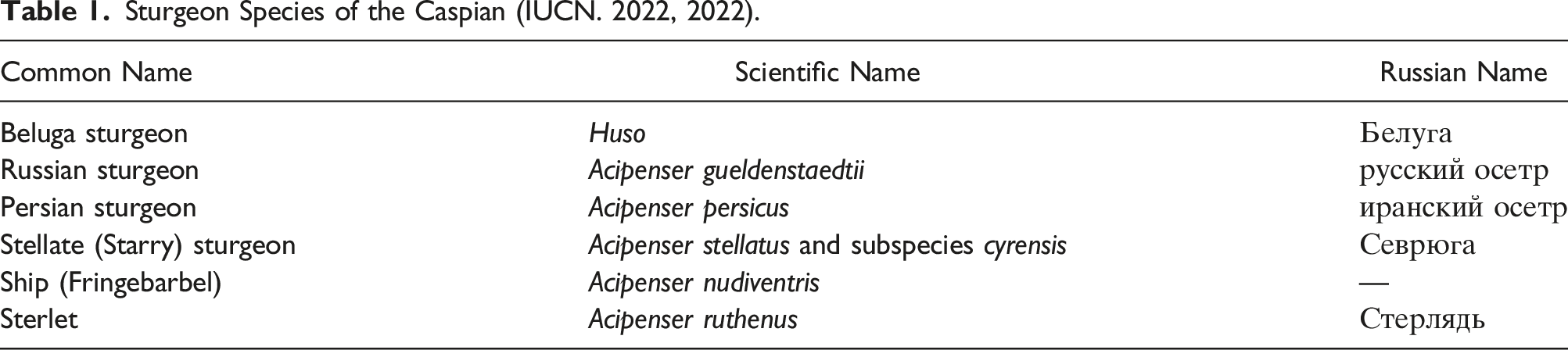
The techniques for producing sturgeon products have changed under industrial conditions. Since the end of the 20th century, sturgeon aquaculture began to substitute production from capture fisheries (Bronzi et al., 2019; Kautsky et al., 2001). The three main traded species of sturgeon are Beluga, Osietra (Russian sturgeon), and Sevruga (stellate sturgeon) (Bronzi & Rosenthal, 2014). The main processed products from sturgeon aquaculture and wild harvests are sturgeon meat – which is sold smoked, canned, or frozen – or its unfertilized roe as caviar (Bronzi et al., 2019; UNODC, 2020). Small quantities of caviar are used as ingredients in cosmetic products, such as facial creams (UNEP-WCMC, 2010).
Materials and Methods
This research undertook a seven-month ethnographic investigation with semi-structured interviews in over 12 sturgeon fish hatcheries and aquaculture facilities, in addition to related species and environmental monitoring agencies in Azerbaijan, Kazakhstan, and Turkmenistan. Visited sites were chosen specifically because of their stated role in producing Caspian sturgeon commodities, as well as their varying degrees of participation in sturgeon conservation work.
Fieldwork data was supplemented with a discourse analysis and collated literature search of the resource term published over the last decade. This allowed for relevant values and ideas discussed in conjunction with the resource notion to be mapped. The IPBES framework depiction of relationships between people and nature then was analysed alongside a thematic mapping of the resource term within the literature. This allowed for identifying conceptual gaps and assessing the extent to which prevailing resource depictions and discourse could explain resource use patterns and understandings in Eurasia.
While the IPBES framework proposes a more encompassing conceptual framework for tracing knowledge implicated in resource and sustainability ideas, the framework has been criticized for fundamentally remaining premised on a utilitarian view of nature to people (Maier & Feest, 2016) With the utilitarian perspective embedded with its own theories of value, the IPBES framework consequently can be biased against non-utilitarian and alternative cultural relationships with the natural world. The IPBES framework therefore was supplemented with an ethnography to overcome conceptual limitations by capturing respondent’s perceptions, meanings, understandings of situations which otherwise may not have been exposed through the framework (Punch, 2005, p. 168).
Integrating the IPBES framework with an ethnography, the findings from this research show how resource meanings lie in process also provided directions for future research into how resources gain meaning in cross-cultural settings. It also gives indication for developing more informed conceptual bases for Eurasia as a distinct region for future academic inquiry.
Results
Despite sweeping systemic change brought on by the dismantling of the Soviet Union, visits to all aquaculture field sites revealed an industry with modern infrastructure, scientific expertise, and market competency. Under the Soviet centrally planned economy, an extensive network of sturgeon hatchery infrastructure and research networks endowed Caspian states with technical and scientific knowhow in the sphere of sturgeon breeding and wild population management (Mamedov, 2019). Interviews with industry specialists and scientists demonstrated how these capacities continue to be leveraged under the current nation-state market system by being integrated within commercially viable business models alongside a species conservation approach which focuses on supply chains and regulatory measures (Bronzi et al., 2019; Fajardo del Castillo, 2016). Interview data also revealed the extent to which sturgeon aquaculture producers must work to remain viable under current market conditions by adopting a range of business strategies. These ranged from high volume production through increased feeding regimes for faster growth rates, to genetics research for eventual pharmaceutical application and fish feed innovation.
The reshaping of Caspian sturgeon aquaculture in favour of market demands reflected in Caspian producer business models was apparent across a range of activities. From decisions at the level of daily operations (i.e., timing and amount of feed, water temperature levels to induce multiple breeding cycles annually, breeding programmes favouring female sex ratios, and transitioning to faster growth sturgeon hybrid breeds (such as ‘Bester’ – male Beluga (Huso huso) and female Sterlet (Acipenser ruthenus) or Siberian (Acipenser baerii) with Sterlet (Acipenser ruthenus), rather than breeding native Beluga sturgeon (Huso huso).
Across all study sites, a principal concern and important area of investment were technologies for controlling water quality parameters as sturgeon are survival rates are a known challenge in artificial environments. One respondent noted:
‘Sturgeon are very sensitive fish. They are difficult to grow and cannot grow in dirty water or with varying water temperature. We keep them in the indoor facilities – not in the outdoor ponds – and their tanks are supplied only with well water so that temperatures stay between 16–18 degrees C and there are no pollutants’.
Two important industry developments increase the significance of water quality monitoring. Unlike in Soviet times, fish are kept year-round and finished in facilities rather than being released for restocking wild populations to harvest from. Second, under increased feeding regimes which result in larger amounts of waste to process, controlling water quality factors through advanced filtration systems and laboratory-based monitoring facilities becomes even more significant. While filtration systems and tank design considerations for removing waste were present under Soviet sturgeon farming, these requirements were not of a commensurate scale as those today. Senior industry specialists with experience under both the Soviet and current market system described how Soviet techniques utilized natural processes and integrated them into sturgeon-growing programmes (i.e., by releasing fish into natural waters to grow and where waste is diluted naturally). The scaling up of production within artificial environments under market settings, therefore, amounts to an increased in costs to compensate for the lack of natural factors. Ultimately, the return on investment for water quality monitoring capacities (laboratory facilities and filtration systems) reduces production costs and fish casualties, increases productivity, and equates to time savings.
The preceding description of Caspian sturgeon aquaculture based on interview data seeks to briefly illustrate changes in the region’s knowledge landscape under scaled up and industrialized conditions. Yet what makes these changes significant for the purpose of this study is considering the resulting effects from these changes. Of the 12 aquaculture facilities visited, eight were producing sturgeon meat exclusively, while the remaining four were producing caviar in addition to sturgeon meat. However, of the caviar producing farms, only one was producing caviar for human consumption. The remaining three had invested in sturgeon roe harvesting for the purposes of breeding females. Therefore, of the 12 total sites, only one currently sold caviar. The caviar from this facility was for domestic purchase, although the farm intended to export to foreign markets in 2 years after sufficient profit could be allocated for necessary international export certificates.
Collected fieldwork data revealed an overarching industry trend towards producing sturgeon meat products, rather than caviar, ultimately functions as a means for enabling culture. While economics (whether under a centrally planned or market system) are important insofar as sustaining a market, economics alone did not create the market for sturgeon meat. Instead, this relationship of culture creating the conditions of appreciation for sturgeon meat to which economics could plug into similarly is what Caspian sturgeon aquaculture producers mapped onto.
Figure 1 provides a general depiction of current overall product types from the sturgeon facilities visited during the course of this fieldwork. Sturgeon production commodity breakdown from visited farm sites. Pie chart numbers correspond to the 16 interviews conducted.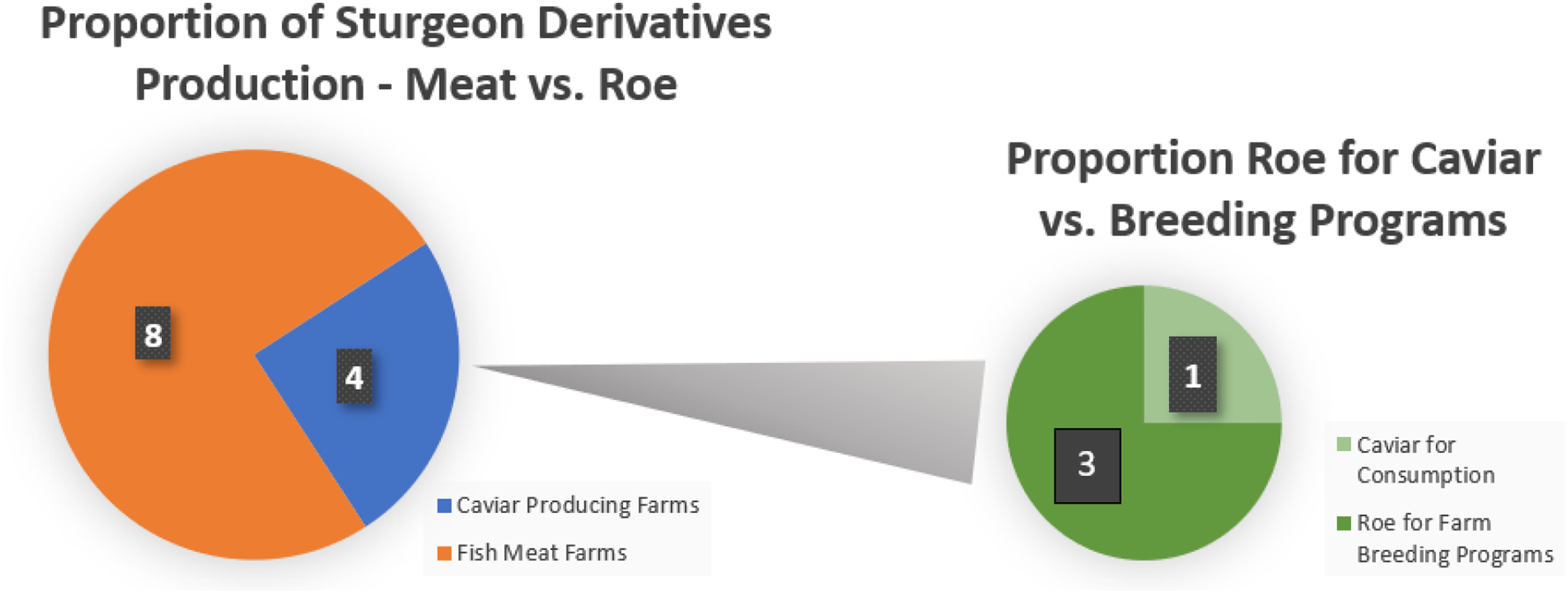
This study approached this culture enabling economics relationship as reflecting an underlying investment structure in Eurasia. Orienting the use of new industrialized techniques and knowledge according to a distinct and endogenous logic, this investment structure preserves a goal of keeping culture.
Rather than viewing these Soviet-era scientific competencies or market-oriented regulatory strategies as a sole preoccupation or goal in and of themselves, this research approached sturgeon aquaculture as embedded within a cultural system with its own history of interactions with and understandings of the land. In doing so, interview data from aquaculture specialists and empirical evidence from fish farm visits could be analysed according to the region’s history and endogenous knowledge system. From this, the results from fieldwork demonstrate aquaculture’s increasing orientation toward meat products (as opposed to caviar) as meaningful.
Discussion
In accounting for the development history of mobile peoples in Eurasia which gave rise to a particular appreciation for sturgeon meat products, the capacities and competencies in Caspian aquaculture can be seen as supplementary elements within a cultural system informed by its own values and history of land relations. This history of knowledge and values orient sturgeon aquaculture industry choices today. Not only does this history of appreciation of sturgeon within customary dishes in Eurasia generate the market for the region’s aquaculture industry today, it enables narrative. As historically oral societies, customary acts and the narration of them are vital means for knowledge transmission. The key dishes involving sturgeon meat in Eurasia are ‘Plov’ (in Azerbaijan and Turkmenistan) and ‘Beshbarmak’ in Kazakhstan depicted in Figure 2. Eurasian cultural food habits of substituting red meat for sturgeon fish when in proximity to the Caspian. Azeri and Turkomen plov are both rice-based dishes. Azeri plov typically consists of dried fruits (apricots, dates, or raisins) and chestnuts served with fresh herbs. It is often cooked in saffron, and can be encased in an egg, flour, and butter crust for special events (Gazmag). Turkomen plov can be distinguished by thinly sliced carrots and onions. Kazakh ‘Beshbarmak’ is a wheat (noodle) dish with a gravy base. It also is noted for containing potatoes, caramelized onions, and black pepper seasoning.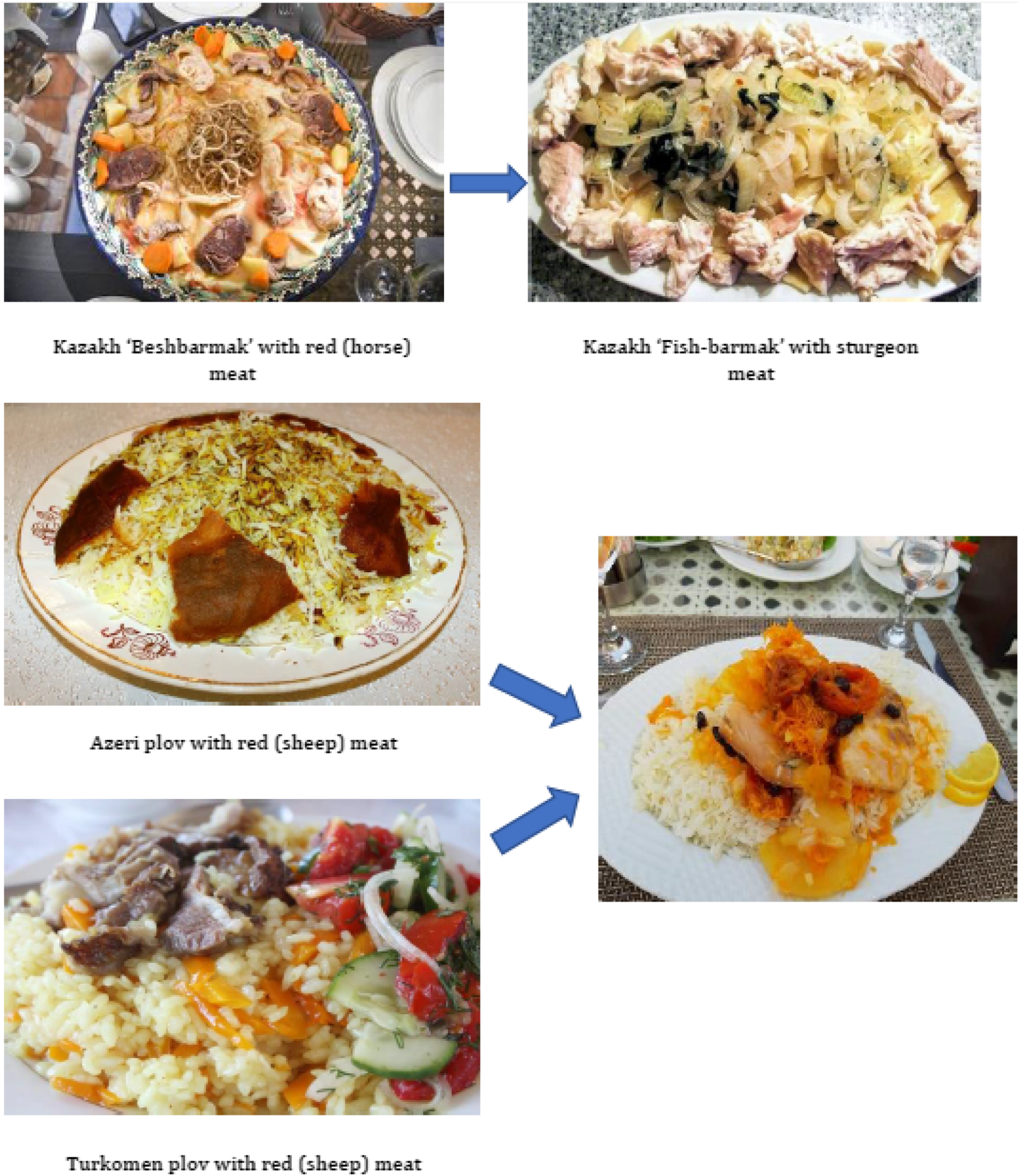
While these dishes typically consist of red meat (beef, sheep, goat, or horse in the case of Kazakhstan), there is a consistent variation where the red meat components are substituted for fish meat when in proximity to the Caspian. While there are 130 endemic fish species to Caspian, sturgeon meat specifically was the most prominent fish-based variation to these dishes (Negroni et al., 2012).
Connected by customary sturgeon meat dishes, enduring food practices preserve ways of knowing and relating to the Eurasian geography. Even if not spoken of explicitly, the consistency of sturgeon meat dishes across all sites of this study signified that its meaning was understood internally. Enduring food customs reflect a method by which the geography continues to gain meaning. Thus, with sturgeon plov and ‘fish’ barmak remaining widespread near the Caspian shores, Caspian sturgeon aquaculture producing the commodities which maintain these dishes can be seen as enabling culture.
Food gives a base of values and norms for the re-telling of a culture’s history and transmitting knowledge (Caldwell, 2002). Customary food practices point to the manners in which a landscape was related to and gained meaning. Institutions of food relations become archived in lived practices and customs. Excerpts from interviewees highlight the relevance of the region’s distinct history of relations with the land and the role of food within this development story.
‘There is a philosophy to how Kazakhs actually feel when we eat traditional foods… these feelings have become reduced or framed to make sense to modern sustainability sensibilities by explaining how things are used in terms of an individualized resource’.
More than a matter of efficiency and survival, the interviewee’s comment on the importance of sheep products highlight not only the place but the mode by which one engages with and learns the natural world (i.e., through food). The trouble is in how the conventional resource concept and discourse give a particular language and means for thinking about the environment transmitted in a certain lexicon. Despite being spoken of in terms of feelings, the sensibilities referred to in the above quote are embedded and become significant when viewed from the cultural and knowledge systems to which they are conditioned. Following on from the previous excerpt, another interviewee underscored how the context of learning about the physical environment has been radically altered in the region’s recent history.
‘We were technocrats trained as scientists. But we feel an environmental connection in our bones. It is in our genetics to have this awareness because we are nomads, but Russia took Kazakhstan and made it industrialized. When we eat sheep, for example, we even use the feces for fire fuel, the skin for clothes, and bones for soup’.
Yet, because both of these quotes are spoken of in terms of feelings, they become difficult to place within the bounds of conventional studies of ecology or sustainability theory, which rely on the scientific method and objectiveness. The idea of narration is offered in this study as a means for highlighting how the resource notion is understood and engaged across different systems. It also underscores how systems level misconceptions can result from theoretical frameworks that decontextualize social experience in one setting and recontextualize them under different conditions.
Notably understudied relative to other regions, Eurasia’s development continues to be poorly theorized. As Laumulin and Laumulin (2009) write, ‘there is not the kind of model or discourse for engaging with or capturing these kinds of [Eurasian] systemic relations, at least within the social and political sciences’ (2009, p. 69). With social theories relying on fixed and rigid social and environmental categories which build from particular systems of thought, Eurasia’s pre-theoretical reality means that emphasis must be placed on the embeddedness of social-ecological phenomena which arise within a system endowed with its own logic derived from the unique physical and geographic realities of the region.
Engaging with Eurasia’s development story demonstrates how the region’s physical geography unequivocally shaped historic interactions between land and peoples to condition a particular human–environment relationship predicated in livestock cultivation and mobile forms of social organization. Totalling a territory of eight million square miles, Eurasia comprises the world’s largest flatlands area spanning from the Black Sea to the plains of Manchuria and eastern Mongolian prairies (Sinor, 1990, p. 2). Despite considerable variety in the terrain of the geography – from coniferous forests of the taiga in the north transitioning to sparse semi-desert environments in the south to deciduous forests extending into Hungary – viewing the Eurasian landmass longitudinally reveals a considerable continuity (Taaffe, 1990, p. 20). With changes in vegetation type as the main distinguishing feature across Eurasia’s ecological zones integrated through larger climatic, soil, and water regimes, the region became connected through a shared strategy of nomadism/pastoralism. Moving across vegetation zones based on seasonal variations produced a common cultural system and set of life strategies. Rather than having a development path limited by being precluded from irrigation-based agriculture, human habitation of Eurasia advanced in spite of it. The physical environmental realities of Eurasia set in motion a particular historical development process which entailed living off animals which could metabolize the abundant grassland biomass to exploit food energy indirectly (Christian, 1994; Dahl & Hjort, 1976; Frachetti, 2009a; Spooner, 1971).
Foraging requirements and grazing styles of individual species in a herd, as well as their age with respect to the breeding cycle, designated the timing and conditions by which a pasture’s productivity could be maximized (Masanov, 1995). Migrations were timed to coincide with the most favourable conditions (vegetative and hydrologic) within the process of pasture selection (Masanov, 1995). The specific biological requirements and grazing characteristics 2 of each breed and individual in a herd meant that environmental variations could be accounted for by alterations in a herd’s species, age, and sex ratio composition. Thus, the particular needs of a herd provided the mechanisms for connecting land and people (Masanov, 1995).
Examining individual herd requirements within a general grazing calendar highlights the logic of nomad pasture techniques and the nexus between land-people-livestock. Winter rangelands historically focused on satisfying forage demand determined by the duration and extent of snow cover. As the most difficult season for livestock survival, elaborate strategies for making best use of winter pasture feed capacities according to their topography has been recorded in well-developed techniques (Masanov, 1995, p. 19). For example, sheep and goats were grazed in a series of lanes which radiated outward from watering sources to ensure sufficient forage remained available as feed would harden after the livestock had walked over top and cloven-hooved sheep would be unable to paw through (Masanov, 1995, p. 147). Amenable to grazing on rocky areas, able to dig through snow unlike other species (such as cattle), and capable of travelling tens of kilometres per day, horses could optimize pasture areas inaccessible to others (Masanov, 1995, p. 100).
The main factor in selecting summer pastures was the availability of consistent water sources. Spring and autumn pastures were located enroute from winter pastures and to summer pastures and acted as an intermediate travel bases connecting economic and ecological requirements of the nomadic economy (Adrianov, 1978). 3 In the spring, pasture selection and migrations were factored around the livestock breeding season where livestock were lactating and unable to move quickly or long distances (A. Khazanov & Pershits, 1979; Masanov, 2000; Rubel, 1969). Therefore, spring pastures were coordinated around seasonal optimizing so that herds could remain stationary for longer periods, particularly for when young were born, typically in April (Fedoseev, 1964). These elaborated techniques reflect Eurasian pastoral and nomadic understanding of environmental intricacies and well-developed strategies for making best use of natural availabilities (Radchenko, 1982).
The most time-consuming process in the warmer months was provisioning livestock with water. In summer, this could be upwards of 2–3 times a day and was very laborious as livestock needed to be watered in sequenced groups to prevent stampeding watering holes (Ischenko et al., 1928; Masanov, 1988). Artificial wells are widely documented across Eurasia as a means of supplementing natural water supplies and enabling pastures to support larger herds. 4 Water use principles mapped onto what Masanov describes as an associations-based style of relations. Because of the seasonal use of pastures, virtually no groups or communities had a monopoly on land or water. Instead, access (as a proxy of ownership) was validated through demonstrated contribution to the maintenance or upkeep of the respective land or water cycles (Pershits, 1959).
The system of seasonal rotation of pastures required residential mobility either of the whole population, or in sequences where some members travelled at different moments to attend to other elements of the nomadic system (such as supporting product production from animal derivatives, sowing of crops, etc.,) (Petrov, 1975; Tapper, 1997). With the minimum number of human groups required to meet the necessary tasks of a given herd in one moment consistently in flux, patterns of human reshuffling unfolded according to seasonal conditions. From shearing sheep, harvesting crops, supplementary food sourcing (such as fishing or hunting), to maintaining artificial water sources, the labour requirements of Eurasia’s pastoral system was possible only through the close integration between different pastoral groups (Masanov, 1995).
Accounting for how the mobility element was central to human habitation of Eurasia for millennia allowed this study to take a more informed analytic lens to contemporary social phenomena and values for knowledge transmission within sturgeon aquaculture. Mobility strategies require information about the land across a wide geography and create a proclivity to network. Exchange of social knowledge was given high value as it was understood to be necessary for identifying land uses and potentials within an ecosystem in the first place. As Bonte (1981) suggests, it ‘increases knowledge and experience of geographic and cultural variation and promotes cultural contact’ (1981, p. 46). A particular adeptness and competency in land use ways became distributed within Eurasia’s knowledge design structure to facilitate ‘collaboration, learning and awareness of foundational conditions (plant communities and governance structures) to ensure collective preservation’ (Manzano et al., 2021, p. 653). The resulting arrangement of social knowledge vested in Eurasia’s landscapes generated a cultural map. Transmitted through social memory and the enactment of cultural practices, these maps retain information of vast geospatial diversity and cultural meaning.
The idea of a ‘map’ goes beyond a cartographic representation of a physical landscape to which location coordinates can be assigned. For Eurasian peoples, the map becomes the knowledge of the land through the narration of it, and (in the case of this research) how sturgeon fish enable that narration. The thought here is not to make this knowledge explicit by tying the use of a particular ‘resource’ (i.e., sturgeon) to a precise set of GPS coordinates, nor is it to timestamp their use to definite historical moments. The intent is to engage with the knowledge exchange dynamics of the livestock economy and the subsequent nurturing of human relations which facilitated further dispersion and valuing of this map. Yet, because this map is not depicted holistically in material form, organized linearly, or even discussed locally in terms of a ‘map’, it can be difficult to identify. Indeed, the sweeping systemic changes (industrializing under the Soviet Union and transitioning to market economies and independent nation-states) over the last century give the impression that such a map would not have the basis to endure. Although seemingly small or insignificant, food practices involving sturgeon with a known history in Eurasia give indication of this enduring system. In knowing of sturgeon fish use – and maintaining this knowledge through social exchange – knowledge of fish (sturgeon) becomes woven into a tapestry of collective information and values blended with land use practices. Rooted in a common-pool understanding of the ways in which the physical geography gains meaning, sturgeon fish reflect and give entry for reading this cultural map. Approaching sturgeon fish as an isolated variable in and of themselves is not what allows them to be read within this cultural map. Instead, they must be located according to the knowledge, value processes, and how the valuing of those value processes give social cohesion and meaning.
With this culture map of Eurasian peoples residing in customary practices, traditions, and in the narration of them, knowledge is recorded and transmitted through social memory. The logic of this knowledge structure premise gains validity when appreciated as occurring in a culture of historically oral peoples. History does not exist in footnotes or textual sources for oral societies. It is archived in collective memory and through the enactment of cultural customs and practices. Thus, the narrating of this history through these traditional practices preserves the cultural map which is embedded with its own land and land use understandings.
The overlapping factors of a multispecies herds and associated human labour requirements created chains of social-ecological relations to form a system where mobility itself was given value.
5
By generating land use possibilities not achievable under sedentary conditions, mobility created factors unifying human populations with the geography through livestock. Accordingly, incorporating the mobility variable by expressing the livestock element in the IPBES framework (Figure 3) better represents knowledge systems and resulting resource ideas for cultures with non-sedentary histories. Expanded IPBES for representing land use and value creation mechanisms. Incorporating the livestock element into the IPBES framework allows the primary link between land and Eurasian peoples to be foregrounded within the processes of resource making and the ways in which the environment acquired meaning. The presence of livestock in the IPBES model allows for engaging with the highly integrated and holistic nature of Eurasia’s system based on the nexus of relations between people-land-livestock.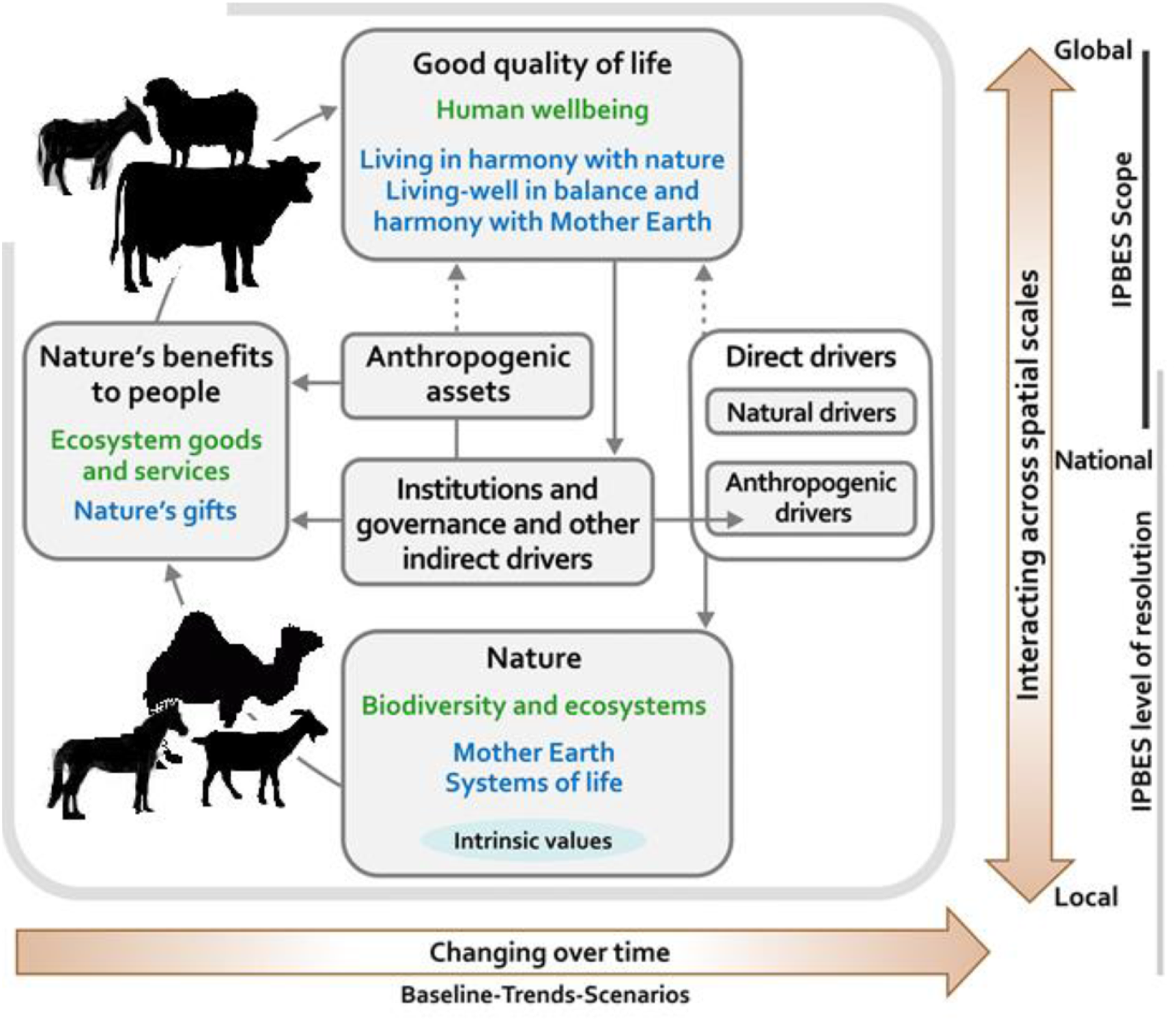
The presence of livestock in the IPBES framework and representation of mobility allow for engaging with Eurasia’s endogenous knowledge generation processes where mobility is accorded value and livestock provide the value creation mechanism.
Moreover, the logic of incorporating the livestock element is to address a common research challenge when working with oral societies. Often referred to as the ‘archival problem’ – archival problem insofar as methodologies relying predominantly on material sources or based on available evidence which can bias imperial histories (Filippelli, 1976). The majority of social analyses look to the material, especially textual sources, as the most verifiable and robust way to examine social processes and characteristics constituting a culture. However, direct human agency and interaction, whether carried out with explicit intent or through diffuse mechanisms, give important shape and structure to culture and systems of knowledge. For millennia, the shear transport of people across Eurasia was of an order (in degree and intensity) that fundamentally shaped the trajectory of the region’s history and the cultural understandings of that history. Whether this movement was forced (i.e., military campaigns) or natural (i.e., livestock pasture management, trade relations), this history of relations and exchange allowed ideas to accrete around particular understandings and thought frameworks. Rather than textual sources then, it was customs and traditional practices – whether performed daily or irregularly – as well as spoken language, which created the templates for maintaining collective understandings and social meanings. The weight of these interactions often is overlooked by analyses of the Eurasian and oral/mobile peoples.
Customary food practices give access to value systems and a culture’s relation with the land in which it developed. The consistency by which cultural practices of sturgeon meat is used in customary dishes and remains understood demonstrates Eurasian peoples are continuing to value meanings of the geography embedded in culture. In activating culture, these meanings link knowledge of how to be mobile and endure within Eurasia’s distinct physical geography. This study frames this dynamic in terms of a map and the idea of food enabling narration to capture how food practices give access to land knowledge and appreciation embedded in Eurasia’s archive.
Guided by the value framework of culture, changes in sturgeon aquaculture can be seen as updates to Eurasia’s production framework. That is, allowing sturgeon to remain within the value of culture by updating the production techniques. The continuation of sturgeon as food allows the land and geography to continue to exist and be relevant to the value framework of culture, while incorporating new economic frameworks (with their own land and land use interpretations) such that they can be leveraged to exploit new production methods.
While the societal characteristics and histories of Eurasian peoples have undergone vast transformations after seventy years of the Soviet Union and transition to independent market economies today, a distinct value system embedded in culture has endured and, more importantly, continues to inform processes today. Guided by the value framework of culture, the industrialized and modern methods by which sturgeon fish are produced in the region can be seen as making the cultural value framework viable to modern realities. That is, sturgeon aquaculture in general, and changes to producing sturgeon meat over caviar more specifically, can be seen as updates to Eurasia’s production framework. Updating the production techniques allows sturgeon as a food item with an embedded connection to land understandings to remain within the value framework of culture under modern conditions.
Conclusion
Human interpretations and socially or biologically designated requirements transform components or dynamics of an ecosystem into a form that is meaningful for a culturally defined purpose (Greider & Garkovich, 2010; Schmidt, 2012; Zobler, 1962). Beyond meeting basic physiological or nutritional requirements, fish therefore can act as culture-makers and represent components within environmental meaning-making processes. However, when considering these meaning-making processes, they do not necessarily rely on an abstracted understanding of the environment as this presupposes intellectual frameworks and thought systems which may have little bearing on Eurasia’s premodern knowledge ways.
While sturgeon fish uses can be correlated to terms and ideas across a physical environment that have been removed from their social making, these explanations may not be what give the ‘resource’ (sturgeon) meaning. Introducing a perspective where the environment is decoupled from its cultural context for analysis often biases interpretations or misrepresents endogenous features. Therefore, this research approached sturgeon as embedded in understandings and value systems co-constituted within a constellation of mechanisms according to how a culture has come to know the world.
The empirical data of sturgeon as a food product bestowed with cultural significance enabled ‘speculative possibility by engaging cultural thought and practices as the analytical starting point itself’ (Chandler & Reid, 2020, p. 490). This study’s expanded IPBES model meets the call of the IPBES framework for addressing environmental discourse and resource understandings which naturalize categorical distinctions. For example, viewing human–environment relationships along a single conduit, rather than as relations triangulated between land-livestock-people, privileges sedentary society understandings where concepts such as ‘Nature’s Gifts’ remain a quality given to humans, rather than gaining value through the process(es) of relating through humans, ecosystems, and livestock.
Resource understandings become resource understandings to the extent that they are articulated in a narrative credible within the knowledge system from which they were derived. Locating sturgeon fish within the cultural map connects it to the region’s endogenous history of meaning, because it enacts narrative. From the perspective of conventional resource ideas and interpretations, sturgeon fish occur in an abstracted physical environment and exist within a value landscape characterized by quantitative production and consumption values and threshold levels.
The findings from this research give alternative definitions of the resource notion. These definitions supplement the current sustainability concept by demonstrating that the Caspian Eurasia resource meaning arises out of the distinct knowledge modes embedded in culture. This research’s findings make contributions in two directions. First, by emphasizing modalities, it expands sustainability resource definitions to shows that resource lies in process. These processes are culturally embedded and carry their own systems of meaning. Second, with much of Eurasian life remaining pre-theoretical, this research gives indication of direction for future studies in order to generate more informed conceptual bases for Eurasia.
Leveraging new means of production towards specific derivatives of sturgeon fish which support important cultural customs demonstrates that Eurasia’s value framework of culture persists. Yet such processes can be misinterpreted or not fully connected by analyses when approached through interpretive frameworks with concepts developed elsewhere, or when the development histories are not accounted for. By recognizing the diverse social and bio-geophysical realities by which a resource can come to be, more systems of meaning can come to be represented.
Footnotes
Declaration of Conflicting Interests
The author(s) declared no potential conflicts of interest with respect to the research, authorship, and/or publication of this article.
Funding
The author(s) received no financial support for the research, authorship, and/or publication of this article.
