



Abstract
This study explores the functioning of the lowest elected tier of local government in Kazakhstan that governs villages, towns and small cities. While the existing literature on this issue mostly relies on quantitative data, document reviews and comparative analysis with foreign countries, this study explores new angles on the subject through the qualitative interview method. In so doing, this investigation evaluates the strengths and weaknesses of the lowest elected tier of local governments, their vertical interaction with higher-level local government and social engagement. The following conclusions have been obtained. First, providing authority to aul akims (heads of the lowest elected tier of local government) to develop budgets from locally collected revenue creates unequal opportunities for service provision. This is because the capacity of such local governments to collect taxes varies by population size, geographical features and remoteness from large cities. Second, aul akims now allocate more funds than before, but financing conditions still make them dependent on higher authorities. Third, recent requirements stipulating that aul akims discuss local issues in a local community meeting have made the heads much more socially accountable. Finally, legislation that regulates the functioning of aul akims is complex and incomplete. Based on these findings, this study suggests a number of practical recommendations for policymakers, contributes to existing knowledge via enhancing contextual information and provides directions for future research.
Keywords
Introduction
According to normative statements, the significance of local government in society is that it prioritises local problems and needs, protects citizens from central authorities and encourages democratisation and participation in decision-making (Klugman, 1994; Stoker, 1996). However, numerous studies have demonstrated that local governments do not always have sufficient autonomy to operate within the framework of normative ideas because higher authorities control and pressure lower governments through many mechanisms (Erlingsson & Ödalen, 2013; Goldsmith, 2002). Ladner et al. (2016) demonstrated how the autonomy and powers of local governments vary by country. Therefore, studies on local governments are usually country-specific (Chandler, 2005). In addition, it is evident that in addition to central–local relations, relationships between tiers of local governments fluctuate by context. In countries where intergovernmental relations are traditionally structured vertically, the powers of local governments appear to shrink according to their position in the hierarchy.
This study explored the functioning of the lowest elected tier of local government 1 in Kazakhstan. Data were collected through qualitative interviews, and the Gioia method was used for data analysis. The study sought to answer the following research questions: (1) what are aul akims 2 (heads of the lowest elected tier of local governments) experience with vertical and social accountability, (2) what is the scope of aul akims’ power and activity and (3) how can local government be improved at the lowest level? Addressing these questions is important for at least three reasons.
First, the findings provide in-depth understanding of the context and broaden existing knowledge of local government functioning. Exploring how the lowest elected tier of local government functions in Kazakhstan could enhance understanding of intergovernmental relations, citizen participation and decision-making in a centralised society. The study also adds to the existing literature on local governments in Kazakhstan as there is a dearth of scientific information on this subject.
Second, and more important, this study evaluates the recent course of national policy towards decentralisation and local self-government. In the first years of independence, Kazakhstan formed a highly centralised government structure in which akims 3 and their offices were responsible for implementing the decisions of the central government in their territories. Each akim was a ‘representative of the President and the [central] Government of the Republic of Kazakhstan’ (The Law of the Republic of Kazakhstan dated 23 January 2001). Even though the central government has adopted several initiatives regarding decentralisation and local self-government reforms since 2000, the reality has not changed. Thus, this study enhances existing knowledge regarding why local governments within Kazakhstan remain weak despite initiatives promoting good local governance and decentralisation.
Finally, the existing literature does not address intergovernmental relations between local government structures, the scope of power held by the heads of the lowest elected tier of local government or the factors that motivate people to become aul akims. The qualitative interview method adopted in this study helps to reveal information about these issues. Therefore, the findings have practical relevance and provide direction for future studies.
The rest of the paper proceeds as follows. The next section briefly explains the study’s contextual background. The third section summarises previous studies on local government within the global and local context of central–local relations and decentralisation. The fourth section outlines the data collection and analysis methods. The fifth section briefly discusses data analysis procedures. The sixth section presents the results of the data analysis derived from the qualitative interviews. The seventh section critically discusses the findings of the study and compares them with those of the existing literature. Finally, the last section briefly outlines the main study conclusions and discusses the limitations of the study and directions for future research.
Setting the scene: Local governments in Kazakhstan
Kazakhstan, a former USSR country located in Central Asia, declared its independence in 1991. Like many other countries of the former Soviet Union, Kazakhstan’s present local government structure and intergovernmental relationship traditions were shaped in the tsarist Russia period. The monarchs of tsarist Russia strictly controlled local governments, and the centralised governance structure continued in the Soviet period as the Communist Party and central government controlled local soviets (Lapteva, 1996; Gel’man, 2002). After independence, Kazakhstan retained a centralised hierarchical system of government in which higher levels of government exercised top-down control over the lower levels of government and essential decisions were made by central authorities.
Administrative and Territorial Units in Kazakhstan on 1 July 2022.
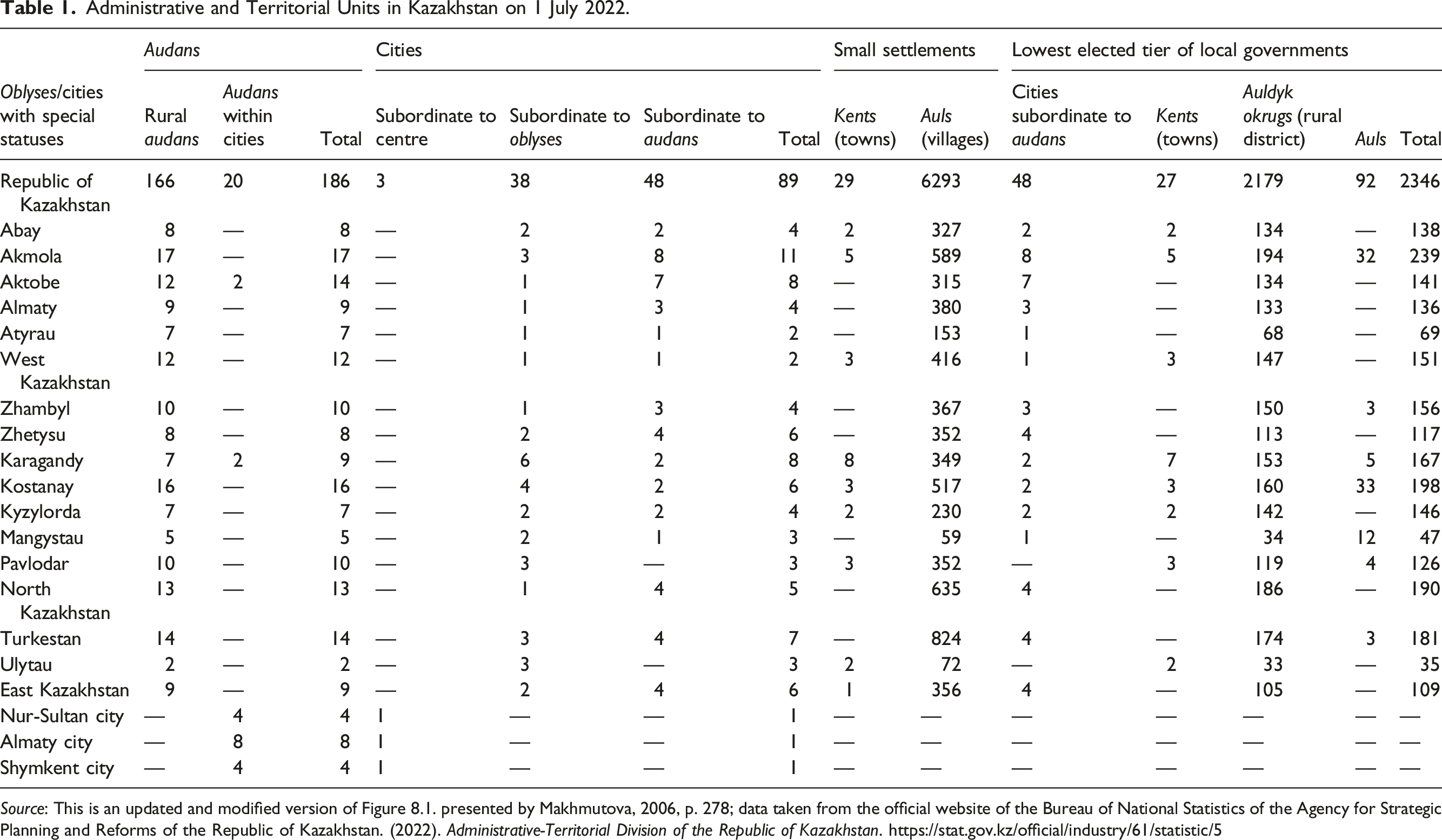
Source: This is an updated and modified version of Figure 8.1. presented by Makhmutova, 2006, p. 278; data taken from the official website of the Bureau of National Statistics of the Agency for Strategic Planning and Reforms of the Republic of Kazakhstan. (2022). Administrative-Territorial Division of the Republic of Kazakhstan. https://stat.gov.kz/official/industry/61/statistic/5
Studies on local governments in Kazakhstan have found that they do not have real power to address local issues adequately, as they are heavily subordinate to the higher government tiers in all areas (Bhuiyan, 2010; Makhmutova, 2006; Siegel, 2016; Urinboyev, 2015). Onalbaiuly (2019) argued that the vertical structure crippled local initiatives and decision-making, and this was the case for both the central–local relationship and the relationship between local tiers of government. Central authorities have initiated reforms intended to improve local government through decentralisation (Bhuiyan, 2010). This section only briefly describes recent changes in local government because Bhuiyan (2010) and Busygina et al. (2018) have delineated the Kazakh political context under which decentralisation and local government reforms are being undertaken, while Makhmutova (2004, 2006) has clarified Kazakhstan’s local government structure and local self-government functioning.
Reforms at the lowest level have begun and have surprised some scholars (Junussova, 2018), as these local governments – located mainly in rural areas – have long suffered from a shortage of resources and limited freedom in solving local issues (Makhmutova, 2006; Siegel, 2016). In the context of these changes, since 2018, aul akims have been authorised to generate their own budgets, with revenues raised from certain types of local taxes and payments, which must be discussed and approved at the local community meeting. 4 Until 2013, aul akims were appointed by higher akims, between 2013 and 2021, they were elected by the deputies of audan maslikhat. 5 However, since 2021, they have been directly elected by the local population. Official rhetoric states that these changes have been proposed as a push towards democratic decentralisation (Oficial’nyj sajt Prezidenta Respubliki Kazakhstan, 2021). However, the failed experiments of the past years indicate that a more critical consideration of this interpretation is required.
Central–local relations and decentralisation
Central governments play a key role in determining the value, capacity and freedom of local governments. Numerous studies have examined the attitude of central governments towards local governments through interrelated ideas of central–local relations, decentralisation and local autonomy.
Scholars who favour localism have argued the importance of autonomy for local governments and suggested a conceptual definition for it. Earlier authors defined local autonomy as the capability of local governments to influence the welfare of the local people independently (Wolman & Goldsmith, 1990). Pratchett (2004) defined the fundamental concepts of local autonomy ‘as freedom from central interference; as freedom to effect particular outcomes; and as the reflection of local identity’ (p. 358). In the same vein, Chapman (1999, 2003) argued the importance of local autonomy and extended its definition to legal, fiscal and land use areas. He defined fiscal autonomy as the ‘ability of a jurisdiction to set tax rates and establish the revenue base without outside influence’ (Chapman, 2003, p. 16).
A considerable number of studies focus on how deep into local affairs central government interventions ought to be. Many scholars emphasise that this depends on how central authorities define local government. Rhodes (1999) suggested that previous studies on central–local relations divided local government into the ‘partner’ and ‘agent’ model. When it is considered a partner, local government is treated as an equal actor by the centre, whereas when it is considered an agent, it is dependent on higher authorities. Similarly, Chandler (2008, 2010) introduced ‘expediential’ and ‘ethical’ justifications of local government. Expediential justification refers to the local government being valued to the extent that it serves the purpose of another institution, the higher government. In this case, the higher government considers the institution below it as an efficient service provider that can act on its behalf. In contrast, ethical justification appreciates local government only as a fulfilment of a morally desirable purpose, regardless of other institutions. A number of studies examined the central–local government relationship via the principal–agent theoretical framework (Nyman et al., 2005; Siregar & Pratiwi, 2017). In this dichotomy, a ‘principal’ delegates authority to an ‘agent’ to execute a service for the principal (Kiser, 1999). In this case, the central administration is the principal that authorises the agent, which is the local government. This model considers local government as a subordinate institution existing to serve the principal.
More recent studies have approached central–local relations from the decentralisation framework perspective. Rondinelli, (1981) suggested a broader definition of decentralisation, defining it as the allocation of responsibility for planning, management and resource raising from the central authority to other institutions. The commonly accepted types of decentralisation are those that are political, administrative and fiscal. Specifically, political, administrative and fiscal decentralisation refer to the transfer of decision-making power, operational responsibility and resource management, respectively, from central government to local tiers (OECD, 2020; Ozmen, 2014; Schneider, 2003). Whether decentralisation is beneficial for society is currently under debate, but the common-sense argument offered by its advocates is that it ‘brings government closer to people’ (Treisman, 2007, p. 4). In fact, in many countries, decentralisation has led to the formation of local self-government (Rai, 2014). In other words, decentralisation was the impetus for the enhancement of local authority and autonomy.
However, democratic decentralisation reforms have not always empowered local governments. In many countries, particularly in most developing countries, reforms have often resulted in a transfer of power to unelected local institutions (Ribot, 2007). Yilmaz and Venugopal (2008, 2010) demonstrated that central governments’ fear of losing control is the reason for limited decentralisation. Ironically, the results of some studies have demonstrated how decentralisation has created new opportunities for centralised control in many places around the world (Mutebi, 2004; Ribot et al., 2006).
The decentralisation trend seems to loosen central governments’ control over local governments. However, Goldsmith (2002) argued that central control has moved from direct to indirect control implemented through informal means or regulation processes. These processes include controlling local governments’ revenues and expenditure and administrative regulations or prescriptions and controlling the access permitted to local authorities. In this vein, interestingly, some scholars have suggested that central authorities are able to exercise power over local governments by controlling the definition of self-government, as they can define the term in a manner that suits their interests (Erlingsson & Ödalen, 2013).
Many contextual studies have analysed local government within the concept of decentralisation. Bhuiyan (2010) argued that despite decentralisation and good local-governance initiatives by central governments, in reality, local governments are weak, hierarchically dependent and low on social accountability. Some investigators have emphasised that a lack of a clear decentralisation strategy and ad hoc actions are the reason for unexpected results (Junussova, 2018). Busygina et al. (2018) argued that the lack of internal risks for the incumbent (at that time), less preoccupation with geopolitics and an endeavour to integrate the country into the global world allowed Kazakhstan to experiment with fiscal decentralisation while remaining politically centralised. In a similar trend, Umarov (2020) also concluded that Kazakhstan implemented ‘façade’ decentralisation. Scholars who have comparatively investigated Central Asian countries have highlighted the impact of international donors on decentralisation. Kyrgyzstan is far more reliant on international aid than is Kazakhstan, and Uzbekistan has provided more autonomy to local governments in order to obtain the confidence of donors (McGlinchey, 2011, as cited in Siegel, 2021). In contrast, Urinboyev (2015) claimed that decentralisation can exacerbate regional disparities in Central Asia because local elites are more concerned with controlling resources than with regional development. Overall, studies that have examined the cases of developed economies have demonstrated the benefits of decentralising authority and building a strong local government (Gadenne & Singhal, 2014; Sellers & Lidström, 2007).
Method
A contextual literature review on the lowest elected tier of local government and self-governance in Kazakhstan revealed that most studies have relied on document analysis, statistical data and comparative analysis – that is, the investigation of local government structures in foreign countries. This study approaches the subject from a different angle – surveying the experiences of the aul akims. Therefore, in-depth interviews based on the interpretivist–qualitative research paradigm were chosen as the most suitable data collection method.
Considering the constraints of the COVID-19 pandemic, the resources and logistics required to conduct face-to-face interviews, and Kazakhstan’s vast size, conducting interviews via Zoom or telephone was determined to be most cost-effective. This facilitated the participation of aul akims from remote areas that are difficult to access physically.
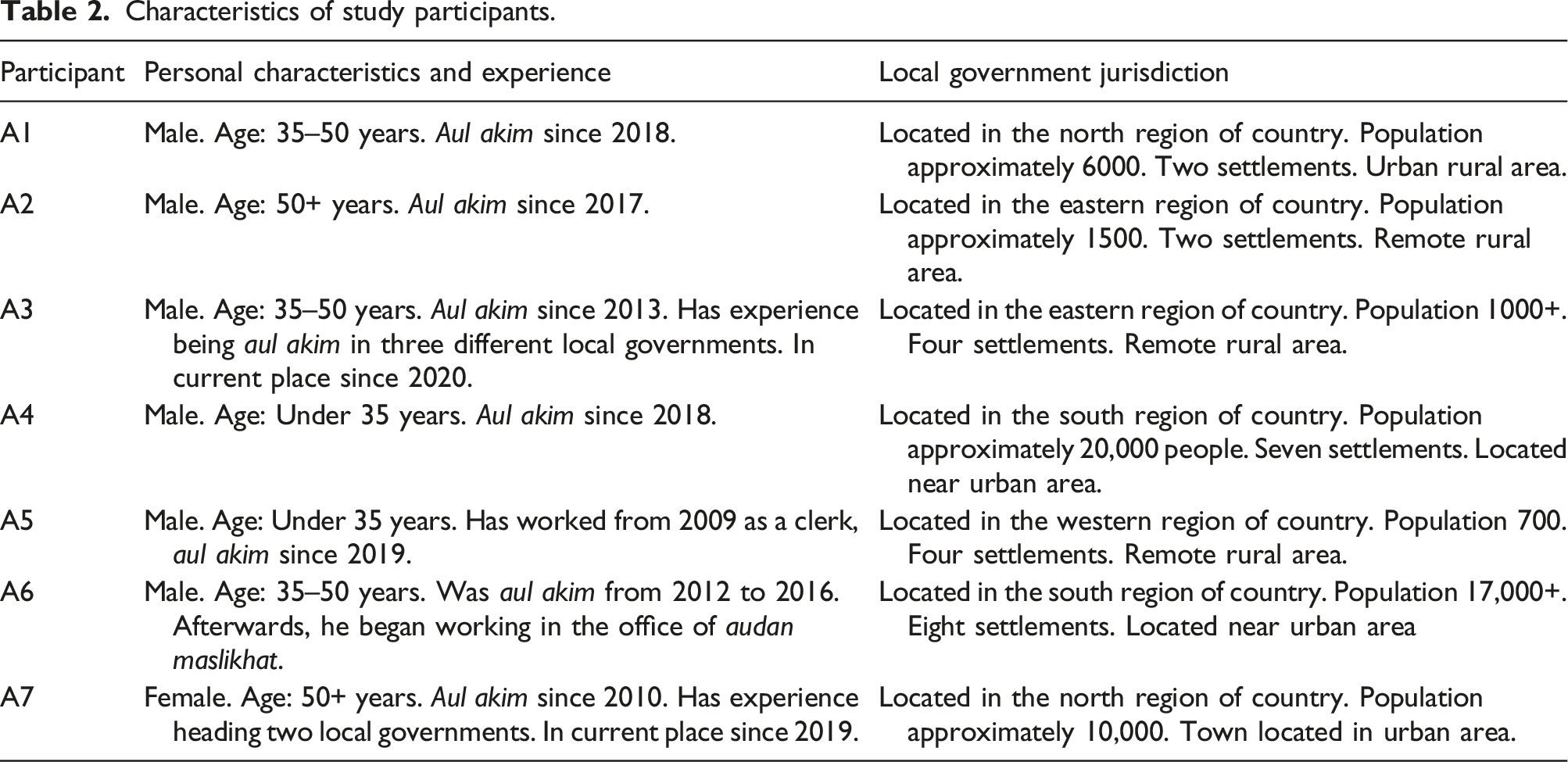
Many scholars emphasise that informed consent, confidentiality and anonymity (vs coercing or manipulating responses) and data storage are the most important norms of interview ethics (Allmark et al., 2009; Mohd Arifin, 2018). All these factors were considered before the interviews and throughout the research process. To maintain the confidentiality of the respondents, no personal information, including important geographical features of the administrative territory, was disclosed. In this study to conceal their identity, participants are coded as A1, A2… (i.e. each interviewed akim is designated a letter–number code). Ethical approval from the University of Birmingham was obtained for conducting the investigation.
Questions for the aul akims were developed after completing the literature review and in accordance with the purpose of this investigation. All questions were open-ended and expansive, which allowed subjects to express their opinions on issues that they thought were important. The order of the questions was structured to start with basic questions about the respondents’ background and experiences followed by more complex questions.
A pilot interview was conducted on 15 July 2021 with a participant who had experience as a local government employee. The interviews were conducted from 19 July to 1 August 2021, and interview times ranged from 19 to 56 minutes with a median of 40 minutes. The appendix lists the questions that participants were asked.
Characteristics of study participants.
Data analysis
This study defined the data analysis procedures and techniques considering Brinkmann’s (2013) explanations and the works of other authors (e.g. Braun & Clarke, 2006; Elliott, 2018). The author transcribed the interview records verbatim for analysis. Because this is a small-scale project with a low sample size, handling data manually was feasible and relevant. Data-driven coding, wherein codes emerge from the data without using previously determined concepts or themes, was employed.
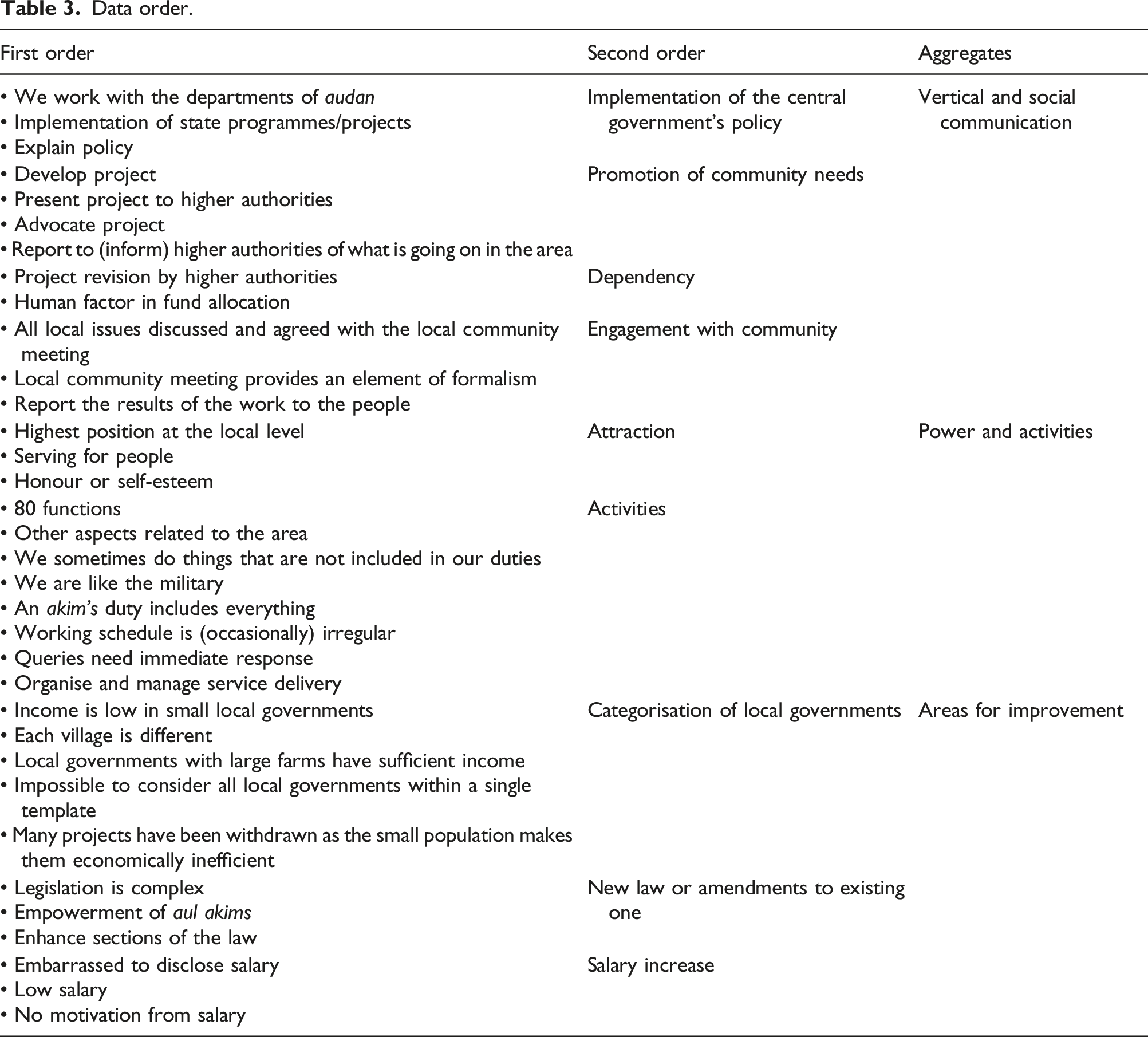
The Gioia method was employed to derive themes from the data (Gioia et al., 2013) and was useful in assembling relative codes, thereby reducing themes. In the Gioia method, initial themes become first-order codes from which second-order codes are developed, and these codes in turn are developed for aggregation. In this study, all the relevant information in the interview transcripts was labelled. Then, for each of these labelled fragments, a short phrase (heading) that best describes the meaning of that passage was given, and these became the first-order codes. All first-order codes were then checked to observe whether they were related to each other; this was done to group the associated themes into a single concept. The grouped themes became second-order codes. Subsequently, linked second-order codes were assembled into aggregates created by taking into account the project research questions.
Results
Data order.
Vertical and social communication
The first research question focussed on obtaining information on aul akims’ experience with vertical and social accountability. The findings revealed that the aul akims’ function is to enact national policy, communicate the local community’s issues to higher governments and facilitate communication between these entities. In particular, aul akims’ main tasks, specified by the second-order themes, were grouped under the aggregation vertical and social communication: ‘implementation of the central government’s policy’, ‘promotion of community needs’, ‘vertical (fund) dependency’ and ‘social accountability’. These themes clearly describe the accountability and engagement of the lowest elected tier of local government in Kazakhstan.
The interviews revealed that despite recent policies aimed at improving local self-government, aul akims are still dependent on higher governments in various areas and cannot make crucial decisions without the approval of higher authorities. While recent changes have focussed on increasing the accountability of aul akims in the face of strengthened social engagement by the local community, there is still much room for improvement. Nevertheless, this represents progress, as previous studies have found little social communication at the lowest level of government (Siegel, 2016). Further, aul akims mentally align themselves with the vertical power structure rather than with their local communities. In other words, aul akims identified themselves as an in-group with higher-level government and categorised residents as the out-group with respect to social identity theory (Hogg, 2016). This is an interesting finding requiring further investigation because, if the heads of the lowest level of government are aligned with the central government, they likely do not protect the local people effectively.
As stated in the introduction, all tiers of government constitute a single power system, where akims are representatives of the president and central government in local areas. Therefore, it was not surprising that in the interviews, it was revealed that aul akims have close relationships with higher authorities that allow them to implement the central government’s decisions. Several interviewees illustrated how they implemented the central government’s policy by citing the national vaccination policy, wherein the participants had to convince the locals to be vaccinated. Another aspect of the work related to state policy is the implementation of government projects.
Aul akims not only have to work closely with higher authorities in the implementation of central government policy, but they must also play an important role in obtaining finance from higher-level budgets for local development projects. A1 stated that funds were now well allocated because there are many government programmes for village development. Almost all interviewees agreed that their projects were evaluated by the departments of audan/city in order to allocate finances.
How easy is it to obtain finance allocation? Answers to this question varied among the participants, with some blaming colleagues for being too proud to ask for funding, while others said the mood (attitude) of higher authorities was crucial. Nevertheless, if projects were evaluated by the higher government, aul akims would not be able to self-govern fully. Overall, the interviews revealed that human initiative plays a role in the allocation of funds from the higher government. Craftiness and the communication skills of aul akims were seen as critical, as the participants reported that they might deploy various forms of leverage to obtain approval for their projects. One interviewee stated the following.
A2: ‘To be honest, you do not sit back after you ask for finance. You explain to them that you need it, and describe the situation, [and) maybe [even] call the media. Human factors might have an influence… maybe someone who makes decisions is a native [of that area/settlement] and may advocate for it’.
Overall, aul akims are dependent on higher-level local governments and implement their decrees. Therefore, despite the introduction of elections and other innovations aimed at enhancing local self-government, aul akims still depend on higher authorities. As A5 admitted, the audan akim regularly calls them to meetings and gives them written or oral orders to fulfil.
Aul akims have to work together with the local community, particularly with local community meetings. These assemblies exist in the lowest elected tier of local governments, and according to legislation, members are delegated by locals. Aul akims must consult with the local community meeting to determine what kind of work has to be done with the tax revenue collected from that area. In the interviews, one aul akim clearly explained their relationship with the local community meeting.
A7: ‘We agree about all issues of local importance with the local community meeting. The budget, the revenues of the budget, the expenditures of the budget for improvement of settlement, for sanitation, what kind of works should be carried out… if funds are allocated for repairs, then which roads will have priority. This is paramount because everyone shouts; everyone wants roads. Here, the local community meeting makes a decision with a majority vote: [they] select some streets that will [take] priority, then [after voting], it will be implemented. This is how decisions are made. For example, will we do a tree pruning this year? If yes, then where. If no, then [we] postpone it and spend the funds on other necessities’.
Other aul akims commented on the efficacy of members of the local community meeting in helping entrepreneurs find solutions for local issues. In other words, aul akims might deploy members of the local community meeting to mobilise local entrepreneurs or residents. However, the activities and efficacy of the local community meeting may change according to location. As one participant admitted, the local community meeting appeared to work on paper, but it was different in reality. Another finding, as suggested by the interviewees, is that aul akims play a key role in selecting members of the local community meeting. Usually, aul akims can select people whom they want, and some of them prefer active people that can go address higher-level government officials and exert pressure on them. Other aul akims want passive local community meeting members from whom it is easy to obtain approval.
The following excerpt from one interview effectively illustrates the aul akim’s vertical and social relations.
A4: In my district, I have 7 villages, so in the local community meeting, there are 14 members, two from each village. They report what is happening in the village. They also suggest, for example, [that the village] needs drinking water infrastructure, a change [in] the electrical grid, bus stops, a playground for children, or a kindergarten. We discuss this in the local community meeting, and then they record it in a protocol. We take it, approve it, and submit it to the audan akim on our behalf. There, the Department of Economics [Audan] reviews the financial side, designs a project, then together with other responsible departments, for example, the Department of Housing [Audan], presents it to the maslikhat, which approves it’.
Some aul akims complained about citizen passivity in light of the engagement solutions required for local issues. They hoped that the direct form of elections introduced in 2021 would gradually increase the involvement of the population in solving local issues. Participants also admitted that this innovation would make them more oriented to the needs of the local community, despite also remaining subordinate to the higher-level local government. A surprising finding was that many aul akims said they would continue to be subordinate to higher-level local governments after the direct election introduction. Participants said that this was acceptable because they had to implement the central government’s policy; therefore, they continued to receive orders and be monitored by higher authorities. A previous study that examined experimental elections in 2001 concluded that aul akims would continue to be subordinate to higher akims as per the government hierarchy (Makhmutova, 2004). Therefore, their subordination was not surprising, but their consent and concurrence with the situation was.
Some participants believed that direct elections would be much better than the previous electoral rules, wherein aul akims were elected by audan maslikhat deputies, while two aul akims were sceptical about direct elections. Proponents said that when aul akims were elected by the maslikhat, deputies might have been influenced by the opinions of other colleagues or higher officials. Onalbaiuly (2019) also stated that higher akims might force deputies to elect friendly candidates.
A6: ‘I think it is the right thing for aul akims to be directly elected by the population, because [then] people can express their opinion. For example, in the past, aul akims were appointed. In that period, the opinions of local communities were not considered during the appointment. Later, deputies of the audan maslikhat elected aul akims on behalf of the people. But since they were elected by the audan maslikhat, there were only one or two deputies from that village [area]. Therefore, they asked colleagues that were elected from that area their opinion of candidates. That deputy might say, this person is good, support that one. This kind of case might occur’.
Powers and activities
Participants mostly talked about the advantages of being the head of the local government at the lowest level because it is a public position. As a formal authority, their power is displayed through their functions, making decisions related to that area and providing services. Respondents said there was no financial motivation because the salary or financial rewards were low compared to other forms of employment. Respondents also mentioned respect from the population and helping others as reasons for taking office. Thus, it can be inferred that people are interested in taking this job because they become the formal leader of the community with an opportunity to govern. This position is attractive to people who have leadership ambitions, seek public respect and want to serve their community. A6 summarised these motivations as follows.
A6: ‘Aul akim is the highest position at the rural level. These are, for example, individuals who are the head of a population. Despite laborious conditions, there are individuals who execute their job well and get acclamation from the people. They take that position in order to serve citizens with their skills. The motivation is to serve the people in their hometown’.
Respondents also mentioned that their authority increased as office holders that made decisions. This helped to increase not only their formal power but also their informal influence through which they gained respect from the community for good service.
One respondent complained that they have about 80 responsibilities. It is important to note that the principal law indicates that there are less competencies for aul akims. However, many functions are identified by other laws such as the law ‘On Veterinary Medicine’, which determines the competence of aul akims in (1) determining places for animal pasturing in lands of inhabited locality and (2) organising sanitary clearance of the territory of inhabited localities (The Law of the Republic of Kazakhstan dated 10 July, 2002, Article 10-1). In addition, the interviewees revealed that there are even more tasks than these. This is because, under one of the listed responsibilities of the aul akim office, which states that aul akims ‘shall be responsible for fulfilling the tasks assigned to them by superior akims’, higher local authorities might assign aul akims extra tasks (The Law of the Republic of Kazakhstan dated 23 January 2001, Article 35, 3).
A6: ‘In the list of functional responsibilities of aul akims there is a clause regarding “other issues that have to be arranged in that area”’.
Because of this clause, when an aul akim receives an instruction from the higher authorities related to that area, they cannot object on the basis that the task is not part of their responsibilities. Some participants illustrated this using the example of when aul akims were instructed to convince residents to be vaccinated, others used the example of when they had to ask farmers to disclose the quantity of vegetables they produced as the higher government wanted to know the statistics. In other words, there is legal justification for higher akims to instruct aul akims to perform any tasks that need to be completed. Therefore, higher authorities can give instructions directly to aul akims, thus bypassing and infringing the authority of elected heads of local government. In this case, the clause creates another mechanism that makes aul akims dependent on higher-level local governments.
In response to the question focussing on the resources needed for local government, many participants stated that they had sufficient supplies. Their information contradicted the results of previous studies that concluded that the lowest elected tier of local government had access to meagre resources (Makhmutova, 2006; Urinboyev, 2015). This may be explained by the fact that recent improvements, particularly the right to create a budget from local revenues, improved financing after 2018. In addition, fund allocation for rural areas in the framework of government programmes, such as Aul – El Besigi, which aimed to modernise the social infrastructure in villages, might be the reason for this contradiction (Official Information Source of the Prime Minister of the Republic of Kazakhstan, 2019).
Many aul akims reported that their offices had sufficient employees. However, interview participants mostly talked about overtime and work that had to be done outside of the normal work schedule. This problem exists in relation to vertical structures and within local communities. For example, they may need to attend to higher governments’ requests for immediate information or citizens’ issues that arise outside working hours, which is considered acceptable because people in small settlements tend to know each other well.
A2: ‘Sometimes they [higher officials] might ask for information that they need in the morning or at 6 o’clock in the evening [their deadline was in the morning and they ask for information in the evening]. It is necessary to standardise this. They may ask for information today that they needed [because they had a deadline] yesterday at 6:20 pm. For example, we need time to collect that data, even if we have that information, we need time for writing it down properly’.
A5: ‘We have an approved work schedule for civil servants, but we do not work only in the framework of that schedule: [we sometimes] go beyond normal working hours. In the countryside, people always call by phone or WhatsApp on various issues. Then we will go to work to solve the problem, regardless of whether it is a Saturday or Sunday’.
If aul akims say they have enough staff to implement their duties, then a large volume of work and overtime arises not from a dearth of employees but because of last-minute and abrupt requests. However, A1 mentioned that their schedule might not be considered a normal 8-hour work schedule, even though they were not always overworked. In other words, sometimes, for various reasons, aul akims may work outside working hours, but usually their work flows in a normal way, an 8-hour workday.
Areas for improvement
The third research question focussed on obtaining domains that need consideration, namely, necessary positive changes. Three themes emerged from the perspectives of participants: categorisation of local governments, new laws or amendments to existing ones and salary increases.
One major issue that was mentioned by almost all participants was the need for different approaches to different local governments taking into account the demographical, economic and physical characteristics of that place. In other words, giving the lowest elected tier of local governments the right to create their own budgets from local taxes and revenues aggravates the issue, and it is impossible to consider all rural districts within a single framework.
A2: ‘We get funds from audans as grant for sure. But one thing, as I mentioned in the beginning, there are some rural districts that have sufficient income. For example, they have large farms and can collect a good amount of land tax and transport tax from individuals and entities. Those farms can bring investments and that might help to repair the roads, for instance’.
A6: ‘I think it is not fair to give each aul akim the right to have budget formation and tell them to carry things out with their own income, because there are small rural districts with very low incomes. Okay, large villages can collect somewhat good taxes. For example, in our area, we have villages with a population of 3,500. Their taxes are small. They cannot implement anything’.
Some local governments have far smaller populations. For example, an aul akim with fewer than 1,000 residents complained that many projects were cancelled as they were considered economically inefficient because of the small population.
Another finding from the interviews was the need to enhance the law that regulates the operation of the lowest elected tier of local government, particularly to increase their power to control local public institutions. Specifically, several participants complained that the principal law that regulates how local governments work has not clearly defined the competence and power of aul akims. Many issues in local government are regulated by other legal documents such as the law ‘On Veterinary Medicine’ or ‘Budget Code of the Republic of Kazakhstan’. This makes legislation in this area complex and questionable. Thus, many participants suggested developing a law that clearly regulates the aul akims’ work.
Another issue that was commonly expressed was the low salary of not only aul akims but also employees. One participant reported that staff motivation was low because of low salaries. Others shared similar opinions. One interviewee reported that in some local governments, staff turnover was high. It is necessary to add that the low salaries of local government officials were also noted in interviews from other studies (e.g. Onalbaiuly, 2019). However, in July 2021, the wages of civil servants increased, and thus, this issue needs to be re-evaluated.
Discussion and critical reflection
The aul akims’ role in enacting government policy and taking the local community’s issues to higher officials is to administer and maintain communication between the parties. Aul akims have to notify the local community about national policy, provide information, assist the population in obtaining services from higher levels of government, inform higher authorities about local issues and promote and advocate for local projects in order to obtain funding. However, the aul akims’ experiences in enacting policies given by higher governments and communicating local needs to higher authorities have not been analysed thoroughly in the literature. Therefore, this deduction needs further investigation.
Consistent with the results of other reports (e.g. Shiyan, 2020), this research demonstrated that recent changes have improved lower-level government financing by giving aul akims the right to develop local budgets from certain types of local taxes and government rural infrastructure development projects, though these changes have not enhanced aul akims’ financial independence. In addition, our study found that aul akims’ personal skills, such as communication with higher authorities, mobilisation and advocacy, were important in obtaining financial support from higher officials. Onalbaiuly (2019) made a similar point, emphasising that ‘individual akims can still get support, depending on their own place in society’ (p. 150). This strengthens the idea that without fiscal decentralisation, it is impossible for local governments to secure autonomy and freedom.
Most aul akims politically align themselves with the central government; that is, they organise themselves into a single vertical power structure. There are several reasons that aul akims may affiliate with higher governments and be willing to continue being dependent on them. First, all of the interviewees have several years’ experience in local government and therefore are accustomed to the existing system. Onalbaiuly (2019) suggested a more pragmatic reason, saying that citizens associate positive changes with akims, and negative changes with the central government. Other studies have found that blame-avoidance behaviour is a widespread matter in public policy (Weaver, 1986), and that this may arise in central–local relations (Ran, 2017).
The attraction of the aul akim position is that it is the highest position at the local level. The position also provides an opportunity to gain formal power over a community. Peiró and Meliá (2003), argued that ‘formal power is based on structural power sources related to the hierarchical position, while informal power is based on personal power sources not necessarily associated with formal structure’ (p. 17). Scholars have found that these power types may be linked because people establish leadership from formal positions (Ramos et al., 2019). Accordingly, it can be inferred that an aul akim’s position is highest at the local level and provides an opportunity to become a formal ruler, which attracts people with career development and leadership ambitions.
Recent changes have improved the social accountability of aul akims, particularly communication with the local community meeting, where many local problems are discussed. However, the efficiency of the local community meeting varies in each local government. If members of the local community meeting are active, then many community issues can be solved with its help. Many researchers have found variations in the efficacy of each local community meeting according to location (Shiyan, 2020). Onalbaiuly (2019) quoted one aul akim who said that ‘at the village level, public councils were very useful in helping to resolve local conflicts and criminal cases without the involvement of law enforcement bodies’ (p. 151). Nevertheless, it seems that the formation of the local community meeting and the obligation of aul akims to discuss local issues in relation to it have increased social accountability in the lowest level of local government. As previous investigations have found, there are few social ties in the lowest elected tier of local government between aul akims and the community (Siegel, 2016).
The capacity of the lowest elected tier of local government to collect taxes and revenue varies by population size, geographical features, remoteness from large cities and service provision. In other words, the formation of a budget from local taxes and revenues offers varied opportunities to provide services. Local governments’ capacities may differ in terms of creating budgets from local revenue, as expressed by the aul akims who participated in other studies. In particular, Onalbaiuly (2019) presented contrasting comments from aul akims: One said that the formation of a budget from local taxes helped in handling problems while another complained that the budget was sufficient only for the provision of a very few services. This confirms the vitality of allocating extra resources to local governments that have limited capacity to collect taxes in order to equalise service-providing opportunities by aul akims.
This research illustrates that the legislation that regulates the functioning of the lowest elected tier of local government is complex and incomplete. Many studies have also demonstrated a need for laws related to local self-government, but they have not been adopted for various reasons even though the issue has been on the agenda since the 1990s (Makhmutova, 2004; Nurpeysov, 2016). The conclusions of the present study provide further evidence of the need for law reform.
The legal clause that states the aul akims ‘shall be responsible for fulfilling the tasks assigned to them by superior akims’ (The Law of the Republic of Kazakhstan dated 23 January 2001, Article 35, 3) not only increases their work volume but also raises their dependency on higher authorities. This is because they cannot resist orders by claiming that they are not in their list of duties. However, very little was found in the existing literature on clauses that limit the freedom of aul akims. Thus, further studies on this matter should test this claim.
To sum up, since the independence of Kazakhstan in 1991, the central authorities’ rhetoric and initiatives indicate that Kazakhstan intends to build strong local governments. However, the results of numerous studies have demonstrated that, in reality, local governments are hierarchically dependent, and their decision-making autonomy is limited (Bhuiyan, 2010; Makhmutova, 2004, 2006; Siegel, 2016). Busygina et al. (2018) concluded that external positioning and internal circumstances allow the policymakers of Kazakhstan ‘to experiment with fiscal decentralisation while maintaining the flexibility of centre-region relations’. In other words, a decentralisation mentality focusses on maintaining the stipulations that allow higher governments to keep a tight rein on descending local governments. The result is ‘limited’ decentralisation in which some administrative functions are transferred to local government and elements of local democracy are adopted, but the necessary tools to control lower structures by higher governments remain. This explains why local governments are still weak despite initiatives promoting good local-governance systems.
Conclusion
While the existing literature mostly relies on quantitative data, document reviews and comparative analysis with foreign countries, this study explored new angles on the subject through the qualitative interview method. The research found that although reforms in recent years have generated some positive changes in the lowest elected tier of local government, more effort is needed to ensure their effective functioning in rural areas. Overall, this study shows evidence of the challenges facing the lowest elected tier of local government in Kazakhstan and makes recommendations for future consideration.
Limitations and directions for future studies
This study has the following limitations. First, the sample size is small, which means that it is difficult to generalise the findings. However, Kvale (2008) stated that ‘Analytical generalisation may be drawn from an interview investigation regardless of sampling and mode of analysis’ (p. 138). Therefore, the common issues faced by aul akims identified in this study could also apply to other locations. Second, this project did not consider a representative sample of aul akims, particularly with respect to their ethnic backgrounds. Even though people of many ethnicities live in Kazakhstan, and some comprise large populations within particular local governments, in our study, all respondents were Kazakhs. Aul akims of other ethnicities with different backgrounds may have different opinions.
Considering these limitations, the results of this study need to be tested in future quantitative studies. Comparative research that investigates the lowest elected tier of local governments by their demographic, geographic and remoteness characteristics would enable us to obtain more in-depth information.
Footnotes
Acknowledgements
I thank Dr Karin Bottom from the University of Birmingham for her guidance and direction in the research process. I would also like to express my gratitude to Dr Philip Whiteman from the University of Birmingham, Dr Meruert Makhmutova from the Public Policy Research Centre, Dr Nurbek Pussyrmanov from the National Academy of Education named after Altynsarin and Dr Kiun Hwang from the Journal of Eurasian Studies for their support and advice. I also appreciate the comments of the two anonymous reviewers. Lastly, I would also like to thank Editage ( ) for English language editing.
Declaration of conflicting interests
The author(s) declared no potential conflicts of interest with respect to the research, authorship, and/or publication of this article.
Funding
The author(s) received no financial support for the research, authorship, and/or publication of this article.