



Abstract
The article examines the relationship between the late Qing constitutional movement of 1905–1911 and the vast borderland regions of the Qing Empire–that is, Mongolia, Tibet, and Xinjiang. It traces how intellectuals and officials concerned with devising constitutional policies foresaw the integration of these regions into the nascent parliamentary institutions at the provincial and central levels. The article argues that the status of the borderlands played a significant role in late Qing constitutional debates, and that debates on borderland constitutionalism were a phenomenon of a wider constitutional wave affecting Eurasia in the 1900s. Chinese intellectuals and officials felt the competition of the emerging parliamentary institutions in Russia and the Ottoman Empire, and anticipating that constitutional and parliamentarist movements among Mongols, Tibetans, and Turki could lead to the separation of the respective regions, they hoped that parliamentary representation, albeit limited, would be an instrument against centrifugal tendencies on the borders. Hence, they called for constitutional reforms in China and for the inclusion of the borderland populations into the new parliamentary institutions. Yet, arguing with the sparse population of the borderlands as well as with their alleged economic and cultural backwardness, they denied the direct application of the constitutional plan to these territories. The differentiated policies eventually applied to the borderlands were a lackluster compromise between these conflicting interests.
Keywords
It would be disastrous to give the new colonies representative government in the sense of a government appointed by popular election; but a really representative government can be formed by other, and in certain circumstances better, means than voting. It is not difficult for an impartial authority, such as the Crown, or governors appointed by it, to select the best men of every important section of the community, and to select them in numbers proportionate to the importance of each section, and form them into a council more truly representative than any that could be created by any system of election.
Now, the habits of Mongolia are still nomadic, and those of Tibet are those of a superstitious religion; the level of their people is far below that of the inner regions, by several degrees. In the future, elections for the Lower House will naturally be difficult to be carried out. Since there would, for now, not be a single person to represent them in the Lower House, one has to plan how to place them in the Upper House. . . . We would say that it behooves us to treat Mongolia copying the method with which England treats Scotland and Ireland, letting their leagues, according to their comparative size, respectively appoint one—or two or three—people to be members of the Political Consultative Council. It behooves us to treat Tibet copying the method with which England treats the monks, appointing a few of their Lamas, Kalonpas, Kablons, Tsongkhapas, &c., to act as members of the Political Consultative Council.
Introduction
The political reforms of the last years of the Qing dynasty, from around 1906 to 1911, carried out under the label of “constitutional preparation,” envisaged the creation of a “strong and prosperous” (fuqiang 富强) nation-state (Meienberger, 1980, pp. 88–89; Zarrow, 2006). These reforms are mostly recounted as part of “China’s response to the West” (Teng & Fairbank, 1979), and held to have been inspired by Japan’s meteoric rise on the international stage. Yet, they took place in an international environment in which several Eurasian powers—Russia, the Ottoman Empire, and Persia—were more or less simultaneously undertaking constitutional reforms aimed at overcoming the deep political and economical crises which were afflicting these polities (Moniz Bandeira, 2017a).
Core part of the constitutional reform program was the establishment of deliberative assemblies at all political levels as a preparation for a National Assembly to be convened when the final constitution would come into effect. Parliamentary representation, it was hoped, would foster nationalism and strengthen the state by bringing people and government closer together. In reality, this policy strongly exacerbated existing tensions between the central and local governments. At the same time, as the central government was criticized for trying to strengthen its rather weak position, the new provincial assemblies provided local elites with platforms to push forward their own interests.
These provincial assemblies remained limited to China’s Inner Provinces. Mongolia and Tibet were still governed as separate domains within the Qing Empire under the jurisdiction of the Board of Inner Asiatic Affairs (Lifan yuan 理藩院). Xinjiang (at the time still often literally translated into English as the “New Dominion”) had only been recovered by the Qing Empire in 1877 and then lied in the jurisdiction of the Ministry of Inner Asiatic Affairs until 1884. It was then officially created into a common province (see Millward, 2007, pp. 136–139), but due to its scarce population of largely non-Han ethnicity, it still posed special problems similar to Mongolia and Tibet, and was still mostly treated in conjunction with those. Accordingly, no such institutions were created in Mongolia and Tibet, and the one established in Xinjiang remained a façade.
Yet, the creation of Xinjiang into a province was a phenomenon of a larger trend. By the late 19th century, Chinese intellectuals had come to see the Qing Empire as one of several “large entities locked in competition” (Mosca, 2013, p. 3), and the foreign threat to “virtually the entire circumference of China’s borders” had caused Chinese intellectuals to reevaluate these remote regions as “vitally important ‘shields’ on which the very survival of China depended” (Ewing, 1980, p. 151). As Chinese nationalism emerged, Chinese intellectuals had to conceptualize the nation in light of the various non-Han ethnicities, and later keep the territorial claim over these regions in Republican times (for studies on the topic see, for example, Esherick, 2011; Leibold, 2007; Matten, 2012).
But if the borderlands were so “vitally important” for China, as Thomas Ewing writes, how did Chinese intellectuals conceive of them in relationship to the “constitutional preparation” of the late 1900s? How did the emergent constitutional law of the Qing Empire address its political diversity, which was coupled to considerable ethnic, linguistic, and religious diversity?
This article shows that the role of the borderlands was indeed a significant aspect of late Qing constitutional debates, and argues that the treatment of the peripheries of the Empire in late Qing constitutional debates reveals their embeddedness in the Eurasian constitutional wave of the 1900s. At the same time as Chinese intellectuals and officials judged that the populations of Xinjiang, Mongolia, and Tibet were not yet ready for parliamentary government, they also anticipated nationalist, reformist, and constitutional movements among them. They were not only wary of foreign imperialist powers such as Russia or Great Britain trying to take advantage of these regions’ lacking integration in the Chinese Empire, but were also moved by fears that these regions might secede from China in favor of other constitutional or constitutionalizing Empires where ethnic minorities were gaining parliamentary representation, such as Russia or even the Ottoman Empire. Thus, showing consciousness of ethnic support bases for their proposed policies, they came to think of parliamentary representation as a way to secure the loyalty of borderland elites, and to counter centrifugal tendencies of the borderlands.
Hence, this article argues that officials and intellectuals had to define the status of the borderlands within the emerging constitutional architecture against the background of two main conflicting tendencies—traditionally autonomous regions with populations deemed to be unfit for constitutional rule vis-à-vis the need of national integration and parliamentary representation of the borderlands in light of their perceived vulnerability. The practical result was a compromise which did not create local parliamentary institutions and only left a rather unremarkable borderland presence in the newly created proto-parliament at central government level. The newly created institutions, thus, did not fully reflect the significance of the borderlands in late Qing constitutional debates.
Mongolia, Tibet, and the creation of provincial assemblies
Gradualism and “constitutional preparation”
One of the defining features of late Qing constitutionalism was the creation of some kind of representative institutions, even if only for deliberative rather than for legislative purposes—with some observers going as far as equating one with the other (e.g., United States Department of State, 1910, vol. 1, pp. 179, 191). The official policy in regards of this was one of gradualism, which sprang out of the reasoning that a parliamentary system could not be grafted onto the Chinese polity from scratch, but had to conform to China’s national conditions. In particular, a parliamentary system could only be adopted for an educated people, a condition which, in the eyes of the government and of many intellectuals, was not yet met with in China.
On September 1, 1906, the Qing government officialized this position, declaring that it would undertake “several years” of thorough reforms and then decide on a date to implement a constitution (Gugong Bowuyuan Ming-Qing dang’anbu 故宮博物院明清檔案部, 1979, vol. 1, pp. 43–44; for English translations see United States Department of State, 1910, vol. 1, pp. 349–350; Meienberger, 1980, pp. 42–44; for a German translation see Betz, 1908, pp. 3119–3121). It is noteworthy that the goal of “constitutional preparation” was not only addressed to China proper, but also expressis verbis to the borderland regions. Arguing that the people were “not yet properly equipped with the necessary knowledge” (minzhi wei kai 民智未開), the edict ordered “all the Tartar generals, viceroys, and governors to instruct the gentry classes and the common people to study with ardour” (fafen wei xue 發憤爲學; the translation is adapted from United States Department of State, 1909, p. 350, and from Meienberger, 1980, p. 44).
A few months later, when asked about their opinion on preparatory reforms of provincial government, most viceroys and provincial governors argued against the proposal in the same vein of lacking education. The borderlands were no exception to this—as will be seen, policymakers perceived the situation of education there to be exceptionally dismal. On behalf of the government of Xinjiang, governor Liankui 聯魁 (1849–?) declared that the people there was “too low-level and did not yet have the qualifications for local self-government” (Xinjiang renmin chengdu tai di, shang wu zizhi zige 新疆人民程度太低,尚無自治資格; Zhongguo shixuehui, 1957, vol. 4, p. 23). As a matter of fact, provincial leaders saw an additional cultural, educational and economical gap between Xinjiang and the rest of China and would come to disagree sharply among themselves about how to close that gap (Schluessel, 2016, pp. 85–103.).
For the Empire as a whole, the central government decided that all kinds of norms had to be drafted and the people had to be educated before a national assembly could convene. However, part of the reform program consisted in slowly accustoming the population of all political levels to the new constitutional system of representative assemblies, and many members of local gentries increasingly pressured for the speedy introduction of deliberative assemblies. The central government tried to follow the Japanese experience. There, in the eighth year of Meiji (1875), the government had instated the Council of Elders (Genrōin 元老院), which was later tasked with preparing a constitutional charter and was abolished together with the convening of the National Diet in 1890. Accordingly, the first reform of “constitutional preparation” carried out by the central government in November 1906, dealing with the reorganization of central government, foresaw the creation of a proto-parliamentary assembly before the establishment of the National Assembly. The so-called “Political Consultative Council” (Zizhengyuan 資政院) as a place to “broadly collect public speech” (bocai qunyan 博采羣言; Gugong Bowuyuan Ming-Qing Dang’anbu, 1979, vol. 1, p. 472). An edict of September 20, 1907 put this stipulation into practice, creating the Council and appointing a Manchu prince and a Han official as its two directors (Zhu & Zhang, p. 645, also contained in Gugong Bowuyuan Ming-Qing dang’anbu, 1979, vol. 2, p. 606).
Although the Zizhengyuan was the first deliberative assembly to be created by Imperial edict, in September 1907, the plan was forming assemblies from bottom to top, and the national Zizhengyuan only convened 3 years later. Before the Zizhengyuan could convene, local and provincial councils had to be established. An edict of October 19, 1907 officially provided for provincial assemblies (ziyiju 諮議局) to be created, which in turn should care for the establishment of assemblies (yishihui 議事會) in the lower administrative units (Gugong Bowuyuan Ming-Qing dang’anbu, 1979, vol. 2, p. 667). A year later, the central government issued first detailed regulations about the Zizhengyuan (July 8, 1908; Gugong Bowuyuan Ming-Qing dang’anbu, 1979, vol. 2, pp. 631–637) and about the provincial assemblies (ziyiju 諮議局, on July 22, 1908; Gugong Bowuyuan Ming-Qing dang’anbu, 1979, vol. 2, pp. 667–684; for an English translation see United States Department of State, 1912, vol. 1, pp. 182–188).
Representation for Mongolia and Tibet
However, such provincial assemblies were not established in the entirety of China. They were only established in provinces—thus excluding Mongolia and Tibet. For one, as they stood outside of the provincial system and were largely autonomous, the central government could not dictate such a profound change in their internal political structure in the same way as it could for the provinces. At the same time, however, the exclusion of Mongolia and Tibet was not a matter of course. It was the result of lively political debates about how to treat the non-provincial territories.
The first official documents concerning the deliberative assemblies on national and provincial levels, such as the “List about the officialdom of the Zizhengyuan” (Zizhengyuan guanzhi qingdan 資政院官制淸單; Zhongguo di-er lishi dang’anguan, 1991, pp. 91–92; pp. 93–97), issued in late 1906, ignored Mongolia and Tibet. The exclusion of Mongolia and Tibet was expressly favored by some members of the intellectual public, such as Yang Du 楊度 (1875–1931), a constitutionalist reformer. In his Doctrine of Gold and Iron (Jintiezhuyi 金鐵主義), written in 1907, Yang defended a wide-reaching policy of total assimilation (tonghua 同化) of all borderland peoples. For him, active and passive voting rights should only be decided by a single “cultural standard” (wenhua zhi biaozhun 文化之標準), which would be the domination of the Chinese language. Himself not a speaker of any other language of the Qing Empire, he thought that literary languages like Mongol, Tibetan, or Chaghatay were not only less useful than Chinese, but also did “not even reach a ten thousandth of the beauty and richness of Chinese” (wenzi zhong suo baohan zhi meifu bu ji Hanren wanyi 文字中所包含之美富不及漢人萬一; Yang, 1986, pp. 368, 371).
Yang argued that this task could not be undertaken immediately for reasons of logistics, but that it would be feasible after the adoption of a constitution and creation of a parliament. As the criterion for access to the National Assembly was the Chinese language, Mongolians, Tibetans and Turkic peoples would have a strong incentive to learn it, thus fostering the national unity of a new Chinese national state: Now, equality between the Han and the Manchu, as well as the assimilation of Mongols and Muslims is what I defend, and the opening of a National Assembly is the easy method which I hold up as a slogan for the Empire. I solve all problems in the country with the four words “Convene a National Assembly,” and both the equality between Han and Manchu and the assimilation of Mongols and Muslims are also included in it. . . . As to what I have laid out above, it is the grand strategy to force the Mongols and Muslims by way of a National Assembly. Maybe someone questions the ease of assimilating the Mongols and Muslims. But according to the proportion of populations, it is like 123 people converting a single person. If only the administration is ordered after the convening of a parliament, since the transportation will be convenient and the education will greatly thrive, what difficulties would there be to speak of? (Wang, 1986, p. 371; all the translations are by the author himself, if not otherwise noted.)
Yang Du’s position that the borderland peoples needed to be assimilated before their regions could be incorporated into the emerging Chinese nation-state on equal terms as the inner provinces was in fact frequent across the political spectrum, even though the actual approaches to such an assimilation differed considerably (see, for example, for the position the revolutionary T. Zhang, 1907, p. 9, translated by Pär Cassel in T. Zhang, 1997, p. 30. On Zhang’s position and debate with the constitutionalists see Schneider, 2017, pp. 143–210). Yet, for a great number of Han intellectuals, the borderland regions nonetheless had to be represented in the provisional parliamentary assembly as well as in the coming National Assembly. In the wake of a general movement for a speedy establishment of a parliament, quite a few Han officials and scholars noticed the omission of Mongolia and Tibet from the early documents on the Political Council, and pleaded to change this. For example, in the beginning of 1908, the Cantonese Zhu Ruzhen 朱汝珍 (1870–1942), a member of the Hanlin Academy, submitted a memorial in which he suggested that the Court should appoint “Mongol princes, Tibetan monks, and wealthy merchants as members of the Zizhengyuan,” so as to “settle the people’s minds and pacify the borders” (pai Meng wang Zang seng ji yinshi shangmin wei Zizhengyuan yiyuan, yi gu renxin er an bianyu 派蒙王藏僧及殷實商民。為資政院議員。以固人心。而安邊圉。; Daqing lichao shilu: Daqing Dezong Jing Huangdi shilu, n.d., cap. 586, p. 28). Remarkably, Zhu Ruzhen also saw the problem of a lacking mutual language, but came up with a surprisingly reciprocal solution: One should not only set up Chinese language schools in Mongolia and Tibet, but also schools of Mongol and Tibetan languages in China proper (yu neidi she Mengzangyu xuetang 於内地設蒙藏語學堂; Daqing lichao shilu: Daqing Dezong Jing Huangdi shilu, n.d., cap. 586, p. 28).
This position calling to appoint elite members of the borderlands to the Zizhengyuan is best represented by another statement submitted in February 1908 by the Political News Society (Zhengwenshe 政聞社) to Prince Pulun 溥倫 (1874–1927), who was the designated Manchu director of the Zizhengyuan. The text, drafted by the ostracized Liang Qichao 梁啟超 (1873–1929), but signed by Ma Xiangbo 馬相伯 (1840–1939) and others, circulated widely at the time, in slightly differing versions. Its arguments, which show a good knowledge of foreign constitutional models and recent developments, reflect many of the issues at hand in the contemporary intellectual debates about the borderlands, and accordingly, its policy proposals were shortly later adopted by the Qing court.
The memorial’s main argument for conferring political participation to the borderland elites was that parliamentary representation was a powerful factor in political cohesion. Mongolia and Tibet were especially vulnerable to imperialist ambitions, and if their elites were not properly represented in Peking, they could instead opt to succumb to the pressures of Russia and Britain, respectively, where they would be better represented: If one eavesdrops the people there, they are in utter despair. They say that the Zizhengyuan is the fundament for the future parliament, and if they are now excluded from the Zizhengyuan, one could know that they will also be excluded from the future parliament. Although the whole country trusts that the Court absolutely does not have any discriminatory intent, if there were this suspicion, it could serve as a basis for rumours. Currently, both Russia’s (policy) towards Mongolia and England’s (policy) towards Tibet are that of uttering sounds of friendlyness and currying their favour. Since the Russian parliament has convened, the Mongols in the European parts of Russia have the right to vote. Currently, although our country is trying its hardest to conciliate (the nationalities), it still has difficulties to make sure that their hearts absolutely do not have centrifugal tendencies, and how much more so (would that be so) if we give them a pretext to disintegrate (Ma, 2014, p. 70)
Hence, the memorial argued that the Qing Empire had to do what Russia and Great Britain were doing, that is, giving Mongols and Tibetans political representation. However, in Russia, Mongol peoples such as Buriats and Kalmyks were able to vote for the Lower House, the State Duma, while the Zhengwenshe’s statement expressly denied electoral representation (on the Russian Far East in the inter-revolutionary Russian Empire see Sablin, 2019, pp. 33–73). Instead, the Qing Empire’s policies should model themselves on Great Britain solely, giving Mongols and Tibetans Upper House representation. Remarkably, the Zhengwenshe’s argument built on the status of Scotland and Ireland, not touching upon the example of British India—which would have been the closest for someone afraid of Tibet succumbing to British imperialist pressures. But it was only adducing the British Lords Temporal and Spiritual that the memorial could argue in favor of Mongol and Tibetan elite representation in the Political Assembly: We have checked that in the English Upper House, there are 28 members from the Irish aristocracy, 16 members from the Scottish aristocracy, and 26 members from the clerical aristocracy. When our country defines the place of Mongolia and Tibet, it would truly behoove it to take this as an example . . . We would say that it behooves us to treat Mongolia copying the method with which England treats Scotland and Ireland, letting their leagues, according to their comparative size, respectively appointing one—or two or three—people to be members of the Zizhengyuan. It behooves us to treat Tibet copying the method with which England treats the monks, appointing a few of their Lamas, Kalonpas, Kablons, Tsongkhapas,
1
&c. (Lama ji Galunbu, Gabulun, Zongkanba deng 喇嘛及噶倫卜噶布倫總堪巴等), to act as members of the Zizhengyuan.
2
[Even though one would provide them useless, sinecurial jobs of no importance,] by professing the sincereness of the Court’s unselfish fairness, one could strengthen their intention to turn their heads and come back to the center. This is truly how to strengthen the border and stabilise the foundations of the state, and one must carefully consider this. (The text in square brackets is included in Dagongbao, 1908a, pp. 1–2 and Beiyang fazheng xuebao, 1908, pp. 5–7, but lacks in Ma, 2014, p. 70 and B. Zhang, 1909, p. 37)
It can only be speculated why the versions of the text based on the publication in the magazine Zhenglun 政論 no. 4 (Ma, 2014, p. 70) omit the part about the borderland representatives being “useless, sinecurial jobs of no importance” (beizhi banshi, wu zu zhongqing 備值伴食無足重輕). Possibly, it was a conscious decision in order to avoid polemics concerning the proposal to create “useless” jobs when the public demanded the abolition of sinecures, but it could also have been a simple editorial oversight. The comparison of the different variants also shows two different modes of argumentation as to why lower house representation was to be denied to Mongols and Tibetans. One version writes that Mongolia and Tibet are vast and sparsely populated (di guang ren xi 地廣人稀; Ma, 2014, p. 70), and that the Chinese administrative system of prefectures counties had not yet been implemented there. As there would be “for now, not a single person to represent them” (zan wu yi ren yi daibiao zhi 暫無一人以代表之; Ma, 2014, p. 70), it would be “difficult to suddenly handle elections for the Lower House” there (Xia yiyuan zhi xuanju, yi ju nan cuoshou 下議院之選舉,亦驟難措手; Ma, 2014, p. 70). The second version gives a more cultural argument, stressing the alleged inferiority of Mongolia and Tibet: Now, the habits of Mongolia are still nomadic, and those of Tibet are those of a superstitious religion; the level of their people is far below that of the inner regions, by several degrees. (Dagongbao, 1908a, p. 1; Beiyang fazheng xuebao, 1908, pp. 5–7.)
Although the Zhengwenshe was soon after disbanded as an organization, the position voiced in its memorial was the dominant one, and the policy recommended by it was adopted by the Qing government in July 1908 (see below for details of the Zizhengyuan’s set-up). That the central government’s reasoning coincided with the Zhengwenshe’s becomes clear from a memorial of April 14, 1909, in which the Ministry for Inner Asiatic Affairs reported about special measures for “borderland constitutionalism” (fanshu xian-zheng 藩屬憲政): Although the circumstances of the Mongol, Tibetan, and Muslim regions are different from the inner territories, their land and population are equal to those of all provinces of the inner territories. They are an integral part of the national territory (guojia wanquan zhi lingtu 國家完全之領土) and are governed by one and the same sovereignty. Because provincial assemblies are hard to be established at once, hereditary nobility from these regions should naturally enter the selection as delegates of the upper half, together with the Imperial family and Manchu and Han princes and hereditary nobility. (Xuebu guanbao, 1909, p. 5a, and Yubei lixian gonghui bao, 1909, p. 15)
Elections for Mongolia and Tibet?
It seems, however, that to some Han intellectuals, mere Upper House representation was not enough. In the political discussions going on in the capital, some held the opinion that political representation to the Mongols and Tibetans should not be given only by appointing their elites to the Zizhengyuan, but also by way of voting. In October 1908, under the heading “Should Mongolia and Tibet obtain voting rights?” (Meng Zang de wu xuanjuquan hu 蒙藏得無選舉權乎), the Tianjin paper Ta Kung Pao 大公報 summarized this more far-reaching idea: Since Mongolia and Tibet are Chinese territory, its people naturally have the right to vote for members of parliament: Recently, there are a whole lot of people who advocate this opinion. (Dagongbao, 1908b)
This position also reached the attention of the government. However, on the grounds that the level of development and education in the borderland regions was allegedly too low, it refused to go further than the elite representation in the Upper House which had been accorded in July 1908. As the Ta Kung Pao writes, central government bigwigs Zhang Zhidong 張之洞 (1837–1909) and Lu Chuanlin 鹿傳霖 (1836–1910) flatly denied any requests for voting rights arguing that “in Mongolia and Tibet, popular knowledge is not yet developed—it is extraordinarily limited. If one goes along with this and accords them the right of political participation, this would truly not be the right thing to do” (Mengzang minzhi bu kai, yichang zhisai, ruo zun yu yi canzheng zhi quan, shi fei suo yi. 蒙藏民智不開,異常窒塞,若遵與以參政之權,實非所宜; Dagongbao, 1908b).
Zhang’s and Lu’s assessment was somewhat unfair, as some members of the Mongol elite had long been interested in Qing constitutional politics. Perhaps, the most prominent and active of them was Prince Palta of the Torghuts (1882–1920), whose court was in Qarashahr in Xinjiang (on Palta see Batdorj, 2016). As early as 1904, he had published a 12-point “political memorandum” (zhengzhi tiaochen 政治條陳) containing proposals concerning the development of education, economy and politics of Mongolia ([Palta], 1904, pp. 46–47). Art. 8 proposed that the league captain-generals be elected by the tribes (gongju 公舉) instead of by the Board of Inner Asian Affairs (the original nomination process was more complicated, as the captain-general was first elected by the noblemen of the league before the proposal reached the Board of Inner Asian Affairs; see Hsieh, 1925, p. 326, on the function of the league captain-general see further Hagihara, 1990).
In 1906, Palta visited the father of the Meiji Constitution, Itō Hirobumi 伊藤博文 (1841–1909), who was acting as the Japanese Resident-General in Korea, and discussed the Qing Empire’s constitutional plans with him (see Asahi Shimbun, 1906). As many Japanese observers, Itō maintained a very cautious view about China’s constitutional plan (see Moniz Bandeira, 2017b, pp. 155, 161–175), and tried to convince his Chinese interlocutors, including Palta, to be more prudent (Asahi Shimbun, 1906). These words of circumspection did not stop Palta’s constitutional enthusiasm (on it see further Bayilduɣči, 1997, p. 23). In 1910, Palta was one of the founders of the Mongolia Industrial Company (Menggu shiye gongsi 蒙古實業公司). When the Zizhengyuan convened for the first time, he and his business partners Amurlingɣui (1886–1930), Lhawangbürügjil (1870–1931), and Süjügtübaɣatur (1889–1926), the three of whom were from Inner Mongolia, demanded listening access to the session, which was about to discuss the industrial development of the borderlands (Dagongbao, 1910d).
Against this background, Zhang’s and Lu’s verdict did not close the debate. The Ministry for Inner Asiatic affairs envisioned the creation of such an assembly in 1909, with elections foreseen for 1912 (Shenbao, 1909b). By the time when the Zizhengyuan convened, these Mongol dignitaries continued to call for the establishment of a provincial assembly in Mongolia, especially in Inner Mongolia, and received full support from Minister Shouqi 壽耆 (1859–?). Yet again, the political elites at the directorate of the Zizhengyuan and the Constitutional Office rejected this alleging that “knowledgeable gentry and merchants” were “extremely few” there (you zhishi zhi shenshang jishao 有知識之紳商極少; Shenbao, 1910).
Mongolia and Tibet, thus, remained without elected provincial assemblies throughout the late Qing period. This lack did not mean that no thoughts had been devoted to them in the constitutional debate: there had, including calls for a provincial assembly in Inner Mongolia, which was more populous and had closer connections to the central government than Outer Mongolia and Tibet. Because of the ethnic, linguistic, social and economic differences of these regions to Inner China, elections were thought not to be feasible there. Yet, intellectuals were aware of centrifugal tendencies of these regions, not least because of the constitutionalising tendencies of Eurasia, as, for example, Mongol people were gaining representation in Russia. Hence, the traditional mode of governing these regions had to be adapted to parliamentary government—instead of by local elections, the loyalty of local elites should be assured by giving them a voice in the projected upper chamber of a parliament.
The constitutional reforms and Xinjiang
The “provincial assembly”
This was the situation in Mongolia and Tibet. But what about the erstwhile borderlands which were now governed as provinces, that is, Xinjiang and Manchuria? The case of Manchuria did not differ much from China proper. In the wake of the constitutional reforms, the region was incorporated into the provincial system in April 1907. The court appointed a Viceroy for the “three Eastern Provinces” (Dong san sheng 東三省) of Mukden (Fengtian 奉天), Jilin 吉林, and Heilongjiang 黑龍江, and the Tartar generals ruling them were converted into governors. In July of that year, the Qing court reformed the structure of provincial governments, introducing some new offices and a rudimentary division between executive and judiciary, and declared that the reform should first be tested in the three Manchurian provinces as well as in Zhili and Jiangsu 江蘇 for a period of 15 years (Gugong Bowuyuan Ming-Qing dang’anbu, 1979, vol. 1, pp. 510–511). As the population of Manchuria was largely sinicized and provided a basis for the type of assembly envisioned by the government, the provincial assemblies were established there in 1909 without differences to the other provinces.
Different, however, was the situation in Xinjiang. There, a provincial assembly was created in July 1908, together with all others, but never functioned as such. The reason for this lay in both the conditions set by the central government and in the reluctance of parts of the provincial government. Article 3 of the regulations on provincial assemblies of July 22, 1908 stipulated that all voters for the provincial assemblies had to be male, of at least 25 years of age or older, and to fulfill at least one of the following five requisites: the candidate had to (a) have been successfully engaged for 3 years or more in teaching or in some other occupation conducive to the public good; (b) have graduated from a (new-style) middle school; (c) possess an old-style literary degree; (d) have held a high civil or military official position, or (e) have a business or real estate valued on above 5,000 dollars. Furthermore, articles 6–8 of the regulations gave a list of negative conditions which disqualified many voters, including those who were currently holding a public or military office (Gugong Bowuyuan Ming-Qing dang’anbu, 1979, pp. 671–673).
These conditions limited suffrage to a small percentage of the population even in China proper. For example, in as rich a province as Jiangsu—which was home to a vigorous pro-constitutional movement—there were about 877 voters per seat in the provincial assembly (Report no. 38 [“Report on proceedings of Chiangsu provincial assembly”], December 9, 1909, FO 228/2209, National Archives, Kew, p. 190.). In Xinjiang, the conditions basically left no voters at all, let alone conditions to hold elections in which the potential candidates did not basically choose themselves. In theory, the provincial assembly should be comprised of 30 seats, which was the smallest projected assembly in the Empire, together with the Manchurian provinces of Jilin and Heilongjiang. As the provincial government reported, there was not a single elector qualified under (a) or (b), and as the provincial quota for the old-style examinations had been of only two graduates per exam, very few were qualified under (c), most of whom fell under one of the exceptions of article 7 or 8. There were no civil officials qualified under (d), and the qualified military officials were disqualified for lacking education according to article 6. Finally, the few wealthy merchants who qualified under (e) were of Han ethnicity and on bad terms with the native non-Han population (Shenbao, 1909a; File no. 474 [“Report on the provincial assemblies”], December 20, 1909, FO 228/2209, National Archives, Kew, pp. 253–254).
Under these circumstances, the provincial government did not carry out elections. However, given that the provincial government opposed the elections on the basis of the enormous difficulties of implementing the constitutional policies in Xinjiang, why was the region included into the official scheme of provincial assemblies in the first place? The Qing government did not provide official explanations, but a report about all provincial assemblies prepared by the British legation to Peking for the Foreign Office gives a possible cause: The remoteness of the New Dominion, in conjunction with the wide differences of race and custom of the bulk of the population, which is scanty and scattered, must have suggested a doubt whether the inclusion of the region in a scheme of popular government was practical or wise, but the Central Government evidently considered that the political risk run by differentiating it from the rest of the empire, and so perhaps facilitating a future separation, were greater than any immediate danger likely to arise locally from the new experiment. (File no. 474 [“Report on the provincial assemblies”], December 20, 1909, FO 228/2209, National Archives, Kew, 252)
We can corroborate the likelihood of this diplomatic assessment by adducing Chinese sources which show this preoccupation with their country’s sovereignty over Xinjiang. Indeed, these concerns reflected quite closely those about Mongolia and Tibet, but the different political status called for a different policy. Urban intellectual circles, which often tended to be enthusiastic about constitutionalism being the key to solving China’s woes, declared the adoption of constitutional policies to fundamental for maintaining Qing sovereignty over Xinjiang. Thereby, they used an argument very similar to the one encountered in the Zhengwenshe statement: the local elites might otherwise break away from a Qing Empire which did not follow the tide of the times. The Shanghai newspaper Shenbao 申報, for example, discussed the constitutional policies which were being carried out in the thitherto ailing Ottoman Empire, foretelling that the country would rapidly recover through these policies. The article was sure that the Muslims of Xinjiang (and other Muslim-majority regions in China) would demand a similar constitutional government from China. The Shenbao then also introduced the well-known argument of foreign imperialism—but with the somewhat surprising Ottoman Empire as protagonist. Noting that the European powers were using Christianity as a means to expand their spheres of influence, the article feared that, if China did not carry out constitutional reforms, the Muslims of Xinjiang would turn to the constitutional Ottoman Empire for protection: In the past, she [Turkey] was but sleeping and dreaming, but now she has mightfully awakened. With the progress of events, if she demands to sign a treaty in accordance with international law, our government will not have a reason to reject it. But our Xinjiang, Shanxi, and Gansu have all for a long time been Muslim colonies. The Muslims are wont to follow the old religion, but they are also willing to respect a new constitutional government, and thus they will certainly oppose it if no constitutional government is established. Turkey, then, will make use of this group of people to expand her powers, and, in accordance with the example set by France protecting the religionists, demand to protect Islam. The Muslims will rely on their protectors and carry out reckless resistance. It will be hard to guarantee that the provinces of the Northeast do not repeat the disastrous events of Macedonia, and Turkey will take the profits from this while our country will suffer the losses! (Shenbao, 1908)
Positions on constitutionalism within the provincial government
Chinese-language literature sometimes contends that the Xinjiang Assembly was never opened (e.g., Chang, 2007, p. 52), but this is not completely accurate. By the end of 1911, the government is reported to have had assembled a group of 31 “assembly members,” most of whom were not native to the province and none of whom was Turki (see Gao & Zhao, 2005, p. 46, with further reference). This group remained unnoticed and at any rate could not have much of an impact due to the demise of the Qing. But the provincial assembly had been, in fact, opened in 1908 as an organization office for the local implementation of constitutional policies lato sensu. It was led by the provincial treasurer (Wang Shunan 王樹枏, 1851–1936), the provincial education commissioner (Dutong 杜彤, 1864–1929), and the provincial judge (Rongpei 榮霈, ?–?) as its heads (File no. 474 [“Report on the provincial assemblies”], December 20, 1909, FO 228/2209, National Archives, Kew, 253). Realizing the enormous difficulties of applying the central government’s constitutional policies to the province, the Provincial Assembly, too, decided to investigate foreign models, choosing to examine different systems of colonial government in the East (Japan vis-à-vis Formosa) and in the West (the United Kingdom vis-à-vis India) to draw conclusions for China’s policies toward its borderlands (File no. 474 [“Report on the provincial assemblies”], December 20, 1909, FO 228/2209, National Archives, Kew; see also Shenbao, 1909a).
Xinjiang ziyiju 新疆諮議局, the “provincial assembly” of Xinjiang at Ürümchi. Photograph by the Australian journalist George Ernest Morrison (1862–1920), July 1910 (Mitchell Library, State Library of New South Wales).
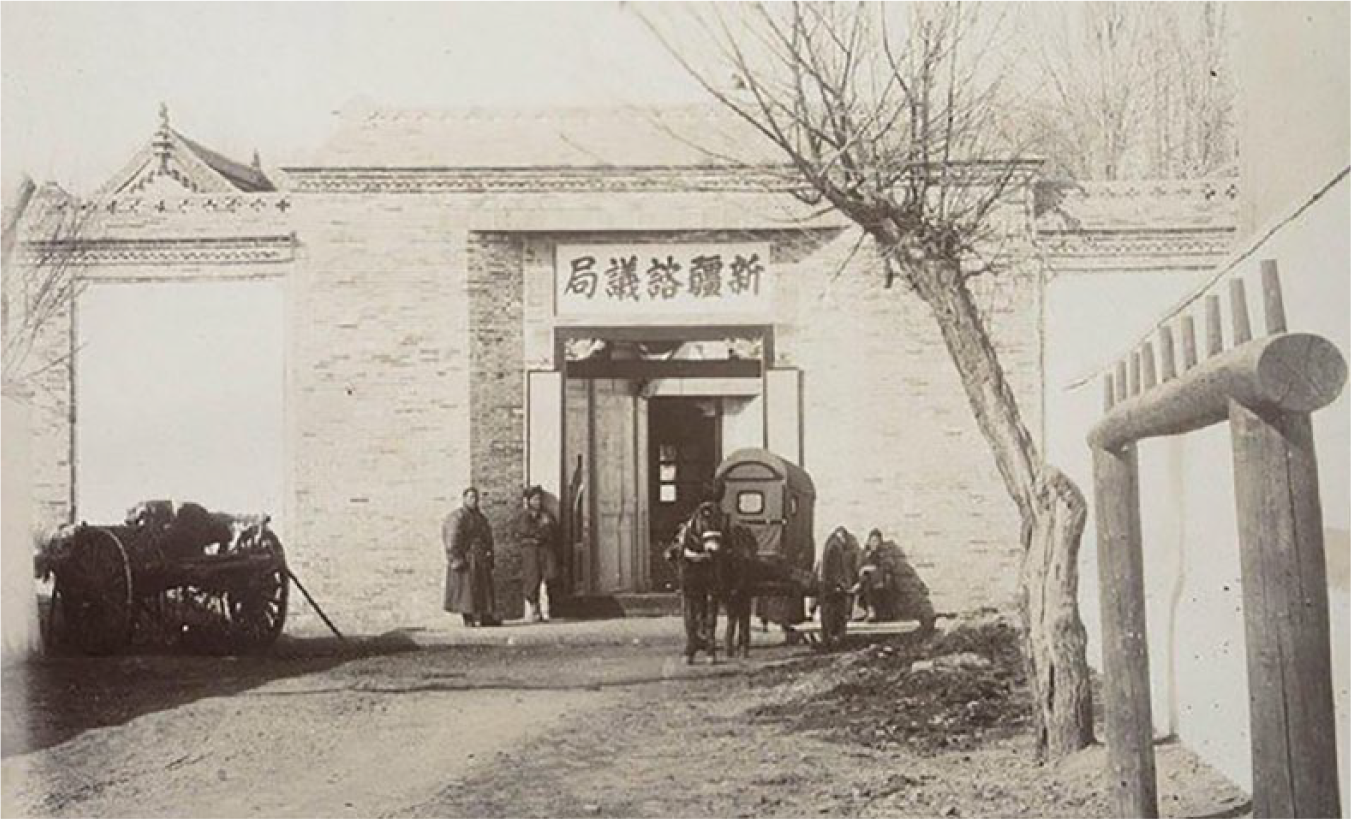
The constitutional and parliamentary questions, thus, emerge as part of a larger debate of how to approach Xinjiang—and other frontier regions—which went on well beyond the late Qing. In his recent doctoral dissertation, Eric Schluessel (2016, pp. 85–103) has found certain factionalism within the Xinjiang government as to what approach was the right one for the province, since the memorials of governor Liankui to the Throne often contain the differing, even contradictory voices of Dutong and Wang Shunan. Dutong was generally positive toward constitutional reforms: He sought to elevate the local Turkic populations into the new national community through education (Schluessel, 2016, p. 102) and, impressed with the Japanese model, built hundreds of schools which also taught in the medium of the local language (Schluessel, 2016, p. 88).
On the other hand, it was Wang Shunan who pressed to see Xinjiang as a “colony” (zhimindi 殖民地). Seeing the local populations as “uncouth barbarians” (shengliao yeman 生獠野蠻; Shenbao, 1909a), Wang’s stress lay on exploiting and developing the colony economically (see Schluessel, 2016, pp. 91–92). Just as the intellectuals who were discussing the topic in the capital, Wang was well-informed about global affairs, and made use of foreign examples to corroborate his positions. However, in contrast to Liang Qichao/Ma Xiangbo, who shunned the example of British India and rather turned to Ireland and Scotland, as well as to Russia, to advocate for limited borderland representation, Wang used the Indian and other models to justify as little representation as possible. Confering civil liberties to the natives of Xinjiang through voting rights was out of the question for the moment. After all, he argued, the constitutional governments of Great Britain, France, and Japan, too, governed their colonies like India, Annam, and Taiwan, autocratically. Wang observed that Great Britain had different categories of colonies governed according to the proportion of their white population and their supposedly correlated level of civilization, ranging from crown colonies with neither representative institutions nor a responsible cabinet, up to fully self-governed ones such as Australia, Canada, and Natal (Shenbao, 1909a). Wang’s model was not Australia or Canada (Schluessel, 2016, p. 91), but India, for . . . If the state suddenly confers sovereign rights of self-government to the natives in places were the natives were the majority and the whites the minority, the whites will not be able to control the natives, and there surely will be a rupture that will destroy the order and harm security. (Shenbao, 1909a)
However, although he saw Xinjiang at the level of a crown colony ruled directly by a governor, Wang did not see this as a permanent condition, or, at any rate, he could not express such a view because the central government had already decreed the establishment of a legislative assembly. His words, thus, had to offer a vision of how to gradually proceed to representative government, or as he himself put it, of how to slowly proceed “from autocracy to self-government, from self-government to unity” (you zhuanzhi er zizhi, you zizhi er tongyi 由專制而自治由自治而統一).
His text in Liankui’s memorial of 1909 takes up the question of language education, which, together with his emphasis on representative institutions only being present in colonies ruled by the “same race” (tongzhong 同種), reflects the discourse about assimilation that was being led by Yang Du, Zhang Taiyan and others (Shenbao, 1909a). The language question was, however, one aspect in his “developmentalist” and “radically materialist” perspective (Schluessel, 2016, p. 91): More than the education of the locals and the establishment of parliamentary institutions, what mattered most in this view was the economic exploitation of the colony. Or as Yuan Dahua 袁大化 (1851–1931) put it, Liankui’s successor as governor who followed Wang Shunan’s line, China should first develop railroads, the industry and the finances of the region, before the development of “military administration, education, police, judiciary, elections, self-government” and the like would become easy tasks (Shenbao, 1911a, 1911b).
Wang Shunan’s position was only that of one of the two factions within the Xinjiang government, and it was also severely criticized in mainstream constitutionalist Chinese media (see, for example, Meng Sen 孟森, 1909, p. 300, calling it “utterly shameful”—shu kekui 殊可愧). When the court investigated Wang for corruption, the censor Ruixian 瑞賢 (1845–?) also accused him of ignoring the constitutional reforms (on the faction and the investigation see Schluessel, 2016, pp. 93–98). Yet, he was not only one of the key figures in the last years of late Qing Xinjiang; out of his circle also emerged the long-term provincial strongman in the Republican period, Yang Zengxin 楊增新 (1864–1928, r. 1912–1928), whose rule, “in many ways” was “a realisation of Wang’s ideas” (Schluessel, 2016, p. 98; on the patron-disciple relationship between Wang and Yang see also Jacobs, 2016, p. 20).
The case of Xinjiang was a hybrid between a province that had to conform at least formally to the standards as all other provinces and a borderland that was not deemed not to be equal to the inner provinces. As such, it is perhaps the one which best highlights the tensions around which the debate about “borderland constitutionalism” revolved. Due to Xinjiang’s status as a province, the central government had more direct control than in Mongolia and Tibet, meaning that it was also pressed to treat it in equal terms as the provinces of Inner China, but also enabling discourses such as that of Wang Shunan defending its use as a colony. Pressure from foreign imperialism due to the low economic development and doubtful loyalty of the local population was feared in all borderland regions, but it was Xinjiang’s large Muslim population which prompted the Shenbao’s comment that without constitutional reform in China, Xinjiang might fall to the Ottoman Empire. Although, given the geographical distance between Xinjiang and the Ottoman Empire, such a fear might have seemed far-fetched even at that time, the comparison is revealing of the Eurasian constitutionalising pressures at work around 1908.
Borderland representation at the central level
The Zizhengyuan and its set-up
Although, thus, Xinjiang was in theory equal to all other provinces of the Empire, in practice, it remained without a representative assembly, just as the two other borderland regions of Mongolia and Tibet. But all these regions were integrated into the emerging late Qing parliamentary system through the Zizhengyuan (for a monographic treatment of the Mongol members of parliament in late Qing and early Republican times see J. Zhang, 2012). Carrying in itself the seeds of a future bicameral system, it was composed of 200 delegates, 100 of whom were to be sent by the provincial assemblies—the future lower house—while the other half was to be appointed by the Imperial Court —the future upper house. In the lower half of the Council, the representation of each province was roughly determined according the population of each province, with Xinjiang being accorded the minimum of two seats. As elections were not held there, the two seats remained vacant. When the Political Council convened, in 1910 and 1911, the total number of delegates for the lower half was thus of 98 instead of the planned 100 (see also Gao, 2011, p. 353).
As delineated, borderland representation happened in the upper half of the Council, where 14 were reserved from nobility of the Mongol, Tibetan, and Muslim regions. The Regulations for the Election of the Members of the Zizhengyuan (October 26, 1909; Xia, 2004, pp. 91–102) went into further details. Art. 1 of the section on the borderland delegates gave a list of titles defining what exactly was meant by “nobility of borderland regions,” while Art. 3 of the section further distributed the 14 slots geographically. The overwhelming majority was accorded to Mongol representatives: The article mandated that each of Inner Mongolia’s six leagues had to be represented by one delegate and each of Outer Mongolia’s four leagues had to be represented by one delegate. Kobdo and the Mongol banners in Xinjiang were represented by one delegate, as were the Mongol banners of Qinghai and elsewhere. Tibet and the Muslim regions were represented by one member each. The status of Xinjiang was rather peculiar. As the region had up to two slots in the upper half of the Zizhengyuan, it was in theory doubly represented in the Zizhengyuan, evidencing the region’s hybrid status between province and traditional borderland area.
Suitable candidates were to be selected in a first step by the Ministry of Inner Asiatic Affairs, and then to be confirmed by the Zizhengyuan, which would retransmit the list to the Court. The Court would then use the Zizhengyuan’s list to determine the 14 delegates for the next session of the Council. Notwithstanding the complaints heard in the capital about the scarcity of prepared people in Mongolia, in 1909, the Ministry of Inner Asiatic Affairs identified 259 candidates who were eligible for the 14 slots (Su & Wu, 2008, p. 69; Xuebu guanbao, 1909, p. 5b, have 279 candidates; for a full list of the 14 borderland delegates see J. Zhang, 2010, p. 199).
What was then the significance of these 14 borderland slots in the emergent upper house? As Su Qin 蘇欽 and Wu Xianping 吳賢萍 (2008, p. 68) have noted, the borderland representation scheme respected the system of governance over the Mongol regions which had been adopted since the beginning of the Qing Empire, treating their nobility on equal terms with the Manchu and Han nobility. It was an attempt to transpone the personalized old system of creating loyalty among the non-Han elites into a new parliamentary setting. By doing so, it was also the first time when representatives of the non-Han population of the three borderland regions had a right to directly participate in an organ of the central government with jurisdiction for the whole Empire (Su & Wu, 2008, p. 70). Although many of the 14 minority members remained unconspicuous, perhaps most remarkable among them were the business partners of the aforementioned Mongolia Industrial Company, three of whom were elected to the Zizhengyuan: Güngsangnorbu (1871–1930), Nayantu (1873–1938), and Bodisu (1871–1914). For them, the participation in the Zizhengyuan was only the first parliamentary experience, as they would later become members of the Republican Senate (On the first ones see Atwood, 2002, pp. 83–87, 96–98, 278–281, 311, 947–949, and passim).
Prospects for a definitive national assembly
The Zizhengyuan was only temporary, to be abolished after the establishment of a permanent National Assembly. But what were, then, the long-term plans for the application of the Qing constitution to the borderland territories? Indeed, both the government and a large part of constitutional scholarship considered how to deal with the borderland regions. As the conditions were so different from inner China, most of scholarship proposed to continue with a differentiated solution in the definitive Imperial constitution for as long as the real conditions on the ground did not substantially change.
A full official draft of the final constitution was never produced, as the drafting process was interrupted by the Xinhai revolution, but the two private constitutional drafts that were published in book form at that time both mention the issue of the borderlands. The Japanese scholar Kitaoni Saburō 北鬼三郎 (?–1912), in the prefatory remarks to his Draft Constitution for the Qing (Daishin kenpōan 大清憲法案), published in 1909, only included a brief remark on the topic, excusing the lack of norms concerning the borderlands with his not yet having examined the issue. It is perhaps telling of the limitations to the role of Japan as a model for the late Qing constitution that it was the Japanese scholar Kitaoni who did not offer a substantial contribution to the borderland question. Although he also studied the application of mainland Japanese law to Taiwan, Karafuto, and Korea (Kitaoni, 1910), it did not occur to him to draw parallels to China. Instead, Kitaoni wrote, the borderland lacuna in his draft should neither mean that the borderlands should be treated the same as inner China—at the moment, at least, he deemed this to be clearly impossible—nor that they should continue to be governed according to the old system (Kitaoni, 1909, p. 4).
Where Kitaoni was not able to offer a clear answer to borderland constitutionalism except that these regions merited special treatment, Zhang Bolie, a Qing-loyal Chinese student who resided in Japan, offered a specific norm with a long justification in his Hypothetical Draft of a Constitution for China (Jiading Zhongguo xianfa cao’an 假定中國憲法草案), which was published in the same year of 1909. His art. 42 explicitly foresaw a specific borderland representation in the Upper House of parliament, not unlike the one already stipulated for the Zizhengyuan. The article contained an astonishing blunder: Its justification (B. Zhang, 1909, pp. 36–37) was a plagiarism of the Zhengwenshe statement originally drafted by Liang Qichao. Zhang maintained the criticism of the Qing government for failing to provide political representation to Mongolia and Tibet, without noticing that the government had heeded that exact criticism. Thus, his norm, independently drafted by him as a suggestion for a final parliament, closely reflected the already existing constitutional practice of the Qing, at least in regard of the borderlands: The Upper House shall be organised according to the election law passed by the Upper House. It shall be composed of imperially selected (nobles with a status of) princes and higher and of borderland princes, as well as of as popularly elected delegates who have undergone a second round of selection (by the provincial assemblies). (B. Zhang, 1909, p. 36)
Zhang’s arguments were all also to be found in Bao Tingliang’s 保廷樑 (1874–1947) œuvre On Qing constitutional law (Daqing xianfa lun 大清憲法論), which is probably also the opus magnum of late Qing constitutional scholarship. At 507 pages, it was the most extensive compendium of constitutional law produced in Qing times. Discussing all kinds of problems of constitutional law with copious references to foreign scholarship and legal norms, it also gave detailed recommendations as to what policy the Qing Empire should apply. In contrast to Zhang and the official policy, Bao foresaw popular representation for the borderlands, albeit, citing the remoteness of the border regions and difficulties of transportation, a very modest one: Two delegates for Inner and Outer Mongolia each, and two delegates for Western and for Eastern Tibet each (Bao, 1910, pp. 206–207).
Bao’s stress, therefore, also lay in the Upper House (Bao, 1910, pp. 149–150). For him, borderland representation was a matter of course (dangran 當然), as the term “Qing Empire” used in Art. 1 of the official Outline of a Constitution was not restricted to the provinces of Inner China. Bao’s argument, thus, also was directed at China’s national sovereignty. Having the same outer imperialist threats in mind as Zhang and others, Bao spelled out how important borderland representation was to foster national cohesion in the creation of a unified nation-state: To discuss this from the facts, it happens that although (the central government) has instituted supervisory officials for Mongolia and Tibet, (these regions) do not usually have contacts with the inner territory. Script and habits are separated like heaven and earth. Although by name they belong to the territory of the Great Qing, in reality one could well-nigh forget that they are the same country. Furthermore, strong neighbours are lurking and frequently use lure and coertion (qie qianglin huansi, wangwang liyou weipo 且強鄰環伺。往往利誘威迫。). Therefore, we cannot fail to rely on this (upper-house representation) in order to solidify their determination, and in order to import civilisation for them. This, again, is a point that cannot miss in political strategy. (Bao, 1910, p. 150)
The borderlands in the practice of the Zizhengyuan
If late Qing officials and intellectuals spend so much energy in defining the place the borderlands in the nascent deliberative assemblies of the Empire, how did the regulations work out in practice? According to the rhetoric used in the commentaries to the legal norms, authorities stressed the importance of the matters concerning the borderlands before both sessions of the Zizhengyuan (1910 and 1911). In 1910, for example, Prince Regent Zaifeng 載灃 (1883–1951) stated that “all motions concerning Mongolia” were “more important than the others” (suoyou guanyu Mengfan yi’an, jiao ge yi’an you wei zhongyao 所有關於蒙藩議案,較各議案尤爲重要; Dagongbao, 1910a; for a similar statement the next year see Dagongbao, 1911c). Such matters included, among others, the industrial development of Mongolia, which had a lobby group in the assembly in the form of the partners of the Mongolia Industrial Company. Yet, reality was much less rosy.
One often finds complaints about the borderland delegates being out of place and not contributing anything to the Council, such as the magazine Guofengbao 國風報, which reported that most borderland delegates even “did not know what the Zizhengyuan is” (duo bu zhi Zizhengyuan wei he wu 多不知資院爲何物; Guofengbao, 1910, p. 6). Indeed, while some of the Mongol delegates were already resident in Peking, some others came from their home regions and had little knowledge of Chinese in either spoken or written form (Uljitokto, 2009, p. 40). The Tibetan delegate, an ethnic Mongol, was hindered by the difficult transportation from Tibet to Peking, arrived two months late and missed most of the session (Guofengbao, 1910, p. 6).
The delegates from Outer Mongolia, particularly, seemed to have difficulties taking part in the activities of the Zizhengyuan because of linguistic difficulties (Guofengbao, 1910, p. 6; Dagongbao, 1910b). The government tried to address these by providing interpreters to the delegates (Guofengbao, 1910, p. 6; Dagongbao, 1910b). However, problems with the new format of public oral debates in the Zizhengyuan were not exclusive of the borderland delegates, but included all imperially appointed members, who had had no experience at the provincial assemblies, and for whom the government created a “training ground” (lianxisuo 練習所; Dagongbao, 1911b) to prepare for the second session of 1911.
Some of the more dismissive comments about the borderland delegates, such as the Guofengbao’s, probably reflected a certain patronizing attitude by the public, but they also coincided with a regional division within the Mongol group of delegates. As noted above, a regional assembly was considered for Inner Mongolia, and it were mainly Inner Mongolian elites who were interested in the Qing constitution. In addition to them, some Western Mongol figures were also known for their involvement in constitutional politics, such as the aforementioned Prince Palta from the Torghut Mongols of Xinjiang, as well as the Kobdo delegate in the Zizhengyuan, Sodnomjamtsoi (Suotenamuzhamuchai 索特那木札木柴, ?–?), who was noted for both his knowledge of Chinese and his enthusiastic work (Dagongbao, 1910c). This relative closeness of Inner and Western Mongolia to the constitutional reforms had deep-seated historical roots: Over the nearly three centuries of Qing rule, Inner Mongolia had differed much from the regions further in the north. Inner Mongolia had surrendered to the Manchu as early as in 1636, much earlier than the Mongolian tribes further north. Inner Mongol princes then had helped the Manchus conquer China and intermarried more with them, being generally closer to the Manchu elite. Furthermore, the regions of Inner Mongolia came to be much more penetrated by Han agriculturalists and merchants. Inner Mongolia became more urbanized, had more administrative infrastructure developed and was under closer control of the Manchu government. (see Lan, 1996, pp. 47–59; see further Atwood, 2002, pp. 23–42)
Hence, it was especially among a part of Outer Mongolian princes that an incipient independentist sentiment was palpable around 1910. As the Qing system was eroding, they were loath of the increasingly aggressive policy led by Peking, which threatened to replace the traditional relationship of suzerainty to the Manchu by the sovereignty of a Chinese state (see Liu, 2006, p. 7; Rupen, 1954, pp. 235–236). Khalkha nobles then declared independence on December 1, 1911, 2 months after the beginning of the Wuchang 武昌 Uprising, which led to the proclamation of the Republic of China. However, preparations for secession had begun months earlier, and while the Wuchang Uprising may have triggered the declaration of independence, its actual roots lay in late Qing times (Rupen, 1954, p. 249; Liu, 2006, p. 7; Tachibana, 2014, pp. 69–70). In this context, it certainly did not help that, at the first session of the Zizhengyuan in 1910, none of the motion proposals concerning economic, military and educational matters of Mongolia was successful, leaving some of the delegates so disappointed that they declared not to come again the next year (Dagongbao, 1911a).
The high importance of Mongolia and Tibet in rhetoric was not fully replicated in practice. If political actors had hoped that the system of borderland representation would help prevent centrifugal tendencies in the outer regions during China’s transition from empire to nation, the two sessions of the Zizhengyuan in 1910 and 1911 did not advance this goal. Nonetheless, borderland representation in the parliament considerably outlived the Qing dynasty. In Xinjiang, where there had been no real interest in breaking away in late Qing times, the status as a province given to it in late Qing times precluded special Muslim representation, but Muslim aristocrats continued to demand it (see Brophy, 2012). However, Republican electoral practice for Mongolia, Tibet, and Qinghai, came close to granting ethnic quotas for these regions (Brophy, 2012, pp. 350–351; Su & Wu, 2008, p. 70).
Conclusion
In view of the underwhelming results of the first two sessions of the Zizhengyuan in its Mongolia-related matters, Zhang Jianjun 張建軍 has argued that the Mongol delegates “were only a few pawns used to increase and protect the governing power of the Qing Court” (zhi shi xie zengjia weihu chaoting tongzhi shili de fama 祇是些增加維護朝廷統治勢力的砝碼; J. Zhang, 2010, p. 203). However, the function of late Qing borderland representation cannot be so easily dismissed. In as far as it was devised to integrate the Qing-Empires vast non-Han regions into the Qing Empire‘s emerging constitutional system and thus to secure sovereignty over these regions of doubtful loyalty, it was a significant element in the creation of a modern Chinese nation-state.
The inclusion of Mongol, Tibetan, and Muslim candidates into the upper half of the Zizhengyuan was the result of a compromise. On the one hand, the majority opinion did not see Mongolia, Tibet, and Xinjiang as fit for the new parliamentary institutions, which were “premised on the existence of a pool of educated Han gentry outside the bureaucracy—a milieu conspicuously lacking” there (Brophy, 2012, p. 350). On the other hand, the integration of these regions into the new constitutional system was indispensable in the eyes of Chinese intellectuals and officials, not least because the frontier regions were deemed to be especially vulnerable to secession as well as foreign imperialism.
In a way, the borderland representation scheme devised in this way transposed traditional modes of differentiated government into the constitutional age. David Brophy (2012, p. 358) distinguishes two models of managing diversity: the “patrimonial” one whereby the Qing gave aristocratic privileges in return for loyalty to the Han governor on a personal basis, and the “constitutional” one, which sought for parliamentary representation for China’s non-Han ethnicities. These two models were not entirely separate, however. In fact, the borderland representation scheme in the late Qing constitution was an attempt to convert the old method of bestowing aristocratic privileges in return for loyalty into a new method of bestowing parliamentary representation in return for loyalty.
At the same time, the borderland representation scheme was also informed by a knowledge of constitutional systems outside of China. In contrast to the frequent analysis of the Qing constitutional movement under the Japanese prism, the Japanese experience did not offer too many references in regard to the borderlands, except for the occasional mentioning that the Meiji constitution did not apply to Taiwan and Hokkaidō. Rather, the argument that similar minority representation existed in the case of Great Britain’s “internal colonies” such as Scotland and Ireland prevailed over comparisons with overseas colonies without any representation, such as British India. Perhaps most importantly, in spite of the often condescending and patronizing attitude toward the frontier regions, there was a significant fear that the global constitutional trend might inspire reformist and constitutionalist movements in Mongolia, Xinjiang, and Tibet, leading to separatism if the Qing Empire did not carry out constitutional reforms herself. Hence, the debate about how to deal with these regions was a local element of a Eurasian movement defining parliamentary assemblies and constitutions as indispensable elements of modern statehood.
Footnotes
Acknowledgements
The author is grateful to the anonymous reviewer as well as to Christopher Atwood, Jargal Badagarov, Peilin Chiu, Asanuma Chie, Pei-chih Chou, Stanley Ong Gieshen Setiawan, Lisa Lindkvist Zhang, Ying-kit Chan, and Hung Tak Wai for their helpful comments and suggestions.
Funding
The author(s) disclosed receipt of the following financial support for the research, authorship, and/or publication of this article: This work was supported by the European Union’s Horizon 2020 research and innovation program under grant agreement no. 649307.