




Abstract
This study investigates citizenship representation styles and their compositional modalities in contemporary Georgia. The article starts with a discussion of legal, social, and political influences that shaped conceptions of citizenship in post-Soviet countries, including Georgia. The study presents the results of a survey of 700 students from 10 universities in Georgia. They completed questionnaires exploring citizenship styles and associated predictor variables. The study suggests that a cultural citizenship style is dominant among Georgian students. It is best predicted by the level of national identification, followed by patriotism, nationalism, in-group attitudes, and religious orthodoxy. The data also show the opposing roles of nationalism and patriotism on ethnic and civic citizenship styles. The article argues that a cultural citizenship representation style could be the compromise solution in the ethnic versus civic citizenship dichotomy and might be more appropriate for societies characterized by ethno-nationalist tendencies.
Introduction
Citizenship is a social identity denoting criteria that people use to decide who they regard as fellow citizens (Brubaker & Cooper, 2000). It remains the subject of legal, social, and political debates.
Citizenship is understood in two ways. The first defines citizenship as an institutional model, which evolved through historic and political processes (Kohn, 1944; Marshall & Bottomore, 1992; Smith, 1991). Scholars supporting this view generally explore citizenship in a state-centered perspective, emphasizing rights, duties, obligations, and the criteria for becoming members of a national community. The second view considers citizenship as personally defined by the subjective imagination of the meaning of nationality, that is, identity. Behind this view, citizenship has a substantive psychosocial dimension that involves a sense of being part of a larger entity (Jamieson, 2002; McCrone & Kiely, 2000; Portis, 1986).
Social psychology offers a theoretical framework to study and conceptualize the abstract principles that engender citizenship styles including in-group and out-group dynamics, group boundaries, membership status and criteria, social perception, attitudes, stereotypes, and discrimination. Moreover, citizenship is a self-categorization construct, which defines in-group membership and has a direct effect on people’s everyday actions and attitudes (Reijerse, 2012).
Researchers traditionally have put forward nationalist, civic, social, and political models of citizenship (Kohn, 1944; Marshall & Bottomore, 1950; Schuck, 2009; Smith, 2011). As Schuck (2009) claims, these models are “analytically distinct but conceptually, politically, and legally related” (p. 152). They denote specific elements, such as civil, political, and social rights; territoriality; and participation in economic and social life.
In this article, I explore civic, ethnic, and cultural citizenship representation styles and their attitudinal predictors. First, I present a theoretical overview of conceptualizations of citizenship in post-Soviet countries. Then I discuss the Georgian case, including social, political, and legal dimensions of citizenship. As citizenship has social/psychological meaning apart from the legal aspects of citizenship, I use a deductive approach to deconstruct citizenship into citizenship representation styles, and identify attitudinal dimensions for each citizenship style. I argue that people appear to view citizenship as distinct from the legal context and political discourse. I look at the criteria that creates civic, ethnic, and cultural citizenship styles and link them to nationalist, religious, and cultural attitudes.
The study involved 700 students aged 18 to 24. I used a convenience sampling approach and recruited students from different universities located in West, East, and South-East Georgia. A student sample was chosen, because they are the future actors in political life, and thus understanding their citizenship styles is important. Even though this limits the external validity of the data, the study still contributes to the field of citizenship studies, particularly given the analytic rather than descriptive nature of the study.
This article attempts to contribute to the field of citizenship studies theoretically and empirically. On a theoretical level, it shows how citizenship as a legal and social concept has evolved over the decades in Georgia. This is discussed in the wider context of post-socialist countries, and identifies a number of similarities and differences in citizenship regulation and practice. Second, on an empirical level, the study estimates the impact of religious, cultural, and nationalist attitudes on ethnic, cultural, and civic citizenship representation styles among Georgian students.
Development and dynamics of citizenship trends in post-Soviet countries
After the dissolution of the Soviet Union, two major circumstances shaped the politics of the newly independent states: national upheaval and economic crisis. These factors lead to chaotic and conflicting times. People faced harsh economic conditions after independence and national sentiments were amplified. The long-time deprivation from national self-expression (self-determination) brought nations to another extreme and gave rise to ethnocentrism, chauvinism, and discrimination toward those who had a different language, culture, and/or religion. When the nation is defined in terms of race, language, and culture, the equality of citizens cannot be guaranteed. Consequently, the model of citizenship is based on ethnicity.
Ethnicity-based democracy was attractive for the former Soviet republics, as it legitimated ethnic majorities’ power over other citizens (Smooha, 2002). On one hand, ethnic democracy helped retain the basic principles of democracy, on the other hand, it retained racial, ethnic, and cultural purity within the discourse.
In some post-socialist countries, the citizenship law was designed to control minorities. One example of this is in the republics of the former Yugoslavia. There “state socialism” turned into “state chauvinism,” and “class,” formerly a basic category of social/political discourse, was replaced by “nation.” Moreover, the citizenship law was used to control minorities: citizenship determined not only most basic rights but also the right to property, work, and residence. Differentiation was not made between natives and newcomers: even people who had long lived in the territory were subjected to intolerance and injustice (Hayden, 1993).
Political disintegration and political instability in post-Soviet countries fueled a surge in ethnic conflicts. Those conflicts promoted more chaos. In eastern and southern Europe (Yugoslavia and Czechoslovakia) as well as in six former republics of the Soviet Union (Russia, Azerbaijan, Armenia, Georgia, Moldova, and Tajikistan), ethno-cultural divisions escalated into armed conflict (Shevel, 2009; Smooha, 2002).
Georgia was not an exception. In the 1990s, the collapse of the Soviet Union was followed by a surge of nationalism. The 1990 legislative elections brought to power the nationalist electoral coalition, “Round Table,” who popularized the slogan “Georgia for Georgians.” This slogan perfectly reflected the spirit of Georgians toward those who had different ethnic backgrounds: Armenians, Azerbaijanis, and Russians among others. These circumstances indicated that the law on Georgian Citizenship would likely be ethno-nationalist/exclusive. However, it never happened. Instead, unlike in many post-Soviet countries, Georgia passed an inclusive/civic law on citizenship. During the Soviet period, as every republic in the Union of Soviet Socialist Republics (USSR), Georgia had an inclusive citizenship policy. It was possible to acquire citizenship by territory of birth, that is, even if one’s parents were not Soviet citizens, it would be possible to obtain Soviet citizenship. Even in the case of naturalization, no knowledge requirements (e.g., of language, history, or the constitution) were set to obtain Soviet citizenship (Soviet Union, Vladimirtsev, Kaliteevskaia, & IUmashev, 1975).
After the dissolution of the Soviet Union in 1991, the Supreme Assembly of the Republic of Georgia passed a draft law on citizenship. It envisioned the automatic acquisition of Georgian citizenship to everyone who was a permanent resident at the time, had a permanent job/legal source of income or any property on Georgian territory, and expressed their willingness to become Georgian citizens. It is noteworthy that despite the excessive nationalism that was present in Georgia, the draft law did not differentiate between Georgian and non-Georgian ethnicities. Taking into consideration the nationalist attitudes of political elites who ruled the country, the purely civic citizenship law was quite surprising. Some scholars talked about this as an unimaginable reality, because society was divided by ethnic conflict (Shevel, 2009).
In 1992, the political regime and ideology turned pro-Russian and ethnocentrism diminished. But when the newly established parliament started to discuss a new citizenship law, contradictory ideas emerged reflecting the concern that easy naturalization would allow countries in the neighborhood to influence Georgia. The obligation of 15 years residence for citizenship through naturalization was reduced to 10 years and the law was in force until 2008.
The next change occurred in 2003 with the Rose Revolution. It brought Western-oriented, young politicians to power with the slogan “I am Georgian, therefore I am European.” It was a dramatic shift of social identities: the ethnic concept on Georgianness was replaced with a European one (Beacháin & Coene, 2014; Kakachia & Minesashvili, 2015; Mestvirishvili & Mestvirishvili, 2014; Nodia, 2009).
From 2008, the Georgian government designed a new citizenship regulation. Georgian citizenship could be acquired by birth or by naturalization. To acquire citizenship by birth required having one parent to have Georgian citizenship. Citizenship by naturalization could take place through permanent residency within the territory of Georgia for 5 years, knowing Georgian language at an established minimum, being familiar with the history and legislation of Georgia at an established minimum, having a job or any real estate on the territory of Georgia, entrepreneurial activities on the territory of Georgia, or a share in a Georgian enterprise (Art. 26 of the Organic Law on Citizenship of Georgia). After the Rose Revolution, dual citizenship was frequently permitted and President Mikhail Saakashvili used to grant this right to many foreigners and Georgians living abroad by “exceptional means.” Currently, the Georgian Constitution allows dual citizenship for people who hold high governmental positions such as president, prime minister, and parliamentary chairman.
The Georgian Government tried to adopt a liberal and Western-oriented approach, making a clear distinction between ethnicity and citizenship, stating that everybody has equal rights to obtain Georgian citizenship regardless of his or her ethnic origin (Saakashvili, 2007). However, recent survey results indicate that for 63% of Georgians, having Georgian ancestors is an important criteria for citizenship and for 62%, it is important to be born in Georgia (Inglehart et al., 2008). This result shows that citizenship is not just a passive criterion, which connotes rights, ethnic belonging, group membership, an idea of inclusion, and legal privileges but also a socio-psychological construct that implies personal-level factors such as social perceptions of in-group boundaries and nationalist, cultural, and religious attitudes.
Theoretical background
Citizenship discourses are influenced and generated by the mutually reciprocal relationship between individuals and society. Citizens are actors, who influence society, but they also accept the responsibilities of being a member of society. On one hand, there are political and legal institutions and cultural and religious traditions that influence citizenship styles. On the other hand, there are personal factors, emotions, attitudes, beliefs, and expectations that shape citizenship styles. In this study, individual-level analysis is employed to explore how citizenship is constructed and represented among Georgian students.
I use a deductive approach to deconstruct citizenship into subcategories: citizenship styles and personal-level variables such as social and cultural attitudes, religious beliefs, and national feeling.
Traditionally, the literature identifies two styles of citizenship: ethnic and civic. The ethnic citizenship style assumes that the existence of genealogical bonds is essential to be a member of a dominant ethnic group. It has an exclusionist and essentialist nature: language, territory, and blood ties/common ancestors are the main components of the ethnic citizenship style. When these are presented, then membership in the national group is guaranteed. However, essentialism shrinks group boundaries, because national belonging is defined by ethnic origins. In contrast, the civic style of citizenship is more inclusive. It could be granted to those who respect and recognize a country’s laws and who actively participate in the country’s social and political life. Civic citizenship focuses on the duties, rights, and privileges of community members. Special focus is made on traditional election activities: voting, board membership, and community-organized social activities. Civic citizenship criteria are inclusive: everyone regardless of ethnic origin could become a member of the national group who respects and obeys the country’s laws. The theoretical ethnic–civic dichotomy structure was shown empirically by data from 33 societies: having national ancestry was primarily related to ethnic citizenship, while obeying the national laws to the civic one (Reeskens & Hooghe, 2010).
Recently, the ethnic–civic dichotomy of citizenship styles was questioned by researchers, who hypothesize that in modern society, there is also a third style—cultural citizenship (Kymlicka, 1995; Vega & Hensbroek, 2010; Stevenson, 2003). Cultural citizenship links political rights and responsibilities to the cultural power, thus expanding the legal framework of citizenship status into the cultural sphere (Hudson & Slaughter, 2007; Pakulski, 1997). It is a discursively constructed concept, sensitive to culture-related issues, conveying more symbolic than normative meaning. People with a cultural citizenship style show high degrees of respect toward the national culture and an eagerness to protect it (Reijerse, Van Acker, Vanbeselaere, Phalet, & Duriez Bart, 2013). Consequently, anyone who adopts, respects, and protects elements of the national culture could obtain membership in the national group (see Table 1).
Criteria and group boundaries for citizenship representation styles.

Citizenship representation styles are created under the influence of social, political, and cultural attitudes. Past studies suggest that nationalist attitudes play a central role in determining political ideology and socio-political behavior (Todosijević, 2001). For instance, nationalism is positively associated with conservatism (Baughn & Yaprak, 1996; Sharma, Shimp, & Shin, 1995; Sullivan, Piereson, & Marcus, 1993), out-group derogation, and negatively correlated with level of education (Howard, 1990; Sharma et al., 1995). Considering this evidence, I hypothesize that nationalist attitudes might also have a considerable effect on how people perceive and practice citizenship styles. I also test whether cultural attitudes influence citizenship styles.
Individualism/collectivism (IC) is one of the major classifications of cultural attitudes. IC is a cultural dimension based on a set of values and beliefs people have about how the world works as well as the norms of behavior derived from that set of values (Gorodnichenko & Roland, 2012). The IC cleavage is considered the single most important dimension in cross-cultural psychology (Heine & Ruby, 2010; Oyserman, Kemmelmeier, & Coon, 2002). It has been considered as a descriptive norm, which helps to understand individuals’ self-identification, behaviors, values, goals, and interrelations. Past studies indicate that IC is related with national identification (Takano & Osaka, 1999) and social attitudes (Federico, 2006). However, it remains unknown whether or not and how IC is related to citizenship styles. Finally, I test whether the religious dimension is a determinant of citizenship style.
In this study, special emphasis is made on nationalist and religious attitudes as potentially robust predictors of ethnic citizenship style. The reasoning is that contemporary Georgian society is characterized by a high level of nationalism, religiosity, and conservatism. According to the Caucasus Barometer (The Caucasus Research Resource Centers, 2011), national identity is one of the most salient social identities: 60% of Georgians primarily identify themselves with their own nationality, and 98% report being very proud or quite proud of their nationality. However, when asked about the criteria for good citizenship, only 37% of Georgians say that being critical toward the government is extremely important and 80% think that following traditions is extremely important for a good citizen. Moreover, 82% of Georgians fully or somewhat trust religious institutions. By comparison, only 23% trust the president and 22% trust the courts (The Caucasus Research Resource Centers, 2013).
Even though Georgia passed its citizenship law based on civic criteria, the high level of nationalism, religiosity, and national self-identification in Georgian society sparks doubt that on the individual level, people might not pursue civic/inclusive criteria of citizenship, but instead choose ethnic/exclusive criteria.
Notably, Saakashvili’s administration promoted inclusive nationalism by signaling that irrespective of ethnic origin, all Georgian speakers were to be welcomed. This linguistic turn affected the attitudes of the young generation who prefer language as the main criteria for in-group membership to ethnicity (Berglund, 2016).
The aims of the study are to (a) identify which citizenship style is generally endorsed by adolescents in Georgia: ethnic, civic, or cultural? (b) and to estimate the predictive power of nationalism, patriotism, positive in-group attitudes, IC, and national identity for each citizenship style. I hypothesize the following:
Ethnic citizenship style is the prevailing citizenship representation style among study participants.
Civic citizenship style is positively predicted by patriotism and individualism, but negatively by nationalism.
Ethnic citizenship is positively predicted by nationalism and religious orthodoxy, and negatively by patriotism.
Religious orthodoxy is a dominant predictor variable for ethnic citizenship style.
Method
Participants
Participants were recruited from seven major universities in Georgia: Three of them are located in the capital city; another three are universities in the eastern, central, and western parts of Georgia. Overall, 430 female and 270 male students between the ages of 18 and 24 (M = 1.66, SD = 2.10) completed the questionnaire.
Procedure
All respondents were recruited during the daytime from the universities and participation was voluntary. Interviewers invited five to 10 students into a small auditorium, where they were provided paper questionnaires. Interviewers introduced the basic principles of how to fill out questionnaires. Instructions were also included in the questionnaire. All items were evaluated on a 7-point Likert-type scale. Respondents provided detailed information about socio-demographic characteristics at the end of the survey.
Measures
Citizenship representation styles
The citizenship representation style scale consists of three subscales, each related to the three different citizenship types: ethnic, cultural, and civic citizenship. Items related to ethnic citizenship emphasize membership in ethnic groups (e.g., common ancestors). Cultural citizenship items emphasize care and protection of a dominant national culture. Civic citizenship items emphasize respect for norms and laws, as well as active engagement in public life.
National identity and in-group attitudes
National identity is intended to measure different properties of national identification. Five items aim to explore the extent to which respondents identify as Georgian. In addition, 12 adjectives reflecting personal characteristics were selected to understand whether respondents’ in-group attitudes stemmed primarily from cognitive and/or emotional valuation of national group members.
Patriotic and nationalist attitudes
To measure patriotism as an attitude, I have employed the subscale of Kosterman and Feshbach (1989), which was originally titled the patriotism scale and includes items that measure feelings related to the homeland. I did not use nationalism subscales from the same questionnaire, because items from the nationalism subscales emphasized the United States’s military, political, and economic strength/dominance. These were therefore irrelevant in the Georgian context. In studying nationalist attitudes, I used a 17-item nationalism scale developed by Todosijević (2001). This scale includes items that reflect both ethnocentric and romantic forms of nationalism that are relevant for most countries.
Religious orthodoxy
To study religious orthodoxy, I employed the religious orthodoxy subscale from the Post Critical Belief Scale Duriez, Soenens, and Hutsebaut (2005) developed. This scale consists of 39 items that capture four different religious representation types located in two-dimensional space. Accordingly, the Post Critical Belief Scale measures four different religious orientation types: Orthodoxy, second Naiveté, relativism, and external critique.
Individualism–collectivism (IC)
Fischer’s IC scale (Fischer et al., 2009), which is based on Triande’s theory and is a revised version of Yamaguchi’s (1994) original IC scale is used. Twenty-two pairs of statements reflecting collectivism and individualism as opposite orientations are placed on opposing poles of a 7-point scale.
Results
The descriptive findings show that 56% of respondents pursue a cultural style of citizenship, 25% civic, and 19% ethnic. A correlation matrix shows that cultural citizenship style is positively associated with patriotism, nationalism, and religious orthodoxy, whereas, civic citizenship style has no association with nationalism and is only weakly associated with religious orthodoxy and patriotism. Ethnic citizenship style is also positively associated with nationalism, religious orthodoxy, and patriotism (see Table 2).
Correlation and descriptive statistics for citizenship styles, nationalistic attitudes, religious dimensions, and individualism/collectivism.
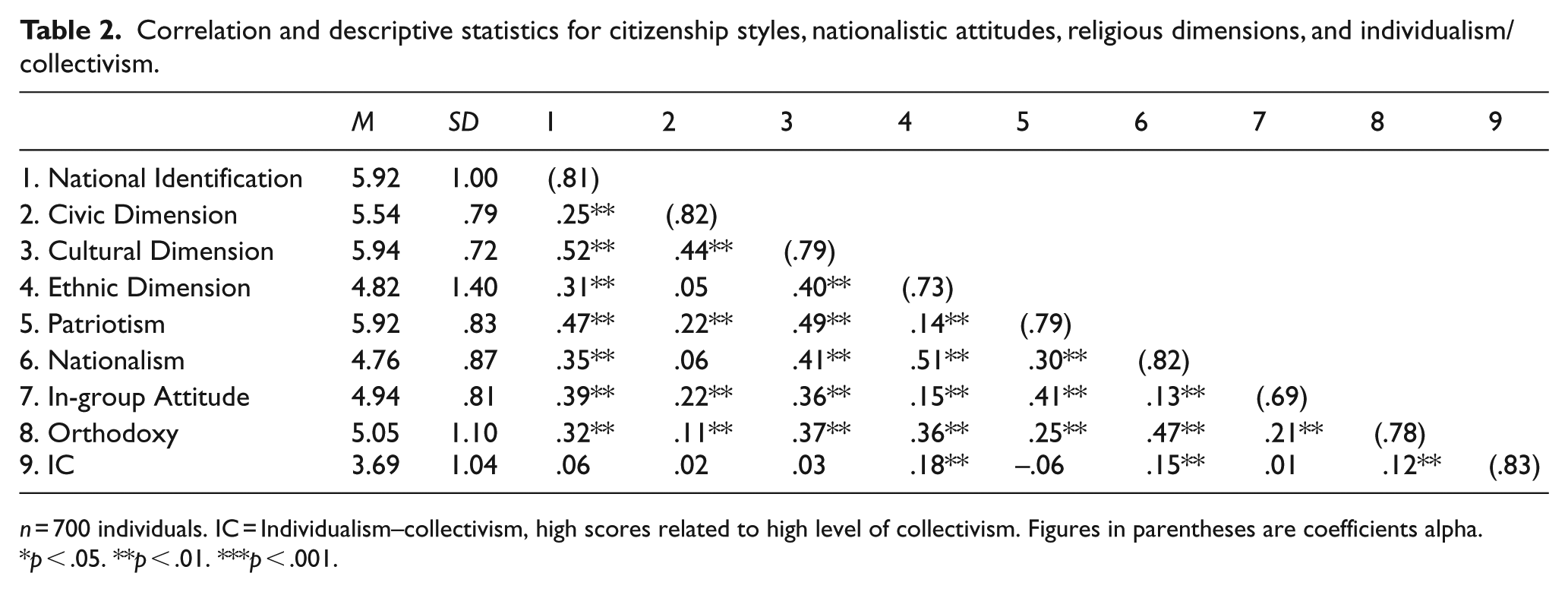
n = 700 individuals. IC = Individualism–collectivism, high scores related to high level of collectivism. Figures in parentheses are coefficients alpha.
p < .05. **p < .01. ***p < .001.
While religious orthodoxy was assumed to be the influential variable in defining citizenship representation styles, moderation analysis was performed to understand the role of religion on citizenship representation styles. As Figure 1 illustrates, the regression coefficient between patriotism and ethnic citizenship style decreases substantially when religious orthodoxy is entered into the equation (Sobel z = 5.5108, p = .00).
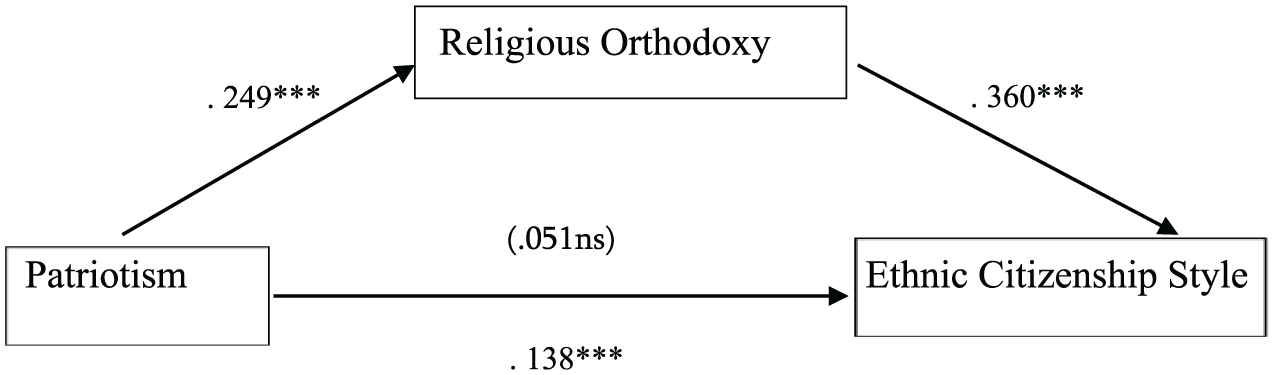
Mediation analysis for ethnic citizenship style.
In Step 1 of the mediation model, the regression of ethnic citizenship representation style total scores on patriotism scores (N) (ignoring the mediator) was significant, b = 0.138, t(700) = 3.367, p = .00. Step 2 showed that the regression of the mediator, religious orthodoxy scores, was also significant, b = 6.45, t(192) = 0.249, p = .00. Step 3 of the mediation process showed that the mediator (Orthodoxy), controlling for the patriotism scores, was significant, b = 0.347, t(700) = 9.534, p = .00. Step 4 of the analyses shows that controlling for the mediator (religious orthodoxy), patriotism scores were no longer a significant predictor of ethnic citizenship scores, b = 0.051, t(192) = 1.410, p = .159. A Sobel test was conducted and found partial mediation in the model (z = 5.5108, p = .00).
Religious orthodoxy is strongly associated with ethnic citizenship style and has the power to form the relationship between other interconnected variables. Patriotism was no longer associated with ethnic citizenship style when the influence of religious orthodoxy was controlled for. This suggests that the only reason why patriotism would be associated with ethnic citizenship representation style is because of religious orthodoxy. For people who are not characterized by religious orthodoxy, patriotism is not associated with the ethnic citizenship representation style.
Primary analysis
The main goal of the study was to estimate the predictive value of national identification, nationalism, patriotism, in-group attitudes, IC, and religious orthodoxy for each citizenship representation style. For that reason, hierarchical multiple regressions were performed for each citizenship representation style separately. Preliminary analyses were conducted to ensure no violation of the assumptions of normality, linearity, and homoscedasticity. In addition, correlations among the predictor variables (national identification, patriotism, nationalism, in-group attitudes, religious orthodoxy, and IC) included in the study were examined and these are presented in Table 2. All correlations were weak to moderate, ranging between r = .11, p < .01, and r = .55, p < .001. This indicates that multicollinearity was unlikely to be a problem (see Tabachnick & Fidell, 2007).
Age, gender, and region were entered in the first stage to control for their influence on the dependent variable. In the next, in-group attitudes, collectivism/individualism, and religious orthodoxy were entered, and in the last, the predictive ability of nationalism, patriotism, and national identity were estimated, controlling for demographic variables (DV), religious orthodoxy, in-group attitudes, and IC.
In the first stage of the hierarchical multiple regressions, three predictors were entered: age, gender, and region. This model was statistically significant when predicting ethnic, F(3, 678) = 7.204, p < .00, and cultural citizenship, F(3, 678) = 7.455, p < .00, and explained 3% of the variance in citizenship representation styles (Table 3). After the entry of religious, cultural, and in-group attitudes, the total variance explained by the model as a whole was 17%, F(6, 675) = 23.107, p < .00, for ethnic citizenship; 24%, F(6, 675) = 35.374, p < .00, for cultural citizenship; and 6%, F(6, 675) = 6.859, p < .00, for civic citizenship. The introduction of nationalist attitudes and national identification explained an additional 15% of the variance in ethnic citizenship style, after controlling for the DV and cultural, religious, and in-group attitudes, R2 change = .15; F(9, 672) = 34.448, p < .00. In the final model, six of the nine predictor variables were statistically significant, with nationalism recording a higher beta value (β = .41, p < .00) than national identification (β = .13, p < .00), patriotism (β = –.12, p < .01), and orthodoxy (β = .12, p < .01).
Summary of hierarchical regression analysis for variables predicting citizenship styles.
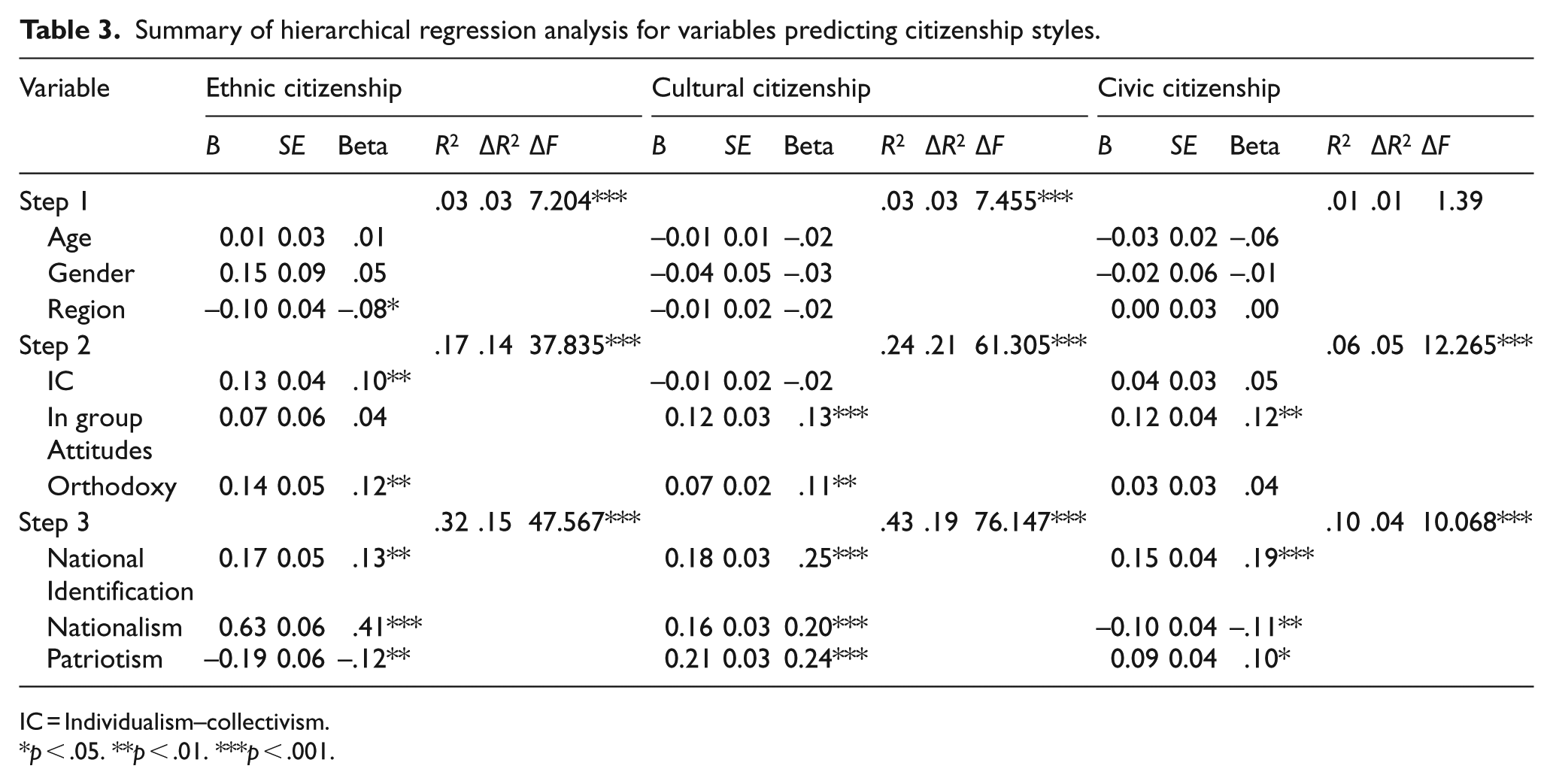
IC = Individualism–collectivism.
p < .05. **p < .01. ***p < .001.
The same model for cultural citizenship showed the following values: nationalist attitudes and national identification explained an additional 19% of variance in ethnic citizenship style, after controlling for DV and cultural, religious, and in-group attitudes, R2 change = .19, F(9, 672) = 56,842, p < .00. In the final model, five out of nine predictor variables were statistically significant, with national identification recording a higher beta value (β = .25, p < .00) than patriotism (β = .24, p < .00), nationalism (β = .20, p < .00), and in-group attitudes (β = .13, p < .00).
Regression analysis for civic citizenship representation style showed that nationalist attitudes and national identification explained an additional 4% of the variance in ethnic citizenship style, after controlling for DV and cultural, religious, and in-group attitudes, R2 change = .04, F(9, 672) = 8.113, p < .00. In the final model, four out of nine predictor variables were statistically significant, with national identification recording a higher beta value (β = .19, p < .00) than in-group attitudes (β = .12, p < .01), nationalism (β = –.11, p < .01), and patriotism (β = .10, p < .05).
Discussion
The results did not confirm the first hypothesis that ethnic citizenship is the most common citizenship style. Most participants choose a cultural citizenship style and relatively few an ethnic citizenship style. The hypothesis was based on the fact that nationalism and religiosity are predominant features of Georgian society, and therefore they shape the citizenship style in an ethnic way. The results show that currently cultural criteria are the most relevant ones for Georgian students. Partially this result can be explained by the age of participants. The younger generation has more liberal attitudes which are reflected in their personal views. Consequently, they do not choose ethnic criteria for citizenship. Another explanation might be the Western-oriented political discourse. It influences people’s perceptions and attitudes. The results could be evidence of progress made by Georgian society in democratization and liberalization. In the theoretical overview, I showed that in the last two decades, the Georgian government tried to follow a European and Euro-Atlantic course. The slogan from 1991, “Georgia for Georgians” in 2003 was replaced with “I am Georgian, therefore I am European.” Even though religiosity and nationalism remain salient features of contemporary Georgian society, cultural criteria of citizenship including respect toward cultural norms and traditions win over ethnic criteria (place of birth, blood ties, etc.).
Regression analysis partially confirmed the second hypothesis: patriotism is a positive predictor and nationalism is a negative predictor for civic citizenship style. However, individualism did not show any predictive value for civic citizenship style. In addition, positive in-group attitudes also positively predicted civic citizenship style (see Figure 2).
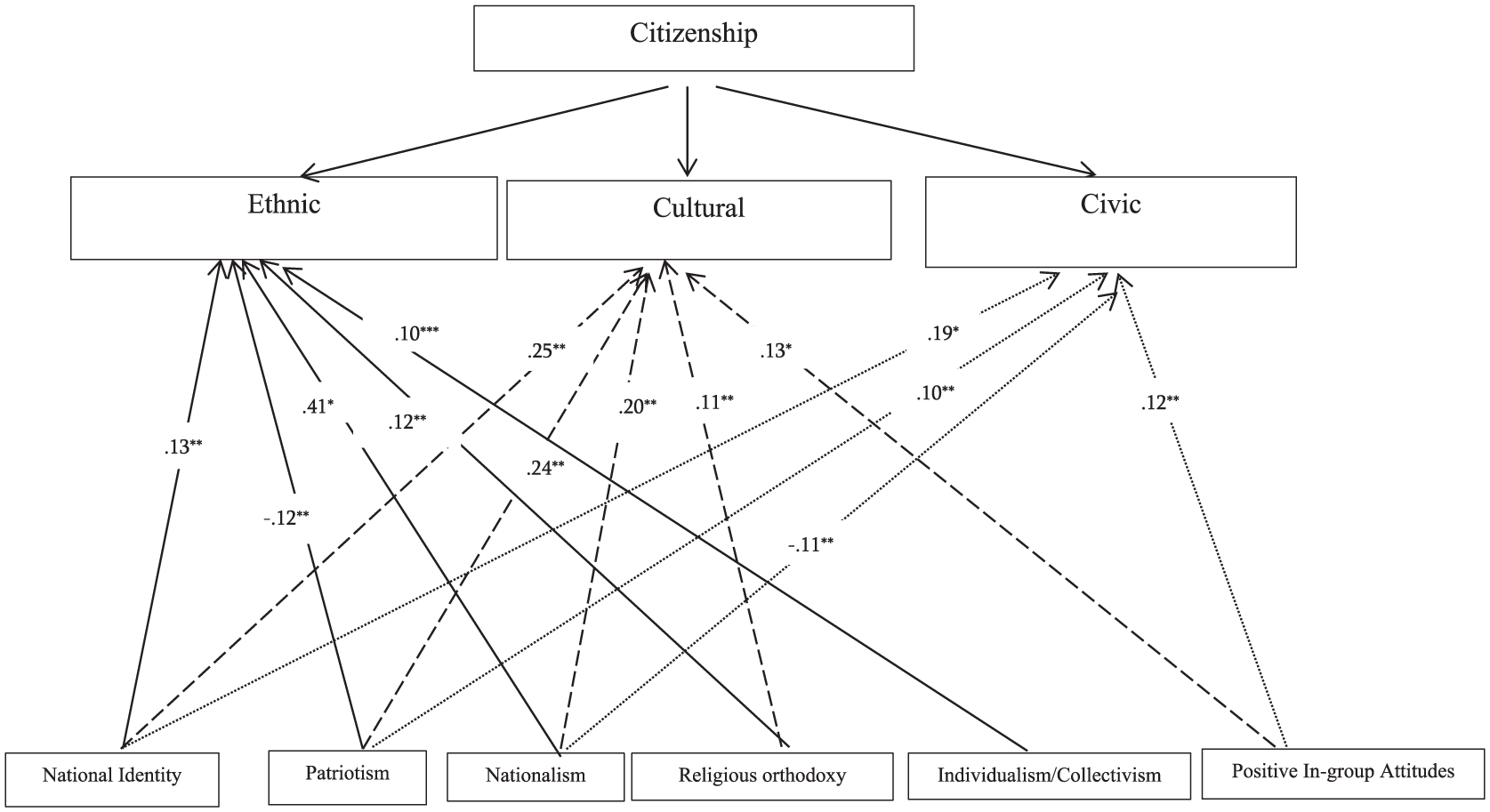
National identity, nationalism, patriotism, religious orthodoxy, positive in-group attitudes, and individualism/collectivism predict citizenship representation styles.
The study results confirmed the third hypothesis: ethnic citizenship style is positively predicted by nationalism and religious orthodoxy but negatively by patriotism. Further analysis show that collectivism is also a positive predictor of ethnic citizenship style.
Regression coefficients show that national identification is a common predictor for all three types of citizenship styles. This suggests that strong identification with the nation (a high score on national identification) could reinforce any type of citizenship style. When national identification is formed, citizenship styles are established. That is, citizenship styles are based on how one perceives one’s own national identity. The data yield findings that may support Social Judgment Theory which states that people have rigid attitudes toward things that are personally important. In other words, high ego-involvement results in firm and unchangeable attitudes.
The analysis shows an interesting tendency: Cultural citizenship is positively predicted by patriotism, nationalism, and national identity. Nationalism positively predicts ethnic citizenship and negatively predicts civic citizenship. In contrast, patriotism negatively predicts the ethnic citizenship style and positively civic citizenship. But, both nationalism and patriotism positively predict the cultural citizenship style. This association is not unexpected for civic and ethnic citizenship styles, as they are in line with theoretical definitions of each. But, these results suggest a new perspective in understanding cultural citizenship. Cultural citizenship reconciles the civic and the ethnic citizenship representation styles. Hence, it is more acceptable for people with either ethnic or civic citizenship criteria. This somehow balances incompatible civic–ethnic tendencies of citizenship styles.
Correlation analysis confirmed the strong link between ethnic citizenship, nationalism, and religious orthodoxy. From a social-psychological perspective, this association might be explained by the fact that both nationalist attitudes and ethnic citizenship styles include the notion that national identity is based on fixed attributes such as common ancestors, place of birth, and native language, among others. In Georgia, orthodox religious orientation also creates a static and rigid religious philosophy. Orthodoxy rejects the possibility of understanding religious meanings symbolically, and therefore leaves no place for personal interpretation. Consequently, the association between religious orthodoxy, nationalism, and ethnic citizenship style might be explained by the fact that some people generally prefer a rigid rather than flexible cognitive interpretation. Consequently, nationalism, religious orthodoxy, and preference for ethnic criteria all have one common root—rigidity in cognitive interpretation. Moreover, these results are in line with cognitive dissonance theory. Clearly, nationalism is associated with ethnocentric tendencies and people view their ethnic group as exceptional and superior. Taking into account that nationalism is strongly associated with ethnic citizenship, it becomes clear that the feeling of superiority or feeling of being better is immanent for people with ethnic citizenship. The theory of cognitive dissonance might be helpful in explaining this association. Individuals are motivated to reduce discrepancies between the two incongruent constructs and to maintain consistency between them (Festinger, 1962). If constructs are considered unchangeable and permanent, then people tend to overestimate goodness of permanent features to keep congruency between attitudes and constructs and to maintain positive self-concept. The same is evidenced in this study: people with an ethnic citizenship style hold the view that their national identity is defined by and based on fixed attributes that lead them to overestimate the goodness of their nation.
The study also supports the fourth hypothesis: religious orthodoxy is an important player in the relationship between citizenship styles and nationalist attitudes. It has not only a direct but also indirect effect on citizenship styles. The results show that orthodoxy partially mediates the relationship between patriotism and ethnic citizenship style. The data show that even though there is a weak positive correlation between patriotism and ethnic citizenship, this relation might be mediated by orthodoxy. Mediation analysis showed that there is no direct link between patriotism and ethnic citizenship. Instead, religious attitudes mediate the relation. This suggests that people who endorse patriotic attitudes develop ethnic citizenship but do so because of their religious attitudes. The indirect and direct effect of religious attitudes on attitudes toward country (e.g., nationalism and patriotism) lead to the conclusion that for Georgians, love of country is very similar to God’s love and that this association results in the construction of citizenship style in an ethnic style.
Conclusion
Citizenship is legally defined but socially constructed: on one hand, the citizenship law is the main document which defines the rights and responsibilities of citizenship, on the other hand, people have personal views on the criteria of citizenship. These criteria can be categorized as ethnic, civic, or cultural. Nationalist, religious, and cultural attitudes influence the representation of citizenship style.
The citizenship law in Georgia is civic/inclusive; however, a cultural citizenship style is the most common style among Georgian students. Even though the results cannot be generalized to the entire population, it clearly indicates that in contemporary Georgia, citizenship rights are expanded to cultural rights and duties, which are the knowledge and respect of cultural traditions and adaptation to local culture. Nationalism increases the chance of ethnic citizenship style and decreases the probability of civic citizenship. Patriotism has the opposite effect, increasing the chance of civic citizenship style and decreasing the probability of the ethnic style. Both nationalism and patriotism are positive predictors of cultural citizenship style. This result suggests that cultural citizenship is a unique, independent, original mix of criteria that could be easily endorsed by people with civic or ethnic citizenship styles.
The current trend in citizenship studies refers to cultural citizenship as a liberal and progressive view, which does not discriminate against people by their origins, race, religion, or language, but instead offers equal opportunities to all of those who are familiar with and adopt the culture.
The study has several limitations. First, the study sample is not random. So generalization of the results to the entire population of Georgia is not possible and the distribution of citizenship styles in the general public remains unknown in Georgia. A second shortcoming of this study is that it does not contain all possible variables that may shape citizenship style in Georgia. Namely, along with nationalist, religious, and cultural attitudes, there are some other attitudinal factors, which possibly shape citizenship styles. I decided to choose the most salient and important (for Georgia) variables for this study.
The importance and popularity of cultural citizenship style is a clear indication that cultural aspects of citizenship should be studied more closely and thoroughly. Future studies should focus on those cultural elements, symbols, language, norms, and values that are closely related to the concept of citizenship.
Footnotes
Funding
The author(s) disclosed receipt of the following financial support for the research, authorship and/or publication of this article: The study was conducted with the support of the Academic Swiss Caucasus Net (ASCN), coordinated and operated by the Interfaculty Institute for Central and Eastern Europe (IICEE) at the University of Fribourg (Switzerland). It is funded by the Gebert Rüf Foundation. The views expressed in this publication are those of the authors and do not necessarily represent the opinions of the Gebert Rüf Foundation or of the University of Fribourg.