



Abstract
In ASEAN region, while EIA is acknowledged as customary international law, its implementation varies in each country due to differences in historical backgrounds, legal status of the EIA, political motivations, and economic development priorities. This article examines the role of EIA as customary international law and EIA implementation in ASEAN member states to analyze challenges in EIA integration in the ASEAN region. It is concluded that the EIA implementation in the ASEAN region still faces several legal issues that need to be addressed. The key issues include the diversity of domestic legal framework, a lack of clear regulation and guidelines for public participation, insufficient political will and overlapping authorities, and traditional ASEAN cultures, particularly the “ASEAN way” or the principle of non-intervention among member states. Accordingly, ASEAN needs to enhance cooperation and adopt a unified approach to effectively integrate EIA practices, aligning them with regional environment and sustainable development goals.
Introduction
The Environmental Impact Assessment (hereinafter “EIA”) is a procedure for assessing the possible environmental impacts and economic effects of proposed projects or activities before they are approved and implemented. Conducting an EIA for proposed activities with potential to cause significant transboundary environmental harm 1 is an obligation of state parties in multilateral treaties, and it has been declared customary international law by international courts. 2 However, the International Court of Justice (hereinafter “the Court”) has stated that each state's domestic law discretion should determine the specific details and methodology of EIAs, taking into account the nature and magnitude of the proposed development and the degree of adverse impact on the environment. 3 Thus, the obligations entailed in an EIA might evolve and be influenced by the capabilities of the involved parties and the specific context of each case.
The principles and practices of EIA are recognized as the principles of customary international law related to environmental protection and sustainable development. 4 In the ASEAN region, customary international law is essential in guiding the development of regional EIA standards and guidelines, and as a basis for legal dispute. The principle of common but differentiated responsibilities and the principle of prevention are examples of a customary international law principle that can guide ASEAN member states in their efforts to develop a coordinated approach to EIA that considers the different levels of economic development among member states. Despite the fact that all ASEAN member states recognize EIA as customary international law, ASEAN has several challenges in enforcing EIA. This article will focus on the role of customary international law as a mechanism for international affairs and clarify the obligation of EIA law, especially in EIA regulation frameworks in ASEAN member states. Finally, it analyses the challenges in EIA integration into the ASEAN region.
The Role of Customary International Law Related to EIA
The evolution of customary international law's role in EIA
The EIA development started with environmental issues during the industrial period (around the 1700s and 1800s) when lead levels in the atmosphere significantly increased due to pollution from factories and numerous industrial activities. After the unimpeded transboundary flow of pollutants, it became an international and, later, global issue. Given the global transboundary nature of pollution, safeguarding against pollution necessitates the establishment of regulations under international law. International environmental law is characterized by three basic forms that reflect its historical development: customary international law, international agreements, and non-binding soft law. 5 Likewise, international environmental disputes occur when two countries have conflicting interests regarding environmental problems.
Consequently, customary rules of international law must be considered in international conflicts as long as international law is recognized. The country causing the damage is responsible for stopping environmental harm from crossing international borders. In earlier times, states assumed absolute sovereignty and had the freedom to exploit resources in their territories without considering the impact on neighboring states. When environmental rights fit into the framework of international law, state sovereignty cannot be exercised in isolation since the actions and conduct of one state often affect those of others and their sovereign rights. 6
Later, the scope for discretionary action arising from the principle of territorial sovereignty was determined by customary international law. It was sic utere tuo ut alienum non laedas
7
(hereinafter “the sic utere principle”), or the principle of good neighborliness. In the context of customary international law, the principle prescribes that no state may use its territory, or allow the use of it, in a way that causes serious damage to the territory of another state.
8
However, similar terms can readily be found in several other international treaties, other international instruments, and the principle of state responsibility for actions causing transboundary damage, such as the Declaration of Paris (1856), the Stockholm Declaration, the United Nations Convention on the Law of the Sea, etc. Moreover, their implications can also be found in international case law. There are several legal cases in which publicists apply to argue for their claims that the sic utere principle is required. The two cases most often cited are the Trail Smelter Arbitration
9
and the Corfu Channel Case
In fact, the Trail Smelter Arbitration was only to assess the nature and extent of compensation to be paid by Canada to the United States regarding transboundary pollution from the smelting industry in Canada. Hence, the existence of the sic utere principle as a rule of international law is not clear. On the other hand, the Corfu Channel Case, the Court stated “every state's obligation not knowingly to allow its territory to be used for acts contrary to the rights of other states.” 11 the Court held that Albania was responsible under international law for the mine explosions in the Corfu Channel that had taken place in Albanian territorial waters, as well as for the damage and loss of life that had occurred. This statement affirms the sic utere principle, which broadly interprets the words “the rights of other states” in a suitable manner. However, the Court's statement can only support the customary existence of the sic utere principle if it interprets the phrase “the rights of other states” to encompass a state's right to prevent harmful behaviors occurring in another state. 12 As a result, this Corfu Channel principle provides a more authoritative and generally applicable statement of the principle previously enunciated in the Trail Smelter arbitration.
Later, in the Pulp Mills Case, the Court characterized EIA as gaining so much acceptance among states that it may now be considered a requirement under general international law. 13 Consequently, the obligation to conduct an EIA is recognized as a customary international law duty, particularly when proposed industrial activities pose a risk of significant transboundary to shared resources. 14 The Court further established that this responsibility is directly linked to the principle of sic utere as outlined in Principle 21 of the Stockholm Declaration. Additionally, the Court identified two essential elements of the duty to conduct an EIA under international law: the need to carry out the EIA before the project is implemented, and the duty to consistently monitor the environmental effects once the project has started. The Court has thus confirmed the norms of customary international law regarding EIA. 15
Although the Court never used the term of “general international law” and “customary international law” as synonymous in the Pulp Mills Case, it frequently assumes that customary practices from the source of international law. Han Kelsen mentioned in 1952 that the term of general international law refers to norms of international law that are broadly applicable to all states worldwide. 16 Indeed, general international law is, in fact, a kind of customary law. Since treaties are generally obligatory for the parties involved and there is no treaty that has been agreed upon or accepted by all the countries in the world, the only type of international law that exists is customary law, not conventional general international law. 17 Later, the clarification between these terms often comes through the context in which they are used, with courts and scholars delineating the scope and applicability of international legal norms based on the source, acceptance, and recognition of those norms within the international community.
In addition, the joined cases of Certain Activities Carried Out by Nicaragua in the Border Area (Costa Rica v. Nicaragua) (hereinafter the “Costa Rica v. Nicaragua Case”) and Construction of a Road in Costa Rica Along the San Juan River (Nicaragua v. Costa Rica) (hereinafter the “Nicaragua v. Costa Rica Case”), 18 important questions were raised concerning the obligations of due diligence and the necessity of conducting an EIA. In the main judgment of both cases, the Court confirmed its previous position that the obligation to carry out an EIA was a requirement of general international law and again linked the duty to conduct EIAs directly to a state's due diligence obligations. 19 The Court established a connection between the obligation to conduct an EIA and the obligation of due diligence by emphasizing the need for a preliminary assessment to determine the risk of significant transboundary harm. The relationship between the two obligations was previously explicitly articulated in the Pulp Mills Case, 20 and then again underscoring that conducting an EIA is a critical element of the process arising from the international obligation of states to exercise due diligence in avoiding or mitigating significant transboundary harm. 21
To summarize, the customary international law of EIA has significantly developed since the Pulp Mills Case and has continuously evolved through subsequent judicial proceedings. It could be determined that the obligation to conduct EIAs has solidified into a principle of the customary international law. This body of law is essential in the international legal system, particularly, concerning the obligation of conducting an EIA and a state's duty to exercise due diligence. Furthermore, the aforementioned judgements clarify the circumstances under which international law mandates a preliminary EIA before a state permits an activity, a project or a plan that might cause significant environmental impacts.
Key determination of EIA obligation in international law
While both customary international law and treaty offer a legal framework for the EIA, their scope and applicability vary. Treaty is typically considered binding only to the parties involved in the international conventions or treaties. Conversely, customary international law, characterized by general practice accepted as law, is presumed to be universally binding. 22 When a rule is defined by treaty, customary law is not applicable. Nevertheless, certain treaties are recognized as customary law. As a result, even parties not bound by the treaty itself are still obligated to adhere to the treaty as a customary rule. 23 In the context of EIA, the EIA duty has crystallized into a rule of customary international law and is contained in various treaties.
However, the relevance of customary international law becomes particularly significant in the absence of a treaty. Customary international law can still oblige a state to conduct an EIA when there isn’t a specific treaty obligation mandating one 24 , particularly, when activities have the potential to cause significant transboundary environmental harm. A non-party to a treaty can be addressed by applying customary international law as long as it has become a customary practice supported by opinio juris. It includes scenarios where treaties express the obligation in general terms without detailing the procedure, as seen in the United Nations Convention on the Law of the Sea (UNCLOS), and in cases where treaties do not explicitly mention any EIA obligations. Thus, regardless of whether a treaty specifies EIA obligations, the principle embedded in customary international law and interpreted through the Vienna Convention mandated that states consider how their activities might impact the environment. As the Pulp Mills Case provides a compelling sample of how international law interprets and applies the obligation to conduct EIAs even when it is not explicitly mentioned in treaties. 25
Customary international law mandates that states conduct the EIAs under certain conditions. These requirements stem from general practices and principles inherent in customary international law. The necessity for an EIA under customary international law typically involves various factors or conditions related to potential environmental impacts of particular activities.
Firstly, a state is obligated to perform an EIA when a proposed project or activities is expected to have significant negative environmental effects, encompassing both direct and indirect impacts. The Court's judgment in Costa Rica v. Nicaragua Case indicates that to meet the due diligence obligation in preventing measures before beginning any activities that could adversely affect the environment of another state. These measures include assessing whether there is a substantial risk of transboundary harm, which would require conducting an EIA. 26
Secondly, planned activities must fall within the jurisdiction or control of the state. This broad condition includes activities within a state's territorial and extends to areas under its jurisdiction or control, such as maritime zones defined by the UNCLOS (contiguous zones, exclusive economic zones, etc.), and potentially activities abroad under state control or by its nationals. Control refers to the level of influence a state exerts over individuals, entities, or situations that could lead to internationally wrongful acts. 27 This concept is closely related to the principle of states liability for acts that violate international obligations, known as responsibility for internationally wrongful acts. As Jame Crawford noted, state responsibility under international law requires active measures to prevent actions that could lead to violations of international obligations, including environmental harm. 28 Accordingly, under the principles of prevention and due diligence in international law, “control” is interpreted as the state's ability to influence physical actions. The Court's advisory opinion in the Namibia Case defines “control” in international law, establishing that a state can have legal effects even without recognized jurisdiction over specific acts or events, covering scenarios of de facto jurisdiction despite the lack of de jure jurisdiction. 29
Thirdly, there is the requirement that the damage must constitute “significant harm.” The international law commission (ILC) explains that “significant” implies more than just “detectable,” but it does not necessarily mean “serious” or “substantial.” Such adverse effects must be measurable and quantifiable using factual and objective criteria. 30 For example, in Nicaragua v. Costa Rica Case, the Court assessed the road's length and proximity to the San Juan River. Nearly 18 kilometers of the road runs along the riverbank, within 50 meters of the river, and half of the road is within 100 meters of the riverbank. Due to the road's proximity and the risk of sediment discharged from slopes, potential natural disasters, and the geographic conditions of the river basin, the Court determined that Costa Rica's road construction posed significant risks of transboundary harm. 31
The last condition concerns the extent of the damage. Customary international law mandates states to assess environmental impacts in two scenarios: first, when activities within a state's borders could cause significant harm to the environment of another state (transboundary harm). Second, when actions pose a significant risk to areas beyond national jurisdiction, such as on the high seas or in an area that has a direct effect on another state's territory or areas that fall under its jurisdiction. It includes harmful high seas consequences on another state's ships or platforms. For example, the danger of extermination of a fur seal population by unrestricted hunting in an area of the high seas 32 , the pollution of the high seas caused by violation of Article 194 of the UNCLOS can significantly affect one or more states by contaminating their beaches with toxic residues or leading to the closure of their coastal fisheries. 33
EIA Regulations Frameworks in ASEAN Member States
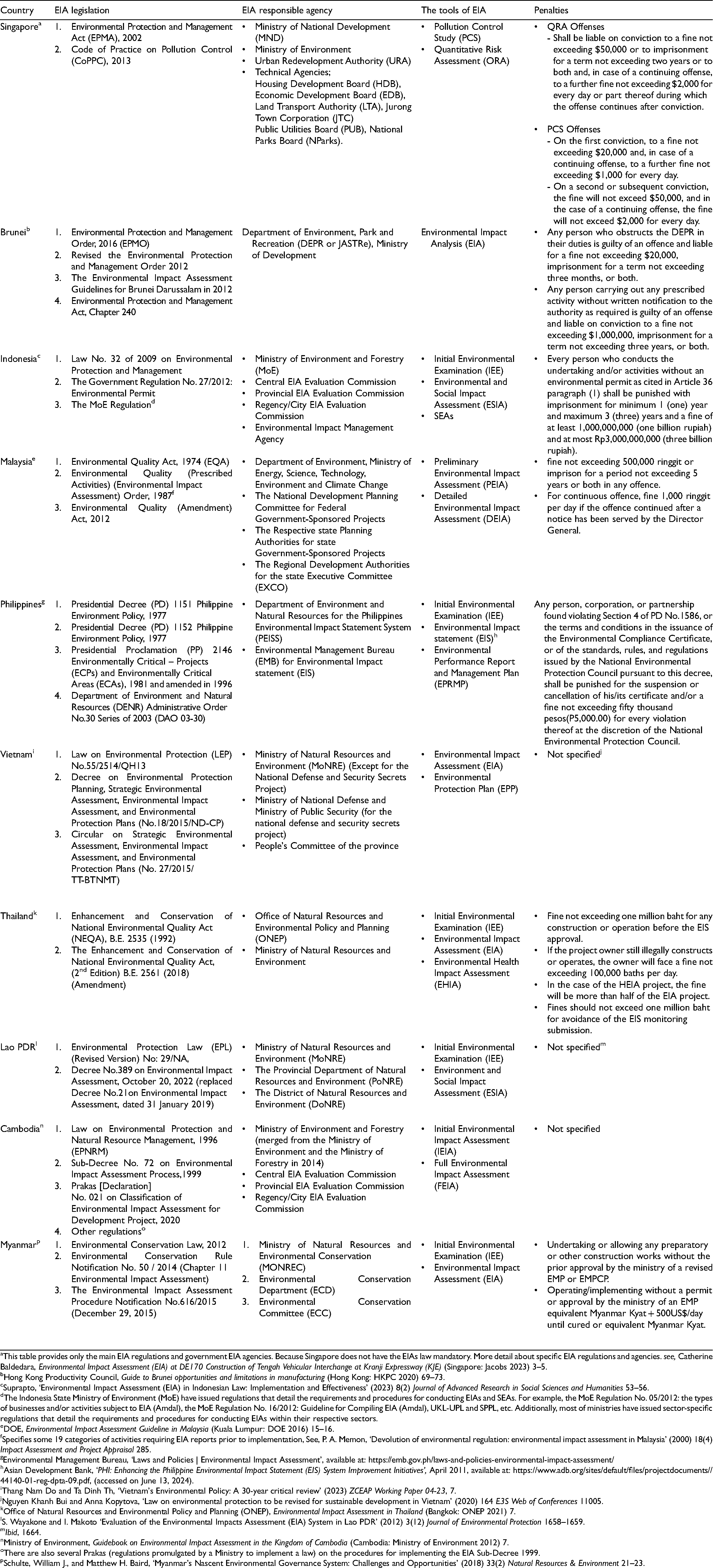
This table provides only the main EIA regulations and government EIA agencies. Because Singapore does not have the EIAs law mandatory. More detail about specific EIA regulations and agencies. see, Catherine Baldedara, Environmental Impact Assessment (EIA) at DE170 Construction of Tengah Vehicular Interchange at Kranji Expressway (KJE) (Singapore: Jacobs 2023) 3–5.
Hong Kong Productivity Council, Guide to Brunei opportunities and limitations in manufacturing (Hong Kong: HKPC 2020) 69–73.
Suprapto, ‘Environmental Impact Assessment (EIA) in Indonesian Law: Implementation and Effectiveness’ (2023) 8(2) Journal of Advanced Research in Social Sciences and Humanities 53–56.
The Indonesia State Ministry of Environment (MoE) have issued regulations that detail the requirements and procedures for conducting EIAs and SEAs. For example, the MoE Regulation No. 05/2012: the types of businesses and/or activities subject to EIA (Amdal), the MoE Regulation No. 16/2012: Guideline for Compiling EIA (Amdal), UKL-UPL and SPPL, etc. Additionally, most of ministries have issued sector-specific regulations that detail the requirements and procedures for conducting EIAs within their respective sectors.
DOE, Environmental Impact Assessment Guideline in Malaysia (Kuala Lumpur: DOE 2016) 15–16.
Specifies some 19 categories of activities requiring EIA reports prior to implementation, See, P. A. Memon, ‘Devolution of environmental regulation: environmental impact assessment in Malaysia’ (2000) 18(4) Impact Assessment and Project Appraisal 285.
Environmental Management Bureau, ‘Laws and Policies | Environmental Impact Assessment’, available at: https://emb.gov.ph/laws-and-policies-environmental-impact-assessment/
Asian Development Bank, ‘PHI: Enhancing the Philippine Environmental Impact Statement (EIS) System Improvement Initiatives’, April 2011, available at: https://www.adb.org/sites/default/files/projectdocuments//44140-01-reg-dpta-09.pdf, (accessed on June 13, 2024).
Thang Nam Do and Ta Dinh Th, ‘Vietnam's Environmental Policy: A 30-year critical review’ (2023) ZCEAP Working Paper 04-23, 7.
Nguyen Khanh Bui and Anna Kopytova, ‘Law on environmental protection to be revised for sustainable development in Vietnam’ (2020) 164 E3S Web of Conferences 11005.
Office of Natural Resources and Environmental Policy and Planning (ONEP), Environmental Impact Assessment in Thailand (Bangkok: ONEP 2021) 7.
S. Wayakone and I. Makoto ‘Evaluation of the Environmental Impacts Assessment (EIA) System in Lao PDR’ (2012) 3(12) Journal of Environmental Protection 1658–1659.
Ibid, 1664.
Ministry of Environment, Guidebook on Environmental Impact Assessment in the Kingdom of Cambodia (Cambodia: Ministry of Environment 2012) 7.
There are also several Prakas (regulations promulgated by a Ministry to implement a law) on the procedures for implementing the EIA Sub-Decree 1999.
Schulte, William J., and Matthew H. Baird, ‘Myanmar's Nascent Environmental Governance System: Challenges and Opportunities’ (2018) 33(2) Natural Resources & Environment 21–23.
Each ASEAN country has its unique approach in implementing the EIA legal framework and process. This divergence can be categorized into three main classifications; the first group is Singapore. While most governments worldwide have enacted mandatory EIA laws, Singapore does not have a law mandating that EIAs be conducted or made disclosed to the public. Instead, it adopts an ad hoc approach governed by the Ministry of the Environment and Water Resources. EIAs have been more formally carried out since around 1989. 34 Still, there are regulations in the new integrated Pollution Control Act (1999) that enable the Ministry of Environment to study environmental pollution control and focus on the potential pollutive impacts of a project.
Many developments, including major infrastructure projects, have been done without the integration of EIA. However, Singapore has a unique approach to environmental management and its reliance on sector-specific regulations. The planning authority (URA) claims that environmental considerations are built into their planning processes. The Ministry of Environment also maintains that sufficient safeguards are in place to minimize adverse pollution effects. Furthermore, under the URA's planning act, all proposals are reviewed by technical agencies before the planning permission is issued. Recently, the National Parks Board (NParks) has centralized the management of EIA consultancy service. This centralized approach was piloted in early 2023 for new development projects by the Housing Development Board (HDB) and Jurong Town Corporation (JTC) that require EIAs. 35 This change aims to standardize, emphasize Singapore's biodiversity and support the city in nature policy. For this reason, even though conducting an EIA is not mandatory, the centralized function of ministries and departments in Singapore ensures that EIAs are effectively implemented in most cases due to the country's small size. 36 Moreover, the top decision-making level in all ministries also contributes to the effective implementation of SEA.
The second group has previously implemented the EIA process, specifically Thailand, Malaysia, the Philippines, and Indonesia. The EIA system in these countries has been effectively implemented since 1990. These countries have established detailed standards for various aspects of the EIA process. The EIA in Thailand, Malaysia, and the Philippines is enforced by their national constitutions, which serve as the supreme legal authority with which all legislation must comply. 37 These factors impact the implementation of EIA since a single statute or agency cannot solely manage it. 38 However, because this group had the EIA law come into force earlier, it is essential to streamline and clarify EIA regulations to ensure consistency across different sectors and regions. This involves harmonizing regulations and providing detailed instructions on the EIA process, criteria for impact assessment. 39 Furthermore, several countries within this group still encounter significant shortcomings, particularly decision-making processes, inconsistent execution, limited community participation, overlapping jurisdiction between agencies at either state or federal level 40 , and untransparent process. 41 In fact, local authorities often lack the capacity and budget for effective monitoring. 42 Therefore, the legal framework would benefit from periodic reviews and updates to incorporate emerging environmental issues and EIA best practices, e.g., SEA, CIA, biodiversity impact assessment etc.
The third group consists of the mid-phase those who adopted, which include Vietnam, Lao PDR, Cambodia, and Myanmar. These countries formally implemented the EIA after 1990, although they had specific environmental regulations in force before. Nevertheless, the rapid implementation encountered its own array of challenges. Myanmar has made great strides to build a strong environmental legal framework since opening up 43 and possesses several laws related to environmental conservation and protection. Still, the government lacks the essential administrative and legal frameworks, standards, safeguards, and political will to carry out these rules effectively. 44 While companies must disclose project details and the final EIA report, there's no mandate for public engagement. Moreover, while breaches incur administrative penalties, the EIA process doesn't adequately address local community and indigenous resettlement concerns due to environmental impacts. For example, an evaluation of the EIA for the Thilawa Special Economic Zone highlighted its shortcomings relating to global standards and best practices. The EIA report pinpointed issues like insufficient project description, absent public engagement, incomplete power supply analysis, etc. 45 Thus, Myanmar's EIA system and implementation are lacking.
Meanwhile, in Vietnam, Lao PDR, and Cambodia, EIA processes often face challenges such as limited public engagement, insufficient environmental data, weak post-assessment oversight, and a lack of enforcement mechanisms. For example, Lao PDR possesses a commendable structure of environmental policies, regulations, and directives. However, the implementation remains weak due to insufficient political support and commitment at various levels of government. The country also lacks best practice guidelines and has weaknesses in its EIA procedures. The MoNRE has not imposed any fines on developers who have violated the law because there is no established mechanism detailing the roles and procedures for imposing such fines or the types of punishment available. 46 Additionally, implementation is often problematic in Lao PDR because processes are not carried out appropriately, and there is some political influence. 47 For Vietnam, the 2014 Law on Environmental Protection and associated EIA regulations, despite certain advancements, exhibit numerous shortcomings. Notably, the environmental administrative mechanisms are fragmented and not streamlined. There is a policy vacuum on emerging environmental issues and noticeable overlap and inconsistency with other legal statutes. Additionally, the Law on Environmental Protection 2014 has revealed many inadequacies, lack of uniformity, and a lack of regulations on EIA and environmental protection plans. 48 Meanwhile, in Vietnam, Lao PDR, and Cambodia, enforcement and penalties are not stringent enough to deter non-compliance.
The last group,
Because Brunei has adopted EIA laws, which have been in effect for less than a decade. Although these laws are strict and comprehensive, public participation remains limited in practice. 52 Typically, public involvement is confined to social impact questionnaires and occasional communication with residents in the vicinity of the project. Social impact assessments are usually desktop studies based on standard methodologies. In case of large projects, community leaders may be informed and consulted, but this practice should be done in general. On the other hand, NGOs in Brunei are not very active and tend to be slow in their responses. There is no legal requirement to carry out SEA. Therefore, successful implementation of EIAs requires full commitment from all stakeholders 53 , including the public sectors, local authorities, consulting engineers, contractors, and suppliers.
The Challenges to Integrating Environmental Impact Assessment in ASEAN
The ASEAN member states have diverse environmental policies and regulations, shaped by their unique historical contexts, legal traditions, political motivations, and economic development priorities. Although many member states aim to protect the environment, ASEAN has faced challenges with the integrating and compliance of these goals, largely due to the characteristics of EIA law in each state.
Diverse legal framework and the legal status of the EIA
The environmental regulations of ASEAN member states differ in scope and methodologies due to diverse historical backgrounds, colonial influences, legal traditions, and cultural factors. The enforcement of legal hierarchy is critical for ASEAN member states. Certain nations have environmental rights or provisions directly embedded in their constitution. These constitutional provisions can provide a robust foundation for EIA laws. For example, the Philippine Constitution explicitly includes the right to a healthful environment, which can strengthen the legal basis for EIA. 54 Thailand's constitution also has progressive environmental clauses supporting comprehensive EIA processes. 55 Constitutional backing gives EIA Law a stronger footing in the face of competing economic or political interests.
However, a key difference among the countries is the legal status of the EIA. Brunei and Thailand mandated EIA by law, but the specifics are detailed by EIA guidelines. Meanwhile, Indonesia, Vietnam, Myanmar and Lao PDR also mandated EIA by law, but governed and detailed by ministerial regulations, particularly in Lao PDR detailed by Decree and Prakas. Whereas Singapore and the Philippines are totally difference from other states. Singapore does not have an EIA law; enforcement of EIA is carried out only when projects meet the requirements imposed by regulatory agencies for environmental assessment. In the Philippines, the EIA process is mandated by a Presidential Decree, with detailed rules provided by guidelines.
At present, even though EIA has become a customary international law, while ASEAN does not have ASEAN EIA convention or agreement. Therefore, each state must determine in its domestic legislation whether it is consistent with other countries in the same region. A critical weakness in these varying approaches is the necessity for EIA procedures to be formalized as legislation enacted by the Parliament, which would strengthen the status and effectiveness of the EIA throughout the region.
Lack of clarity in public participation in EIA
The significant weakness in current EIA practice in ASEAN region is the lack of clarity regarding public participation. Public participation involves three critical aspects. The first is identifying which people or communities should be consulted. The second is determining the appropriate timing for consultation. The third is deciding what information should be provided to the public and the method of its delivery. In most cases, the national EIA legislation often lacks clarity regarding its requirements. Typically, it does not specify who the EIA consultant should inform and consult with or what information should be shared with stakeholders. For instance, in Cambodia, locals often lack the opportunity or awareness to participate in public consultations and social biases restrict women's participation. 56 Thailand offers the clearest guidelines on who should be consulted during the EIA public participation process. Meanwhile, the Lao PDR EIA guidelines provide the most detailed instructions on who should be consulted, when consultation should occur, and some guidelines on how these consultations should be conducted. 57 However, the right to access information is frequently not clearly defined, making it challenging to ascertain whether the community can access the draft EIA, the final EIA, or the Environmental Management Plan (EMP). Thus, even though public participation is mostly encouraged under existing law and regulations, but guidelines are too general, often excluding some ethic minority group. 58 Access to project information and EIA reports can be limited. Additionally, public participation tends to focus only on the initial stages, such as the screening/scoping of the project (before the final decision-making) and the EIA report preparation and review process. There is a need to ensure that public consultation and participation continue after EIA report is approved. Notably, there is no provision for participation of the public in project monitoring during the construction, operation and closure stages.
Lack of political will and overlapping powers
The implementation of EIA in ASEAN member states is very often too late, commencing when the major project decisions have already been made, thereby rendering the EIA a mere formality. Many observers have attributed these problems to a lack of political will reflected in asymmetries in institutional power. 59 The environmental authority overseeing the EIAs frequently is under or politically inferior to and/or financially dependent upon another government institution or private proponent of the project. Such initiative derives from top government decision-makers. They will only be convinced if it can be shown that EIA will improve the quality of life and contribute to overall economic growth. As the result, most local governments may therefore have been unwilling to challenge major infrastructure investment projects that are financed or supported by the central government and large corporations.
Additionally, the environmental impacts are assessed at the national level and require coordination between different ministries. It often creates overlapping jurisdiction between agencies at either the state or federal level. In Cambodia, Thailand, and Vietnam, the environment ministries, responsible for assessing and managing the EIA process, are often overruled by more powerful sectoral ministries. In Cambodia, this includes the Ministry of Agriculture, Forestry, and Fisheries; in Vietnam, the Ministry of National Defense and Ministry of Public Security; in Thailand, the Ministry of Agriculture and Cooperatives. 60 Thus, a lack of integration between the central and sectoral agencies or between ministries also create confusion and unnecessary complexity.
Strict in ASEAN WAYs or the non-intervention principle
Although this challenge is not a direct legal issue, it cannot be ignored. The “ASEAN way” presents a normative challenge surrounding EIA and its integration, particularly regarding EIA as customary international law within ASEAN region. This approach, based on non-intervention and respect for diversity, focuses on accommodation and consultation and utilizes non-binding commitments rather than formalized, binding regulations and codified norms, which is regarded as customary law within ASEAN. It is distinguished by a mutual obligation to abide by the norm in the absence of formal agreement. The ASEAN Way is not simply a matter of history but also of culture. Southeast Asian countries have experienced various historical challenges, including mutual distrust, insurgencies, wars, and extended periods of extraterritorial powers. This backdrop has played a crucial role in shaping their collective understanding of the importance of regional collaboration, particularly in matters of peace and security.
This perspective has influenced their approach to regional cooperation, emphasizing voluntary participation and adhering to the principle of non-intervention or non-interference in each other's internal affairs. As articulated by Rodolfo C. Severino, a former Secretary-General of ASEAN, “ASEAN was not meant to be a supranational entity acting independently from its member states.” 61 ASEAN member states have generally been reluctant to surrender portions of their sovereignty to the organization, preferring a more cautious approach to cooperation, especially in areas they consider internal affairs. Thus, some disputes or environmental problems could take many decades to resolve or even remain unresolved until now, such as transboundary haze pollution between member states’ borders. Integrating ASEAN ways as a customary international law into the domestic framework often raises concerns about infringing on states’ sovereignty. Given ASEAN's principle of non-interference in the internal affairs of its member states, pushing for the uniform implementation of international standards can be diplomatically sensitive.
Conclusion
The analysis of EIA regulations within ASEAN member states reveals a varied implementation landscape. Apart from Singapore, each member state has established a legally binding EIA system for major projects with significant environmental or social implications. In spite of Singapore's ad hoc EIA approach (not mandatory), the ministries and governmental agencies can contribute to the effective implementation of EIA and SEA. On the other hand, other states with established detailed EIA standards still face challenges particularly inconsistent executive, weak enforcement mechanisms, and limited community participation.
Finally, the study on integrating EIA as customary international law into the ASEAN region reveals significant legal issues due to diverse legal frameworks, limited public participation in regulations and practices, insufficient political will and overlapping authority, and traditional ASEAN cultural practices, particularly the “ASEAN way” or the principle of non-intervention among member states. The ASEAN way presents a normative challenge surrounding the integration of EIA. The ASEAN Charter's preference for non-binding negotiations over judicial resolutions creates enforcement challenges to the integration of EIA as customary international law. Therefore, addressing these challenges requires harmonizing legal frameworks, attractive public participation, enhanced cooperation and adoption of a unified approach to effectively integrating EIA practices, aligning them with regional environmental and sustainable development.
Footnotes
Funding
The author received no financial support for the research, authorship, and/or publication of this article.
Declaration of conflicting interests
The author declared no potential conflicts of interest with respect to the research, authorship, and/or publication of this article.