




Abstract
Clustering in wireless sensor networks has been the research focus in recent years. No single technique for making clusters is best for creating clusters and identifying cluster heads. Deterministic-type uneven clustering has frequently been used to make uneven-size clusters and select cluster heads. Fuzzy-dependent clustering is a type of uneven deterministic clustering that uses the FIS to accomplish the above two tasks. To compare the efficiency and lifetime of the network both methods of fuzzy logic, Mamdani and Sugeno, are used to make the cluster, and selecting the cluster head are used in this paper. Both methods are implemented and compared based on the lifetime of WSNs in case the first node is dead, half node dead, and last node dead, and also based on energy variance. The Sugeno method is compared with the Mamdani method. In scenario-1, 50% of nodes died after 817, 759, 221, 321, 376,300, 307, and 288 rounds in Sugeno, Mamdani, EAUCF, DUCF, FLEACH, MOFCA, DECUC, and FUCA, respectively. In scenario 2, 50% of nodes died after 752, 689, 22,345,380,307,330, and 315 rounds in Sugeno, Mamdani, EAUCF, DUCF, FLEACH, MOFCA, DECUC, and FUCA, respectively. In scenario 3, 50% of nodes died after 497,740, 199, 337, 380, 298, 315, and 286 rounds in Sugeno, Mamdani, EAUCF, DUCF, FLEACH, MOFCA, DECUC, and FUCA, respectively. In scenario 4, 50% of nodes died after 749, 740, 157,377,278,324, and 230 rounds in Sugeno, Mamdani, EAUCF, DUCF, FLEACH, MOFCA, DECUC, and FUCA, respectively. Simulation results proved that the Sugeno method exhibits better results than Mamdani, which are shown in all the comparison tables and graphs. We took different scenarios based on the location of the base station, number of nodes, and area of interest.
This is a visual representation of the abstract.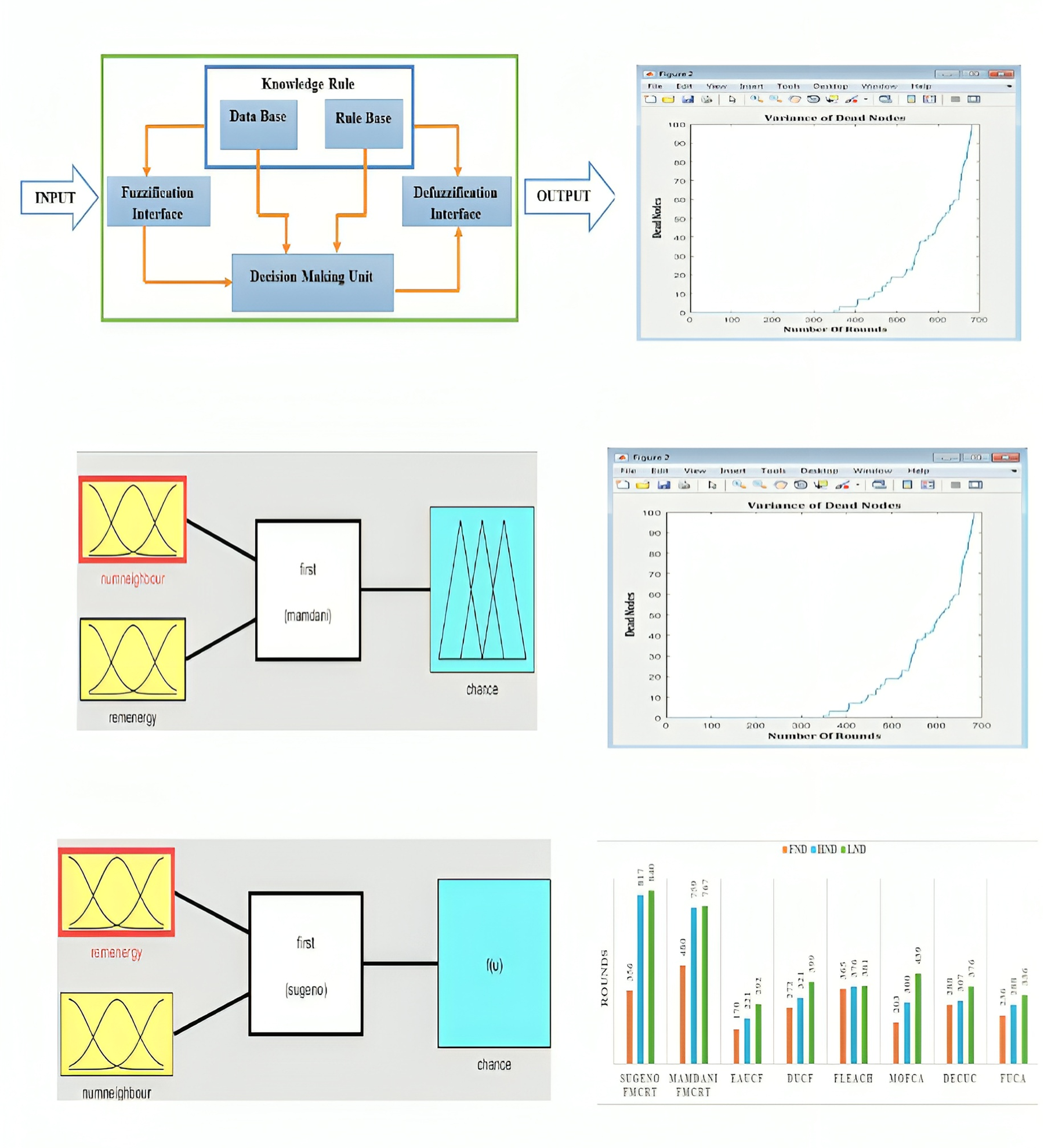
Keywords
Get full access to this article
View all access options for this article.