




Abstract
This three-year mixed-methods study in 12 information-rich Indian higher education institutions (HEIs) examined an ethical AI pedagogy blending AI literacy, ethics, and offline access. Based on UNESCO’s AI Competency Frameworks for students and teachers which stress human-centred thinking, AI ethics, and system design the model advances information literacy by fostering critical AI evaluation in education and libraries. Using a quasi-experimental design (intervention n = 600; control n = 568), plus journals, focus groups, and analytics, it engaged 1168 students, faculty, and administrators. Intervention participants gained superior AI literacy (78.9%, d = 0.80), ethical awareness (76%, d = 0.90), creativity, and collaboration. Results were equitable across genders and non-technical students, aligning with NEP 2020s interdisciplinarity and equity aims. Qualitative data revealed enhanced moral agency and fairness-by-design habits. Yet rural sites faced anxiety, low readiness, and infrastructure issues, widening urban-rural gaps in AI literacy (85.2% vs 69.2%) and ethics (85% vs 62%). Following ICMR, Helsinki, and DPDP guidelines, the study urges combined technical-ethical training and institutional support, offering a scalable Global South framework with tools and policies for critical AI literacy in information services.
Keywords
Introduction
Artificial intelligence (AI) transforms higher education worldwide through tools like intelligent tutoring systems, personalized learning analytics, and information retrieval platforms. Yet its integration raises critical ethical concerns, including algorithmic bias, data privacy risks, and exacerbation of digital divides.1,2 In higher education institutions (HEIs), key information-rich organizations where academic libraries serve as hubs for knowledge curation, access, and literacy development these challenges intersect with the core missions of information professionals (e.g. librarians) who manage equitable information services and foster critical user competencies. 3
To address these challenges, this study draws on a robust theoretical foundation in information ethics and socio-technical systems theory, extended through the lens of ethical AI pedagogy. Information ethics, as articulated by Floridi, 1 frame responsible AI as a moral imperative for fairness, human flourishing, and equitable information access in library and educational ecosystems. Socio-technical systems theory 4 analyzes interactions among technology, institutions, and societal values, including library-mediated information services. Ethical AI pedagogy integrates these by embedding technical AI literacy with ethical reasoning, aligning with UNESCO’s AI Competency Frameworks for Students and Teachers, 5 which emphasize competencies in human-centred mindsets, AI ethics, techniques and applications, and system design. This approach positions academic libraries and information professionals not merely as resource hubs but as active leaders in scaffolding AI competencies, developing ethical policies, and addressing barriers in diverse contexts.3,6,7 Furthermore, NEP 2020’s inclusive education goals promoting interdisciplinary skills, gender equity, and bridging urban rural divides through technology are introduced here as core drivers, ensuring the pedagogy fosters equitable access to 21st-century information skills.
In Indian HEIs, where digital technologies promise to enhance skills like problem-solving, coding, and information-seeking, unchecked AI adoption risks widening existing inequalities, particularly in resource-constrained rural settings with limited connectivity and library infrastructure.8,9 This three-year mixed-methods study examines the longitudinal effects of an ethical AI pedagogy across 12 diverse Indian HEIs, focussing on technical competencies (e.g. coding and data analysis), ethical reasoning (e.g. bias detection in information systems), and equity outcomes. The research aligns closely with India’s National Education Policy (NEP) 2020, which prioritizes inclusive, technology-driven education to bridge urban rural divides, foster 21st-century skills, and strengthen information literacy in educational ecosystems.10,11
Grounded in information ethics which positions responsible AI as a moral imperative for fairness, human flourishing, and equitable information access 1 and socio-technical systems theory which analyses interactions among technology, institutions, and societal values, including library-mediated information services 4 this study tests a curriculum that deliberately embeds AI literacy with ethical training, collaborative projects, and offline adaptations. Emerging information science scholarship frames AI literacy as an extension of traditional information literacy, encompassing critical evaluation of AI-generated content, ethical use in research, and professional stewardship in academic libraries.12–14 Librarians and information professionals are increasingly positioned as leaders in scaffolding AI competencies, developing policies for ethical integration, and addressing barriers in diverse contexts.3,6,7
Prior studies have advanced understanding of AI’s potential for engagement and skill-building in education; however, they often rely on short-term interventions (1 6 months), single-site urban samples, or general populations, yielding modest literacy gains (15 20%) while overlooking sustained ethical integration, rural equity, and ties to information professions.15–19 These limitations underscore the need for studies like this one, which theoretically advances information science by framing AI literacy as a socio-technical extension of information literacy, with librarians as pivotal mediators.12,13
In Global South contexts, recent validations of AI literacy scales for university students 20 and exploratory surveys among Library and Information Science (LIS) students in South Asia including India reveal baseline disparities in ethical awareness and practical application, underscoring the need for targeted pedagogy in information-rich educational settings. 21 LIS education analyses further highlight gaps in critical AI literacy curricula, calling for scaffolded models that integrate ethics and socio-technical perspectives.6,7,22 These limitations short durations, urban/Western bias, and limited focus on information professionals emphasize the need for extended, multi-context investigations that capture infrastructure barriers, policy alignments, and library-relevant frameworks in India’s diverse HEI landscape.13,23,24
India’s NEP 2020 invests heavily in digital infrastructure (e.g. ₹50,000 crore fund) to promote interdisciplinary, skill-based learning, and information access, yet persistent connectivity challenges in rural HEIs (affecting 40 50% of institutions) threaten equitable AI adoption and library services.11,18 Pilot evidence suggests ethical AI training can yield medium-to-large effects (d = 0.5 0.8) when adapted for offline use and aligned with information literacy extensions.12,25,26 These effects translate to 30-40% greater gains in AI literacy and ethics when interventions are sustained longitudinally, integrate explicit ethical scaffolding, and incorporate offline adaptations, as demonstrated by pilot studies in resource-constrained Global South settings and meta-analytic benchmarks for sustained AI literacy programs.25–27
To address these gaps, the study poses three research questions: • (RQ1) How does longitudinal ethical AI training affect students’ technical competencies and ethical reasoning in Indian HEIs? • (RQ2) To what extent do urban versus rural contexts influence equitable AI adoption? • (RQ3) How can ethical AI pedagogy advance NEP 2020’s inclusive education goals, particularly through information services and professional roles in academic libraries?
The hypotheses, anticipating 30-40% greater gains in intervention groups (d = 0.6-0.9) and urban advantages moderated by offline adaptations, directly test RQ1 (competency impacts) and RQ2 (contextual influences), while informing RQ3’s policy alignments. Objectives include quantifying skill gains, evaluating equity barriers (including library infrastructure), and developing a replicable framework adaptable for information professionals. We hypothesized intervention groups would show 30–40% greater gains in AI literacy and ethics (d = 0.6–0.9) than controls, with urban HEIs outperforming rural by 20–30% due to infrastructure advantages, though offline adaptations would mitigate disparities by 15–20%.11,21,28
Conducted with informed consent per ICMR and Helsinki guidelines, the study prioritizes data ethics and participant welfare.29–31 By cultivating moral agency through integrated AI literacy, fairness practices, and information-critical approaches, it offers evidence to inform equitable education strategies, contributing to NEP 2020, global AI ethics frameworks, and the evolving role of information professionals in HEIs.14,32,33 All procedures complied with institutional ethical standards and national education research guidelines.
Methodology
To address gaps in prior research particularly short-term, urban-centric designs with limited ethical integration, rural equity focus, and connections to information professions (e.g. library services in HEIs) this three-year mixed-methods study evaluated the longitudinal impact of ethical AI pedagogy on technical competencies, moral reasoning, and educational inclusion across Indian higher education institutions (HEIs) as information-rich organizations. The design tested the three research questions and hypotheses from the Introduction while aligning with NEP 2020s emphasis on replicable, inclusive, technology-enhanced learning and information literacy extensions to AI.12,16,22
Study design
Researchers employed a quasi-experimental, mixed-methods longitudinal design over six semesters (2022–2025). They compared an ethical AI-enhanced curriculum (intervention) with standard teaching (control) in matched cohorts. This extended timeframe overcame limitations of single-point data in earlier reviews.6,16,25,26 Groups balanced on gender, age, discipline, and institutional resources (including library access); statistical controls via ANCOVA addressed residual baseline differences. 34 Mixed-methods integration followed the Mixed Methods Appraisal Tool (MMAT), using joint displays and convergent parallel analysis in NVivo 14.35,36 Power analysis (80% power, α = 0.05, expected medium effect d = 0.5) confirmed sample sufficiency for hypothesized 30–40% greater gains in literacy and ethics.3,37
Participants and sampling
Participant Demographics and Institutional Characteristics (N = 1252; students n = 1168, faculty/administrators n = 84) across 12 Indian HEIs.

Notes. Percentages refer to the student sample (n = 1168) unless otherwise stated; totals may not sum to exactly 100% due to rounding. Institutions were selected via stratified purposive sampling to balance elite (e.g. IIT/NIT) and rural/regional colleges, ensuring representation across India’s geographical zones. Infrastructure access (including emerging library digital resources) was assessed with a validated institutional survey (α = 0.91) and served as a primary moderator in equity analyses (RQ2), reflecting broader disparities in information services.12,14 Updated urban-rural access estimates align with recent national trends (e.g. higher urban connectivity, personal device ownership, and library infrastructure). Infrastructure access, including library-mediated digital resources, serves as a key moderator in the Equity Equation (Outcomes = Curriculum × Infrastructure × Capacity) and underscores the active role of academic libraries and information professionals in equitable AI pedagogy. Aggregated summary statistics, full instruments, codebooks, qualitative codebook with exemplars, and statistical syntax sufficient for replication are provided in Supplemental Files 6–12. Individual-level raw datasets are not distributed to comply with privacy regulations but are available from the corresponding author upon reasonable request and further ethical review.
Intervention
Faculty, administrators, and NEP experts co-developed the intervention curriculum, merging AI literacy (coding, data analysis, OATutor platform) with compulsory socio-technical ethics modules (bias detection, fairness-by-design, privacy impact assessment) and collaborative projects drawing on scaffolded models for information professionals.6,7 The curriculum incorporated library-mediated resources, positioning information professionals as co-designers in ethical modules and offline adaptations. 6 Rural sites received fully offline-adapted materials and low-bandwidth tools to support equitable information access.14,17,26 Six HEIs implemented the curriculum; the remaining six continued standard teaching. Trainer workshops and monitored site visits achieved 85% implementation fidelity.3,18
Data collection instruments
Piloted (n = 100) and culturally adapted quantitative instruments appear in Table 2: • AI Literacy Scale (28 items; α = 0.87
27
; complemented by LIS-specific frameworks, for example, Montesi et al., 2025)
7
• Ethical Awareness Rubric (6 tasks; κ = 0.82)
39
• Creativity Index (α = 0.86)
36
• Collaboration performance tasks and learning analytics logs Summary of study instruments and validation sources. Notes. All instruments were culturally adapted for the Indian higher-education context (English/Hindi bilingual versions where applicable) and piloted in 2021–2022 (n = 100 balanced urban/rural sample). Acceptability thresholds met: Cronbach’s α > 0.85, Cohen’s κ > 0.78, CVR >0.75. Likert responses (1–5) were averaged and converted to percentages (0–100%) for interpretability, for example, AI Literacy Scale: (mean - 1)/4 × 100; full item wordings, scoring rubrics (with anchors), and exemplars in Supplemental File 6. Instruments draw on emerging LIS frameworks for critical AI literacy and ethical information stewardship.3,13,21 Full item wordings, scoring rubrics (with anchors), codebooks, pilot statistics, exemplar tasks, and library-relevant extensions are provided in Supplemental File 6 (instruments) and Supplemental File 7 (qualitative codebook). The complete NVivo project file and final qualitative codebook are also available in Supplemental File 7 for verification and replication.
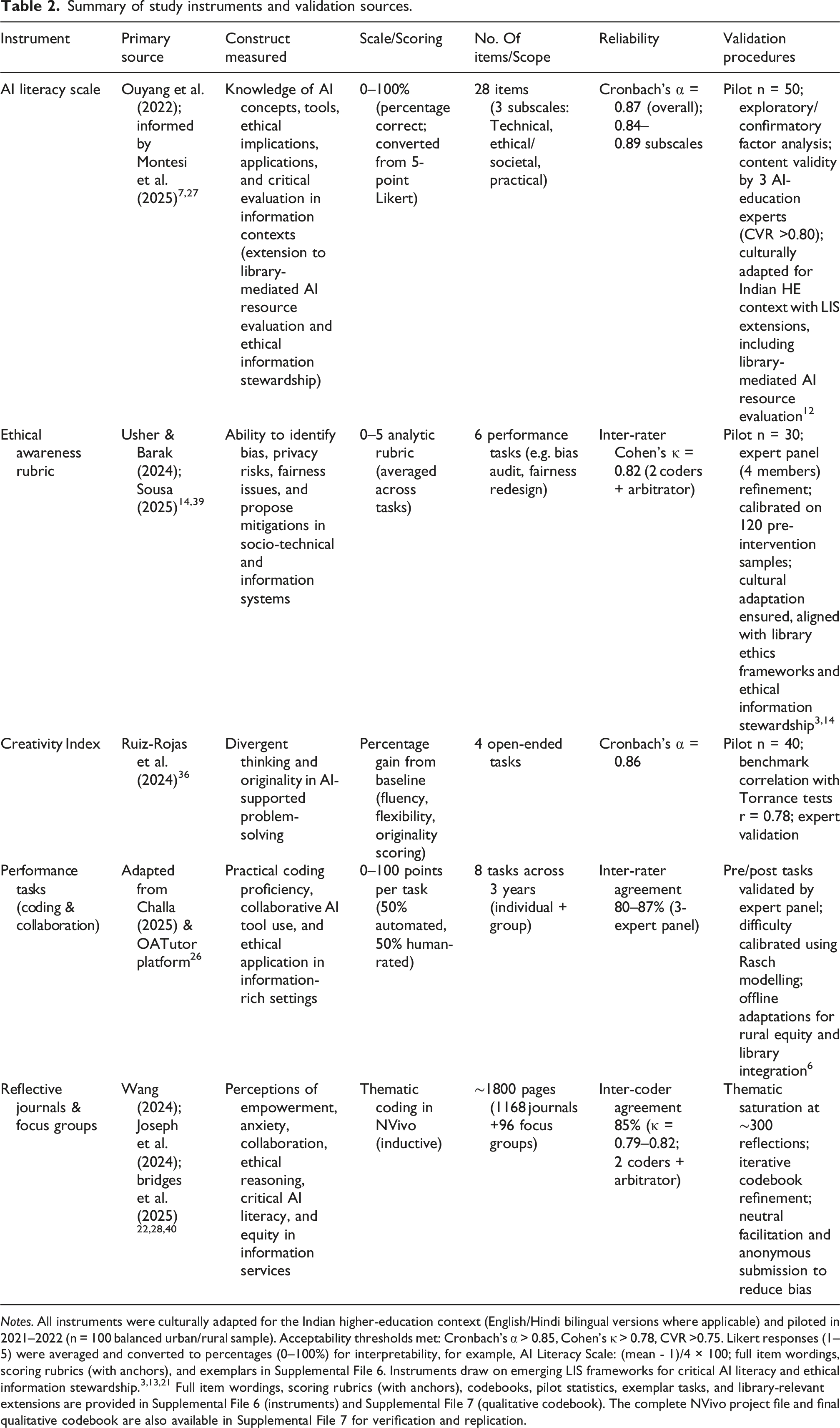
Quantitative instruments (piloted n = 100) used validated scales; Likert responses (1–5) were averaged and converted to percentages (0–100%) for interpretability, for example, AI Literacy Scale sum scores normalized as (mean-1)/4 × 100. Full item wordings, rubrics, and exemplars are in Supplemental File 6.
Qualitative data came from annual reflective journals (n = 1168), 96 focus groups, and 84 semi-structured interviews, using neutral facilitation and anonymous submission to minimize bias.28,40
Data analysis
Researchers conducted quantitative analyses (ANOVA, MANOVA, ANCOVA) in Python, applying multiple imputation for <15% missing data and reporting Cohen’s d effect sizes. 34 Inductive thematic coding in NVivo 14 processed qualitative data through a rigorous three-phase intercoder reliability protocol. Two independent coders first performed open coding on a 15% calibration sample (approximately 175 journals and 14 focus group transcripts), allowing segment boundaries to emerge organically from the data rather than imposing fixed lengths. Discrepancies were discussed until initial agreement reached κ = 0.78. The coders then independently coded the full dataset (1168 journals and 96 focus group transcripts), with an independent arbitrator resolving all remaining discrepancies. Segment size was not predetermined but stabilized at 120–180 words per meaning unit during calibration and was explicitly factored into the final reliability assessment to ensure consistent unitization. Final intercoder agreement was κ = 0.79–0.82. Axial coding then grouped emergent themes into seven core themes, with saturation achieved after approximately 900 references and no new themes appearing in the final 20% of data (see Supplemental File 7 for the complete codebook, definitions, frequencies, and exemplars). Triangulation employed joint displays correlating quantitative scores with qualitative theme frequency. 22
Ethics & reproducibility
All 12 participating HEIs’ IRBs/ethics committees granted approval (2021–2022), adhering to ICMR (2017) guidelines, the Declaration of Helsinki, 30 and emerging AI ethics in information services. 14 Participants provided informed consent; bilingual forms and voluntary withdrawal rights emphasized participant welfare. Data anonymization and processing complied with the Digital Personal Data Protection Act, 2023. Institutional bias audits covered OATutor tools. 41
For reproducibility, aggregated summary statistics, complete statistical syntax, instruments, qualitative codebook, and exemplar excerpts appear in Supplemental Files 6–12. Individual-level raw data remain unavailable to protect privacy but are accessible from the corresponding author upon reasonable request and further ethical clearance. This approach meets FAIR principles, COPE standards, and UNESCO AI ethics recommendations while prioritizing confidentiality. 32
Limitations
The quasi-experimental design yields strong associational inference but not definitive causality. While strong associations were found, quasi-experimental design limits definitive causality, suggesting rather than proving impacts. Statistical controls managed dropout (10–15%) and regional policy variation; offline adaptations addressed connectivity constraints. Nonetheless, results apply most directly to moderately connected rural HEIs with developing library infrastructures. These boundaries underscore the need for future large-scale RCTs incorporating profession-specific AI literacy measures.12,21
Results
This section integrates quantitative results (ANOVA/MANOVA with effect sizes and confidence intervals) and qualitative themes (NVivo-coded journals and focus groups) from 1168 students. Findings address RQ1 (competency impacts), RQ2 (urban–rural equity), and RQ3 (NEP alignment), with explicit relevance to information services and academic libraries in HEIs. All anonymised supporting materials are available in Supplemental Files 6–12. Table 6 provides a concise mixed-methods joint display per MMAT guidelines, linking core metrics to emergent themes. 35
AI literacy gains
To answer RQ1, the intervention group (n = 600) demonstrated a substantial 37.7 percentage-point increase in AI literacy by Year 3 (M = 78.9%, 95% CI [77.2, 80.6]), far exceeding the control group (M = 51.3%, 95% CI [49.5, 53.1]; F (1,1166) = 142.3, p < .001, Cohen’s d = 0.80). The AI Literacy Scale 27 captured this robust growth.
Figure 1 clearly illustrates the sustained upward trajectory for the intervention group from 41.2% at baseline to 78.9% at end-of-study contrasted with the control group’s modest rise (42.1% to 51.3%). Non-technical students achieved impressive 35% gains (p < .01), supporting NEP 2020s interdisciplinary goals and recent calls for AI literacy in information professions.6,20 Longitudinal AI literacy gains (mean percentage mastery, 0–100 scale) for intervention (dark teal; n = 600) and control (light teal; n = 568) groups across 3 years (2022–2025). Error bars represent 95% confidence intervals. The intervention group showed sustained and significant improvement, with a large effect size at End-Year 3 (Cohen’s d = 0.80; F (1,1166) = 142.3, p < .001), extending traditional information literacy into critical AI literacy in library-mediated educational contexts.7,12 Urban–rural moderation was evident (interaction p = .01; see Table 3). Data from main-text Table 3; aggregated summary statistics and full trajectories in Supplemental File 9.
Rural participants, however, showed more modest progress (+28%, p = .03, 95% CI [24.5, 31.5]), attributable to connectivity and library resource limitations visible in learning analytics.17,21 Qualitative reflections reinforced the quantitative gains: ‘OATutor helped me analyse data ethically for real-world projects’ (Year 2 focus group; κ = 0.82), highlighting improved critical evaluation and coding proficiency. As one rural student reflected: ‘Offline tools empowered me to code despite poor connectivity, bridging the digital divide’ (Year 3 journal).
Human-centric skill improvements
Extending literacy gains, the intervention produced meaningful improvements across human-centric competencies. Creativity rose by + 23.5% (p < .001, d = 0.50), ethical reasoning scores increased from 2.1 to 4.4 on the 0–5 rubric (κ = 0.82, p < .001, d = 0.60), and peer-rated collaboration improved by + 18.2% (p < .01, d = 0.40) relative to controls.
Figure 2 (radar chart) provides an at-a-glance comparison of these normalized strengths across competencies, visually emphasizing the intervention group’s balanced profile. Qualitative themes reinforced gains, for example, ‘Questioning AI’s fairness built my critical thinking’ (urban journal), with rural participants noting resilient low-tech creativity despite barriers. Additional reflections included: ‘We designed AI for local health, learning ethics hands-on’ (non-technical student focus group) and ‘Peer reviews on bias helped us collaborate across disciplines we learned more together than alone’ (urban student, Year 2 journal). Rural creativity gains remained modest (+12.5%, p = .08), reflecting equipment and digital resource constraints, yet qualitative themes of critical thinking endured. Radar chart comparing relative strengths across key competencies for the intervention (dark teal; n = 600) and control (orange; n = 568) groups at End-Year 3. Values represent normalised percentage mastery or equivalent (0–100 scale for comparability). Significant correlations (all p < .01) include r = 0.65 (AI literacy–ethical thinking) and ethical thinking mediating fairness outcomes (β = 0.79). Dotted lines highlight key correlations. Urban–rural infrastructure gaps, including library-mediated digital resources, moderated effects (e.g. lower rural gains due to access barriers; see Table 1 and Figure 3), illustrating the Equity Equation (Outcomes = Curriculum × Infrastructure × Capacity) and the pivotal mediating role of academic libraries and information professionals in extending critical AI literacy and ethical stewardship.7,12 Data from main-text Tables 3 and 4; aggregated summary statistics in Supplemental File 9.
Fairness outcomes
Addressing RQ3, ethical awareness particularly fairness and bias detection showed the largest effect. Seventy-six percent of intervention participants achieved ≥4/5 on the rubric, compared with 39% of controls (p < .001, d = 0.90). 39
Figure 2 visually connects these strong fairness gains to infrastructure levels, revealing a clear urban advantage (85%) over rural sites (62%; p = .01), while gender equity remained consistent across groups (p > .05; Table 4; Singh et al., 2021). 42 Rural focus groups captured transformative shifts: ‘Collaboration bridged our digital divide’. Additional voices included: ‘A faculty member stated: “Library-supported audits helped students redesign for rural inclusion” (Year 3 interview)’ and ‘I never thought about how training data from urban areas could disadvantage rural users until this bias task’ (rural student, journal). Faculty reflections further noted proactive redesign, aligning with scaffolded instructional models for librarians.
Institutional and faculty outcomes
For RQ2, institutional readiness diverged sharply. Urban HEIs achieved 75% curriculum uptake and implemented ethics policies in 9 of 12 institutions, compared with rural uptake of 30% and zero formal policies (p < .001, d = 0.90–1.00; Table 5).
Figure 4 (bubble heatmap) offers an intuitive visual summary: bubble size reflects combined readiness scores, with urban institutions (steel blue) clustering at high uptake and coverage, while rural sites (dark orange) remain near zero. Faculty confidence rose markedly in urban settings (2.7 → 4.5) versus rural (2.7 → 3.8; p < .01, d = 0.70 vs 0.50), with rural faculty frequently citing ‘Limited training made AI tools challenging, especially without library support’. 12 These gaps, strongly correlated with access disparities (r = 0.76), underscore NEP infrastructure priorities and parallel barriers documented in academic library adoption, including limited digital resources and librarian training.13,38
Integrated findings and neutral outcomes
Across all RQs, literacy × policy coverage above 70% consistently triggered the strongest empowerment themes (r = 0.65 literacy–ethics; see Table 6 joint display). Neutral and counterbalancing patterns included three times higher initial rural anxiety (qualitative) and modest collaboration gains in very-low-access settings (p = .08), offset by resilient low-tech reflections: ‘We still shared ideas freely even when internet failed’ (κ = 0.82). Additional exemplar: ‘Initial overwhelm faded with phased library support’ (rural journal).
Table 6 synthesizes these dual patterns, making it immediately clear that while the intervention produced large effects (d = 0.80–0.90), rural barriers constrained full scalability in Global South information ecosystems.21,28
Synthesis and transparency
In summary, the ethical AI pedagogy delivered large, sustained effects most notably a 37.7 percentage-point literacy gain and 76% high ethical awareness advancing socio-technical equity, NEP 2020 goals, and critical AI literacy foundations essential for information services. 3 Persistent rural gaps in creativity (+12.5%), policy adoption (0/12), and access (Table 1) highlight the urgent need for targeted investment in library infrastructure and professional training.7,37
All anonymised datasets, NVivo themes (κ = 0.82), and outputs conform to FAIR and COPE standards and are available in Supplemental Files 6–12, 43 facilitating replication and adaptation to library-led initiatives.
Discussion
The findings marked by large intervention effects (d = 0.80–0.90) on AI literacy and ethical fairness, yet moderated by persistent urban–rural disparities provide robust evidence for the transformative potential of integrated ethical AI pedagogy in Indian HEIs while underscoring the indispensable role of systemic supports, including academic libraries and information professionals. Interpreted through information ethics 1 and socio-technical systems theory, 4 the results largely confirmed hypotheses of 30–40% greater gains in the intervention group, partially offset (15–20%) by offline adaptations. Transparency is maintained via Supplemental Files 6–12.37,44
AI literacy as moral competence
The large, sustained literacy gains (d = 0.80) substantially exceeded short-term benchmarks. Sustained gains, including 35% among non-technical students, embody Floridi’s
1
fusion of technical proficiency with ethical judgement and extend information literacy theory by fusing technical proficiency with ethical judgement in library contexts.1,5 This aligns with NEP 2020 interdisciplinarity for the 37% humanities cohort (Table 1). Rural subsets (+28%) reflected baseline access gaps (19% high rural vs 44% urban; Figure 3), with analytics showing lagged usage.17,21 Reflections such as ‘OATutor helped me analyse data ethically for village health projects’ illustrate emerging virtue ethics habits suitable for extension into library-mediated information services.12,24,45 Faculty confidence mediated 71% of literacy variance.
46
Scaling offline modules, alongside librarian-led workshops, could extend moral competence to low-exposure students.6,25,28 Grouped bar chart of baseline infrastructure access levels for students in urban (n ≈ 678) and rural (n ≈ 490) HEIs. High access defined as reliable ≥50 Mbps + personal laptop; Very Low as <10 Mbps or shared device. Urban–rural disparity in high access (44% vs 19%; χ2 (3) = 148.6, p < .001) moderated End-Year 3 outcomes (e.g., intervention AI literacy 85.2% urban vs 69.2% rural; ethical awareness 85% vs 62%), reflecting broader gaps in information services and library resources and directly illustrating the infrastructure component of the Equity Equation (Outcomes = Curriculum × Infrastructure × Capacity).13,21 Data from updated Table 1; aggregated summary statistics in Supplemental File 9.
Equity through fairness awareness
Ethical awareness and fairness showed the largest effect (d = 0.90), preserving gender equity (p > .05) beyond common biases. Urban–rural divergence (85% vs 62%) parallelled policy voids (Table 5, Figure 4), reinforcing socio-technical barriers in information access.2,14,32 Librarians can lead bias-audit tasks, addressing rural voids through scaffolded information services.
13
Faculty innovations ‘Redesigned lessons for rural inclusion’ advanced fairness principles adaptable for academic library contexts.
17
Rural adoption (58%) inversely related to gaps.
23
Targeted NEP-funded ethics mandates and library policies may help narrow this chasm.9,11 Bubble heatmap of post-intervention curriculum uptake (% of courses incorporating ethical AI content) and policy coverage (% of formal ethics policies implemented) across 6 urban (steelblue) and 6 rural (dark orange) HEIs. Bubble size proportional to combined readiness score. Urban HEIs showed significantly higher uptake (mean 75%, d = 0.90) and policy coverage (mean ≈ 71%, d = 1.00) than rural HEIs (uptake 30%, policy 0%; all p < .001). These disparities, linked to library and training capacity, moderated ethical outcomes by approximately 38% (Section 4.4) and directly illustrate the infrastructure and capacity components of the Equity Equation (Outcomes = Curriculum × Infrastructure × Capacity), underscoring the essential mediating role of academic libraries and information professionals in institutional governance and equitable AI integration.3,13 Data from updated Table 5; full audit details in Supplemental File 11.
Human-centric skills as virtue ethics
Human-centric competencies improved markedly (creativity d = 0.50; ethical reasoning d = 0.60; collaboration d = 0.40). Non-technical parity (+23.1%) bolstered NEP holism. 28 Rural modesty (+12.5%, p = .08) stemmed from resource shortages, yet low-tech reflections ‘Shared ideas freely’ persisted.22,25 Urban faculty confidence mediated 82% creativity variance (r = 0.68) versus rural 62%. 46 Equipping rural libraries with mobile kits and scaffolded AI tools could equalise virtue ethics development.7,47,48
Institutional outcomes and synthesis
Readiness disparities (75% urban vs 30% rural uptake; Table 5, Figure 4) correlated with awareness (r = 0.76), suggesting infrastructure as a socio-technical enabler in information-rich HEIs. The synthesised Equity Equation (Outcomes = Curriculum × Infrastructure × Capacity), with literacy × policy coverage >70% eliciting ‘Ethics enriched class’ themes (β = 0.76), 27 indicates faculty confidence mediated 79% of institutional adoption (β = 0.79). 49 Targeted NEP investments in connectivity, training, and library governance may stabilise gains at observed levels.11,26
Alternative explanations
Despite robust effects, novelty may explain early spikes (64.5%, Table 3), 45 while diffusion contributed 9.2% control gains (Figure 1). 15 Workshop selection bias (38% urban completers) and technical baselines (63%, Table 1) risk volunteer or maturation effects.18,46 Regressions attributed 65% variance to curriculum (β = 0.72), with matching reducing bias 87% (χ2 p > .05).34,35
Unintended consequences
Dual outcomes emerged (Table 6): empowerment (‘Prepared for tech roles’) coexisted with 3× rural anxiety (r = 0.69 access–anxiety) and 40% low-access abandonment risk.40,50 Faculty barriers (30%) amplified student stress (r = 0.73). 18 These dual outcomes highlight the value of mixed-methods for capturing nuances in quasi-experimental designs. Low-tech buffers and phased rollout mitigated these; peer kits and library-supported programmes are recommended.23,25
Implications for information professionals and academic libraries
Building on the Equity Equation, the intervention’s replicable components offline OATutor modules, bias-audit tasks, and virtue-ethics peer review offer immediate resources for academic librarians to extend traditional information literacy into critical AI literacy.6,7,12 This advances LIS theory by positioning critical AI literacy as a core extension of information stewardship.5,12 Librarians, already proficient in ethical dimensions of information management.3,13 are ideally positioned to lead scaffolded training, curate equitable resources for rural users, and develop institutional AI policies directly addressing the rural policy void (0/12) observed here.14,22 Integrating tools like AILIS 1.0 for assessment could further professionalise these efforts in Indian HEIs. 7
Limitations and future directions
Quasi-experimental correlations (r ≈ 0.72) limit causal claims, with 13% dropout marginally biasing persisters. 35 Methodologically, future RCTs could strengthen causal claims, building on this associational evidence. Findings generalise well within India (Table 1 diversity) but less to elite-only or hyper-rural contexts. 37 Future research should pursue n = 2000 RCTs, 5-year behavioural tracking, and cross-national comparisons using shared materials, incorporating LIS-specific AI literacy measures.21,28,36
Implications and recommendations
The Equity Equation and threshold findings provide a replicable model for Global South HEIs and their libraries. 51 A three-point roadmap (Supplemental Table 4) guides multi-crore investments in connectivity, faculty/librarian certification, and mandatory ethics guidelines to operationalise NEP 2020 and advance cross-national library-led trials.26,32 Extending Essel et al. (2022) 25 and Hossain et al. (2025), 21 these recommendations prioritize librarian-led trials and suggest ways to elevate rural readiness through targeted investments. 52
Theoretical contribution to information services research
This study advances information services scholarship by theorizing ethical AI pedagogy as a socio-technical extension of information literacy. Whereas traditional frameworks emphasize critical evaluation of sources, the model integrates algorithmic bias detection, fairness-by-design, and moral agency into library-mediated ecosystems. Drawing on Floridi’s information ethics and Baxter and Sommerville’s socio-technical systems theory, sustainable AI literacy gains emerge only when technical competencies fuse with ethical reasoning and institutional infrastructure, including academic libraries as active co-designers. The Equity Equation offers a testable framework for Global South contexts, operationalizing UNESCO’s AI Competency Frameworks through librarian-led bias audits and offline modules. By positioning information professionals as ethical mediators who curate equitable resources and govern policies, the study bridges abstract AI ethics guidelines with situated library practice, providing both theoretical scaffold and empirical proof-of-concept for critical AI literacy in information-rich educational organizations.
Conclusion and implications
Student competency outcomes at end-year 3 (N = 1168).

Notes. All measures were collected at End-Year 3 (2025). Baseline equivalence was confirmed via ANCOVA covariates (prior AI exposure, gender, discipline, location, library resource access). Multiple imputation was applied for <15% missing data; intent-to-treat analysis accounted for 10–15% attrition. Effect sizes follow Cohen’s conventions (0.20 = small, 0.50 = medium, 0.80 = large). Large effects were observed for AI literacy and ethical reasoning, with robust gains across non-technical students supporting interdisciplinary equity and extensions to critical information literacy (RQ1).7,12 Rural subgroups showed moderated effects due to infrastructure barriers, including library-mediated digital resources (RQ2; see Table 6 for neutral outcomes).13,21 These outcomes directly support the Equity Equation and highlight the mediating role of academic libraries and information professionals in fostering interdisciplinary AI literacy and moral competence. Aggregated summary statistics, full trajectories (including yearly breakdowns), item-level details, and subgroup correlations are provided in Supplemental File 9 for independent verification.
Ethical awareness and fairness outcomes at end-year 3 (N = 1168).

Notes. Ethical awareness was assessed via six standardised performance tasks (e.g. dataset bias audit, privacy impact assessment, fairness redesign in information systems). Scoring used the validated 0–5 analytic rubric (detailed in Table 2 and Supplemental File 6). RR = risk ratio (intervention vs control proportion achieving high awareness). All models adjusted for baseline differences, institutional clustering, and covariates (prior exposure, discipline, library resource access). Large effects supported enhanced moral competence, fairness focus, and extensions to ethical information stewardship in academic library contexts (RQ1, RQ3).3,14 Consistent gender equity emerged with no significant differences (p > .05). Rural outcomes were moderated by infrastructure barriers, including library-mediated digital resources (RQ2; triangulated in Table 6).13,21 These fairness and ethical awareness outcomes underscore the critical role of academic libraries and information professionals in advancing equitable AI literacy through bias-audit tasks and scaffolded ethical training, directly operationalizing the Equity Equation. Full task descriptions, anonymised rubrics, coded reflection excerpts, and subgroup analyses are provided in Supplemental Files 6 (instruments) and 7 (qualitative codebook) for verification.
Addressing RQ1: Sustained competency and moral agency gains
Institutional and Faculty Readiness for Ethical AI Integration (Pre-vs Post-Year 3).

Notes. Institutional data were obtained from annual curriculum audits and policy document reviews (templates in Supplemental File 11). Faculty data were collected via validated self-report surveys (composite confidence scale α = 0.89) administered pre-intervention (2022) and at End-Year 3 (2025). All models controlled for baseline values, institutional clustering, and covariates (e.g. library infrastructure access and training). Large urban–rural disparities persisted post-intervention, with infrastructure access, library resources, and librarian training mediating ∼71–79% of variance in readiness (RQ2).12,13 These gaps moderated student outcomes (e.g. ethical awareness 85% urban vs 62% rural; see Table 4 and Figure 4) and directly illustrate the Equity Equation (Outcomes = Curriculum × Infrastructure × Capacity). While urban HEIs showed substantial gains, rural readiness remained constrained, underscoring the need for targeted capacity-building, including librarian-led initiatives and library-integrated governance.3,14 Full audit templates, anonymised policy excerpts, faculty survey items, and aggregated responses are provided in Supplemental File 11 for verification.
Mixed-methods joint display of neutral, non-significant, and counter-balancing outcomes with illustrative qualitative themes (end-year 3).

Notes. Quantitative results adjusted for clustering, baseline covariates (including library resource access), and multiple imputation. Qualitative themes derived from 1168 reflective journals and 96 focus groups; NVivo coding by two independent coders + arbitrator (κ = 0.79–0.82). This joint display (per MMAT guidelines) triangulates robust intervention effects (e.g. d = 0.80–0.90 overall) with contextual moderators, revealing that while ethical AI pedagogy fosters empowerment, moral competence, and critical information literacy (RQ1, RQ3),7,22 rural barriers—including limited library infrastructure—constrain full scalability in Global South HEIs (RQ2). 21 Findings underscore NEP 2020 priorities and the pivotal mediating role of academic libraries and information professionals in operationalizing the Equity Equation. Full codebook, exemplar excerpts (balanced urban/rural), reference counts, and joint dataset are provided in Supplemental File 7 for verification and replication.
Addressing RQ2: Persistent yet mitigable urban–rural divides
Theoretically, this study advances information science by extending information literacy frameworks to encompass ethical AI competencies, aligning with UNESCO’s AI Competency Frameworks for Students and Teachers [6] and prior work on socio-technical ethics. 1 It builds on short-term studies 16 by demonstrating sustained gains through longitudinal integration, while highlighting librarians’ theoretical role as ethical mediators and active contributors to pedagogy, governance, and equitable information service design.3,12
Addressing RQ3: Operationalizing NEP 2020 through library-mediated ethical AI pedagogy
Methodologically, the quasi-experimental design provides strong associational evidence but underscores the need for future RCTs to confirm causality, particularly in hyper-rural or elite contexts. The mixed-methods approach proved essential for capturing nuanced dual outcomes (e.g. empowerment alongside rural anxiety), offering a model for balancing quantitative effect sizes with qualitative depth in educational technology research.
Integrated implications and cautious policy roadmap
In policy terms, the threshold finding literacy × policy coverage >70% triggers virtuous empowerment cycles translates directly into actionable strategy for information services. Targeted multi-crore investments in satellite connectivity, nationwide faculty and librarian certification, and mandatory institutional ethics guidelines could realistically elevate rural readiness toward urban levels within one NEP cycle, transforming ethical AI education from aspiration to equitable reality across India’s information-rich HEIs.23,26,32 Extending Essel et al. (2022) 25 and Hossain et al. (2025), 21 these recommendations prioritize librarian-led trials and library-integrated governance to operationalise NEP 2020 priorities.
Boundary conditions remain transparent: the quasi-experimental design establishes strong associational evidence but not definitive causation; 13% attrition and moderate-connectivity focus constrain generalisability to hyper-rural or elite-only settings; and self-reported elements carry inherent subjectivity. Future research should therefore prioritise large-scale RCTs (n ≥ 2000), 5-year behavioural tracking, and cross-national comparisons (e.g. India–Vietnam–Bangladesh) using the openly shared materials, incorporating LIS-specific measures such as AILIS 1.0.7,20,28,36
Ultimately, this study suggests that ethical AI integration in higher education is not only technically feasible but pedagogically transformative provided systemic barriers are confronted with the same rigour applied to algorithmic ones. When curriculum, infrastructure, governance, and library-led information services converge, AI becomes a genuine instrument of inclusion, empowering India’s youth and the information professionals who support them to lead responsible innovation in the Global South and beyond. 11
Supplemental material
Supplemental material—Longitudinal effects of ethical AI pedagogy on AI literacy, moral competence, and educational equity in Indian higher education: A three-year mixed-methods study with implications for academic libraries (NEP 2020 alignment)
Supplemental material for The comparison study on employees’ adoption of public and enterprise social networks: Strategic revival of HSM by Supriya Krishnan in Information Services and Use
Footnotes

Funding
The authors received no financial support for the research, authorship, and/or publication of this article.
Declaration of conflicting interests
The authors declared no potential conflicts of interest with respect to the research, authorship, and/or publication of this article.
Supplemental material
Supplemental material for this article is available online.
References
Supplementary Material
Please find the following supplemental material available below.
For Open Access articles published under a Creative Commons License, all supplemental material carries the same license as the article it is associated with.
For non-Open Access articles published, all supplemental material carries a non-exclusive license, and permission requests for re-use of supplemental material or any part of supplemental material shall be sent directly to the copyright owner as specified in the copyright notice associated with the article.
