



Abstract
The IEEE Author Name Change Policy, aligned with the Committee on Publication Ethics (COPE) guidelines, enables authors to update their names in publications without requiring justification or legal documentation, prioritizing privacy and inclusivity. This study examines the policy’s implementation, challenges, and broader implications for academic publishing. Analysis reveals that 75% of name change requests involve conference papers, while 25% are for journal or magazine articles. Sixty-three percent of authors request changes for single articles and 14% do so for multiple publication types. IEEE has established effective workflows with Google Scholar, achieving high success rates in reflecting changes. However, inconsistencies persist across the scholarly ecosystem, with only 30% of indexing partners having formal policies. The paper highlights ongoing challenges in synchronizing updates across external platforms and technical limitations in modifying certain file formats. It advocates for industry-wide standardization through initiatives such as the NISO working group to enhance inclusivity, streamline processes, and improve academic record integrity while respecting author privacy. This research contributes to the evolving landscape of author identity management in scholarly communication, emphasizing the need for collaborative solutions to support diverse author needs and to maintain publication record cohesion.
Keywords
Introduction
The accuracy and consistency of author names in academic publishing are essential for proper attribution, discoverability, and scholarly integrity. Researchers rely on consistent author records to track citations, measure impact, and establish professional credibility. However, there are numerous circumstances in which an author may need to update their name in published works, including legal name changes due to marriage or divorce, gender transition, cultural realignment, or personal preference. Historically, many publishers and indexing services have lacked clear policies for managing such requests, resulting in barriers that prevent authors from maintaining accurate professional records.
These reasons for author name changes are varied and stem from personal, legal, or professional considerations, and they reflect broader societal and institutional dynamics. Marital status changes, gender identity transitions, and religious or cultural affiliations are frequent drivers. Additionally, authors may seek changes due to legal processes, personal preferences, or to address technical and ethical considerations, such as maintaining consistency across digital platforms and the ethical handling of “deadnames,” the names that transgender or non-binary people were assigned at birth. The variety of reasons underscores the importance of flexible and respectful name change policies.
The Committee on Publication Ethics (COPE) has established five guiding principles for publishers to follow when implementing author name change policies: accessibility, comprehensiveness, invisibility, expediency and simplicity, and recurrence and maintenance. These principles aim to create a more inclusive publishing environment that respects author privacy while maintaining the integrity of the scholarly record. 1
Several prominent publishers have implemented author name change policies that prioritize inclusivity, privacy, and simplicity. These policies generally align with the COPE guidelines. For example, publishers allow authors to replace their prior name with their current name without requiring justification or legal documentation, updating publications, citations, and metadata confidentially. Organizations such as the Association for Computing Machinery (ACM), the American Psychological Association (APA), The Institute of Physics (IOP) Publishing, and the American Institute of Physics (AIP) Publishing offer various options and approaches, all reflecting a growing trend towards supporting author identity management while maintaining the integrity of the scholarly record.2–5
In response to these challenges, the IEEE Author Name Change Policy was introduced to support authors seeking to update their names in previously published IEEE materials. The policy aligns with the COPE recommendations for an inclusive and author-centered approach to name changes. Notably, IEEE does not require authors to provide legal documentation or justification for a name change, ensuring accessibility and privacy. Furthermore, name changes are applied across IEEE’s metadata records, citations, biographies, and indexing updates while maintaining confidentiality by not notifying co-authors or issuing public corrections.
Despite these advances, challenges persist in the broader academic publishing ecosystem. This paper aims to provide an in-depth analysis of IEEE’s Author Name Change Policy, its implementation, and the challenges associated with ensuring consistency across academic records. We will examine data trends in name change requests, IEEE’s collaboration with Google Scholar and indexing services, and the broader implications for the academic community. Finally, we will discuss the ongoing efforts led by the National Information Standards Organization (NISO) to standardize author name change policies across the scholarly publishing landscape. By addressing these issues, we hope to highlight the need for industry-wide collaboration to enhance inclusivity, maintain scholarly integrity, and streamline the name change process in academic publishing.
Methodology
This study employs a mixed-methods approach to evaluate the IEEE Author Name Change Policy’s implementation, incorporating both quantitative and qualitative data collected between January 2020 and December 2024. 1. Data Sources: • Anonymized data from IEEE’s internal records of author name change requests. This dataset includes requests submitted through IEEE’s formal channels. 2. Quantitative Metrics: • Volume and Distribution of Requests: The study analyzed the number of name change requests, categorized by publication type (conference papers, journals, and magazines). • Success Rates of Metadata Updates: Evaluated the effectiveness of metadata updates across IEEE’s platforms (e.g., IEEE Xplore) and external indexing services (e.g., Google Scholar). • Compliance Rates of Indexing Partners: Assessed the adherence of indexing partners to update requests. This was determined through a survey of 20 major services collaborating with IEEE. 3. Process Documentation: • Workflow Analysis: Examined workflows for updating author names in IEEE Xplore. This included metadata adjustments and notifications to indexing partners. • Google Scholar Procedures: Reviewed the processes for Google Scholar submissions, encompassing spreadsheet logs of DOI/URL updates and manual verification of search results. 4. Limitations: • The study is limited to data from requests submitted through IEEE’s formal channels, excluding authors who did not utilize the policy. • Compliance rates of external indexing services were determined through policy audits and direct communication with partners. • Manual verification of Google Scholar updates may introduce human error. 5. Analysis: • Descriptive statistics are employed to summarize quantitative data, while process mapping is used to analyze workflows. These methods allow for evaluation of technical, ethical, and logistical dimensions within IEEE’s policy implementation.
The IEEE Author Name Change Policy
Policy overview
The IEEE Author Name Change Policy was established to support authors in updating their names in previously published IEEE materials while ensuring inclusivity, privacy, and discoverability.
6
IEEE recognizes the importance of author identity in academic publishing and aligns its policy with the Committee on Publication Ethics (COPE) guidelines, which advocate for author-centered name change procedures. Unlike traditional name correction policies, which often require legal documentation or co-author approval, IEEE’s approach prioritizes accessibility by allowing authors to update their names without disclosing the reason or providing legal proof (Figure 1). IEEE Author Name Change Policy.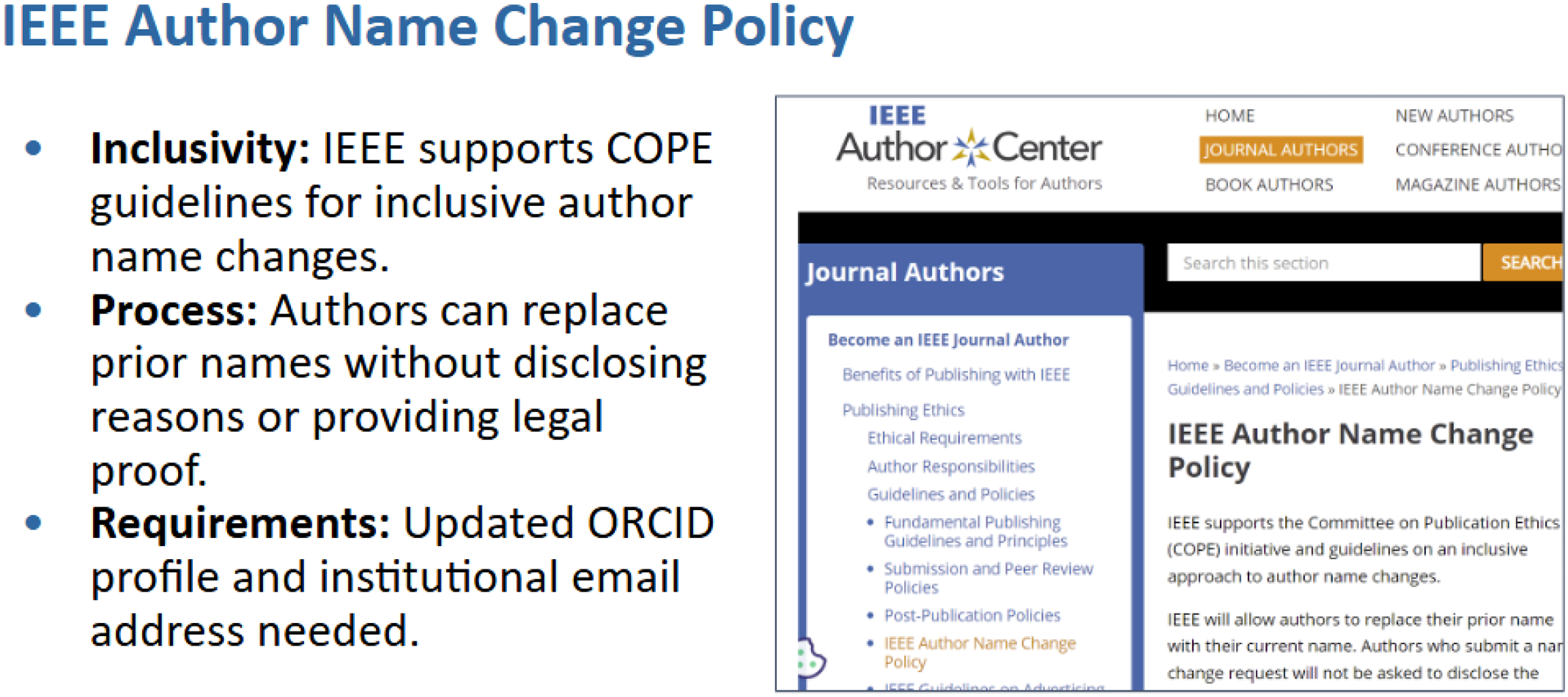
Under this policy, IEEE allows authors to replace prior names with their current names across their entire body of work published under IEEE. The name change request process is designed to be confidential, ensuring that co-authors are not notified and that no public correction notice is issued. This approach helps protect authors from potential privacy concerns, especially for those undergoing gender transition or changing their names for personal or cultural reasons.
Name change request process
IEEE has streamlined the name change request process to minimize administrative barriers while maintaining accuracy in its records.
7
Authors seeking to update their names must submit a formal request,
8
which includes: 1. Their updated name as they wish it to appear in IEEE publications. 2. Prior name(s) 3. An updated ORCID profile, which helps ensure consistency across multiple research databases. 4. Articles to be updated 5. An institutional email address, which is used for verification purposes.
Requests submitted on behalf of another person are not accepted to maintain security and prevent unauthorized changes. Once a request is approved, IEEE applies the name change across its digital publication infrastructure, including metadata records, author profiles, and article references (Figure 2). IEEE author name change contact and support.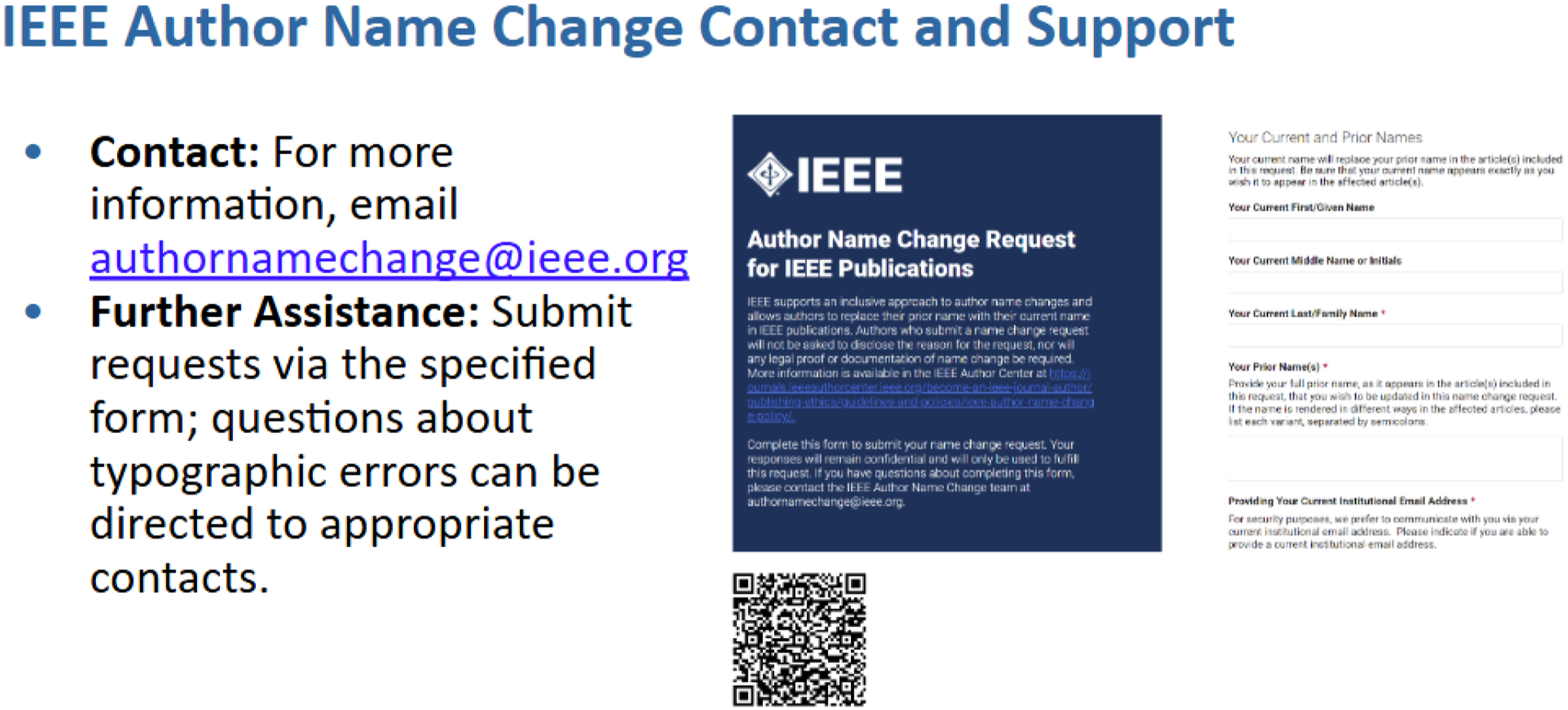
Metadata and citation updates
IEEE ensures that an author’s updated name is reflected comprehensively in its digital archives. The following aspects are updated as part of the process: • Metadata Records: The author’s name is corrected in IEEE’s internal databases, which index all IEEE publications. • Article References: Any mention of the author’s name within an article, including captions, acknowledgments, and biographies, is updated. • Email Addresses: If the author’s contact information has changed alongside the name, the email address listed in IEEE publications is also updated. • Indexing Services: IEEE forwards updated metadata to major indexing partners, including Google Scholar, CrossRef, and institutional repositories, to improve discoverability.
These updates ensure that the author’s work remains correctly attributed and easily searchable under their current name. However, some limitations exist, as name changes may not be automatically reflected in external indexing services that have independent policies on metadata updates (Figure 3). IEEE author name change workflow.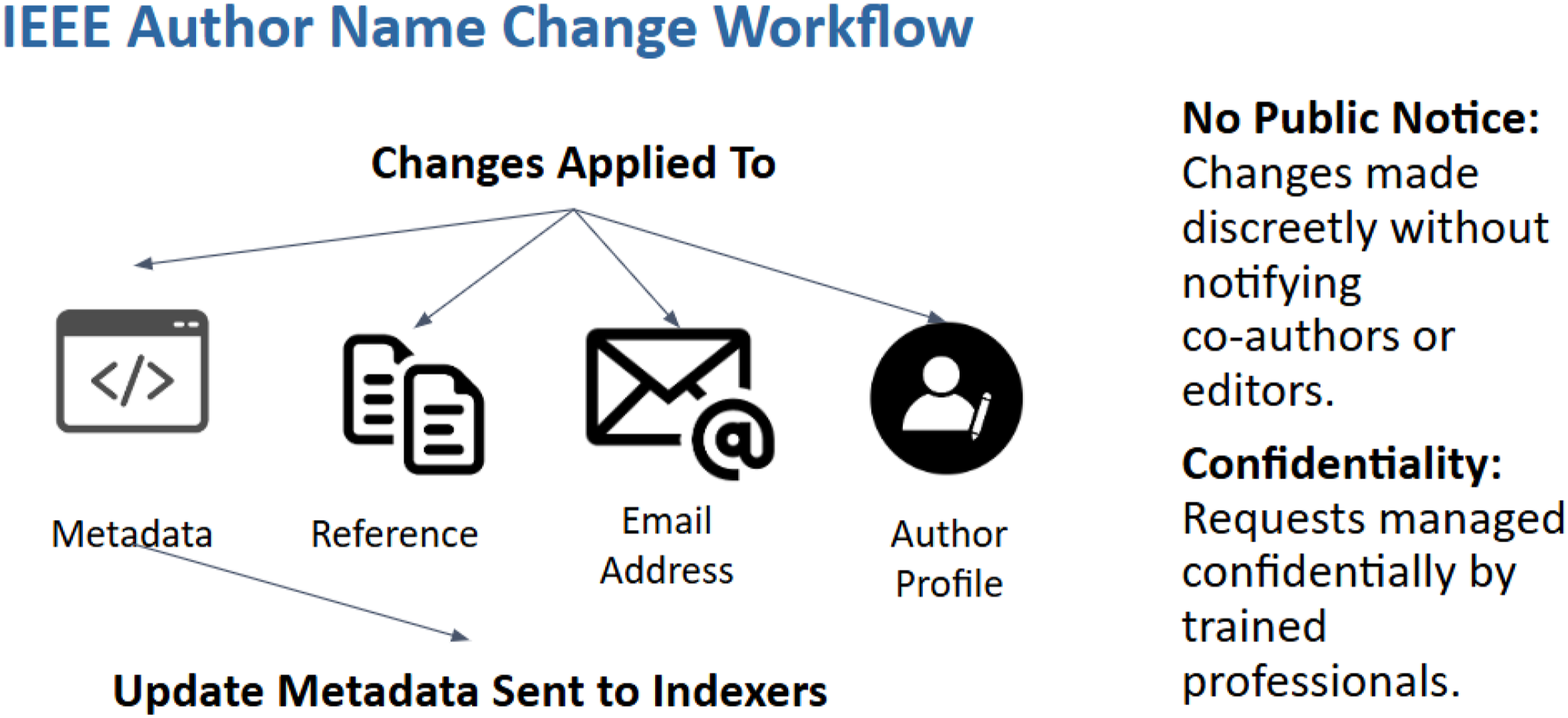
Privacy and ethical considerations
One of the distinguishing features of IEEE’s policy is its emphasis on confidentiality and author privacy. To protect authors from potential bias, discrimination, or unwanted inquiries, IEEE implements the following measures: • No Public Correction Notice: Unlike traditional errata for factual errors, name changes are applied quietly without issuing a public update. • No Co-Author Notification: Co-authors are not informed of name changes, respecting the author’s right to privacy. • Retention of Original Records for Legal Purposes: While IEEE’s digital records are updated, the original versions remain archived internally for legal integrity and record-keeping. • Dedicated Support for Authors: Authors can seek assistance from IEEE’s customer support team to ensure that their name change is processed accurately and efficiently.
These policies demonstrate IEEE’s commitment to fostering an inclusive scholarly community by accommodating author identity changes while maintaining academic integrity.
Limitations and challenges
Despite the comprehensive approach, IEEE acknowledges certain limitations in the name change process: • External Indexing Services: Although IEEE updates its own metadata, name changes may not cascade automatically to external databases, as indexing partners follow independent policies. • PDF Formatting Constraints: While metadata and text-based citations are updated, changes in PDF versions of articles may result in visible alterations due to formatting adjustments. • Multimedia Files: IEEE is currently unable to modify audio or video materials that contain spoken or visual references to an author’s prior name. • Manual Workflows: The process of updating metadata and ensuring correct indexing requires manual verification, making it time-intensive.
To mitigate these challenges, IEEE collaborates with indexing services and industry stakeholders to improve workflows and enhance the consistency of name changes across the research ecosystem.
IEEE author name change implementation and challenges
Implementing the IEEE Author Name Change Policy requires a coordinated approach involving internal record updates, metadata corrections, and external indexing services. While IEEE has developed a structured and confidential process for handling name changes, challenges persist in ensuring consistent updates across multiple platforms. This section examines the practical aspects of IEEE’s implementation, the trends in author name change requests, and the obstacles faced in maintaining metadata integrity and discoverability.
Trends in author name change requests
Distribution of name change requests by publication type
Analysis of IEEE data reveals patterns in where name change requests occur: • Conference Papers: Seventy-five percent of all requests involve conference papers. • Journals: Twenty-two percent of name change requests are linked to journal articles. • Magazines: Three percent of requests pertain to magazine publications.
The dominance of conference papers in name change requests suggests that early-career researchers and those presenting preliminary findings are more likely to seek updates to their author records (Figure 4). IEEE author name changes case studies.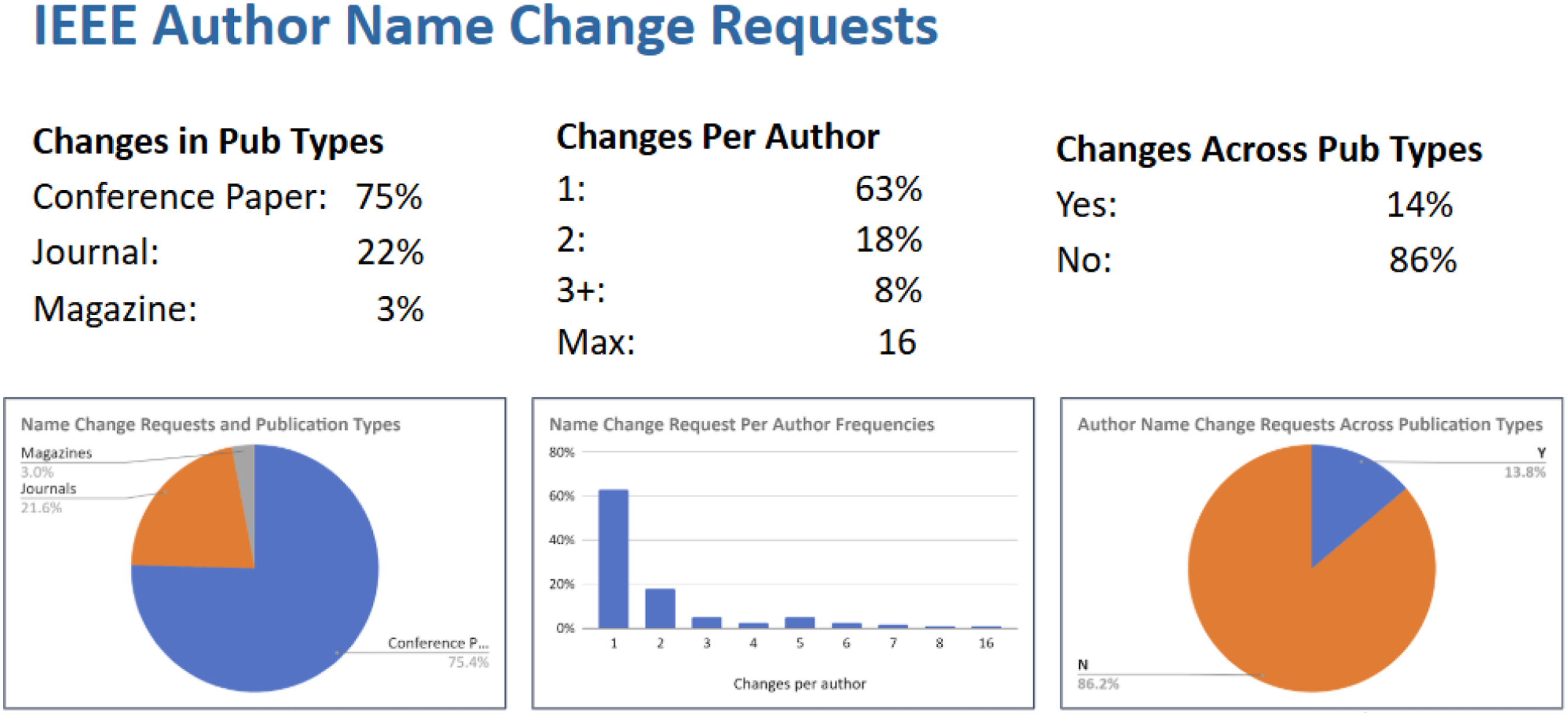
Volume of name change requests per author
The number of name change requests per individual varies: • Single Article Requests: Sixty-three percent of authors request changes for only one publication. • Multiple Publications: Fourteen percent of requests span multiple publication types, with some authors requesting changes for up to 16 articles.
These statistics highlight the varying scope of name corrections, demonstrating the importance of flexible and scalable name change policies.
Collaboration with Google Scholar and indexing partners
IEEE’s submission workflow for Google Scholar
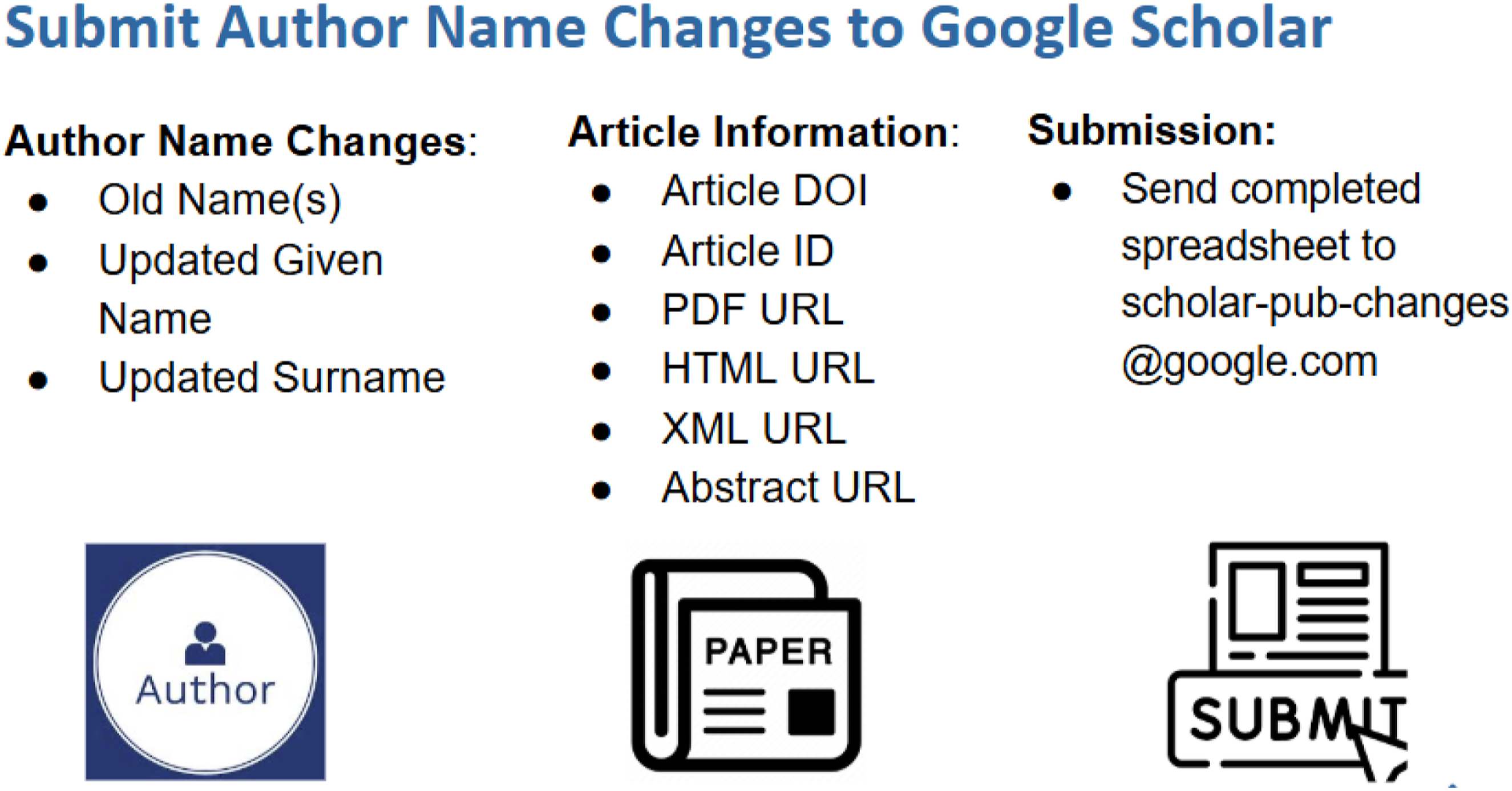
IEEE has established a structured process for updating name changes in Google Scholar, given its critical role in academic discoverability. The procedure involves: • Creating a Detailed Spreadsheet: IEEE compiles a submission file with: Old and updated names Article DOIs and IDs URLs for PDFs, HTML, XML, and abstracts • Submitting Requests: The spreadsheet is sent to • Verification Process: IEEE manually checks Google Scholar search results to confirm successful updates (Figure 5). Submit author name changes to Google Scholar.
Success rate of name change updates in Google Scholar
IEEE’s data analysis reveals the following: • Eighty-nine percent of name change requests were correctly reflected in Google Scholar. • 6.6% of requests were not updated at all. • 4.5% were processed incorrectly, requiring follow-ups with Google Scholar.
Additionally, synchronization issues arise with Google Scholar Author Profiles: • Fifty-four percent of name change requests were correctly synchronized with author profiles. • Four percent of authors had not updated their profiles to match IEEE’s corrections. • Forty-two percent of authors did not have a Google Scholar Author Profile.
These inconsistencies demonstrate the need for a more robust mechanism to ensure automatic updates across citation databases (Figure 6). Verify author name changes in Google Scholar.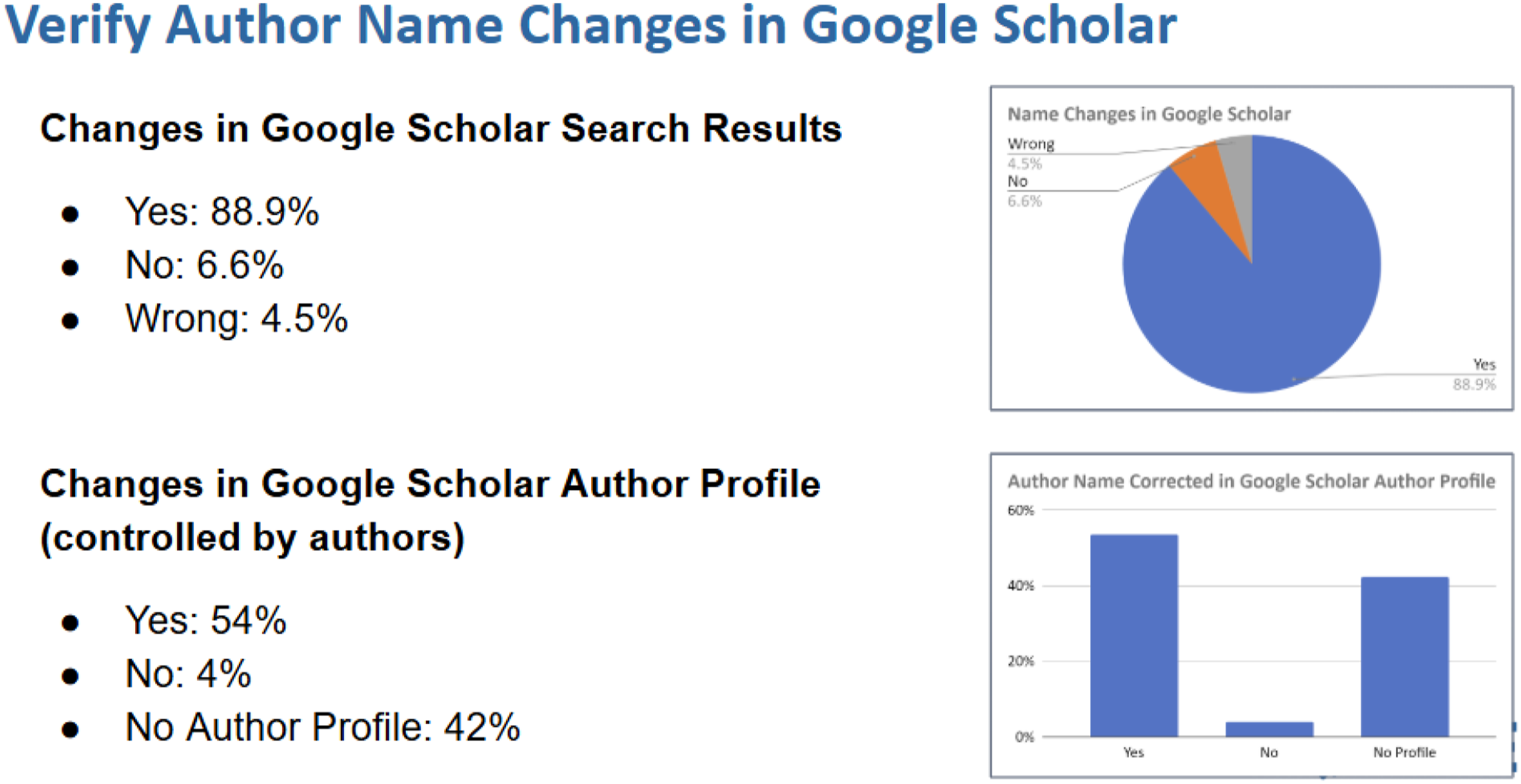
Challenges with indexing partners
While IEEE updates its own records and notifies indexing services, policy inconsistencies mean that name changes are not always reflected in external repositories. • Only 30% of IEEE’s indexing partners have a formal name change policy. • Seventy percent do not have explicit procedures for handling name updates. • Submission Methods Vary: Four partners require a dedicated name change request form. Three partners accept changes via general email communication. One partner has a specific email alias for name change updates.
The lack of standardized policies across indexing services results in discrepancies in author records, limiting the effectiveness of IEEE’s efforts (Figure 7). Author name changes not cascaded to indexers.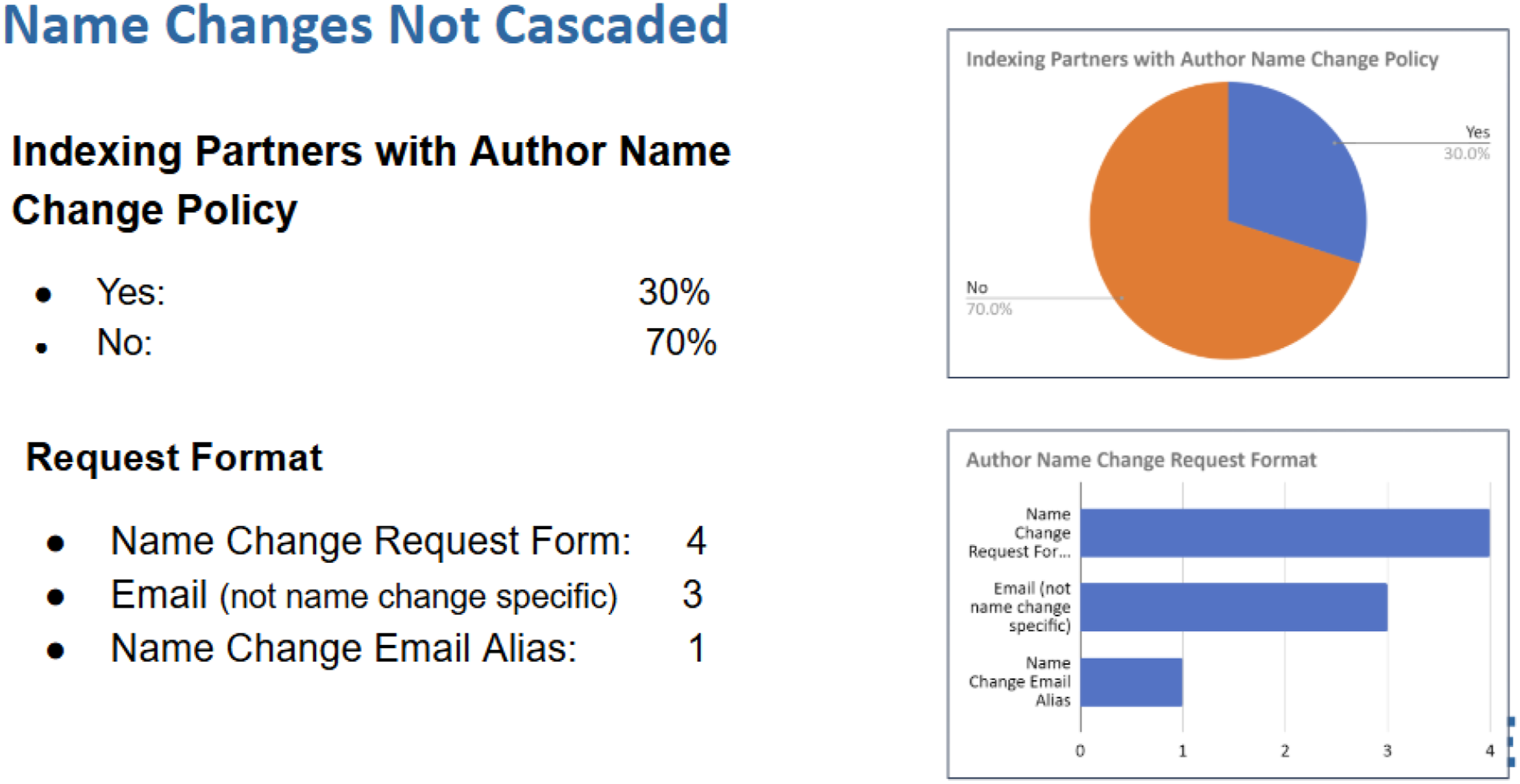
The need for industry-wide standardization
As we look at the current landscape, COPE has already published guidance on author name changes, and NISO’s proposal for a new recommended practice has been approved, with a working group in the process of being formed.
7
This working group is crucial for several reasons: • Standardization: It is essential to establish consistent practices across the industry to ensure that author name changes are handled uniformly. • Collaboration: By fostering cooperation among publishers, libraries, and indexing services, we can streamline the process and make it more efficient. • Integrity: Maintaining the integrity of scholarly records is vital to the credibility of academic publishing. • Inclusivity: Ultimately, these efforts respect and support the diverse identities of authors, which is fundamental to fostering an inclusive scholarly community.
We look forward to seeing this NISO working group help streamline the author name changes across the data supply chain.
Footnotes
Funding
The author received no financial support for the research, authorship, and/or publication of this article.
Conflicting interests
The author declared no potential conflicts of interest with respect to the research, authorship, and/or publication of this article.