



Abstract
Between 1972 and 1986, Ferdinand E. Marcos of the Philippines headed an autocratic system that allowed him to rule with little to no accountability. Some 36 years after FM (as he is popularly called) and family were driven from power into exile in Hawaii, his son, Ferdinand ‘Bongbong’ Marcos, Jr., was overwhelmingly elected President in the May 2022 general elections. This turnaround seemed puzzling to many, but others saw a long-term deliberate process of rehabilitation after the family returned to the Philippines. Our paper explores how Filipinos remembered FM in the years after his ouster. What drives the memory of dictatorship in the Philippines? Using time series data on public opinion about FM post-ouster, we find that a generally positive appreciation of Marcos as former president had crystallised early on across nearly all the major variables of age, sex, education, location and ethnicity.
Introduction: The Marcos Saga
The Philippines went through an authoritarian phase between 1972 and 1986. At the head of this autocratic system was Ferdinand Edralin Marcos, or FM as he is more popularly known. Using a provision in the 1935 Constitution, then-president Marcos placed the entire archipelago under martial law on the pretext of a looming communist threat, which practically allowed him to stay in power indefinitely. Throughout this period, FM acquired and exercised broad emergency powers that effectively subverted pre-martial law political institutions.
Officially, this was to be the ‘New Society’ period (Marcos, 1973) although scholars referred to it as ‘martial law, Marcos-style’ (Durdin, 1975), captured in the term ‘constitutional authoritarianism’ (Butterfield, 1977; Del Carmen, 1973; Hernandez, 1985). These years were also seen by certain scholars and observers as a kleptocracy and an excessive regime that operated at the expense of the poor and the powerless. 1 Not surprisingly, allegations of abuses and accounts of corruption by members of the Marcos family and their cronies emerged early on, and eventually, these allegations became the popular hallmark of the FM years (see Mijares, 1976).
In February 1986, this New Society came to an end when a popular but non-violent uprising (supported by certain members of the Philippine military) forced the Marcoses to hastily vacate the presidential palace and seek asylum in Hawaii under US government auspices. 2 Upon their departure, the anti-Marcos groups filled the power vacuum and re-established pre-martial law institutions. Corazon Cojuangco Aquino, wife of the martyred Senator Ninoy Aquino Jr., was now at the head of the newly established government that promptly drafted a new constitution and proceeded to take measures to retrieve all the wealth accumulated by the Marcoses and their cronies.
However, the exiled life of the Marcoses proved to be short-lived. Members of the Marcos family were allowed to return to the Philippines by 1991, which was promptly followed by their reappearance in the Philippine political landscape (most notably in Ilocos Norte, FM's home province in the north). The Marcos saga ultimately culminated in the phenomenal election victory of the dictator's son and namesake, Ferdinand (Bongbong) Romualdez Marcos Jr. (or BBM), as president in May 2022, receiving around 59 per cent of the votes.
On the surface, this disjuncture makes little sense. Have people really forgotten or forgiven the atrocities committed during the martial law period that have been largely blamed on FM? How can a seemingly reviled and infamous political family like the Marcoses make a successful comeback, even to the point of reclaiming the highest political office in the country? We point out that the apparent misaligned developments between 1986 and 2022 can only make sense once we factor in the impressions that Filipinos had of FM in the post-EDSA period. How was FM perceived by Filipinos, particularly after 1986? This paper posits that the Marcos family's successful and effective political return could be partly attributed to the perceived popularity and continued acceptability of FM as president even after his removal from office. 3 This then begs the question of exactly how popular and acceptable FM was in the post-1986 period.
This turnaround seemed puzzling to many, but others saw a long-term deliberate process of rehabilitation after the family returned to the Philippines (even though FM had died in 1989). Members of the family won various elections to local and national posts. Many observers both in the Philippines (Bagayaua-Mendoza, 2019) and abroad (Cabato and Mahtani, 2022) traced activities on the internet and social media that aimed to ‘whitewash’ the FM administration, particularly the Martial Law years. Using time series data on public opinion about FM as president, our paper tries to pinpoint the timing and factors behind changing attitudes towards the Marcoses without entirely discounting the other likely intervening drivers such as misinformation. 4 However, we do want to acknowledge the argument that simply reducing the variables to social media influence (particularly misinformation) can be problematic as it also assumes that Filipino voters are easily and immediately gullible. In any case, BBM's election victory in 2022 cannot be simply reduced to being an artefact of Internet trolls and social media.
FM remains an intriguing figure in Philippine politics and society, most notably due to the mythology surrounding his perceived accomplishments as well as his presidential tenure. The Marcoses continue to significantly influence the country, particularly since 2022 under the presidency of BBM. Scholars and pundits tend to attribute BBM's 2022 victory to social media trolls, political dynasties, false nostalgia, biased textbooks, disenchantment with democracy, and disinformation, among others.
Our findings suggest that popular support for FM has proven relatively durable even during the post-authoritarian period. We contend that the positive memory for the former president remained robust across major variables even after the People Power Revolution that led to his ouster. This raises the possibility that the People Power uprising was not fully nationally representative of the view that Marcos needed to be removed for the reasons that people might have assumed. 5 Our paper is divided into three parts. The first underscores the importance of memory in the transition from an authoritarian episode. The second part describes the key survey findings on popular impressions of FM, providing logistic regressions on key statements against sex, age, education, location, and ethnicity. The last part concludes.
Drivers of Memory of Dictatorship
Post-dictatorship systems take time to transition towards genuine and effective democracies. An authoritarian episode such as that which occurred in the Philippines can have a long-lasting impact on people's consciousness, even among those who did not directly experience the horrors that typically accompany it. As such, people tend to convey more than one appreciation of a dictatorship. It is also not inconceivable for many to be mesmerised and awed by the monumental infrastructures constructed during the Marcos years. Such displays of the Marcos ‘edifice complex’ were a testament to the way that ‘architecture became an instrument of political propaganda and agent of social pacification’ (Lico, 2003: 156).
The perceived accomplishments and ‘recollections’ of the dictatorship can be more nuanced and can range from ambivalence to indifference (Dulay et al., 2022) to disgust and fear (Aldama et al. 2019) to even nostalgic affection for either the dictator or the dictatorship (Talamaya, 2021) aided by an ingrained authoritarian disposition (Pernia, 2022) as well as maligned information (Mendoza, 2019, 2022). Moreover, the strongman's language that the dictator uses adds to the reputational allure of dictatorship (see Tigno and Franco, 2014).
Alesina et al. (2021) found that dictators can use mass primary education as a policy instrument to ‘homogenise’ or unify the population to preserve the status quo and address the threats to power. As such, the educational system may unintentionally propagate the same narrative even after the ouster of the dictator, thus engendering a more positive and constructive appreciation of the past dictatorship as a whole. Education (as a whole and higher education in particular) can also manifest differently over time as a factor for determining attitude towards a past dictatorship. The literature shows education correlates positively with post-material and democratic values and anti-authoritarian attitudes (Bernhard and Karakoç, 2007).
However, education as a significant factor can eventually fade over time. A study on Portugal utilised two surveys assessing the long-lasting impacts of the fascist-type dictatorship from 1926 to 1974. The first survey was done in 2004, and the second in 2014. What the study found was that, in 2004, education was a relevant variable, i.e., ‘the more educated the respondents are, the less likely they are to assess the New State [the old regime] in a positive fashion [such that] people who attended university are only five percent likely to express positive attitudes and 87 percent likely to be negative towards the past’ (Santana-Pereira et al., 2016: 205). But in looking at the 2014 survey, they found education to be statistically insignificant.
Gender can also have an impact on popular impressions of the dictator. The common assumption is that women under dictatorships either exerted little to no agency or played peripheral, cosmetic, or supporting roles. Ironically, women who have lived under a dictatorship have been found to harbour positive sentiments towards it due to the liberalising and reform-oriented policies that seek to undermine long-standing gender stereotypes. For instance, liberalising reforms directed at women and the family were introduced during the dictatorships in Latin America, especially in the areas of marriage and divorce, family planning, and even abortion (see Htun, 2003).
In 1975, FM created the National Commission on the Role of Filipino Women (NCRFW), an organisation that exists to this day. The body was officially tasked to ensure women's integration in Philippine economic, social, and cultural development. It was the first national mechanism in Asia to uphold women's status in society and politics. It was also in the 1970s when population issues became an integral part of formal development planning specific to attaining the goal of fertility reduction, an issue that would have been a taboo subject for certain religious groups. Such liberalising reforms undertaken during the period of authoritarian rule can engender positive attitudes towards the dictator, especially among women. Of course, this is notwithstanding the fact that many women political activists were sexually and physically tortured and even killed during the martial law years, although these incidents of torture and extrajudicial killings were not reported in the officially sanctioned press at the time and came to the attention of the public only after 1986.
Finally, the ethno-geographical factor can also be a salient and positive variable in determining people's attitudes towards a former autocrat. Scholars of Philippine politics from the 1960s to the present have acknowledged the important role played by geography and ethnicity especially in electoral politics. The works of Landé (1967, 1996) show that political leaders have had to rely on the ethno-linguistic card to win support. Ando (1969), in his study of voting patterns in Philippine presidential elections from 1946 to 1965, shows that, aside from patronage, having ‘a common cultural linguistic background’ is another tie that binds the leader with his followers (p. 570). Holmes (2016) also affirms the salience of geographic and ethno-linguistic factors in determining the patterns of voting support.
Analysing how people remember their former leaders can be fraught with challenges as it entails the examination of the broader web of societal and political connections, experiences, and interactions (Maurantonio, 2017). Thus, different segments of the population – male or female, young or old, of varying educational levels, and various ethnicities – can convey varied impressions of the same phenomenon across several periods. Gugushvili et al. (2017) found that ‘sociodemographic and socioeconomic characteristics such as gender, age, education, residency, employment, and income are important explanations of why certain figures are remembered as heroes or villains’ (p. 478).
Impressions of FM as President – Statistical Breakdown
Within the broad framework of understanding the variables likely to correlate with the nuances of collectively remembering FM of the Philippines, our paper utilises the results of surveys done by SWS asking for responses to trigger statements about Ferdinand Marcos as a former president. The surveys were done in May–June 1986, September–October 1995, March 2016, and February 2022.
The 1986 survey had a sample size of 2,000–500 each from the four main areas of National Capital Region (NCR), Balance of Luzon (Other Luzon), Visayas, and Mindanao. The 1995 and 2022 surveys each had sample sizes of 1,200–300 each from the four main areas. The 2016 survey had a sample size of 1,800 adult-age respondents – 300 each from NCR and Visayas and 600 each from Other Luzon and Mindanao weighted to get their population equivalents. The surveys were conducted using face-to-face interviews with adults (18 years old and above). They had sampling error margins of at most ± 3 per cent for national percentages and ± 6 per cent for area percentages at the 95 per cent confidence level. The respondents were obtained from 240 spots or barangays, with five respondents per spot. A fresh set of respondents was randomly drawn every survey round.
In all four surveys, respondents were asked to give their reaction (agree or disagree) to six statements pertaining to President Ferdinand E. Marcos, which are as follows:
Defender of the poor and oppressed. [Mapagtanggol ng mga mahihirap at mga api.] Caring for friends who enriched themselves by pocketing government funds. [Mapagmahal sa mga kaibigang yumaman sa pangungurakot ng pondo ng gobyerno.] A thief of the nation's wealth. [Magnanakaw ng yamang bayan.] True to the duties of a patriotic president. [Tapat sa tungkulin ng isang makabansang pangulo.] A humble president. [Mapagkumbabang pangulo.] A severe, brutal or oppressive president. [Marahas o mapang-aping pangulo.]
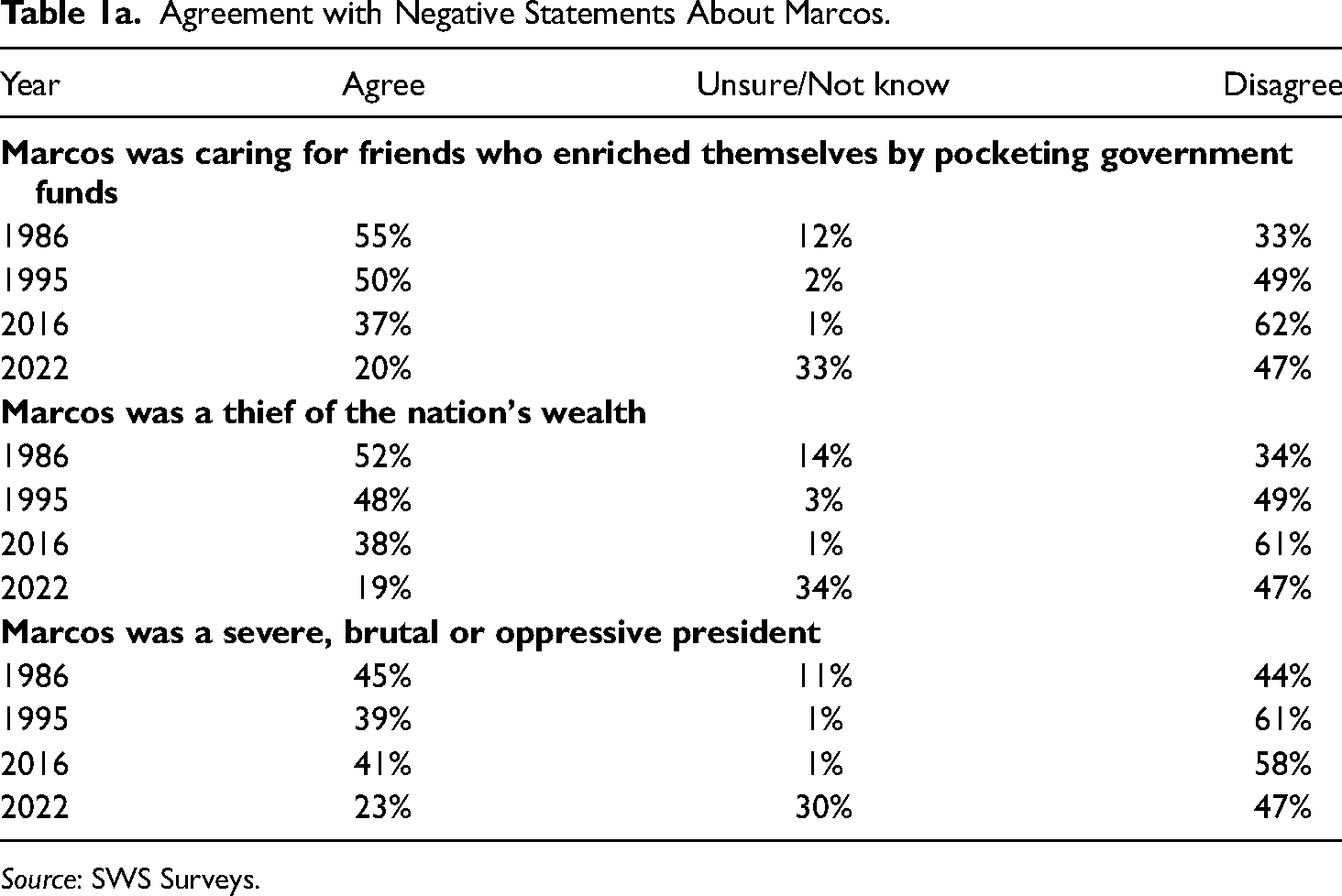
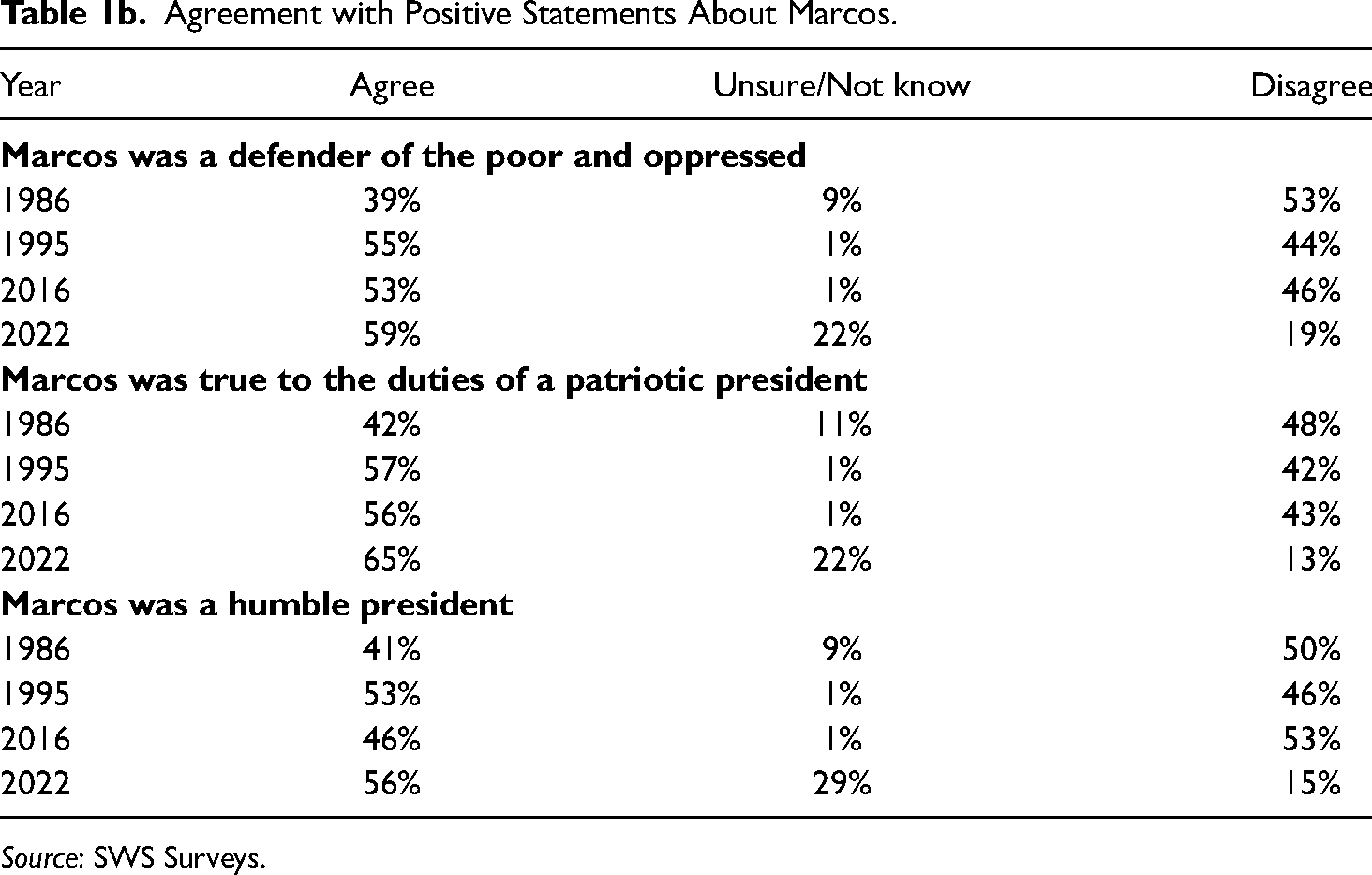
Respondents were then analysed with respect to geographical area (e.g., Metro Manila, Balance Luzon, Visayas, and Mindanao), sex, age group, and education. In Tables 1a and 1b, the results are divided into those negative and positive statements about the former president. Some trends are common to both sets – generally, between 1986 and 1995, there is a lessening of negative sentiments or an increase in positive sentiments. After that, approval of FM stays positive with some fluctuations.
Agreement with Negative Statements About Marcos.
Source: SWS Surveys.
Agreement with Positive Statements About Marcos.
Source: SWS Surveys.
There was one edit to the questions in 2022, when besides asking about agreement or disagreement with the statement, respondents were explicitly offered the option to say that they did not know or were unsure about their response. In the earlier surveys, respondents themselves had to provide such a response. Giving respondents the explicit option did often raise the percentage of those who chose the middle response as shown in the tabulations above. There is also a divergence between positive and negative items in 2022. The increase in ‘unsure/don’t know’ in the 2022 data that was noted above seems to have drawn down both the ‘agree’ and ‘disagree’ for the negative sentiments but only seems to have reduced the disagreement with the positive statements.
In Table 1a, we see that in 1986, respondents only moderately agreed that FM cared for friends who were enriching themselves, moderately agreed that he was a thief of the nation's wealth, but neutral about whether he was brutal or oppressive. However, the initial 1986 survey round had a higher DK/Unsure response compared to the 1995 results, even though this option was not explicitly included in the questionnaire. We offer two plausible hypotheses: (1) Opinions had not yet crystallised to a significant degree at the time, i.e., just four months after the ouster of the Marcoses. By 1995, with all the intervening events, citizens had a chance to make up their minds. (2) A holdover effect of martial law may have made some people more reluctant to express themselves. We do not have the data to decide between these two, and in any case, it could easily be some combination of the two effects that drove the DK/Unsure down to 1 per cent in 1995 and 2016.
By 1995, respondents had become more neutral about the questions regarding funds and wealth and moderately disagreed with the statement about brutality or oppression. By the 2016 round, there was moderate disagreement with all three statements, which remained the case in the 2022 survey round. As noted, there was a decrease in the percentages answering either ‘agree’ or ‘disagree’ when the middle ‘undecided’ option was offered to the respondents.
Table 1b shows respondent reactions to positive statements about FM as president. Overall, respondents were either neutral or moderately positive in their opinions for the first three surveys. There is a discernible positive trend after 1986, but through 2016, the change was less than among the negative sentiments in Table 1a. All three positive statements had about as much change as did the negative statement about brutality or oppression, and this latter changed the least among the negative sentiments.
It is in 2022 that we see a very striking increase in the ratio of agreement/disagreement for positive sentiments. Inspection of Table 1b will show that this is due to a collapse in the percentages expressing disagreement with positive statements. From 1995 through 2022, agreement with positive statements is a stable majority sentiment.
In summary, in 1986, there was moderate concern over ‘cronyism’ and neutral sentiments about other negative aspects. Regarding positive statements, in 1986, respondents were neutral or moderately disagreeing. Over time, negative sentiments beginning in 1995 faded to moderate disagreement by 2022, and by 1995, agreement with the positive statements had become the stable majority response. In Figure 1, we graph those who agree with either the positive or negative statements in Tables 1a and 1b, showing the percentage of respondents expressing views favourable and unfavourable to FM.
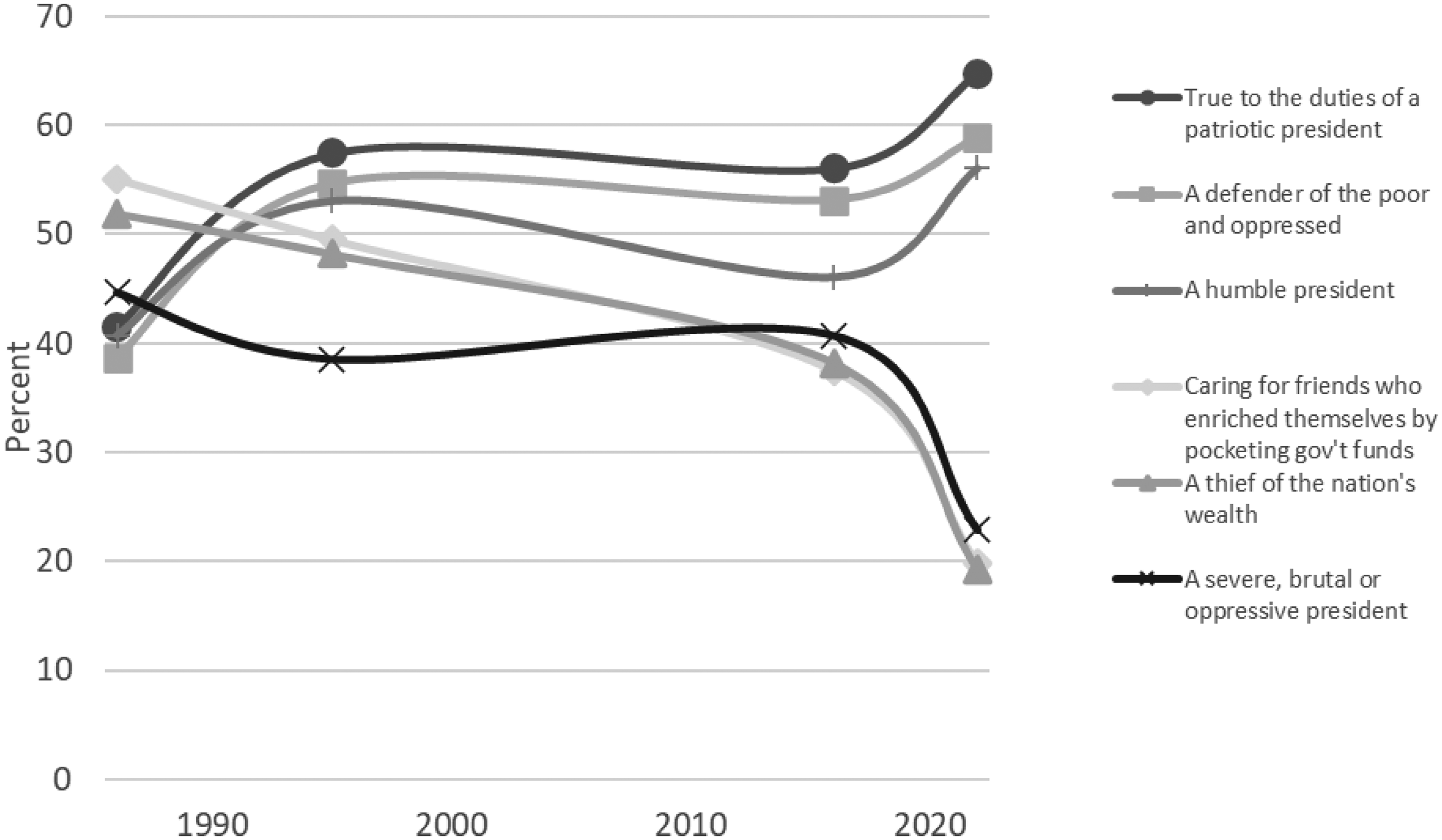
Agreement with statements about FM. Source: SWS, various surveys; figure reprinted with permission from Punongbayan (2024)
The pattern confirms that most of the upswing in favourable sentiments had already happened by 1995 and fluctuated thereafter. Some of the fluctuations are associated with the candidacies of BBM for vice-president in 2016 and president in 2022. As noted below, in discussing recent election efforts, prior positive evaluations of FM may have driven support for BBM. At the same time, BBM's successful campaign may have had a ‘halo’ effect on evaluations of his father.
We see a decrease in disagreement with negative statements accompanying the 2022 increase in the neutral response when explicitly offered by the interviewer. There is no similar decrease in agreement with positive statements since the increase in unsure/don’t know responses seems to have drawn down both agreement and disagreement.
Of all the statements, the one with the greatest change from the 1986 baseline is concern about FM as president caring for friends who enrich themselves (‘Cronies’). This was the most unfavourable response in 1986 but was on the same level in 2022 as the rest of the negatively phrased statements. In short, by 2022, the favourable responses were a plurality if examining negative statements and a majority regarding the positive statements.
Impressions of FM as President – Bivariate and Multivariate Analyses 6
This section introduces sociodemographic associations and differences in these overall conclusions about impressions of FM as president. In general, SWS designs quarterly surveys, so they represent four Areas: Metro Manila, the other parts of Luzon, the Visayas, and Mindanao. Results are not representative of any particular city, province, or administrative region but rather these larger areas. In bivariate analyses, generally speaking, more favourable responses are seen in Metro Manila and Other Luzon (where Ilocanos, the ethnic group of FM, have their provincial bailiwicks).
SWS designs the fieldwork for its probability samples so that respondents are 50 percent male and 50 percent female. This ensures representativeness in the sample and also facilitates analysis of possible differences in responses. In the surveys from 1986 to 2022, there is a relatively consistent pattern of females being more favourable towards FM, though the gap is not large. Such a pattern is unusual in SWS data: there are not often consistent male/female differences in opinions. There can be differences in some of the ‘knowledge’ questions, i.e., females are more knowledgeable of reproductive health information while sometimes being less aware of particular political facts. But differences in attitudes are rare.
Regarding the respondents’ age, there is little consistent relationship with favourable views of the former President. One interesting note is the clear relation in 1986 between age and the ‘unsure/don’t know’ response: the older respondents were more likely to express uncertainty. The percentage rises from an average for the six items of 6.3 per cent among the 18- to 24-year-olds to 19.5 per cent among those over 60. Such a difference may be counter-intuitive since the older age groups had more experience with FM. Still, perhaps that experience led to their reluctance to provide their opinion in an interview.
A second note about age comes from 2022, when those 60 + are always the most, or second-most, favourable to FM. This is consistent with the finding of Dulay et al. (2022) in their analysis of 2022 survey data that those over 55 were more favourable towards the former president. They point out that these respondents were 18 to 39 years old in 1986, a generation that matured under FM, implicitly treating this as an effect of a particular cohort. We do point out that it is also entirely plausible that older respondents are more likely to express positive (if not uncertain) attitudes towards FM simply because their actual experience during the period was mixed. Strictly speaking, with only one survey round, it is impossible to assign any difference to people being of one cohort – it could be an ‘ageing’ effect: that people get more forgiving as they get older. However, their finding is not only consistent with our age group finding above but also with our cohort analysis undertaken below (including multivariate analysis).
This difference continues in the multivariate analysis undertaken by logistic regression, as reported below. But in Ducanes et al. (2023), a similar set of logistic regression models failed to find much effect of gender on satisfaction with the performance of President Duterte, with only one of three waves (September 2016, June 2018, June 2021) finding any statistical significance, and that at only the 0.1 level (pages 31, 36, and 39). The reason for these differences in results may have to do with the contrasting images of FM and Duterte, with the latter being widely criticised for his misogyny (Abad, 2022).
By and large, college graduates were less favourable to FM throughout the period. Substantively, ‘education’ is a complex variable, as noted in the earlier section on the drivers of memory of dictatorship. It could be that more educated citizens are more analytical. It may be that education leads citizens to consume more information in general and hence become more sceptical and critical. Or it may be that education is a proxy measure of social status; higher education is one element in having higher status. As noted above, those with higher education tended to be more critical of the authoritarian interlude in Portugal by Santana-Pereira et al. (2016), but this relationship faded into insignificance over time. In our surveys, the association was still significant for three of the six items in 2022.
A final sociodemographic variable, important in Philippine governance and politics, is ethnolinguistic group. In the surveys analysed here, the ethnicity variable was only available for 2016 and 2022. Ethnicity matters greatly, with Ilocanos overwhelmingly holding a favourable view of FM. 7 To a much lesser extent, Cebuanos and Tagalogs also had a more favourable view of FM than other non-Ilocano ethnic groups. Interestingly, Cebuanos were slightly more likely than the Tagalogs to disagree with the negative statements about FM, whereas the Tagalogs were somewhat more likely than the Cebuanos to agree with the positive statements about FM.
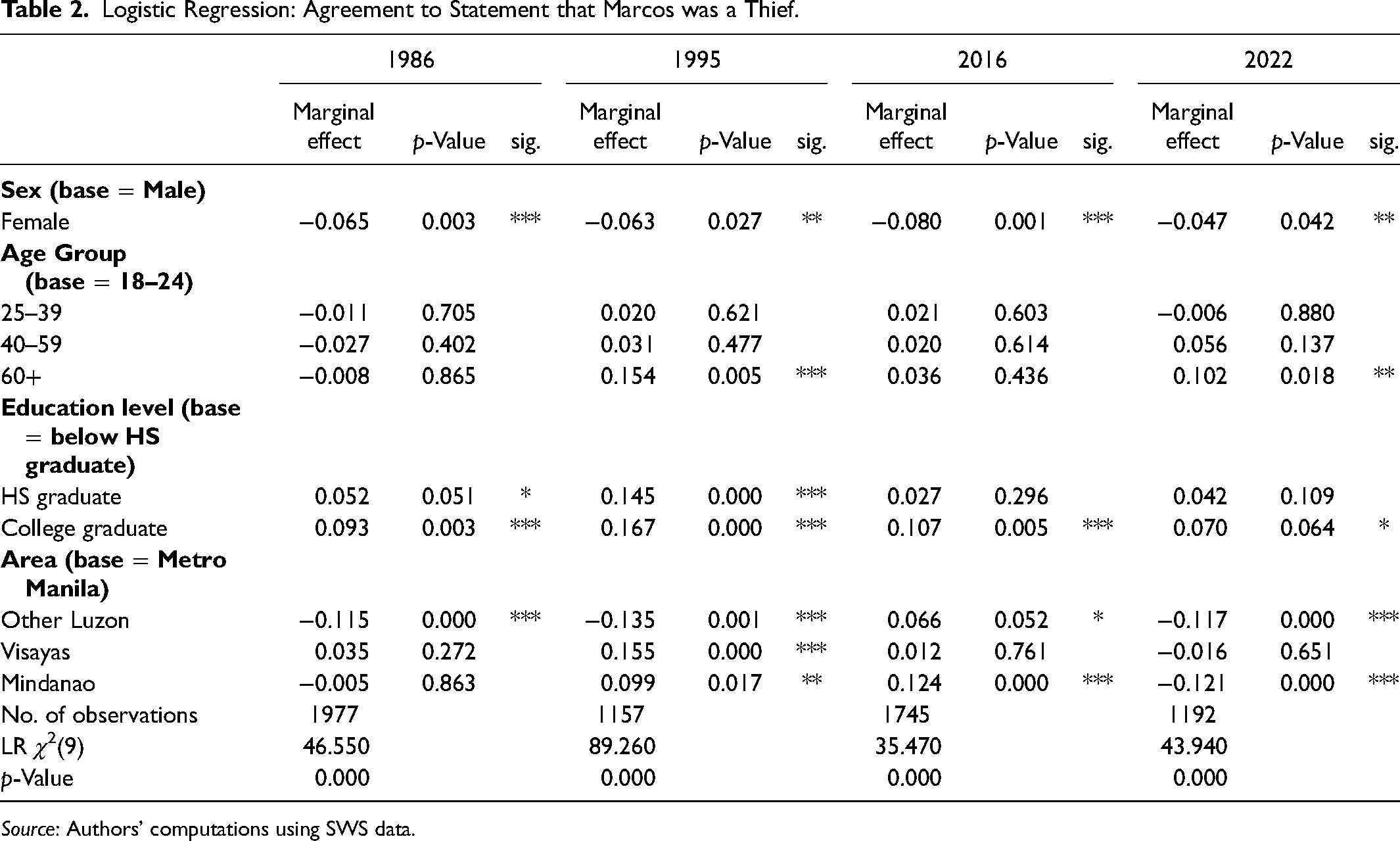
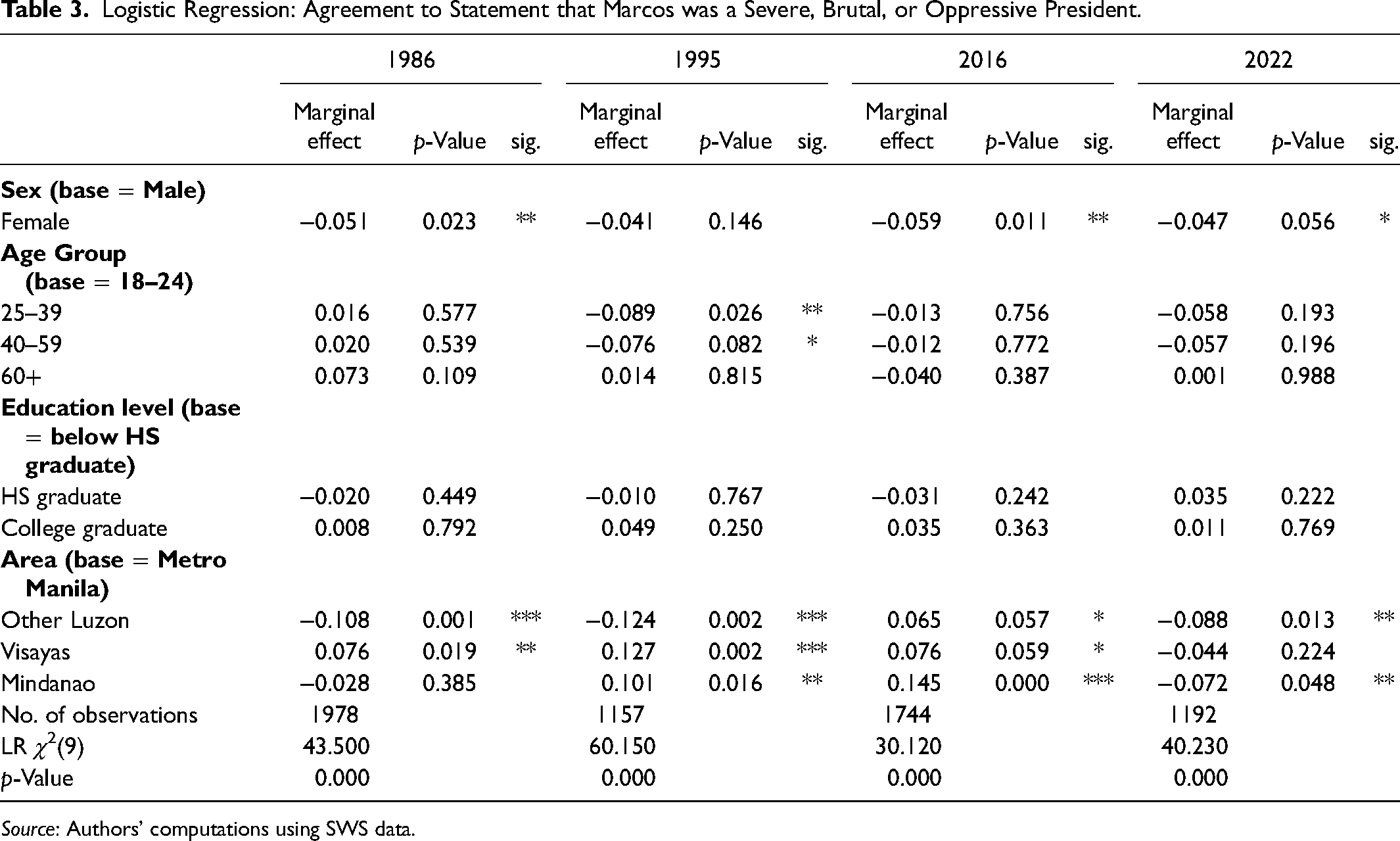
To move beyond bivariate associations, we also did logistic regressions to relate agreements with two statements about FM – that (1) he was a thief of the nation's wealth and (2) a severe, brutal, or oppressive president – with sex, age group, educational level, and area of residence (Tables 2 and 3). 8 In this way, we attempt to tease out the unique association with the statements of each of our social characteristics while taking into account the other characteristics. 9
Logistic Regression: Agreement to Statement that Marcos was a Thief.
Source: Authors’ computations using SWS data.
Logistic Regression: Agreement to Statement that Marcos was a Severe, Brutal, or Oppressive President.
Source: Authors’ computations using SWS data.
The results show that women were indeed significantly less likely to have an unfavourable view of Marcos, even after controlling for the other factors (by 5–8 percentage points across the four surveys on Marcos being a thief of the nation's wealth, and by 5–6 percentage points across three surveys on Marcos being a severe, brutal, or oppressive president). It is plausible that the more positive view towards Marcos is due to the preponderance of efforts and initiatives to improve the role of women in society, the economy, and politics, as discussed above.
The results also show that age level was generally not a statistically significant factor after controlling for the other variables in the regression, except in 1995 when those 60 + were found to be significantly more likely to view Marcos as a thief of the nation's wealth and those 25–39 and 40–59 were found to be less likely to view him as a severe, brutal, or oppressive president. This supports the point made in the previous section that regardless of whether one belongs to the post-dictatorship or the post-transition generation, the effect of age is nuanced and complicated.
The impact of education is also somewhat nuanced. Those with higher education were more likely to view Marcos as thief of the nation's wealth. But in 1986 and 1995, those who were HS graduates to college undergraduates were significantly more likely than those who had less than complete HS education to view Marcos as thief of the nation's wealth. In 2016 and 2022, there was no statistically significant difference between the two groups anymore. However, college graduates were still statistically significantly more likely to view Marcos as a thief of the nation's wealth than those with less than complete HS education. After controlling for the other variables in the regression, education was not a significant factor in explaining the views on whether Marcos was a severe, brutal, or oppressive president. This is in line with the findings of the study by Santana-Pereira et al. (2016) on the significance (and later insignificance) of education in the case of Portugal, as cited above.
The impact of area of residence is likewise interesting. Those from Other Luzon were significantly less likely to have an unfavourable view of Marcos than those from Metro Manila across all years, even after controlling for the other factors. This effect, however, was least strong in 2016 when Bicolano Leni Robredo vied for the Vice Presidency with BBM (both ethnic groups have the ‘Other Luzon’ as their home base). Those from Visayas were more likely to agree than Metro Manila residents that Marcos was a severe, brutal, or oppressive president in 1986, 1995, and 2016, but not anymore in 2022. They were also more likely to agree that Marcos was a thief of the nation's wealth in 1995 but not in 2016 and 2022.
Those from Mindanao were more likely than Metro Manila residents to agree that Marcos was a thief of the nation's wealth and also that he was a severe, brutal, or oppressive president in 1995 and 2016. But in 2022, this completely turned around, and Mindanao residents became significantly less likely than Metro Manila residents to agree with these statements. The fact that BBM and Sara Duterte (daughter of outgoing president Rodrigo Duterte) entered into a political partnership in preparation for the May 2022 elections may have played a role in further strengthening the positive view towards Marcos. 10 One should also not discount the role played by Rodrigo Duterte himself in fostering a strong leadership style that echoes that of Marcos during the martial law period.
Impressions of FM as President – Cohort Analysis 11 and Recent Election Effects
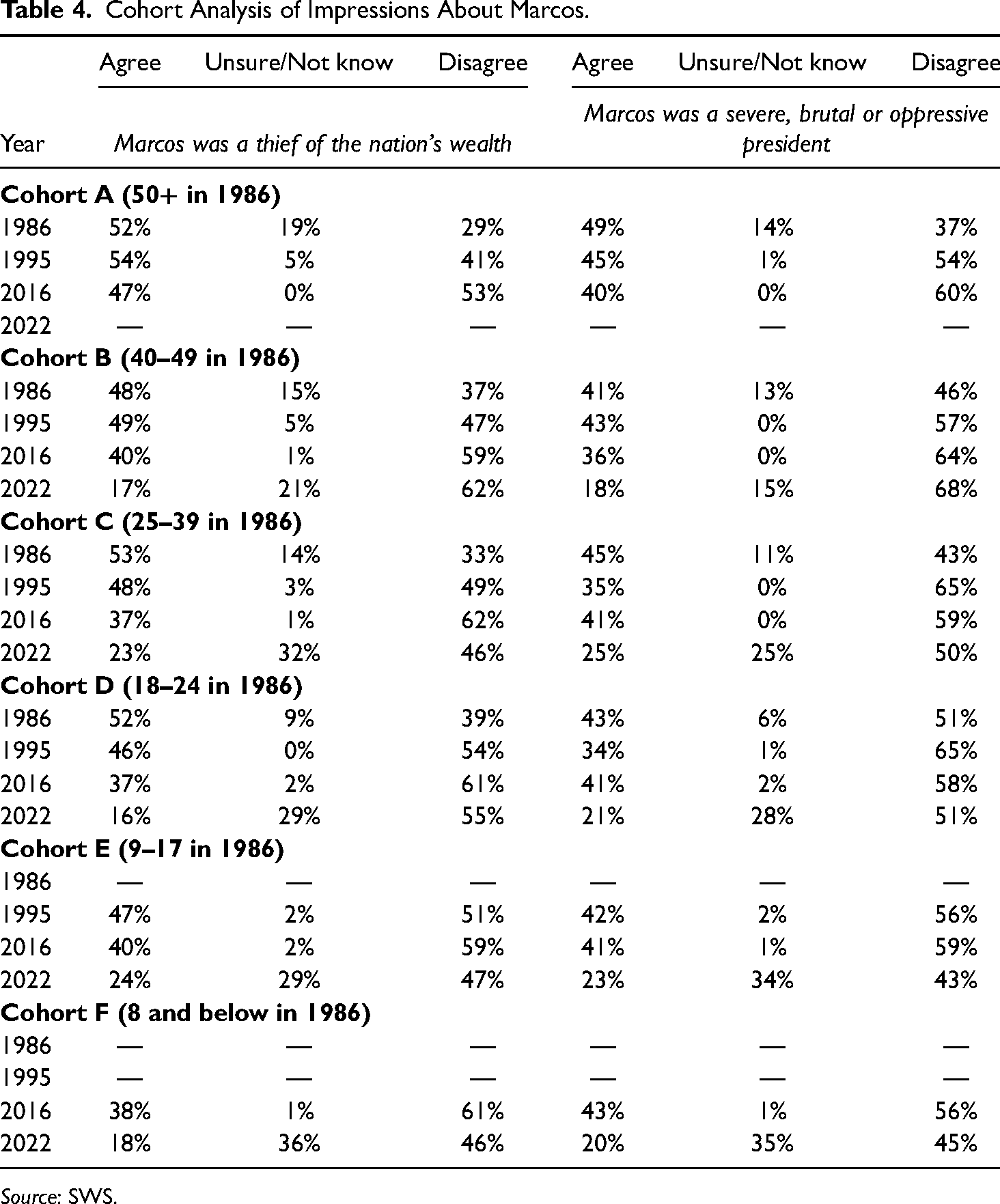
Experience with the dictatorship and the age at the time of experience can also be a factor in one's impressions of FM. Our paper also looks at the relationship between age cohort and impressions of Marcos across all four surveys. Table 4 presents the analyses for the statements on Marcos as a thief of the nation's wealth and as a severe, brutal or oppressive president. We define six cohorts based on their ages in 1986 and describe their possible experiences during particular events before the 1986 People Power Revolution.
Cohort Analysis of Impressions About Marcos.
Source: SWS.
Cohort A – those above 50 in 1986 – their political socialisation was mostly before Marcos was president (they were 30 when he became President in 1965). By the 2022 survey round, they would have been in their late 80 s, and insufficient respondents were found to analyse.
Cohort B – those who were 40 to 49 in 1986. They were at least 18 years of age in 1965, so most could vote in the first Marcos election and all in his unprecedented re-election in 1972.
Cohort C – those who were 25 to 39 in 1986. Most were eligible to vote in Martial Law electoral exercises, including the 1975 Kabataan Barangay (Youth Council) elections and the 1978 elections for the Interim Batasang Pambansa (interim national legislature).
Cohort D – those who were 18 to 24 in 1986. They were newborns when President Marcos won re-election in 1969 and matured into their first presidential election for the 1986 ‘snap’ election. They were then young adults in the immediate post-EDSA period.
Cohort E – those who were 9 to 17 in 1986 – old enough to possibly be generally aware of events, educated in a mix of Martial Law and post-1986 educational establishments, and eligible to vote in all of the elections under the 1987 constitution. Since SWS surveys voting-age adults, these respondents only appear in our analysis beginning in 1995.
Cohort F – Those below eight or not yet born in 1986. Since SWS surveys voting-age adults, these respondents only appear in our analysis beginning in 2016.
Table 4 shows that there is a cohort effect, but it is not consistent among cohorts. For those who were 50 + in 1986, the majority in both 1986 and 1995 agreed that Marcos was a thief of the nation's wealth. For those 40–49 years old in 1986, the majority in 1986 and a plurality in 1995 agreed with the statement. But for the younger cohorts who were already included in the survey in 1986 (25–39 and 18–24 in 1986), although the majority agreed with the statement in 1986, in 1995, either the majority or a plurality already disagreed with the statement. For the even younger cohorts, the majority disagreed with the statement by the time they were included in the survey. Overall, for all cohorts, by 2016, either the majority or a plurality already had a favourable view of Marcos.
For those who were 50 + and those who were 25–39 in 1986, a plurality in 1986 agreed that Marcos was a severe, brutal or oppressive president. However, for the other cohorts who were already included in the survey in 1986 (40–49 and 18–24 in 1986), a plurality already disagreed with the statement even in 1986. For all cohorts who were already included in the survey in 1986, the majority already disagreed with the statement in 1995. As with the previous case, the majority of the even younger cohorts already disagreed with the statement by the time they were included in the survey.
Overall, all cohorts followed the overall patterns in Table 1a, with the exception of Cohort B. These respondents began their adult political life when President Marcos was first elected in 1965 and were in mature adulthood by the time of his 1986 ouster. The difference in their pattern of responses occurs in the last survey round in 2022. The other cohorts in that year had a large percentage of Unsure/Don’t Know responses, with reduced percentages expressing either agreement or disagreement with the statements (as was the case in 2022 shown in Table 1a). But in 2022, Cohort B had a smaller percentage in the middle category and no decrease in the ‘disagree’ category – so there was no reduction in President Marcos's positive evaluation. In short, they had a more crystallised and even nuanced view of the senior Marcos, and their positive evaluation was firmer, exactly as predicted by Bellelli et al. (2007).
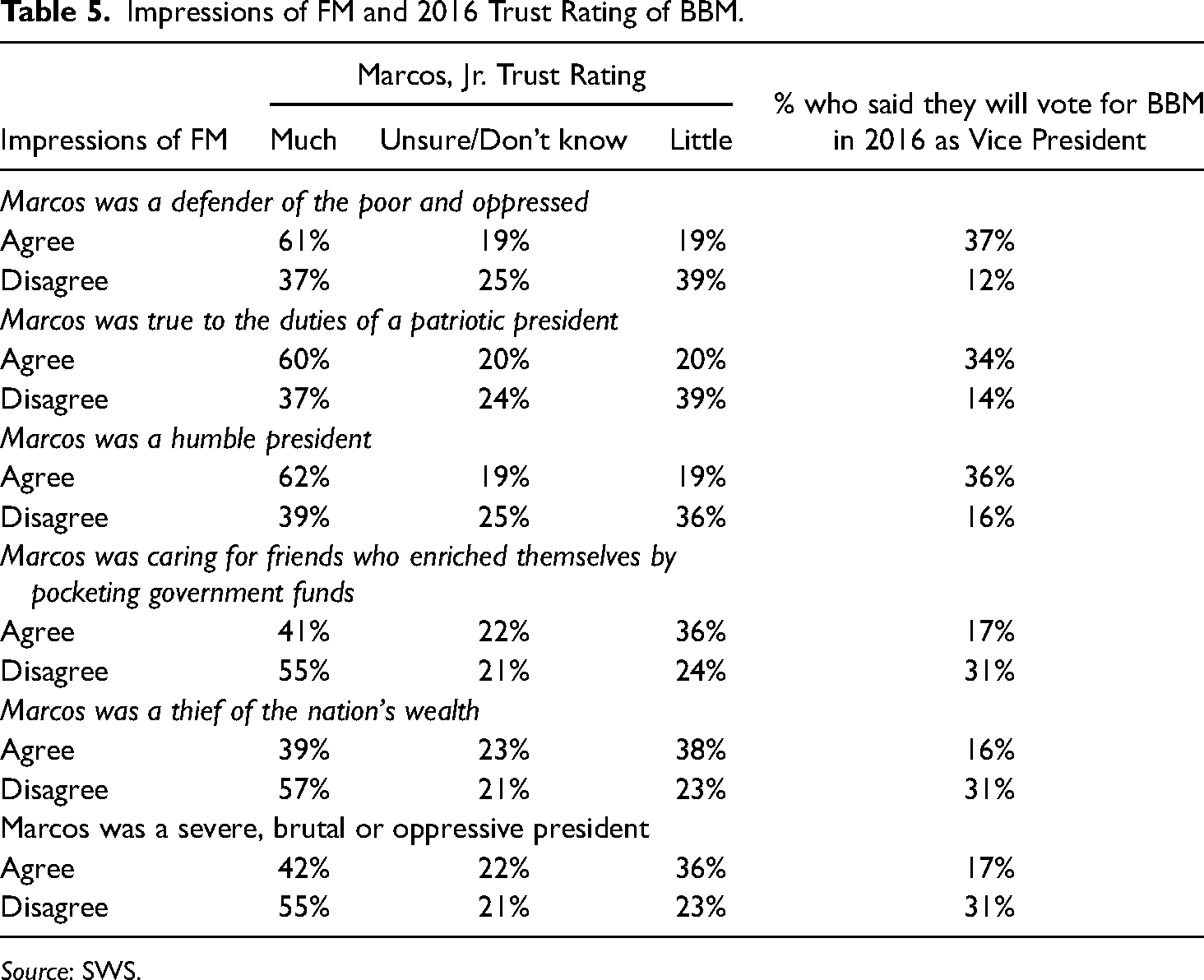
Given the candidacy of BBM in both the 2016 and 2022 national elections as vice-president and president, respectively, there was a great deal of public discussion about FM's achievements during the martial law years. 12 This factor cannot be discounted insofar as increasing the number of people who would have a positive impression of FM as president to a greater degree had there otherwise been no public conversation on the martial law legacy. Indeed, it can even be surmised that they (i.e., BBM's candidacies and the positive impressions of FM) have become mutually reinforcing, which could explain the rapid rates of change between 2016 and 2022 relative to the earlier years. 13 Table 5 compares the impressions of FM with the trust rating and vote preference as vice president for Ferdinand R. Marcos, Jr (i.e., BBM) in the 2016 election (Table 5). The results show those with more favourable views of FM tended to give higher trust ratings to BBM. All negative statements have roughly the same effect on trust ratings, and all positive statements likewise make about the same amount of difference. Respondents with positive evaluations of FM were between 14 and 25 percentage points more likely to say that they would vote for BBM as vice president.
Impressions of FM and 2016 Trust Rating of BBM.
Source: SWS.
Conclusions
The ouster of FM and family in 1986 does not seem to align with the ascendance of BBM in 2022. Only by taking into account the impressions of people of FM in the post-EDSA period, can this make sense. Our findings provide additional context for BBM's unprecedented election victory that go beyond the discourse about the influence of social media and fake news. Despite the lack of endorsement from his immediate and highly popular predecessor, Rodrigo Duterte, BBM managed to dominate the entire presidential campaign via pre-election surveys through to the final tally.
The 2022 political victory obtained by BBM has been attributed to a variety of factors ranging from the deployment of trolls in a large-scale systematic disinformation campaign on social media to deodorise the Marcos name and legacy (see Mendoza, 2019, 2022; Ong and Flores, 2011) to a weak and ineffective opposition operating within a system dominated by personality politics and family dynasties as well as to a growing sense of disappointment with the post-1986 regime leading to a false sense of nostalgic longing for a so-called ‘golden age’ past (see Dulay et al., 2022; Punongbayan, 2024; Talamaya, 2021). More importantly, impressionable young Filipinos are said to have been heavily influenced by social media disinformation intended to whitewash the tarnished reputation of the dictatorship and adopt a more positive view of the martial law period as well as that of the Marcoses (Cabato and Mahtani, 2022).
While the disinformation-via-new-social-media factor cannot be discounted entirely, it does beg the question of why the positive views towards FM began to grow even before the advent of new social media in the Philippines. Indeed, the internet can even be seen as a tool for developing a sense of agency among young people (Pangrazio, 2011). At the same time, new social media can provide a platform for pro-authoritarian sentiments. Free speech and pervasive social media can convey anti-democratic norms and values that threaten and undermine democratic institutions and processes.
It is of interest to note that the positive valuation of the dictatorship does not come only from those old enough to have lived through it but also from those too young to have had any direct experience with the period and its leaders. Nostalgic sentiments can arise when the democratic transition is followed by economic crises (ironically, because of dictatorship). This can breed resentment of the present regime and invoke a nostalgic impression of a ‘golden era’ past (see Kim-Leffingwell, 2022). At the same time, the de-Marcosification program initiated at the beginning of the Corazon Aquino administration may have conveyed a more punitive (rather than reformist) character that would likely have had a negative effect on the morale and political sentiments of members of the bureaucracy and government. 14
In any case, the positive impressions of Marcos did not just happen in recent memory but have been a long-standing sentiment among Filipinos even after February 1986. Indeed, the immediate post-Marcos period had shown a stable and significant positive impression of FM, especially in his base region north of the Philippines (see Rood, 1991). And estimates of the actual results of the 1986 election by Rood (1988) based on aggregate Commission on Elections (COMELEC) results as well as the tallies of its watchdog counterpart, the National Movement for Free Elections (NAMFREL) show Marcos obtaining between 45 per cent and 48 per cent of the vote nationwide – a clear loss but a close election. The May 1986 Survey by Social Weather Stations consortium obtained 64 per cent of respondents saying that they had voted for Cory although such retrospective questions are subject to considerable errors of recall. At the end of the day, the massive People Power crowds heavily concentrated in Manila and Luzon (combined with military rebels opposed to FM) were enough to force the departure of the sitting president although FM still had a considerable reservoir of loyalist support from 1986 onwards.
Our findings show that positive impressions of FM crystallised very early on, well before the internet spawned new social media platforms. Any project to examine the current emergence and rise to power of BBM should not be detached from its key precursor – the FM years. How specific public figures are seen, whether negatively or positively, and how such perceptions are utilised in public discourse in order to direct or redirect collective narratives are potential areas of research that can be explored further, especially incorporating mixed methodologies. Variations in collective memory over time can certainly be tracked across geographical regions to provide longitudinal and more nuanced data. Studies can also be done to investigate which events and memorials are commemorated and credited in public discourse.
Supplemental Material
sj-docx-1-saa-10.1177_18681034241248763 - Supplemental material for They Never Left: Drivers of Memory of Dictatorship and Impressions of Ferdinand E. Marcos as President After February 1986
Supplemental material, sj-docx-1-saa-10.1177_18681034241248763 for They Never Left: Drivers of Memory of Dictatorship and Impressions of Ferdinand E. Marcos as President After February 1986 by Jorge V. Tigno, Geoffrey M. Ducanes, Steven Rood and Vladymir Joseph A. Licudine in Journal of Current Southeast Asian Affairs
Footnotes
Declaration of Conflicting Interest
The authors declared no potential conflicts of interest with respect to the research, authorship and/or publication of this article.
Funding
The authors received no financial support for the research, authorship and/or publication of this article
Supplemental Material
Supplemental material for this article is available online.
Notes
Correction (May 2024):
The affiliations of the 2nd, 3rd and 4th authors are updated.
Author Biographies
References
Supplementary Material
Please find the following supplemental material available below.
For Open Access articles published under a Creative Commons License, all supplemental material carries the same license as the article it is associated with.
For non-Open Access articles published, all supplemental material carries a non-exclusive license, and permission requests for re-use of supplemental material or any part of supplemental material shall be sent directly to the copyright owner as specified in the copyright notice associated with the article.
