



Abstract
Since independence, Myanmar has prioritised a non-aligned foreign policy to preserve autonomy in the international arena. Yet, it has done so in contrasting and sometimes opposite ways. Historically, Myanmar's great power diplomacy has resembled a pendulum swinging between two ideal types: ‘positive non-alignment’ and ‘negative neutralism’. The former represents a proactive blend of non-aligned behaviour that seeks to assert independence by achieving a diversified range of international partnerships, whereas the latter endeavours to accomplish the same goal through diplomatic disengagement and self-aloofness. This article analyses Myanmar's shifting recourse to opposite archetypes of alignment by examining its foreign policy between 2011 and 2021. Building upon a comprehensive theoretical classification of different forms of non-alignment, the analysis contends that Myanmar's evolving great power diplomacy is ultimately rooted in oscillating degrees of political legitimation held by its leaders, which pushed them to alternatively tilt towards positive non-alignment or negative neutralism.
Introduction: Neutralism, Non-Alignment, or Hedging? A Taxonomy
Since its establishment as a sovereign actor, Myanmar's foreign policy has been relentlessly shaped by one, overarching goal: safeguarding the country's autonomy, independence, and room for manoeuvre amidst great powers (Bhattacharya, 1965; Myat, 2021; Passeri, 2020; Tarling, 2017). This ambitious purpose, however, has been pursued in different and sometimes opposite ways. In fact, from an historical perspective, the evolution and trajectory of Myanmar's foreign policy has resembled the motion of a pendulum swinging back and forth between two ideal types of alignment policy utilised by small powers vis-à-vis more powerful actors, namely ‘positive non-alignment’ and ‘negative neutralism.’ The former, most notably, refers to a foreign policy blueprint that seeks to actively assert autonomy and independence in the diplomatic realm through the achievement of a highly diversified pool of international partnerships, which, in turn, should project a secondary actor in a somewhat equidistant position amongst great powers and thus prevent its overreliance on a single external patron. As such, positive non-alignment stands out as a proactive and carefully crafted self-help strategy that came initially to the fore during the Cold War era to navigate the perilous waters of the bipolar confrontation (Ul Haq, 1977: 39–40). On the opposite side of the spectrum, negative neutralism endeavours to uphold an autonomous stance by means of a totally different logic, which is ultimately rooted in the idea that the independence of small states should be preserved through disengagement and self-aloofness from the international arena. As a result, negative neutralism postulates the adoption of a reactive, insular, and diffident diplomatic mindset, aimed at erecting a powerful barrier against the outside world whilst state authorities focus on the advancement of their domestic political agenda.
Hence, contrary to a widespread habit the concepts of non-alignment and neutralism should not be used synonymously. Neutralism, at its simplest, means not taking sides in a looming war and was first codified from a legal standpoint with the Hague Conventions of 1899 and 1907. Subsequently, the notion of neutrality developed into what Hakovirta defined as a ‘customized variety’, paving the way for the emergence of sub-variants such as ‘permanent neutrality’, ‘ad hoc neutrality’, ‘neutralization’, and ‘non-belligerency’ (1988: 18). On top of that, during the twentieth century the agency of small powers in interpreting the spirit of neutrality set the stage for the materialisation of two additional nuances: neutralism as ‘status negativus’, which is essentially inward-looking and characterised by a negative security conception, and, on the other hand, a far more activist form of neutralism, labelled as ‘status positivismus’ (Agius and Devine, 2011: 271). According to Peter Calvocoressi, a negative blend of neutralism might ensue when a small state sets aside its dynamism in attempting to mediate the dangerous quarrels amongst great powers and replaces it with a sense of reprobation of the current order, an acknowledgement of the state of powerlessness experienced by secondary actors, a shift in focus towards the domestic arena, and a refusal to take a stand on major international issues (2009: 769). Likewise, the Burmese scholar Maung Maung Gyi portrays the international posture of his country during the Ne Win era (1962–1988) as ‘negative neutralism for group survival’, defining it as a foreign policy blueprint that is inward-looking, xenophobic, and immature in its worldview; fails to infuse dynamism into the nation's economy; lacks the courage to pursue a proactive role in regional matters; and is essentially focused in preserving the dominant role of the ruling elite (1981: 9–15). The conceptualisation of ‘negative neutralism for group survival’ thus highlights an important corollary of this peculiar posture, namely the tendency displayed by various neutral countries such as Ne Win's Burma to blend neutralism with strict adherence to economic self-reliance, which in certain instances can assume the traits of a full-fledged autarky (Tellis, 2012: 3–4). Finally, due to its pessimistic and xenophobic worldview, negative neutralism is also characterised by a diffident approach to multilateralism, as it tends to look at multilateral fora as ‘trojan horses’ utilised by great powers to interfere in the domestic affairs of smaller actors. In the case of Myanmar, this attitude was perfectly captured by the ‘neutral first, bilateral if you must' motto that informed the country's trajectory during the Cold War, as Yangon shied away from multilateral security arrangements such as the ‘Southeast Asian Treaty Organization’ (SEATO) that could hamper its independent posture (Passeri, 2020: 942–945).
Positive non-alignment, by contrast, contends that the autonomy and independence of a secondary actor can be preserved through diplomatic diversification and strategic activism, rather than via self-aloofness. As opposed to neutralism, it did not originate as a legal position but merely as a political one, inasmuch as it prescribed to chart a ‘third way’ between the Soviet and the Western bloc by avoiding entangling alliances with the two superpowers. Accordingly, non-alignment does not translate into a practice of strict impartiality, as it implies the possibility of temporary, limited, and multi-pronged forms of alignment with a broad range of interlocutors, in the attempt of cultivating a diversified portfolio of external partnerships. On top of that, the implementation of a vibrant and effective strategy of positive non-alignment requires a high degree of flexibility, as those who resort to it must be sufficiently responsive to alternatively tilt from a great power's orbit to the other, while maximising the benefits of these temporary oscillations through a policy of ‘play-off’ (Anabtawi, 1965: 358–359). Furthermore, the concept of positive non-alignment subsumes a firm commitment to play a constructive and cooperative role in global affairs, through good offices or bridge-building efforts. As such, it is infused with moral and ethical considerations based on an active contribution to peaceful coexistence, which is often reflected in a strong rejection of colonialism, power politics, and foreign intrusions in the domestic dimension. According to Laurent Goetschel, this idealistic side of positive non-alignment has also a visible impact on a regime's political values and sources of legitimisation, thus acting as an ‘identity provider’ in the formulation of its self-image, worldview, and behavioural patterns in the international arena (1999: 120–121). By the same token, the adherence to such strategy encourages a high degree of dynamism in multilateral fora, where non-aligned countries can unleash their mediation efforts, and it is often coupled with the adoption of development models based on open and market-driven economies, especially after the various fiascos experienced by the ‘Non-Aligned Movement’ (NAM) with planned development (Patrick, 2012; Sengupta, 1976). As a result, the consolidation of a complex network of economic interdependences with the outside world has been increasingly recognised by non-aligned states as the most suited formula to diversify trade and investment links, while defusing the risk of becoming reliant on a single economic patron. When it comes to Myanmar (then known as Burma), Yangon's commitment to an open economic model during the U Nu era (1948–1962) paved the way for the inking of a plethora of trade agreements with a variety of interlocutors, including India (1950), Japan (1950), China (1954), the Soviet bloc (1955), and the US (1956), which materialised as a corollary of the country's endorsement of a positive blend of non-alignment, characterised by a strong push towards the diversification of economic partnerships (Myat, 2021: 10; Thomson, 1957: 278).
Finally, it should be pointed out that the practice of positive non-alignment has significantly evolved since the Cold War era, in order to adapt to the specific contingencies and changing alignment patterns of an increasingly multipolar world. Against this backdrop, this article contends that the most sophisticated and updated manifestation of positive non-alignment can be found in the concept of ‘hedging’, given that both prescribe to fluctuate between different great power orbits in the attempt of maximising the returns of a highly diversified foreign policy. According to one of the most compelling definitions of hedging, this strategic construct is thus depicted as a self-help mechanism employed by secondary actors to cope with the asymmetries and uncertainties stemming from their interactions with great powers (Kuik, 2020). Hence, rather than simply ‘sitting on the fence’, hedging entails a clear insistence in avoiding tight forms of alignment such as alliances; a relentless cultivation of a diversified array of international partnerships; as well as a high degree of diplomatic activism in pursuing opposite measures to offset different risks, for instance through the recourse to a mix of deference and defiance vis-à-vis a more powerful actor. This conceptualisation, moreover, suggests that hedging best adheres under high-stakes and high-uncertainty conditions, as in contemporary Southeast Asia's multipolar strategic landscape. This specification holds in the absence of firm dividing lines between two rival camps, whereby multipolar settings provide small states more options to play off great powers, since they experience less pressure to commit to one side against another. On top of that, as for positive non-alignment hedging encourages its adherents to set aside passive neutrality, pursue limited and multi-pronged alignments with multiple partners, and engage external actors via a deliberate embrace of strategic ambiguity (Tan, 2020: 138).
Likewise, the definition of hedging provided by Evelyn Goh suggests that the final purpose of this strategy is to cultivate a middle position that forestalls having to choose one side, or one straightforward policy stance such as balancing or bandwagoning, at the obvious expense of another. On top of that, Goh specifically links this blueprint to the diplomatic practices of small states, arguing that hedging is ‘a luxury of the relatively weak only’, which can define their security interests in a non-zero-sum fashion (2006: 2). Jürgen Haacke also emphasises the association of hedging with a certain degree of strategic ambiguity, positing that such a blueprint ‘involves alignment signalling that leaves open how a state would react should the potential security challenge materialise’ (2019: 3). Hence, his conceptualisation sees hedging as a proactive form of security risk management, as opposed to Kuik and Goh's definitions of hedging as a ‘portfolio approach’ that pursues mutually counteracting measures to offset strategic uncertainties. Notwithstanding these nuances, the literature on hedging clearly shows that its successful implementation requires a great deal of dynamism and eclecticism on the part of the ‘hedger’, which is required to put in place a bundle of seemingly opposite alignment behaviors to mitigate diffuse risks. Against this backdrop, hedging's multi-pronged and multi-directional nature intimately resonates with the practice of positive non-alignment during the Cold War era, which persuaded various non-aligned countries to alternatively tilt from a great power's orbit to the other. Thus, in light of these vast similarities between the two constructs, which include the need for high levels of political legitimation on the part of government authorities for the implementation of a proactive blend of non-aligned behavior, the following analysis will therefore consider hedging as an actualised version of positive non-alignment, and it will use the latter as a shorthand for this specific type of strategic blueprint that seeks to actively assert an autonomous stance in the international arena.
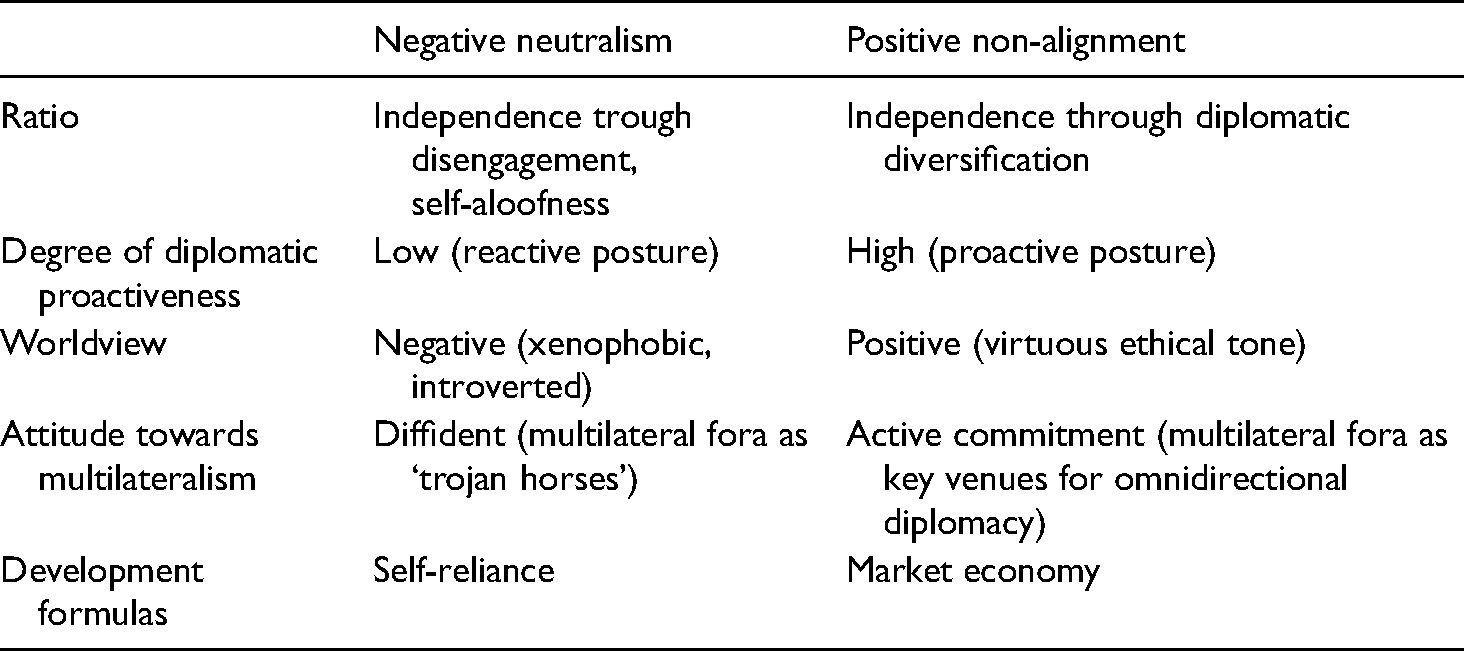
In sum, it is possible to distinguish between a negative blend of neutralism and a positive form of non-alignment by looking at their key attributes as shown in Table 1. First and foremost, in terms of their overarching rationale, the two constructs share the same goal, embodied by the cultivation of a secondary State's independent foreign policy vis-à-vis great powers. However, this common purpose is pursued in opposite ways: negative neutralism seeks to project an autonomous stance through disengagement and self-aloofness from the foreign policy realm, whereas positive non-alignment fosters independence via diplomatic diversification. As a result, the two strategies pave the way for different degrees of strategic activism on the part of small states. Those who embrace negative neutralism will likely show a low level of diplomatic proactiveness coupled by an essentially reactive posture, while positive non-alignment requires vibrant diplomacy that reaches out to a broad range of external partners. In addition, the two paradigms also act as identity providers for secondary actors that strive to find their place in the world, laying the foundations for highly divergent worldviews. In this respect, positive non-alignment is often infused with a virtuous ethical tone that looks at the international arena essentially as a source of opportunities, rather than perils. Conversely, negative neutralism subsumes a much gloomier worldview, tinged by xenophobic sentiments and an equally strong inclination to view international relations as the root causes of constant scrutiny and unwanted intromissions. As an important corollary of these opposite mindsets, negative neutralism pushes small states to approach multilateralism with diffidence and shy away from collective arrangements that might imperil their passive impartiality, as opposed to the active commitment and good offices displayed in multilateral fora by secondary actors that implement a strategy of positive non-alignment. Last but not least, the unwavering pursuit of diplomatic autonomy and independence inspired by the two blueprints has significant implications also in terms of development models. As a result, negative neutralism tends to endorse self-reliant and autarkic formulas, whereas positive non-alignment seeks to assert an emancipated international stance through the embrace of market economy and the consolidation of complex interdependences with a wide array of foreign partners.
Defining Attributes of ‘Negative Neutralism’ and ‘Positive Non-Alignment’.
Political Legitimation and Alignment Choices: Tracing the Connections
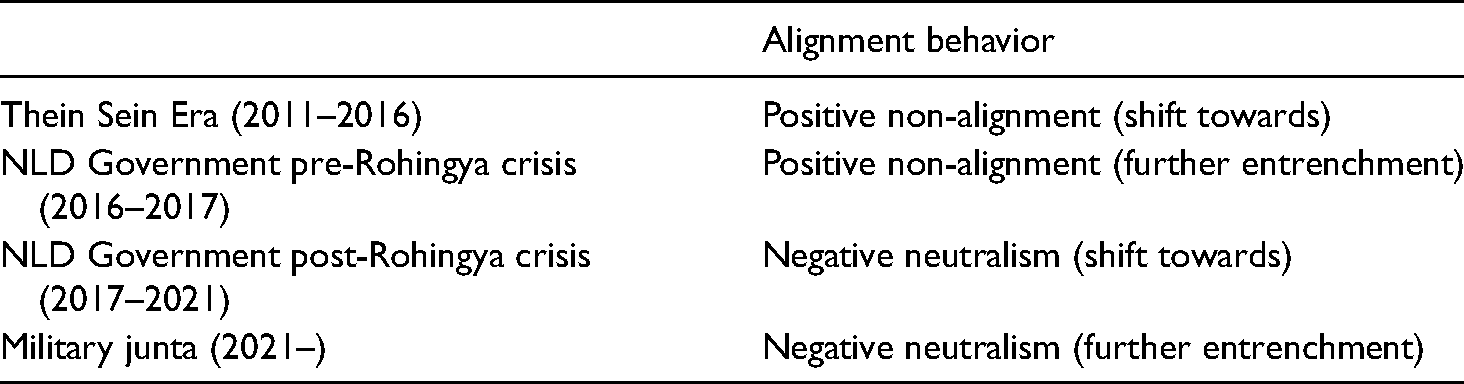
Notwithstanding the conceptual and operational differences that separate negative neutralism from positive non-alignment, the historical record exhibited by small states like Myanmar shows that substantial shifts between these two ideal types of alignment behaviour are not only possible but indeed quite frequent. Yet, the scholarly community has paid little attention to the nature and specific triggers of such swings between opposite paradigms of great power diplomacy. To fill these gaps, the following analysis attempts to shed light on both the hows and whys that shaped the evolution of Myanmar's alignment choices, seeking to address two sets of research questions. Accordingly, the investigation asks how we can periodise the evolution of Myanmar's alignment patterns over the course of the last decade, based on its oscillating reliance on negative neutralism and positive non-alignment. On top of that, the article endeavours to explain why these shifts materialised, what prompted them, and under what circumstances can we expect the emergence of a further swing. Concerning the hows, we propose a periodisation of Myanmar's foreign policy between 2011 and 2021 based on the succession of three different stages, namely Thein Sein's presidential term (2011–2016), the NLD five-year tenure (2016–2021), and the new era of praetorian rule (2021–) brought about by the military coup staged on 1 February 2021. Against this backdrop, the taxonomy introduced in the previous section and the careful scrutiny of Naypyidaw's foreign policy record during the last decade reveal the occurrence of two significant shifts in its alignment choices. The first revolves around the progressive tilt from negative neutralism to positive non-alignment that took place at the start of Thein Sein's mandate in 2011, paving the way for Myanmar's reintegration into the international community after decades of self-imposed marginalisation. The second swing, as indicated in Table 2, materialised in the aftermath of the 2017 Rohingya crisis, as the NLD government sought to fend off the diplomatic fallout of the humanitarian conundrum in Rakhine State by leaning back towards a negative and reactive form of neutralism.
Myanmar's Alignment Patterns and Paradigm Shifts Between 2011 and 2021.
Still, the conceptualisation of positive non-alignment and negative neutralism developed above provides little insight on what prompted such shifts. To illuminate these causal links, it is essential to dig into the conditions and triggers that persuade small powers to recast their foreign policies and alignment choices. In such perspective, the IR literature devoted to the issue of foreign policy change suggests that nations realign their posture in the international arena when confronted by an external shock or sudden threat that drastically impacts their security, or in the event of a visible metamorphosis in the degree of political legitimation retained by their leaderships (Holsti, 1982; Hurd, 1999; Katzenstein, 1976; Putnam, 1988). This means that in the absence of a sudden diplomatic crisis or looming danger that dictate a different course of action, systemic factors such as power asymmetries between great powers and secondary actors do influence the latter's alignment choices, but they unleash their impact in an indirect and incremental fashion, being filtered through small states’ domestic dynamics (Kuik, 2021: 256–257). In this regard, one of the key elements that shapes the relation between the domestic politics of a given country and its international projection stems from the type and overall degree of political legitimation held by the leadership. As such, political legitimation can be interpreted as the ‘currency’ that allows decision-makers to justify their right to rule and refers to a normative belief by an actor or internal constituency that a ruler ought to be obeyed, according to a subjective and relational dynamic that is mostly rooted in the actor's perception of that leadership (Hurd, 1999: 381; Kuik, 2021: 256). Likewise, Holsti portrays it as the capacity of State authorities to command loyalty from their citizens, maintains the essential elements of sovereignty, and operates within the boundaries of a consensus-based political community (1996: 82–83). Hence, political legitimation is not a static attribute: on the contrary, it is often subject to quantitative and qualitative transformations, brought about either by an increase or decline in the overall degree of political legitimation retained by a given regime or by a metamorphosis in the main sources of political legitimation cultivated by the same actor.
Regarding the various legitimation pathways that can be potentially harvested by State authorities, this analysis borrows Leslie Holmes’ classification based on two clusters of sources, which are defined as ‘internal’ and ‘external’ legitimation modes (2007: 18–19). According to this view, a truly legitimised regime can count both on the consensus provided by domestic audiences, and the prestige stemming from a carefully crafted foreign policy agenda, capable of advancing a country's best interest while winning sympathies abroad. Building upon Holmes’ distinction between internal and external legitimation, we contend that the two attributes are not only intertwined but also mutually reinforcing. Consequently, a high degree of international legitimation is expected to positively impact on the degree of domestic legitimation held by leadership, whilst a decline in international legitimation can significantly erode the domestic political authority retained by the same regime. Likewise, when a government's domestic popularity is high, its foreign policy agenda will arguably feature more ambitious goals and a higher level of diplomatic proactiveness in the advancement of its national interests. In the case of Myanmar, a textbook example of this virtuous nexus between domestic and international legitimation can be found in the trajectory of the Thein Sein government (2011–2016), which, upon assuming office, unleashed a reformist agenda both internally and in terms of Myanmar's foreign policy. As such, rapprochement with the West led to a progressive increase in the international legitimation held by the Thein Sein cabinet, which, in turn, positively impacted the domestic arena, as epitomised by the growing popularity enjoyed by the former general during his quinquennium at the helm of Burmese politics (Wilson, 2014). On top of that, a state that enjoys a sufficient degree of legitimacy domestically is also more likely to get approval and recognition on the international stage, thus triggering a virtuous cycle that, in turn, will further boost its political authority in both dimensions (Khan, 2009: 20). Equally important, this framework postulates that each leadership can ideally strike its own compromise between domestic and international sources of legitimation. As noted by Le Hong Hiep, the relative significance of domestic and international political legitimation may vary according to the peculiar nature of a certain regime, as it stems from the leadership's own perception of what is more favourable to its legitimation blueprint (2012: 150).
More specifically, Holmes’ classification encompasses the following types of domestic legitimation: old traditional; charismatic; teleological; nationalism; new-traditional; performance-driven; and legal-rational (2007: 18–19). The ‘old traditional’ mode refers to the divine right to rule of a monarch and still represents a highly viable choice for hereditary regimes shaped by a one-family rule. Charismatic legitimation, instead, resonates very closely with the Weberian concept of ‘charismatic authority’, which rests on a sense of devotion to the heroic figure and outstanding qualities of an individual leader, by virtue of which he or she is treated ‘as endowed with supernatural powers’ (Weber and Parsons, 1964: 358). Third, internal political legitimation can be harvested by relying on a teleological narrative, according to which leaders claim to know the best blueprint to secure the overarching national interest of a given nation. Alternatively, rulers may opt to boost their domestic legitimation through the adoption of a nationalist or xenophobic ideology that emphasises the defence of national sovereignty against real or supposed enemies. When following a ‘new-traditional’ pathway to legitimation, instead, the leadership will likely strengthen its authority by making explicit references to an earlier and ideally charismatic ruler, in order to promote a specific agenda. Finally, performance-driven legitimation and legal-rational legitimation are arguably the most common pathways to political authority in contemporary politics. The former is maximized through the achievements of a certain regime in delivering progress, economic growth, and political reforms, as well as in managing national problems, internal conflicts, and domestic order (Kuik, 2021: 257). Legal-rational legitimacy, on the other hand, rests on the unique procedural features of democratic systems, such as rule of law, free and fair elections, and social justice.
Against this backdrop, the analytical framework employed in this study postulates that leaders can also win the hearts and minds of their constituencies through an attentive cultivation of the external sources of political legitimation. In Holmes’ view, these encompass ‘formal recognition’, ‘informal support’, and the reliance on ‘external role-models’ (2007: 19). Formal recognition by other States or international institutions does not significantly boost a ruler's legitimation; yet, when this basic element is absent and a regime is not recognized as a legitimate member of the international community by its peers, the leadership will be arguably forced to increase alternative sources of legitimation to cope with external pressures and scrutiny. Conversely, when effectively enhanced informal international support can significantly contribute to a regime's popularity and overall political legitimation, especially if other countries back its political agenda and encourage it to retain confidence in its own project and right to rule. Finally, certain governments might choose to strengthen their external political legitimation by relying on an external role model. In such cases, the leadership will tailor its foreign policy around the approaches and doctrines employed by other actors that embody a point of reference, as exemplified in the mid-1980s by Vietnam's decision to base its ‘Doi Moi’ policy on the Soviet perestroika. Still, it should also be noted that the legitimation sources listed above are ideal types that serve analytical purposes, but in practice governments never rely on one legitimation pathway alone. Usually, leadership tends to employ a peculiar combination of them, for instance by choosing a core legitimation mode and a selection of secondary ones, given that a sounder diversification of these sources will arguably result in a more legitimised regime (Hiep, 2012: 150–151). Furthermore, the pool of legitimation sources utilised by a certain government and the relative importance of each pathway must be conceived as dynamic features, which constantly evolve as the final by-products of specific contingencies and political calculus. When confronted by a sharp drop in popularity, a government will thus avoid a legitimation crisis by shifting its emphasis towards alternative sources of political authority.
Still, to highlight the nexus between our independent variable, embodied by the degree of political legitimation held by a certain leadership, and its alignment choices in the international arena, it is essential to further scrutinise the two-level game that shapes small powers’ domestic politics and diplomatic trajectories. To achieve this goal, the argument developed in this study builds upon Holmes’ classification of legitimation sources and explores the implications of either a deficit or a surplus of political legitimation on the alignment strategies displayed by small states, especially when it comes to their inclination to embrace a specific blend of non-alignment. In particular, we argue that a small country that is committed to safeguarding its autonomy vis-à-vis great powers has to choose between different breeds of alignment strategy, ranging between the two opposite archetypes embodied by positive non-alignment and negative neutralism. In the absence of major external shocks that might impact the decision-making process, this choice will depend on a large extent upon the degree of political legitimation held by its leadership. In fact, our framework posits that the overall level of political legitimation retained by a certain regime translates into a significant variable in terms of foreign policy choices, namely its degree of ‘diplomatic proactiveness’. The latter, most notably, refers to the predisposition (or lack of) of a certain State to pursue a dynamic foreign policy, capable of showcasing a high degree of strategic activism in the advancement of its diplomatic agenda. As such, this attribute allows to differentiate between proactive international stakeholders and ‘reactive States’, defined by Kent Calder as international entities that fail to undertake meaningful independent foreign policy initiatives when they have the ability to do so, and respond to outside pressures erratically, unsystematically, and often incompletely (1988: 519).
In summary, as illustrated in Figure 1, our analytical framework postulates that a small state which enjoys a sufficient amount of political legitimation will likely display a higher degree of diplomatic proactiveness. Hence, when choosing between negative neutralism and positive non-alignment as the best-suited alignment blueprint, it will arguably feel confident to tilt towards the latter. As a result, the self-confidence stemming from its high levels of domestic and external legitimation will persuade state authorities to play an active role in regional and global affairs, rooted in an essentially benign worldview that sees the international realm as a source of opportunities rather than perils. Under such conditions, the ultimate goal of preserving the country's relative autonomy and independence vis-à-vis great powers will be thus pursued through a dynamic, multidirectional, and diversified blueprint akin to hedging, aimed at achieving a wide array of international partnerships that can act as reciprocal counterchecks. Likewise, a regime that is popular both at home and abroad will arguably look at multilateral fora as key venues to unleash such vibrant diplomacy, as opposed to the sceptic and diffident approaches towards multilateralism displayed by states that adopt negative neutralism. Additionally, it will also resist the temptation to resort to the autarkic economic formulas popular amongst those who embrace negative neutralism. By the same token, our analytical framework claims that a small state confronted by a deficit in political legitimation will likely experience a proportionate decline in terms of its diplomatic proactiveness, which, in turn, can persuade its leadership to pursue self-aloofness and disengagement from the international arena. As such, the endorsement of this insular and reactive approach to foreign policy would resonate with a much gloomier worldview that perceives international relations with great powers as sources of scrutiny, pressures, and interferences, as postulated by the concept of negative neutralism.
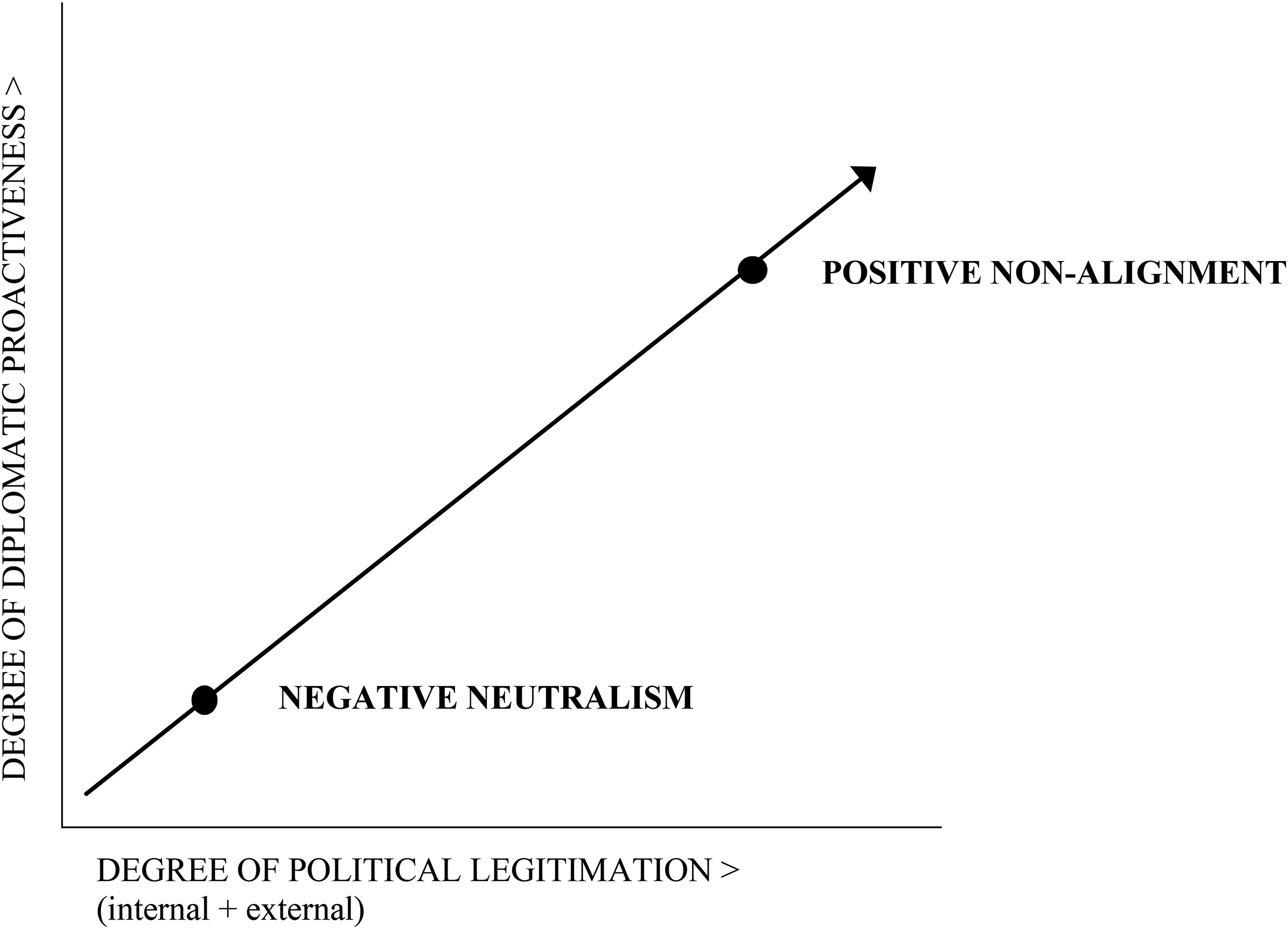
Political Legitimation and Resulting Alignment Choices.
The Thein Sein Era (2011–2016): Embracing Positive Non-Alignment
Following Myanmar's multiparty election in 2010, the Union Solidarity and Development Party (USDP) which took power in March 2011 under the leadership of retired general Thein Sein, seized on the historic opportunity to enact domestic political reforms and gradually reduce the country's economic and diplomatic reliance on China. The resultant jump in performance-driven political legitimation led the USDP to adopt a far more proactive international stance than the previous regime, demonstrated by the Thein Sein government's selective defiance of China, genuine engagement in multilateral institutions, and modest hedging strategy. While the government was a hybrid regime centred on a power-sharing agreement between civilian and military leaders, the partial democratic transition garnered robust domestic support due to decades of pent-up yearning for political participation. Thein Sein's government gradually loosened restrictions on political participation, media, and the economy. In turn, as economic growth accelerated and foreign direct investment (FDI) poured in in recognition of Myanmar's market reforms, the USDP enjoyed a substantial boost in legal-rational and performance-driven political legitimation. However, since the junta only released Aung San Suu Kyi from house arrest the week after the November election, her party, the National League for Democracy (NLD) chose to boycott the election, preventing genuine democratisation. Nevertheless, the new semi-civilianised Parliament saw active debates, quickly passing new labour reform legislation, allowing robust civil society engagement, and delivering a momentous new foreign direct investment law. Notably, the Thein Sein administration also accomplished a Nationwide Ceasefire Agreement between the military and eight ethnic armed groups in 2015, ending decades of civil conflict in certain states.
Thein Sein's tentative steps towards partial civilian governance also attracted international support from western countries that had previously alienated the military junta. The Obama administration promised to reward Naypyidaw's reforms with an ‘action-for-action’ approach, wherein the United States would gradually ease economic sanctions and welcome Thein Sein's government back into the global community in response to progress towards genuine democracy and free and fair elections. Emblematic of this diplomatic thaw, Secretary of State Hillary Clinton paid an historic visit to Rangoon in 2011, the first by a US cabinet official in over 50 years (Nakamura, 2011). Recognising the extraordinary opportunity to rebalance Naypyidaw's external relations and enhance Myanmar's international position, Thein Sein embraced western outreach and deepened relations with regional states by actively participating in the Association of Southeast Asian Nations (ASEAN). The growing degree of external backing combined with domestic support for political reforms granted Naypyidaw the capacity for a proactive non-aligned policy. Under such conditions, the new government intoned a positive ethical worldview while signalling an openness to international markets and willingness to play an active role in regional diplomacy.
Thein Sein's dramatic reorientation of Myanmar's foreign policy borrowed several constitutive elements of U Nu's positive non-alignment between 1948 and 1962. The pivotal dimensions included: increasing economic diversification to mitigate overdependence on China; adopting a modest hedging blueprint to guide the country's non-alignment; a visible change of attitude vis-à-vis ASEAN and multilateralism more generally; and re-emphasising an ethical foreign policy through a concerted revival of ‘goodwill diplomacy.’ Thein Sein's efforts to extricate Myanmar from asymmetric dependence on China reinforced the USDP's domestic sources of political legitimation, further expanding space for his government's flexible foreign policy internationally. 1 As a result of domestic reforms, the Thein Sein government achieved the gradual removal of international sanctions and a parallel surge in bilateral aid, loans, and foreign direct investment (FDI). The European Union, for instance, reinstated its generalised system of preferences (GSP) and duty-free imports, and Washington eased sanctions on investment in Myanmar. In 2013, Naypyidaw and Washington inked a Trade and Investment Framework Agreement (TIFA). The EU similarly lifted economic sanctions against Myanmar in early 2012. In 2012 alone, Myanmar's textile industry saw an 18 per cent rise in global exports (Miller, 2014: 93). Meanwhile, GDP growth rose to a high of 8.4 per cent in 2013, while FDI averaged US$5.5 million throughout Thein Sein's tenure (World Bank, 2020). In 2013, Japan waived US$2.72 billion in debt, and the following year pledged US$96 million for infrastructure development (Mahtani, 2014). Japanese investors provided the lion's share of capital for the Thilawa Special Economic Zone (SEZ) and conceived to rival the China-backed Kyaukphyu SEZ. In 2016, Japan was Myanmar's fourth largest trading partner and the most important exporter for the Burmese automotive sector. At the same time, two-way trade with the United States jumped from US$9.7 million in 2010 to US$577.2 million in 2017 (Dempsey et al., 2018: 21). As such, economic diversification served as a hedge against Myanmar's long-standing overdependence on China.
On the other hand, the country's growing activism between 2011 and 2016 embodied a massive departure from the diplomatic approach of the SLORC/SPDC era (1988–2011), when Myanmar increasingly came to be seen as a reactionary and isolated ‘pariah state’. During those years, the country's negative neutralism further deepened as a result of both external and domestic factors, stemming from western criticism in the aftermath of the brutal repression of the 1988 pro-democracy movements and the xenophobic ideology of the ruling military junta (Haacke, 2011: 118–119). According to Pedersen (2008), this nationalistic worldview persuaded the military leadership to counter any form of foreign influence in the political, economic, cultural, and social spheres as part of its ‘national and professional duty’, with the net effect of severely straining Myanmar's ties with the United States, India, and Japan. In the meantime, China asserted itself as the junta's primary diplomatic protector and largest provider of military hardware, epitomised by Beijing's vetoes at the UN in 2007 and 2009 to block Western-sponsored resolutions against the military regime. In return for such protection, the junta agreed to a series of energy agreements with China, including a 2009 memorandum that approved construction of a dual gas and oil pipeline linking Yunnan with the coastal township of Kyaukphyu. Hence, during the SLORC/SPDC years Myanmar refrained from adopting an overt bandwagoning strategy with China by relying on its longstanding negative neutralist stance (Fiori and Passeri, 2015: 688–693). Yet, the country's mounting marginalisation on the international arena inevitably translated into growing dependence on the PRC, which provided powerful incentives for the materialisation of the quasi-democratic, top-down transition away from military rule that resulted in the drafting of a new constitution and the election of a civilian cabinet led by Thein Sein, entrusted with the task of breaking the chains of international isolation.
As a result, upon assuming office in 2011 the new government utilised newfound international support to adopt a modest hedging strategy, aimed at mitigating Myanmar's overreliance on Beijing and relaunching a more diversified foreign policy. Reflecting Naypyidaw's strategic tilt away from Beijing, Thein Sein announced the suspension of the Chinese-funded multibillion-dollar Myitsone Dam in Kachin State in September 2011. Underscoring the linkage between domestic reforms and foreign policy, he insisted the decision reflected the will of the people (Tun, 2011). As a snapshot of the USDP-era's rebalancing of Myanmar's international ties, the suspension of the massive hydroelectric project illustrates the potency that domestic political legitimation grants political leaders and the opportunities it affords to reconfigure a country's alignment strategy. In Thein Sein's case, Myanmar successfully wielded domestic and international support derived from political and economic reforms to adopt positive non-alignment. Despite the sudden turbulence injected into the bilateral relationship with China, only one month later the two sides elevated ties to a comprehensive strategic cooperative partnership. Thus, while Naypyidaw sought to reduce overreliance on Beijing, the USDP retained some deference towards China, which after all remained its neighbour and largest trading partner. Furthermore, Thein Sein actively advocated a peaceful regional order through multilateral engagement. At the UN General Assembly in 2012, he declared Myanmar was ushering in a new era and expressed eagerness for greater participation in UN activities as a responsible international stakeholder (Sein, 2012). As ASEAN chair for the first time in 2014, Myanmar hosted 12 meetings of heads of state, 34 ministerial meetings and 89 senior official-level meetings (Kyu, 2015). Naypyidaw's chairmanship oversaw the issuing of 34 ASEAN declarations, including notable issues such as the ‘ASEAN Community's Post-2015 Vision’ and the maritime standoff in the South China Sea. Myanmar's activism in multilateral fora further evidenced the Thein Sein administration's growing confidence in foreign affairs, stemming from increased levels of political legitimation at home and abroad.
Finally, Thein Sein's foreign policy emphasised Buddhist ethics and philosophy, in contrast with the inward-looking and reactive worldview of the previous junta. This new moral vision instead presented Myanmar as a ‘responsible international citizen’ intent on contributing to regional peace and diplomacy. At a Chatham House event in 2013, for instance, the president expressed his willingness to ‘enshrine Myanmar's cooperation with the international community not only to strengthen its internal security institutions but also to actively involve [sic] in international security,’ especially in technical areas such as ceasefire implementation, pivotal to Myanmar's domestic peace process (Sein, 2013). Like U Nu, who frequently referenced Theravada Buddhist concepts of metta (‘loving kindness’) and upekkha (‘equanimity’), Thein Sein presented positive neutralism both as a strategy to assuage Naypyidaw's security dilemma and the correct moral path (Passeri, 2020: 940). Upon leaving office in 2016, Thein Sein confirmed his commitment to Buddhism by ordaining as a monk.
The NLD Administration (2016–2021): Drifting from Positive Non-Alignment to Negative Neutralism
Aung San Suu Kyi's National League for Democracy (NLD) won the 2015 election overwhelmingly, receiving a clear popular mandate based on her enormous charismatic appeal. Suu Kyi also retained strong international support as a long-time democracy icon and Nobel laureate, attracting both domestic and external sources of legitimation. High levels of legal-rational and charismatic political legitimation correlated with notable diplomatic proactiveness and initial continuity with the USDP's positive non-alignment strategy. In a 2015 foreign policy manifesto, the NLD pledged to pursue ‘an active and independent foreign policy’ in line with the country's ‘independent non-aligned policy’ and neutralism dating back to the Cold War (National League for Democracy, 2015: 8). The document also emphasised democratic values and committed ‘to work together for the benefit of the region on issues relating to regional organizations and programs.’ Underscoring its commitment to positive non-alignment, the party vowed to deepen Myanmar's connection to international markets and forge ‘strong relations with the UN, the World Bank, the International Monetary Fund, and other such organizations’ (ibid).
At the same time, Aung San Suu Kyi signalled that she would seek pragmatic cooperation with China to further the country's economic and strategic interests. Contrary to Thein Sein, Suu Kyi took a comparatively ‘softer’ stance vis-à-vis Beijing and actively endorsed China's Belt and Road Infrastructure investment in Myanmar via the China-Myanmar Economic Corridor (CMEC). This stance reflected the remarkably strong political legitimation which she already possessed on entering office due to her charismatic leadership and widespread popular appeal (Jones and Myo, 2021). Therefore, she did not face the same political pressure as Thein Sein to reduce overdependence on China, nor did she have to demonstrate a tough approach towards China to attract domestic or international legitimation. Somewhat counterintuitively, Suu Kyi's overtures towards Beijing during her first years in office reflected a position of strength rather than weakness. This is not to say domestic sources of legitimation were inconsequential or that Suu Kyi's deteriorating international legitimacy alone determined the NLD's foreign policy ethos. As we will show below, the NLD and Aung San Suu Kyi were still largely beholden to powerful domestic constituencies with regard to surging Buddhist nationalism and widespread animosity towards Muslims, frustrations with a stalled peace process, and flagging economic growth. On a trip to Beijing months before the 2015 election, Suu Kyi reassured Chinese leader Xi Jinping that she would prioritise relations with Beijing, Myanmar's largest trading partner (Forsythe, 2015). In a carefully worded interview with Chinese media, she opined that ‘Myanmar had no enemies, but relations with neighbors were more sensitive than others and needed to be carefully handled’ (Myoe, 2017: 98). If the Thein Sein years had marked a low point for Myanmar-China relations, Suu Kyi's trip sought to repair ties with Naypyidaw's powerful neighbour. Given these efforts to increase Chinese investment, she returned to Beijing in 2017 for the first Belt and Road Forum. As rapprochement with Beijing gained steam, relations with the West cooled due to Myanmar's Rakhine State crisis and violence against Rohingya Muslim minorities. The military's brutal ‘clearance operations’ in 2016–2017 led to the exodus of nearly 800,000 Rohingya to neighbouring Bangladesh. Facing mounting criticism from western media and politicians, Suu Kyi's government expounded on the importance of self-reliance and denied atrocities by the Tatmadaw, claiming that outsiders failed to understand the complexities of Myanmar's internal issues. These dramatic developments complicated normalisation with the United States, which peaked in September 2016 when Suu Kyi visited the White House, with President Obama announcing the suspension of remaining sanctions against Myanmar (Kennedy, 2016). The decision was intended to signal support for ongoing political reforms, despite the lack of progress concerning the Rohingya crisis. Notwithstanding the removal of sanctions, however, American companies continued to shun Myanmar, which they perceived as too risky (Murphy et al., 2016).
In contrast to the NLD's first year in office, following the Rohingya crisis, the party became increasingly reactive to international criticism, persistent investor caution, and estrangement from western partners. Consequently, Suu Kyi turned towards Buddhist nationalism and pro-military posturing to shore up domestic political legitimation, withdrew from active participation in multilateral diplomacy, and increasingly relied on Beijing's economic and diplomatic patronage. This approach reflected a turn away from the positive non-alignment pursued by Thein Sein and a deepening drift towards negative neutralism. Reflecting the contraction of political legitimation, the NLD struggled to reverse slowing economic growth and failed to advance Myanmar's peace process, areas where Thein Sein had made notable progress. Instead, following the 2016–2017 Rohingya crisis, the NLD adopted a more inward-looking, ‘go-it-alone’ worldview, embracing religious nationalism and xenophobia against Muslims as well as a perceived betrayal by the west. Mounting criticism from the United States and European countries of Suu Kyi's failure to address the Tatmadaw's atrocities in Rakhine State fuelled a growing sense of isolation and mistreatment by the international community and stoked Myanmar's virulent Bamar nationalism. The NLD faced pressure from Washington to fulfil its promise to repatriate Rohingya refugees, and in 2018, the Trump administration sanctioned four military commanders linked to the previous year's violence in Rakhine State (Storella, 2017) as well as Commander-in-Chief Min Aung Hlaing in December 2019 (Psaledakis and Lewis, 2019). In response to international sanctions, the Tatmadaw whipped up anti-US sentiment and militant Buddhist nationalism (Carroll, 2019). Speaking to a crowd of protesters in Yangon chanting ‘Americans, get out!,’ retired Lieutenant Colonel Hla Swe scorned US sanctions and vowed, ‘If American troops are coming to the country, it will be worse than Vietnam for them’ (ibid). A member of the military-aligned USDP told reporters, ‘We cannot tolerate them sanctioning military leaders. Our government should call for action…against any outsiders insulting us.’ Suu Kyi strove to bolster her credibility with the military by personally traveling to the Netherlands to represent the country in the International Court of Justice in The Hague (Bowcott, 2019). Her intransigence won her plaudits among domestic constituents, who have little sympathy for the Rohingya and largely supported the military's ‘clearance operations.’ 2
In a September 2020 campaign speech, Suu Kyi announced that her government had approved 20 billion kyats (about US$15.3 million) for a western border wall and deliberately stoked fears of vague external threats: ‘In defending the nation, we have to consider not only internal perils but external dangers as well. There are tangible defenses, such as the wall along our Western border,’ she warned (Myanmar News Agency, 2020). ‘More profound and challenging is the intangible, invisible task of defending our country in the international arena,’ she said, pointing to external ‘criticism and pressure, rather than understanding, sympathy and help.’ It was perhaps the clearest expression of her administration's increasingly isolationist worldview and adoption of negative neutralism. Naypyidaw successively neglected multilateral institutions, skipping the UN General Assembly in 2017, 2018, and 2019. Although Suu Kyi attended most ASEAN summits as Foreign Minister, she skipped the 32nd ASEAN Summit in Singapore in April 2018, following the violence of 2017 (Kyodo, 2018). Despite pledges in its 2015 manifesto to work with regional organisations, the NLD generally preferred to deal with international partners bilaterally, for instance soliciting trade and support from Japan, India, and Singapore (Thuzar, 2020). Consequently, a passive, more low-profile approach replaced Myanmar's previously proactive engagement vis-à-vis ASEAN during the Thein Sein era. On a rare trip to Europe in 2019, Suu Kyi visited Hungary, where she met with Victor Orban and voiced agreement about the challenge ‘continuously growing Muslim populations’ posed to the two countries’ internal cohesion (Ellis-Petersen, 2019).
Facing western condemnation, Naypyidaw bolstered ties with Beijing, which defended the NLD's characterisation of military operations as a legitimate response to ‘terrorism.’ In the absence of Western investment, Chinese foreign direct investment (FDI) returned to previously high levels: in 2019–2020 nearly 40 per cent of all FDI came from China (including Hong Kong) (Directorate of Investment and Company Administration, 2020). During a trip by Xi Jinping to Naypyidaw in January 2020, the first visit by a Chinese leader in nearly two decades, Aung San Suu Kyi's government agreed to a ‘Sino-Myanmar community of common destiny,’ and the two leaders signed dozens of agreements on infrastructure development (Marston, 2020). Suu Kyi's embrace of the China-Myanmar Economic Corridor and Kyaukphyu SEZ coincided with the retreat of western investors following the Rohingya crisis. Nevertheless, in 2018, the NLD successfully renegotiated the terms of the Kyaukphyu port and special economic zone (SEZ) to reduce the total cost from US$7.3 billion to 1.3 billion and increase Myanmar's stake in the project from 15 to 30 per cent (Yhome, 2019).
The strengthening of Myanmar-China relations under the NLD reflected the larger context of the country's deepening estrangement from the west and multilateral institutions like ASEAN due to the Rohingya crisis and Suu Kyi's defence of the military in The Hague in 2019. In light of dwindling international support for her government and increasing diplomatic isolation, the State Counsellor turned towards militant Buddhist nationalism to shore up domestic political legitimacy. Myanmar's foreign policy between 2017 and 2021 embodied self-reliance and distrust of outsiders, while economic growth and peace talks stalled. The NLD's later years thus reflected what Calder has referred to as ‘reactive states,’ whereby a government fails to initiate an independent foreign policy agenda and responds to external pressures in an erratic and ad hoc manner (1988: 519). Although overall FDI remained high throughout the NLD's first five years, it was comparatively lower than during the Thein Sein administration (US$4.6 billion versus 5.5 billion annually on average). Similarly, GDP growth fell from 8.4 per cent in 2013 to 2.9 per cent in 2019 (World Bank, 2020). Meanwhile, the NLD failed to address economic inequality, instead championing state-led development projects while preaching individual sufficiency and self-reliance as the path to national unity – all traits associated with the country's embrace of negative neutralism (McCarthy, 2020).
Post-Coup Myanmar: Deepening Negative Neutralism (2021–)
Since 1 February 2021, military coup, Myanmar's drift towards negative neutralism, first exhibited during Aung San Suu Kyi's tenure (2016–2021), has hardened as the new junta, or State Administrative Council (SAC), has returned the country to pariah status under Senior General Min Aung Hlaing. As an unelected and near universally hated regime, the SAC suffers from a lack of political legitimation by domestic constituents and the international community. As a result, Naypyidaw has deepened negative neutralism by drawing inward and disengaging from the world. The coup triggered international opprobrium as well as nationwide protests, a striking Civil Disobedience Movement (CDM), and armed resistance by People's Defence Forces (PDF). The Tatmadaw has brutally suppressed protests, effectively destroyed the economy, and abolished rule of law. In an effort to bolster its domestic legitimation, the SAC has propagated conspiracy theories regarding the NLD's corruption and election fraud, blamed ethnic minorities for spreading COVID-19, and lashed out against western criticism, fitting a reclusive worldview bent on self-sufficiency. In one of his regular, rambling speeches in August, Min Aung Hlaing referred to the elected government as ‘terrorists’ and alleged that junta opponents have deliberately spread COVID and bombed hospital clinics (BBC, 2021). The military's violence against civilians has returned the country to international isolation not seen since 2011. As a result, the junta's internal and external sources of political legitimation have dwindled, aside from limited support from Moscow, Beijing, and several authoritarian governments within ASEAN. Thailand, Cambodia, and Vietnam in particular have emphasised that the coup is Myanmar's ‘internal affair’ and that ASEAN should not interfere. Singapore's Foreign Minister similarly rejected economic sanctions against Myanmar following the coup (Abdullah, 2021). Cambodian leader Hun Sen suggested that as ASEAN Chair in 2022, his government would invite Min Aung Hlaing to attend the bloc's meetings, since Myanmar is part of the ‘ASEAN family’ (Chhengpor, 2021). This ‘informal support’ (Holmes, 2007: 19) boosts the SAC's incredibly weakened credibility internationally, even as it struggles to assert dominance through violence domestically. Undeterred, the SAC has deepened Myanmar's insular worldview and pursued a sclerotic and reactive foreign policy.
Although it is too early to provide a definitive account of the junta's alignment strategy, we can nevertheless make several observations at this point. First, the SAC's ruinous economic policies and feckless efforts to control the outbreak of COVID-19 have triggered a currency crisis, investor flight, and the near total collapse of the financial sector. Secondly, much like SLORC/SPDC rule in the 2000s, Min Aung Hlaing's regime has adopted a diffident stance towards international affairs, espoused xenophobic and racist ideologies, and shifted away from free market economics towards self-reliance. As a result, the country has reverted to dependence on Beijing for economic and diplomatic support. The official pandemic death toll passed 17,000 in late-September (Frontier Myanmar, 2021), while the junta hoarded oxygen supplies for military hospitals (Nichols, 2021). Banks have struggled to stay open, with customers withdrawing funds and exchanging their money for foreign currencies. The Ministry of Electricity, meanwhile, reported around US$1 billion in losses as of September 2021 and fired more than 4,000 staff for refusing to work and joining the Civil Disobedience Movement (Radio Free Asia, 2021; The Irrawaddy, 2021b). Singaporean and Japanese investors have pulled out of the country, while Indian corporations fear violating US and EU sanctions. Due to the junta's disastrous economic policies and haphazard pandemic response, the World Bank (2021) estimated that Myanmar's economy would contract by 18 per cent in FY2021. The SAC and Commander-in-Chief Min Aung Hlaing have vocalised staunch ambivalence towards the international community and multilateral institutions including ASEAN and the United Nations. In April 2021 Min Aung Hlaing travelled to Jakarta for a special ASEAN summit on Myanmar, agreeing to a Five Point Consensus, which called for the ‘immediate cessation of violence’ and ‘constructive dialogue among all parties,’ and urged ‘all parties [to] exercise utmost restraint’ (ASEAN Secretariat, 2021). Min Aung Hlaing lent his approval to the statement, only to invalidate it upon returning to Myanmar by insisting that the SAC would only see to it after restoring stability (Jaipragas, 2021a). The commander-in-chief has also shrugged off condemnation of his regime's human rights abuses from the United Nations, while the military even attempted to assassinate Myanmar's Ambassador to the UN U Kyaw Moe Tun in New York after he pledged allegiance to Myanmar's National Unity Government (NUG).
Finally, in light of diplomatic isolation, economic and state collapse, Naypyidaw has turned to familiar partners in Moscow and Beijing. Min Aung Hlaing has visited Russia at least seven times since 2013 (Zaw, 2020), including a trip to Moscow in June for an international security conference, where he met Russian Defense Minister Sergei Shoigu and Secretary of the Russian Security Council Nikolai Patrushev (Jaipragas, 2021b). Shoigu also travelled to Naypyidaw for Myanmar's Armed Forces Day in March 2021. Moscow has continued to provide the Tatmadaw with material and rhetorical support in its war against the Myanmar people. The Chinese Communist Party for its part has refrained from condemning the coup, first referring to the event as a ‘cabinet reshuffle’ in February and subsequently engaging the junta, which it has referred to as the ‘government’ of Myanmar (The Irrawaddy, 2021a; Strangio, 2021). Per Holmes’ concept of regimes’ ‘reliance on external role-models’ (2007: 19), Min Aung Hlaing has actively courted Beijing's patronage by signalling eagerness to resume Chinese infrastructure projects, particularly hydroelectric dams which stalled under the previous government. All told, given Myanmar's deepening isolation under military rule, the SAC has demonstrated an entrenched commitment to a reactive and inward looking brand of negative neutralism.
Conclusion
Since the genesis of Foreign Policy Analysis (FPA) as a sub-field of IR in the 1950s, a growing body of literature has strived to open the ‘black box’ of domestic politics to investigate their impact on state behaviour in the international arena (Fearon, 1998; Kaarbo, 2015). Yet, the scholarly community has largely overlooked the link between internal political factors and variants of non-alignment among small states, thus struggling to put forward a sound taxonomy of the varieties of neutralism or non-alignment exhibited by international actors. The literature on Myanmar's foreign policy and alignment choices is no exception, inasmuch as scholars have tended to describe its key features by conflating ‘neutralism’ and ‘non-alignment’ as synonymous, without examining the key differences between the two blueprints and the country's shifting reliance on their principles (Bhattacharya, 1965; Martin, 1976; Myoe 2020). Regrettably, the scarcity of scholarly works devoted to Myanmar's distinctive approach to non-alignment and the vagueness that still surrounds the theoretical debate around neutralism and non-alignment has created a significant distortion. In fact, the country's embrace of a neutralist/non-aligned strategic blueprint has been often treated as a given, or a static feature of its relations with the outside world, which has been passed down to successive generations of Burmese leaders as an immutable and irrefutable playbook. Contrary to this view, this article has sought to identify a series of major twists and turns in Myanmar's independent foreign policy, arguing that the latter has historically resembled a pendulum swinging between two opposite forms of non-alignment.
In this perspective, the analytical framework introduced in the article examines the changing degrees of political legitimation held by Myanmar's decision-makers between 2011 and 2021 as the independent variable and main trigger for the materialisation of two significant shifts: the transition from negative neutralism to a positive form of non-alignment that came to the fore in the early 2010s with Thein Sein's hedging strategy, and the visible U-turn towards a reactive, introverted, and disengaged practice of neutralism that followed the 2017 Rohingya crisis. In the first case, the growing legitimation acquired by President Thein Sein with his reformist credentials and remarkable accomplishments in setting in motion the country's transition from direct military rule was thus reflected in the implementation of a vibrant and proactive external agenda, conducive to the reintegration of Myanmar into the international community and to the mitigation of its diplomatic and economic overdependence on China. In turn, the evident boost in terms of domestic and international legitimation brought about by the rapprochement with the West and Myanmar's rising involvement within ASEAN endowed the Thein Sein cabinet with the confidence and political capital necessary to further increase its diplomatic proactiveness, thanks to a virtuous cycle that resulted in the full reassertion of Naypyidaw's nonaligned posture after decades of self-aloofness from the international arena. By contrast, the diplomatic fallout of the 2017 Rohingya crisis and Aung San Suu Kyi's sudden fall from grace in the eyes of erstwhile external supporters dealt a massive blow to the NLD's political legitimation, which sought to cope with declining popularity by progressively embracing a nationalist and xenophobic ideology. As postulated by our analytical framework, this quantitative and qualitative variation in the overall degree of legitimation retained by the Aung San Suu Kyi government and in terms of its main pathway to legitimation paved the way for a significant foreign policy reversal, centred on a re-adoption of negative neutralism which became even more deeply entrenched as a result of the 2021 military coup. Following the military takeover in February 2021 and subsequent formation of a new ruling junta, the State Administrative Council (SAC) appears to have embraced its rediscovered pariah status and has vowed that it is prepared ‘to walk with only a few friends’ (Hein, 2021).
Footnotes
Acknowledgment
The authors would like to thank the participants of the 2021 ANU Myanmar Update and Jonathan Liljeblad in particular for their insightful comments on a previous version of the paper.
Declaration of Conflicting Interests
The author(s) declared no potential conflicts of interest with respect to the research, authorship, and/or publication of this article.
Funding
The author(s) received no financial support for the research, authorship, and/or publication of this article.
