




Abstract
For several decades, an increasing number of Indonesian women have worn the Islamic headscarf, or hijab. This phenomenon has been the subject of considerable scholarly analysis, with most analysts seeing it as one sign of growing Islamisation in the country. Relatively few studies, however, have considered the extraordinary variation in hijab styles or analysed how they are used in electoral politics. Through a close study of women candidates running for legislative seats in the Cilacap district in Indonesia’s 2019 election, this article analyses the political meaning of the style of hijab chosen by candidates as part of their political imaging. In particular, the article distinguishes between ideological and instrumental uses of the hijab, noting that while some candidates wore particular styles of hijab in order to convey a broad ideological vision about the future of Indonesia, others were far more instrumental in their use, tailoring their hijab style to increase their electoral chances.
Introduction
A noticeable feature of recent elections in Indonesia is the almost ubiquitous wearing of the hijab, or headscarf, by Muslim women candidates. In official candidate photographs, social media, posters, and billboards, an overwhelming majority of Muslim women candidates wear a headscarf of one type or another. There are many different styles of hijab, ranging from a transparent cloth draped loosely over the head to a dark heavy headscarf and robe allowing only the face and palms of the hands to be seen. In this article, I ask what images are women candidates seeking to project with their choices of hijab? Do women seek electoral advantage from their choices? In other words, do women candidates use the hijab as a strategy for political marketing?
Previous research on Indonesia identifies two main motivations for the wearing of the hijab, or the jilbab as it is commonly referred to in Indonesia: as a theological expression, and as an aesthetic expression. Scholars such as Brenner (1996), Ahmadi and Yohana (2007), Smith-Hefner (2007), Dewi (2012), and Ramadhini (2017) explore the theological background of the wearing of the hijab, explaining how wearers see the garment as a religious responsibility for Muslim women. Authors such as Rofhani (2017) and Istiani (2015), by contrast, explore the aesthetics of the hijab, considering it as a fashion item that can signify social class and express other aspects of identity.
Despite the richness of this literature, there has thus far been little in-depth discussion of the hijab in the realm of practical politics, particularly in electoral politics. That is the topic of the present study. In the 2019 elections, a majority of women candidates wore the hijab, both when interacting directly with voters, and in the photos they used to promote their campaigns. Candidates adopted highly varied styles of the hijab, however. Some wore a style popularly known as the hijab sharia (sharia hijab) which is a hijab made from thick, plain cloth that is relatively full in style so that it covers all of the hair, arms, chest, and neck. Others wore what is often called the hijab modis (fashion hijab): a hijab with accessories that follow fashion trends and include features like embroidery, embellishments, motifs, and other types of decorations. Yet other candidates wore a style of hijab popularly known as the kerudung, a semi-transparent cloth that is worn placed on the head loosely so that part of the hair and neck can be seen.
The goal of this study is to reveal how women candidates strove to construct positive personal images through their choice of hijab style. I show that the different styles of hijab they wore were intended to create varied positive images, including beauty, modesty and courtesy, piety, nationalism, and moderateness, depending on the candidate’s party and the voters she was targeting. By portraying herself as a modest Muslim, a pious Muslim, or as a Muslim of a particular type, a candidate hoped she would gain the sympathy of particular groups of voters and thus increase her chances of electoral success. In particular, while some candidates conveyed ideological messages through their choice of hijab, explicitly identifying with a particular future vision of Indonesia and the place of Islam therein, others adopted much more instrumental attitudes, refining their choice in accordance with the audience. Yet others were primarily concerned about their personal image and upholding standards of beauty. My argument builds on the contention of Indarti and Peng (2016) that the hijab is a part of fashion that functions as a cultural expression and is a means of communication between the wearer and those they encounter. Fashion, according to Barnard (1996), can be used to signify the values or ideology of the wearer. The hijab can thus be read as a symbol, employed by the wearer, in the process of political contestation.
Research for this article was conducted from March to August 2019 in the district of Cilacap, Central Java. The majority of women candidates in the 2019 elections here wore the hijab. Of the 195 women candidates who contested seats at the district level for the Regional People’s Representative Council (Dewan Perwakilan Rakyat Daerah, DPRD), 93 per cent wore the hijab, both in their formal photographs used by the General Elections Commission (Komisi Pemilihan Umum, KPU) and in the images they distributed via the media. As well as collecting candidate images and publicity material, I generated data for this study from in-depth interviews and from shadowing candidates on the campaign trail. In total, I interviewed twelve respondents, consisting of ten women candidates and two members of the “success teams” (or campaign teams) of candidates, choosing candidates from a cross-section of political parties and types of hijab worn.
This article begins with a brief introduction to the history of the hijab in Indonesia and the scholarly interpretations of its rise. I then discuss the hijab as a strategy for political marketing. Next, I turn to the main results of my research, outlining patterns of hijab use among four different groups of candidates: women who wear the full hijab sharia; a traditionalist Muslim candidate who believed her hijab style reflected the moderate nature of the form of Islam she embraced; a set of candidates running for nationalist parties; and an Islamic party candidate who was highly fashion-conscious in her hijab use. Together these stories show the complexity of how women candidates use and think about the hijab, pointing to the nuanced meanings that can be conveyed through varied hijab styles and the varied ways in which the hijab can be used for political marketing.
The Hijab in Indonesia
Different styles of the hijab, signifying different levels of piety and different religious affiliations, have co-existed in Indonesia since at least the colonial period (Muarif, 2018).
In Java in the 1920s and 1930s, the hijab was not widely worn, but among those who did wear it, there were two main styles (Dewi, 2012). The first, kerudung, was a long rectangular piece of cloth, often semi-transparent, placed over the head so that the neck and parts of the hair were still visible. It was associated with traditionalist Muslims affiliated with Nahdlatul Ulama (NU). The second style was a headscarf shaped around the head and neck that did not allow the hair or neck to be seen. This style was associated with reformist Muslims, especially members of the women’s wing of the Muhammadiyah organisation, Aisyiyah (Dewi, 2012; White, 2004). This second type of hijab, known as the kudung, was promoted by Aisyiyah from the 1920s onwards and signified adherence to a “purer” form of Islam.
In the post-independence era, traditional styles of head covering gradually gave way to the style of hijab known as the jilbab. The jilbab is a hijab made from a thicker cloth than that used traditionally, and it is either sewn or fastened under the chin with pins to cover the hair and neck (Smith-Hefner, 2007). The popularity of the jilbab began with a movement among a small number of Islamic activists in state universities such as the Bandung Institute of Technology, the University of Indonesia, and Gadjah Mada University (Arimbi, 2016).
Opposition to the hijab by the Suharto government during the 1980s, including a prohibition on state school students wearing it, made the adoption of the hijab an inherently political act (Yulikhah, 2016). The banning of the hijab inspired Islamic activists to adopt the hijab as a form of protest against government restrictions on Islam. This protest movement was spurred on by the Iranian revolution, which also involved women wearing the hijab in public spaces (Smith-Hefner, 2007). The ban on the wearing of the hijab in schools was lifted in 1991, but it was not until the fall of the Suharto regime in 1998 that the wearing of the hijab bloomed, not just in high schools and on campus, but also in public spaces more broadly. Research by Smith-Hefner (2007: 2) on the 1970s and 1980s shows that, during that period, only about 3 per cent of students at Universitas Gadjah Mada (Gadjah Mada University, UGM) wore the hijab on a daily basis, but this percentage rose to over 60 per cent after 2000. Hijab style also became more varied; there was the more traditional kerudung, the jilbab, and variations on both these, through to the covering of the face with a cadar (veil that covers the entire head except for the eyes).
The research by Ramadhini (2017) among three groups of Islamist Muslims respectively affiliated with the campus-based Tarbiyah movement, Hizbut Tahrir Indonesia (HTI), and the Salafi congregation in Jakarta, shows that women in these communities who wear the hijab have a theological motive: actualising obedience to the command to cover one’s aurat (parts of the body that must be covered). 1 Regarding the style of hijab, students from these three groups all look similar – they all wear the full hijab, meaning that it covers the head, back, whole chest, and both hands, and is made from thick material. However, there are differences in style between them based on different interpretations concerning correct dress commands. The Salafi community adds a cadar; HTI members wear a long, loose gown they call a gamis; and those in the Tarbiyah community pair their full hijab with any loose clothing so long as it does not resemble that of a man. Women in these communities wear these three styles consistently and they are relatively uninfluenced by fashion trends. The styles can be interpreted as expressions of piety as well as markers of group affiliation.
A study by Ahmadi and Yohana (2007) among students in Bandung, West Java, finds that women who wear the full, thick hijab cite reasons of piety or obedience to Islam. These women typically practise a form of piety that they see as involving standards of behaviour that include not having a boyfriend, not hanging around campus if there is no clear reason to do so, and not mixing with students, male or female, who have different views of Islam; this piety is exclusivist in nature. An earlier, foundational piece by Brenner (1996) viewed the wearing of the hijab by Javanese women as mirroring broader processes of Islamisation of dress visible among activists across the Muslim world. She explained that, when women explained their choice to wear the hijab, their “individual narratives implicitly draw upon the ideological premises and rhetorical strategies of the contemporary Islamic movement, which promote the renewal of society through the acceptance of Islamic discipline and commitment to an Islamic future” (Brenner, 1996: 673).
Many of the analysts who focused on the political and theological meanings of the hijab did so either early on during the uptake of the garment in Indonesia (like Brenner) or when focusing on the practices of particular Islamist groups (like Ramadhini). More recently, scholars have begun to consider more deeply the aesthetics of the hijab. Rofhani (2017), for example, demonstrates that alongside a motive of piety, urban middle-class Muslims adopt a style of hijab that projects an image of a modern lifestyle. The hijab they choose has to be from good quality material, be loose-fitting, and from well-known brands. In choosing this style, they demonstrate their obedience to Islamic law while still following the latest fashion trends. They supplement their personal attire by participating in events such as fashion shows for “Muslim clothing” in five-star hotels with prestigious designers. In this context, the hijab functions as a marker of middle to upper class status. Istiani’s (2015) study of Muslim fashion bloggers shows how this group of women wear a creative mix of colours and accessories so as to follow the latest trends. By adopting a stylish version of the hijab and putting these images on their blogs, they construct an image of the hijab as a duty of the Muslim woman that is easy to implement and aesthetically pleasing. Accordingly, although appearing to be influenced by fashion, which is by nature profane, their creative styling still expresses a duty that is transcendental in nature and thus has theological meaning.
Imaging in Electoral Politics
In democracies, each candidate who seeks election has to develop an effective strategy to rally support from as many voters as possible (Schröder, 2012). As one part of doing so, candidates typically try to construct a positive image of themselves in the hope that this image will attract voter sympathy (Newman and Perloff, 2004). Used in this sense, the term “image” originates in the business world, referring to the marketing of products or services offered by a firm (Azhar, 2017). The process of imaging refers to the construction of a positive image for public consumption (Hasan, 2009). As a term, imaging can be defined as an activity aimed at gaining public sympathy and trust, so that the public will make a positive assessment of an organisation or company, which will in turn attract buyers.
In an electoral context, a political image is one that conveys a comprehensive picture of the candidate and the candidate’s programme in the mind of the voter (Schweiger and Adami, 1999). Candidates and parties around the world engage in political imaging in the effort to attract votes. It can take any number of forms. One good example in the Indonesian context is the method of blusukan (unscheduled visits) adopted by the current Indonesian president Joko Widodo in his successful 2014 presidential election campaign. Blusukan was a new style of campaigning in Indonesia that involved “impromptu” visits to communities in slum areas, traditional markets, remote villages, or sites of religious significance, creating an image of Widodo as a man of the people, humble and caring. It contributed greatly to his popularity (Tapsell, 2015: 41–43).
Political imaging helps candidates and parties to present their strengths and popularises them among the electorate. Since 2009 when Indonesia first moved to an open-list proportional representation system, imaging has become increasingly important for candidates. If we liken the candidate to a product, imaging is the marketing of that candidate and constitutes a practical method of political communication (Azhar, 2017). Thus, candidates will build their images as a means to achieve political power. Visual symbols are often overlooked in research on political communication (Schill, 2012), and yet dress and appearance are important aspects of imaging (Rosenberg et al., 1991). In this article, I argue that women candidates engage in political imaging through their choice of hijab style. The hijab is an aspect of physical appearance that any viewer will capture and recognise quickly; it thus has salience for image construction. As Schill (2012: 121) notes, images are the most efficient and memorable means of communication and can be an effective means of making an impact on voter judgements. Following Lull (2000) and Barnard (1996), Indarti and Peng (2016) argue that communication is primarily a cultural practice, depending on the specific cultural context and acting as a signifying system. My research shows that women candidates place great emphasis on their style of hijab and are well aware what their choices signify to voters, making the hijab a very effective medium for women’s campaigning.
Imaging and the Hijab among Women Candidates in Cilacap
Cilacap is a district in the western part of Central Java with a largely rural population of around 1.8 million. Around 97 per cent of the population is recorded as Muslim (Badan Pusat Statistik Kabupaten Cilacap, 2018), though this figure contains a significant number of adherents to traditional faiths who are Muslim only nominally. 2 Politically, at the district parliament level (DPRD), Cilacap has been a stronghold of the nationalist Indonesian Democratic Party of Struggle (Partai Demokrasi Indonesia Perjuangan, PDIP), with other nationalist parties such as Golkar also performing well. Among the Islamic parties, the pluralist National Awakening Party (Partai Kebangkitan Bangsa, PKB) – closely aligned with the traditionalist organisation NU – has generally performed the best. In the 2019 elections, at the district level, PKB won the second highest number of seats, equal to that of Golkar. Although nationalist parties generally outperform parties with an Islamic base in Cilacap, in 2019 it was striking how much religious symbolism was used by candidates across all parties. The obvious examples were the wearing of the peci (a rimless cap similar to the Turkish fez) by men candidates and of the hijab by women candidates.
As noted earlier, among the 93 per cent of women candidates for the district parliament who wore the hijab in their official KPU photographs, there was great variation in the length of the hijab, its colour, the type of cloth used, and the way it was worn. Colour was generally chosen to signify party affiliation, but other choices concerning the hijab were outwardly less political, although as I show, these choices too were a form of political or ideological messaging as well as a marketing tool to attract voter sympathy. I have identified four types of candidates using distinctive hijab styles, each projecting different political messages. These are the so-called hijab sharia, a long, plain hijab that covers the whole body except the face; the moderate Islamic style; the nationalist style; and the beautiful yet modest style. Women chose these styles either for religious or instrumentalist reasons as I will explain. Let us examine them in turn.
Hijab Sharia
In recent times, the terms hijab syari’i, jilbab syar’i, or, more simply, jilbab syariah have become increasingly popular in Islamist circles. These terms literally mean a hijab that accords with sharia or is sharia compliant. People who promote the hijab sharia say that women who wear it are more obedient and subservient to God than women who wear other types of hijab or who wear no hijab at all. Based on sermons and writings I collected for this research, there is no single interpretation of what constitutes the hijab sharia, but in general those who promote it say that it involves clothing that must be long and loose. For example, Felix Siauw (2013: 5), the popular Islamic preacher known for his hard-line views on sharia implementation, says that the hijab sharia is a three-layered outfit consisting of long pants and a top underneath, a loose gown over that, and a long, wide headscarf that covers the chest. Bright and striking colours like red, orange, and yellow must be avoided.
Among my respondents were two women candidates who wore a wide and loose hijab that covered the chest: Siti Atmiatun from the Prosperous Justice Party (Partai Keadilan Sejahtera, PKS) and Nasirotuddiniyah from PKB (Figure 1). In their images on billboards, posters, and stickers, and in person when attending community gatherings, both women consistently wore a loose hijab that covered their chests. However, their motives for wearing the hijab sharia and the images they were seeking to project were very different, matching the distinct ideological orientations of their parties.
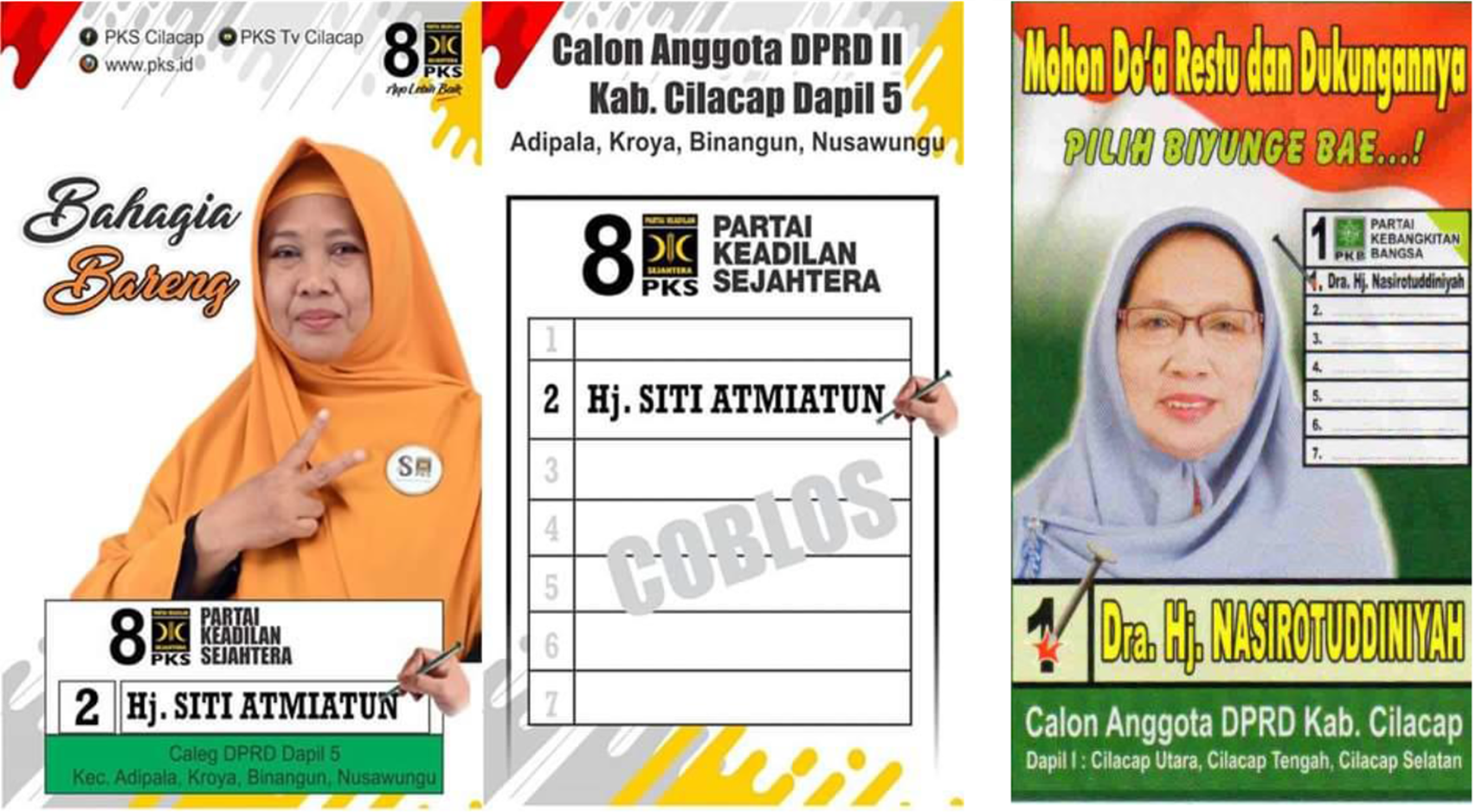
Siti Amiatun from the Islamist Prosperous Justice Party (Partai Keadilan Sejahtera, PKS) and Nasirotuddiniyah from the pluralist Islamic National Awakening Party (Partai Kenbangkitan Bangsa, PKB).
PKS is an Islamist party with a puritanical bent. For Siti Atmiatun of PKS, the keyword when explaining her choice of hijab was “sharia,” with Islamic law being a core issue for her party as a whole. She stated that her choice of hijab was not just for reasons of electoral politics; from its founding as Partai Keadilan Justice Party (Partai Keadilan) in 1998, PKS has set the standards for sharia compliance, including in clothing (Machmudi, 2008):
Of course I have considerations, my considerations are Islamic sharia. I choose a hijab like this because it is in accord with sharia, and in accord with my party line as an Islamic party. By wearing a hijab like this, the community knows that I am a cadre of PKS, which is based on Islam, and our way of being Islamic is not half-hearted; [we aim for an] Islam that is comprehensive (kaffah), Islam that is complete (utuh). Thus, whatever hijab we wear must be in accordance with the teachings of sharia. (Interview with Siti Atmiatun, 31 March 2019)
According to Siti Atmiatun, there is no formal standardisation of the hijab within the party, but PKS candidates know the criteria of a hijab sharia because they often discuss them in their religious study circles (a key organisational building block of the party). Members regard the breasts of a woman as crucial because they can stimulate the sexual desire of men who see them. Because of this, a hijab that is in accord with sharia must extend beyond the head and cover the chest area to disguise the shape of the breasts. For Siti Atmiatun, her involvement with PKS meant that, when she was asked to run, her hijab would definitely be “in accord with the standards that applied in the PKS.” All twenty women candidates running for the party in Cilacap used the hijab sharia in their official KPU photographs, some of them accompanying it with a jacket in party colours.
Thus, alongside theological reasons, Siti Atmiatun’s choice of hijab had a clear political orientation. She saw her choice as furthering the party’s ideology and image. She stated that if she were elected as a DPRD member, one item on her agenda would be to give impetus to the wearing of the sharia-compliant hijab in bureaucratic circles, particularly within the state-sponsored women’s group, the Family and Welfare Empowerment (Pemberdayaan Kesejahteraan Keluarga, PKK) movement. She claimed to have had success on a small scale, requiring some PKK members in the area where she lived to wear the hijab in the neighbourhood around their homes. In short, if elected, she wanted to replicate what student groups affiliated to PKS had done: groups such as Indonesian Muslim Student Action Union (Kesatuan Aksi Mahasiswa Muslim Indonesia, KAMMI) have campaigned extensively to promote the wearing of the hijab in many higher education institutions; she wanted to do the same within government.
In everyday life, Siti Atmiatun consistently wears the hijab sharia, both where she lives as well as in the financial institution where she works; but there are small differences to her political appearance that show she, too, is consciously engaging in political image-building. In her daily life, she prefers simple dark colours, such as dark green, black, grey, and dark brown, and she prefers a so-called hijab instan (instant hijab), which is easy to wear because it can be fastened without a brooch or pins. However, in the candidate photos she distributed to voters, she wore a light-coloured, yellow hijab, similar to the party’s trademark colour, and it was fastened with a brooch that depicted the party logo. Siti Atmiatun explained:
I feel more formal, more serious. If I wear the instant hijab, that’s fine to go to a food stall, but if I’m campaigning and meeting directly with the public, well, it depends on the place. Yesterday I campaigned in the rice fields among farmers, so I wore the instant hijab to appear more relaxed and closer to the people. But if I go to a public building or someone’s home, I wear a hijab like in the photo. Relaxed or formal depending on the situation – what’s important is that it’s a hijab sharia. (Interview, 31 March 2019) .
Though Siti Atmiatun’s narrative shows she was trying to generate a positive image through her choice of hijab, her imaging was not well aligned with the voters she was targeting in rural areas. One of the villages she was targeting, Kalikudi, is home to many people who adhere to the traditional Javanese belief system known as kejawen. Symbols of formal Islam, such as the hijab sharia, do not resonate in such locations. Perhaps partly as a result, Siti Atmiatun was not elected, receiving only 300 votes.
The other candidate who wore the hijab sharia, Nasirotuddiniyah, was also unsuccessful. A member of the pluralist Islamic party PKB, in contrast to Siti Atmiatun, she did not raise the issue of sharia in her campaigning and her choice of hijab was not a political tool. For Nasirotuddiniyah, her jilbab style was incidental; she felt comfortable wearing it because she has worn it for decades. She first started wearing the hijab in the 1960s when she was an undergraduate, and over the years, as she became a teacher, she changed from a simple kerudung-style head scarf to one that is tighter around the head and neck. Nasirotuddiniyah’s personal belief is that there is no single definition of a hijab according with sharia, and she is not interested in problematising women’s appearance. As a preacher herself, she believes that improving behaviour should take precedence over transforming physical appearance. She did not attempt to form a sharia-positive political image with her style of hijab, but rather chose a hijab that allowed her to achieve personal comfort and express modesty in public. As a candidate for the pluralist PKB, it makes sense that she would not use her hijab sharia for imaging, because this garment is associated in the minds of many Indonesians with Islamist groups such as PKS (of the sixteen women running for PKB in Cilacap, only four wore hijab sharia in their official candidate photographs). In short, these two candidates, Siti Amiatun and Nasirotyddiniyah, both wore the hijab sharia but had very different motivations, each influenced by the ideologies of the parties they represent.
Moderat Styles
The term Islam moderat (“moderate Islam”) has come to take on a particular meaning in Indonesia in recent years. It is promoted by groups who see themselves as promoting values such as justice, tolerance, and equality, and is often contrasted with the terms “liberal Islam” and “puritanical Islam” on either flank. People – including candidates – affiliated with NU often claim the moniker Islam moderat. Building on the concept, in recent years NU and PKB have both promoted the concept of Islam Nusantara (archipelagic Islam), meant to combine Islamic tradition with local Indonesian values and practices, by doing so situating NU, and by extension, PKB, as defenders of tolerance and pluralism (Fealy, 2018; Hosen, 2016; Munfaridah, 2017).
Siti Mukaromah, a candidate with a NU background running for PKB for the national legislature (Dewan Perwakilan Rakyat, DPR), sought to express a moderate Islamic standpoint through her choice of hijab (Figure 2). In the photos she used to promote her candidacy through banners, posters and stickers as well as in her live appearances, she consistently wore a hijab made from a square piece of cloth folded symmetrically to form a triangle and then fastened under the chin with a pin, with the two ends of the headscarf pushed back over the shoulders. This style of hijab covers all the hair and the neck but does not cover the chest. She always chose some shade of green, either for the hijab, or for her dress.
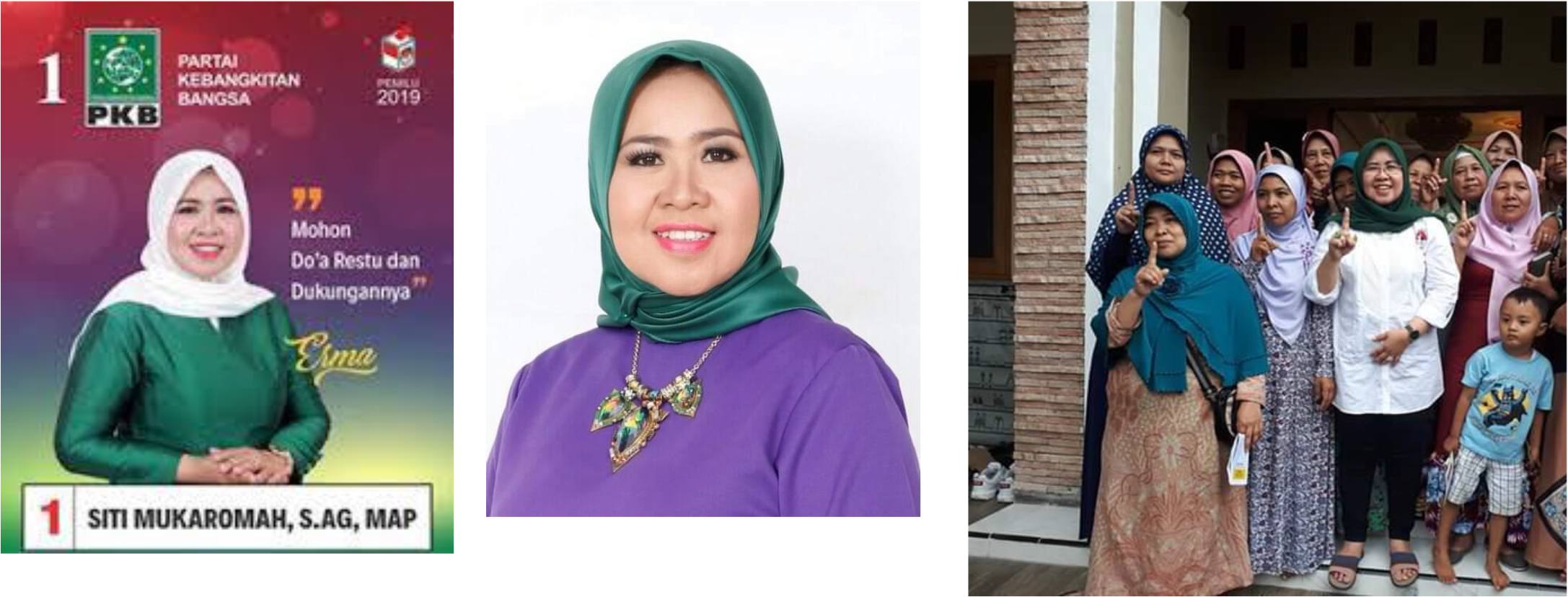
Siti Mukaromah, incumbent candidate for the National Parliament from the pluralist Islamic National Awakening Party (Partai Kebangkitan Bangsa, PKB).
According to Siti Mukaromah, her hijab was not only comfortable, but it was also mostly in accord with her values: Islam moderat. It covered her aurat, that is, all of the body except for her face and the palms of her hands (in accordance with the Islamic teachings she followed), but without losing her “Indonesian-ness” (keIndonesiaan). For her, it was vital that her hijab was a symbol of her Islamic identity, particularly because she has a background as an NU activist, is a graduate of an Islamic school, and is running for a party, PKB, which was established by ulama. But it was also important to portray a local Indonesian flavour:
PKB stresses that you have to always keep your identity as an Indonesian, with special local characteristics. It’s very well known that in Arabic countries, the kerudung is very large, always tightly closed, with a long dress – this is because there are other issues [they have to deal with], because of the desert, lack of trees, bad air circulation, a lot of dust, so it’s natural to cover everything up. But it’s very different in Indonesia where there are lots of trees, the air circulation is relatively good, the weather isn’t as cold or as hot as in Arabic countries, so a kerudung like this is just fine from a health perspective. I think that’s part of the comfort of clothing, where the aurat is covered, but the identity of Indonesian-ness is there, the aspect of modesty is there, beauty is there, upholding the tradition and local culture of Indonesia are also there. In short, it’s not extreme or rigid like in textual Islam, but it’s also not removed from the text about aurat. (Interview, 31 March 2019)
The expression “Indonesian-ness” can be interpreted as a contrast to “Arabness” which, in Indonesia, is associated with the long hijab that comes down to cover the chest and back, is dark in colour, and accompanied by a face covering. In other words, Siti is clearly distinguishing between the hijab she wears and that promoted as the hijab sharia by preachers such as Felix Siauw and Hanan Attaki associated with Islamist organisations.
NU as an organisation demonstrates a relaxed attitude towards rules on wearing the hijab for its members and leaders. As Siti Mukaromah explained:
No PKB ulama have ever complained about the jilbab question, saying that, for example , it’s not in accord with sharia because it’s not wide (lebar) enough. There’s no-one like that. The ulama value the choice of each individual cadre, including those who only wear a turban. They don’t complain. (Interview, 31 March 2019)
Siti Mukaromah’s imaging of the hijab accords with the values contained within the concept of Islam Nusantara. As mentioned previously, through the concept of Islam Nusantara, NU and PKB lay claim to a tradition of tolerance and pluralism. The concept encompasses a model of thinking about, understanding, and practicsing Islamic teachings that has developed with reference to the culture or traditions in the archipelago of Indonesia and other nations of Southeast Asia (Qomar, 2015). Islam Nusantara emerged at the 33rd NU National Congress in 2015 in Jombang as a way of countering the thinking, understanding, and practice of Islamic teachings that seek to impose a uniformity of belief and practice across the globe through acts of violence, global terror in the name of Islam, and political movements representing the ideology of fundamentalism and calling for a restoration of the global caliphate, sidelining the nation-state (Rahman, 2016).
Though obviously appealing for more moderate elements in NU, the concept is controversial in parts of the Muslim community, even within NU itself (Hosen, 2016). In the view of the critics, there is one true Islam and its character is universal; embellishing Islam with a geopolitical label like “Nusantara” is, in this view, a deviation. As with PKS candidates who wore the hijab sharia, PKB candidates who wore a hijab designed to express affiliation to the idea of Islam Nusantara also ran the risk of rejection by voters. This risk did not disturb Siti Mukaromah because, as she explained, she saw elections as ideological contests, and as a time to fight for ideals, including religious ideals. She was successful in her re-election campaign to the national parliament.
Siti Mukaromah’s view on the contestation of elections strengthens the argument by Hanna Herzog (1987) that elections are occasions of ritual and drama defined by their liminality and unsettled or transitional nature, whereby voters and political actors “interact around and within a symbolic environment” As Herzog (1987: 571) writes: “Manipulating and altering meanings and creating symbols are the main activities during such a period.” Political actors compete for support using symbols. The hijab in this sense can be regarded as a symbol that implies a particular message regarding the ideological affiliation of the wearer, emphasising her pluralist Islamic credentials and her nationalist frame.
A second successful PKB candidate I interviewed was less clear than Siti Mukaromah in explaining the ideological values she wanted to convey through her hijab choice. Nonetheless, she implicitly also used her hijab to construct a moderate image. She said she deliberately chose a style of hijab identical to that of Siti Mukaromah because the community she was targeting had the same characteristics as herself, meaning they were affiliated religiously with NU, or were less pious Muslims (abangan). 3 They themselves generally wore the same type of hijab as she did, one that covers the hair and neck but is not very long so that the back and part of the chest are not completely covered. In her opinion, this style of hijab is in accord with the standards of modesty existing in the community because it covers the aurat without being excessively full:
I want to show what’s special about me in this way. Although most of them in Sawaangan are abangan, quite a few of them wear the headscarf. I wear the same headscarf most of them wear. If I wore a large headscarf, a loosely fitting one, I’d be asked: “ What’s that? What strand (aliran) of Islam is that? Looks like you’ve caught a strange disease.” But with a style like this, the community is the same as me, I’m like the community, my Islam is the same as theirs, not a strand (aliran) that’s different. (Interview, 4 April 2019)
The key strategy here was one of group belonging: the candidate was constructing a positive image of being modest like ordinary people in her electorate. She wanted to avoid differentiating herself from her community because then she might be mistakenly thought of as belonging to a different type of Islam.
Nationalist Styles, Instrumental Uses
In contrast with candidates who chose a particular hijab style in order to convey an ideological vision for the future of Indonesia – whether the Islamist views of PKS, or the more self-consciously moderate approach associated with NU and PKB – were candidates who adopted a more instrumental approach to their hijab use, weighing the practical benefits of the style they chose, and how it benefitted them in reaching out to target groups of voters. Many of the candidates in this category were members of the nationalist parties (i.e. parties that did not formally state that they had an Islamic political orientation and were not informally linked to any Islamic organisation).
That some candidates were highly instrumental in their use of the hijab was obvious from the fact that some designed completely different publicity material depending on their target audience. Consider the images in Figure 3: these two candidates, Vicky Shu (a well-known singer) and Ammy Amalia Fatma Surya (the daughter of a prominent leader of the modernist organisation Muhammadiyah), both of whom are Muslim, supplemented their standard campaign images and appearance (on the left) with the images on the right, which they used in locations close to religious boarding schools.
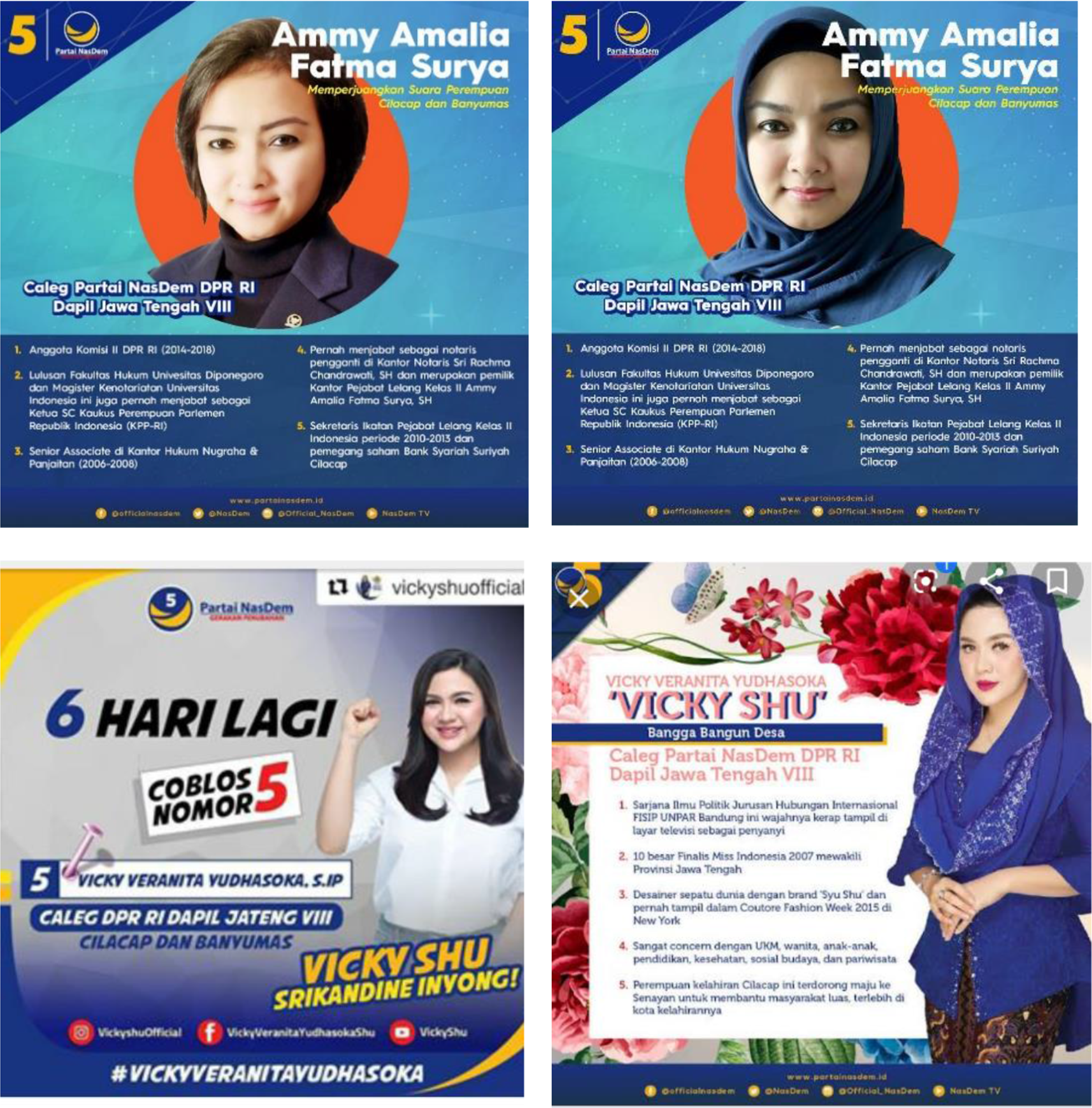
Ammy Amalia Fatma Surya and Vicky Shu, two candidates for the National Parliament from the National Democrat Party (Partai Nasional Demokrat, NasDem).
Other candidates I encountered from nationalist parties expressed mixed and complex motivations when explaining their hijab styles. Take, for example, Anggit Adi Juwita of PDIP (Figure 4). She explained that she wore the hijab as a way of cementing her identity as a Muslim. For her formal campaign material, she chose a relatively simple hijab style, namely a red cloth the edges of which did not extend beyond the chest, fastened with a pin under the chin so that her hair and neck were both covered. In other photos, including those on social media, Anggit sometimes appeared with a different style of hijab, namely a kerudung with an unfastened rectangular cloth with some of her hair and neck showing. She was always consistent in her choice of red, the colour used in her party’s symbol.
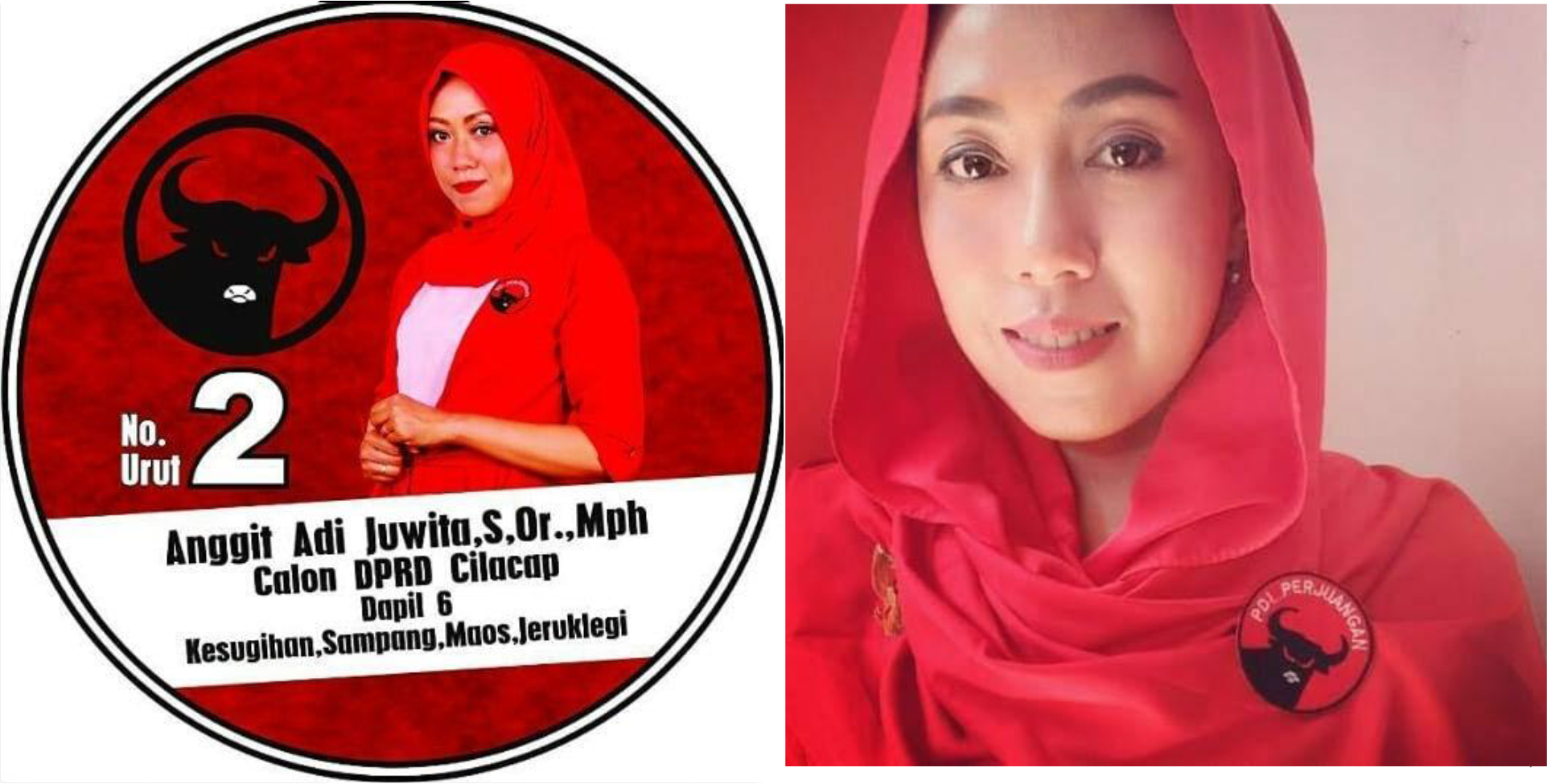
Anggit Adi Juwita, a successful candidate for the Indonesian Democratic Party of Struggle (Partai Demokrasi Indonesia Perjuangan, PDIP).
According to Anggit, and consistent with her party’s perspective of distancing politics from religion, the hijab is a matter of personal choice not connected to her party. However, she acknowledged that she was advantaged by wearing the hijab because her strongest internal party competitor was a Christian. She believed that many voters in her electorate would consider group identity when casting their votes. Having the same religion, she said, facilitated her access to one of the groups she was targeting: the women’s religious study circles (yasinan) affiliated with NU women’s organisation Muslimat:
I really felt that the kerudung helped me a lot, because these days people usually wear the hijab, so if there’s a Muslim who doesn’t wear one, they ask: “ Why? Don’t you like wearing a kerudung?” If we wear the hijab, then people can easily identify our Muslimness; at the very least nobody asks me as a candidate whether I’m Muslim or not. This is different from if I didn’t wear one, then there would surely be some who would ask. The hijab helps me to bypass the question about religious identity. (Interview, 5 April 2019)
At the same time, although she said she opposed the practice of money politics, Anggit admitted that she sometimes responded to requests for money from prospective voters by giving them hijab instead. She told people that the hijab was a gift (sedekah) not a bribe given in exchange for their vote, so they were free to choose or not choose her at the ballot box. She rationalised that the hijab would bring benefit to the women who wore it while still being cost effective. More importantly, I would suggest, by giving out the hijab, she was building an image as an individual who cared about religious matters – despite her background in a party that is not affiliated to any religious group. This approach was particularly relevant to the community in the subdistrict of Kesugihan where she was running, because she understood this community to be a pious one. Although Anggit felt that it was important to identify herself as a Muslim, she said that when it came to politics, the most important ideals for her were nationalist. Several parties, including Islamic parties, had approached her and invited her to run. But she was not inspired to support a party based on any particular religion, believing it was more important to nurture and protect diversity. She saw her style of hijab as presenting herself as a Muslim nationalist. When I asked her about whether she would wear a hijab sharia as worn by her PKS competitors, she answered diplomatically that it would be troublesome for her because it would restrict her movement:
Perhaps PKS has a particular mission with its style of hijab, but I myself don’t. If we look at it from the community’s perspective, they can differentiate, PDIP is more nationalist and pluralist, different from PKS or PAN that recruit only Muslims. With a hijab like this, although I don’t wear clothing that is red like the colour of PDIP, they surely know that I am not PKS, and not PKB. (Interview, 5 April 2019)
Theologically Anggit said she was sure that in the eyes of God, if the hijab sharia was worth a ten points reward, then the hijab she wore would be worth five points because God always appreciates the good intentions of the people.
Amelia Rizqi, from the Democrat Party, also chose a style of hijab that allowed her to present herself as a nationalist Muslim. Identifying herself as Muslim was important for her because a large majority of the voters she was targeting were devout Muslims and she was convinced that these voters would take religious factors into account when casting their vote. With a background as an NU activist, she had no problems promoting herself as a good Muslim, but she also had to campaign among voters who practised indigenous Javanese traditions, and were abangan or non-pious Muslim voters. When targeting these voters, she felt she needed to underscore her nationalism. Among such voters, she avoided any themes that were religious in nature and spoke a lot about her qualifications as a young candidate with a postgraduate education, who mixes easily with people from all walks of life and is prepared to work hard to fight for the community. She was aware that among non-devout voters, giving the impression of being too Islamic was not advantageous, and so she played up her character as a Muslim nationalist. In the photograph on her billboards, she chose a rectangular hijab, folded into three even sections, fastened with a pin under the chin, the corners tied around her neck and the remaining cloth left loose. She paired this with a party jacket to complete her outfit, creating an impression of someone who is young and relaxed. However, like Anggit, she varied her hijab according to the occasion, going for a more religious look among NU women voters, while still choosing patterns and motifs that countered an Islamist appearance.(Figure 5)
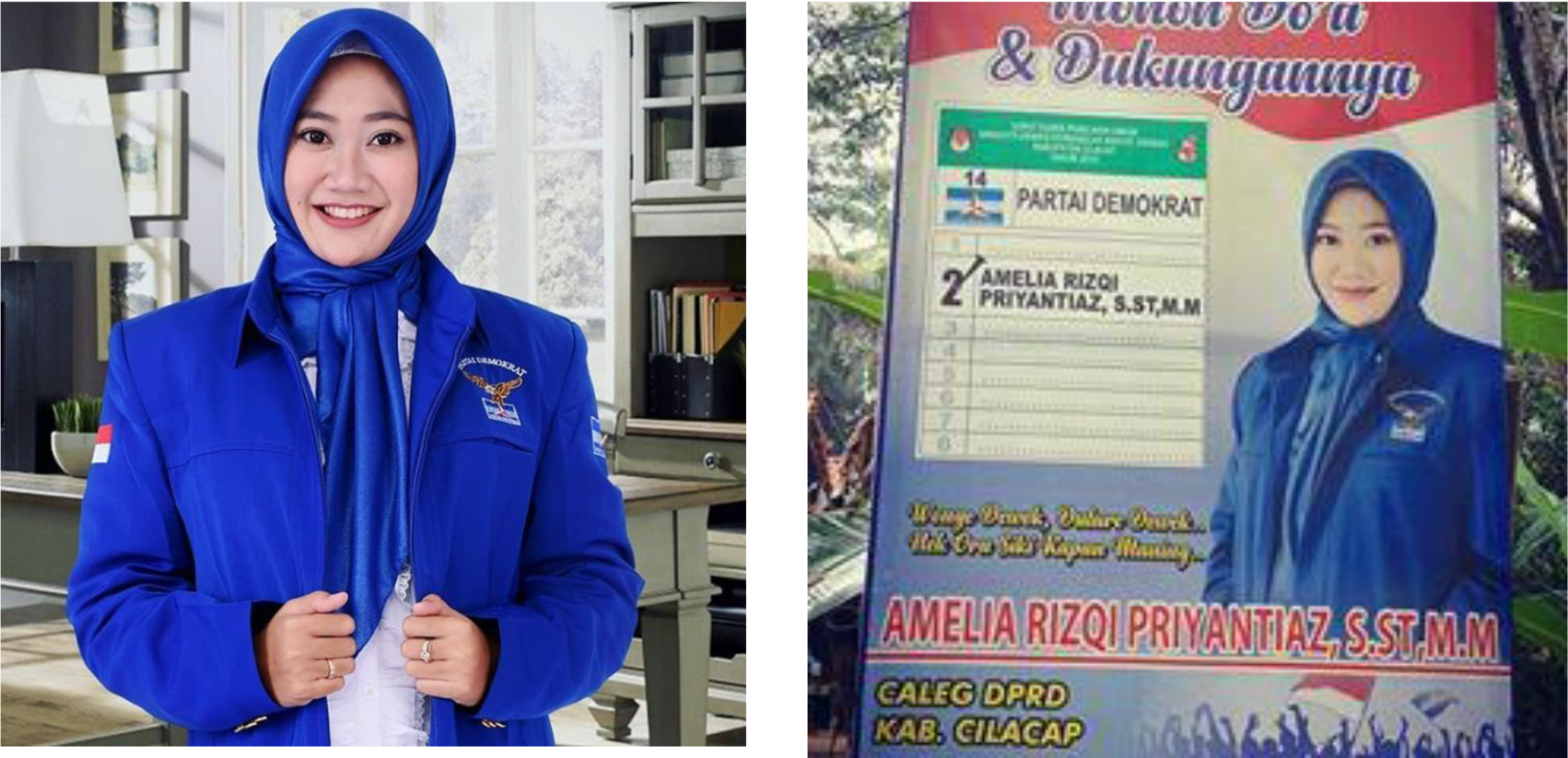
Amelia Rizqi, a successful candidate for the Democrat Party.
Similar to Anggit, Christina Dewi Andriyani, a candidate for the nationalist Gerindra party, gave a lot of thought to the style of hijab she wore. In campaign photos, she wore a simple hijab, the corners of which were tucked into the collar of her blouse. She said that she chose this style to show prospective voters that she was Muslim. She believed this was important because most voters in her electoral district were Muslims, and the party she was representing was not based on Islam. On the other hand, her name can give the impression that she is Christian or Catholic:
The hijab is very important for my purposes in the election, the problem being that my name is identical to the name of a non-Muslim. I remember the experience of the wife of SBY [Susilo Bambang Yudhoyono, former president of Indonesia], Ibu Kristiani Herawati, who was once reported to be a non-Muslim in the run-up to an election. Some people believed this and didn’t want to vote for her. This concerned me. (Interview, 5 April 2019)
Apart from wanting to be identified as a Muslim, Christina also wanted to be known as a candidate who was a hard worker, able to serve her constituents, was agile, and young. She chose a style of hijab to reflect this character. A light brown hijab was paired with a white top, in accord with the colour of clothes often worn by the presidential candidate from her party, Prabowo Subianto, allowing her to be identified with her party.(Figure 6)
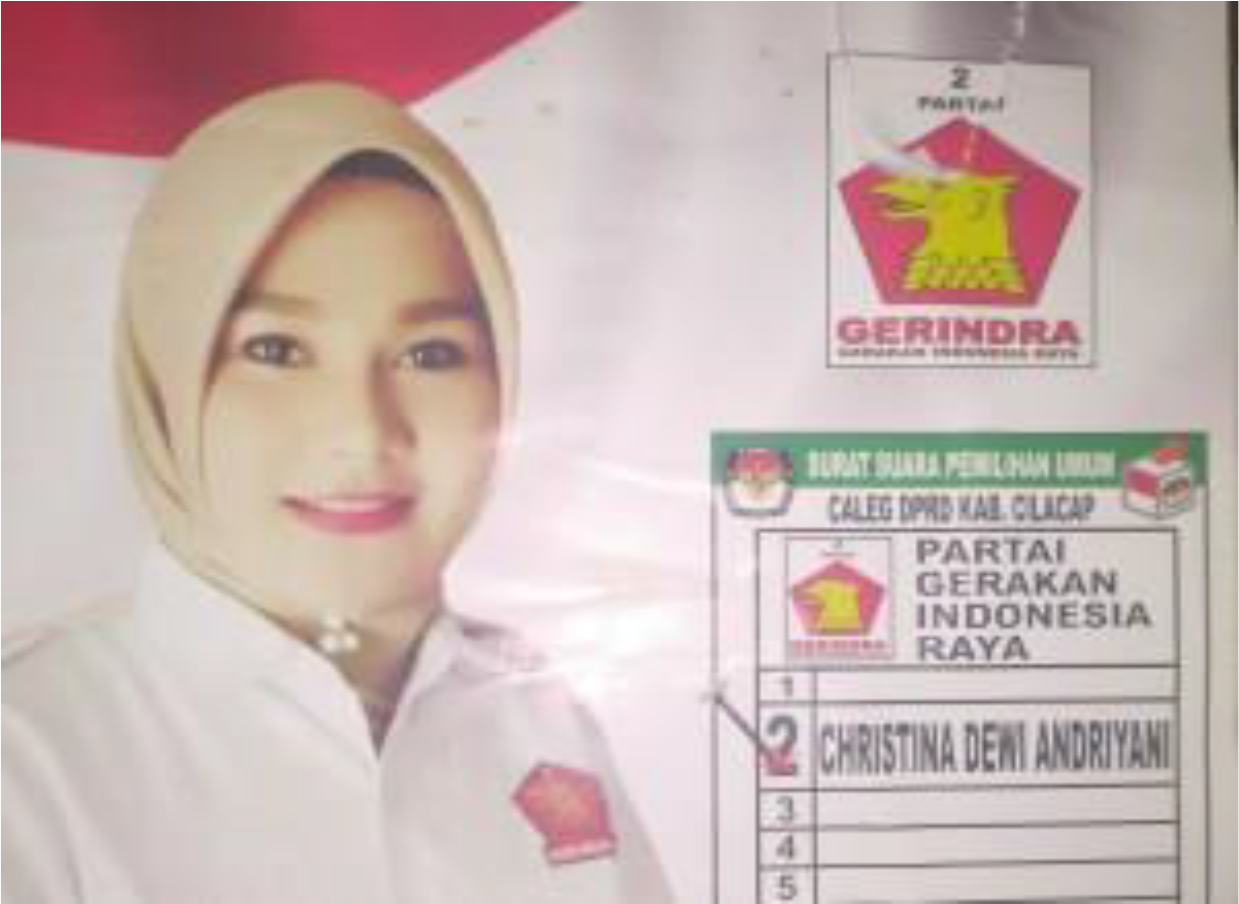
Christina Dewi Andriyani, a successful candidate for the Gerindra Party.
The approach of these three women confirms that in an electoral context, hijab style can have ideological and political implications that candidates need to take into account. All three instrumentalised their hijab to clarify their religious identity, something they found necessary because they were running for non-Islamic political parties. But they had to balance this approach with projecting an image that was not too strongly Islamic. All three of these candidates were elected. The approach of these three candidates to the wearing of the hijab and their electoral success strengthens the argument of Indarti and Peng (2016) that the hijab is an item of fashion that functions to express the cultural values of the wearer and acts as a frame of communication between wearer and audience (in this case, the voters).
Muslims of Beauty and Modesty
As noted above, some scholars have argued that the hijab should be considered above all else as a fashion item and as serving aesthetic functions. Iin Idia Afiatun, an incumbent candidate from the United Development Party (Partai Persatuan Pembangunan, PPP), one of Indonesia’s Islamic parties, seemed to share a similar view. She was upfront about the importance of her appearance for her election strategy:
I had this experience, a group of people had already chosen a particular candidate, saying that candidate was the only one they knew. But after meeting me face to face, they changed their vote, the reason being that I was prettier. So appearance is very important for a candidate, particularly when targeting a community that is not fanatical about their choice. (Interview, 1 July 2019)
To enhance her appearance, Iin chose to wear the hijab pastan (instant pashmina hijab) which is a long rectangular piece of fabric sewn to form a ready-to-wear hijab in a relatively elaborate style, adorned with accessories like a brooch or ribbon on one side (Figure 7: the image on the right was uploaded on her social media account during the campaign season).
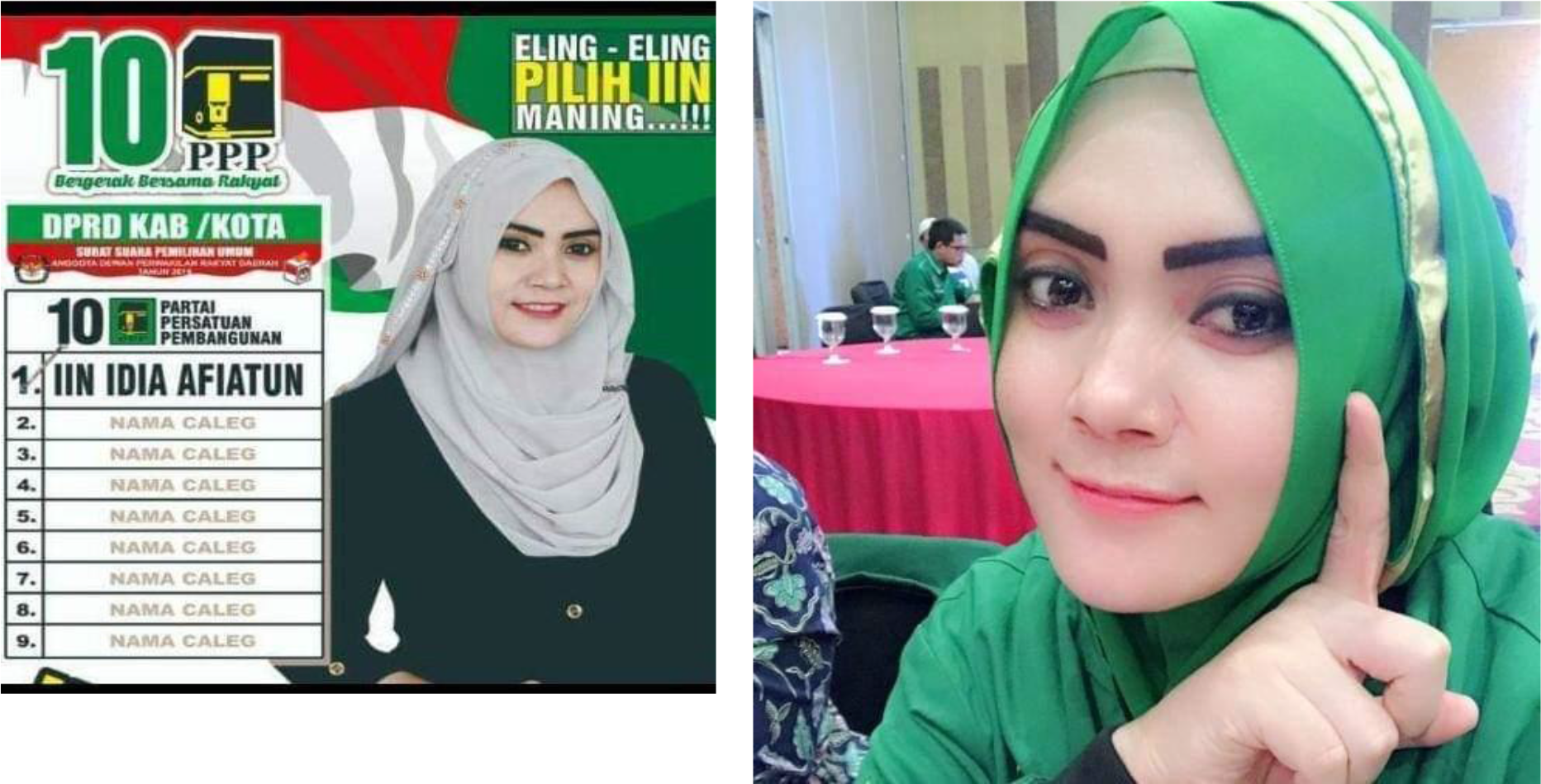
Iin Idia Afiatun, a successful candidate for the United Development Party (Partai Persatuan Pembangunan, PPP).
Iin chose this style of hijab because she has a background as a hijaber, a term used for young hijab-wearing fashion-conscious women, especially those active on social media (Pramiyanti, 2019). As a hijaber, she wants to appear more fashionable than those who simply wear a square scarf fastened with a pin. Further, Iin is not just a hijaber who buys hijab produced by others; she also designs and produces her own hijab that she thinks maximise her attractiveness. She designed all the hijabs she wore in her official candidate photographs, on billboards, posters, digital accounts, and everyday activities; none were available for sale in markets.
Iin did not rely on her appearance as the only means to create a positive image and achieve electoral support. As an incumbent, she explained she was confident of re-election because she already had a base of support because of her efforts to assist her constituents in the previous sitting period in the district parliament. For example, she had fought for a housing reconstruction programme for residents whose homes were unliveable. However, she was hoping to increase her share of votes outside her base area of support, meaning apart from the voters that her campaign team had identified as already loyal to her. Her confidence also meant that she decided not to campaign via open meetings or community gatherings as most other candidates did, instead relying on her previous delivery (as an incumbent) of various programmes to two core villages, distributing images of her wearing her hijab on stickers and posters in a neighbouring subdistrict, and providing free health services each Friday at her husband’s clinic (he was a nurse). Iin was re-elected to the district parliament.
Iin’s opinion that beauty can contribute to electoral success resonates with the findings of recent research on links between voter perceptions of the attractiveness of candidates and voting patterns (Berggren et al., 2017; Lawson et al., 2010). Berggren et al. (2010) showed that in elections in proportional electoral systems, such as Finland where the study was conducted, having an attractive appearance is an advantage. Voters who do not want to vote for underperforming incumbents tend to support candidates they do not know, but who are physically appealing. Another study by Berggren et al. (2017) examining Europe and the United States came to the same conclusion: many voters support attractive candidates in situations of low information concerning competing candidates. Lawson et al. (2010) argued that this is particularly the case when elections are personalised rather than based on party voting. Thus a focus on looking attractive may well provide an advantage to candidates in Indonesia, where information about candidates is often difficult to find and election campaigns are heavily personalised (Aspinall, 2104). 4 Interestingly, studies of the impact of attractiveness on voter choice in the international literature indicate that the boost a candidate receives through attractiveness is not gender dependent (e.g. Berggren et al., 2017; Lutz, 2010).
Iin’s emphasis on beauty and fashion could thus also be read as being strategic. Moreover, as well as enhancing beauty, according to Iin, the hijab can also generate a positive image of modesty and courtesy (kesopanan). Such values, according to Iin, are important for attracting support. In general, the community prefers figures who adhere to polite standards of behaviour, and the standard for a candidate who is from an Islamic party is to wear the hijab in public. Although she knows that her party does not demand that all candidates wear the hijab, for Iin personally, wearing the hijab is a necessity for individual Muslims, for those affiliated with NU (she was also affiliated with this organisation), as well as for representatives of Islamic parties. Others among my interviewees agreed that they wanted to be seen as courteous when they appeared in public, and wearing the hijab was one way to ensure they were:
In my village, there are many people who don’t regularly pray, sometimes they pray, sometimes they don’t, but when they appear at a public event, they wear the hijab, for example at a parent teacher interview or if invited to a social gathering. If I don’t wear the hijab, that would be seen as very strange, it gives the impression of not respecting other people, it’s not polite, so it would be very strange if during the socialisation of my candidature I went around without wearing a hijab when I am a Muslim. (Interview with Amiyati, 4 April 2019)
The above statement shows that the hijab is not always a theological symbol connoting the commands of God, but that the wearing of it also has a strong social element (El-Guindi, 2006). Courtesy and modesty from a sociological perspective are constructs, the standards for which change over time and differ from one place to another, so that standards of dress also change easily. Only a few decades ago, women officials (included elected officials) rarely wore the hijab because it was considered to be the dress of the religiously devout and was associated with tradition, whereas officials wished to convey an impression of being modern and educated. But in this era of Islamic revival, the hijab has begun to be regarded as obligatory for Muslim women, regardless of their social status.
Standards of courtesy and modesty create obligations, not rights (Mertokusumo, 2005: 14). Acting in violation of the standards that apply where one is at any given time invites social sanction. In the context of a general election, legislative candidates ideally must present themselves in accord with the standards existing in the communities they are targeting. By appearing courteous and modest, candidates are accepting the prevailing social standards in the communities where they are seeking votes. If they do not follow the standards, they risk being sanctioned by the community. Such sanctions might include being labelled immodest, being gossiped about, or being boycotted by community members when campaigning; the most salient risk for candidates is of course that they lose votes. Such underlying social pressure accounts a great deal for why the hijab has become so widespread in Indonesia, including among candidates at election times.
Conclusion
This research presents evidence that suggests that when they choose a hijab style, female candidates actively engage in positive image building. All candidates who aim to win a seat must market themselves in much the same way that businesses market their products and services. The goal is to be assessed positively by customers (voters) who “buy” the product being sold. The complexity of hijab choices discussed in this article suggests that the hijab can serve multiple symbolic purposes. Some candidates are certainly conveying distinct ideological messages through their choice of hijab; most, if not all, are also responding to social expectations and rules of etiquette. By varying their hijab style, candidates are able to vary the packaging through which they pitch themselves to different segments in the political marketplace, endeavouring to increase their market value. Not all candidates are equally successful in aligning their hijab choice to the communities they are targeting for votes. One female candidate, for example, appeared unaware that the message her hijab sharia was communicating would not sit well with the voters among whom she was campaigning.
Above all, my research shows that we need to move beyond thinking of the hijab primarily through a theological frame. The hijab serves not merely as a symbol of personal piety and transcendence for women candidates, but it is also a strategy through which candidates attempt to mould public opinion to achieve political power which is, by its very nature, profane. A focus for future research would be to explore the political meaning of the hijab in electoral contests elsewhere in the Muslim world to see if the same underlying logic of the political marketplace applies in other countries or whether the combination of Indonesia’s electoral system and heterogeneous Muslim community makes it a unique case.
Footnotes
Declaration of Conflicting Interests
The author(s) declared no potential conflicts of interest with respect to the research, authorship, and/or publication of this article.
Funding
The author(s) disclosed receipt of the following financial support for the research, authorship, and/or publication of this article: The research for this special issue was funded by the “Supporting the Rules-Based Order in Southeast Asia” (SEARBO) project, administered by the Department of Political and Social Change at the Australian National University and funded by the Australian Department of Foreign Affairs and Trade. The opinions expressed here are the authors' own and are not meant to represent those of the ANU or DFAT.
Notes
Author Biography
Email: