



Abstract
The ongoing administrative reform in the Myanmar Police Force (MPF) has included adoption of community-based policing as the main philosophy of the police department since 2012; however, the democratic values inherent in the community-oriented concept have stagnated under the military influences in Myanmar caused by political instability and armed conflicts among the ethnicities of the country. Many research reports reveal that the success of reform with community-based policing is highly dependent on reducing military influences and establishing the police department as an independent organisation. Subsequently, the problem of adopting community-oriented policing has become chronic under the existing democratisation process. By utilising Herbert A. Simon’s decision-making study, the current study examined the decision-making process in community-based policing, and found that the problem of stagnation of democratic reform in the police department was caused by the nature of the MPF, cognitive limitations in the decision-making process, and value conflicts, rather than military influence.
Keywords
Introduction
After the 2010 general elections, the government of the Union Solidarity and Development Part (USDP) initiated democratic reform in Myanmar. During the democratisation process, the administrative reform plan for the Myanmar Police Force (MPF) was not paid much attention by the government although it included the adoption of community-based policing, the police department is very important for democratic change, and it can be perceived as the face of the executive (Meyer, 2006; as cited in Loh, 2010: 3). Moreover, the reform process has been criticised as a failed attempt at democratisation because of the military influence. The current study, therefore, examines the reform process in the police department to get a deeper understanding of its complexity. The study assumes that the problem – the stagnation of democratic reform in the police department – is not just because of the military’s influence, but because of different objectives and values held by those involved in the decision-making process for reforming the police department. On that account, the study of decision-making, following Herbert Simon’s bounded rationality, is utilised to reveal the actual interests – the values – of decision-makers and the direction of ongoing reform in the organisation.
Background: Community-Based Policing in Myanmar
The concept of community-based policing is defined as a democratic function, with the collective participation of various stakeholders. This concept was developed in the research studies of the San Diego Police Department during the 1970s. There are two main components of community-based policing: community partnerships and problem-solving. Community-based policing can also be described using the following ideological dimensions: “decentralisation, partnership, community engagement, proactive and problem-solving, and philosophy.” Based on these dimensions, we perceive that one of the main senses of community policing is “discretion” – the freedom to carry out police tasks with cooperation between citizens and street-level officers. Community policing is defined as a “philosophy” in much of the literature. It is represented as a big change in policing ideology by promoting decentralisation and the roles of citizens and street-level officers; in other words, it strengthens the relations between police officers and citizens by sharing the responsibilities for problem-solving in order to maintain the quality of life of the community.
In the case of the MPF reform, the police department has been trying to implement community policing under the existing quasi-military nature of its operating procedure. Consequently, the police department has adopted a hybridisation of the People’s War strategy 1 from the military discipline and democratic policing. The initial purpose of adopting the People’s War strategy was to provide police service in all remote areas where armed insurgent groups might exist. Adoption of the People’s War strategy in the police service started in the 1990s and it was continued in the 2012 reform efforts along with democratic values – prioritising public interests. Consequently, the reform process was very difficult to implement from the democratic perspective, and democratic values controversially stagnated under the existing quasi-military policing model. The complexity of implementing administrative reform in the MPF can be stated as follows: although the police department has been arguing for the adoption of community-based policing, with the community-oriented concept as the main philosophy underlying organisation of the police force, military-like reinforcements and a paramilitary policing nature have evidently developed under the quasi-military policing model since 2011. Therefore, community-based policing dependent on democratic values in the MPF could generally be determined to be a failure caused by military intervention. On that account, there are many research reports concerning the obstacles and challenges to successful community policing in Myanmar. For instance, Selth (2012) suggested the close relationship with the military is one of eight factors of colonial continuities that the police department has to overcome for the change to succeed. Selth (2013) identified six categories of major challenges for the reform process. Among them, the most important for the success of democratic policing is for the organisation to be independent of military influence. The United Nations Office on Drugs and Crime (UNODC) report critically suggested changing the name of the police organisation from “Force” to “Service” to reflect the change in the paramilitary nature of the organisation as well. Furthermore, the police force was described as a paramilitary unit in Selth’s (2018), and further study is likely to reveal that democratic norms in policing have already stagnated. Consequently, the reform process of community-based policing in Myanmar has been facing the situation of being “the problem without solution” because of the military influence on the organisation. Therefore, the problem in the MPF ought to be re-examined in light of the current situation to overcome the stagnation of community-based policing.
Literature Review: Decision-Making Study
To clarify the ongoing complexity of the reform process and to provide further improvement of democratic reform in the police department, the decision-making process for adopting community-based policing will be analysed. For the decision-making study, the concept of Herbert A. Simon, which focuses on the interests of decision-makers under limited cognition (Simon, 1959), is adopted in this study. Specifically, the fact and value premises of the decision-making process will be examined to reconsider the source of the problem of stagnation of the community-oriented reform process. The term “stagnation” 2 will be intentionally used in the current study, and this study proposes that the problem resides in the stage of choosing the reform alternative with the numerous limitations.
Generally, Simon’s decision-making study in organisations is applicable to understand the process of planning and controlling techniques in both public and private administrations. The basic assumption is grounded in the notion of bounded rationality (Simon, 1959). Mainly, Simon’s assumption is contrary to the rationality of classic decision-making theories, which is that decision-makers systematically maximise utility under constraints. Consequently, Simon argues that the decisions are in reality made by following the way of satisfaction. In other words, the decisions are just finding acceptable solutions rather than the best of the best solutions with systematic choice. In that case, Simon’s study of decision-making can provide an understanding of the reason for the choice of decision-makers, their priorities, values, and objectives; moreover, it provides for more understanding of the nature of organisations and the management systems in those organisations. On that account, Simon examined the cognitive limitations that play significant roles in the notion of bounded rationality. Within the limitations, decision-makers choose reasonable solutions among the available alternatives, called decision-making under satisficing with limited rationality (Simon, 1959). Furthermore, Simon considered that it is better to emphasise the decisional premises “fact and value” as the units of analysis in the decision-making study, and especially that values are observed to clarify the actual objectives of decision-makers and “the trigger of decisions.” On that account, the analysis in Simon’s decision-making process is conducted using the behavioural sciences, particularly emphasising psychological concepts such as perception, experiences, and human thinking in decisional process.
In Simon’s study of decision-making, empirical studies are emphasised, rather than statistical and formal models, and the study mainly considers the tasks, environmental conditions, and cognitive limitation of the decisional process. The basic assumption of Simon’s decision-making is composed of the followings three factors:
(1) First, decisions are made under the concept of bounded rationality rather than perfect rationality; (2) Second, the quality of decision-making is highly depended on the level of decision-makers’ expertise; (3) Finally, the study of cognitive limitation is very crucial to understand the decision-making process.
Research following Herbert Simon’s decision-making studies is mainly divided into two categories: “the first trend is to examine the behaviour of decision-making by utilising decisional theory; and the second is to scrutinise the detail process of human decision-makers.” In this study, the analysis mainly emphasises understanding of the values and interests of decision-makers at the strategic decision-making level of the MPF; that is, it focuses on the cognitive process among the decision-makers and high-level executives who play very prominent roles in the MPF reform plan and implementation process. Moreover, the method of analysis under Simon’s decision-making study can also be observed in Fry and Raadschelders (2013) as a descriptive model by utilising an inductive approach based on the idea of logical positivism (Copleston, 1953). Subsequently, the decisional premises – values and facts – are considered as the unit of analysis for investigating the nature of organisations (Fry and Raadschelders, 2013), as well as the direction of change in organisational reform. In addition, the concept of the importance of reasoning in decision-making – the study of decision-making using Simon’s concept – can be observed in Pomerol and Adam (2004) as the main theoretical background for their decision support system. It can be understood that the reasoning that informs human choices plays a very vital role in analysing the nature of organisations. Moreover, the limitations imposed by cognitive systems (knowledge in decision-making) and the organisational environment are essential to consider in the study of decision-making processes under Simon’s bounded rationality (Campitelli and Gobet, 2010). Therefore, in the current study, understanding of the perception and value of decision-makers regarding the nature of policing in Myanmar, and the cognitive limitation in decision-making regarding the reform, are mainly focused on along with the study of decisional premises.
The Mechanisms for Decision-Making Study
As the administration of the MPF is complicated and has been intertwined with paramilitary objectives since its establishment, the study of decision-making is thought to be the best way to reach deeper understanding of the reform process. Generally, the administration of the police department can be determined not just as a complex pattern under the military influence, but also historically as having a unique and special form, with military values incorporated in the organisational administration under a quasi-military model that has persisted with successive changes in Myanmar. Therefore, in the study of the stagnation of community-based policing, the decisional premises of the current reform plan are analysed. Decisions are regarded as merely the solution of satisficing available under the limited conditions “a matter of compromise” and the complexity of the environment (Simon, 1959), decisional premises being the main units of analysis to understand the decision-making process. On that account, Simon reveals the importance of the elements of “fact” and “value” in decisional premises, hence the importance of clarifying the actual objectives – “value” – and choosing the means of achieving this objective – “fact.” In Simon, the factual element is described as follows: “Factual propositions are statements about the observable world and the way in which it operates [. . .] factual propositions may be tested to determine whether they are true or false (Simon, 1959).” Basically, factual propositions can be determined to be true or false, correct or not, and they are considered to choose among the alternatives for achieving primary objectives. Value propositions are more than factual and take account of the ethical content, that is, the reasons for a solution, values, and objectives that should be or ought to be, and other ethical reasons in the decision-making process (Simon, 1959). Subsequently, according to Simon, decision-making involves a judgemental process that takes into consideration those preferred values and factual propositions, including the environment, as it is impossible to determine in advance whether the solution is right (Simon, 1959). Also, in Simon (1959), three main factors are considered in the study of decision-making, as follows: “the type of task, the characteristics of the environment, and the distinct features of the cognitive limitation including the previous knowledge or expertise of the decision-maker (Campitelli and Gobet, 2010).” Accordingly, two dimensions will be the focus of this study of the MPF decision-making process, to prove that the value of the community-oriented concept in Myanmar has diverged from the democratic value of community-based policing. The two dimensions to reflect the value of decision-making are: (1) the type of task and its environment, to understand the organisational factors that influenced the values and objectives of the original reform plan, and (2) cognitive limitation in the MPF decision-making process, to understand the individual factors (participants and their knowledge) that guided setting the primary value in the reform process as community oriented. For the first dimension, the two mechanisms “the nature of policing in Myanmar” and “the original value of democratisation” are analysed to examine the types of tasks and the influential environmental factors. For the second dimension, the two mechanisms “the experience, knowledge, and perceptions of participants” and “the judgmental process of value and factual propositions (the factors that the participants brought to the decision-making process to set the primary value of the reform plan)” will be considered to understand the cognitive limitations of the organisation.
Data and Method
The detailed analysis was conducted following the qualitative research procedure (Yin, 2015). The mechanisms are organised to better reflect the real-world condition; that is, the most relevant factors with the decisional premise and cognitive process. Under those mechanisms, the analysis attempts to describe and interpret how the real condition of the current reform process is formulated in the police organisation. In addition, the data collection method sought intentionally to avoid a laboratory-like setting as in other empirical studies, and therefore, in conducting interviews, predetermined questionnaires were intentionally excluded. Subsequently, the primary data were collected from interviews with high-level officials in the police department (to get more reliable and frank discussion, interviews were conducted mostly with recently retired officials who had participated in the reform process). Data were also acquired from government statements, official documents, and reports from the police department. Several recorded videos of policing in real-world settings were collected from social media to analyse the behaviour of police officials in undertaking their jobs. Moreover, news and interviews with police officials from other Internet sources were collected to strengthen the analysis.
Analysis: The Type of Task and Its Environment
The Nature of Policing in Myanmar
For an understanding of the nature of policing in Myanmar, a brief historical background on the types of policing tasks is necessary. Generally, the Myanmar police organisation has its roots in the constabulary police forces under the British colonial government; 3 policing started in 1825 with the first annexation of Myanmar by the British (Hingkanonta, 2013). Several attempts at reform have been undertaken since then in attempts to rebuild the reputation of the police force (i.e. to change the public view of the force from a coercive tool of successive authorities, including the British colonial government, to a prestigious civil service force) (Khaung, n.d). On that account, it is crucial to recognise that successive changes to the police organisation involved adopting two distinct features of policing, “typical civilian policing” and “military policing,” to reflect the chaotic situation of the organisational environments of the respective times. For example, under the British colonial government, military policing was adopted to pacify rebellion, prevent robberies, and quell chaotic situations during nationwide uprisings (Hingkanonta, 2013). Following independence, military policing was embraced to preserve the interests of successive governments and deal with counter-insurgency operations, extreme crime cases such as transnational crimes, and drugs (Khaung, n.d). Although in 1964 the name of the police force was changed to the People’s Police Force (PPF), during reform that aimed to prioritise the interests of the people, later the police force again became a repressive tool of the socialist government against dissenters (Khaung, 2018). It appears that, although reform plans were initiated under diverse political ideologies of distinctive governments, the administration of the police organisation has followed the unavoidable trend of quasi-military policing (i.e. combining “civil policing” and “military policing”).
Likewise, the ongoing reform process can also be observed to be the same as previous reforms. Generally, it can be said that the current reform was initiated in 2012 during the democratic transition of the country but, actually, it was just a continuation of the 1990s’ reform effort by the military regime. In the early 1990s, the military leaders were once again interested in police reform as part of building the new political order in the country, to be a “disciplined democratic country.” The military government initiated the reform process in 1994 (Selth, 2013) under the Committee for Reform of the People’s Police Force Management System (CRPPRMS) chaired by Lieutenant General Khin Nyunt, with the following objective:
… to assess PPF’s present management, intelligence and legal affairs, to analyse PPF training system, to recheck the acts of the police to earn public respect and to do away with corruption and graft, and to promulgate laws, rules and regulations on PPF management and administration and make certain reforms in conformity with the changing situation … ( The New Light of Myanmar, 1994)
The military government changed the name of the police force from “People’s Police Force” to “Myanmar Police Force.” Since 1994, the fundamental concept of reform plan placed emphasis on the community-oriented solution with the following assumption: “the nature of police forces is not the same as military units with distinct responsibility for the public service.” Then, the plan for police reform was introduced by the military regime based on the people-oriented concept from the military People’s War strategy (Khaung, 2018), and the thirty-eight blessings of Buddha’s guidance and called “community-type” doctrine (United Nations Office on Drugs and Crime, 2015). Nevertheless, from the perspective of security concerns, the police force was regarded as a reserve force of the Myanmar military to maintain stability and protect the sovereignty of the country. Therefore, the types of policing tasks in Myanmar were very complicated and showed the unique features of a quasi-military model, with military values and objectives along with the organisational history. Similarly, the decisions on choosing values and objectives consistent with the community-oriented concept were also controversial and complicated by adhering to the military values and objectives of the 1990s’ reform.
Democratic Transition in Myanmar
The 2010 general election brought a new civilian government with a new political ideology and new public administration in Myanmar. The USDP government had become the first democratic government under the 2008 Constitution after the military regime. Although the majority of the cabinet members were former high-level officials in the previous military government, they enthusiastically engaged in the democratisation process and tried to implement far-reaching reform with their confident alternative – “building a disciplined democratic country.” Under the ongoing National League for Democracy (NLD) government, there is no significant change in the MPF reform process; subsequently, only the ultimate goals and values of the USDP government are considered in this article. On that account, it can be clearly observed that the USDP government’s democratisation process had been highly influenced by the security perspective and national unity concern from the very first stage of the comprehensive reform plan with the rooted value “Discipline.” The words “Disciplined Democracy” appeared after the 1988 nationwide uprising. More precisely, “Disciplined Democracy” was constructed with the concept “full discipline is needed to enjoy full democracy (Gaens, 2013)” – based on the chaotic experiences after the 1988 uprising. Also, the method of democratisation under “Disciplined Democracy” was intentionally constructed to maintain the three national causes: non-disintegration of the Union; non-disintegration of national solidarity; and perpetuation of national sovereignty (Gaens, 2013). Furthermore, the USDP government strongly believed that only peace and stability can provide the foundation for the flourishing of democratic norms in the country, and there is no chance to achieve democratic well-being alongside the world’s longest armed conflicts and political instability. The primary intention of the reform plan by the USDP government can be found in the inauguration speech of President U Thein Sein, as follows: “to build a stable and developed nation” by strengthening laws, by-laws, and rules and regulations. Another eminent value that the USDP government pursued under democratic transition was “goodwill” for building trust – by nurturing goodwill among the public employees and building mutual trust incrementally to succeed at democratisation. 4 With these historical experiences and reform plans, the USDP government carefully initiated the reform processes along with the general objective of building a good and clean government. Basically, the USDP government’s reform procedures were constructed under “the People-Centred Development Plan” by means of bottom-up administration (i.e. new administrative procedures defined by the government – from citizens to the government). 5 Specifically, the reform plan of the USDP government was divided into three stages: political, economic, and social and administrative reform. 6
In the social and administrative reform, the USDP government had taken hold of the people-centred approach and attempted to cut bureaucratic red tape in all ministries to promote the efficiency of the public services. Furthermore, the government put great effort into fighting corruption and bribery to build a good and clean government. 7 On that account, the Anti-Bribery Law was enacted on 7 August 2013. Although the administrative reforms in the ministries called for cutting red tape and delegating power – decentralisation – the USDP government believed that only building capacity and controlling the behaviour of the government employees could provide democratic privileges to the people and achieve the primary values of “disciplined democracy” and “nurturing goodwill”; thus, capacity building and changing the employees’ behaviour were the most reasonable alternatives for administrative reforms of government ministries. The government sought to accomplish this by increasing provision of sophisticated training courses and maintaining stringent rules and regulations with centralised operating procedures. Thus, the values and objectives underlying the democratisation process in Myanmar have many distinct features that are different from authentic democratic values; and therefore, it can be determined that the reforms were conducted in the manner of “Myanmarized Democratisation,” with the ultimate values of “discipline” and “goodwill.” 8
Analysis: Cognitive Limitation in the Decision-Making Process
The Experience, Knowledge, and Perceptions of Participants
In this section, major participants in the MPF reform decision-making process, their roles, and their perceptions of the problem of policing in Myanmar are examined in order to understand the cognitive processes in their decision-making. As Campitelli and Gobet (2010) stated, the short-term and long-term memory and mind’s eye are important to observe for understanding cognitive processes (Campitelli and Gobet, 2010). The analysis mainly focused on the thoughts, experiences, and perceptions of decision-makers, which reflect the mind’s eye of participants. In the case of the MPF reform, the decision-makers were not much different from the time before the transition period. In Conceptualising Public Sector Reform in Myanmar, Hook et al. (2015) observed the common features of the emergent policy-making setting under the USDP government. Generally, decision-making under the USDP government was still influenced by the legacy of the previous authoritarian governments, in which decision-making processes were dominated by a small group of top leaders. Mostly, decisions were taken by high-level officials, the president, and his cabinet members. The USDP government to some extent tried to receive policy advice from many advisers and expert groups by forming research societies and committees. The government formed an advisory committee, the National Economic and Social Advisory Council (NESAC, n.d), by inviting distinguished scholars in Myanmar, educated people who had lived in abroad for several years, prodemocracy activists, and well-experienced experts working in international organisations (Hook et al., 2015). The main purpose of the NESAC was to provide substantive initiatives for the USDP government reform plans.
However, in the case of the MPF reform, the decision-making setting can be considered as having an exclusive framework different from other reform plans. As the reform was part of a continuous effort under the MPF’s thirty-year plan (2001–2031) (United Nations Office on Drugs and Crime, 2015), plans for the reform were derived from the decisions of former military leaders with professional expertise in military principles and security concerns about policing in remote areas. As the participation of advisors and other actors was not prominent, the role of high-level authorities and the executive members was more important for negotiating plausible alternatives based on their knowledge, experiences, and organisational memory. 9 Therefore, the cognitive process was very limited, with military doctrine, security concerns, and the experience of quasi-military policing. At the same time, along with the political liberalisation, international organisations were attempting to participate in the reform process by contributing financial aid, required resources, and policy initiatives consistent with democratic norms. In the case of MPF reform, the European Commission participated “by providing financial assists, community-based policing training projects, and training courses (Department of Myanmar Police Force, 2016).” Nevertheless, the participation of the European Commission was as a peripheral actor. The direction of the MPF reform process has concentrated entirely on values and objectives based on the thirty-year plan, which was initiated by the military regime. Consequently, the solutions for the reform process have followed the underlying values and interests of a quasi-military policing model, with the People’s War strategy, setting aside prevalent democratic norms with the rationale of security concerns and conditions of instability owing to ethnic armed conflicts (Khaung, 2018).
The Judgemental Process of Value and Factual Propositions
Regarding the 2012 administrative reform, the government believed corruption and bribery cases were the biggest problems to be eliminated as opposed to constructing the police department as an independent organisation to preserve public interests and democratic values. Moreover, the government believed that public grievances and perceptions of the bureaucrats were all based on employees’ misbehaviour. 10 In this situation, the response to those high-handed manners and misbehaviour could only be to restrain them by means of forming special committees at the various levels of the government bodies for monitoring and control in accordance with laws and regulations. 11 Following the ultimate goals of the democratic reform process, the problems of MPF reform were determined as follows: the antiquated working procedures, outdated gear, dysfunctionalities, corruption, and autocratic characteristics of employees’ behaviour, which were not acceptable under the new political order of the country (Department of Myanmar Police Force, 2016). On that account, the main objectives and values of the MPF reform process can be divided into two separate perspectives from two different groups, that is, those inside the country and those outside the country. Regarding the MPF administration, the problems were perceived inside the country as just a series of typical bureaucratic problems along with indiscipline and bad behaviour of employees as mentioned before. The purpose of reforming the organisation, therefore, was cutting red tape and changing, behaviour of employees by strengthening rules and regulations. Additionally, it was claimed that the corruption and haughty behaviour had been eliminated. 12 Subsequently, the NESAC supported the examination of the outdated organisational structure and legal framework as problems to be solved as part of the whole administrative reform process (NESAC, n.d). At that time, the problems that the government had to solve were numerous and diverse. Therefore, the MPF reform was assumed to be just one part of the nationwide reform plans. Consequently, the MPF reform was very limited and not a very high priority during the transition period. Therefore, in the police department, choosing the alternative for reform by adopting elements of the previous 1990s’ reforms avoided risk under the transition period as an under-resourced organisation awash with corruption and misbehaviour. Also it was believed that strengthening the rules and regulations of the existing reform plan, that is, the MPF’s thirty-year plan, could achieve the main objective of community-oriented service reform (United Nations Office on Drugs and Crime, 2015). That belief appeared to be based on “some factual propositions,”– for example, some indicators regarding the improvement of proactive policing under the hybridised community-oriented concept with the People’s War strategy– which were uncovered in police department records concerning conditions from the 1990s’ successive reforms to the 2012 reforms, as shown in Figure 1 (Department of Myanmar Police Force, 2012).
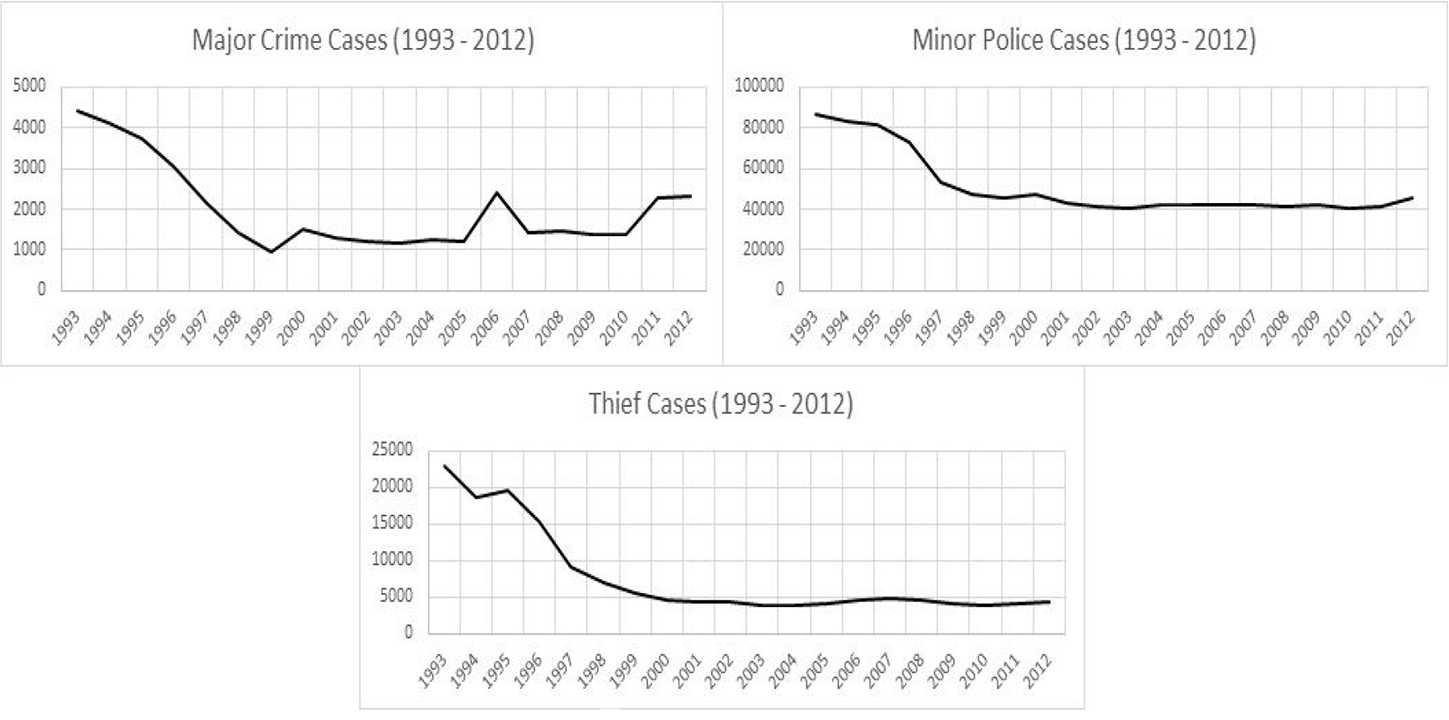
Records from the Police Department.
According to those indicators, there were significant improvements since the 1990s’ reforms and, therefore, just small changes from the 1990s were likely to be preferred by the executive leaders. Moreover, the values and objectives of the ultimate reform plan, as mentioned before, were obviously rooted in security concerns, disciplined mind, and moral emphasis. It can be observed, therefore, that the cause of the complexity of reform and the stagnation of democratic policing in the MPF resides in the very first stage of the decision-making process, that is, the source of the problem is value conflict in the community-oriented concept. The reform process can be viewed as not just a failed attempt at democratisation under military influence; rather, it is the unique solution to hybridising and compromise between security concerns and democratic transition, that is, hybridised disciplined democratic values.
The European Commission introduced a quite different alternative to be more consistent with authentic democratic values (European Commission, n.d). In reality, although many sophisticated alternatives exist for “democratisation,” the police organisation had a limited number of choices and it was very difficult to take risks under the chaotic situation of political transition along with the process of reconciliation among the armed ethnic groups (Khaung, 2018). Given the country had experienced the world’s longest armed conflict, and the conditions of instability, the organisation needed means of achieving its objectives that were based on a combination of the security-minded concerns and the new discipline-oriented democratic concept. Therefore, regarding the MPF administrative reform, the solution can be observed to have been based on judgements regarding such factors as the historical context, budget constraint, organisational experience, and knowledge level of the people involved. In addition, during the transition period, public acceptability was merely to get good service from public employees rather than to get involved themselves (Khaung, 2018). Eventually, the existing reform process of the 1990s and incremental change could be determined to be the best solution that was technically acceptable and easy to implement for the police organisation, given the ongoing situation.
Discussion: Value Conflict in the Reform Process
In the MPF administrative reform process, therefore, the main source of the problem can be determined to be the conflict of values between the concept of community-oriented policing and the quasi-military nature of the MPF. The European Commission introduced community-based policing with the democratic values under the following objective: “the MPF closer to the people (European Commission, n.d).” On that account, the European Commission provided for conducting pilot projects in Yangon, Mandalay, and other big cities; also, EUR 9.5 million in funding was provided to the police department for training courses and community-based projects – more precisely, to develop expertise in the following components: “crowd management, community policing, police vision, doctrine, legal framework governance, media and civil societies, and public press information (Department of Myanmar Police Force, 2016).” The duration of the European Commission’s projects was initially two years , from September 2013 to September 2015, and the International Management Group took responsibility as the implementing organisation. The European Union also invited police officials for brief excursions to observe policing in the United Kingdom and Germany, and they provided equipment and tools. The actual objective, however, of the community-based policing model in the MPF was based on the hybrid alternative of following the People’s War strategy under the quasi-military policing model (Khaung, 2018). The intention of administrative reform was not simply to be consistent with democratic values, but to be more consistent with Myanmar’s own disciplined approach to democratisation by strengthening laws and orders under the quasi-military model policing. Therefore, the value that informed the initial reform plan was a new complex paradigm for a new disciplined democratic nation to meet the needs of the unique national values of “peace, stability, and sovereignty” rather than pursuing authentic democratic values. Furthermore, the government prioritised dealing with the dysfunctional situation in their own way based on their own experiences, “strengthening rules and regulations, promoting professional skills by numerous training courses, and constructing capacity.” 13
Generally, the government, at that time, believed that discipline and goodwill could help to overcome the deterrents and difficulties of the current situation on the way of democratisation, to be a peaceful democratic country. It can be observed in the president’s speech: “all of you to work together with discipline and goodwill in order to improve the efficiency…. ” 14 Thus, the main formula to achieve “efficiency” in the public administration can be described as “Efficiency = Discipline + Goodwill.” Likewise, at the organisational level, those values were constructed as the main root of the reform process under democratisation and, consequently, the MPF set their reform objective to strengthen the existing capacity of the police force, with the following sub-objectives to deal with the current problems: “(1) Improving the overall institutional capacity of the MPF; (2) Making the MPF a more service-oriented police force; (3) Improving the political, legal and public accountability of the MPF (Department of Myanmar Police Force, 2016).” Regarding the factual elements at the organisational level, resource requirements and employees’ haughty behaviour (Department of Myanmar Police Force, 2012) were also very problematic factors. Therefore, the preferred solution was to promote a legal framework for restraining the employees’ behaviour. Moreover, for raising the capacity of the police force, the solutions stressed professional training courses, international collaboration, and renewing the legal framework in the department (Department of Myanmar Police Force, 2016). For the MPF administrative reform, one of the distinct achievements, which was adopted from the People’s War strategy, was to promote interconnection with the society through becoming involved in social activities and social occasions of joy or grief. To build a helpful mindset in police employees and to create trust between police officials and citizens, the police department also promoted the following slogan: “Success will be achieved only with the public participation.” Again, for these purposes, the high-level officials believed centralisation was needed to oversee employees’ activities through stringent rules and regulations in the current dysfunctional situation (Department of Myanmar Police Force, 2012).
Therefore, the failed attempt at adopting community-based policing with the community-oriented concept as the main philosophy of the police department is not only because of the military’s influence, but also because of the value conflict with the community-oriented concept. In reality, the value and objective in respect of the community-oriented concept in Myanmar is constructed under the satisficing practice of human decision-making, as the assumption of Simon: “all the decisions are made as the inferences from the premises (facts and values) residing in the perception or cognitive system of decision-makers” (Simon, 1959); in other words, the possible alternatives are available only within the cognitive limitation of the decision-makers and their environment. Therefore, fostering the cognitive system and inculcating authentic democratic values in the police department is the most applicable solution rather than condemning the numerous limitations and the military’s influence as the source of problem. Also, for the administrative reform, it can be perceived that it is very difficult to import predetermined solutions in the implementation process into a developing country. In reality, it is necessary to prioritise the effort to overcome cognitive limitations that reflect the main value and objective of organisational reform plans, especially for an armed organisation which is determined to be very sensitive to tackle change in a nascent democratic country like Myanmar.
Conclusion
Along with the many limitations and inadequacies of the reform process, the nature of decision-making makes the choices of decision-makers very subjective in a developing country. The study of the MPF case proves that assumption by revealing the stagnation of attempts at changing behaviour was highly dependent on the values of the decision-makers and the choices with regard to organisational objectives. Even though the ultimate purpose is set properly under the democratisation process, progress was harnessed by the limited cognitive system of the decision-makers and the environment. On that account, the organisational experiences and available knowledge among the decision-makers became the most important factors to consider for the success of the reform process. Although the previous literature pointed out the military influences as a main source of reform failure, this study observed that the most important factor to consider for solving the problem is the cognitive limitation of decision-makers, which was based on the organisational experience, information, and knowledge, that is, the cognitive process within the organisation for shaping values and interests, along with the implementation of the democratic reform plan.
Footnotes
Declaration of Conflicting Interests
The author(s) declared no potential conflicts of interest with respect to the research, authorship, and/or publication of this article.
Funding
The author(s) disclosed receipt of the following financial support for the research, authorship, and/or publication of this article: This work was funded by Japan International Cooperation Agency.
Notes
Author Biography
E-mail: