



Abstract
In a contribution to the political analysis of contemporary Vietnam – a single-party state often wrongly assumed to be an author of reform and deploying considerable and varied powers – this paper seeks to provide an understanding of the Vietnamese term ‘authority’ (uy) and its relationship to power. Thomas Hobbes’ Leviathan serves as a reference to the notion of authority in Vietnam and is compared to data: what the Vietnamese thought their word best translated as authority meant. The paper concludes that in the ‘two-way street’ of social contracts, the ruling Vietnamese Communist Party (VCP) actually has little authority. This helps to explain the chronic problems the VCP has faced in securing state capacity and generalised ability to implement policy. It highlights gaps between the current anachronistic use of Soviet-style power in Vietnam and what could be done if the regime deployed new powers based on authority. The authors conclude that, given the identified lack of authority, the VCP is no real Leviathan. Although more research is needed, this conclusion implies that proactive political tactics in Vietnam may move towards a search for acquiring authority in a ‘two-way street’ relationship within the Vietnamese political community. Enhanced state capacity and Party authority could follow.
Keywords
Introduction
Vietnam's contemporary history is puzzling. In non-technical language – from the early 1990s an ‘economic miracle’ started in the early 1990s and a country, still apparently ruled in a coherent manner by an unreformed Communist Party, whose cities were dependent on food aid in the late 1980s, had transitioned to middle-income status by around 2009. Such success is often believed to imply a clear story of focussed policy-driven change, a story in which a ruling Communist Party has adequate status as a coherent actor to be seen to possess powers to deploy needed policies: that is, ‘capacity’. However, there is abundant evidence to deny this picture. First, political conditions in Vietnam are not such that policies are as a matter of course coherently implemented, and there is rampant corruption and insubordination within the Party/State. Second, the idea that economic success stems from a strategic shift in Party thinking at the 1986 VIth Party Congress is actually a myth: success instead drew upon systematic violations of Party ideology dating from the late 1970s, if not earlier (Le Duc Thuy 1993; de Vylder and Fforde 1996; Fforde forthcoming 2018). Third, in particular, recent clear trends to an increasing use of the large domestic security forces to contain rising popular discontent show a lack of people's acceptance of Party rule and criticism of its failure to deal with corruption and to rule properly. This paper 1 presents an analysis that explains this situation as one where lack of authority may be linked – although more research is needed – to the Party's inability to present as a coherent actor. Our 2 topic is relevant to wider discussions of the nature of the powers available to authoritarian regimes, but our argument stresses an inefficiency of the formal political institutions of Soviet origin through which Party rule is manifest.
This paper has gone through a range of permutations, and we thank various anonymous referees, Ann-Marie Leshkowich, Bob ‘RFI’ Smith, Haig Patapan, Joerg Wischermann, Nguyen Dinh Huan, Nguyen Quang Ngoc, Tran Huy Chuong, Bill Turley and many others for comments, insights, positive destructive criticism et al.
Adam Fforde has extensive experience with the ‘participatory observation’ entailed by working as a development consultant in Vietnam in Vietnamese, which showed clearly the problems of state ‘capacity’ facing the VCP, and has a large list of academic publications on the country's contemporary development. Lada Homutova is engaged in PhD research on how the system of campaigns (phong trào) inherited from the Soviet institutions of the Democratic Republic of Vietnam (DRV) and the early Socialist Republic of Vietnam (founded in 1976 – the SRV) can be seen in use after the emergence of the market economy in the early 1990s, revealing attempts to manage issues of legitimacy and authority.
Regime Survival or Regime Success?
The central issue with which this paper engages is the assumption that the VCP is a coherent political actor. Rather, polities or regimes are not conscious entities, although observations of them often encounter pronouncements of intention and statements of their actions. Clearly these terms refer to groups of individuals and the institutions, both formal and informal, that they occupy. In this sense, adherents to any polity will usually seek to secure a basic function: the ability of the regime to survive. This is not always the case, as the Gorbachev-led collapse of the Soviet Union shows. However, so far as can be told, regime survival does not appear to be the main problem of supporters of current Communist regimes like Vietnam or China. Believing their regimes to be robust, they do not want the status quo just to survive; they want it to be successful, both domestically and in international competition. To do this, they must have the capacity to act.
There are many strategies for a regime to prosper rather than just survive. It can be sufficient to secure rule by coercive means (use of violence) but many prefer to use legitimising strategies to persuade the people (mobilisation, ideological persuasion, campaigning) about the rightness of their rule. However, for a regime to be successful, coercion or legitimisation strategies are unlikely to be sufficient. Effectiveness – a capacity to secure goals – is then on the table as a better key to success. Effectiveness means being able to secure several areas; amongst the main ones commonly identified for Vietnam and for other countries are order, stability, and economic prosperity. More generally, effectiveness as a goal for the regime has a more general aspect in the sense that state powers can be deployed to deal with problems, both old and emerging ones, via effective policy responses (good governance). If its adherents believe that the state can indeed deploy powers in such ways, one could say that they believe that there is adequate ‘domestic sovereignty’: regime survival can be secured under any – or most – conditions that might arise. Of course, this judgement depends upon regime adherents’ subjective views of the regime's powers and possible threats and challenges. For ruling Communist Parties that draw upon Soviet formal structures and legacies, a major issue may be whether the old-style institutions offer the specific powers needed under conditions of a market economy rather than central-planning, and with societies that are far more ‘open’ to ideas, travel, etc. The question can then be posed as to whether authority – understood as an acquired general tendency ‘to be obeyed’ – can be deployed to create new forms of power suited to new conditions, and so a capacity to deploy state power into suitable policy and its implementation: to act.
This aspect of the discussion can be related conceptually to whether the political community considers that there is clear domestic sovereignty. On sovereignty, Hinsley (1986) emphasises interactions between rulers and ruled, as a possible example of this ‘two-way street’:
The concept [sovereignty – AF/LH] has been formulated when conditions have been emphasizing the interdependence between the political society and the more precise phenomenon of its government. It has been the source of greatest preoccupation and contention when conditions have been producing rapid changes in the scope of government or in the nature of society or in both. It has been resisted or reviled – it could not be overlooked – when conditions, by producing a close integration between society and government or else by producing a gap between society and government, have inclined men to assume that government and community are identical or else to insist that they ought to be. In a word, the origin and history of the concept of sovereignty are closely linked with the nature, the origin and the history of the state. [2 - stress in original]
This paper concludes that it must be a major and gathering concern to VCP adherents that while the Party seems able to secure regime survival via a combination of coercion and legitimising strategies, it appears to have been struggling increasingly with the issue of effectiveness. This conclusion, which is suggestive and not conclusive, derives from our research on what we see as a core problem, identified as a lack of authority, both inside the Party/State apparatus, in terms of reliable hierarchy, and outside – in relationships between the Party and society. However, this research does allow us to conclude that we are not dealing with a ‘neoliberal project’ and that the VCP is no ‘Leviathan’.
Authority in this article is conceived as some quality of social relationships that means that society (or lower levels of the Party/State apparatus) can be expected, normally, to obey their leadership, not because of the fear or force the VCP can deploy, but for some other reason or reasons. Thus, the lack of authority that we conclude from our data opens the door to a political explanation of the often-reported lack of state effectiveness in Vietnam. To repeat: authority (a general tendency to obedience) would allow deployment of new forms of power suited to new conditions. Without it, the Party must have excessive recourse to now anachronistic and ‘no longer fit for purpose’ Soviet methods.
Why Focus on Political Language?
There is a common assumption that Communist regimes are powerful and coherent political actors but we raise the issue of whether they actually are coherent actors and so what ‘being powerful’ actually means? What is the difference between ‘having power’ and ‘having authority’? The important message of this article is related to our concern about how what is ‘right’, ‘true’ or ‘facts’ is treated by many in social sciences and the Vietnam-related literature. One might imagine that a political scientist should ‘know’ what authority and legitimacy are and what evidence to bring to prove the point. However, after reading an extensive list of publications on arguably three of the most influential concepts in political science – power, authority and legitimacy – we ended up being more confused than enlightened (for example, Badie, Berg-Schlosser and Morino 2011; Goodin and Klingemann 2000; and Kurian 2011). The overlap of the three concepts is enormous and the use of the expressions interchangeably in scientific literature is often misleading and impractical. Political Science's encyclopaedias are also not very helpful, as ‘authority’ is often treated as ‘see legitimacy’ or defined as ‘legitimate power’. 3 Ultimately, however, the aim of this article was not a definition of authority, but uses and explanations that may stand behind the term, and their relevance for Vietnam.
These conceptualisations stem from the two distinct mainstream understandings of the notion of authority, that of Max Weber and Hannah Arendt. We are closer to Hannah Arendt's disruption between power and authority (Arendt 1961); yet, in its complete form, even Hannah Arendt's understanding of authority is not entirely relevant for Vietnamese conditions.
The primary research problem is to access, in some way, an answer to the question of whether the Party has authority. We decided that the simplest way of doing this was to ask people what the ‘apparently equivalent’ Vietnamese word meant. The logic here is that if there is no clear meaning reported, in the particular sense of authority as an acquired general tendency to be obeyed, then it is hard to conclude that the political community is one where its rulers ‘possess authority’. However, discussions also pointed us to the possibilities of what authority in Vietnam might mean. We explore this issue in greater detail below.
What ‘can be’ Authority and how to Gain it in Vietnam? Two Examples
The central issue of this paper is how to grasp a concept labelled ‘authority’ and to use it to identify practical political problems in Vietnam: crucially, how it can be seen as part of a shift from failure to exist as a coherent actor to a situation where ‘things can be done’. For us, such an authority is about relationships and a protection-obedience equation (that is, how shortcomings such as corruption may be tolerated and a regime obeyed if a population feels that that the regime ‘delivers’ protection and other perceived benefits). We seek to establish links between issues of authority in relations between rules and ruled and the question of the internal order (or disorder) of the apparat – the Party/State itself. There is a wealth of evidence that the authority of superior levels in the apparat is often weak; dealing with this and so improving the ability to deliver policies ‘the people like’ would seem a way to secure authority vis-à-vis the population. Instead, however, we suggest that it is useful to look at the causality the other way around – that authority conferred by the people upon political leaders gives those leaders power over the apparat. This allows us to engage with the vexing questions that arise if we confront the evidence that the VCP is very often not best seen as a coherent actor that drives reform and faces and addresses political problems.
Two cases illustrate this problem. Both seem to be about authority, in the sense of some quality of social relationships that means that rulers can be expected to be obeyed, not because of the fear or force they can deploy, but for some other reason or reasons. In these two examples, accepted outcomes based on transparent processes, delegation of power, discussion, and responsibility for the outcome led to the emergence of new authority-based powers for leaders and increased efficiency and popularity.
The first case is part of an evaluation of a Swedish–Vietnamese development cooperation project, known within the cooperation as Chia se (chia sẻ – in Vietnamese). This project saw funds channelled below the commune level – the grass-roots – the lowest level of the Party/State where a Party Committee and a People's Committee could be found. Instead of working at the commune level, Chia se supplied development funds and worked through the lower so-called village level, and when it was operating this level was relatively less influenced by the Party/State. Elections to village leadership positions were sometimes reported as ‘active’ (chủ động) and, as such, were not in keeping with Leninist principles (Fforde 2011). Chia se had nothing to do with village elections, and simply supplied development funds to the village level.
A communal People's Committee chairman was asked whether he lost power’ (mất quyền – not an exact translation) as a consequence of using the project's system for allocating local development funds direct to the village level and requiring participatory methods in place of the extant Vietnamese system (which worked through the commune level and did not require participatory methods). He replied that under the extant system, ‘it started easy but then got hard’ as it imposed management burdens on staff. By contrast, he said that the Chia se system was initially hard to set up, but then became far easier as it attracted popular attention and support, which greatly reduced work for his staff and for the chairman himself. Therefore, the empowerment (trao quyền) of the Chia se system did not reduce his own power but actually increased it. He agreed this meant both that empowerment added to his own power because he gained authority (trao quyền nhận uy), and he also agreed with the suggestion that this meant that Westerners were clever (khôn), which caused the room to laugh. 4
Fforde was a consultant charged with evaluating the project and the discussion was carried out in Vietnamese to an amused audience of Vietnamese consultants, officials and locals.
The second case arose during a consultancy tasked to evaluate the Law on Cadres and Public Servants, working in three localities. The expectation was that the former would be political (‘Party leadership’) and the latter (‘State’) responsible for policy implementation, However, to the contrary, informed opinion (such as the staff of local Party Schools) were of the strong opinion that whilst the distinction between cadres and public servants should be clear, it was not, and there was no coherent distinction between political leadership and policy implementation. Further, the discussions linked this to an extreme problem of weak hierarchy within the apparat. However, the team also visited Đà Nẵng, where it appeared that this problem of insubordination was absent. Asked just how the local political leadership had managed to devise and implement effective urban development (exceedingly rare in Vietnam), a local businesswoman said that the politician concerned (the late Nguyễn Bá Thanh) usually took three steps: he met with the population to “problematise” (“hình thành vấn đề”), he then set up a specialised group of local officials to deal with the problem, and finally he took personal responsibility that the group would actually perform. He put his prestige on the line and so his prestige gave him authority over the local apparat (interview by one of the authors, Đà Nẵng, 2009).
Fforde owes to discussion with his close colleague Nguyen Dinh Huan the hypothesis that here there is a particular configuration of a more general ‘triangle’ of relations between people, apparat and the ‘local King’, and that these configurations are but different ratios between the constant length sum of the lengths of its three sides. Thus, in Đà Nẵng, the ‘local King’ was rather far from the apparat and so rather close to the population, whilst in other areas the Party was too close to the apparat and so ‘far from the people’ (xa dân, in the common Vietnamese phrase). This suggests in turn that increased state capacity requires a distancing of the local King from the apparat. This can be understood functionally as a distinction between, as Sun Yat Sen puts it, state capacity (năng) and political power, for him ‘people power’. 5
I.e. Dân quyền – for, for him, national independence is Dân chủ, which is nowadays translated as democracy. Sun Yat-Sen aka Tôn Trung Sơn, Chủ nghĩa Tam dân, passim. See Nguyen Thi Lam (2012) for an official view that his thought is part of the origins of Ho Chi Minh Thought.
Both these stories suggest that whilst the Vietnamese as a political community possess resources for managing the political issues of what Party sloganising calls the ‘market economy with a socialist orientation’, this has to be put beside evidence that capacity to devise and implement policy, and so for rulers to acquire authority/legitimacy remains weak. The recourse to Leninist campaigns (phong trào) 6 to ease the political problems created by widespread corruption suggests that, whilst these may ease the situation, they are the anachronistic legacy of very different circumstances. They also suggest that two very different activities (one an aid programme, the other a local political strategy) can both be seen as leading to the acquisition of an authority and so effective subordination of the apparat to intentional politics, and a shift of the Party towards coherency and an ability to be an actor – in another language, acquisition of agency.
Political campaigns in Vietnam are numerous and have arguably multiple functions, among which the main ones are to emphasise certain issues and distract attention from other real problems.
We now turn to locate these puzzles within a wider political science framework, linking them to questions of social contract theory and Hobbes, and to the common view that contemporary Vietnam is an example of a ‘neoliberal project’.
Section 1 – Hobbes; Neoliberalism
Thomas Hobbes and Authority: Vietnam
There is very little discussion in the Vietnamese studies literature of social contract theory and how Locke and Hobbes both in their different ways as political theorists address the notion. This is itself interesting and suggests that this literature has paid insufficient attention to core parts of political science thinking. Here we seek to explain how these ideas are useful and how reflection on the differences between Locke and Hobbes is informative to understanding Vietnam's political problems. We also believe that this discussion helps explain issues in the frequent identification of Vietnam in the literature as a neoliberal project.
Locke tends to focus upon ‘consent’, rule of law and limited government; Hobbes upon the ‘authorisation’ of state power. The former tends to be seen as more liberal than the latter; for example, because the powers of Hobbes’ Leviathan are stated to be absolute. However, we argue that, in examining the politics of contemporary Vietnam, we get far further when viewing the situation through a Hobbesian lens. This is mainly because, constitutionally, the Party's position is deemed absolute, and as Constitutionally the prescribed site of acts manifesting domestic sovereignty challenges to its position are deemed absolutely illegitimate. The focus of this paper is to ask whether this works politically, and makes political sense, in Vietnam's ‘socialist-oriented market economy’.
As Thomas Hobbes wrote, the life of a man without a state would be “solitary, poor, nasty, brutish and short” (Hobbes and Tuck 2003: 89). Hobbes (1588–1679) was one of the pre-eminent state theoreticians and published his seminal work, Leviathan, in 1651. The central question of this work concerns the possibility of legitimate authority (that is, of the Leviathan or state) and, more precisely, what makes legitimate authority possible. Hobbes's answer was the “state of nature”, which describes the human condition before states developed; for him it is a “war of all against all”, where individuals pursue their own goals, being driven by sense, fear and desire (Hobbes and Tuck 2003: 86–90). Rather than living in such an unstable environment, men choose to submit to the authority of a sovereign. This is a basic principle of all social contract theories: the idea that individuals agree to confer authority on a state. In this sense, individualism and a protection–obedience relationship are, in Hobbes's theory, very important. We feel that much of the existing literature on Vietnam has ignored what is clear to political scientists, which is that authority is a two-way street: Party rule is felt by many contributors to be obvious, coherent and powerful, and shows it to be a key actor; yet, as we hope our discussion of social contract theory shows, it is possible to argue that the population, by deciding not to come to the two-way street, prevents the Party from existing as a coherent actor.
Leviathan has many different interpretations, framings and readings. One interpretation fears that Leviathan easily becomes a dangerous totalitarian monster, while others see Leviathan as a prototype of a liberal constitutional state.
So, where to from here? Is the Vietnamese Party/State an oppressive and despotic Leviathan, or is it the notion of a Leviathan referring to a prototype of an authorised, if not democratic, state that is missing in Vietnam? We are not satisfied with a limited interpretation of Hobbes's Leviathan as despotic and totalitarian. Rather, we note that comparisons between Locke and Hobbes tend to consider both men as students of the notion of a social contract, so that the position of the state is (in different ways) conditional upon its relationship with its subjects: it is a ‘two-way street’. Thus, we take Hobbes's “authority of the sovereign” to mean an absolute but accepted authority, one which citizens on the whole deem it to have, and which is authorised in order to protect and support them.
Before we get to that, however, it is useful to discuss in greater detail the context of current Vietnamese politics, and whether it is usefully seen as an example of a neoliberal project, as is commonly argued in the literature, for this appears to assume that, constructed as subjects, much of the population accepts and authorises Party rule.
Neoliberalism in Vietnam?
The Vietnamese studies literature contains much discussion of neoliberalism, which many accounts describe as the core of a Vietnamese ‘reform project’ (e.g., Schwenkel and Leshkowich 2012; Nguyen-Vo 2008; Craig and Porter 2006; Akram-Lodhi 2007; McElwee 2009; Gillespie 2006; Salemink 2006; Harms 2009; Masina 2012, 2006; and Beresford 2008). As far as we can ascertain, most of these authors, with the notable exception of Beresford, are not trained political scientists. A shared theme in this literature appears to be that the Party is a coherent actor whose policies and interests in various ways have driven change as a ‘neoliberal project’ – thus, change is ‘reform’. However, this view assumes that there is a coherent capacity to implement policy, generally speaking. As we have argued, this is both challenged by much evidence (such as the lack of conceptual and practical clarity in the difference between political ‘cadres’ and state ‘officials’) and also assumes the existence of some form of social contract whose ‘two-way street’ sees the Party granted authority within and by the Vietnamese political community (more or less).
On the surface, aspects of the view that Vietnam is a ‘neoliberal project’ appear to be correct. For example, since the early 1990s the Vietnamese people have lived in a country with a market economy. They enjoy a rather free national labour market (albeit without a general freedom of association – so far), are usually free to travel domestically and internationally (if they have the money) and have generally open access to the globalised society of the moment with its massive stores of information available to anybody with a connection to the internet (with some limits imposed by the Party). Certainly, there is evidence that the Vietnamese appreciate their market economy (Goertzel 2006: 4–5).
In many, but not all ways, Vietnamese society is now ‘more open’. People in Vietnam often seem to expect to be governed as ‘subjects’ (as opposed to ‘objects’), and therefore, as citizens of the Vietnamese state, to have something like ‘rights as subjects’. In reality, however, we believe they are relatively autonomous economic subjects, and at the same time, far from free political objects. There has been no programme of political reform in Vietnam, and the design of the country's formal political institutions 7 still rests on the same principles as before the market economy emerged. They remain those of an unreformed but post-Stalinist Soviet Union, originally designed under Lenin and Stalin but also those created by Khrushchev after the fall of Beria for rule over a closed society with a largely centrally-planned economy. In this view, formal political institutions designed for control appear no longer ‘fit for purpose’.
Fforde and Mazyrin (forthcoming 2018) argue that the particular nature of the Soviet engagement from the late 1950s led to a softening of Vietnamese Communist implementation of Soviet institutions, such as in the shift in the pattern of aid around the middle of the First Five Year Plan (1961–1965) in the Democratic Republic of Vietnam (DRV) so that staples did not have to be secured from the collectivised Red River delta rural areas through violence (the 1950s Land Reform had seen plenty of that).
We argue that this situation has led to substantial problems best interpreted as a lack of state effectiveness.
First, in the past few years Vietnam has suffered from a slowdown in economic growth. Many have linked the Party's inability to effectively deal with the situation to a failure to create a political landscape where implementable policy supports the social and economic institutions suitable for continued rapid growth in a market economy where workers, capitalists and others now make free economic choices. Many people are concerned about whether, and how, the country will transition through middle income status (reached in 2009), 8 with the observation that this transition will require major implementable reforms of low-performing public sectors, such as health and education. The donor literature contains continued implicit or explicit concerns as to whether policy is implementable (for example, World Bank 2006: vii).
For an overview of the political implications and requirements of transition to middle income status see Gill and Kharas (2007), which stresses the need for an ability to devise and implement suitable policies, such as for crucial public goods such as health, education and urban infrastructure, an area where Vietnam continues to face severe problems. On this see also World Bank (2011 and 2013), Ohno (n/d), Tran Van Tho (2013), and Berliner, Thanh, and McCarty (2013).
Second, the Vietnamese press has widely reported that the Party acknowledges that the country suffers from high levels of corruption. However, despite strong Party expressions of its intention to deal with corruption, the Party's government has generally not been able to devise – or, crucially – to implement suitable policies. Consider the following report:
Results (Table 5) show that from 2009 to 2011, each firm in the sample paid on average from 460 to 600 million VND in informal costs per year (between USD 20,000 to USD 30,000), yet still made 512 to 646 million VND in profit before tax each year (between USD 24,000 and 30,000). The informal payments were equivalent to 78 %–107 % of the firm's PBT (Profits Before Tax) […] to make 100,000 VND in profit, a firm has to pay between 70,000 and 100,000 VND in informal cost. (Nguyen et al. 2016: 9) 9
The exchange rates used are those of the original – AF/LH.
Finally, at the core of the two abovementioned problems, there is evidence from a range of sources that the general capacity of the VCP to devise and implement policy is severely limited. A striking example is the report cited in Fforde (2009: 88) as “Study Team 2009”, which shows a lack of effective implementable policy towards State Businesses (at the time producing 40 per cent of GDP):
Ministries and People Committees […] do not adequately grasp information on the activities of these units. The Ministry of Finance is tasked on paper to carry out state financial management but only participates indirectly in the management of capital and assets via the reports of the Ministries and People's Committees and of the units themselves. (Study Team 2009: 20, translated in Fforde 2009)
This suggests openly that the Party/State hierarchy is riddled with insubordinate activities, encapsulated by the pithy Vietnamese phrase- “trên bảo dưới không nghe” (“superiors instruct, inferior levels do not listen”). 10 Clearly, for its adherents – and others – such evidence pushes for the conclusion that the regime is ineffective.
Quoted in Fforde (2011). For a Vietnamese discussion, see, amongst many others, Ngọc Linh (2015), who largely blames it on male testosterone. Making some distinction between an intention-bearing political ‘cadre’ and a functional ‘state official’ is surely crucial to any understanding of sovereignty within the State itself. See also Gainsborough (2010).
This starts to raise strong questions about views that Vietnam is an example of a neoliberal project, where an authoritarian regime possesses enough acquired authority to deploy new suitable powers to solve new problems, governing subjects. Many of the views we refer to could perhaps be thought of as not fully thought-through because, as deployed in the Vietnam studies literature, the term ‘neoliberal’, relating to political projects as ‘reform’, seems to refer more to attempts to rely on an extensive use of markets. Crucially for our purposes, we believe that this presumes an ability to govern subjects whose free choices dominate society (e.g. Schwenkel and Leshkowich 2012: 394, or Nguyen-Vo 2008: xviii). This conflates political and economic subjectivity.
The next section brings our arguments together and lays out our methodology and method. Our central point is that members of a political community whose rulers have acquired authority will be able to provide clear answers to the question ‘what does your word for authority mean?’ The answers reveal and articulate their beliefs that authority is something that is acquired, rather than simply a force that has to be obeyed. They are, thus – for them – political subjects.
Section 2 – Methodology and Method
One Concept of Authority?
To the question ‘what is authority?’ mainstream political science (since Max Weber) has usually answered, ‘legitimate power’. If we think of authority as legitimate power, then our primary question should be why people in Vietnam believe that the VCP should rule (for example, should it legitimately use coercive power). That is, on what basis is this rule legitimate? And what are the beliefs supporting it? For example: Vietnamese people believe the VCP can lead them to a just communist society (goal); or the VCP deserves to rule because it improves living standards of people in Vietnam (performance); or purely irrationally, the VCP is persuasive and people believe in what the VCP says: we are doing everything ‘because of the people, with the people and for the people’ (charismatic authority). For us, however, the answer that authority is legitimate power is rather dissatisfying because it leads to the questions above, which we find to be less relevant in the Vietnamese context, and because it does not allow us to view concepts such as authority as evolving, open and part of specific political discussions and contentions. If we say ‘authority is’, we are claiming to consider authority as something that is ‘given’, a substance, something with a stable referent; this is to exclude the option that authority refers to something dynamic. Therefore, the more accurate reference is to ‘an’ authority.
In addition, as we have already mentioned, there is the question of state capacity. As Mary McAuley pointed out some years ago, the particular sorts of power deployed by Soviet regimes can be thought of as far more limited than might be imagined (McAuley 1977; cited in Fforde 2013: 3). This may limit the ability to develop state capacity, such as the introduction of new systems and policies to suit new conditions. The authority of a regime will not be available to be deployed to command obedience in new situations, where new forms of power are needed. Our emphasis is on the political acts required to make this happen (as seems to have been the case in Đà Nẵng, presented above).
In the next part of this paper, we will show how different framings of authority can point to these new political options, as well as problems of such framings. In the Vietnam studies literature, for example, the common view just discussed, that Vietnam is an example of a ‘neoliberal project’, has recently been challenged in a way that brings to the fore the issue of authority (Cherry 2016). For us, the value of Cherry's contribution is that he shows different framings of Leviathan. On the one hand, Cherry treats Hobbes's views as an option for the Vietnamese people as they explore possibilities for their political community:
Hobbes wrote in Leviathan that a sovereign has by the authority “given him by every particular man in the commonwealth […] the use of so much power and strength conferred on him, that by terror thereof, he is enabled to form the will of them all, to peace at home, and mutual aid against their enemies abroad.”23 Sovereignty consists, therefore, in the recognition of the supreme authority of the sovereign in a territory. This authority is necessary unitary and absolute. But Hobbes was aware that such power could be challenged or contested, even if it could not be shared. [page 7]
In this framing, an authority is relational, and therefore acquired. It is not inherent in whoever or whatever rules, but may be ‘given’ by the population to their rulers, or may be withheld (a ‘two-way street’). Clearly – as the Đà Nẵng story above suggests – this might be a viable option; it is an authority that might be created in Vietnam.
On the other hand, Cherry included a description of Peter Zinoman's account in which a real and existing Leviathan, the VCP, is oppressive and despotic:
By turning our attention to the fashioning of Leviathan in preceding periods, Peter Zinoman has suggested, historians might better understand the origins of the violent and highly repressive state in Vietnam today […]. 11
However, Cherry did add that “And what historians need to understand, the contemporary Vietnamese state must also try to understand. For as Furnivall warned, ‘Leviathan himself must fail unless he can adapt himself to human nature’” (Cherry 2016).
In Zinoman's framing, any authority the ruler might have is dependent upon choices made, not by those ruled, but by the ruler. This treats social contracts as ‘one-way streets’, which we think is misleading.
We therefore frame Hobbes's Leviathan as an option, rather than an existing reality; an option for the creation of a relationship between rulers and ruled where the ruled confer an authority on the ruling VCP. That option is understood as a potential that may, or may not, happen in Vietnam. As Hobbes did, we have focused on the possibilities for creating political order in Vietnam. Our research concludes that, because people do not explain the term in a way consistent with this, the Party does not (yet?) have an acquired authority.
Before we present our data, a last preliminary issue is a more detailed account of our interpretation of Hobbes's Leviathan, one in which we see a potential normative proposition for Vietnamese politics (specific to identified local, Vietnamese, needs). Apart from arguing that Hobbes's Leviathan is not a despotic monster, how here do we interpret Hobbes?
Leviathan in Our Normative Proposition
Having so far left our interpretation of Leviathan rather general, we now address this issue more specifically. In our reading, an important element in Hobbes's Leviathan is the possibility of a creation of an order, in which individuals confer authority on a sovereign. Within this are two components that are often confused as one. The first component is that Leviathan necessarily obtains absolute power, coercive in nature, to be deployed in any manner, with the asserted goal of protecting and supporting people. This view obscures any the basis of this relationship in a social contract, the product of a ‘two-way street’. This reading leads many to see Leviathan as a potential danger – of unbound power. However, protection is an important component in this equation.
In thinking about Vietnamese politics, in our reading of Hobbes, the second component (often overlooked) is that Leviathan, as a political project, has to secure an order including stable hierarchies (a functioning state), such that he/she is enabled to protect people. Crucially, there must be state capacity. This, in addition to the obvious need for a coercive apparat, implies a need for governing, of subjects, which secures the ability of Leviathan to actually protect people and keep the state running. This is challenged in any examination of contemporary Vietnam by the Vietnamese sense (used above) of pervasive “trên bảo dưới không nghe” (“superiors instruct, inferior levels do not listen”). The Party's security apparatus is powerful, but governing, it would now seem, requires different types of power: power to do something, rather than power over someone. Here we are using perhaps an unusual reading. We are aware that the relationship between rulers and ruled is Hobbes’ main focus, rather than that between, in his language, the king and his officials; that is, the patterns of hierarchy within the State, its ‘internal sovereignty’. Yet, it seems not unreasonable to consider, although more work is needed, that acquisition of popular authority should give authority to higher levels within the Party/State over lower levels, not least to create positive feedback by giving people policies that they want.
Here, the Chia se and Đà Nẵng stories are telling. As the two stories imply, central to this issue seems to be a use of authority to separate political leadership (‘the Party’) from state implementation capacity (a notion central to Soviet political thinking as well as to that of Sun Yat Sen). A political community usefully feels that government has a capacity to ‘act’ – a problem can be identified and then solved. In that fashion, authorised political leadership must be able to hold to account those made responsible for implementation. In a nutshell, a real Leviathan can be expected do things, but a paper one will be seen as being unable to.
Our Method
We have attempted to discover Vietnamese perceptions of authority and how they are discussed and positioned within power relations. For this purpose, we chose analysis of politics via language in the form of qualitative semi-structured interviews.
In the following section we present our research data and findings to unveil a deeper insight into current Vietnamese understandings of authority.
Section 3 – Political Authority in Vietnam: Discussions in Hanoi 2013 and 2014
Data
Our research 12 involved engaging a range of people, mainly in Hanoi, in informal discussions. The interviewees ranged in age from 19 to over 70 and from a range of social backgrounds with relative gender balance (women were slightly less represented than men). The interactions were carried out in Vietnamese, with no interpreter, and took the form of extended exchanges. The basic stance was an expressed desire on the part of the interviewer to be informed, as a non-Vietnamese person speaking Vietnamese, by their discussant. Questions were formulated in politically neutral ways and did not directly ask for opinions; rather, we asked interviewees to help us understand the language and what the terms mean. The discussions were ‘open’ and allowed for the interlocutor to go where they saw fit in their explanations. 13
The research reported here was ‘guerrilla’ in nature, involving a series of ad hoc meetings, often in public, effectively with strangers. Given the political nature of the research, and the dangers of attention from the security forces, we did not ask for personal details. Whilst the discussions took place in urban areas, this does not necessarily mean that interviewees were ‘urban’. It is our impression that there was not significant variation in replies across possible categorisation schemes, but further research would throw light on this.
Vietnamese is written, and understood, as a series of separate syllables. A Vietnamese word, as written, may have one, two or perhaps three syllables, written separately. Therefore Vietnamese words confusingly appear (for the typical Western learner) written as a series of what seem to be short words. Thus equivalent terms for ‘authority’ may appear as ‘uy’ or as ‘uy quyền‘. Both are words in the sense of distinct dictionary entries. We found no discernible difference in usage between ‘uy’ and ‘uy quyền’, so we use these three terms (‘uy’, ‘uy quyền’ and authority) interchangeably for the rest of this article.
Whilst we put our argument here in Hobbesian terms, the words used were not ‘ours’ and were also no more and no less than how our Vietnamese interviewees also discussed and explained them. Thus, the research process went beyond any technical academic framework of ‘social contracts’ and extended to Vietnamese practical issues. During our sessions, interviewees actively attempted to engage in discussions and to answer questions. None of them shrugged their shoulders and said they did not know. They were – strikingly for us – very willing to engage in discussion. This seems to indicate an important capacity for a future when we could see these debates happening within the Vietnamese political community. Interviewees presented us with what they saw as the following varied characteristics of what Vietnamese mean by their ‘word for authority’. It also suggests that there is a certain positive potential within the social and cultural (and linguistic) resources that they deployed into the discussion.
Authority as Fear, or Respect?
A large majority of interviewees connected authority to the notion of fear and awe, and we discovered an overall confusion and difficulty facing interviewees in explaining whether ‘uy’ is positive or negative. Interviewees often tried to distinguish between a sense of ‘uy’ as entailing fear, on the one hand, and on the other hand a sense of ‘uy’ as entailing ‘prestige’. Our sense is that simply translating ‘uy tín’ as prestige may be confusing, as the semantic range includes the sense that the person concerned is (more or less) trusted, honoured and valued.
Translated into the language of our data, authority (as fear) for some is “something that makes other people frightened” (“Cái làm cho người khác sợ”) or connected to “exploitation of a position of power (chức quyền), to exert authority (ra uy 14 ) over another so as to force obedience to oneself (“Lạm dụng chức quyền, để ra uy với người khác bắt người khác phải phục tùng theo mình”). Two interviewees expressed authority in terms of “intimidating or threatening people, deterrence, being afraid” (“Sự mạnh mẽ, oai phong của người có chức quyền”). Another interviewee emphasised that authority “brings fear, creates an invisible strength with which it pressures everybody – everybody obeys” (“Mang tính chất sợ hãi, tạo ra sức mạnh sức ép với mọi nguời vô hình mọi người sẽ nghe theo”). However, some interviewees understood the word authority as “strength” (“sức mạnh”) and “respect” (“tôn trọng ”); for example, “the authority of father and mother regarding their child so as to educate and guide” (“Uy của bố mẹ đối với con cái để giáo dục, chỉ bảo”). We observed that this positive sense is barely mentioned in connection to politics.
VDict (http://vdict.com/) translates “ra uy“ as to “put on airs”. This is not what seems to fit here; though it feels linked to the sense that authority can be illegitimate, which is likely the point the interviewee is trying to make.
Authority as Position or Reputation?
According to the answers of our interviewees, the sources of ‘uy’ are a given. These can be economic or social position, or the power of position (‘chức quyền’) – a neat use of word order. The first (qualifying) term is ‘chức’, which is well translated as ‘position’ within an organisation (‘tổ chức’), which in the Vietnamese context suggestively means the Party-State. Thus, according to two interviewees authority (‘uy’) is linked to “the strength, somebody with a position of power imposes something on us” (“Sự mạnh mẽ, oai phong của người có chức quyền”). Another interviewee describes authority (‘uy quyền’) as follows: “This is not something everybody has – somebody with a high social position will as a result [of that position] have it, somebody with authority may or may not have prestige (“uy tín”) … but somebody with prestige often has authority” (“Uy quyền không phải ai cũng có, người có vị trí cao trong xã hội mới có được, người có uy quyền có thể có hoặc không có uy tín … và người có uy tín thường có uy quyền”). This shows the struggle to differentiate between authority based on position and authority based on prestige (honour, trust, value). The subsequent quote emphasises the relation between power (coercive) and reputation as follows: “Prestige and power are closely related and interdependent. When there is power, use of it requires prestige for power to get maximum results. And it is not certain that somebody with prestige will have power. Prestige plus authority equals power”. (“Uy tín và quyền lực có mối quan hệ khăng khít, tương trợ cho nhau. Khi có quyền lực, sử dụng quyền lực thì cần có uy tín thì quyền lực mới đạt hiệu quả cao nhất. Và chưa chắc người có uy tín sẽ có quyền lực. Uy tín + uy quyền = quyền lực”). This suggests that prestige (honour, value, trust) and authority are both needed if one is to have power; however, only one interviewee was able to state this opinion so eloquently. Thus, this interviewee came closest to the principal suggestion of this article: power and authority are qualitatively very different and power itself is not sufficient to secure good results in politics.
Authority of Individuals or of Institutions?
Almost all answers concerning authority referred to individuals, not to institutions or organisations or their members. Judges, priests, and so on are not mentioned, and certainly not Party leaders. Indeed, it is consistent with our broad arguments that, as they have very little authority, Vietnam's political institutions are not used by the Vietnamese to explain authority. The only exception was when one interviewee referenced the National Assembly – the Vietnamese parliament. However, this was done in negative terms, highlighting authority (“uy quyền”) as “the imposition of will on the people: for example, the National Assembly.” (“Sự áp đặt ý muốn lên nhân dân ví dụ: Họp quốc hội”). The lack of confidence towards political institutions has some important implications. If the VCP wants to transition towards governing and create effective and just political order, it will have to reform institutions to ensure that they fulfil their prescribed roles. That change would be reflected by people's recognition of the authority of these institutions, which is something we will be potentially able to observe in Vietnamese politics in the future.
One individual who often appears in discussions on authority as an example of a person with positive character, a person with “prestige” (“uy tín”), is Ho Chi Minh: “Uy tín – this Sino-Vietnamese word, is about trust and belief and being praised by everybody in a positive sense. For example: The Vietnamese people trust and love Hồ chí Minh” (“Uy tín: từ hán Việt đó là sự tin tưởng và được mọi người ca ngợi hiểu theo nghĩa tích cực, Ví dụ: Hồ chí Minh được nhân dân Việt nam tin tưởng và kính yêu”). Prestige in Vietnamese (‘uy tín’), as we wrote, has to do with trust and belief; people often describe it in the duality of promise followed by acts: “Something done to make others believe” (“Cái làm cho người khác tin”), or “This [prestige] is a way of speaking so that others follow and believe in one, and [one] must preserve that trust, and do correctly what one has said one will do” “(Uy quyền: không phải ai cũng có, người có vị trí cao trong xã hội mới có được, người có uy quyền có thề có hoặc không có uy tín […] và người có uy tín thường có uy quyền”). This, again, is something that seems to be missing currently.
There was a strong emphasis on Ho Chi Minh's morality (‘đạo đức’, ‘đức’); ‘morality’, in discussions, is a far more vivid word and, for the interviewees, often seemed a more interesting word than ‘authority’. This suggests to us that the Vietnamese feel the need to recreate morality in politics; it is what they know from their received histories, and perhaps, what they believe to be a panacea for the political problems of the present.
Another related finding is that whilst illustrative examples of individuals with authority are given, they are predominantly abstract. The only two exceptions, which were made relatively concrete, were those of the school principal and the parents. 15 The other obvious concrete examples – police, teachers, state officials, Party leaders, etc., and institutions these individuals relate to – were not broached.
This way of replying occurred despite the interviewer pushing for concrete examples.
Authority as Power?
The crucial observation that came out of our interviews is related to one phenomenon that occurred repeatedly during our discussions, namely a frequent snap change of topic from authority (‘uy quyền’) to power (coercive) (‘quyền lực’). Thus, when asked to do so, the discussants often tried to differentiate these two, but then quickly forgot about the distinction and returned to using them interchangeably. This suggests that they do not yet really think in terms of authority being different from power at all. On several occasions, interviewees started to explain authority but then, when asked further, shifted to use the term power instead. This implies that political discourse in Vietnam is saturated with relations of power as domination. The apparent result of such an atmosphere is the detachment of people from politics, and this may indeed be desired by those who rule. As Nguyen et al. (2016) suggested, reporting that there is something like a 50:50 profit share between the de jure owners of their sample's businesses and VCP officials receiving “informal payments”, this political crisis is highly profitable for some.
Contextual Observations Made by Interviewees
From the answers obtained during our interviews, informed by observations and informal debate on the streets of Hanoi, we have presented a narrative of how the Vietnamese we spoke with saw problems of power and authority in Vietnam, viewed through a linguistic lens. However, our interviewees often sought to contextualise the question, making three general points, as discussed below.
Politics is a Sensitive Area
Firstly, many informants’ initial thought on politics in Vietnam was that it is “sensitive” (“nhạy cảm”) or a “forbidden area” (“khu vực cấm”). This naturally affects people's response to politics in general and political authority in particular. It seems clear that this is part of the existing political order.
Strong Leadership and Order
Secondly, political values in Vietnam are generally asserted to be very distinct, and so-called traditional values are thought of as formed by historical development and cultural specifics. Issues that came up often included the struggle of the Vietnamese to keep their identity in a region of mighty kingdoms and empires, suggesting that nationalism is strong and united leadership in Vietnam preferred. For example, the Vietnamese often express admiration for strong leaders such as Russia's Vladimir Putin (Figure 1 shows some books for sale in Hanoi). At root, this implies a sense that political order with authority is important.
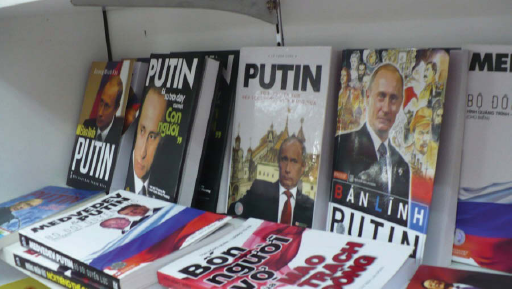
Books for Sale in Hanoi
Morality in Politics
Thirdly, we noted above that Ho Chi Minh appears often in discussions as an archetype of morality and his political thought receives considerable official attention. This seems to indicate political authority, or a source of political authority, because, according to the Vietnamese, “morality” – moral standing – would reportedly lead to respect and obedience. Thus, an erosion of authority within the political order is generally associated with a lack of morality. We can read into this one important implication: that the Vietnamese believe that the VCP is not moral enough.
What Does the Data Tell Us about Contemporary Vietnamese Politics?
Our conclusions from analysing the data can be split into three broad categories.
Authority and Power
Our data revealed that the Vietnamese struggle to differentiate authority from coercive power. Whilst authority (‘uy’) was shown to be important, the distinction between rule and government was blurred, which is expressive of a political situation where actual transition from rule to governance remains blocked: there is no ‘two-way street’ leading to a social contract between rulers and subjects. It seems that the position of the Party is not ‘authorised’; rather, its position more rests on fear and deference to its perceived power. Therefore, as there is no widespread clear idea of authority as something that is acquired, it does not have such authority, in general. The Vietnamese seem to think of power and authority as based on fear and, when asked about positive aspects of politics, they automatically switch the discussion to different terms involving what they know from their past; for example, Ho Chi Minh was trusted by many as a strong moral personality because they thought he did what he had promised and took personal responsibility.
As we interpret it, viewed dynamically, interviewees suggest that elements in Vietnamese society are groping towards a political restructuring that will allow the country to have political leaders upon whom are conferred authority, likely justified by their being deemed ethical and moral (‘đạo đức’). Our observations in Vietnam showed that the Vietnamese believe that if politicians become moral, it would potentially improve many of the country's political problems. This suggests that the nagging issues of inadequate state capacity – highlighted, for example, in donor concerns about the need for new powerful and implementable policies if Vietnam is to avoid the ‘middle income trap’ – are at root due to the political failure to acquire authority from the population and, therefore, over the state apparatus. Generalised – normal – policy implementability is a consequence of capacity, not directly of authority, although authority seems to confer a better likelihood of being obeyed by officials as well as the general population.
Neoliberalism in Vietnam?
As we have noted, many analyses view contemporary Vietnam as a ‘neoliberal project’, where the Party is seen as a coherent actor deploying powers sufficient for it to be seen as the author of a reform project and, more specifically, using techniques of power that ‘construct subjects’.
It is clear from our interviews that because there is no clear sense that ‘uy’ refers to acquired authority, Vietnamese cannot easily be considered to be political ‘subjects’. If the VCP wants to be a neoliberal project (without any judgement about whether it should be the goal in Vietnam), and if it wants to use neoliberal governing techniques, it must reform politically and, concurrently, secure authority.
Is There a Vietnamese Leviathan?
The third category concerns possible answers to the question of whether the VCP is a Leviathan. Leviathan in Hobbes's writing is an impersonal entity that stands above both rulers and ruled (Hobbes and Tuck 2003). We argue that, at a symbolic level, this basic Hobbesian premise of authority is missing in Vietnam. Leviathan in Vietnam is not above those who rule (the VCP) or those who are ruled (Vietnamese society). Instead, those who rule in Vietnam, the VCP, artificially and somewhat dubiously position themselves as a Leviathan Party-State and do not act as though it was an ‘absolute power above them all’. In terms of the postmodern thinking of Claude Lefort, explained by Ernesto Laclau and Chantal Mouffe, that position has to “stay vacant” (Laclau and Mouffe 2001: 186).
‘You can have power without authority, but you cannot have authority without power’
This well-known saying throws light upon the issues facing regime adherents in Vietnam.
The Đà Nẵng story is here very indicative. Authority, as part of a ‘two-way street’, is acquired by doing things that people want, which requires both finding out what they actually do want, and then delivering it to them. Generalised policy implementability is a consequence of capacity, not directly of authority. This suggests that future research should examine how authority (uy) can be linked to capacity; that is, to the perceived effectiveness of the state, especially in the eyes of regime adherents. This clearly entails an examination of different forms of power and deeper discussion of the meanings of the word ‘power’ (quyền). Further research, and likely time, is needed in order to see how use of this term may evolve and throw light upon Vietnam's political opportunities. This may happen sooner rather than later. As we argued at the start of the paper, regime success cannot now so easily rely upon old and anachronistic forms of power (propaganda, a theatrical and fake constitutionalism, a judiciary and security forces directly controlled by the Party, Leninist Mass Organisations, hostility to civil society, etc.). It must deploy new forms of power, and we suggest that acquired authority, giving a tendency to ‘general obedience’, would allow for deployment of policies that would in general encourage the population to feel comfortable with granting the regime that authority. However, it is clear from our data that this is not the case.