



Abstract
In an attempt to better grasp the realities of Myanmar's national legislature, which was formed after the 2010 elections, this paper examines the personal profiles and social backgrounds of its elected and appointed members. I have sought to record data on the social composition of Myanmar's first “post-junta” parliament and provide a dataset for further comparative research on the resurgence of legislative affairs in the country. The study draws on official publications containing the biographies of 658 national parliamentarians. Focusing on six socio-demographic variables, the findings suggest that the typical Burmese legislator still closely mirrors the conventional image of Myanmar's characteristic postcolonial leader: a man, in his mid-fifties, ethnically Bamar, Buddhist, holding a Myanmar university degree, engaged in business activities or in the education sector (in the case of the 492 elected legislators) or in the security sector (for the 166 military appointees). However, I argue that the profile of Myanmar's first post-junta legislature offers a quite unexpected level of diversity that may augur well for the emergence of a new civilian policymaking elite in Myanmar.
Keywords
Introduction
A new parliamentary class has emerged almost ex-novo in Myanmar 1 since general elections were held by the State Peace and Development Council (SPDC) 2 in November 2010. Session by session, the new national parliament 3 (or Pyidaungsu Hluttaw when its two chambers convene together) has risen to political prominence, whilst obviously attempting to play a leading role in post-SPDC reform activity (Horsey 2011; ICG 2013; Kean 2014). According to the country's 2008 Constitution, three-quarters of Burmese parliamentarians are elected on a first-past-the-post basis by the national electorate, while the remaining quarter are constitutionally appointed by the commanding heights of the Burmese armed forces (or Tatmadaw). This new generation of Burmese legislators has contributed to the gradual development of Myanmar's new legislative body and the resurgence of parliamentary affairs in the country after decades without any significant legislative activity (Moe Thuzar 2013; Egreteau forthcoming 2014). 4
Without any political connotation, I have used the vernacular and official name of the country “Myanmar”. However, the English adjective “Burmese” will be used for ease of simplicity: it refers to the citizenship of the people inhabited Myanmar, while “Bamar” (directly derived from “Myanmar”) more specifically designates the ethnic majority of the country, which also dwells non-Bamar (thus non-Myanmar) ethnic minorities, such as the Kachin, Mon, Chin and Shan.
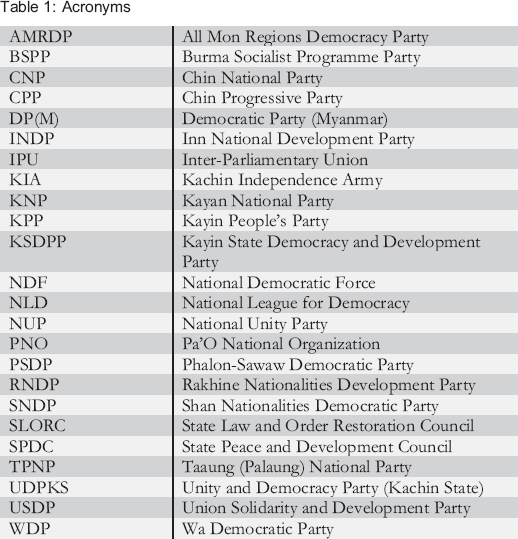
See Appendix Table 1 for a list of acronyms.
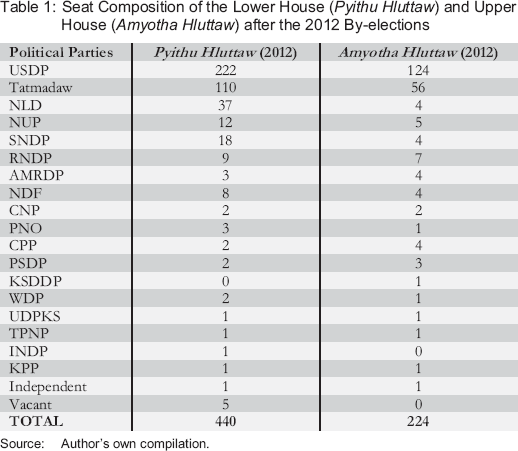
Seat Composition of the Lower House (Pyithu Hluttaw) and Upper House (Amyotha Hluttaw) after the 2012 By-elections
Source: Author's own compilation.
Hereafter, the terms “parliament”, “legislature” and “legislative assembly” or “legislative body” are used interchangeably. In Burmese language, the conventional term for parliament is “hluttaw”.
I wish to thank the editors, Christina Fink, David I. Steinberg, Ian Holliday, Min Zin and Mael Raynaud for their constructive comments on earlier drafts of this paper, as well as the anonymous reviewers for the significant suggestions for improvement. I also gratefully acknowledge the assistance provided by the Embassy of France in Myanmar during the field research I carried out on Myanmar's legislature in 2013 and 2014. Finally, I wish to thank the organizers of an international symposium held on 29–30 July 2014 at Yunnan University, China, where I presented parts of this paper.
The first democratically elected assembly of post-independence Myanmar was convened in 1947 and tasked with drafting the country's first constitution. Subsequently, three national legislative bodies were crafted following legitimate polls in 1951–1952, 1956 and 1960. A few studies have briefly examined these post-independence assemblies when they were in session, without providing any in-depth analysis of their social composition (Maung Maung 1956, 1960). After the military coup d'état staged by General Ne Win in 1962, parliamentary debates and all other meaningful legislative mechanisms were suspended. The second constitutional text of the country, adopted in 1974, established a unicameral “People's Assembly” (or Pyithu Hluttaw), which convened between 1974 and 1988. However, all members of this assembly belonged to a single legitimate party, the Burma Socialist Programme Party (BSPP, or Lanzin) and they offered only cosmetic commitments to conventional legislative activities (Nakanishi 2013: 180–194). In the aftermath of the collapse of Lanzin regime in 1988, national elections were held on 27 May 1990, but the new ruling junta refused to hand over power to the 485 elected members until a new Constitution was drafted. The drafting process took another decade and a half, ending with the adoption of a new constitutional text in 2008. The latter established a “post-junta” hybrid and quasi-civilian regime based on a parliamentary system. Therefore, the general elections held on 7 November 2010 and the new bicameral body of 659 national parliamentarians that convened three months later attracted considerable international attention. 5 This interest was heightened when Daw Aung San Suu Kyi, the democratic icon, jubilantly entered the lower house of the parliament after by-elections were held on 1 April 2012. The new national legislators have since been the object of an increasing interest, both inside and outside the country. They now form a rising political “elite” seeking to play a decisive policy role in Naypyitaw – a first in Myanmar since the 1950s.
Due to ongoing conflict at the time of the polls in November 2010, elections in five constituencies were cancelled.
But who are the members of this elite that entered the national parliament after the 2010 and 2012 votes? Drawing on Hanna Pitkin's concept of descriptive representation (Pitkin 1967: 61), this article highlights that Myanmar's first “post-junta” legislature is certainly not a “mirror image” of the country's current electorate, or even population. However, a closer look at the social composition of the national parliament reveals some unexpected features. In November 2010, the sweeping electoral victory of the regime-backed political movement, the Union Solidarity and Development Party (USDP), came as no surprise to domestic and foreign observers. Despite a realignment provided by the 2012 by-elections and the subsequent entrance in national parliamentary politics of 41 delegates from Daw Aung San Suu Kyi's National League for Democracy (NLD), the dominance of the parliament by the USDP has conveyed the general impression that the country's highest legislative body has been utterly controlled by former army generals and retired junta bureaucrats, who merely dropped their military uniform to adopt the traditional longyis of Burmese politicians after the 2010 elections.
This article challenges this conventional view by simply asking what kinds of Burmese people became legislators after the 2010 and 2012 polls. In order to better grasp the new realities of Myanmar's first post-SPDC legislature, I claim that it is essential to examine the political and socioeconomic profiles of the parliamentarians sitting there. The research draws on The Parliaments of Myanmar, an official publication that includes the biographies of all elected and appointed national members of parliament (MPs). Prepared and published after the 2012 by-elections – that is, a year-and-a-half after the start of the legislature – the bio-sketches of 658 parliamentarians (out of 664 seats) are available both in Burmese and English.
This article focuses particularly on six socio-demographic variables, all commonly explored in comparative parliamentary research on legislator types and considered constitutive of the “social background” of an individual: gender, age, religion, ethnicity, educational level and professional background. The socio-economic environments in which legislators are brought up, educated and socialised largely influence the patterns of their legislative behaviour once elected. Here, I follow the argument made by Robert Putnam, who considered the social background of elites to be a key indication of where power lies in a society (Putnam 1976: 43). Changes in the social composition of leaders, at all levels of leadership, are also indicators of the degree of democratisation, modernisation and professionalisation of a society in transition. In particular, as Putnam stressed, a longitudinal examination of the social composition of successive legislatures can provide “insights into changes in the foundation of social power”, especially in the context of free and regular elections (Putnam 1976: 166). Therefore, comparative analyses of the composition of Myanmar's present and upcoming legislatures may indicate whether future fundamental changes in the structure of social power in the Burmese society, and whether this change (or lack thereof) has had an impact on the country's legislative professionalisation, and ultimately its modernisation and democratisation.
The remainder of this article starts with a comparative review of the literature exploring the socio-economic profiles of legislative elites worldwide, and provides a concise explanation of the methodology followed for this study. I then look specifically at the social composition of the two chambers of Myanmar's first “post-junta” national legislature elected in 2010, by examining each socio-demographic variable chosen for the research; namely the gender, age, ethnicity, religion, education, and occupational background of all Burmese national legislators. I then consider the implications of the current profile of the first post-SPDC national parliament, and identify the prospects for comparative analyses with the second post-junta legislature to be crafted after general elections are held in 2015. In recording this type of data, I hope to provide impetus to further comparative studies on the resurgence of parliamentary affairs in Myanmar, and the influence of the legislative power over the country's transitional processes and modernisation.
Exploring Social Backgrounds and Political Profiles of Parliamentarians
Parliamentarians form specific career-oriented political elites. They enter parliament because of the particular personal attributes they can present during election campaigns, as well as once elected to office, such as their charisma and key financial networks. But they also rely on explicit social and family backgrounds, a higher level of educational achievement, and specific ethno-religious profiles. Consequently, as oligarchic power elites, legislators seldom reflect the people they are meant to represent in parliament, although a large body of recent literature has argued that they should (Mansbridge 1999; Best and Cotta 2000; Dovi 2002). As Eliassen and Pedersen underscored in their study of well-established Scandinavian legislative bodies, “the legislature never mirrors the population at large,” adding that “this is a universal generalisation” (Eliassen and Pedersen 1978: 286).
Building on Donald Matthews’ seminal work on US legislative elites in post-war America (Matthews 1954), among other sources, an extended scholarship has comparatively delved into the profiles and backgrounds of national and local legislators around the world (Hjelm and Pisciotte 1968; Ranis 1970; Verner 1974; Rosenthal 1981; Ellickson 1992). This scholarship has principally underscored a direct link between the socio-economic background and past political experiences of elected parliamentarians, and the way the latter behave in assembly, successfully perform their legislative functions, and then consider their chances of being re-elected – and therefore shape a “legislative career” for themselves by becoming “professionals” of parliamentary affairs. As John Hibbing (1999) later argued, this is a good indication of the evolution of a legislative institution towards professionalisation.
Thus, American scholars showed early on that certain personal attributes of US lawmakers (including education, race and gender) and, consequently, one specific and quite unambiguous profile (the middle-aged, wealthy, well-educated white male of post-war America) lead to broader and more systematic legislative success. Focusing on the occupational diversity in US state legislatures, Peverill Squire has further highlighted that the more professional American lawmakers are, the less diverse the assemblies they sit in become (Squire 1992, 2007). Indeed, legislators in mature and consolidated parliamentary democracies often develop into “professional lawmakers” and form a legislative “elite”, which appears to be trained in same schools and top-ranked universities and originates from the same milieu and social backgrounds (Norris 1997; Löwenberg, Squire, and Kiewiet 2002; Costa and Kerrouche 2009). There is even a manifest tendency to “pass on the torch” of political and legislative functions from one generation to another – echoing French sociologist Pierre Bourdieu's “reproduction of elites”. This trend has been acutely observed in Japan, for instance, where seats in the national parliament, the Diet, are often “inherited” and passed on from a retiring father to a rising son or daughter (Ishibashi and Reed 1992; Taniguchi 2008).
Furthermore, the personal backgrounds of legislators strongly affect the nature of the political conflicts that may arise within the law-making assemblies in which they sit, and subsequently determine the strength of the legislative power (Mezey 1983). This has been observed in various post-authoritarian countries, where legislative institutions have long remained fragile and dominated either by powerful executive branches or by entrenched political parties and legislators stemming from the old regime. Independent and novice lawmakers often have a crucial role to play in transitional processes from an authoritarian ancien régime to a new semi-democratic political system based on regular elections. Recent studies have examined changes in legislative personnel in post-military Latin America (Power 1996), post-authoritarian Asia (Rüland et al. 2005; Zheng, Lye, and Hofmeister 2014), and post-communist Europe (Olson and Norton 1996; Semenova, Edinger, and Best 2014). These studies have demonstrated how regular changes in the profile and background of legislators have consolidated the transition these polities have experimented – or not. Donald Horowitz looked at Indonesia's legislature during and after the fall of General Suharto in 1998 and showed that a large number of Indonesian politicians who had served under Suharto managed to survive free and fair elections after 1998, but that the elections in 2004 and 2009 brought new faces into parliament, thereby consolidating the post-Suharto transition (Horowitz 2013). The present article takes its cue from this extant scholarship and looks at the political profiles and socio-economic backgrounds of the emerging Burmese legislative elites in the post-SPDC context of the 2010s, with the intention of serving as a data set for further comparative studies.
Research Setting
The formal structure of Myanmar's new “post-junta” legislative power, as framed by the Constitution ratified in 2008, is based on a bicameral national parliament as well as on 14 local assemblies. The national legislature, seated in Naypyitaw, combines a lower house (Pyithu Hluttaw, or House of Representatives, with 440 seats) with an upper house (Amyotha Hluttaw, or House of Nationalities, with 224 seats). When convened together, the two houses form the Union Parliament (or Pyidaungsu Hluttaw), which has been Myanmar's highest legislative body since it was first convened in January 2011. I have limited the analysis in this paper to the national level, to which I was granted access, and have left aside the 14 state and regional hluttaws. In both chambers, the Burmese armed forces have constitutionally secured one-fourth of the seats: 110 appointed MPs in Pyithu Hluttaw, and 56 in Amyotha Hluttaw. All military MPs are appointed without any oversight by the army's top commander and have actually been replaced on a regular basis during the sitting of the legislature, unlike their civilian colleagues who have a mandate of five years (Egreteau forthcoming 2015). Oaths of office were administered for all the new members of parliaments, both elected and nominated, during the first parliamentary session in January 2011. Since then, every newly elected or appointed MP must take the oath publicly before sitting in parliament.
However, a few parliamentary seats were not filled after the 2010 national polls, particularly in the most remote areas of the country, such as the northern Kachin and Shan states, where armed conflict was still raging. Also, several parliamentarians were nominated to ministerial or chief ministerial positions in the 14 state and regional executive bodies between January and March 2011, and therefore had to resign their legislative seats. In April 2012, 43 seats at the national parliament (as well as two more in local assemblies) were up for grabs in by-elections announced by the Union Election Commission, mostly to replace the MPs who had joined the local and national governments. Daw Aung San Suu Kyi's NLD captured all but two of these seats (Tin Maung Maung Than 2013). A year-and-a-half after the first session was convened, 658 parliamentarians were registered in Pyidaungsu Hluttaw: 435 (out of a possible 440) in Pyithu Hluttaw (325 civilian MPs and 110 military MPs) and 223 (out of 224 seats) in Amyotha Hluttaw (167 civilian MPs and 56 military representatives). Table 1 shows the distribution of seats for the political parties in both houses after the 2012 by-elections (see annex 1 for the list of acronyms).
For simplicity, this study captures a snapshot of Myanmar's first post-SPDC legislature at a specific moment, when all national parliamentarians provided their biographical details at the same time. Data for this research was gathered from the official parliamentary publications detailing the bio-sketches provided voluntarily by all 658 legislators, including the 166 military MPs who were commissioned to the legislature by mid-2012. However, many military appointees have been substituted since, which makes traceability more difficult. A few more national MPs have also resigned since, and two have passed away, in April and November 2013, respectively. These concise biographies are available in both Burmese and English (The Parliaments of Myanmar 2013). However, the publication (which is also partly available online, and in Burmese language only, for 314 civilian representatives sitting in Pyithu Hluttaw) 6 is littered with numerous mistakes, inconsistencies and typos, as well as a paucity of accurate details. For example, many ethnic MPs have provided information in a language that is not their native one (Myanmar language), which has led to a substantial number of errors and grammatically incorrect name writing. Also, the English version was clearly compiled by ethnic Bamar translators who are unfamiliar with Shan, Kachin, Rakhine or Kayin geographical terms and personal names. Lastly, as civilian and military MPs were given free rein to write their own biographies, some have provided lengthy notes about themselves, whereas others have written only a dozen or so words.
See www.pyithuhluttaw.gov.mm/?q=representatives (accessed on 17 September 2014).
Nonetheless, the mini-biographies of the 658 national legislators provide a wealth of information and anecdotal evidence for anyone able to read between the lines or pay attention to the details – particularly the dates of birth, ethnicities, religions, education levels and occupational backgrounds – as well as, in many cases, a chronological list of their past professional activities and whereabouts. This study also draws on a series of interviews carried out with 39 legislators from both the Amyotha Hluttaw and the Pyithu Hluttaw. The interviews lasted from 30 minutes to two hours and were held in Naypyitaw and Yangon at regular intervals between February 2013 and July 2014. A few MPs were interviewed more than once, with regular exchanges aiming to cross-check written biographical data or balance the lack or inconsistency of it. The following sections focus successively on six demographic and socioeconomic variables, all of which are constitutive of one individual's “social background” and are used in comparative legislative studies: gender, age, religion, ethnicity, educational level, and professional background.
Gender
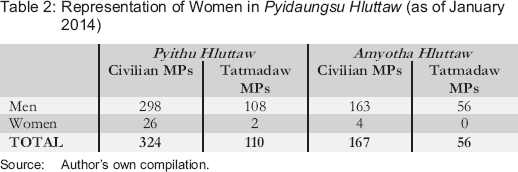
Women have been sorely underrepresented in the first post-SPDC national legislature. Only 18 women candidates were elected MPs after the 2010 general elections (out of 493 civilian MPs); of these, ten belonged to the dominant USDP. Having been allowed to re-register as a legal party in November 2011 and to compete in the 2012 by-elections, the NLD included a number of female activists and former political prisoners in its list of electoral candidates, starting with the most charismatic among them, Daw Aung San Suu Kyi. Twelve out of the 41 seats the NLD won at the national parliament were filled by women (29 per cent of the NLD's total number of MPs). 7 All sit in the lower house. Despite this great leap forward in 2012, both chambers of the national parliament remain dominated by male parliamentarians. The 26 women MPs in the lower house represent only 8 per cent of the 325 elected MPs sitting there in early 2013, while the four women delegates in the upper house represent only 2.4 per cent of the elected parliamentarians. Three of these four women representatives in Amyotha Hluttaw belong to the USDP and one, Daw Khin Waing Gyi, represents the National Democratic Front (NDF). A former local leader of the BSPP before 1988 and ex-NLD member, Daw Khin Waing Gyi has been active in the upper house – even spearheading the parliamentary debate on the reform of the electoral system; however, she does not appear inclined to promote her gender while performing her legislative functions. She acts in parliament as a politician, not a female leader, she claims. 8
The name of Dr May Win Myint, a medical doctor and NLD activist who was elected in the 1990 polls and attended the first National Convention (1993–1996) before being sentenced to seven years in jail, is often overlooked by observers, as indeed the honorific “Daw” (for women in Myanmar) is more commonly replaced by the professional “Dr” in official publications. Therefore, many news articles and reports have only mentioned 11 female NLD MPs as being elected in 2012, and therefore, 25 women MPs in Pyithu Hluttaw, instead of 26 (see for instance Minoletti 2014).
Interview with author, Naypyitaw, February 2013.
In a surprising political decision, the Tatmadaw leadership appointed two female army officers to Pyithu Hluttaw in January 2014. Lt-Colonel Daw Soe Soe Myint and Lt-Colonel Daw San Thida Khin then replaced two lower-ranking male army majors as military representatives. 9 This could be interpreted as a strategic move by the army top commanders to diversify the military delegates in parliament and counter criticism of discrimination in a military institution that, like any other military institution, is dominated by male officers. As of 2014, there were therefore 32 female legislators in both houses of the national parliament, which is less than 4.9 per cent of the 657 elected and army national parliamentarians (see Table 2).
Representation of Women in Pyidaungsu Hluttaw (as of January 2014)
Source: Author's own compilation.
New Light of Myanmar, 10 January 2014.
Interestingly, similar representation of women can be found in the national assemblies recently elected in Sri Lanka (5.8 per cent in the legislature formed in 2010) or the Maldives (5.9 per cent in the parliament elected in 2014). 10
As calculated by the Inter-Parliamentary Union (IPU): data available online at www.ipu.org/wmn-e/classif.htm (accessed on 17 September 2014).
The two largest (and oldest) Asian democracies – India and Japan – do not present much higher scores, however. In the Indian national parliament last elected in 2014, women MPs formed only 11.6 per cent of the total contingent of Indian national legislators, while only 10.8 per cent of the Japanese legislature elected in 2012 (for the lower house) and 2013 (upper house) were women MPs. In Indonesia, Cambodia, and the Philippines, women's parliamentary representations at the national level recently stood respectively at 16.8 per cent (2014), 18.5 per cent (2012–2013) and 27.1 per cent (2013). 11
Ibid.
However, this situation has been a clear reflection of Burmese traditional politics and society. The social stigma against women lives on in Myanmar and it remains extremely challenging for Burmese women to be politically engaged, and even more so to be fully devoted to national politics (Harriden 2012; Than 2014). For example, the interviews I conducted with women MPs from the NLD revealed that those who chose to run for the 2012 by-elections have already had a long and difficult personal history of pro-democracy struggle, if not years under house arrest or jail. Some had even already been elected in the 1990 elections, which were then not recognised by the junta. The grooming of a new generation of younger female politicians will probably take time in the country (Minoletti 2014). Therefore, one should not expect in Myanmar a trend that approaches proportional representation anytime in the near future.
Age
According to the 2008 Constitution, the minimum age at which a Burmese citizen can be elected to parliament is fixed at 25 for the lower house (article 120a), and 30 for the upper house (article 152a). Halfway through the current legislature (mid-2013), the average age of the 658 Burmese national parliamentarians (both elected and appointed) was 54.5 years. The average age was higher for elected civilian MPs, at 57.9 years in Pyithu Hluttaw, and 59.1 years in Amyotha Hluttaw. From a comparative perspective, a joint report commissioned in 2012 by the United Nations and the Inter-Parliamentary Union collected date from 129 parliaments and estimated that the average age of parliamentarians in the world was 53 (UNDP-IPU 2012: 108). In the first post-Suharto parliament elected in Jakarta in 1999, the average age of the Indonesian legislators was 54 (Ziegenhain 2008: 116). Similarly, in India's lower house elected in 2009, the average MP was 53 years old – and Indian local legislators in their fifties remained dominant in India's numerous regional assemblies during the 2000s (Jaffrelot and Kumar 2009).
The extant scholarship on legislative politics has long stated that one can expect to commonly draw senators and lawmakers from the older age groups of a society (Matthews 1954; Rosenthal 1981). This would tend to confirm that a substantial majority of Burmese parliamentarians elected in 2010 and 2012 came to office with a minimum of political or administrative experience. For instance, almost all of the 17 elected representatives of the NUP had previously been involved in the administration of General Ne Win's regime, before its collapse in 1988. 12 Sixteen of 41 representatives of the NLD who entered parliament in 2012 (39 per cent) had already been elected in the 1990 elections, which were annulled. Several MPs from the USDP were also members of the first National Convention, which had been tasked with drafting a new constitutional text before it was adjourned in 1996.
Interview with author, Naypyitaw, February 2013.
The eldest parliamentarian elected in Pyithu Hluttaw was born in 1932: U Maung Nyo, a renowned Arakanese intellectual from the Rakhine Nationalities Development Party (RNDP, which became the Rakhine National Party in 2014). U Maung Nyo had already participated in the 1990 electoral campaign, but was defeated by a local rival; therefore, his election in November 2010 came as a surprise for the 78-year-old. 13 The most senior member of Amyotha Hluttaw was born in 1931: U Kyaw Din is an ethnic Kayah, member of the dominant USDP, and a former lieutenant-colonel of the Myanmar police force who enrolled in the Insein Police Academy (in the northern outskirts of Yangon) at the time of independence in 1948. The two youngest representatives in Pyithu Hluttaw and Amyotha Hluttaw were born in 1985 (Sai Thein Aung, a Shan MP from the Shan Nationalities Democratic Party elected in Tachileik) and in 1977 (U Hsan Yei, a Christian Kayah member of the USDP), respectively. In summary, a substantial majority of elected MPs in Myanmar's current lower house were born between the mid-1940s and late 1960s; in the upper house, civilian parliamentarians born between the early 1950s and early 1970s dominate, but in more equal proportions (see Figure 1).
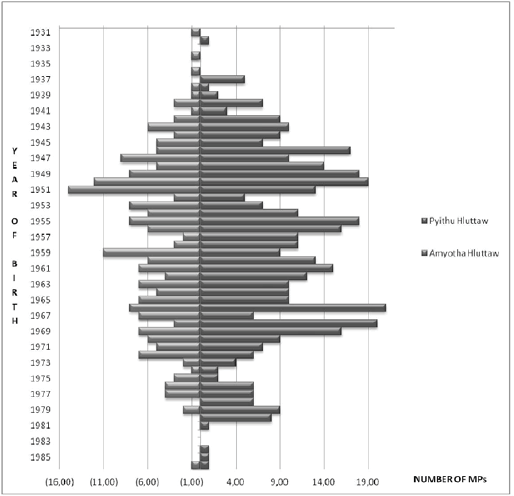
Age Pyramid of Pyidaungsu Hluttaw (2010–2015) – 658 MPs
Interview with author, Naypyitaw, July 2014.
However, the 166 military appointees in both houses appear far younger than their civilian counterparts: professionals, they are constrained by a strictly enforced retirement age, which is fixed in the Burmese armed forces at 60 years old. In 2013, the average army MP was 43.5 years old in the lower house and 44.5 years old in the upper house. As of early 2013, the two chambers of the national parliament included eight brigadier-generals, 18 colonels, 40 lieutenant-colonels, 80 majors and 20 captains – fascinating anecdotal evidence for anyone interested in Burmese numerology. Logically, the youngest military delegates are to be found among the army, navy and air force captains, officiating majors and majors, whilst the two most senior army representatives (half-way through the legislature) were also the highest-ranking ones: Brigadier-General Wai Linn in Pyithu Hluttaw (born in 1954, a former deputy regional commander of the Triangle Region Command) and Brigadier-General Kyaw Oo Lwin in Amyotha Hluttaw (born in 1955, a former deputy regional commander of the Coastal Region Command).
Ethnicity
Myanmar is one of the world's most ethnically diverse polities. Ethnic cleavages have been endlessly politicised since independence, and state power has long remained in the hands of the Bamar ethnic majority, to the detriment of the remaining third of the population. The composition of Myanmar's postcolonial state institutions reflects this dominance. In his analysis of Ne Win's regime (1962–1988), Yoshihiro Nakanishi has demonstrated this supremacy imposed by the ethnic Bamar over the government structures, the single legitimate party (Lanzin) and the unicameral legislature crafted after 1974 (Nakanishi 2013). To avoid the perpetuation of the ongoing stalemate between Myanmar's myriad of ethno-linguistic groups and its Bamar-dominated centre, the Burmese leadership must find new avenues to consolidate pluralistic politics, ensure regular, free and appropriate electoral processes, whilst fostering power-sharing institutions specifically designed to ensure the representation of minorities. The legislature is one of them. However, diversity in state and national parliaments is not necessarily a first step towards peace and stability for divided societies, as ethnic cleavages can easily be reproduced in the legislature (Reilly 2001; Lijphart 2008).
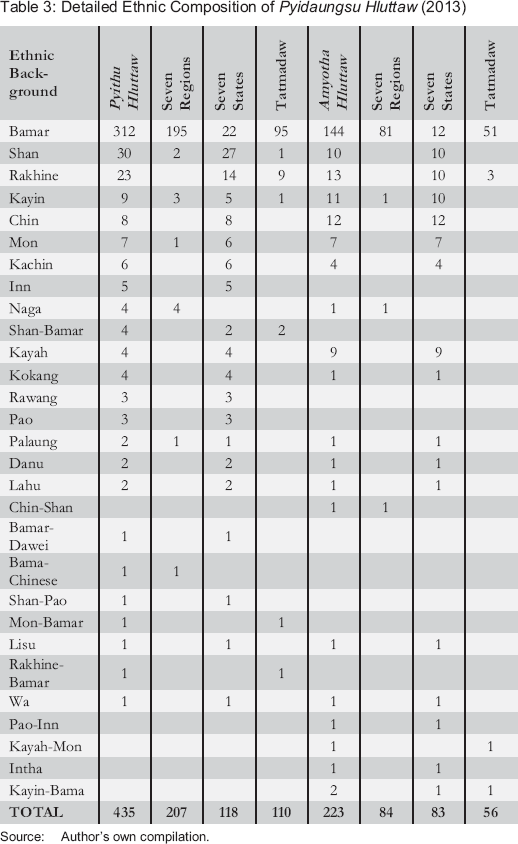
The statistics presented hereafter are based on information provided by the Burmese parliamentarians themselves. Identity and ethnicity are always self-defined, so the MPs (both elected and appointed) have stated their ethnic background in the way they felt was right rather than according to pre-established categories such as those drawn from Myanmar's official census data, for instance. As such, none of the 658 national MPs self-identified as a member of the so-called “Rohingya” Muslim minority from Western Myanmar; the three MPs from this minority indicated “Bamar/Myanmar Muslim” for their ethno-religious background. Furthermore, a few MPs have mentioned confounding double identity profiles that would surely not be accepted by Myanmar's official administration for registration cards, for instance, such as Bamar-Shan (for four of them), Rakhine-Bamar, Kayah-Mon, or Shan-Pa'O. One USDP parliamentarian elected to Pyithu Hluttaw from a rural constituency in Sagaing Region even indicated his ethnic background as “Bamar-Chinese”. Legally, this would have precluded him from entering the national parliament, as the Chinese various populations in Myanmar are not recognised as one of the official 135 “national races” of the state and are therefore considered as “foreign races” (see Table 3).
Detailed Ethnic Composition of Pyidaungsu Hluttaw (2013)
Source: Author's own compilation.
A substantial majority of the 658 MPs in both chambers are ethnically Bamar: 71.7 per cent of the Pyithu Hluttaw, and 64.5 per cent of the Amyotha Hluttaw. This appears to be in line with the conventional acceptance that Myanmar's total population consists of a two-third majority of ethnic Bamar. 14 However, a closer look at the wider ethnic composition of the legislature shows that ethnic diversity is definitely there. This is not only due to the emergence of 15 legal “ethnic” parties (out of the 19 political parties that won seats in the 2010 and 2012 polls), but also to the integration of ethnic candidates into the dominant political parties, the USDP and the National Unity Party (NUP). For example, U Shu Maung – a retired army officer – is an ethnic Danu. He was integrated at an early stage into the USDP bureaucratic machine in his hometown in the heart of the Shan States and he now proudly sits as Amyotha Hluttaw‘s representative for his native Danu region. 15
Myanmar's latest official census carried out in March 2014 will not reveal ethnic data until late 2015/early 2016.
Interview with author, Naypyitaw, January 2014.
In the two chambers, 456 out of 658 elected and military MPs are ethnic Bamar (69.3 per cent of the entire legislature), followed by 40 Shan (6.1 per cent), 36 Rakhine (5.5 per cent), 20 Chin (3 per cent), 20 Kayin (Karen, 3 per cent), 14 Mon (2.1 per cent), 13 Kayah (Karenni, 2 per cent), and 10 Kachin (excl. the Rawang 16 ; 1.5 per cent). All other legislators from other ethnic minorities, such as the Naga, Wa, Kokang, Pa'O, or Palaung had fewer than five seats each (see Figures 2 and 3).
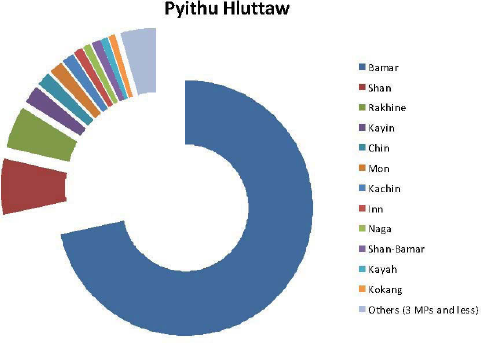
Ethnic Representation in the Lower House (435 MPs)
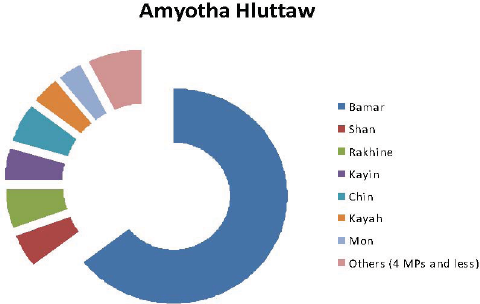
Ethnic Representation in the Upper House (223 MPs)
Ethnic Rawang people are often categorised as “Kachin” in Myanmar's official data, although they strongly resent being considered as such, for historical, cultural and political reasons; author's interview with a Rawang MP from the National Unity Party (NUP), Naypyitaw, January 2014.
As shown in Table 3, in Pyithu Hluttaw, there is a clear distinction between elected representatives from the seven administrative regions (traditionally dominated by Bamar populations since their creation by the 1974 Constitution, and confirmed by the 2008 Constitution) and their colleagues from the seven states (dominated by ethnic minorities). As far as the former are concerned, 195 out of 207 MPs are ethnic Bamar (or 94.2 per cent). However, only 22 MPs (out of 118, or 18.6 per cent) elected in one of the seven states are Bamar. In Amyotha Hluttaw, the difference is even sharper. Among the 84 MPs representing the 12 constituencies of each of the seven regions, only three are not Bamar. Among the 83 MPs of the seven states, 17 only 12 were Bamar (14.5 per cent), a proportion equivalent to other nationalities: 12 Chin, 10 Shan, 10 Rakhine, 10 Kayin, nine Kayah and seven Mon, among others. This appears to indicate that ethnicity matters more in the upper chamber (or House of the “Nationalities”).
One Rakhine parliamentarian from Amyotha Hluttaw passed away in April 2013.
Nevertheless, while ethnic diversity may be obvious among elected parliamentarians, the 166 military appointees in the two houses of the legislature offer a quite different profile (see Table 3 and Figure 4). The vast majority (87.9 per cent) is ethnic Bamar, but there are also quite a few non-Bamar Tatmadaw officers commissioned to the national parliament, including 12 Rakhine, one Shan and one Kayin (Karen). The literature on the Burmese armed forces has long highlighted the fact that despite an utter dominance of Bamar senior officers in the commanding heights of Myanmar's military hierarchy, racial background was less an issue for promotion and power-grabbing than social and religious backgrounds (Selth 2002: 173; Maung Aung Myoe 2009: 199). Rakhine, Mon and Shan Tatmadaw officers could rise above the ranks as long as they could prove that they were Buddhist, well-educated and had similarly educated spouses. The military MPs provided biographical information voluntarily, like their civilian colleagues, and several mentioned having a dual racial background, such as Shan-Bamar, Rakhine-Bamar or Mon-Bamar – a position they can not support in other official data questionnaires.
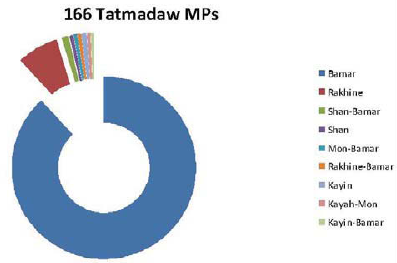
Ethnic Representation of Military MPs in Both Houses (166 MPs)
Religion
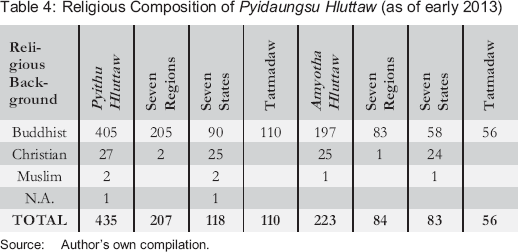
Myanmar asserts itself as a Buddhist country. Therefore, it is no surprise that a great majority of national MPs claim to be Buddhist. Four hundred and five out of 435 elected and appointed MPs in Pyithu Hluttaw (93.1 per cent of the lower house), and 197 out of 223 delegates (or 88 per cent) in Amyotha Hluttaw listed Buddhism as their own faith (see Table 4 and Figure 5). As for ethnic background, the distinction between the Bamar-and Buddhist-dominated seven regions and the ethnic-dominated seven states is again quite evident. Only two of the 207 elected MPs representing the seven regions in Pyithu Hluttaw are not Buddhist: they are two USDP representatives of Kayin-dominated constituencies located deep into the Irrawaddy delta (both happen to be Christian). Similarly, only one MP from Amyotha Hluttaw‘s 84 representatives of the seven regions is not Buddhist: a Christian Kayin medical doctor from Mandalay. Even more notable is the fact that every single one of the 166 military MPs is Buddhist. Again, this seems to corroborate the conventional wisdom that in order to rise above the ranks in the Tatmadaw, one needs to be a Buddhist – more than a Bamar.
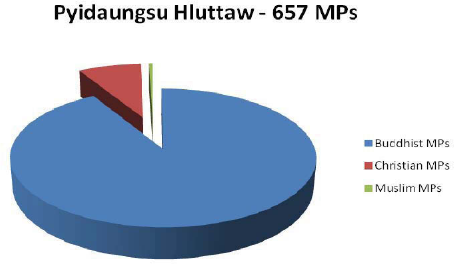
Religious Composition of Pyidaungsu Hluttaw (2013)
Religious Composition of Pyidaungsu Hluttaw (as of early 2013)
Source: Author's own compilation.
Interestingly, all 658 parliamentarians (with one exception, which appears to be an omission) have declared a faith; none have indeed stated “no religion” or “atheism”. However, revealing the religious background of legislators may prove sensitive for divided societies, particularly when there are obvious representational distortions. Under General Suharto, Christians have long been over-represented in the Indonesian national legislature (Rüland et al. 2005: 183). This was a calculated move to counter the rise of Islamist political forces in parliament. In other neighbouring societies, religion has also often been used as a powerful tool to enter parliament and influence policy-making and law-making. In India, for instance, religious and caste-based political parties have consistently proved able to form powerful vote banks for MP elections and future assembly, both at the national and local levels. This is a remnant of postcolonial Indian politics (Kochanek 1968; Jaffrelot and Kumar 2009).
In Myanmar's current national legislature, 52 civilian MPs in both houses (7.9 per cent of the 658 parliamentarians) have cited Christianity as their personal religion (27 parliamentarians in Pyithu Hluttaw, and 25 in Amyotha Hluttaw). Most are Kachin and Rawang, as well as Chin, Kayin (Karen), and Kayah (Karenni). Interestingly, all Naga MPs declared themselves Buddhists – in stark contrast to the largely Christianised population they represent. Finally, only three parliamentarians (0.5 per cent of the total legislature) declared themselves Muslim. The latter are the two USDP representatives of the constituencies of Maungdaw and Buthidaung in Northern Rakhine State (who are sitting in Pyithu Hluttaw), and their USDP colleague elected for the same combined constituencies in Amyotha Hluttaw. However, all three self-identified as “Bamar” or “Myanmar” Muslims in their official bio-data, despite claiming otherwise privately. 18 There lies a potential for further religious tensions in the country (frequently plagued by the rift between Buddhist and Muslim populations), particularly if the Burmese Muslim electorate remains ostensibly under-represented in the upcoming legislature (2015–2020).
Interview with author, Yangon, May 2013. A bitter controversy has gradually emerged among the USDP ranks, with many party members now being openly at odds with their three co-opted “Rohingya” colleagues mostly being referred to as “Bengalis”.
Even if Myanmar's first legislature appears to be dominated by Buddhist parliamentarians, they all appear to have been drawn from political parties without any outright religious agenda – so far. A change in the religious profile of Myanmar's legislature after the second “post-SPDC” general elections scheduled for the end of 2015 will certainly indicate whether parliamentary debates in the country can more acutely revolve around divisive religious matters, with MPs increasingly putting forward their religious identity in parliament and electoral politics, or not.
Educational Achievement Level
Parliamentarians form a political elite within the society for which they intend to produce laws and regulations. University degrees and high educational credentials are often essential prerequisites for access to these decision-making elites. The importance of higher educational achievement level for legislators has long been underscored by experts of legislative elites (Verner 1974; Putnam 1976: 58; Rosenthal 1981: 57–60; Gaxie and Godmer 2007). In some societies, legislators are even required by law to have at least a bachelor's degree. This was the case in Thailand, for instance, under the (now-defunct) 1997 and 2007 constitutions (Sawasdee 2014: 97). Although Myanmar's current constitutional law has no such stipulations, my own research shows that national representatives in the first post-SPDC legislature are generally well educated. This represents another feature that further distinguishes them from the rest of the Burmese society as an emerging “elite”.
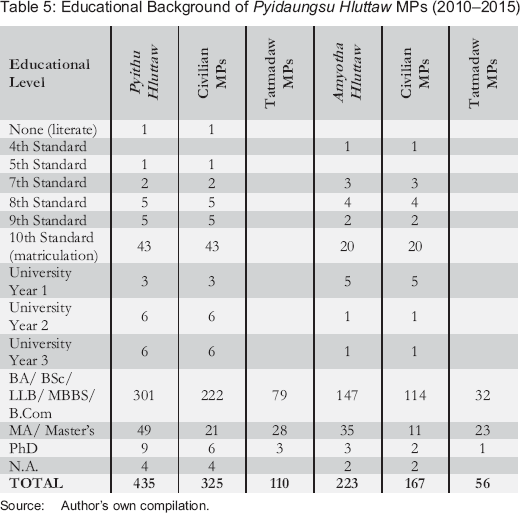
Eighty-three per cent of the 658 Burmese MPs registered in 2012 boast a university degree, usually obtained from a domestic academic institution in Myanmar (see Table 5, Figures 6 and 7). Interestingly, this is in line with both other developing regional countries and mature democracies. In Indonesia's first post-Suharto legislature (1999–2004), 75 per cent of legislators were college graduates (Rüland et al. 2005: 175). In the French National Assembly elected in 2002, 82 per cent of the parliamentarians had graduated from university (Costa and Kerrouche 2009: 333).
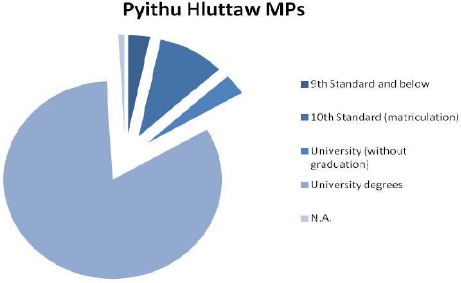
Educational Achievement Level of Pyithu Hluttaw‘s 435 MPs (2013)
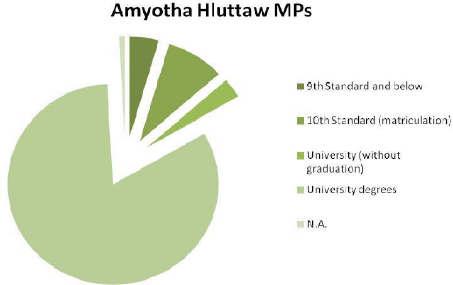
Educational Achievement Level of Amyotha Hluttaw‘s 223 MPs (2013)
Educational Background of Pyidaungsu Hluttaw MPs (2010–2015)
Source: Author's own compilation.
In Pyithu Hluttaw, 359 elected and appointed military MPs (out of 435; 82.5 per cent) are university graduates and hold at least a bachelor's degree in arts, law or science, a medical graduate degree (MBBS) or the equivalent. Similarly, 184 parliamentarians (out of 223; 82.5 per cent) in Amyotha Hluttaw possess a university degree, BA (or equivalent) and above. Interestingly, a few Burmese MPs were awarded international university degrees, mostly from the United States, Australia, Thailand, Israel, Japan, Russia, China, Scotland and Belgium. Given their respective ages, some MPs clearly spent several years abroad during the supposedly autarkical regime of General Ne Win (1962–1988), whereas other younger MPs appear to have received international training far more recently, in the 1990s and 2000s.
The former rector of Yangon University, for instance, a USDP delegate now representing the constituency of Kamayut in Yangon, recalls the time he spent in northern Italy in the late 1960s, where he received his doctoral degree from Trieste University. 19 Eight other MPs in Pyithu Hluttaw and three of their colleagues in Amyotha Hluttaw also boast domestic and international doctoral degrees.
Interview with author, Naypyitaw, August 2013.
Furthermore, 22 MPs mentioned having enrolled in years 1, 2 and 3 of university, before being forced to drop out from university without graduating, for various reasons (university closure, conflict, arrest or personal matters, most probably).
A further 43 MPs in Pyithu Hluttaw (10 per cent of the assembly) and 20 MPs in Amyotha Hluttaw (9 per cent) declared a “Standard-10” educational level, which corresponds to the matriculation exam in Myanmar. 20 Lastly, a few of the ethnic MPs originating from the country's most remote areas have admitted lower educational backgrounds in Burmese-language curriculum. For instance, the Kokang and Wa representatives of the most northern constituencies of the Shan State have indicated that they followed Myanmar's curriculum in Burmese language until Standard 3 or 5, but achieved another curriculum in Chinese language up to matriculation (or Standard 10). Only one MP admitted having received no formal education, but still confirmed being literate in his bio-sketch.
Myanmar's education system was based on the United Kingdom system. Burmese children are supposed to undergo ten years of post-kindergarten education, from Standard 1 (6–7 years old) to Standard 10 (15–16 years old).
The lack of higher education credentials does not usually exclude a politician from being elected. In fact, legislatures in developing countries are peppered with charismatic leaders who have not necessarily followed the usual educational and university path. In Myanmar, several ethnic and communist leaders have spent years fighting the Burmese armed forces as members of militias or insurgent groups before being elected legislators in 2010. Having been excluded from the country's mainstream, many of these individuals have never enrolled in Burmese schools or in the state's higher education institutions. Furthermore, having a university degree does not necessarily imply that a newly elected parliamentarian will prove to be an effective legislator who is able to draft bills, debate budgets or simply discuss new and old legislation. Many legislators around the world come from business or education backgrounds and must acquire new expertise on law-making processes and legislative mechanisms before being able to successfully perform their legislative role as a “professional” lawmaker. In Myanmar, where higher education standards have remained low, many MPs have obtained university degrees in botany, zoology or chemistry – areas that are not traditionally considered useful training for dealing with legislative works.
Collectively, the 166 military MPs appear to be by far the most educated delegates in parliament. All are college graduates and two-thirds hold at least a BA or BSc, with 51 (30.7 per cent) having been awarded a master's degree or equivalent. This latter category is comprised either of the youngest officers born in the 1970s and early 1980s, or the most senior ranking ones, who have completed post-commission master's courses at a later stage in their careers (particularly from the National Defence College). Four army officers hold doctoral degrees, in engineering, public health (medical doctor), physics and history (for one major who was an assistant lecturer in the history department of the Defense Services Academy based in Pyin U-Lwin). A few officers have also been trained abroad, mostly in one of the various universities of Moscow and Beijing.
Professional Background
The purpose of scrutinising the occupational background of legislators is two-fold. First, it shows the sectors of the society from which lawmakers and politicians are drawn. This has a strong impact on the way these legislators think, consider policy issues and behave in parliament. Second, it illustrates the degree of professionalisation of the legislature and the time MPs devote to legislative work, compared to outside activities (Maddox 2004; Squire 2007). In mature and professionalised parliaments, legislators no longer identify themselves by the occupations they hold outside the parliament, but rather as full-time lawmakers. In emerging and fragile legislatures, however, MPs must learn the ropes and still often spend more time looking after their own business outside the parliament (trade, legal work, teaching, civil service) than focusing on legislative work.
One of the most interesting features of the socio-professional profiles declared by the 492 elected MPs in both chambers of Myanmar's national parliament is that, contrary to the widely held stereotype, only a minority of parliamentarians elected in 2010 have military backgrounds. Many observers of Burmese politics would have expected the first post-SPDC legislature to have a strong khaki tint, with ex-army officers (plus the active-duty officers that represent 25 per cent of each hluttaw) overshadowing the new legislative assemblies. However, only 40 of the civilian parliamentarians in Pyithu Hluttaw, in addition to 21 in Amyotha Hluttaw, come from Myanmar's wider security sector (12.4 per cent of the 492 civilian MPs, or 9.3 per cent of the total number of delegates). They stem from the Burmese armed forces, the police forces and also the former armed rebellions and ethnic or ideological militias of a country with a long history of insurgency, such as the Kachin Independence Army (KIA), the Palaung State Liberation Army (PSLA) and the Communist Party of Burma (CPB). If we include the 166 military MPs from the two chambers, then 227 of the 658 national parliamentarians do indeed have a military background and represent roughly one-third of the bicameral parliament (34.5 per cent). However, among elected representatives, retired army officers form only a minority of national MPs. U Ye Myint, a former infantry lieutenant-colonel who was elected in the rural constituency of Nyaunglebin, recalls that he did not expect to become a politician after retiring from the armed forces in 2002. But in 2010, when he was encouraged by local USDP leaders to run for a legislative mandate, he accepted and has since very much enjoyed participating in parliamentary affairs. 21
Interview with author, Naypyitaw, July 2014.
The substantial majority of the civilian representatives in Myanmar's parliament are involved in trade, business and banking activities (see Figure 8). A total of 141 (21.4 per cent of the parliament) indicated earlier careers as shopkeepers, merchants, traders, property owners and company managers. This group is followed by professionals from the education sector: teachers, school headmaster, university lecturers, and private tutors (83 MPs, or 12.6 per cent of the parliament) and then by civil servants, public administrators and what the literature on legislative affairs labels as “politicos”, who have forged their careers in politico-bureaucratic institutions such as the Burma Socialist Programme Party before 1988, the Union Solidarity and Development Association between 1993 and 2010, as well as the NLD since 1988 (81 MPs in both chambers, or 12.3 per cent of the total parliament). Many parliamentarians, in both houses, worked for years as salaried employees in political parties (when they were legal) or institutions sponsored by the state. An illustrative case is that of U N'Hpung San, a Pyithu Hluttaw MP elected in Machanbaw, a remote constituency located at the foothills of the Himalayas in northern Kachin State. He joined the BSPP in 1966 and served as its local chairman for more than two decades. In 1988, he remained loyal to his bosses when they transformed the BSPP into the National Unity Party; as he said in an interview: “I'm an old gater.” 22 He won against a USDP rival on 7 November 2010.
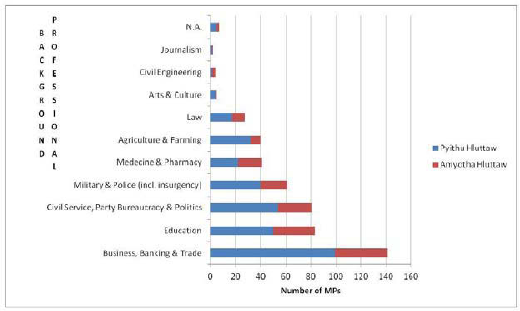
Occupational Backgrounds of Pyidaungsu Hluttaw elected MPs (2013)
Interview with author, Naypyitaw, January 2014.
Furthermore, 41 MPs (6.2 per cent of the 658 parliamentarians) have declared being health-care professionals (medicine, pharmacy, dentistry and veterinary), whilst 40 MPs (6.1 per cent) come from a wider agricultural and farming background. Somewhat surprisingly, considering the difficult task of reviving a meaningful legislative process, the legal profession is not the predominant occupation for Burmese lawmakers in the first post-junta legislature.
In mature democracies of the Western world, lawyers abound in elected assemblies (Best and Cotta 2000; Costa and Kerrouche 2009; Maddox 2004); this phenomenon is also observed in India and the Philippines (Rüland et al. 2005: 197). In Myanmar, however, only 27 MPs (17 in Pyithu Hluttaw and 10 in Amyotha Hluttaw) come from the Burmese law sector. Similarly, in Indonesia's first post-military legislatures (1999–2004), lawyers represented only 3.6 per cent of the assembly (Ziegenhain 2008: 116). This may indicate that the more consolidated a democratic parliamentary system is, the more lawyers and legal specialists we may find among the legislators’ ranks.
Lastly, five Burmese MPs have mentioned that they earn revenues from performing arts and cultural activities. U Aung Zin, for instance, has been a NDF delegate for Yangon's Pazundaung constituency in Pyithu Hluttaw since 2010. A graduate of Yangon University, he struggled for many years to make a living as a painter before entering politics in the midst of the 2010 electoral campaign. 23 Lastly, only two MPs, one in each house, have admitted being journalists (a dangerous statement in Myanmar in the not-too-distant past).
Interview with author, Yangon, May 2013.
Concluding Remarks and Further Research
The purpose of this paper was to propose a closer sociological analysis of Myanmar's emerging national parliamentary elite. With the transition from direct military rule to a hybrid quasi-civilian regime, a new class of policy actors – the legislators – has emerged, almost ex-novo in the country. By looking at who entered the new national parliament, one may hope to better situate where social power lies in Myanmar's current polity and understand who (still) possess rule- and law-making influence, as well as the capacity of shaping a new decision-making elite. As my findings suggest, the typical Burmese legislator sitting in the first post-junta national parliament (2010–2015) closely mirrors the conventional image of the Burmese typical postcolonial leader: a man, in his mid-fifties, ethnically Bamar and Buddhist, holding a Myanmar university degree (BA or equivalent), engaged chiefly in business activities or in the education sector, and with a relatively high probability of having been involved in bureaucratic and/or governmental politics during previous administrations (whether Ne Win's regime or its successor after 1988), but not necessarily in the state security sector (armed forces or police), save for the 166 military delegates of both chambers. However, the national parliament still offers a remarkable diversity. In the same legislative arena now sit former political prisoners, retired generals, ethnic minority leaders, wealthy business people, ex-communist insurgents, active duty army officers and school teachers.
Changes in the social composition of leaders, at all level of leaderships, are indicators of the degree of democratisation, modernisation and professionalisation of a society in transition. There are future lines for comparative research on the resurgence of parliamentary affairs in Myanmar and the influence of this new tribe of Burmese legislators. The investigation of the differences and similarities in the social composition of Myanmar's first two “post-SPDC” legislatures (2010–2015 and 2015–2020) may, in the near future, indicate whether there are patterns of professionalisation and fundamental change in the structure of social and political power of Myanmar. How many MPs elected in 2010 and 2012 will run again, thereby initiating a “legislative career” for themselves, to become “professionals” of parliamentary affairs? Will the newcomers of the second “post-SPDC” national legislature offer the same socio-demographic profiles as their predecessors? What will this mean for the country's law-making process? The same comparative work may also be conducted using Myanmar's 14 local parliaments (Region and State Hluttaws) as case studies.
Furthermore, a closer look at the social and occupational backgrounds of Burmese national lawmakers does not fully and comprehensively explain why Burmese MPs have behaved in one way or another when sitting in parliamentary sessions or in committees. Systematic research on the legislative behaviour of Burmese national parliamentarians is needed. Studies should more thoroughly examine the link between the profile of a legislator and the way s/he behaves in parliament, the types of draft bills s/he supports, how s/he votes, what question s/he asks, and so on. How do the socio-economic background and past political experiences of a Burmese legislator predetermine his or her legislative behaviour? This connection needs to be empirically tested, which is a daunting research objective. The primary aim of this article was to provide a new dataset that can be used for further research. Beyond the comparative investigation, it is hoped that this study will pave the way for new lines of inquiry on legislative work in Myanmar, encouraging the collection of solid behavioural information about the Burmese MPs, and connecting these behavioural indicators with the social background of the legislators.
Footnotes
Appendix
Acronyms
| AMRDP | All Mon Regions Democracy Party |
| BSPP | Burma Socialist Programme Party |
| CNP | Chin National Party |
| CPP | Chin Progressive Party |
| DP(M) | Democratic Party (Myanmar) |
| INDP | Inn National Development Party |
| IPU | Inter-Parliamentary Union |
| KIA | Kachin Independence Army |
| KNP | Kayan National Party |
| KPP | Kayin People's Party |
| KSDPP | Kayin State Democracy and Development Party |
| NDF | National Democratic Force |
| NLD | National League for Democracy |
| NUP | National Unity Party |
| PNO | Pa'O National Organization |
| PSDP | Phalon-Sawaw Democratic Party |
| RNDP | Rakhine Nationalities Development Party |
| SNDP | Shan Nationalities Democratic Party |
| SLORC | State Law and Order Restoration Council |
| SPDC | State Peace and Development Council |
| TPNP | Taaung (Palaung) National Party |
| UDPKS | Unity and Democracy Party (Kachin State) |
| USDP | Union Solidarity and Development Party |
| WDP | Wa Democratic Party |