



Abstract

In February 2013, the conference “New Perspectives on the 1965 Violence in Indonesia” brought together community-based researchers and representatives from human rights and advocacy organisations across several regions of Indonesia to discuss new historical understandings about the tragedy of 1965 and its impact on Indonesian society. Together with a number of Australia- and Indonesia-based researchers, these community-based researchers and NGO advocates discussed a wide range of themes, including the role of the state in the violence, the patterns of violence, the impacts of the violence on women, children and communities, and the legacies of this mass social violence in particular regions of Indonesia. These discussions were animated and broad-ranging, with each of the participants bringing unique views and experiences, particularly those from the grass-roots and national NGOs represented.
After this conference, participants from the various NGOs were invited to contribute a report on the activities and aims of their individual organisations to this special issue of the Journal of Current Southeast Asian Affairs. Below are the four NGO reports submitted, respectively, by ELSAM (Institute for Policy Research and Advocacy), SekBer ‘65 (Joint Secretariat for 1965), SKP-HAM (Solidarity with Victims of Human Rights Violations) and Syarikat. These contributions vary significantly in scope, yet each captures the essential mission and activities of its organisation, giving some insight into the valuable work being done by these organisations, their members and their supporters into uncovering truths about the violence of 1965 and reconciling this past in Indonesia.
Each of these contributions has been translated from the Indonesian into English. Any errors are my responsibility. I wish to thank Mathias Hammer and Katharine McGregor for their assistance with these translations.
ELSAM (Institute for Policy Research and Advocacy – Lembaga Studi dan Advokasi Masyarakat), Jakarta
Background
In 2013 ELSAM celebrated its twentieth anniversary. ELSAM was the brainchild of a number of senior activists who thought it necessary to establish an organisation focused on policy advocacy. These senior activists included Asmara Nababan (now deceased), Agustinus Rumansara, Abdul Hakim Garuda Nusantara, Hadimulyo and Sandra Mniaga. In 1993, they came together to form ELSAM, dedicated to the principle of human rights and the respect for human rights, with the aims of creating a democratic civil society and achieving social and economic justice. This vision remains relevant because several injustices and abuses of human rights, including gross abuses of human rights, have yet to be resolved.
To implement this vision, ELSAM's mission as a non-governmental organisation (NGO) is to fight for human rights, including civil, political and economic, social and cultural rights. This mission is carried out through several interconnected programmes and actions that are rooted in research, training, the formation of networks and advocacy for victims of human rights violations. All of the programs strive to shift social attitudes towards respect for human rights, democratic rights, social and economic rights as well as gender rights. Two things that disappointed the activists when they founded ELSAM in 1993 were that there was no NGO in Indonesia that focused on the study of policy and its impact on human rights, and that there was also no NGO in Indonesia that focused on human rights education for societal groups that had become victims of various state policies.
During the New Order period, ELSAM's advocacy work was focused on cases outside Java. The reasons were simple: 1) The further away from Jakarta, the less likely unwanted attention would come from those governing in the capital city. 2) The cases taken on would, in turn, create openings to push for larger policy changes.
Dealing with past Gross Human Rights Abuses
After ruling for more than thirty years, on 21 May 1998 the New Order regime came to an end. At the time of the fall of Suharto, ELSAM formulated the idea for a truth and reconciliation commission (TRC) as part of an effort to effect a transition to democracy. They sought a method not based on legal mechanisms to deal with cases from the past. Attending to past cases is very important as an effort to break the chain of violence.
Cases of violence that occurred in the past include: human rights abuses in 1965, the mysterious killings of the early 1980s (Petrus), the kidnappings of political activists in 1998, the shooting of university students at Trisakti in 1998, the shooting of university students at Semanggi I and II in the late 1990s, and the 1989 Talangsari Lampung killings. These cases were considered important test cases; they had to be dealt with in order for the nation to move forward.
The TRC presented an alternative to the conventional judicial method of dealing with such cases through trials. The reason the TRC was actively promoted by ELSAM was rooted in the justice system's poor reputation and the belief that the system was unlikely to provide sufficiently robust judicial processes to try cases involving serious violations of human rights. Under the authoritarian New Order, the legal system lost its credibility because the government often intervened in legal cases.
Another reason for pushing for a TRC was to support the political stability of the new regime. The new political leaders did not represent a strong regime. This was evidenced by the issuance in 2000 of Decision No. 5 of the People's Consultative Assembly (Majelis Permusyawaratan Rakyat – MPR) in 2000, regarding national unity and togetherness (Pemantapan Persatuan dan Kesatuan Nasional). The MPR's decision recommended that the TRC be an extrajudicial organisation tasked with revealing the truth and exposing the abuse of power and human rights violations in the past and to carry out processes of reconciliation. Law No. 26 of 2000 regarding human rights courts also recommended the formation of a TRC to deal with gross human rights abuses that had occurred before the law was implemented in 2000.
At the beginning of the legalisation process, ELSAM organised several activities. By 2003 the TRC had become a priority for ELSAM, whose aim was to make the TRC a public issue, raising the aspirations of victims of past human rights abuses that some measure of justice might be achieved, increasing the number of supporters of the idea for the TRC and preventing public amnesia regarding past cases of human rights abuses.
In 2003 ELSAM held a meeting with victims of the New Order. This meeting of victims was attended by victims and their advocates from several regions of Indonesia, including those branded by the New Order as the “extreme left” and the “extreme right”. The aims of the meeting were to 1) help victims formulate ideas for achieving justice, 2) increase victims’ awareness of their own rights, 3) develop a platform from which victims could cooperate and 4) build networks for organisations and groups of victims.
Following this meeting in 2003, ELSAM assigned special priority to the issue of dealing with past gross human rights abuses, and in 2004, it organised several activities to that end. In February 2004 ELSAM launched the film Flowers and the Wall at the film centre of Usmar Ismail in South Jakarta. It is a documentary that tells the story of the struggle for justice on the part of victims of the New Order. The film also pointed out how victims with different ideologies (the “extreme right” and “extreme left”) could work together in their struggle for justice. This was followed by other activities, including the launching of the book The Year that Never Ended (Tahun Yang Tak Pernah Berakhir), which tells the story of gross human rights abuses in 1965, and the book Breaking the Inheritance of Memory (Mematahkan Pewarisan Ingatan). Besides campaigning, ELSAM also lobbied factions in the national parliament to approve the Draft Law on Truth and Reconciliation and sought representation with members of the special committee for the law.
These efforts resulted in the approval of the 2004 Draft Law regarding the TRC. Law No. 27 on the TRC provided a mandate for uncovering the truth, dealing with gross human rights abuses from the past and for reconciliation. This was a national TRC to be based in the capital city of Jakarta with jurisdiction over the whole of Indonesia. The TRC was to consider the gross violations of human rights which occurred before the implementation of Law No. 26 of 2000 regarding human rights courts.
The passing of the law resulted in the expression of pro and contra views amongst commentators and potential stakeholders. Some considered the TRC as a complementary mechanism to justice and there were some who clearly wanted the truth to be unveiled and for this past to be dealt with. However, other groups considered the TRC to be a mechanism for impunity or a way for perpetrators to wash their hands of their crimes because the TRC was considered to be oriented more towards perpetrators than victims. In addition, there were shortcomings in the law that made it less than ideal: there were a number of clauses with potentially undesirable implications for the victims, such as the amnesty clause that would apply to perpetrators as a prerequisite for providing compensation, restitution and rehabilitation to victims. Another was the clause stating that cases handled by the TRC could not be brought to trial.
In the end, ELSAM, along with Kontras (the Commission for Missing Persons and Victims of Violence), Imparsial (The Indonesian Human Rights Monitor), the Jakarta Legal Aid Foundation (LBH), Solidaritas Nusa Bangsa (Homeland Solidarity), LPKP 65 (The Foundation for the Study of the Victims of the 1965 Massacres), LPRKROB (Organisation for Rehabilitation Struggle for New Order Victims) and a personal request from Raharja Waluya Jati and Tjasman Setyo Prawiro, conducted a judicial review of several clauses in the law that were considered to contravene the constitution. Suspect were clauses 27, 44 and verse 1 of clause 9, each of which were associated with the mechanism for the resolution of cases – that is, compensation, restitution and rehabilitation of victims. It was argued that these clauses would result in the proposed TRC becoming a substitute for justice and a vehicle for amnesty.
The purpose here was to create an ideal TRC, but what occurred was the cancellation of the law. On 7 December 2006 the Constitutional Court cancelled the TRC law. This decision was genuinely unexpected, and the result was that this attempt to resolve human rights cases outside of the court system failed.
Women as Another Entry Point for the Resolution of past Gross Human Rights Abuses
At the time of the cancellation of the TRC law, ELSAM, along with the Indonesian Institute of Social History (Institut Sejarah Sosial Indonesia, ISSI) and several individuals, was looking for another way to address past human rights abuses. Together these organisations decided to create a women's circle, believing that this approach might be help resolve the issues of the past.
Tutur Perempuan (Women's Circle) was a meeting of women from several victims’ groups who all wanted to share their feelings and experiences and to exchange knowledge and learn from one another about how to solve problems. It was also hoped that this forum could create new ideas to strengthen the women's movement in Indonesia.
The first Tutur Perempuan was held in October 2000 at the National Gallery of Indonesia as part of the programme for the Dolorosa Sinaga Statue Exhibition. At this time, numerous people were involved, including victims of the 1965 tragedy, the May 1998 tragedy, the Semangi I and II tragedies, as well as individuals from various groups, such as Voices of Concerned Women (Suara Ibu Peduli), Jaringan Kerja Budaya and others. In the first meeting, at least two things were concluded: First, we were aware of the need for women to have a space to reflect on their lives, to explore their wishes and to give each other strength. Second, because of this we felt it necessary to continue to hold the Tutur Perempuan meetings by involving women from broader groups in society: women who were victims of civil-political and domestic violence, workers and fisherwomen, even teachers from high schools and university students.
There were two themes we hoped to address via these meetings: The first was to discuss the experience of women facing violence, both civil-political violence and domestic violence. The women who became victims of civil political violence, directly or indirectly, often had to cope with the after-effects in terms of economic vulnerability and societal and cultural pressures. They were forced to support their families while facing stigmas that limited their space to move.
Besides the matter of violence, generally women also faced several challenges because the state was not able to manage economic problems or to provide affordable education, health and housing for every citizen. There were also specific problems that women faced because of gender discrimination, including unjust treatment of women workers, sexual harassment in public places, etc. The low level of prosperity of these women was primarily caused by the patriarchal system in place. We held several seminars, workshops and gatherings in which these issues were analysed. But the women themselves needed a chance to tell how they had survived in light of these challenges.
Through these forums, women were invited to revisit their problems in a broader framework. It could be that until then they considered these problems personal when in fact they were collective; alternatively, what they had believed were domestic problems were in fact structural problems that required more organised actions to prevent them. For that they could learn from the group or from individuals who had made preliminary efforts or begun to organise to overcome these women's problems. As such, the participants in Tutur Perempuan were invited to give their opinions on these themes – that is, how women experienced involvement in social activism.
Several women's organisations with varying missions and activities are based in Jakarta. These organisations were founded by women who cared about problems specific to women and general societal problems. These organisations had deliberately opposed the efforts to subordinate women that had begun with the New Order coming to power, and which was symbolised by the break-up and banning of Gerwani in 1966. Suara Ibu Peduli, for example, for several years has opened cooperative networks of borrowing and saving that have now developed in seven regions of Jakarta to help women overcome the economic problems they face. How have they worked so far? It was hoped women who had joined Gerwani would share their experiences of advancing society via activities they once organised such as providing education for women and children, arisans (social gatherings organised and run by women to raise money) and providing health clinics and marriage consultation bureaus.
It was hoped that the activities of Tutur Perempuan would bring together the experiences of women from different generations. Reflections from these experiences and the solidarity that was awakened because of them was the starting point for efforts to build a non-violent, caring society in which people love and care for one another. The future of coming generations depends on the efforts of women today. The events were all closed and held exclusively for women with a maximum of forty people. The aim of these activities is to give women a space to reflect on their struggles, to exchange information, to learn from others’ experiences and to formulate new ideas to tackle their problems. The aim of Tutur Perempuan in general is to build and strengthen networks of solidarity and mutual cooperation among women.
At these gatherings of women, it seemed that women victims of 1965 held back and did not talk much; there was a reluctance and fear of being accused of being influenced by communism. It is for this reason that we provide a special space for women victimised by the terror of the mid-1960s. Tutur Perempuan meetings aimed toward women affected by the violence of 1965/1966 were held in several cities, including in Solo, and in Central Java in the village of Argosari, as well as in Bali and in Boyolali. In 2007 we organised an audience with the National Commission of Women's Rights (Komnas Perempuan) for members of the Tutur Perempuan group and this was followed by a special report by Komnas Perempuan about the violence experienced by women in 1965, which was titled Gender-Based Violence: Listening to the Voices of Victims of 65 (2007). This report was delivered to the president, but there has been no response. The report was also delivered to the National Commission of Human Rights (Komnas HAM), which responded to it by conducting an investigation into the events of 1965; the investigation's results have already been delivered to the Attorney General.
Documentation
Usually after each Tutur Perempuan meeting, ELSAM staff members document the stories of victims; ELSAM now achieves this by conducting interviews with victims taking part in meetings in several regions, such as Solo, Boyolali, Medan, Argosari in East Kalimantan, and in Central Sulawesi and Bali. Besides documentation in the form of interviews, ELSAM has also created a documentation centre for the Coalition for Justice and Truth-Seeking (Koalisi Keadilan dan Pengungkapan Kebenaran – KKPK), and this documentation is available on an open-access system. ELSAM also houses old photographs, photographs of the activities of victims, and documents such as release letters and the identity cards of former political prisoners.
In 2012 ELSAM launched a book titled Bringing them Home: Piecing Together the Stories of Forced Disappearances in Indonesia. It tells the story of forced disappearances in several areas of Indonesia during the New Order. Materials for this book were gathered by the ELSAM network in places such as Medan, Bali, Palu and Makasar.
In 2013 ELSAM launched a film titled Bacem Bridge. One of the stories we had gathered was the account of one victim who escaped execution at the Bacem Bridge. The Bacem Bridge is located at the edge of the cities of Solo and Sukoharjo which was used as an execution site and from which corpses were thrown into the Bengawan Solo River. Thanks to the efforts of the organisation Pakorba Solo we were able to meet the person who escaped, who also serves as the narrator of the film.
Certainly ELSAM will not cease its work; this year it is set to collaborate with the KKPK to organise the Listen to Testimony programme, and in this regard ELSAM has been entrusted to organise one component of the Listen to Testimony programme: the Listen to Testimony of Victims of Violence forum to facilitate testimonies by victims from different ideological backgrounds and beliefs.
To this end, ELSAM will research sites of violence in North Sumatra and will begin memorialisation projects as forms of public memory of these violent episodes.
SekBer ‘65 (Joint Secretariat for 1965), Central Java. A Report on the Founding and Activities of SekBer ‘65: Investigating Mass Graves as Evidence for the Crimes of 1965 to 1966
Background on the Founding of SekBer ‘65
The Sekretariat Bersama ‘65, better known as SekBer ‘65, was founded in 2005 in the hopes that it would become a coalition of and advocacy centre for the victims of 1965. The organisation was established in response to the lack of coherence and cooperation between victim groups. These divisions were caused more often by technical rather than ideological issues. Individually, the victims of 1965 face a number of challenges, physically, economically and politically. Physically, most victims are now very old and have numerous health problems. Many are in vulnerable financial positions, partly due to the fact that in 1965 their property and belongings were stolen, or because they were fired from their positions and forbidden to work in certain areas. Victims have also endured political forms of repression. There has been, quite simply, no greater human rights violation in Indonesian history than the 1965 tragedy. All the victims have left is their spirit to fight on, to endure, and to demand the rights that were taken from them all those years ago.
But a fighting spirit is sometimes not enough. Investigating the 1965 tragedy is a long and difficult task. The crimes are complex, involving many actors, not the least of which being members of the Indonesian military. In the face of such difficulties, SekBer ‘65 was set up to unite the victims of this tragedy. By uniting and working together, victims and their advocates are stronger. This need for unity is reflected in the vision of SekBer ‘65: to uncover the truth, to seek justice, and to prosper. These struggles form the basis for our mission: to get the Indonesian state to acknowledge grievous human rights abuses carried out in 1965 and 1966.
SekBer ‘65 has centres across the regencies of Surakarta and Banyumas, including in Solo, Sukoharjo, Karanganyar, Klaten, Wonogiri, Purbalingga, Cilacap, and Banjanegara subdistricts. The following tables list the individual areas, when monthly meetings are held, and how many members attend these meetings.
Surakarta District
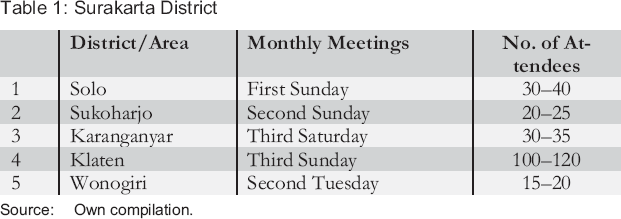
Surakarta District
Source: Own compilation.
Banyumas District
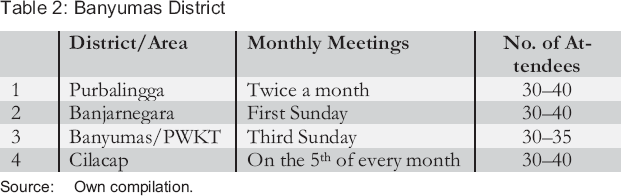
Source: Own compilation.
Kedu District: There is a meeting every three months, the location changes. It is attended by approximately 50 to 60 people.
There are thousands of victims from 1965 who have yet to join our organisation. SekBer ‘65 continues to hold these meetings routinely in order to build this community and to collect concrete data about 1965. Some of the members who have joined in recent years have passed away.
On financial matters: Since its founding in 2005, SekBer ‘65 has yet to secure ongoing funding. What funding is received is sporadic. As a result, SekBer ‘65 holds fund-raising events and collects donations in other ways, some from members of SekBer ‘65 who are financially able to donate. These funds are donated freely, and it is because of these generous donations that SekBer ‘65 has been able to operate. The members of SekBer ‘65 often feel as if it is the place where they can go to work together, and this is perhaps why they donate. The challenges faced by SekBer ‘65, however, are many and come from both internal and external sources.
Activities Carried Out by SekBer ‘65
SekBer ‘65 carries out political education activities for the victims of 1965, including by holding regular, scheduled meetings. At these meetings, political events and issues which concern them are discussed. These discussions inform the direction members of Sek-Ber ‘65 wish to go in our campaigns.
We also conduct political education activities with youth groups. These activities also aim to inform young people about Indonesian history.
SekBer ‘65 works to form networks with groups and individuals outside the 1965 victim group in order to build alliances and inform public opinion, including on public policy.
We continually compile information about survivors (currently there are listings for 1,167 survivors in our database).
We document the locations of mass graves.
We create documentary films which incorporate survivor testimonies.
SekBer ‘65 functions as a centre for investigation into the events of 1965/1966.
Activities Relating to the “Year of Truth-Seeking” (Tahun Pengungkapan Kebenaran) Campaign
As part of the “Year of Truth-Seeking” campaign, on 13 December 2012, SekBer ‘65 worked with the KKPK (Koalisi Keadilan dan Pengungkapan Kebenaran) to hold a public hearing with the motto “The Truth is Our Future” (“Kebenaran Adalah Masa Depan”), at the Surakarta deputy mayor's residence.
This public hearing was not designed to re-open old wounds but was rather intended as a form of community remembrance in order to preclude that these kinds of tragedies and terrible events be repeated by future generations. Violence is never a viable option. Violence is never the answer. In this public hearing, six survivors testified to past human rights violations:
Magdalena Kastinah, a woman who was imprisoned for 14 years and detained at the Plantungan women's internment camp, had been arrested when she was 17 years old after having been accused of being a member of Gerwani and a participant in the coup at Lubang Buaya, even though she had been living at Purwokerto at the time, a long way from Jakarta.
Djasmono Wongso Pawiro, a victim of 1965, had been detained on Buru Island for 13 years.
Sanusi, a victim of 1965, had been detained on Nusakambangan Island for 8 years.
Sudiharjo, a victim of 1965, was imprisoned in a detention camp in the city of Solo for 7 years.
Budiarti, the mother of an activist who was kidnapped and killed during the 1998 Reformasi demonstrations and his body was thrown into Hutang Magetan.
Sugeng Yulianto, a victim of the Talangsari/Way Japara case, was imprisoned on Nusakambangan Island for 10 years, accused of supporting a separatist Islamic nation.
This public hearing was moderated by a member of the Citizen's Board, which is made up of public figures, academics, religious and professional leaders and whose job it is to ask questions without judgement, and to prompt memories from the victims so that they might be shared honestly and completely.
Leading up to the public hearing, SekBer ‘65 had been gathering filmed documentation since October 2012 on the six victims’ experiences of human rights abuses, which included four short film clips with testimony from the 1965 victims who had been detained on Buru Island, Nusakambangan Island, the Solo city camp and the Plantungan women's internment camp.
In order to build public awareness and support for the public hearing, on 20 November 2012, SekBer ‘65, together with the Department for Communication and Information, held a book launch for a new book edited by Baskara T. Wardaya, Suara Di Balik Prahara (English publication title: Truth Will Out), at the Surakarta Press Monument. This event was opened by the mayor of Surakarta/Solo, F. X. Hadi Rudyatmo. The radical Islamic leader and founder of Mega Bintang, Modrick Sangidu, also gave an address. The event was attended by 225 people, despite the fact that the committee had issued only 150 invitations.
One of the conditions imposed by local administrators for holding the public hearing was consultations with the victims of serious human rights abuses in the Solo region, and communication with various sectors of the public (religious leaders, public figures, youth and student organisations, NGOs, educators and trainers, and city officials) and the media to build public support for the truth-telling event, letting people know about these past violations and the struggles of the survivors. The KKPK campaign, of which SekBer ‘65 is a part, is pushing for 2013 to be the “year of truth”.
Mass Grave Sites
The tragedies of 1965 and 1966 represent some of the worst instances of crimes against humanity of the twentieth century. Hundreds of thousands, if not millions, of people were slaughtered by civilians and soldiers. People were captured, tortured, raped, killed and illegally detained without any due process. This dark history affected many Indonesians, including those who were members of the Indonesian Communist Party (PKI, Partai Komunis Indonesia), and its associated organisations, such the BTI (the Indonesian Farmers’ Front), PR (the People's Youth), Gerwani (the Indonesian Women's Organisation), LEKRA (the People's Cultural Institute), the IPI (the Indonesian Students’ Association), the CGMI (the Central Indonesian Students’ Movement), SOBSI (the All-Indonesian Union Organisation) and many more. Even sympathisers and those who were in no way connected with these organisations were affected. If a soldier fell in love with another man's wife, he could simply take her. In order to do this, he would accuse her husband of being a member or sympathiser of the PKI; the husband could then be imprisoned, tortured and killed, and his wife would subsequently be taken. There have been many witness statements made by survivors both as oral histories and written records that have been published in the media, in books and in other outlets. But there is still not systematic record of all the mass grave sites, partly because no records were kept at the time. These mass grave sites provide evidence for how complex the violence was in 1965/1966.
Why is this data collection and research on mass grave sites yet to be done? To put it simply, the situation in Indonesia today and the current political conditions do not permit it. The New Order's influence is still very strong, particularly in the area of security. But if we do not begin this research into the mass graves now, they will never be found: First, many of the direct eye-witnesses have already passed away; second, these sites will be lost in time as eye-witnesses will no longer be able to identify locations; and, third, civil society groups still face threats and pressure from security forces, particularly the army. With these considerations and risks in mind, SekBer ‘65 continues to carry out this work on mass grave sites because they are physical evidence of the violence perpetrated in 1965. SekBer ‘65 has already investigated 18 grave sites in Karanganyar, Wonogiri, Sukohargo, Boyolali, Klaten and Banyumas. In Solo, the bodies of victims were thrown over the Bacem Bridge into the Bengawan Solo River. Many of the victims were executed by being shot, and many were tortured beforehand.
At this time, SekBer ‘65 is working to uncover two mass grave sites in the Klaten region. What follows is the testimony of the witness who led members of SekBer ‘65 to the location of these graves.
First Witness Testimony
Name: Gunardi; Age: 64; Residence: Klaten
Chronology of Events
This mass grave holds victims of the massacres who were killed by civilian militias. The position of the mass grave is actually in the open area in front of Gunardi's house. At the time of the killings, Gunardi was only 16 years old and was attending school in Yogyakarta.
According to Gunardi, it was his father's position as a local PKI leader which led to the events that followed. His father, Purwodisastro, was quite well known in his village, as a local leader and a quite well-off farmer. Their house was used as a place for people to gather, to practise dancing and for other activities. He was a well-respected local PKI leader who cared about his community and often defended the rights of the poor.
Before the 1965 coup, Purwodisastro had dug a deep hole behind their house to be used for a septic tank. Before he had finished digging the hole, the coup at Lubang Buaya in Jakarta occurred. In a truly frightening turn of events in Klaten, Purwodisastro was accused of digging the hole so that he could use it to dispose of the bodies of the PKI's enemies. The soldiers gathered a crowd and went to Purwodisastro's house. That night, Purwodisastro (who was also known as Ngadenan), Suparjo (Purwodisastro's younger brother), Parto Suwarno (his brother) and six other people were attacked by the mob. Before they were killed, three holes were dug in the open area in front of Purwodisastro's house (1 × 3 metres each). Purwodisastro was stabbed and tortured by the mob in a cold-blooded way, his throat slashed, garrotted, and then his body buried in one of the holes along with his friends and relatives. The open area in front of his house became the mass grave for all nine. After the mob had killed Purwodisastro and his relatives, they then set fire to his house. Fortunately, it did not burn down completely.
Sumiyati, Purwodisastro's sister, who was nearby when this happened, said she could hear the screams of the victims from their parents’ house. After hearing their screams and witnessing their murder, Purwodisastro's parents went mad. There was blood spread throughout Purwodisastro's house. The victims were simply thrown into the hole, like animals, the mob treating their bodies with no respect and seemingly feeling no guilt about it. They were instead satisfied with having perpetrated these killings.
In addition to this mass killing, the hole that had been dug for the septic tank behind Purwodisastro's house was used as a mass grave for another 21 victims. These 21 victims were shot and killed. So, in the end, Purwodisastro's house became a mass grave.
Currently, the house is occupied by Purwodisastro's second child, Gunardi, along with his wife and children, his mother-in-law, and grandchildren. The layout of the house has not changed. The grave containing the nine victims, including Gunardi's father, is still in the open area in front of the house, and there are still 21 people buried in the hole behind the house. Gunardi stated,
I have never changed anything, or moved their bones, became I'm not game to. If I did, the government or the army would harass me. I will just stay here in my father's house, Purwodisastro's house. I have a simple hope, that my father and the others will someday be buried properly.
Second Witness Testimony
Name: Suparjo; Age: 74; Residence: Klaten
Chronology of Events
Suparjo explained: I was arrested without due process and imprisoned in Klaten. In the interrogation process, I was tortured. I was kicked, beaten, thrashed with a wire, and beaten with a rifle butt. Essentially, I was ordered to confess that I was a member of the PKI, even though I wasn't. I had only hung out a few times with PKI members from the village or people who were considered members of the PKI. What did I do wrong by simply talking with them? And the PKI was a legal party at that time. They used every method to try to get me to confess. But I would not, because I wasn't a PKI member. My interrogators were from the police, the army and from the civilian militias and all became increasingly frustrated with me, so they decided that they would kill me.
On the first day, a group of nine other prisoners and I were forced onto a flat-bedtruck. We were then taken by some soldiers and militias to a place near a bridge. Once we arrived, one by one we were ordered to get down. And then one by one the prisoners were ordered to squat down so that their throats could be cut. If they didn't immediately die, the soldier would shoot them in the head – bang! Then the prisoner would die and would be thrown down [into the river]. Then the next one was called and would be killed the same way. If a prisoner was garrotted and shot and still wasn't dead, then the soldier would say, “Sorry, I'm just a soldier and I'm just following orders.” And then, bang! Over and over. Bodies fell on top of bodies. I have no idea why, when it finally came to my turn, the last person, the executors just forgot about me. Maybe God intervened on my behalf.
On the second day, the same thing happened. I was put on the same truck with the other prisoners, only there were more victims this time. There were about eleven of them and they told me that they were from near Merapi. They were killed in the same way as those on the first day. This time people from the community saw the executions as well. Nothing changed. They were all thrown down the same way. That is, along the side of the road beneath the bridge beside the river. And after they were killed one by one, their bodies were simply thrown down, buried just like that. And on the second day, I again escaped death.
On the third day, the same thing happened once again. There were nine people who were to be killed. I didn't know who they all were, and I didn't know the killers. I only knew that they were all wearing military uniforms, and that there were also a few civilians. On the third day, I also escaped this sadistic death. I think God kept me safe and that it was a miracle.
One day after this third day, my older brother became the local village leader [lurah], and came to take me away from the prison. I thought to myself, what if I escaped from death because my brother became the lurah? That was probably the reason. Even though I escaped death, I still remember how those people were killed, when their throats were cut and they were shot in the head. The blood spilled across the ground and the smell of it assaulted your nose. I still have waking dreams about it, and wonder how those killers could do what they did so calmly? I still don't know the answer. I want to testify about this, because I'm already old and I want to be rid of this burden. And I hope that, for the sake of the younger generation, such things never happen again.
Conclusion
From the statements by the two witnesses above, it is clear that the tragedy of 1965/1966 involved mass violence and many killings. According to the testimony, the perpetrators were from the military and they worked with the civilian militias in an organised fashion. The killings were systematic and carefully planned. The massacres took place without any form of judicial process. As such, it is clear that the forced disappearances and killings had been planned.
There are many mass graves in the regions. SekBer ‘65 is continuing its focus on studying these mass grave sites. However, SekBer ‘65 will not be involved in exhumations, for a number of reasons: First, the task of uncovering these graves in the responsibility of the state. Second, SekBer ‘65 does not want a recurrence of the terrible events that followed the mass grave exhumation carried out by the YPKP (Yayasan Penelitian Korban Pembunuhan, Research Foundation for Victims of Murder) in Wonosobo, in which civilians, backed up by the military, refused to allow the bones of the victims to be reburied. The YPKP achieved nothing by the exhumation. In addition, the survivors of 1965/1966 remain traumatised and are continuously viewed with suspicion in their communities. Third, it remains unsafe to attempt any further exhumations. Fourth, the safety of eyewitnesses who reveal the locations of mass graves cannot be ensured.
These four factors have led SekBer ‘65 to decide that it is best to carry out investigations into the mass grave sites through documentation, the recording of data, looking for primary and secondary witnesses, and drawing up maps that indicate the location of mass graves, taken from eyewitness testimonies. This work is done carefully in light of the security and safety issues. But we are also aware that sometimes we must confront these issues. Our main concern regards how to protect eyewitnesses and find funding to carry out our work.
Recommendations
Aside from political concerns, there remains little understanding of the human rights violations perpetrated during 1965/1966, mainly due to the complexity of the violence which took place at that time. The events of 1965 need to be understood in terms of their massive scale, the number of victims, the various regions, the types of violence perpetrated, and so on; it also needs to be emphasised that this violence occurred in almost all regions of Indonesia.
Reflecting on the complexity of the tragedies of 1965/1966, on the fact that these complicated events involved all state institutions and with the evidence that there are mass graves across all regions, it is important that the state acknowledge that the events of 1965 and 1966 constituted serious human rights violations. Along these lines, SekBer ‘65 calls for the state acknowledge the events of 1965/1966 as an episode of grave human rights abuses. Why should the state acknowledge this? Because the current government continues to deny that the events of 1965/1966 were a crime against humanity; rather, it upholds the propaganda created during the New Order regime which posits the PKI as a dangerous enemy that needed to be destroyed in order to save the nation. Because of this, our suggestion is that the state resolve this tragedy by means of reconciliation. In this, we concur with the recommendation made by Komnas HAM that these human rights violations be resolved by non-judicial means (such as by a TRC). However, the suggestion of non-judicial resolution is by no means ideal, particularly when viewed from a legal perspective.
Yet, reconciliation offers a relatively simple way forward in the current political climate. The more ideal method for dealing with these events would be to hold an ad hoc human rights court. Given the condition of the legal system in Indonesia at this time, the setting up of such a court is unlikely in regards to any of the instances of abuse mentioned in this paper, including the case of the assassination of Munir. None of these cases has been resolved adequately. In our opinion, therefore, reconciliation is the only realistic option.
The road to reconciliation, however, is not easy. There are many groups in society who resist reconciliation, so the government continues to hesitate to take steps. Meanwhile, if the government allows these cases to remain unresolved, these old wounds will fester. The crimes of the past cannot remain a burden for future generations. The government of Indonesia needs to realise this. SekBer ‘65 understands that it is only a small organisation near Solo, far from the central government. As an organisation, we are clearly limited in both funds and human resources. It is our hope, however, that the international community will pressure the Indonesian government to deal with these serious human rights violations.
SKP-HAM (Solidarity with Victims of Human Rights Violations), Central Sulawesi
Solidarity with Victims of Human Rights Violations (Solidaritas Korban Pelanggaran Hak Asasi Manusia – SKP-HAM) is an organisation that advocates on behalf of victims of human rights violations and their families. It was formed on 13 October 2004 in Palu, Central Sulawesi. Central Sulawesi has been the location of several such episodes of human rights violations – for instance, the humanitarian tragedy of 1965/1966, the Dongi-Dongi farmers’ case, the Maesa Palu bomb case, the Poso conflict case and many others. To help the victims and their families recognise and fight for their human rights, the Institute for the Study of Law and Human Rights Advocacy (Lembaga Studi Advokasi Hukum dan HAM – LPS-HAM), assisted by the Commission for Missing Persons and Victims of Violence (Komisi Untuk Orang Hilang dan Korban Tindak Kekerasan – KONTRAS) and the Indonesian Association of Families of the Disappeared (Ikatan Keluarga Orang Hilang Indonesia – IKOHI) initiated the formation this organisation.
As an organisation of victims, SKP-HAM focuses on human rights in order to organise, strengthen and empower the victims of human rights violations and their families. Therefore its vision is to embody solidarity and justice for the victims of human rights violations and their families, in order to create a just and democratic society. To realise this vision, SKP formulated four activist agendas that jointly comprise its mission:
to encourage solidarity between victims of human rights violations and their families, and to become a place for the struggle of victims and their families to defend their human rights;
to struggle for the resolution of cases of human rights abuse;
to unleash the social, political, economic and cultural potential for advocacy on behalf of victims and their families; and
to struggle for the achievement of a just and democratic society.
After being active for eight years, the organisation continues to grow. What was originally an effort to gather together and organise victims has become a major human rights campaign. This development occurred in unison with increasing awareness among the victims that they could assert their rights without relying on accompanying organisations. SKP-HAM is also heavily involved in an effort to create a database of victims of human rights violations. As an initial step toward this database, cases of human rights violations connected to the tragedy of 1965/1966 have recently been documented in four regions: the city of Palu, Donggala district, Sigi district, and Parimo district. As a result of this documentation programme, SKP-HAM recorded how 1,210 people in Central Sulawesi became victims of the tragedy. Beyond this number, of course, lie the stories of many more victims which have not yet been recorded.
In creating the database of victims of the humanitarian tragedy of 1965/1966, SKP-HAM joined with groups in Java, Jakarta, Sumatra, Borneo, Bali and Sulawesi. They then formed the Network for Joint Documentation (Jaringan Dokumentasi Bersama – Jardokber). One of the members of Jardokber is the International Centre For Transitional Justice (ICTJ Indonesia). It is this institution which supports SKP-HAM with funding to carry out the latter's documentation work.
The cooperation with ICTJ Indonesia for the purpose of documentation was established in 2010 and 2011. Prior to this collaboration, SKP-HAM had already been collecting data and personal documents belonging to victims. This process of documentation began in 2005 in a variety of ways: inviting victims to remember and record lists of their friend's names, asking victims to write down their life stories, and asking victims to write the story of a friend who had died. We also explored the stories of victims through witnesses such as village heads, imams, and actors on the ground who were involved in the capture of the victim at the time in question. We collected documents in the form of letters of release from detention, copies of ID cards, photos of victims, and other important documents belonging to victims. From Koramil and villages’ head offices in the city of Palu and the district of Donggala we received documents in the form of registration sheets of the victims’ families.
Learning from previous experiences of collecting data and documents from victims, SKP-HAM continues to develop methods to encourage the participation of victims’ families. On these occasions, the child, spouse, grandchildren, and daughters- and sons-in-law or other close family members are trained to become documenters of the victim's life story. Acts of violence experienced by victims are recounted quietly amongst community members. Unfortunately not all narration processes run smoothly, as the trauma that has been haunting victims over the years becomes an obstacle in the interview process. Some victims decline to tell their story to their own family members who become documenters. At the same time, the documenters get tired of constantly being rejected by the victim. But over time, the narration process eventually comes into motion, albeit through several separate interviews, held over a duration ranging from one month to one year. This long process turns out to benefit the recovery of trauma victims. Often a victim feels more peaceful after telling stories from 1965 and 1966 to their own family.
The results of the documentation by SKP-HAM are very meaningful for the struggle of the victims in Central Sulawesi. The documentation approach succeeds when a victim (korban) recovers from the trauma and thus becomes a survivor (penyintas). Although not all victims have recovered from their trauma through this approach, the journey of building the organisation over the past eight years still made them realise that the rights of victims of human rights violations must be fought for by these victims and their families themselves. Armed with the results of our documentation, we were also able to strategise on how to approach the local government in Palu and the provincial government of Central Sulawesi in order to open up communication about the rights of victims. These attempts eventually paid off: Victims of 1965/1966 in the city of Palu received acknowledgement from the mayor, H. Rusdy Mastura. In an open dialogue event commemorating the Day of the Right to Truth and the Dignity of Victims of Human Rights Violations (24 March 2012), the mayor delivered an apology to the victims on behalf of himself as a person and on behalf of the government of the city of Palu.
This apology from the mayor of Palu is currently becoming the basis of a formal decree on behalf of the local government. The decree will also regulate a program for the rehabilitation for victims. The initiative of the Palu city government has the support of the National Human Rights Commission (Komnas HAM), the National Commission for Women (Komnas Perempuan) and the Witness and Victim Protection League. The KKPK, a national coalition that also pushes for the completion of cases of human rights abuse, became another active driver of the rehabilitation programme for the victims in Palu. Even though governmental recognition has just been received from the mayor of Palu, we hope the mayor's policy will inspire other local governments in Central Sulawesi, and possibly even local governments across Indonesia.
Syarikat Indonesia, Yogyakarta
The modern Indonesian nation-state's journey through the decades has been marked by conflicts which have claimed the lives of many citizens. These conflicts have often been in the form of political confrontations in which class, ethnic and even religious sentiments have been exploited to incite violence. As we know, in conflict and post-conflict situations, women are often made vulnerable to particular forms of violence. When viewing the many conflicts which have occurred in Indonesia, women as a group have also often borne the brunt of disadvantage as, apart from becoming victims, they also became responsible for sustaining their families and households. Female victims have also been discriminated against and stigmatised by both the state and society.
Syarikat Indonesia was founded on 10 December 2001 by a number of organisations, including LAKPESDAM Jakarta, P3M Jakarta, INC RES Bandung, LAKPESDAM Cirebon, INDIPT Kebumen, KOLMAS TER Wonosobo, LKIS Yogyakarta, LKPSM Yogyakarta, LKTS Boyolali, LPAW Blora, ALUR Batang, LEPIM Kediri, LPSM Salatiga, FSAS Jepara, LAKPESDAM Blitar, LAKPESDAM Pasuruan, SD INPERS Jember, and LAKPESDAM Banyuwangi (all local NGOs which focus on human rights).
The founding mandate of Masyarakat Santri unuk Advokasi Rakyat (Religious Society for Advocacy on Behalf of the People), or Syarikat, is to work towards conflict resolution through reconciliation by using culturally appropriate methods to directly target the grass-roots levels of communities, first and foremost by focusing on past conflicts which have had the greatest effect on citizens of the country, especially women. Syarikat Indonesia is a network organisation which in the course of its development has come to include networks in thirty cities in Java and Bali. The secretariat of the network is in Yogyakarta. In its organisational structure, Syarikat consists of the following three organs:
the Syarikat Indonesia Council (Majelis Syarikat Indonesia), which acts as a board of trustees and consists of founding member associations and individuals who are concerned with human rights and democracy, including: M. Imam Aziz (chairman of PBNU), Kamala Chandrakirana (former chairwoman of Komnas Perempuan), Hilmy Aly, Candra Aprianto, Saiful Huda Shodiq, Loly Suhenty and Ruth Indyah Rahayu;
the Executive Secretary (Sekretaris Eksekutif), a position currently held by A. S. Burhan; and
the Network Meeting Body (Musyawarah Jaringan), the highest decision-making body in the organisation, which meets every three years and decides on the strategy and direction of the organisation.
Syarikat Indonesia aims to set up grass-roots reconciliation movements by positioning community initiatives as both the means and the end of reconciliation. This decision was taken for several reasons: The first consideration stems from the fact that the conflict which erupted in 1965 was on such a large scale in terms of its geographic spread and the number of victims, and the stigmatisation after the conflict was so widespread and severe and not only affected the victims themselves but also their extended families. The nature of the stigma visited upon the victims and their families also involved the loss of their civil and political rights, as well as of their economic, social and cultural rights, forming several layers of stigmatisation. Yet all these past and present conflicts also involve other civilian groups as perpetrators. Syarikat Indonesia carries out the following activities in order to bring its strategy of reconciliation as a grass-roots movement to fruition:
These investigations are carried out by gathering and compiling data about cases of conflicts that have victimised various groups in society or particular communities. It is hoped that the research results can be used to change public perceptions and attitudes, as well as that they will serve as the basis and the primary material for mediation at the community and the grass-roots levels.
Mediation
This is the process of developing consciousness and understanding both among the victims of conflict and between victims and perpetrators. It is done through goodwill meetings, social, economic or cultural activities, or joint humanitarian actions. These activities form a starting point for those involved to meet and mutually share with each other the goal of reaching reconciliation, to create a common space in order to apologise for and forgive the actions of the past, as well as to prevent past conflicts from being repeated in the future.