




Abstract
In this article, findings from 300 standardized interviews with representatives of Civic Organizations in Ho Chi Minh-City and Ha Noi are presented. Following a view of civil society as a specific mode of social action and interaction, data analysis unveils the existence of core dimensions of such action (respect, empathy/ sympathy, and the willingness to compromise and stick to agreed-upon rules), though the respective values of those dimensions vary strongly. Inseparably linked with such civil society action of whatever kind is consensus-seeking, an aversion to conflicts, and an affinity to synthesis. These attitudes and practices, dominating various Civic Organizations’ internal decision-making processes, represent elements of authoritarian political thinking in Civic Organizations’ leaders’ mindsets and courses of action. Combined, those characteristics make up civil society action “in Vietnamese colours”.
Introduction: Civil Society Action as a Resource for Governance
Governance is a scarce good, as Peters (2001) once ascertained (Peters 2001: 4). This thesis is especially applicable to Vietnam. The assumption that lies at the centre of the research project this article reports on is that this good has become so scarce that Vietnam faces a time of especially great difficulty – even danger – in all three of the functional areas of governance: legitimate rule, security, and welfare. 1 Suffice it to mention the following:
The author wants to express his sincerest thanks to German Research Foundation (DFG) that funded the project for a term of 24 months and to the German Institute of Global and Area Studies (GIGA), which added funds for an additional two-month period. Furthermore he wants to thank two anonymous referees and Michael Nelson for extremely helpful comments on a first draft of this article.
In the sphere of legitimate rule, a largely unchanged formal governance architecture as laid out in the Vietnamese Communist Party's 1991 manifesto (platform) is preserved. Governance difficulties are related to “a weakness of hierarchy within the Party-State apparatus” (Fforde 2009: 82). Thus, it proves difficult to gather and to focus state power for the purpose of coping coherently and deliberately with the various demands which Vietnam faces en route to middle-income status. Another manifestation of governance weakness is corruption. Well-informed observers even claim that corruption is rising.
In the area of security, forms and processes of governance that help to mediate conflicts are scarce. Capabilities for solving conflicts without resorting to authoritarian and/or even violent means are only slightly developed in the state as well as in the societal sphere. Outbreaks of violence in cases of strikes or so-called “re-dedication” of farmland, and the allocation of such land to investors, are a case in point. But violence against women is even more frequent. According to various Vietnamese studies, gender-related violence is a widespread “everyday phenomenon”.
In the sphere of welfare, forms of “de-regulation”, i.e. self-regulation that is hardly regulated at all, dominate. As a result of a policy of privatization of previously public goods and services, many citizens can hardly afford or have no access at all to education and health services despite the government's efforts to introduce a modified and new public welfare and social security system. The government's efforts notwithstanding, many HIV-positive persons and AIDS patients, but also drug addicts and sex workers face various problems in accessing medical and social services.
Forms of political and social exclusion, lack of intersubjective-sociocultural recognition and economic discrimination call into question core principles of a socialist republic – equality and justice – espoused by the Communist Party of Vietnam.
Thus, at the centre of the socio-political challenges is the Communist Party of Vietnam. Ruling single-handedly, its ability to govern seems to be quite limited: “The Party continues, at roots, to rule rather than govern” (Fforde 2005: 1).
Additional and/or new resources for the amelioration of the symptoms of those challenges brought on by the existing forms of governance are of great importance in this situation. Civil society action is the kind of new and additional resource that could help to lessen if not to resolve the problems in all three functional areas of governance; for example, it could help governance structures change to achieve more equality and justice.
The general goal of the research project is to investigate the accomplishments of civil society action in respect to changes in governance in Vietnam.
In this article empirical findings are presented from Part One of the research project, in which specifics of civil society action in Vietnam were explored. Our research approach is based on a sociological understanding of civil society that differs from a conventional understanding of civil society and offers intriguing new insights into the specifics of the social action of the representatives of various Vietnamese Civic Organizations.
Within the last decade quite an impressive number of studies on civil society, Civil Society Organizations (CSOs) and Civic Organizations in Vietnam have been published. Norlund (2006, 2007), Hannah (2007), Menge (2009) and Lux and Straussmann (2004) focus explicitly on the subject of civil society. Kerkvliet et al. (2008), Thayer (2002, 2009), Abuza (2001), Wischermann (2002, 2003), Wischermann and Nguyen Quang Vinh (2003) and other authors in their contributions to Kerkvliet, Heng, and Koh (2003) focus on the relationship between CSOs or Civic Organizations and the Vietnamese state.
From a theoretical point of view, most analyses of civil society in Vietnam (and elsewhere) are based on the premise of a domains-based approach. Following the basic assumptions of this specific understanding, civil society is a realm separate from the state, economy and the private sphere, in which associations of various sorts are active and in one way or the other are serving democracy and/or processes of democratization and/or at least pursue common interests if not the common good. 2
Diamond (1999), in a widely used definition, characterizes civil society as “the realm of organized social life that is open, voluntary, self-generating, at least partially self-supporting, autonomous from the state, and bound by a legal order or a set of shared rules. It is distinct from ‘society’ in that it involves citizens acting collectively in a public sphere to express their interests, passions, preferences, and ideas, to exchange information, to achieve collective goals, to make demands on the state, to improve the structure and functioning of the state and to hold state officials accountable. Civil society is an intermediary phenomenon, standing between the private sphere and the state” (Diamond 1999: 221). In a similar and also widely used definition Anheier (2004) characterizes civil society as “the sphere of institutions, organizations and individuals located between the family, the state and the market in which people associate voluntarily to advance common interests” (Anheier 2004: 22).
However, a closer look at some assumptions this approach is based upon unveils problems that are even more important when an analysis of civil societies in authoritarian regimes such as the one existing in Vietnam is intended. 3 Suffice it to mention just four problems:
The term “regime” is used here in an analytical way and in a sense that answers Snyder's (2006) four questions which help to classify the respective regime type: “(1) who rules? […], (2) how do rulers rule? […], (3) why do rulers rule […], (4) how much do rulers rule?” (Snyder 2006: 1). Due to a lack of space here, it is not possible to describe and analyze the specifics of the authoritarian character of the Vietnamese political-administrative system.
This approach presumes clear-cut boundaries between the state and civil society (at least in an ideal type of the concept) and civil society is thought to be (fully) “autonomous from the state” (otherwise it can not fulfil its tasks, for example to limit the power of the state). 4 Even Diamond (1999) admits that the boundaries between state and civil society are always blurred and are thus a matter of degree rather than a matter of an either/or view (Diamond 1999: 224). Furthermore, there are good reasons to assume that the relationship between state and (civil) society in any kind of regime is based on “interrelatedness rather than separateness” and is thus “more complex and reciprocal than the state-society dichotomy depicts” (Beckman 2001: 55). It might be more fruitful to assume that civil society “exists by virtue of state-society interaction, not as something in between, separate from or autonomous from either” (Brook and Frolic 1997: 12).
It would be even more difficult to assume the whole civil society as opposed to the state: “Civil societies elsewhere include both those associations that strive to limit state power or even change the regime and those who cooperate with the state in achieving their goals. The interaction between the two realms thus includes conflict, compromise and cooperation at the same time” (Perinova 2005: 7).
Civil society is also depicted as separate from the economy. But boundaries between civil society and the economy are also blurred. Keane (2001), referring to similar discussions on global civil society and their relationship with the capitalist economy, criticizes that “the dualism between market and global civil society […] is a phantom, a bad abstraction, for in reality markets are always a particular form of socially and politically mediated interaction structured by money, production, exchange, and consumption. Global civil society […] could not survive for a day without the market forces unleashed by turbo-capitalism. The converse rule also applies” (Keane 2001: 31).
Based on the logic of domains there is the problem of deciding who should be seen as actor(s) within this realm. In the case that all actors in this realm are automatically included, then hate groups and criminal gangs could also be seen as civil society actors. Thus, in analyses based on a realm-based approach, specific types of associations are introduced and specified as “civil society-like organizations” (especially NGOs) and/or normative criteria such as tolerance, adherence to non-violent behaviour and the like are used in order to differentiate between civil and “uncivil” actors and behaviour. 5 Such classifications based on fixed (Western) norms more often than not lead to assessments that conclude that civil societies in the “Third World” are “weak”, not (yet) “fully developed” and the like.
This problem is mirrored in the question of whether kinship- and ethnicity-based groups and organizations should be included. Gellner (1994) once argued that civil society does not include organizations that are based on family relations, since civil society action should (if at all) not solely be directed against a tyrannical state, but also against “the tyranny of the cousins” (Gellner 1994: 7).
Last but not least, this approach is based on the assumption that civil society and civil society organizations have the power to strive for democracy, promote and strengthen democracy and processes of democratization or at least strengthen the development of democratic virtues. However, if not for theoretical reasons (convincingly presented in Warren's 2001 seminal analysis of the relationship between associations and democracy) then for empirical reasons it must be concluded that not all associations are democratic, virtuous or trustful, let alone that in their struggle to fight for their various interests they are always and exclusively non-violent as far as the means applied are concerned. Civil society as a “catch-all concept” can not be depicted as conducive to democratization as a whole (Abrahamsen 1996: 20).
A way out of such problems seems to be offered by Croissant, Lauth, and Merkel's (2000) conceptualization of a “structural-functional” approach. Directed at a de-historization of civil society, Croissant, Lauth, and Merkel (2000) discern five functions civil societies perform (these functions are thought to be more or less invariant) and combine these functions with two normative criteria that should help to exclude that each and every association could be called a civil society actor – namely a commitment to strictly non-violent behaviour and political and religious tolerance (Croissant, Lauth, and Merkel 2000: 18). Their approach is relatively open to analysing the “dark sides” of civil societies and not every contribution of civil society is seen as conducive to democracy. Moreover, the importance of context (institutions, socio-cultural vestiges, economic conditions, international environment) as regards various shapes of civil society is stressed. However, this approach was developed in order to analyse the role of civil societies in the course of processes of democratization and it rests on strong and rather contentious normative foundations. Both characteristics limit the usefulness of this approach for analyses as far as Vietnam is concerned – and this is even then the case when Uphoff and Krishna's (2004) excellent idea of understanding civil society and the relationship between civil society and the state “as a continuum and not as a buffer zone” is applied. Here I refer to Hannah (2007) and Menge (2009) who both applied such a structural-functional approach and followed Uphoff and Krishna's suggestion in a very creative way.
In sum: In domains-based approaches, presumptions such as “autonomy of civil society” and the role of civil society as
countervailing powers create together an image of state–society dichotomy in which the state is associated with coercion and civil society with freedom and in which these two realms are opposed to each other. This view […] tends to preclude that civil society can exist only under more or less democratic regimes, because it is obvious that under authoritarian rule no organization can be wholly autonomous and separate from the state (Perinova 2005: 7). 6
This argument mirrors what is called Walzer's “paradox of the civil-society argument”. This paradox basically says “that a democratic civil society seems to require a democratic state, and a strong civil society seems to require a strong and responsive state. The strength and responsiveness of a democracy may depend upon the character of its civil society […], reinforcing both the democratic functioning and the strength of the state. But such effects depend on the prior achievement of both democracy and a strong state” (Foley and Edwards 1996: 48).
Following approaches based on such assumptions makes it rather difficult, at the very least, to analyse civil societies under authoritarian rule. Following a structural-functional approach yields little since Vietnam is not in transition to democracy.
We follow a view of civil society based on the logic of action rather than a conceptualization based on the logic of domains. In our understanding, civil society is a particular mode and interaction within a given society and not a fixed entity. It manifests itself in those concrete actions, and also in social institutions. Thus, we understand civil society not as a noun but as an adjective that describes a certain kind of action (Uphoff and Krishna 2004: 358). Moreover, we see civil society action as a relationship (between people; between people and the state and/or the economy; between various actors’ practices and what constitutes those practices, value- and/or norm-wise, etc.). 7
This approach has been worked out by scholars from the Social Science Research Center Berlin, namely Dieter Gosewinkel and Dieter Rucht, Shalini Randeria (now at Zürich University), Sven Reichardt (now at Konstanz University), Paul Nolte (now at Freie Universität Berlin) and Jürgen Kocka (Chair).
Our research project explores interactions and concrete actions within the Vietnamese society and in state agencies as well as in the economy. More specifically, our research is not on civil society as such. Rather, we focus on what Vietnamese actors call civil society and what in their view constitutes civil society action; we explore what motivates them to engage in Civic Organizations; and we ask for their view on their Civic Organizations’ relationships with the State and Governmental Organizations. In doing so, we neither presuppose a specific set of values and norms (for example tolerance or non-violence) nor do we assume beforehand a specific mode of relationships between actors and their organizations and the state and the economy (for example opposition between civil society's actors and the state). Hereby, the respective understanding of what civil society and civil society action is or should be and what is at its centre stage is in itself the subject of the exploration.
However, applying an actors-centred approach does not exclude an appraisal of actors’ views, attitudes and practices. This is done by applying a theoretically founded understanding of civil society action and an assessment tool based thereupon (“civil society action as a continuum”).
Theoretically we proceed from the assumption that civil society action differs from other types of action and interaction, namely from power and rule, with the concomitant hierarchical relationships; exchange and other market-related activities; that of family and kinship that is based on closeness and personal relations; last but not least that of fighting wars and other acts of unrestrained and indiscriminate use of force. Civil society action realizes and manifests itself in social interactions which draw boundaries within (against what is seen at a specific time and under specific conditions as “un-civil” terms of action) and without (here we assert a form of action with its own inner logic in respect to: power-driven relationships, mainly that of the political-administrative institutions; money-based transactions of economic market places; communities mediating and mediated by kinship, social closeness, etc. (Gosewinkel and Rucht 2004: 51, 52). 8 Civil society action comes into being by way of the discourse on how to deal with force, power and social exclusion.
This understanding of specifics of civil society action derives from various sociologists’ (such as Parsons and Giddens), but also political scientists’ (such as Offe) and philosophers’ (for example Habermas) analyses of modern capitalist and other societies. Their analyses are based on the assumption that within such societies various societal subsystems such as economy, state and a private sphere do exist and that all these subsystems are equipped with specific means of social coordination which help to coordinate actors’ activities. In this (third) sphere, civil society is either included (as is the case in Habermas’ as well as in Giddens’ analysis) or the third sphere is reserved for family, and civil society is conceptualized as a fourth sphere, distinct from the realm of the private sphere. Furthermore these authors concur in the assumption that those various spheres penetrate each other and that they are merged; and they adhere to the assumption that different mechanisms exist in various ratios in all spheres but that they are dominant in only one of them (money, for example, in the market sphere, power in the state sphere; civil society action only in the third or fourth sphere) (Gosewinkel and Rucht 2004: 41–48).
Based on such a general description of civil society action and the delimitation of civil society action vis-à-vis action in the sphere of economy, state and community (“Gemeinschaft”), it is possible to define civil society action as a specific type of interaction which takes place in the public sphere, but also in other spheres.
This action and interaction is
founded on respect vis-à-vis the right to exist and room for development of other persons and groups – a right which has its limits at the point where others’ rights and collective goods are going to be violated. Such recognition is neither based on morals nor motivated by affections or emotions. It is based on the advantages of persuasive power that cooperation offers, and it reaches foreigners, the representatives of competing interests and values, within the framework of the above mentioned boundaries which are ultimately those of Kant's categorical imperative. Integrative and coordinating powers derive from the more or less abstract insight that peaceful coexistence and readiness to compromise offer enormous advantages. On the practical level such recognition crystallizes in procedural rules, i.e. the acceptance of certain ways of dealing with others. A sphere of interaction with such rules could be called civil society (Gosewinkel and Rucht 2004: 45, 46 [translation by JW]).
Mutual recognition is at the core of our understanding of civil society action and “the empirical validation of the principle of ‘mutual recognition’ is the central criterion of civil society” (Gosewinkel 2003: 5, FN 13 [translation by JW]). 9
Like the term civil society action, we do not understand this central criterion as a fixed term. Rather such terms are seen as developing over time, being developed by various actors, and thus, are in a constant flux. The respective sense is different at least to a certain degree for different actors according to the region in which actors apply it: Context matters. Civil society action has a fluid and localized character.
The basis for the acceptance of “mutual recognition” as the foundation of societal interaction might be the “insight that such action arises out of a general interest in justice and reason” as Gosewinkel and Rucht call it (Gosewinkel and Rucht 2004: 48, 49). But it might also have faith-based reasons, moral-related obligations or any other reason. Since in our research approach we take actors’ perspectives as an instructive point of departure, we have assumed and found a variety of reasons that help to establish mutual recognition (to a different extent and to a varying degree) at the core of civil society action in Vietnam.
Our understanding of civil society is not itself normative but “raises the empirical validity of certain norms to a criterion. In this way it is possible to come to a decision as to whether and to what degree one can speak of a civil society” (Gosewinkel and Rucht 2004: 49 [translation by JW]).
For heuristic purposes, we describe civil society action as follows:
Civil society relations imply respect, but not like-mindedness and social closeness; recognition of procedural rules, but not a commonality of world vision; readiness to compromise, but not a convergence of interest; empathy, but not unconditional identification (Gosewinkel and Rucht 2004: 50 [translation by JW]).
From an operational point of view, civil society action has the following four dimensions:
Empathy/ sympathy: These are two intertwined facets of a single, though multidimensional, phenomenon with cognitive as well as affective aspects, encompassing a set of constructs appertaining to responses of one individual to the experiences of another. We follow Davis’ (2004) suggestion to understand sympathy as one element of a comprehensive model of empathy-related processes and outcomes (Davis 2004: 21).
Respect is an attitude, i.e. a complex “way-of-being-toward something” (Dillon) in the sense of a recognition of the Other in virtue of shared humanity (Fraser 2004: 49, FN 32), independent of his/her social standing, individual characteristics, or proven achievements or moral merits, as well as independent of one's own wishes, ideas and interpretations (cf. Dillon 2007).
Willingness to compromise means to be willing and able to, at least according to the situation and/or time, fully or partly, permanently or temporarily, relinquish one's own goals.
On a practical level mutual recognition crystallizes in procedural rules, i.e. the acceptance of certain ways of dealing with others. Acceptance and adherence to agreed-upon rules of conduct (especially those that are meant to regulate conflicts) imply the willingness and ability to relinquish the use of illegitimate means of reaching a goal.
The category of gender is integral not only to the analysis of states, markets and families, but also to the analysis of civil society action (Howell 2007: 428). Gender relations comprise “culturally specific roles, norms and values that delineate men and women as socially distinct beings” (Howell 2007: 426). Gender relations permeate civil society and they pervade it in more or less the same way that they interpenetrate all other sorts of action and all sites dominated by various kinds of action (the economy, the state, the realm of the family). Civil society action is not only constituted by gender relations, but it also shapes gender relations in diverse ways (Howell 2007: 427). Civil society action is “gendered” in nature.
We applied these dimensions and characteristics to four continua that (each) range from “less and somewhat civil society-like” to “more civil society-like”. These continua accord with our assumption that civil society only exists in a “more-or-less-like” way, but never in a “completed” or “achieved” way. 10 These continua serve as an instrument that allows us to assess whether, in which sense, and to which extent we can speak of civil society action in Vietnam.
Because in our understanding, civil society is a specific mode of action and interaction, we use the terms civil society and civil society action interchangeably.
We use the label Civic Organizations as a general term for a heterogeneous ensemble of formal and semi-formal, in the broadest sense non-state, volunteer, non-profit-oriented societal organizations (Wischermann and Nguyen Quang Vinh 2003: 186, 187). 11 Within this ensemble of organizations we differentiate between Mass Organizations (Women's Union, Trade Union, Youth Union, Peasants’ Union, Veterans’ Union, Fatherland Front), Professionals’ Associations, NGOs and other Issue-oriented-like Organizations (hereinafter referred to as “NGOs”), and Organizations of Businessmen and -women. 12 The organizations we analyse are concerned with public ends (rather than private ends), interested in articulating societal interests and affecting policy. Our understanding and classification of societal organizations in Vietnam is based on a taxonomy reached using empirical and inductive methods as well as on the results of our own and others’ research.
The research team in Vietnam comprises Prof. Dr. Bui The Cuong (Head), Prof. Nguyen Quang Vinh, Ms. Nguyen Thi Minh Chau (all affiliated with the Southern Institute of Sustainable Development/ Vietnamese Academy of Social Sciences, Ho Chi Minh-City), Ms Dang Thi Viet Phuong (Institute of Sociology/ Vietnamese Academy of Social Sciences, Ha Noi) and Ms Le Hai Ha (Dept. of Health Social/Hanoi School of Public Health). In Germany the research team consists of PD Dr. Patrick Koellner (Head), Dr. Jörg Wischermann and Mr. Dennis Eucker (all affiliated with the German Institute of Global and Area Studies/ Institute of Asian Studies, Hamburg). The research project started in April 2008 and will be completed by June 2010.
Professionals’ Organizations in Ha Noi are for example the “Central Association for Vietnamese Students” and the “Vietnam Association of Psychology and Pedagogy”. In Ho Chi Minh-City we classified the “Ho Chi Minh-City Association of Lawyers” as such an organization. In Ha Noi we categorized “Centers” such as the “Rural Development Services Center” (RDSC) or “Institutes” such as the “Institute for Social Development Studies” (ISDS) as NGOs and other Issue-oriented-like Organizations (hereinafter referred to as “NGOs”). In Ho Chi Minh-City many of the NGOs are working in the field of social work. Such organizations are for example the “Social Development and Research Consultancy” (SDRC), or “Clubs” that take care of street children such as “The Club for the Sai Gon Train Station Kids”, but also “Centers” that are active in the fight against HIV/AIDS such as “Ho Chi Minh-City's Youth Social Work Center”. Organizations of Businessmen and - women in Ha Noi are for example the “Vietnam's Young Entrepreneurs Organization” and the “Hanoi Association of Small- and Medium-sized Enterprises” (HASME). In Ho Chi Minh-City we categorized for example the “Club 2030” and the “Saigon Businesswomen's Club” as such organizations. The term “NGOs and other Issue-oriented-like Organizations” is used in order to classify a specific subtype of Civic Organizations that in various organizational forms addresses subjects such as those of education and information; social welfare, charity work, and counselling; applied research (e.g., concerning rural and urban development); training and consulting; community development; environmental protection; consumer protection; improving the political system and making it more accountable and democratic, and the like. In Vietnam the term NGOs has become common in order to mark organizations like the ones we call “NGOs and other Issue-oriented-like Organizations”.
These societal organizations form a continuum that ranges from highly formalized to semi-formalized organizations. We do include some semi-formalized organizations (for example soup kitchens organized by Buddhist monks that serve the poorest of the poor, the elderly, the handicapped, etc.) because organizations of this sort are typical for grassroots organizations addressing social problems in Ho Chi Minh-City. 13
In the present documentation (2009) we came across many of those small, semi-formal organizations which we had found in our first survey (1999–2001), which means that these semi-formal Civic Organizations are rather stable in their existence.
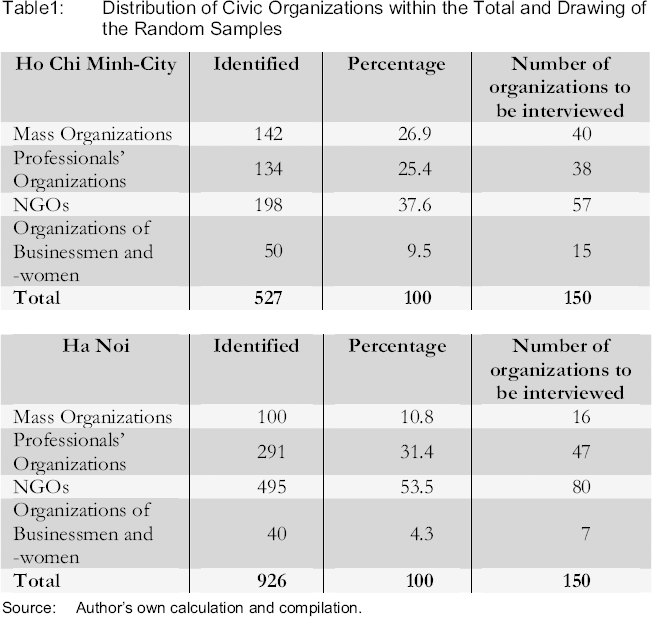
Our documentation of Civic Organizations based in Ha Noi and Ho Chi Minh-City includes 1,453 societal organizations (926 in Ha Noi and 527 in Ho Chi Minh-City, as of 15 April 2009). 14 In comparison: In spring 2000 our research team had identified 706 Civic Organizations in those two cities (Wischermann and Nguyen Quang Vinh 2003: 189, 190).
The distribution of those various organizations within the total are presented in the appendix (see Table 1). The ways and means applied in order to identify those organizations in Ho Chi Minh-City and Ha Noi were almost the same. The team of Vietnamese researchers used the data bank from the survey undertaken in our first survey (1999-2001) (see Wischermann and Nguyen Quang Vinh 2003) as a point of departure; then they used lists (date unknown) provided by various Mass Organizations and lists (date unknown) from various “Unions” (such as the “Union of Vietnamese Science and Technology Associations” and the “Vietnam Psychological and Educational Science Association”) that mention member organizations; they then searched the 2008 Yellow Pages of both cities and undertook extensive internet-based research; furthermore, the researchers searched through Vietnamese newspapers and magazines; finally, they phoned a randomly chosen 10% of those identified organizations and checked information gathered (Ha Noi) or called all those identified organizations where information was missing or incomplete (Ho Chi Minh-City).
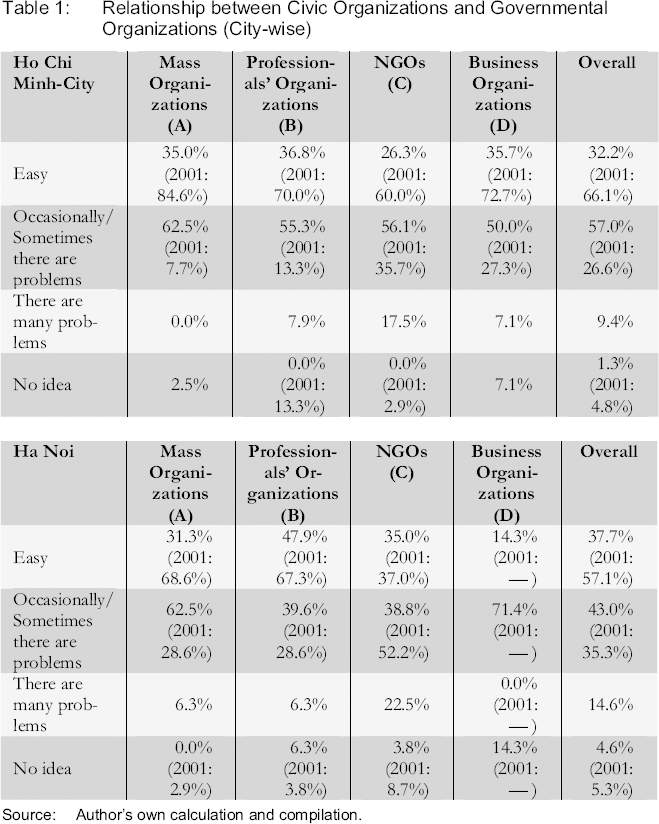
Relationship between Civic Organizations and Governmental Organizations (City-wise)
Source: Author's own calculation and compilation.
Between September and November 2008 the research team carried out 24 exploratory field studies in Ha Noi and Ho Chi Minh-City. In the course of these, we explored the basic understanding of civil society as seen by a representative sample of Civic Organizations’ representatives: We studied representatives’ motivations; their general attitudes towards women and social minority groups; the principles of their internal decision-making processes; how they regulate conflicts; how they see their Civic Organizations’ relationships with Governmental Organizations, etc. 15 This kind of exploration was led by the theoretically founded assumption that civil society action comes into being by way of the discourse on how to deal with force, power and social exclusion. Thus, in those 24 case studies we focussed on Civic Organizations and their representatives (who were all chairpersons, directors, presidents or at least deputies of those top officials) who are active in the fight against domestic violence and discrimination against people living with HIV/AIDS (PLWHIV), and we explored in detail power-related, internal decision-making processes in various Civic Organizations.
Because in this first part of the research project we wanted to investigate what understanding Vietnamese society has of civil society, and because it is virtually impossible to carry out standardized interviews of randomly chosen citizens in Vietnam, for research-pragmatic reasons this understanding was investigated among actors of different Civic Organizations. This is not for reasons of logic of domains. Since the whole variety of different types of organizations is only to be found in the big cities of Vietnam, we concentrated geographically on those organizations in Vietnam's two largest cities (Ho Chi Minh-City and Ha Noi).
Between April and July 2009 the research teams carried out standardized interviews with 300 randomly chosen representatives of Civic Organizations in Ha Noi (150) and Ho Chi Minh-City (150). To that end we draw random samples out of all sub-groups in both cities. 16 In interviews with representatives of those organizations (who were all chairpersons, directors, presidents or at least deputies of those top officials), we explored in which way and to what extent the results from the exploratory field studies could be generalized. 17
Details of the drawing of the sample are to found in the appendix (see Table 1).
Most, if not all, items in the questionnaire for the standardized interviews were citations from those exploratory case studies. For a copy of the questionnaire (English or Vietnamese version), please contact the author:
The analysis of data from the 300 standardized interviews leads to an assessment of whether or not, in what sense and to what degree one should or could talk of the existence of a civil society and civil society action in Vietnam. Hereby the analysis tool “continuum of civil society action” provides a valuable service. In this presentation of selected findings I will not apply this tool. The final comprehensive assessment of the degree of civil society action in Vietnam is left to a concluding analysis of our research results (to be published later this year). 18 Here I confine my assessments to an appraisal concerning whether and in what sense the findings represent civil society action in Vietnam.
This final analysis will include an analysis of the results of Part Two of the project, in which the impact of civil society action on changes in governance was investigated. For this purpose between November 2009 and February 2010 three case studies were implemented.
In what follows I will present an analysis of the data from 300 standardized interviews with randomly chosen representatives of Civic Organizations in Ho Chi Minh-City and Ha Noi (carried out between April and June 2009). I will focus on the analysis of data which concern the above-mentioned core elements of civil society action.
I will start however with some information concerning who those actors we spoke with are (in terms of their education, age and gender); when their respective Civic Organizations were founded; which activities they undertake; what motivates them to engage in those organizations; and their understanding of civil society.
Actors
Who are those randomly chosen 300 representatives of Civic Organizations? From the biographical information they provided us with we can learn that
They are well educated: More than half holds a university (dai hoc) degree (53%); almost a fifth, a doctoral degree (18%).
More than two thirds are 49 years old and older (almost half is between 49 and 66 years old, another fifth is 66 and older); the largest peer group consists of those who were born between 1955 and 1960 (21%).
More than two thirds are men (68%). In Ho Chi Minh-City the gender ratio is a bit more balanced (39%:61%) compared to the one in Ha Noi (25%:75%). It's only within the peer group of those between 49 to 54 years old that more women than men are chairpersons, directors, etc., of Civic Organizations (56%:44%).
Men dominate the Professionals’ Organizations, the Organizations of Businessmen and -women and the Mass Organizations. It is only in NGOs where the gender ratio is slightly more balanced (60%:40%), and only in Ho Chi Minh-City's organizations of this type is the percentage of female and male representatives almost equal. Among the (randomly chosen) Ha Noi-based Business Organizations’ representatives there is literally no female representative and we find almost the same blatant disparity among Ha Noi's representatives of Professionals’ Organizations.
“Social responsibility” is, if not the most important, then at least the motivation named most by all representatives from various Civic Organizations. “Contributing to the development of an equal, fair and just society” comes next for those engaged in Mass Organizations and Organizations of Businessmen and -women, whereas those working in Professionals’ Organizations and NGOs refer to their professionalism and professional ethos as the next-important driving force for their engagement in Civic Organizations. It is after these social and professional motivations that more personal and emotional motivations are named: “compassion” and “solidarity”. For some representatives of Mass Organizations, but also those from NGOs and other Issue-oriented-like Organizations, the wish to remain useful is also a strong motivation.
Motivation that representatives of NGOs and Professionals’ Organizations based in Ho Chi Minh-City disclose seem to be somewhat different from those described above. To representatives from both these types of organizations there, personal and rather emotional motivations seem to be much more important than the results above suggest, and professionalism does not figure in as prominently as the general finding suggests. 19 Whereas representatives from the former name “empathy”, the latter name “mutual love” second most. The representatives of Ha Noi-based Professionals’ Organizations as well as those from NGOs name professional conscience much more often than their Southern colleagues. It is only after those two (social responsibility and professional conscience) that, for the Northern actors from these two Civic Organizations, a more personal and emotional motivation is named (“compassion”).
Since from a methodological point of view one can not conclude from enumerations the importance such sources of motivation have to actors, “important” is used here and in the following paragraphs in a rather loose sense.
However, despite this differentiation in general, those personal motivations (empathy, mutual love, compassion, solidarity and sympathy) are very important to all Civic Organizations’ representatives, although to a varying degree and varying with the type of Civic Organization. However, it seems that especially the Southern NGOs representatives seem to follow the “habits of the hearts” (Tocqueville) a bit more than their colleagues from the North.
Within the sample of those actors who state that they know the term “civil society” and would use it in order to describe the motivation that led them to engage in their respective Civic Organization, social motivations (social responsibility, professional conscience, professionalism) are named more often, and thus could be seen to be more important to those actors than various rather personal and emotional sources of motivation (“compassion”, “empathy”). In general it's a varying combination of social and personal motivation that pushes Vietnamese people to engage in Vietnamese Civic Organizations. The respective bundle of social and personal motivations is very powerful.
Dominating the civil society/civil society-like action discourse in these two cities in Vietnam are three positions, although this happens to a strongly varying degree:
Named most frequently is the idea that says that civil society is represented in Civic Organizations (
The respective item in the questionnaire says: “Civil society is represented in unions and associations. These promote and protect interests of their members, clientele and/or beneficiaries. They entertain a formal dialogue with local authorities/government. They may serve as a bridge between state and people.”
Named second-most is a notion of civil society that we know very well from Eastern and Western Europe, but also from Latin America and Africa: Civil society is the most democratic society (
The respective item in the questionnaire says: “Civil society is the most democratic society. However, state's and government's roles as regards development and management of civil society may vary from country to country.”
Named third-most is the concept which sees civil society as a distinct sphere between state, economy and family (
The respective item in the questionnaire says: “Civil society is a sphere that is separated from, but connected with the State, the economy and the private realm and family. There individuals and groups voluntarily undertake social and other work that is not, not yet, or not sufficiently done by the government. In Vietnam state, government and civil society co-operate.”
“Essentialist” refers to the assumption that civil society is a fixed sphere that is separated from and opposed to other spheres, namely that of the market, state and family (see above, 2).
Whereas one may read a strong impetus towards political change and democracy into
Those 24 explorative case studies actors in favour of the second position's understanding of civil society unveiled that they aim at having a stronger say in processes of policy-forming and decision-making; that they want to have a bigger say as regards holding officials accountable; and that they rather openly criticized the supremacy of the Vietnamese. Thus, this understanding is powerful in terms of politics and clearly oriented towards political reforms.
The distribution of views on what civil society means to which actors along the lines of various types of Civic Organizations can be summarized as follows:
The understanding that civil society is presented in the ensemble of Civic Organizations (
The understanding that civil society is the most democratic society comes second and is an opinion held by somewhat more than a quarter (27%) (
The view that says civil society is a distinct sphere (Item 2) (
… vis-à-vis Women
The overall results (from all 300 representatives of Civic Organizations) from both cities show a clear picture:
60% of the interviewees hold this view: “From a biological point of view men and women are different. However, qualified women can become leaders.” (Item 2)
26% declare that they are of the opinion that “Men and women have the same capabilities. However, due to biological specifics women have specific social functions and there are jobs that are more suitable to women.” (Item 3)
10% state that “Men and women are equal. Differences between them have nothing to do with biological and other physical differences.” (Item 4)
4% indicate that “From a biological point of view men and women are different and so are their capabilities.” (Item 1)
Among the 96 female interviewees, the majority is even stronger in favour of Item 2 (71%), Item 3 comes to 17%, Item 4 comes to 9% and as regards Item 1, 2% of the female interviewees checked this item. Representatives of NGOs are a bit stronger than others in favour of the position that says: “Differences between them have nothing to do with biological and other physical differences” (15%) (in Ho Chi Minh-City: 20%; in Ha Noi: 12%). It is noteworthy that many representatives of Organizations of Businessmen and -women do not share the majority's view – among those representatives the following opinion prevails: “Men and women have the same capabilities. However, due to biological specifics women have specific social functions and there are jobs that are more suitable to women” (50%).
The views of those (96) actors that indicate that they know the term “civil society” and would use that understanding in order to describe their motivation and the orientation that guides them in general do not differ significantly from those in the total. 25 The position that says “Men and women are equal. Differences between them have nothing to do with biological and other physical differences” in general has a bit more support (13%) (compared to 10% in the total). 26
Measured in percentage rates for the respective items.
It's noteworthy that the latter is not the case as far as representatives from Professionals’ Organizations with a specific view of civil society are concerned.
In general, however, civil society-related views do not help to diminish and eliminate gender prejudices and stereotypes that are widespread not only in Vietnamese society, but also among representatives of Civic Organizations. At the roots of such prejudices and stereotypes is an essentialist view of gender and gender differences. Such a view is prevailing even among representatives of Civic Organizations that feel motivated and guided by civil society-related ideas. This conclusion can be drawn from the following specifics of Item 2, which has the support of the majority of representatives:
First, whereas Item 3 states that men and women have the same capabilities, the majority's position (among all 300 representatives, but also among those who hold a civil society-related perspective) encapsulated in Item 2 leaves exactly this question open. Referring to what is called “a biological point of view” might imply that men and women are not equal in terms of capabilities, but this is not stated openly.
Second, the second part of Item 2 (“However, qualified women can become leaders”) is revealing: It does not only imply that women have to fulfil the criterion of being “qualified” (which should be a criterion for women and men alike); but also the word “however” implies, if not openly then at least more or less well-hidden, what critics in Vietnam (like Gencomnet 2006) call gender prejudices – patriarchal beliefs and the assumption of a certain inequality between men and women.
Third, this potential discrimination is closely related to an essentialist understanding of gender. We have put this understanding at the core of the four items of this gender-related question. This understanding implies that men and women are equal before the law, but that there are nevertheless differences between men and women in terms of capabilities and social roles, and that these differences have to do with unchangeable biological distinctions that make men different from women, from which in turn ideas of men's superiority over women derive. These allegedly unchangeable differences might lead to and support discrimination – in an open or not so open form.
The high degree of respect that is given in the almost unanimous consent to gender equality before the law is strongly limited by an understanding of gender that is basically essentialist. In most but not all actors’ views, women are seen as unequal to men in the strictest sense of the word because of what in Vietnam are called “biological facts”.
… vis-à-vis People Living with HIV/AIDS (PLWHIV)
A big majority of representatives from Civic Organizations (62%) in both cities is in favour of respectful views vis-à-vis PLWHIV and wants to see them treated like other people (sum of values for Items 1 and 2). 27 In general those representatives that hold a civil society-related view and who claim that this guides their orientation are even more strongly than others in favour of any position that includes more or less strongly articulated non-discriminatory attitudes and practices based on these vis-à-vis PLWHIV.
Item 1 says: “We should treat them as we treat all other members of our society.” Item 2 says: “There should be no different treatment. However, they should be treated with more attention than ‘normal’ people.”
… vis-à-vis Drug Addicts
Of the 300 representatives of Civic Organizations almost two thirds (63%) are in favour of discriminatory views and practices vis-à-vis drug addicts (the sum of values for Items 3 and 4), whereas a minority of somewhat more than a third (36%) is in favour of non-discriminatory views and practices. 28 However, again, representatives of NGOs are at the forefront of a more respectful view: Here at least a strong minority of 44% is in favour of more respectful views and practices based on these (sum of values for Items 1 and 2). 29 In Ho Chi Minh-City this more respectful view is even in the majority as far as NGOs are concerned. In Ha Noi, discriminatory views and practices are more strongly developed than is the case in Ho Chi Minh-City.
Item 3 says: “They need more health-care and more education than ‘normal’ people. But government could temporarily keep those people at special health care and education centers if considered necessary.” Item 4 says: “Taking drugs is forbidden by law. Drug addicts should be treated accordingly.”
Item 1 says: “We should treat them as we treat all other members of our society.” Item 2 says: “They need more health-care and more education than ‘normal’ people. But they should not be discriminated against and not kept isolated from ‘normal’ people.”
Whereas civil society-related motivations and orientations seem to precipitate, as far as this issue is concerned, a somewhat more respectful view, in general, even among actors with a civil society-related view, the majority is still in favour of discriminatory views and practices based thereupon vis-à-vis drug addicts. Again, it is only among representatives of NGOs with a specific view on civil society based in Ho Chi Minh-City, where non-discriminatory views vis-à-vis drug addicts prevail.
83% of all 300 representatives state that they feel “very much” or at least “much pity for drug addicts in bad health condition roaming the streets”. This “sympathy rate” is highest among representatives of Mass Organizations (86%), although that of representatives from NGOs and Professionals’ Organizations is almost as high. Only representatives from Organizations of Businessmen and -women do not feel so much sympathy for drug addicts (59%).
Among the people who know the term “civil society” and would use this term in order to describe their motivation to engage in their organization, even more sympathy for drug addicts is articulated. Remarkable in this context are the high levels of sympathy that representatives from Business Organizations indicate (83%). It is Business Organizations’ representatives based in Ho Chi Minh-City where all representatives from those organizations feel “very much” or “much” sympathy for drug addicts (100%), whereas among the Northern colleagues it is “just” 75 % that feel “very much” and “much” sympathy for drug addicts.
Empathy – Does Empathy Help to Understand and to Address Problems Related to Drug Addicts?
Three quarters and more of representatives among the 300 representatives of Mass Organizations, Professionals’ Organizations and NGOs think that empathy helps if and when one wants to understand and address problems related to drug addicts. However, 33% of the representatives of Organizations of Businessmen and -women in Ho Chi Minh-City and 29% percent of their colleagues in Ha Noi think that empathy does not help. And it should not be overlooked that at least 27% of the representatives from Mass Organizations in the South do not support such a view. Thus, the overwhelming majority of Vietnam's representatives of Civic Organizations sees empathy as useful if and when one wants to understand and address problems drug addicts face.
In general representatives of various types of Civic Organization who know the term “civil society” and would use this term in order to describe their motivation to engage in their organization do not or at least do not consistently support in a stronger way (measured in percentage rates and in comparison to those in the total) an empathetic view vis-à-vis drug addicts. 30
Note that support for such a view among actors who articulate a civil society view and find this applicable to what motivates and guides them is pretty high.
Basically, the data analysis of all 300 interviews discloses four positions: First, “I make no concessions” or “I make concessions if there is no other way to reach a mutual agreement” (
It is remarkable that in the view of Vietnamese actors the combination of various views and the synthesis of various ideas are called a “compromise” or “compromising”. 31 Although in Europe, the US, and other parts of the world, “compromising” may have different connotations, it always implies to be willing and to be able to, at least according to the situation and/or time, fully or partly relinquish one's own goals – it implies at least the willingness to exchange differences related to the objectives pursued. “Compromising ‘Vietnamese style’”, where various ideas are combined, implies that no one gives in or gives up something (or at least pretends not to), let alone that he/she is prepared to and/or willing to exchange differences related to his/her objectives. Rather, such compromises are based on “combinations and syntheses of various ideas and objectives” – preferably without an exchange of differences (at least not those that are equal to conflicts). Thus, the Vietnamese actors’ understanding of compromising tends to imply neither processes of mutual give and take nor processes wherein conflicts take place.
Here I want to recall that those various items and underlying ideas concerning “making concessions” and “compromising” are the result of the explorative 24 case studies.
In general, Civic Organizations’ representatives that know the term “civil society” and would use their respective idea of civil society in order to describe internal decision-making processes have a stronger willingness to make concessions (measured in percentages and in comparison to the total); but they are not more open to compromising.
However, representatives of Organizations of Businessmen and -women who know the term civil society and would use their respective ideas of civil society in order to describe internal decision-making processes constitute an exception: These actors are clearly more in favour of “compromising” than their civil society-inspired colleagues representing other types of Civic Organizations.
32
And these representatives in general are less in favour of
Measured in percentage rates to be found in the respective sub-samples.
In general, those representatives who know the term “civil society”, and who find their respective view of civil society applicable to the decision-making processes of their Civic Organization's internal practices, put into practice the respective “Positions” more often than is the case in the total (measured in “sometimes” and “very often” and compared to percentages rates in the total).
However, this does not mean that these actors who share a civil society-related view are more willing to change their standpoint as far as their respective position in terms of making concessions, compromises, etc. is concerned when internal decisions have to be made. They stick to their respective positions and apply them more often.
How Important is Reaching a Mutual Consensus If and When Activity-related Decisions Have to be Made?
Reaching a mutual consensus is the sacred cow of Vietnamese Civic Organizations in terms of their internal decision-making processes. Among all 300 interviewees there is just one representative (representing an Issue-oriented Organization in Ha Noi) who says that reaching such an agreement is “not important”.
Reaching a mutual consensus is “very important” and “important” to almost all representatives from all sorts of Civic Organizations: 99% of the representatives in Ho Chi Minh-City and 98% of the interviewed representatives in Ha Noi are of this view. However, it could be significant that to Ho Chi Minh-City-based representatives reaching a mutual consensus does seem to be slightly less important. There, it is 29% who find reaching such a consensus is “important”, but not “very important”, whereas in Ha Noi the respective figure is 14%. Among representatives from NGOs and Organizations of Businessmen and -women in Ho Chi Minh-City the proportion of those who hold the view that reaching a mutual consensus is “important” (and not “very important”) is relatively strong (39% and 53%). Representatives who know the term civil society and hold this view on this issue applicable to internal decision-making processes do not differ significantly from the total.
Disagreements, Controversies, and Conflicts
The empirical facts are clear without ambiguity:
87% of all 300 representatives are of the view that disagreements and controversies are normal, but that conflicts within one's own organization should be avoided.
87% of all 300 representatives share the view that the existence of a multiplicity of views on topics the organization addresses is desirable.
65% of all 300 representatives hold the view that expressing personal views, insisting on his/her own viewpoints and getting tense is bad behaviour.
Views of those (94) representatives who indicate that they know the term xa hoi dan su (civil society) and would use it in order to describe their organization's internal decision-making processes do not differ significantly from the total. 33 Thus, the overall impression suggests:
Almost all actors, irrespective of their knowledge and view of civil society, are strongly and deeply averse to internal conflicts.
The existence of an internal pluralism of viewpoint is strongly supported; among those who feel inclined to civil society-related ideas, this wish seems to be even more strongly developed than it is among other sub-samples or the total of actors.
Two thirds of all actors believe that expressing personal views, insisting on one's own viewpoint and getting tense is bad behaviour.
These seem to be contradicting views only as long as one does not assume that in fact there is a hierarchy of objectives:
Seeking a consensus and a synthesis of views comes first.
Subordinate to this objective is that a multiplicity of views is desirable and that disagreements and controversies can take place. Conflicts are seen as disturbing an alleged harmonious cooperation.
The precondition of such a view is that all interests and viewpoints can be reconciled and that there are no interests and viewpoints that are so contradictory in nature that they cannot be reconciled. As far as this is not – or at least not always – the case, the alleged synthesis and harmony can only be achieved by means of ignoring those contradictions and/or by authoritarian means.
We used the term xa hoi dan su instead of other terms (for example xa hoi cong dan) as a result of the 24 case studies wherein interviewees clearly indicated that they prefer to use this term.
The recently mentioned seeming paradox (a general aversion towards conflicts and the strong support for the presentation of a multiplicity of views within one's own organization), is here once again: 83% of the 300 representatives indicate that “internal rules should help to avoid disagreements, controversies and conflicts”; however, almost the same number and proportion of representatives in the total, and an even larger proportion of those who have a specific knowledge of civil society, state that internal rules should ensure that a multiplicity of views can develop and be effectively presented within one's own Civic Organization. It is just 6 out of those 96 civil society-inspired representatives of Civic Organizations that do not share the view that internal rules should help to avoid conflicts.
Internal rules are seen as pivotal for ensuring that conflicts do not disturb the alleged harmonious cooperation within Civic Organizations and the highly desired representation of a multiplicity of views. A potential conflict of objectives is either not seen or not acknowledged – at least not yet or not yet in public. Rather, three quarters of the representatives favour a seeming solution that says: “Internal rules should help to channel conflicting views and help to come to a decision that reflects
Relationships between Civic Organizations and Governmental Organizations
At first glance the results are not very exciting:
Somewhat more than a third of all representatives of Civic Organizations rate their organization's relationships with Governmental Organizations as “easy” – representatives from NGOs and from Organizations of Businessmen and -women indicate the lowest rate here. Remarkable also is the low rate of “easy” relationships that representatives from Mass Organizations indicate.
Half the representatives of all Civic Organizations indicate that “occasionally/ sometimes” there are problems in this relationship. It seems remarkable that Mass Organizations’ representatives are leading in this respect: Almost two thirds claim that there are such problems. 57% of the representatives of Organizations of Businessmen and -women indicate such sorts of problems.
A fifth of the representatives from NGOs indicate that there are “many problems”.
However, if we compare the data broken down city-wise with those data from our first survey held 9 years ago (see Wischermann and Nguyen Quang Vinh 2003: 199–213) the results become more interesting.
Five findings might be worth singling out:
In 2009 approximately one third, compared to up to two thirds in our study from 2001, of all representatives indicates that these relationships are “easy”, and this is the case in both cities. In general the proportion of “easy” relationships between Civic and Governmental Organizations significantly declined between 2000 and 2009.
In 2009 up to 57% of the representatives state that “occasionally/sometimes” there are problems compared to a third and less in our previous study. In general, the proportion of those indicating problems arising out of the relationship between those organizations, encountered at least case- or time-wise, nearly doubled between 2000 and 2009.
In 2009 representatives from Mass Organizations in both cities and those from Business Organizations in Ha Noi indicate more strongly than representatives from other Civic Organizations that their organizations have, case- or time-wise, more problems arising out of their organizations’ relationships with Governmental Organizations.
In 2009 one fifth of representatives of NGOs in both cities and less than a tenth of representatives of Professionals’ Organizations and Organizations of Businessmen and -women in Ho Chi Minh-City indicate that there are “many problems” arising out of the relationship with Governmental Organizations. 34
In 2000 we could not ask this question.
In general the relationships between Civic Organizations and Governmental Organizations are more relaxed in Ho Chi Minh-City than in Ha Noi. In this respect things did not change so much in those 10 years.
Those representatives who indicate that they know the term “civil society”, and would use it in order to describe their organizations’ relationships with Governmental Organizations, in general do not point to more strained relationships with Governmental Organizations. In this respect it seems significant that especially representatives of NGOs with such a view on civil society based in Ho Chi Minh-City and to a lesser degree also their colleagues from Ha Noi indicate a lower degree of “seriously” strained relationships with Governmental Organizations. 35 However, representatives with a civil society-related view from Organizations of Businessmen and -women in Ho Chi Minh-City and from Mass Organizations in Ha Noi report on significantly more serious conflicts (“There are many problems”) their organizations encounter in these relationships. 36
As expressed by “There are many problems.”
Again, here I refer to a comparison of the percentage rates indicated in the respective sub-samples and I refer to a comparison with the percentage rates I find in the total.
Thus, on the one hand, in general there is a trend towards what I would see as a process of normalization in the relationships between Civic and Governmental Organizations (in terms of a decrease in “easy” relationships” and an increase in problems arising “occasionally/ sometimes”). This trend is even a bit more distinct in the sub-samples of those who know and would use the term “civil society” in order to describe their organization's relationship with Governmental Organizations. Undisturbed, “easy” relationships between State agencies and Civic Organizations is not what one should expect to find in a polity where a gamut of Civic Organizations signifies a diversified society and where a governance architecture has been preserved that dates back to the early 1990s and has been managed since then in a way that has led to very limited experience with forms of democratization (cf. Fforde 2009: 81).
On the other hand, the higher conflict level actors with a specific view on civil society representing Mass Organizations in Ha Noi and Organizations of Businessmen and -women in Ho Chi Minh-City report, and the (albeit to a varying degree) lower conflict level (measured in “There are many problems”) representatives of NGOs with such a civil society-related view in both cities indicate, need some further explanation. The following considerations based on empirical evidence explain these findings:
Mass Organizations have become more important in terms of governance within the last few years; they have taken over many tasks the state performed in former, socialist days, and they have gained more room to manoeuvre. However, the status these organizations enjoy within the existing political system has remained basically the same. Party/State and many if not most of its officials still see those organizations as “transmission belts” and subordinates. From the perspective of many Mass Organizations’ representatives, however, their organizations have outgrown the roles assigned to them and the mechanisms within which they have been active. Besides, some may think that the State apparatus could work better and more effectively. Thus, on a systemic and on a personal level there are many reasons for problems to arise between those organizations and their representatives. Those problems might even be more distinct among those representatives of Mass Organizations in Ha Noi who have moved towards a deeper understanding of what in their view civil society is all about, and those from State agencies who, especially in times when the Vietnamese Communist Party's Central Committee has related civil society to “peaceful evolution”, might develop a strong(er) aversion to those representatives and their views.
Organizations of Businessmen and -women and their representatives in Ho Chi Minh-City have developed a strong self-confidence which is further bolstered by their independence in terms of financial and other resources (at least as far as the running of their own organizations is concerned). Such resource-independency is a potential source of friction. If actors develop modes of action that are strongly civil society-like, for example the capability to change roles and to take others’ positions (i.e. applying an empathetic view), this might help to smooth the relationship with Governmental Organizations. However, if State and City government's officials insist on being the ones who call the shots as regards important economic, social and political decisions, then this might contradict representatives’ of Business Organizations ideas of how decision-making processes should be structured and could provoke not only problems arising every now and then but may even lead to “many problems”. This might be the case even more strongly among those representatives of Business Organizations who have moved towards a deeper understanding of what civil society is all about.
Representatives of NGOs who know the term “civil society” and would use it to describe their organizations’ relationships with Governmental Organizations are strongly engaged in service-delivery functions – services the State does not (any longer) or does not adequately render, as well as services within Government-funded programs. Reliance on funds for services provided by the State and a close cooperation between those Civic and Governmental Organizations might help to reduce frictions. The somewhat higher level of conflicts (as expressed by “There are many problems”) representatives from NGOs based in Ha Noi indicate (in the total, but also in the sample of representatives of such organizations in Ha Noi with a civil society-related point of view) implies that various kinds of specific, region-related context factors have to be taken into account. Here I think of a bias against non-state activities still to be found among many State officials and the idea of the State's dominance vis-à-vis citizens organized in various Civic Organizations and other socio-cultural vestiges from the past that might be found rather in the North of the country than in the South. Such notions may contend with those Civic Organizations’ representatives’ demand to be treated on par by governmental agencies and their wish for more political say in decision-making processes.
In the data from standardized interviews (carried out between April and June 2009) with 300 representatives of Civic Organizations representing the ensemble of Civic Organizations in Ho Chi Minh-City and Ha Noi, I have found strong and solid empirical evidence for civil society action in Vietnam.
I find such action in many of those representatives’ forms of social action and interaction, albeit to a varying extent and degree. In general, however, civil society action is more distinct in that third of approximately 100 interviewees (among those 300 interviewees) who indicate that they have a specific understanding of civil society and would use this specific understanding in order to describe their motivation to engage in Civic Organizations, their respective activities, etc. More specifically, the data analysis unveils the existence of respect, empathy/ sympathy, and the willingness to compromise and to stick to rules once agreed upon, though the respective values of those dimensions of civil society action vary strongly.
Aside from those characteristics, I find elements that are strongly developed and that are inseparably linked with those elements and dimensions of civil society action: consensus-seeking, an aversion to conflicts and an affinity to synthesis. They represent elements of authoritarian political thinking in Civic Organizations’ leaders’ mindsets. 37 Taken together those characteristics make up what I call civil society action “in Vietnamese colours”. The general results of our survey can be specified and summarized as follows:
Here I refer to Dahrendorf's (1965) seminal analysis of post-war Germany, in which he identified consensus-seeking, aversion to conflicts, and an affinity to synthesis, (predominant in Germany not only in the 1950s and 1960s), as core elements of authoritarian political thinking (Dahrendorf 1965: 222).
Motivation named most (“social responsibility”) as well as the aspiration named second-most (“to contribute to the development of an equal, fair and just society”), both indicate the strong wish of Vietnamese Civic Organizations’ actors to serve public ends and much less, if at all, to work in Civic Organizations in order to meet private means. Thus, in terms of their motivations, almost all interviewed 300 Vietnamese Civic Organizations’ representatives act in a way that meets an expectation that says that civil society is “the sphere of private people come together as public” (Habermas 1991: 27).
There is strong empirical evidence that in general there is respect – the central criterion for civil society action – vis-à-vis women, people living with HIV/AIDS (PLWHIV), and drug addicts. However, respect is not shown towards all people and societal groups to the same degree and extent.
Civil society action “in Vietnamese colours” is deeply “gendered”. Whereas equality before the law and formal equality between men and women is not at issue among all 300 representatives of Civic Organizations, gender prejudices, gender stereotypes and patriarchal thinking based on an essentialized understanding of gender are nevertheless prevalent if not predominant among representatives of Civic Organizations, female representatives, and even among actors who feel motivated and guided by civil society-related ideas. 38 These habitualized attitudes effectively weaken respectful attitudes and practices based thereupon towards women.
This is an understanding of gender that assumes that bodily characteristics influence capabilities and social roles and from which ideas of men's superiority can derive.
Among the 300 representatives from various Civic Organizations, I find a very high degree of respect vis-à-vis people living with HIV/AIDS as well as a high degree of sympathy for drug addicts, and empathy demonstrated for drug addicts. However, only a minority of those representatives holds the view that drug addicts should be treated with full or at least some degree of respect.
Among those approximately 100 representatives who feel motivated and guided by civil society-related views, respect vis-à-vis people living with HIV/AIDS, sympathy for various societal groups, but also respect vis-à-vis drug addicts is slightly more distinct (in comparison to the total). However, to demonstrate full or at least respect to a certain degree vis-à-vis drug addicts is the minority view even among those actors.
On the boundaries, where civil society action develops in confrontation with “un-civil” attitudes and behaviour (for example in NGOs addressing the problems of drug addiction), discriminatory attitudes and practices are contested, and at least in those sub-samples respectful attitudes and practices vis-à-vis drug addicts do already prevail.
From the fact that Civic Organizations’ representatives do not show respect to all people to the same extent and to the same degree, I conclude that those actors do not have or at least do not follow strict principles of equality; that the respective principles are not important to the same degree to various groups of actors; that habitualized attitudes and practices based thereupon counter the egalitarian potential of civil society-related attitudes and respective practices. Lack of respect vis-à-vis women and drug addicts are a case in point.
Civil society action “in Vietnamese colours” might be based strongly on and often follow what Tocqueville once called “habits of the hearts”. However, civil society-like action “in Vietnamese colours” can also follow rather exclusively rational and cognitive patterns: Compromising, more strongly (than in the case of their civil society-inspired colleagues representing other types of Civic Organizations) developed among representatives of Organizations of Businessmen and -women who feel motivated and guided by civil society-related ideas is a case in point. This finding signifies the existence of civil society action that 1) is based on recognition of equality as a matter of principle which in turn leads to forms of interaction that follow negotiation-like patterns; 2) is impelled by the conviction that compromising offers comparable advantages; and 3) is based on a highly rational view.
As regards internal decision-making processes, most if not all Vietnamese Civic Organizations’ representatives’ bodies of thought and practices disclose patterns of authoritarian political thinking. Consensus-seeking, conflict aversion and affinity to synthesis dominating internal decision-making processes are cases in point. The wish to see a plurality of views presented within one's own organization and a dominating aversion to conflicts is no contradiction. In practice, both perspectives are reconciled more often than not by more or less authoritarian patterns of leadership practices within Civic Organizations.
The above-mentioned patterns of authoritarian political thinking hinder further development of compromising, whose practices and forms of understanding are limited up to now to a specific Vietnamese meaning of such a mode of action. Furthermore, they block further development of another important element of civil society action: “Sticking to rules once agreed upon”. Up to now, those rules are more or less formal in nature and not bound to regulating conflicts. Thus, they do not help to further develop a culture of conflicts, which is an important part of civil society action. 39 However, such a culture of conflict is developing in the Vietnamese society and within Vietnamese Civic Organizations: The decline of “easy” and the development of relationships between Civic Organizations and Governmental Organizations in which “sometimes/ occasionally” or even “many problems” arise, are cases in point.
Such a culture of conflicts can take many forms and shapes.
Due to the above-described characteristics, (the existence of a rather high degree of respect vis-à-vis women and vis-à-vis various societal and so-called marginal groups; the high degree of sympathy and empathy for those groups; to a certain extent also the actors’ willingness to compromise), civil society action “in Vietnamese colours” could help to lessen problems in at least two out of three functional areas of governance (namely, security and welfare). Civil society action “in Vietnamese colours” could turn out to be a new and effective additional resource especially as far as problems are concerned that represent issues of mis-recognition and mis-representation. It could play a decisive role in efforts that aim, for example, at raising women's security, improving gender equality and ensuring equal rights for people living with HIV/AIDS.
Footnotes
Appendix
Distribution of Civic Organizations within the Total and Drawing of the Random Samples
| Ho Chi Minh-City | Identified | Percentage | Number of organizations to be interviewed |
|---|---|---|---|
| Mass Organizations | 142 | 26.9 | 40 |
| Professionals’ Organizations | 134 | 25.4 | 38 |
| NGOs | 198 | 37.6 | 57 |
| Organizations of Businessmen and -women | 50 | 9.5 | 15 |
|
|
|
|
|
|
|
|
|
|
| Mass Organizations | 100 | 10.8 | 16 |
| Professionals’ Organizations | 291 | 31.4 | 47 |
| NGOs | 495 | 53.5 | 80 |
| Organizations of Businessmen and -women | 40 | 4.3 | 7 |
|
|
|
|
|
Source: Author's own calculation and compilation.