



Abstract
This article deepens understanding of Polanyi's double movement and countermovement concepts. Through an exploratory case study of a Chinese wet-market, it interrogates a Chinese countermovement and develops an analysis on how it informs, and is informed by, a larger double movement. This article is differentiated from other attempts to deconstruct Polanyi's countermovement concept as it interrogates the unconscious countermovement. It expands Polanyian theory by proposing a mechanism by which the unconscious countermovement may lead to something conscious. The article argues that there is both an unconscious countermovement and a conscious Polanyian movement in Chinese society which look towards rural China for social protection.
Introduction
Karl Polanyi's double movement and countermovement concepts continue to be used to analyse the expansion of the logic of the self-regulating market and the societal backlash this provokes (Carton, 2020). Polanyi argues the two organising principles in marketised society are economic liberalism “aiming at the establishment of a self-regulating market,” and “the principle of social protection aiming at the conservation of man and nature” (Polanyi, 2001: 138). The second of these, Polanyi describes as a “countermovement” (Polanyi, 2001: 136) or the “self-protection of society” (Polanyi, 2001: 87), which checks the expansion of the self-regulating market movement. Scholarship often reduces the double movement to “a perpetual to-and-fro between regimes that disembed and re-embed the market” (Dale, 2012: 14) with no solution to this oscillation. Polanyi, however, puts forward two possible results of the double movement dynamic: one, his hope of socialism, the other, his fear of fascism (Alcock, 2020; Dale, 2012).
Micro-level case studies of the countermovement have avoided engaging with Polanyi's understanding of the difference between countermovements within the double movement dynamic and movements aimed to transcend it towards either socialist- or fascist-like “solutions.” This article aims to fill this gap through analysing a contemporary Chinese countermovement, placing it within a specific Chinese double movement, and putting forward arguments on the mechanism by which this double movement impasse may be transcended. This article uses the Polanyian schema developed in Alcock (2020, 2024) to interpret the countermovement and double movement concepts. It builds on Alcock's argument (2020: 153) that Polanyi's definition of the countermovement suggests it is non-ideological, non-conspiratorial, internal to the self-regulating market and unconscious of the systemic market logic that Polanyi argues forces individuals into acts of self-protection. This definition means that countermovements must not explicitly challenge the logic of the self-regulating market system, nor must individuals engaging in the countermovement have a consciousness of Polanyi's thesis that the market system is the root cause of the negative effects they are attempting to counter. Further, it accepts that Polanyi's definition of the double movement is dialectical, based on a fundamental contradiction that the countermovement and the movement for an expansion of the self-regulating market are both necessarily destructive to society. For Polanyi, the market mechanism disintegrated due to: “the measures which society adopted in order not to be, in its turn, annihilated by the action of the self-regulating market”(Polanyi, 2001: 257).
Polanyi further explains: “a self-adjusting market […] could not exist for any length of time without annihilating the human and natural substance of society […] Inevitably, society took measures to protect itself, but whatever measures it took impaired the self-regulation of the market, disorganized industrial life, and thus endangered society in yet another way […] finally disrupt[ing] the social organization based upon it” (Polanyi, 2001: 3–4).
This contradiction creates the possibility of dialectical “progression” which, for Polanyi, manifests in socialist or fascist forms. This understanding of the countermovement and double movement concepts constitutes a significant divergence from most of the writing on these concepts. However, I argue, along with Lacher (1999, 2007) and Alcock (2020, 2024), that the elements suggested above are important in defining the countermovement and double movement concepts even if relatively neglected in contemporary scholarship.
The first section of this paper will review the use of Polanyi in literature on China and suggest that the rural–urban divide provides a cleavage that helps illuminate China's Polanyian struggles. The second section introduces the case study of an everyday unconscious countermovement of individuals aiming to protect themselves from the negative effects of the self-regulating market without attempting to challenge the self-regulating market itself. It argues that consumers looking to less-marketised rural spheres for self-protection constitutes a countermovement as described in The Great Transformation. The third section outlines the theoretical conclusions that can be drawn from this case study in Polanyian terms, including how it informs a macro-political double movement of the peasant in contemporary China. In the final section, this paper expands Polanyian theory by suggesting how unconscious countermovements may become conscious and aim for Polanyi's goal of the transcendence of the self-regulating market by referring to China's New Rural Reconstruction Movement (NRRM).
Polanyi in China
Since reform and opening, China has experienced a transformation from a planned economy to one which is more market-oriented (Cheng et al. (2012); Wang, 2008, 2012). It is therefore unsurprising that Polanyi's seminal work The Great Transformation (TGT) has been widely applied in the Chinese context.
Numerous China scholars have documented the penetration of the market into Chinese society and commented on its negative effects. For Wang (2008: 52), China experienced the “birth of market society” in the 1993–1999 period, at which stage “the market threatened to become the dominant mechanism integrating all society.” This threat was met with a countermovement (Wang, 2008). With specific reference to rural China, Cheng et al. (2012) argue “‘market orientated reform’ […] induced huge numbers of mass conflicts as people struggled against the commodification of their land and labour.”
Polanyi's work has been adapted on occasions to fit the China “special” case. Zhang (2013) turns Polanyi's self-regulating market thesis into a Chinese disembedding self-regulating state thesis using Polanyi's double movement thesis as a tool to describe an intraparty double movement of factional divides. Chuang and Yasuda (2021) concentrate on rural China using Polanyi's double movement to analyse the trajectory of state policies since 1949. Alcock (2023) critiques this use of Polanyi's double movement concept to analyse the Mao state-socialist period; however, he argues positively for Polanyi's concepts to be utilised to examine the market-disembedded period of post-1984 China. While Hann (2009) argues that the increase of marketisation in China should actually be considered a type of Polanyian embedding.
Other scholars have used more recognisable Polanyian arguments to analyse China. Lim (2014), for example, describes the Chongqing development model as a countermovement in which the state protects society from the market, and Zhang and Qi (2019: 115) use Polanyi to analyse a countermovement of “social self-protection” led by “peasants, scholars, NGOs and urban consumers” to develop safe food initiatives in China.
While Zhang (2013) argues that China's authoritarianism leaves little scope currently for countermovements, Lim (2014) suggests that it is the very power of the state that can be used as a countermovement to protect society from the market. Differences between the European context and the Chinese context are contemplated by Zhang (2013), who notes that the lack of liberal democracy in contemporary China complicates the transfer of Polanyi's thesis to a Chinese context. However, countermovements do not need democracy to operate. For Polanyi, the countermovement began in England in 1834 (Polanyi, 2001: 87), when England was not a functioning liberal democracy.
What is necessary for the countermovement to “spontaneously” emerge is the logic and implementation of the self-regulating market and the negative effects it creates on the social institutions developed for individual and community protection. Polanyi's countermovement thesis works well in China because whilst liberal democracy is not necessary for the emergence of the countermovement, market dislocation is.
In the context of China, Polanyian papers on the countermovement often concentrate on the state as an initiator of either, or both, the market move and the countermovement against the market (Chuang & Yasuda, 2021; Hann, 2009; Lim, 2014; Zhang, 2013). This also reflects a current in Polanyi literature outside of China (Blyth, 2002; Carr and Alcock, 2020; Özdemir, 2023). However, a clear difference is that while combative movements directly challenging the state on ideological grounds make up a large proportion of the Polanyi literature on the countermovement outside of China (Atzmüller et al., 2019; Barham, 1997; Fraser, 2017), these are, for obvious reasons, limited in papers on China. This absence, far from weakening scholarly understanding of Polanyi's countermovement in China, in fact, strengthens it as countermovements should not be understood as ideologically informed (Alcock, 2020, 2024).
As an example, Xu et al. (2013) present a detailed Polanyian study of the “unconscious” countermovement, even if they do not use this terminology. They argue that peasant farmers are engaged in a Polanyian countermovement to protect themselves and their family from “food for money,” or food that is produced for the market, by growing a separate “food for life,” for family consumption. This food is deemed safer to consume as peasant farmers consciously use fewer pesticides and herbicides. Here there is no appeal to the state or a combative ideology of transcending the current political and macro-economic arrangement, but spontaneous individual protective action against potential negative health effects of food marketisation. This phenomenon can be credibly described as a countermovement due to its lack of conscious articulation of the Polanyian fact that only transcending the self-regulating market can fully protect individuals from the negative effects of the market mechanism.
Another example, Lu (2024: 23), discusses a 2012 “cross-class social countermovement against the excessive encroachment of the developmental state” in the context of a protest against a proposed industrial waste disposal pipeline. While again not explicitly framing the protest in the terms of an “unconscious” countermovement what the paper describes can be defined as such – a movement primarily to protect individual and in-group economic and health interests within the current system from the negative effects of increased state and corporate market expansion – not an ideological movement to transcend this system. I argue that these “unconscious” countermovements are widespread in China, even if not always theorised using Polanyi's countermovement concept (Fu, 2017; Lora-Wainwright, 2017; O’Brien, 1996).
The next section introduces a case study on a specific countermovement in China. This illuminates the Polanyian definition of a countermovement as well as demonstrating how the specific countermovement is placed within a Chinese double movement.
Wet-Market Case Study
This section brings the theoretical re-examination of the countermovement from Alcock (2020, 2024), briefly discussed above, to a Chinese “countermovement in action” (Kentikelenis, 2018). A wet-market research location was chosen for several reasons. Firstly, food safety has been a major research focus of contemporary Chinese scholarship (Yan, 2012; Yasuda, 2017a, 2017b), including within the context of “moral economies” (Bunkenborg and Hansen, 2020; Merrifield, 2020), which lends itself well to Polanyian analysis. Secondly, Xu et al. (2013) developed a compelling Polanyian argument of self-protection within the context of food-safety concerns in China. This article is uniquely successful in capturing “local-level responses, emphasising cultural aspects of social protection, and tracing the micro-foundations of countermovements […] shaped by the macro-institutional context” (Kentikelenis, 2018: 40), while also being able to be understood within the definition of a countermovement as an “unconscious” act of individual/group self-protection. Xu et al.'s (2013) “One Family Two Systems” research has continued for ten years (Ping et al., 2024), demonstrating sustained research on an active countermovement. My case study considers whether there is a similar consumer countermovement within the same macro-institutional context of food-safety concerns in China.
Current research suggests that rural peasant produced food can be perceived as safer. Schneider (2017: 343) describes a small-scale farmer commenting that when he “travels to cities, he is afraid to eat meat because companies use drugs and chemicals in production and processing, and he does not trust that government regulatory oversight can effectively monitor or enforce food-safety standards inside agribusiness operations. For him, the only meat that is safe to eat is the meat that he or his neighbours raise.” Fang and Liu (2018: 63) highlight comments by a farmer who said, if she must buy vegetables, she prefers to buy from neighbours as she knows how they have used pesticides. Si et al. (2019) also highlight the importance farmers attach to food produced by family or friends in the local community likely to be produced in a more “green” and therefore “safer” way. Wang et al. (2015) and Yasuda (2017: 78–92) demonstrate a lack of trust in large-scale agricultural operations by middle-class consumers at organic farmers’ markets. My study tests whether this logic holds in a more traditional wet-market setting. If surplus “food for life” produce makes its way into informal commercial avenues, which Ping et al.'s (2024: 143) survey suggests may happen in 22.3 per cent of the cases they investigated, and consumers are actively seeking it for self-protection, I argue this constitutes a consumer countermovement aiming to avoid “unsafe” “food for money” in a similar way as Xu et al. (2013) argue producers avoiding the consumption of “food for money” is a Polanyian countermovement. This suggests a “One Market Two Products” phenomenon within the wet-market setting – one “safer” product not primarily grown for market exchange, and another product, considered less safe, grown for profit. Xu et al. (2013), along with subsequent research (Fang and Liu, 2018; Ping et al., 2024; Si et al., 2019; Zhang et al., 2017), demonstrate that peasant self-grown produce for self-consumption uses fewer chemical inputs and therefore is likely to be seen as safer in the minds of consumers (Garnett and Wilkes, 2014: 95).
A third reason a wet-market research location is chosen is because most studies on food consumption habits are of relatively privileged urban consumers, while “little targeted research has been done on rural populations or second- and third-tier cities, or on more ‘traditional’ sales venues such as wet markets” (Holdaway and Husain, 2014: 55). Further, Alita et al. (2020: 14) argue “more in-depth research on wet markets is needed” due to their “surprising” finding of the “high degree of vegetable safety in wet markets” in China. My research helps fill these gaps through focusing on food-safety concerns at a wet-market in a third-tier city.
I followed the extended case method (Burawoy, 1998: 16), which elaborates “existing theory” rather than establishing its representativeness. Using participant observation and surveys, I extract data to develop a pre-existing theory on Polanyian countermovements and food safety in China. While I cannot claim this study to be representative of Chinese wet markets as a whole, almost all Chinese cities will have similar markets as the one I studied and rural farming households producing “food for life” is common, with, according to Si et al. (2019: 88) “more than 60% of rural households” being involved in “food for life” differentiated production. The theories developed in this article have the potential to be seen in other locations, as the phenomenon of peasant farmers providing surplus home-grown food, including through commercial sales, to outsiders was found in almost a quarter of the 148 smallholders Ping et al. (2024: 143) interviewed in six provinces of China.
My research area was Chifeng, Inner Mongolia. In total, with the help of a research assistant, I conducted 177 consumer surveys and sixty-five seller surveys over five days in August and September 2017. I undertook a follow-up trip to the research location in July 2025 to ascertain if the same “One Market, Two Products” structure was present. The surveys were divided into “morning market” surveys and “day market” surveys, as it became clear my chosen wet-market had a set of informal sellers who were only tolerated by local enforcement until 7 am, while the formal stalls ran until midday. Due to this case study's exploratory nature, over time, I expanded the number of open-ended questions to better understand the complexities I encountered.
Morning Market Seller Surveys
I first had to establish whether there were “self-grown” vegetables being sold at this market (Table 1).
Morning Market Sellers Survey 1
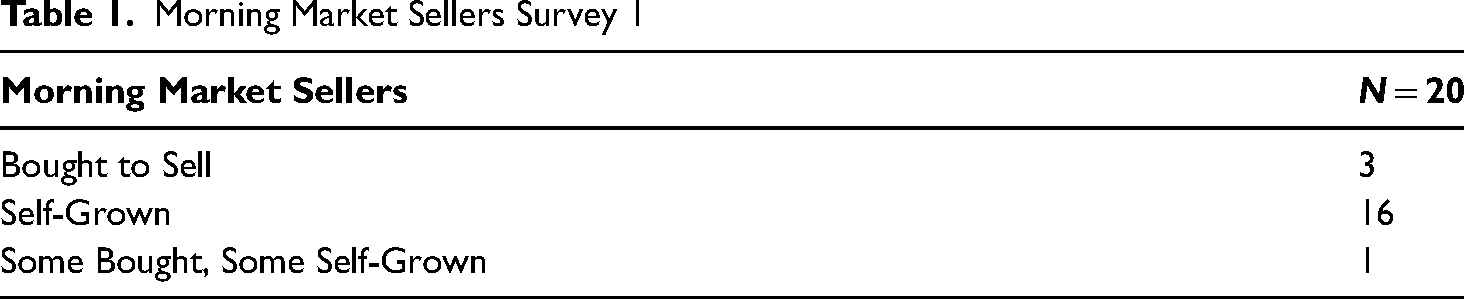
In the morning market, most sellers surveyed stated their produce was self-grown. The number of sellers surveyed represented almost all of the morning market sellers that day. Two of the three sellers who stated their produce was bought specified that it was bought directly from peasants, whilst one said they bought it from a wholesale market. When conducting fifteen supplementary morning surveys of the seven sellers I had not originally surveyed, six said their produce was self-grown, whilst one said it was wild produce foraged by himself.
A second connected question was designed to fit with Xu et al.'s (2013) study but in the market setting. This asks if the vegetables are self-grown, or if they are also vegetables that the seller's family eats. All who described their vegetables as self-grown answered yes. However, this question was insufficiently nuanced to ascertain whether the food that was being consumed was the “food for life” produce described by Xu et al. (2013). I therefore conducted fifteen supplementary surveys which included two questions, asking if the vegetables that were being sold were (a) partly eaten by the seller's family and partly sold or (b) only for selling, and asking whether the seller grows their own vegetables that are only eaten by their family and not sold (Table 2).
Morning Market Sellers Survey 2

Most sellers stated they ate part and sold part of the produce. The four who said they only sell the produce included the only two sellers who reported that not all their produce was self-grown. Thirteen out of fifteen said they did not grow produce solely for their family to consume and not to sell at the market. One respondent commented that if they can’t finish the food they grow, then they sell it. This demonstrates that, within this morning market, there is evidence that a certain amount of the produce being sold is surplus “food for life” produce and therefore produce that is likely to be seen as safer in the eyes of consumers.
Day Market Seller's Surveys
The same questions were asked of the sellers at the day market. These sellers reported different results (Table 3).
Day Market Sellers Survey 1
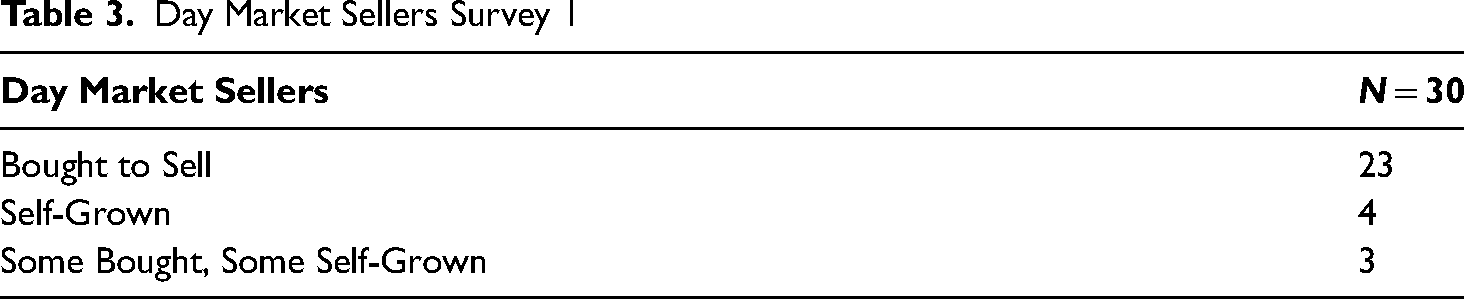
Most of the day sellers stated their produce was bought to sell. Nineteen out of twenty-nine (one person did not answer) said they only sell and do not eat their produce. This represents approximately 65.5 per cent. Compared to the supplementary morning market survey, in which over 73.3 per cent stated the opposite (that they sold part, and their family ate part). Of the twenty-three that reported their produce was bought, eighteen reported they only sold the produce and did not eat it, while of those that reported all their produce was self-grown, three out of four reported that they sold some and ate some.
These results indicate the existence of “two products” being sold at the day market: (1) produce that is mainly bought to sell at the market, and is less likely to be eaten by the sellers themselves, and (2) produce that is more likely to be grown and eaten by the sellers themselves. Including morning market results in which nearly all stated their produce was self-grown, and over 73.3 per cent stating their family eats the produce, there is evidence for the “One Market, Two Products” concept at this market. However, it may make more sense to split the day and morning markets and argue that there are, in fact, two markets and two products.
These results suggest that Xu et al.'s (2013) study of the two systems of peasant production is being translated into this wet-market setting. The more informal morning market provided somewhere to buy informal peasant-grown produce, which may have used fewer chemical inputs, and the more formal day market was a place to buy produce grown for the general market, potentially with more chemical inputs. The consumer surveys were designed to ascertain if consumers at this wet market were actively trying to consume this less formal “food for life” produce.
Consumer Surveys
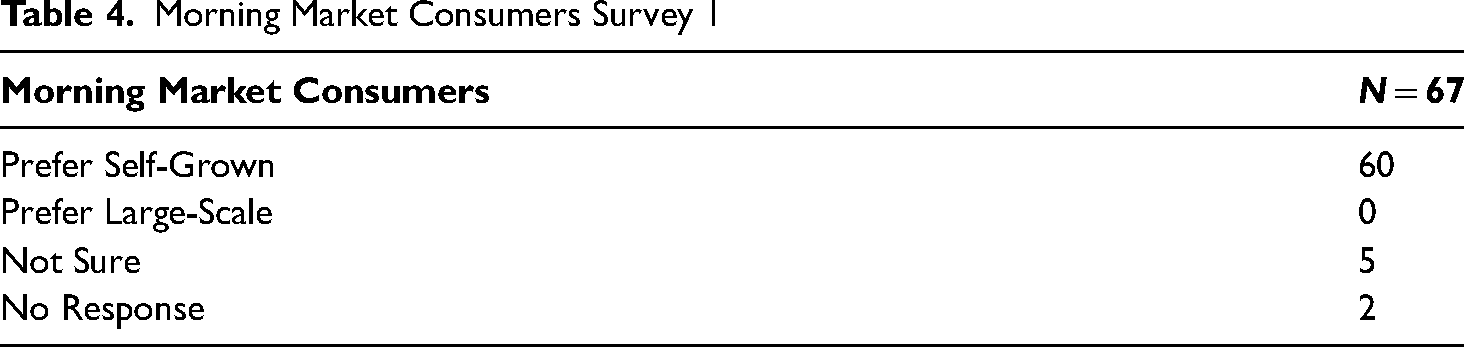
Consumers were asked whether they were most inclined to buy (a) large-scale produced vegetables, (b) peasant self-grown vegetables, or (c) “not sure” (Tables 4 and 5) .
Morning Market Consumers Survey 1
Day Market Consumers Survey 1
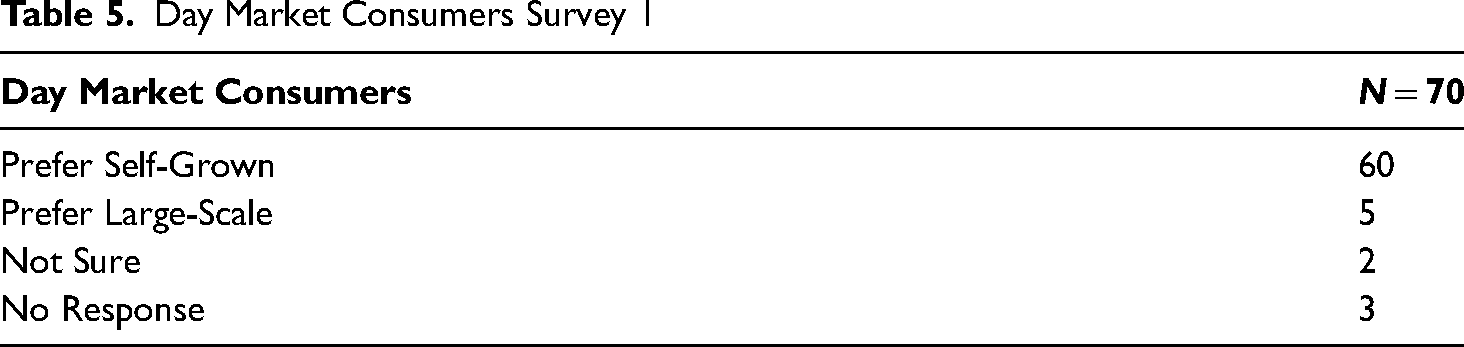
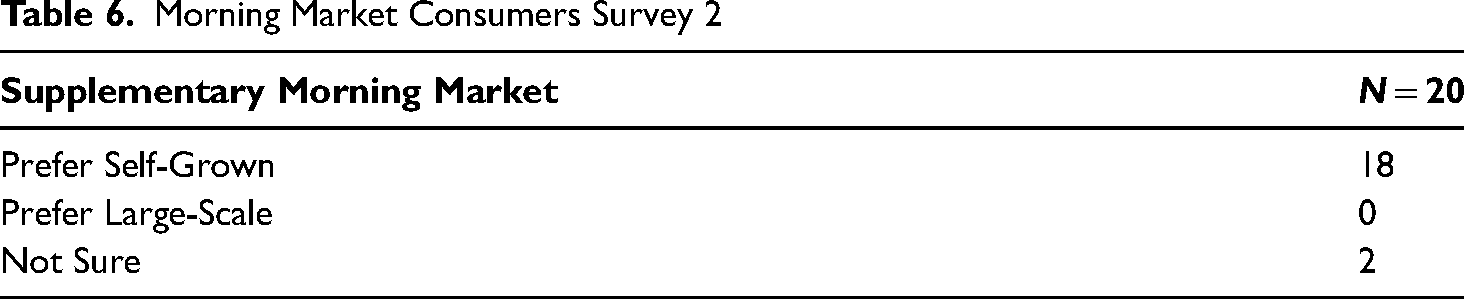
These results demonstrate consumer preference for peasant self-grown vegetables. Two of the day market consumers who reported that they were more inclined to buy large-scale produce stated that the reason was simply that they were unable to buy peasant self-grown vegetables. One of these respondents reported in a previous question that she would prefer to eat the same vegetables that peasant farmers grow to feed their families because they have fewer pesticides and chemical fertilisers. Another respondent, who picked large-scale produce, stated the two types of produce were “broadly similar,” while in a previous question, she also reported she would prefer to eat the same vegetables as peasant farmers feed their families because they are healthy. The remaining two that chose large-scale produce did not answer why. One of the consumers who answered “not sure” gave the reason that her own family has a plot of land to grow vegetables; therefore, presumably, a large amount of the vegetables they eat are home-grown. When asked if she would prefer to eat the produce peasants eat themselves, she answered yes because they use less chemical fertiliser. The second person who answered “not sure” did not give a reason (Tables 6 and 7).
Morning Market Consumers Survey 2
Day Market Consumers Survey 2
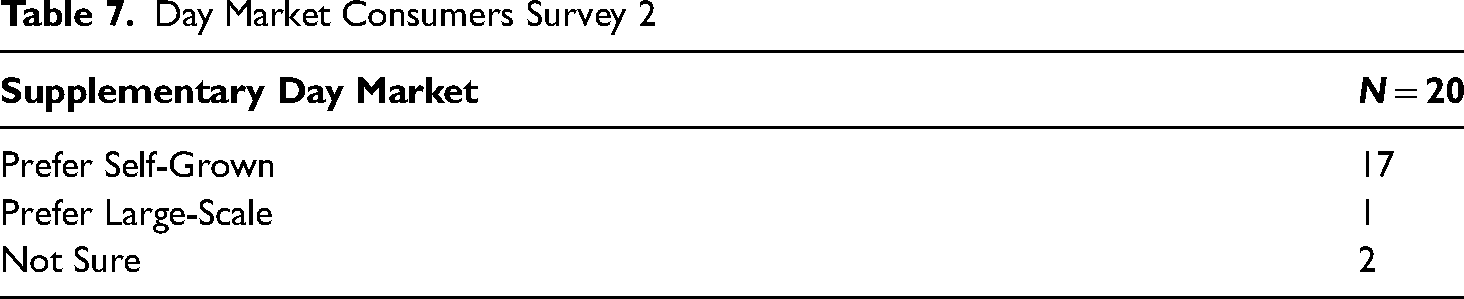
The supplementary surveys confirmed previous results and demonstrated overwhelming preference from consumers in this market for peasant self-grown vegetables.
After thirty morning surveys, I expanded the questionnaire to ask respondents to explain their choice. Thirty-seven morning market consumers were given the chance to explain their answer; twenty-seven answered. Thirteen directly answered that peasant self-grown vegetables were “safe” (安全, anquan), one answered “health” (卫生, weisheng), presumably meaning that these types of vegetables are better for their personal health. Two answered that these vegetables did not cause public harm (无公害, wu gonghai), likely to mean they produced fewer public health problems. Four mentioned using either fewer or no chemical fertilisers or pesticides. Since pesticide and chemical fertiliser residue are health and safety concerns, I also conceptualised this under “safety.” This meant twenty out of twenty-seven mentioned something connected with the vegetables being “safer.” Other comments were “fresh” (新鲜, xinxian) from three people exclusively and four people in conjunction with other terms. Three people wrote that this type of produce was “cheap” (便宜, pianyi) or “affordable” (实惠, shihui) – the sole reason for one person and a reason in conjunction with others for two. This demonstrates there are also economic reasons for buying self-grown vegetables; however, safety reasons dominate morning market consumers’ answers for buying peasant self-grown vegetables rather than large-scale produce.
Day market consumers had similar results. “Safety” (in which I include terms such as “safe” (安全, anquan), “at ease” (放心, fangxin [the use of the term 放心 with regards to food consumption is expanded upon in Fihl (2020: 266–267)]), “no chemical fertiliser” (无化肥, wu huafei), “low pesticide” (农药少, nongyao shao), “pollution-free” (无污染, wu wuran), “healthy” (健康, jiankang)) accounted for forty-one of the sixty-five who chose to answer this question. Other answers arguably hinted that peasant agriculture is safer, for example, one respondent wrote “天然” (tianran) meaning peasant agriculture is more “natural” while another wrote “无添加” (wu tianjia) meaning “nothing added” or “no additives,” presumably nothing bad added, such as harmful chemicals. Eight respondents chose freshness as a non-safety-inspired motivation to choose peasant-grown produce (six exclusively, two in conjunction with other reasons), and seven responded with an economic motivation: that peasant-grown produce was cheap or affordable (two exclusively, four in conjunction with other reasons).
A large majority of morning market and day market consumers saw peasant-grown produce as safer than large-scale produce. I expanded this question to integrate the “Two Systems” theory, asking if consumers were more inclined to choose to buy peasant-grown vegetables, were they also more inclined to choose to buy peasant-grown vegetables grown for family consumption? The answers were similar to the previous question (Table 8).
Morning Market Consumers Survey 3
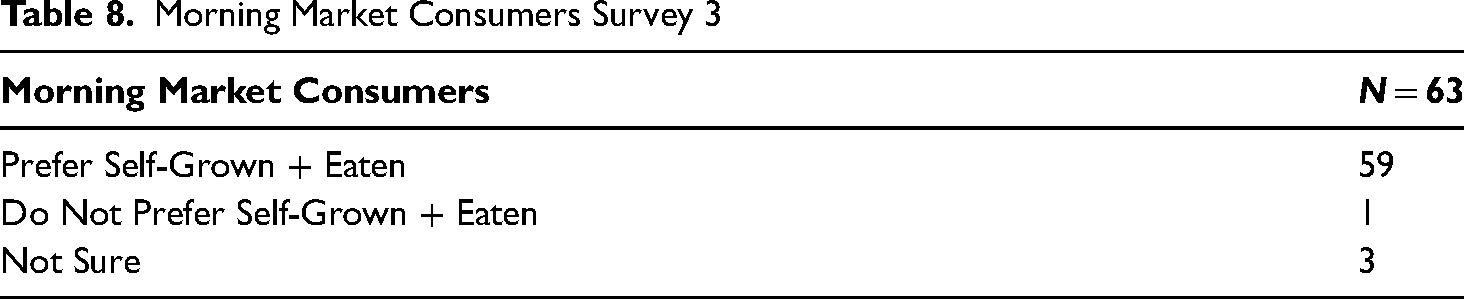
Most morning market consumers preferred peasant self-grown vegetables that were also eaten by the peasants themselves. The respondent who answered that they did not prefer to buy peasant-grown vegetables grown for family consumption previously answered that he would be more inclined to buy peasant self-grown vegetables because they were safer in the previous question. The reason given that he is not inclined to buy peasant products that were grown for family consumption was that “there is almost no self-grown vegetables.” Of the four that answered not sure for the previous question, two of them answered yes for this question, integrating the “Two Systems” theory; one did not answer, and one answered not sure. The reasons were similar to the previous answers; something to do with “safety” was cited twenty-two times out of thirty in the morning market (Table 9).
Day MArket Consumers Survey 3
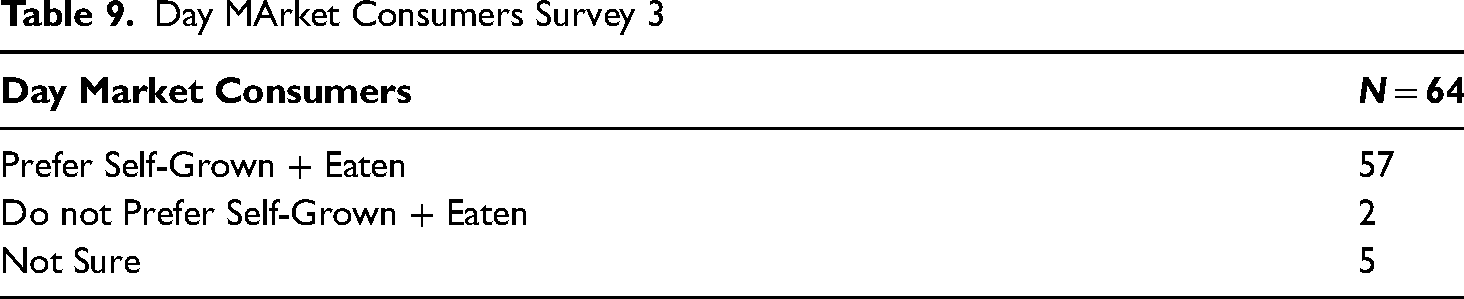
Most day market consumers also preferred peasant self-grown vegetables that were eaten by the peasants themselves. Their reasons were broadly similar to the previous answers, with “safety” cited forty-five times out of the sixty-one who answered this question. Of those that answered, they were inclined to buy large-scale produce in the previous question; two said they would be inclined to buy peasant-grown produce grown for family consumption, one answered they would not be inclined to, while two did not answer. Of those who answered “not sure” to the previous question, one answered that they would be inclined to buy peasant-grown vegetables produced for family consumption, while the other did not answer.
One respondent pointed out that the food the peasants eat themselves uses animal droppings as fertiliser rather than chemical fertiliser. Another responded that if the peasant farmers eat it, it must be good, therefore they would eat it – this was not conceptualised as “safety” for my purposes, as it was not clear if the produce was good because it was safer or for another reason. A third stated that because the peasants themselves eat it, it will therefore not have chemical fertiliser, and it will be relatively “green” produce. These answers give some evidence that while peasant-grown produce is popular, if the consumers think it is grown for the farmer's own family to consume, it is more popular. This suggests consumers are aware that there are “Two Systems” of peasant produce, corroborating Zhang and Qi's (2019: 119) argument that “it is an open secret in China that peasants separate food for market and food for family consumption.”
Supplementary Consumer Surveys
I conducted forty supplementary consumer surveys to ascertain where/how consumers acquire peasant self-grown vegetables. As above, a large majority replied they were more willing to choose to buy peasant-grown vegetables, eighteen out of twenty for the morning market (two stating “not sure”) and seventeen out of twenty for the day market (two stating “not sure,” one stating they preferred large-scale produced vegetables). Further, fifteen out of the nineteen that gave a reason for the choice in the morning market stated something I conceptualise as having to do with better “safety.” Thirteen out of the twenty day market surveys stated something to do with “safety.” One person commented that not applying chemical fertiliser means less chance of illness, strongly linking chemical fertiliser with health concerns.
The new questions asked included: “Do you think it is convenient or not to buy peasant self-grown vegetables?” and “How do you usually get peasant self-grown vegetables?”
In the morning market, fourteen out of twenty, and twelve out of twenty in the day market stated it was convenient. Asked to elaborate, participant answers varied. In the morning market, two people stated that the morning market has this produce. Three other participants partly agreed with this, saying “although there is not enough peasant-grown produce, you can get it early at the morning market, but later there is none.” One participant suggested the “night market” as a place to find peasant self-grown produce. However, another participant stated that the peasant farmers don’t come to the city because “they” (presumably the city government) don’t let them sell on the street.
In the day market, there were contrasting explanations of convenience. Seven participants stated that the peasant farmers come to the market to sell their vegetables, while five stated that it is too far for them to come or that there is none available at the market. Two respondents stated that most sellers are middlemen/peddlers at this market, so it is not clear where their produce originates from.
Asked how consumers usually got peasant self-grown vegetables, nine out of twenty morning market respondents stated they can get peasant self-grown vegetables at the morning market, and four stated at “the market.” A second important response to this question was that three respondents explained that their relatives would get them peasant self-grown vegetables from the countryside. This type of consumption avoids not only modern retail but also traditional wet markets. A further answer from one respondent was that in rural areas, there are peasant-grown vegetables, and every year she orders them and they are sent to her. This might be classified as an “alternative food system” reported as a growing trend in China, although mainly in tier-one cities (Cheng and Shi, 2014).
In the day market, ten people mentioned buying peasant-grown vegetables at “the market”; none mentioned the morning market specifically. Four respondents mentioned relatives when asked where they get peasant-grown vegetables. For example, one respondent stated they have relatives who live in the countryside and don’t use chemical fertiliser. A further three people stated they go to the countryside to buy peasant-grown vegetables without mentioning relatives. It seems a relatively common theme amongst respondents that they obtain vegetables directly from the countryside when possible. Further interesting comments included one person stating they have their own place to grow vegetables, and one mentioning a market in the new district of the city where she believes more peasant farmers go to sell produce. These trends, I suggest, once again demonstrate that non-market social spheres – the family and less-marketised spheres where “nonmarket factors still exist” (He, 2007: 29) – the rural, are conceptualised as locations of safety from the negative effects of marketised food.
Discussion of Findings
The evidence from this case study demonstrates the existence of a Polanyian consumer countermovement in vegetable consumption habits in three ways. Firstly, consumers generally look towards the peasant to gain “safer” produce. This self-protective measure can be classified as a Polanyian countermovement, as rural land in China is not fully operated through market exchange. Village collectives own rural farmland, and peasant families are allocated land use rights (Donaldson and Zhang, 2015; Ho, 2001). This reflects the householding principle Polanyi argues “has nothing in common either with the motive of gain or with the institution of markets” (Polanyi, 2001: 56) and initially could be described as a “‘small peasant socialist’ model” (Wang and Karl 2004: 12). However, although this system has provided farmers with “political bargaining power” (Donaldson and Zhang, 2015: 52) to “resist agribusiness” (Donaldson and Zhang, 2015: 56), the market has increasingly encroached upon this system and considerable agro-industrialisation has occurred focusing on larger scale production and markets (Schneider, 2015, 2017). Donaldson and Zhang (2015) describe five types of farmers that have developed in the period of scaling-up and modernization of China's agriculture, from “Commercial Farmers” that are “usually not under any direct domination or exploitation, other than the unfavourable terms of trade they may endure on the open market”(Donaldson and Zhang, 2015: 56) to “Proletarian farm workers” – “landless labourers” (Donaldson and Zhang, 2015: 66) working for agribusiness. The varying levels of exploitation depend on the varying levels of control the farmers maintain to the use rights of their land, but all variations demonstrate “China's path toward agrarian capitalism” (Donaldson and Zhang, 2015: 68). In this process of creating different forms of farming operations the market encroaches upon peasant land, forcing, in varying ways, peasants to produce “food for money” (Xu et al., 2013). This changes the basis of householding away from “accessory production for the market” (Polanyi, 2001: 56) to production that caters for the needs of a national or global market which often demands uniform and attractive produce necessitating herbicide and pesticide inputs (Hansen, 2020: 315). If peasant farmers maintain control of their land, many spontaneously perform a countermovement against the negative effects of this market encroachment, producing “food for life” (Xu et al., 2013) – self-protection from inputs they deem unsafe. My case study suggests consumers recognise this producer countermovement and thus perform a second, more specific countermovement that aims to consume this limited peasant self-grown produce grown for peasant self-consumption. However, due to the limited availability of this produce as it is squeezed to the periphery of peasant farming, there is a third countermovement evident at the wet-market studied, one that aims to bypass even the local informal market – using family members with access to land to gain self-protection from market produce. This principle of “reciprocity” is a second principle of non-market economies that Polanyi (2001: 51) details in TGT.
These countermovements aiming at bypassing modern, distant, large-scale and inaccessible food provisioning systems can be seen as attempts at increased knowledge about who and how food is produced through face-to-face contact with producers. This form of “knowing” (Merrifield, 2020: 288) to gain safe food has been analysed in the context of a farm-to-market restaurant and community-supported agriculture initiatives (Merrifield, 2020). However, in this case study, face-to-face interactions are enabled in an informal and more traditional setting of a wet market.
Seeking refuge from “the market system” through buying peasant-grown vegetables at a wet market may sound paradoxical. However, Polanyi clearly separates a social system run through the market from buying and selling in a market: “[…] the end of market society means in no way the absence of markets” (Polanyi, 2001: 260). While surplus “food for life” can be sold, the logic of production was self-protection, not maximising profit in line with a self-regulating market demand. Ploeg et al. (2022) similarly argue that hegemonic marketisation can be fought by peasants using “the market.”
The countermovements I find in this wet market fit the Polanyian definition of the countermovement in TGT, as they are not consciously aiming to undermine the market system but, spontaneously, in an atomised yet collective move, protecting themselves from the negative effects of the self-regulating market. This definition contradicts much of the contemporary Polanyian literature, including literature on Chinese rural development which has argued countermovements can be considered consciously counter-hegemonic (Escher et al., 2018) and therefore ideological. However, there is evidence to support the non-ideological interpretation within TGT (Alcock, 2020, 2024; Reisman, 2019). An additional observation is that the majority of consumers at both the morning and day markets were middle-aged or above. This leads to the question as to how, and if, younger people in this neighbourhood are engaged in food-safety countermovements.
The analysis presented here fits with Becket's (2009: 51) argument that scholarship claiming Polanyi as its inspiration should focus on questions including: “how are actors responding to the increasing uncertainties they face in consequence of the marketisation of ‘fictitious commodities’?” Here, the fictitious commodity of land is becoming marketised with results which ripple through society. These specific countermovements are ripples of a larger general countermovement, in contemporary Chinese society, that looks to the less-marketised rural sphere as a space of relative safety from rapid market transformation.
The Peasant Double Movement
The self-protective countermovement is only one side of the double movement dynamic. The concurrent move aims at the establishment of a self-regulating market. This is not a natural phenomenon. For Polanyi, the “laissez-faire economy was the product of deliberate State action” (Polanyi, 2001: 147). This has occurred in China as reforms have allowed increasing market penetration into previously less-marketised rural spheres (Caixin, 2018). However, as my case study demonstrates, there is a spontaneous and unconscious move of self-protection against the negative effects of market encroachment. In this double movement, the rural and the peasant become politicised subjects, framed on the one side as “backwards” (Day, 2013: 68: 917; Schneider, 2015) and an impediment to modernisation and growth, while on the other as a refuge for the perceived negative health effects of market-led food production.
The importance farmers attach to food produced by family or friends in the local community (Fang and Liu, 2018; Schneider, 2017; Si et al., 2019) demonstrates the spontaneous countermovement at play, unconsciously resisting the “backwardness” narrative placed on the rural sphere and the peasant to “modernise” them through marketisation. These moments instead frame “agroindustrialization [as] […] the problem, for which nongmin and China's tradition of smallholder farming are part of the solution” (Schneider, 2015: 344). This “double movement” suggests the state project of increasing the marketisation of rural China (Day and Schneider, 2017) will continue to experience backlash as a sphere of refuge from the negative effects of the market increasingly becomes part of the market system.
According to Polanyi, the double movement is a dialectical dynamic in which neither side can achieve a lasting victory, as both the marketisation move and the unconscious countermovement it provokes are destructive of society (Alcock, 2020, 2024). The market is destructive through its commodification of social protective institutions, and the countermovement is destructive through self-protective measures that unconsciously undermine the market system society has become “existentially dependent on” (Lacher, 2007: 60). However, Polanyi states that this dialectic dynamic can be transcended to something that breaks the double movement impasse. These “conscious” movements (Alcock, 2020) are also identifiable in the sphere of Chinese rural/peasant politics.
Expanding Polanyian Theory
Although Polanyi (2001: 242) in TGT suggests society may “transcend” the double movement impasse he does not explicitly articulate the steps by which this happens. The goal is for society to “consciously subordinat[e]” the market to “democratic society” (Polanyi, 2001: 242), or re-embed the economy into society, likely necessitating the decommodification (Lacher, 1999) of “fictitious commodities” (Polanyi, 2001: 75), including land. Within the context of Chinese rural politics, potential mechanisms for the unconscious countermovement sparking conscious Polanyian movements (Alcock, 2020) – movements that have an ideological understanding of the negative effects of the market and therefore put forward an ideological narrative against the market system – become apparent. This can be seen as a process of the self-protective and unconscious countermovements – unconscious of the systemic market process that forces individuals/groups into acts of self-protection from the negative effects of the market system – informing conscious Polanyian movements to pursue “social co-protection” (Xu et al., 2013: 33). Both Xu et al. (2013) and Zhang and Qi (2019) argue that the consumer countermovement for food safety can be seen within alternative food networks (AFNs) in China, often linked to the New Rural Reconstruction Movement (NRRM) (Si and Scott, 2016).
The NRRM emerged around 2005 (Yan et al., 2021: 860) in response to rural decline. The NRRM has been linked to Polanyi by Day (2008). NRRM scholars such as Pan and Wen (2016: 135) explicitly use Polanyian theory to argue that industrialisation, urbanisation and de-agriculturalisation have brought about “social self-protection” and this is the source of the “widespread and diverse rural reconstruction practice.” As Pan and Wen (2016) demonstrate, the academic debates in the NRRM are conscious of Polanyian ideas, the NRRM should therefore be referred to as a “conscious Polanyian movement” (Alcock, 2020), aiming for “social co-protection” rather than countermovements. Of course, it is not necessary for organisations to be aware of Polanyi to be classified as a conscious Polanyian movement; they can simply articulate similar political narratives as found in Polanyi's work (Alcock, 2020).
As Yan et al. (2021: 858) suggest, the spontaneous unconscious countermovements for self-protection in rural China were present before the NRRM theorised their existence as the “sannong crisis.” However, with the creation of NRRM AFNs Polanyian-like ideology becomes explicit.
Current AFNs mainly cater for middle-class consumers. However, Xu et al. (2013) and Zhang and Qi (2019: 2) argue that the peasant–consumer co-operation principle within AFNs, if expanded, may serve as a form of social co-protection in which food is re-embedded into social relations. Day and Schneider (2017: 2, 3), however, suggest these more recent “urban consumer-led” AFNs are in response to a 2008 policy shift that emphasised “rapid marketisation of land and agriculture, and urbanisation of the peasantry,” which undermines the NRRM's more “fundamental goal of transforming rural social relations.” They hold the opposite view to Xu et al. (2013) and Zhang and Qi (2019), suggesting that a focus on “mostly elite urban consumption […] has the potential to further entrench existing class inequalities within and across rural and urban spheres” (Day and Schneider, 2017: 3). Here there is very little space for AFNs to re-embed food production and consumption for urban–rural co-protection. More likely, food continues to be disembedded from social relations and constructed as a commodity to fulfil the demands of a wealthy elite.
An understanding of the unconscious countermovement and the conscious Polanyian movement (Alcock, 2020) helps flesh out the opposing views. While Xu et al. (2013) and Zhang and Qi (2019) suggest AFNs are countermovements, Day and Schneider's (2017) description of AFNs is more relevant to Polanyi's definition of a countermovement. This is because, to be classified as a countermovement, AFNs must not challenge market logic and will, as all countermovements do, necessarily fail to achieve a re-embedding. This is due to Polanyi's definition of the countermovement as spontaneous, non-ideological, self-protective reactions to the negative effects of the self-regulating market. If AFNs are a countermovement, Day and Schneider (2017) are correct to suggest their function is to protect the wealthy elite from the negative effects of the self-regulating market, uninterested in systemic reform. However, if Xu et al. (2013) and Zhang and Qi (2019) are correct in suggesting AFNs have the potential to create “social co-protection” and re-embed food into social relations, this suggests AFNs are in fact not countermovements, but conscious Polanyian movements. AFNs, in this reading, have become (without necessarily engaging with Polanyi's work) conscious of the systemic flaws of a market system that Polanyi describes – that marketisation of the fictitious commodity of land has disembedding effects with negative consequences for the whole of society. To be conscious Polanyian movements necessitates AFNs to have political narratives, likely to critique mainstream agricultural policy based on the marketisation of land and the commodification of people. These narratives are evident in certain NRRM AFNs in China (Alcock, 2019) and are the kinds of AFNs Zhang and Qi (2019: 121) describe, which become “[…] an entry point for critical examination of the commodification of food and other social relations in modern Chinese society.” Si and Scott (2016: 1091, 1094) also suggest NRRM AFNs are “empowering an alternative rural development movement” and that “having a very different vision of rural development from the Chinese state, the NRRM itself is political.” This political nature disqualifies them from being countermovements. Of course, not all AFNs have political narratives. Corporations have aimed to use certain AFNs to ride the wave of food-safety concerns in order to profit (Yasuda, 2017b: 82). These AFNs would have little potential to transform rural social relations. Disaggregation of AFNs therefore becomes important, and each operation ought to be analysed in its own terms as to whether it is an unconscious self-protective move (a countermovement) or a conscious “social co-protective” Polanyian movement.
In this rural case study, the societal norm of collective ownership of village land, outside of the market mechanism, is fundamental. This social institution is threatened by marketisation, causing social dislocation and the rise of unconscious self-protecting countermovements. The conscious Polanyian movements recognise this and aim to protect and expand this non-market institution by creating an ideology of social co-protection. This ideology of social-co-protection is a project to transcend the destructive market mechanism and the double movement contradiction.
The self-protective countermovement and conscious Polanyian movements described here, looking towards the rural as refuge from modernisation, give evidence to affirm Yan's (2012: 725) argument that China has developed into a modern “risk society” as people have become sceptical (consciously and unconsciously) of “science and market mechanisms as solutions to their food-safety problems” (Yan, 2012: 706). However, contrary to Yan's (2012: 721) conclusion, that the “role of science and technology and modernity in the formation of contemporary food-safety problems remains a blind spot in Chinese public opinion,” this article demonstrates more recent developments – that Chinese citizens point to markets and modernisation as a problem to be solved through consciously revitalising embedded land institutions or unconsciously grasping at the last vestiges of the legacies of embedded land on the peripheries of marketised agriculture.
For Polanyi, a successful and progressive transcendence of the double movement dynamic is only realised in socialism, and socialism is only realised on a large scale after the countermovement has unconsciously undermined the self-regulating market mechanism. However, the narratives of embedding the market into society contained in conscious Polanyian movements, embryonic within the self-regulating market, may be those which are grasped once the unconscious countermovement has undermined the self-regulating market system. For an eventual progressive societal transcendence, numerous conscious Polanyian narratives are likely to be required. In rural China, these narratives are activated through the market attempt at the creation of the “fictitious commodity” of land. Due to environment and food safety being “largely politically ‘safe’ topics in China” (Si and Scott, 2016: 1094), these organisations can more openly challenge structures that they believe are undermining the collective health of society and the environment. AFNs can push a pedagogical process through their business activities, which muddies the water between business and politics and may help avoid political scrutiny. Education is fundamental for Polanyi; his transcendence of the self-regulating market necessitates “a new mass culture of economic and political education” (Polanyi, 1932: 63). Therefore, it is likely that the pedagogical process of these types of organisations, and many hundreds of thousands across society, constitute the mechanism through which Polanyi believes the transcendence of the self-regulating market may eventually occur.
Whilst a handful of organisations within society with transcendental ideologies are unlikely to create a Polanyian transcendence, once the unconscious countermovement inserts enough interventions into the market that unwittingly undermine the self-regulating market mechanism, people will increasingly experience the negative effects of market breakdown and look to different ideological narratives for a solution. In Polanyi's social theory, there is no peasant or worker vanguard to his transcendence; Polanyi's unit of analysis was society as an organic whole (Selwyn and Miyamura, 2014: 641). A collective understanding that the self-regulating market is a danger to the whole of society, including the social welfare of elites themselves, is fundamental for Polanyi's hope of a progressive transcendence. A demonstration of how peasant, less-marketised agriculture, and peasant rights can protect the health of the whole of Chinese society, therefore has transcendental potential.
Conclusion
This article uses an exploratory case study to interrogate Polanyi's double movement and countermovement concepts. It uses the micro-foundations of the Chinese countermovement identified to understand China's contemporary rural political context. Through this process, the paper clarifies what an actually existing countermovement looks like as well as how the countermovement interacts with a larger peasant double movement. It helps demonstrate how countermovements are dependent on a political context in which parts of society aim to shift society towards a self-regulating market “utopia.” It expands Polanyian theory by suggesting that rural China, due to its continuing and high-speed transformation, is a useful location for understanding the possibility of Polanyi's ultimate hope of a transcendence beyond the self-regulating market. It suggests that there is potential for political movements articulating pro-peasant politics, often within food movements, to protect rural China from becoming a market society. However, this is by no means inevitable, as there is significant power invested in transforming rural China into a tributary of the self-regulating market. Further, a close reading of Polanyi's TGT suggests there will have to be a breakdown of the self-regulating market before a general transcendence is possible (Alcock, 2024).
This article argues that Polanyian researchers, aiming to locate actually existing countermovements, ought to find acts of self-protection by people unconscious that the negative problems they are facing, and must protect themselves against, are due to the systemic market problems Polanyi identifies. It emphasises that it is important to place countermovements within larger socio-political debates and to locate the conscious movements sprouting from the unconscious countermovement to achieve a broader understanding. While this article suggests Polanyi's hope of transcendence relies on expanding certain intellectual narratives on phenomena within society and necessitates a breakdown in the market mechanism brought by the interventions of the countermovement, it also demonstrates that praxis comes from multiple different locations within society and often comes spontaneously from large groups of the most marginalised. It therefore calls for more attention to be paid to these spontaneous, large-scale, yet atomised, moves which do not openly articulate collective values. These countermovements are often neglected in favour of more easily identifiable political movements which publicly articulate a coherent political ideology.
Footnotes
Acknowledgements
The author would like to thank the anonymous reviewers for their valuable feedback. The author also gratefully acknowledges the support of The Hong Kong Polytechnic University (Grant No. P0053854) and the Research Grants Council of Hong Kong (Grant No. P0053806).
Declaration of Conflicting Interests
The author declared no potential conflicts of interest with respect to the research, authorship, and/or publication of this article.
Ethical Approval
Research Ethics Approval: Ref No.: SSH_DPIR_C1A_17_016.
This research received ethics approval on behalf of the DPIR Departmental Research Ethics Committee (DREC) in accordance with the procedures laid down by the University of Oxford for ethical approval of all research involving human participants.
Funding
The author disclosed receipt of the following financial support for the research, authorship, and/or publication of this article: This work was supported by The Research Grants Council of Hong Kong, The Hong Kong Polytechnic University (grant numbers P0053806 and P0053854).
