




Abstract
In the early first decade of the twenty-first century, the Chinese Communist Party (CCP) began reassessing its relationship with capitalism, notably with private entrepreneurs. Following the reassessment, the CCP embraced the private sector in a strategy of “co-optation” and private entrepreneurs joined the party in increasing numbers. From 2012, the new Xi administration pushed for stronger political allegiance from all enterprises, resulting in a shift from “state capitalism” to “party-state capitalism.” As a result, party cells within enterprises of all ownership types have surged. The article employs a two-pronged approach to investigate the intricate relationship between the party and private businesses under Xi Jinping. It examines policy documents and analyses four recent case studies from Guangdong province based on interviews and company documents. Our main finding is that while the push for party integration has been significant, the role and influence of party cells vary notably across private enterprises.
Keywords
Introduction
Party–business relations in China have emerged as an important research field. Until recently, scholarly attention has focused primarily on the role of organisations of the Chinese Communist Party (CCP) in state-owned enterprises (SOEs), while few studies have explored the CCP's role and function in private companies. Drawing on policy analysis and case studies, this article provides empirically grounded insights into the organisational presence of the CCP in Chinese private companies in Guangdong province. To our knowledge, no other study offers such organisation-level insight.
During the 1990s, many SOEs introduced corporate governance practices that increasingly converged with Western practices (Beck and Brødsgaard, 2022). They established boards with outside directors and professionalised their business operations under the slogan, “separating government and business.” All had party organisations, but these mainly dealt with welfare issues and were not an integral part of board-level decision-making structures.
This convergence towards Western practices began to change in the early first decade of the twenty-first century, and especially after 2012. The 2008 global financial crisis questioned the attractiveness of the Western model, while the colour revolutions of 2004–2005 and the Arab uprisings of 2010–2011 caused Chinese leaders to tighten political control.
From 2012, during the Xi Jinping era, the CCP gradually increased its control over SOEs. New regulations required company boards to refer deliberations of major issues to the company's party organisation before being formally decided by the board, and stipulated that the chairman of the board and the party secretary were to be the same person. From 2017, as part of a broader party-building drive, the State-owned Assets Supervision and Administration Commission (SASAC) required SOEs to write the role of the party into their corporate charters. In practice, these developments made it increasingly difficult to distinguish between party cadres and professional managers at the firm level.
In terms of the number of companies, contribution to GDP, and share of urban employment, SOEs have retreated since the 1990s and a vibrant private economy has developed. A great number of studies show how the Chinese economy gradually “grew out of the plan” (notably Naughton, 1995; see also Kroeber, 2016; Lardy, 2014; Qian and Wu, 2000). However, few have assessed the relationship between the private sector and the political power system. As a result, the empirical foundation for theorising about the party-state is porous, limiting our understanding of how the Chinese party-state functions in the economic sphere.
Undoubtedly, resources in the Chinese economy are increasingly mobilised and allocated by market forces, in accord with the principles that the market should play a “basic role” and, since 2013, a “decisive role” (Central Committee, 2013). It therefore appears theoretically sound to describe the economic system – marked by the co-existence of SOEs and private companies – as a form of “state capitalism” (Kurlantzick, 2016; Naughton and Tsai, 2015; Wright et al., 2020). However, the simultaneous strengthening of the CCP's role necessitates a reconceptualisation of state capitalism that explicitly incorporates party leadership (Pearson et al., 2021).
Research on the party's expanding role in the theory and practice of corporate governance in Chinese SOEs has generated substantial insights into the party-state dimension of party–SOE relations. Yet, given the growing weight of the private sector in the economy, the question of whether conclusions derived from knowledge about the SOE sector can be generalised to the economic system as a whole remains open. Here our findings challenge an influential study by Milhaupt and Zheng, which argues that SOEs and privately owned enterprises (POEs) are not significantly distinguishable in terms of state access, influence, and privileges (Milhaupt and Zheng, 2015). In our view, private firms operate under a different legal and regulatory framework than SOEs and, although private entrepreneurs may be represented in local people's congresses, they are not integrated into key political power structures. Notably, for example, no private entrepreneurs are members of the elite Central Committee.
We argue that refining our understanding of the Chinese party-state requires in-depth studies of party–business relations in the private sector. The private sector has not escaped the ongoing party-building campaign, as evidenced by the widespread inclusion of CCP-related provisions in the corporate charters of private firms. Yet, fundamental questions remain: what does the presence of the party in Chinese private business look like in practice and is it uniform across sectors and types of enterprises? What regulatory foundations underpin the current strengthening of the party's role in private Chinese firms? Finally, is state capitalism an adequate conceptual framework for capturing the evolving Chinese political-economic system, particularly, the deepening role of the CCP? These are the key questions this article aims to address.
Methodology
Research for this article combined desk research and fieldwork in China.
First, we conducted an exhaustive online desk review of all central-level policy documents and speeches relevant to the CCP in private businesses. The focus was on formal policy documents issued by the central party-state, which constitute the regulatory and legislative framework for CCP penetration into private companies. Documents retrieved from the Chinese internet via the Baidu search engine were supplemented with materials from mercator institute for China studies’ policy tracer “PoliXi” and the database “Chinese Party-State Politics – A Catalogue of Policy Documents” of the European Union's China Horizon project, “Dealing with a Resurgent China” (China Horizons, 2025). Only about a dozen policy documents from central authorities deal directly with party building in private companies, but hundreds of local-level documents exist. Since these largely reiterate and operationalise the central directives within specific jurisdictions, this article does not analyse them.
Second, the authors conducted fieldwork in Guangdong province in September 2023, carrying out semi-structured interviews with managers at four privately owned companies of varying sizes and sectors: Guangzhou Shiyuan Electronic Technology Co. (CVTE), NetEase, Lion TCR, and Guangzhou TianRen (Haoyuan Group). Access to the companies was facilitated by the Guangzhou Institute of the Greater Bay Area. At CVTE and NetEase, we interviewed the party secretary directly, while at Lion TCR and Haoyuan, we spoke with the CEO and the Head of Public Affairs, respectively. All interviews were conducted in Chinese (Mandarin) without the assistance of interpreters. Due to the sensitivity of the subject, they were not recorded or transcribed. In addition, we were shown around each company's facilities by senior staff. These gave us opportunities to engage in more informal talk and provided information supplementing the formal interviews. Impressions and insights gained from these guided tours were recorded immediately after each company visit and are an important part of our empirical material. Findings are thus based on handwritten notes taken during the meetings and after tours, supplemented with desk research on each company.
Third, we consulted the publicly accessible (巨潮资讯网, Juchao zixun wang) database (www.cninfo.com.cn) as well as the China stock market & accounting research database database of the listed enterprises, to assess the extent of company charter amendments that formally incorporate the CCP into the corporate governance structure of private-sector companies.
It should be noted that conducting fieldwork on the CCP in the private sector is fraught with difficulties for foreign scholars, including identifying possible fieldwork sites and gaining access to the internal party organisation in companies. Statistics concerning party organisation coverage by industry, region, and company are also less available in the POE sector than in the SOE sector. Given these constraints, the detailed information gained from our case interviews, particularly from CVTE, is unique and not available in other studies.
To sum up, the contribution of this article consists of four main elements:
It systematically traces the evolution of party-building policies in POEs during the Xi Jinping era. It reveals the varied patterns of party embeddedness in the private sector, based on first-hand interview data. It proposes the theoretical framework of “variegated party-led state capitalism” to explain differential patterns of CCP integration. It provides unique empirical evidence from Guangdong enterprises, thereby addressing a critical lacuna in the existing literature.
Literature Review
Party organisation within China's SOEs has been extensively documented, with a broad consensus that the communist party is strengthening its leadership through new regulations (Beck and Brødsgaard, 2022; Jin et al., 2022; Leutert, 2018; Leutert and Eaton, 2021; Wang, 2014). In contrast, much less is known about party influence in the private sector.
Existing literature on this topic can be broadly divided into two strands: historical-institutional studies within the China Studies tradition, which are mostly qualitative; and quantitative business and management studies that investigate the relationship between party control or party organs and various measures of corporate behaviour and performance in private enterprises.
Within the China Studies tradition, Ma and He (2018) examine party–business relations from the perspective of political absorption and organisational embeddedness. They argue that private businesses facilitate the establishment of party organisations within their companies and enter the political arena in order to secure protection and acquire benefits associated with state capture, such as priority access to administrative approvals, SOE partnerships, and bank loans. Ma and He conclude that party–business relations are characterised by mutually beneficial interdependence. Similar dynamics are identified by Yan and Huang (2017), who argue that the supportive and facilitative functions of enterprise party cells – key tasks of party building – contribute positively to the development of private companies.
Other studies challenge this interpretation. Zhang (2019) argues that the political campaign to integrate the communist party as the core force in corporate governance in China has reversed the trajectory of market reform. Koss (2021) also disagrees with Yan and Huang, demonstrating that most private entrepreneurs in a Hebei prefecture were highly critical of establishing party cells within their firms. He further shows how loyalty to family clans complicates internal lines of authority. Koss interprets party building in private companies as a redeployment of Mao-era institutional inventions under new conditions to exert control over economic organisations, conceptualising this party-building process as a form of institutional bricolage. Marquis and Qiao (2022) introduce imprinting theory to evaluate the relationship between private entrepreneurship and the CCP. They argue that Chinese entrepreneurs, as well as Chinese society in general, continue to be deeply imprinted by Maoism, and that Maoist principles and maxims continue to shape business practices. Consequently, private entrepreneurs are not necessarily hostile to party involvement in their enterprises.
A recent Swedish study on the CCP's increasing influence over businesses in China situates party influence within changes in Chinese laws, intra-party regulations, and policies (Almén and Carlsson, 2025). Similar to our article, it also is based on firm-level interviews. However, its empirical focus is on seven Swedish companies with subsidiaries in China, rather than on firms owned by private Chinese actors. Even so, the Swedish study's description of the CCP's increasing influence in the private sector resonates with our theoretical conclusions regarding the characteristics of Chinese party-led state capitalism. In this sense, the two studies complement each other.
Several quantitative studies identify positive correlations between the establishment of party cells in private companies and improved corporate philanthropy (Yu and Chen, 2021); social insurance and employee protection (Dong et al., 2016; Yan and Xu, 2022); corporate social responsibility (CSR) and green innovation (Gu and Yang, 2023; Li et al., 2020; Zhang et al., 2024; Zhou et al., 2021); audit quality (Zeng et al., 2021; Zheng et al., 2019); innovation performance (Lin et al., 2023); and firm performance and business valuations (Chang and Wong, 2004; Chen et al., 2023; Lin et al., 2023). Overall, these studies confirm that enterprise party cells function increasingly as channels the party-state uses to exert demands and communicate new policies to firms. This special type of “state capture” facilitates the transfer of information on CSR frameworks or employee-friendly practices, while appearing to provide access to benefits such as loans and R&D partnerships.
Two very recent studies analyse amendments to company charters during 2015–2018 that formally incorporate the party, examining their effects on stock market valuations, though their primary focus remains on SOEs (Chen et al., 2023; Xie et al., 2022). With respect to POEs, there is also a notable lack of case studies; therefore, the actual nature, extent, and mechanisms of party-state influence over private companies via party cells remain a “black box” (Xie et al., 2022: 12). This article addresses these gaps by analysing party cells in private business from two angles: central policies and regulations and case studies of party organisation in four POEs in Guangdong province. The analysis of central policies and regulations provides an essential context for understanding the practical implementation and implications of party organisations in private companies.
An influential stream of research attributes growing party control over private Chinese enterprises to the reorientation of China's political economy towards party-state capitalism (Pearson et al., 2021) – a revision of “Chinese state capitalism” that highlights the CCP's increasing appropriation of state functions (Brødsgaard and Grünberg, 2018). Snape (2024), for example, substantiates this recalibration of party-state relations through an analysis of the rise of “party law,” arguing that “intra-party regulations” extend beyond the party itself to govern relations between party and business. The party is everywhere, including in the Chinese private sector. The key analytical question concerns the modalities of that presence.
Under the banner of “the Party leads everything,” the party has assumed a central role in the Chinese polity at the expense of state institutions. We concur, stressing the dominance of the party by coining “Party-led state capitalism” rather than “Party-state capitalism.” Moreover, recognising that the extent and form of the CCP's organisational presence in Chinese enterprises varies by ownership type and firm size, we coin the concept of “variegated party-led state capitalism,” taking inspiration from theoretical debates on “variegated capitalism.”
Regulatory Framework
Policy documents indicate that the presence of party cells in private companies is not a recent development. The establishment of such cells was first legally mandated by China's inaugural Company Law, which took effect on 1 July 1994. The law required that the activities of party organisations within all companies conform to the constitution of the CCP. Subsequent revisions of the Company Law (2004, 2005, 2013, and 2018) further emphasised that companies shall provide “necessary conditions” for the activities of party organisations, thereby legally stipulating the establishment and functioning of party cells in enterprises, regardless of ownership form. Despite this legal framework, actual penetration remained limited: in 2003, a mere 6 per cent of private enterprises had established a party cell (Koss, 2021: 229).
Since 2012, the CCP has issued a series of documents aimed at clarifying the purposes and functions of “Party organizations as a fighting fortress in the non-public economy.” That year, the Organization Department of the Central Committee issued “Opinions on Strengthening and Improving the Work of Party Building in Non-Publicly Owned Enterprises” (Central Organization Department, 2012). According to this important document, the overarching mission of establishing party cells is to: (i) propagate the party's guiding policies; (ii) foster cohesion and solidarity among employees; (iii) protect all actors’ rights and interests (within the company); (iv) cultivate an advanced corporate culture; (v) promote healthy corporate development; and (vi) support personal growth and self-development.
In terms of specific functions of party cells, the 2012 document outlined objectives such as recruiting talent into the party, aligning company missions with party objectives, mediating individual rights and interests within the company, and, not least, collecting and managing party cell and membership-related funds. The financing of party cells and their activities was further addressed in a 2014 notice jointly issued by the Organization Department, the Ministry of Finance, and the State Administration of Taxation. This notice reiterated that party cell operational costs are to be covered through companies’ management expenses (Central Organization Department, Ministry of Finance & The State Administration of Taxation, 2014).
The overarching goal was to weave the party “comprehensively” into the fabric of the economy's private sector (Central Organization Department, 2012). Local authorities were directed to establish special agencies to support this goal and firms were requested to seek guidance from local party leaders on important managerial decisions. Further, governments were mandated to use firm-based party cells to advance party-related policy beyond the reach of formal state institutions. The service-oriented character of party organisation was also underlined in a Central Committee document from 2014. While mainly addressing party cells in public organisations, it stipulated that company-based party cells should assist corporate production and operation, and serve as the central mechanism for political leadership of a company's development (政治引领, zhengzhi yinling) (General Office of the Central Committee, 2014).
The 2012 central regulation was personally endorsed by Xi Jinping in several speeches (Xinhua, 2012). The intervention of the top party leadership contributed to a rapid increase in the percentage of private businesses with a party cell embedded in their organisation: from 21 per cent in 2010 to 73 per cent in 2017 (Koss, 2021: 229). Among China's top 500 private companies, 92 per cent had established party cells by 2020 (Chinese Private Enterprise Survey, 2020). Nevertheless, implementation efforts encountered various challenges, including the lack of clear and specific guidelines, instances where business owners co-opted party organisations for their own benefit, and a significant number of inactive party cells (Yan and Huang, 2017).
In 2016, the party's Central Organization Department issued a notice on promoting the establishment of party organisations in non-public organisations (Central Organization Department, 2016). The document reiterated the requirement that all social and private organisations achieve “dual coverage” (两个覆盖, liang ge fugai), meaning that all organisations should establish party cells capable of performing their prescribed functions. The need to restate these principles in a formal policy suggests that the pace of party penetration into private companies had not advanced satisfactorily, 4 years after the formal regulations had been introduced.
Following the 2016 notice, Xi Jinping emphasised the importance of establishing a modern enterprise system for SOEs centred on party leadership in corporate governance (Xi, 2016). This marked the beginning of a party-building campaign in the state sector that was to spread to the private sector. A central element of this campaign was the pressure applied to SOEs to amend their company charters to formally incorporate the party organisation (Central Organization Department and SASAC, 2017; SASAC, 2017).
From 2017 onwards, new regulations and party documents triggered a broader and deeper party-building campaign across the business sector, including a cascade of company charter amendments that included the party within company corporate governance structures. This marked a significant move towards deeper party involvement in both state- and privately owned enterprises. In 2018, 5 per cent of the listed POEs had emulated the SOEs in rewriting their charters. The share had reached almost 50 per cent by 2022. According to the publicly accessible Juchao Information Network (巨潮资讯网, Juchao zixun wang) database (www.cninfo.com.cn), there are over 13,000 amended charters spanning 2003–2022 that mention the party. We analysed these documents, focusing specifically on POE amendments between 2017 and 2022.
A number of documents indicated a turn towards a more normative-ideologically infused approach concerning the economic roles and political responsibilities of leading business people. As important employers, accumulators of social wealth (积累社会财富, jilei shehui caifu), and contributors to China's economic development and competitiveness, entrepreneurs were acknowledged as key actors in strengthening national power (Central Committee and State Council, 2017).
A 2019 Central Circular (Central Committee and State Council, 2019) and a 2020 document from the General Office of the CCP (General Office of the Central Committee, 2020) further emphasised the vital role of private enterprises in China's development. The Central Circular explicitly framed private entrepreneurs as crucial for achieving China's two centennial goals: a moderately affluent society by 2021, and a modernised, strong, socialist state by 2049. To achieve this end, it insisted on political guidance and compliance in private companies, enforced by party cells.
The 2020 CCP document published by the General Office of the Central Committee positioned the integration of the private sector as a core component of united front work. Entrepreneurs were encouraged to study Xi Jinping Thought on Socialism with Chinese Characteristics for a New Era, and to adopt the correct perspectives on the nation, the law, career development, and wealth as they contribute to society. This aligns with the CCP's broader strategy of co-opting private entrepreneurs into Xi Jinping's project of national rejuvenation.
Regulations issued by the CCP in 2021 similarly identify private business owners as a key target group in united front work (Central Committee, 2021). The intention was to link up business associations and chambers of commerce with the United Front system, creating an even thicker web connecting party organisations with the private economy.
In “Opinions on Promoting the Development and Strengthening of the Private Economy” issued in July 2023, the conceptual integration of party and economy became even more salient (Central Committee and State Council, 2023). While party cells are not discussed in detail, this strategic policy document illustrates how political ethos, regulatory integration, and business leadership are expected to go hand in hand: “Party cadres and private entrepreneurs should establish a new type of close, clean and unified politics-business relationship that goes both ways” (党政干部和民营企业家要双向建立亲清统一的新型政商关系, dangzheng ganbu he minying qiyejia yao shuangxiang jianli qinqing tongyi de xinxing zhengshang guanxi) (Central Committee and State Council, 2023: section 6). In this relationship, party leadership is the core.
Party organisations at the county level and above were required to establish working party-building mechanisms in private companies. In areas of high company density (industrial zones and parks), a single regional party committee might be responsible for multiple firms. In areas with few private companies, existing party organisations (e.g. village or neighbourhood branches) generally took over the responsibilities of party building. Even individually owned businesses and gig workers in delivery and transportation services – too small to have their own party organisations – were to be regulated and supervised by local market supervising authorities. A recent notice includes a demand that local party organisations shall be formed by way of networks of self-employed individuals (个体工商户, geti gongshang hu) or small firms (State Administration for Market Regulation, 2023). This attempt to charge a state administration with enforcing party regulations follows the logic of the integrated party-state.
Taken together, a two-pronged approach to party building has emerged in the private economy. Firstly, the legal and regulatory framework was developed and expanded, codifying the rules for party cells in private firms. Secondly, we observe a normative-ideological push to incentivise efforts by companies and entrepreneurs to align with China's official political agenda. The speeches and writings by leaders and influential party-state media set the tone for the desired work styles (作风, zuofeng) of model workers and patriotic entrepreneurs in the private sector.
Our review of important central documents reveals an evolving CCP strategy, shifting from mere presence in private enterprises to a deeper, more structured integration, especially under Xi Jinping's leadership since 2012. This evolution has led to the institutionalisation of party cells across various types of enterprises, influencing not only their governance structures but also their operational ethos.
Part of United Front Work
The formal placement of CCP units into corporate architecture will be discussed extensively in the case studies presented below. However, this is only the tip of the iceberg when it comes to party penetration into the private economy. Indeed, Chinese policy documents show that the CCP's role in the private economy is regarded as part of the party's united front work. This means that at the central party level, the United Front Department of the Central Committee is responsible for ensuring that party work in the private sector aligns with the party's overall policies. The United Front Department is also engaged in research on the development of private enterprises and funded the establishment of the Chinese Private Economy Research Association (CPERA). In co-operation with the All-China Federation of Industry and Commerce (AFIC), the State Administration for Market Regulation, the Chinese Academy of Social Sciences, and CPERA, the United Front Department has co-hosted the Chinese private enterprise survey. The survey has been conducted nearly biennially since 1993 (Chen et al., 2019).
AFIC is an economic organisation that functions as China's non-governmental Chamber of Commerce. It represents the interests of private enterprises in relation to state agencies and assists in working out administrative regulations. The AFIC party secretary, Xu Lejiang, serves concurrently as vice minister of the United Front Department, indicating the department's overall responsibility for party work in non-governmental organisations.
In March 2023, the CCP established Central Department of Social Work to strengthen party work in mixed-ownership enterprises, non-publicly owned enterprises, industry associations, social organisations, and new employment groups (Li, 2024). The responsibility for coordinating their party-building work has been transferred to the Social Work Department (Pieke, 2025). New employment groups are primarily in the gig economy, which employs millions of people. The CCP has made clear that this informal segment of the economy will not remain outside its system of grassroots governance. New forms of employment within digital technologies have also attracted the attention of the Central Social Work Department.
The reinforcement of the party's organisational reach into the private economy is clearly aligned with the current party-building campaign and the “Rise of Party Law,” which aims to recalibrate both the party's internal operations and its relationships with the state and society more broadly (Snape, 2024). The CCP aims to be embedded in all sectors of the economy, without exception.
Case Studies on the Party Organisation in Private Business
Field Research: Case Studies in Guangzhou
To gain a deeper understanding of how the policy guidelines and regulations outlined above play out at the firm level, four illustrative case studies were conducted based on fieldwork in Guangdong province in September 2023. They show the diverse nature of the party's relationship with the private sector and illustrate the various organisational structures and functions of party organisations in different POEs.
The cases originate from Guangdong province, a region known for its liberal economic policies, dynamism, and entrepreneurial spirit. This geographical concentration might introduce certain regional specificities or biases that are not representative of the entirety of China. Moreover, all interviews with enterprise managers were conducted at a single point in time, which, while offering a snapshot perspective, might not capture evolving sentiments or changes in organisation and influence over time. Finally, the topic of party organisation and influence in private business is highly politically sensitive, which adds to the complexities of interpreting interview responses. Nevertheless, these diverse four cases in terms of industry, scale, and ownership structure (all privately owned entities) enable a comprehensive exploration of various party configurations within POEs. This variety is vital, as it significantly expands the research scope and enhances the generalisability of the results.
Case 1: Guangzhou Shiyuan Electronic Technology Co. (广州视源电子科技股份有限公司, Guangzhou Shiyuan Dianzi Keji Gufen Youxian Gongsi)
Guangzhou Shiyuan, also known as CVTE, is a large, mainland-listed, technology manufacturing company based in Guangzhou, China, specialising in electronic products and solutions. Among CVTE's 6,000 employees, about 1,700 are party members. The holding group Party Committee of CVTE consists of seven members appointed in accordance with the principle of “one post, two jobs” (一岗双责, yigang shuangze) in the sense where the members’ managerial work in the company is directly related to their positions in the party organisation. The party secretary serves concurrently as chief strategic resources officer and the deputy party secretary serves as deputy strategic resources officer. There is a second deputy party secretary who functions as a full-time deputy party secretary who has no other position in the company.
In addition, the Discipline Inspection Committee member (纪检委员, jijian weiyuan) is also Risk Control Director (风控总监, fengkong zongjian), the Propaganda Committee member (宣传委员, xuanchuan weiyuan) is also Corporate Image Manager (企业形象经理, qiye xingxiang jingli), the Organization Committee member is also HR manager, and the group workers’ committee member is also chairman of the Workers Union. The idea is that party building can fully empower enterprise development (Anonymous 1, 2023). CVTE has under the main party committee's leadership established seventeen directly affiliated party branches (直属党支部, zhishu dangzhibu): two in the holding group secretariat, and one in each of the fifteen business units in the holding group (see Figure 1). In addition, the company has set up four regional and jointly established party branches (指导共建党支部, zhidao gongjian dangzhibu) in Hefei, Suzhou, Qingsong, and Shanghai. As a private company, CVTE is not subject to the nomenklatura system. The party secretary is elected by party member-employees of the company rather than appointed by higher-level party organisations.
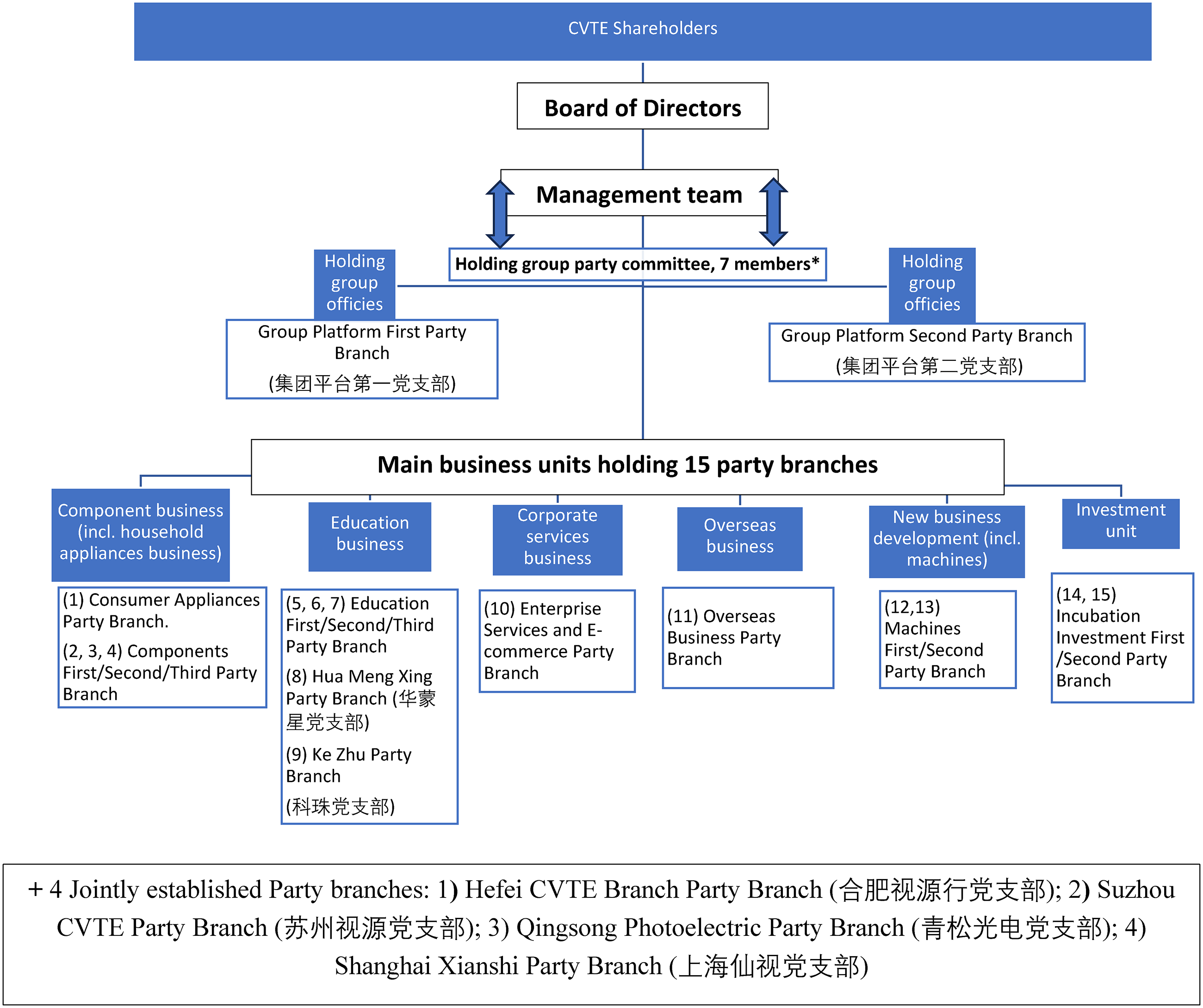
The party organisation in CVTE.
The party structure at CVTE indicates that the CCP is deeply embedded at all levels of the company. As core principles in SOE governance such as “three majors, one big” (三重一大, sanzhong yida) and “bidirectional entry, cross appointment” (双向进入, 交叉任职, shuangxiang jinru, jiaocha renzhi) do not apply to private enterprises, no party committee members sit on the company board, but they hold key positions on the management team (Beck and Brødsgaard, 2022).
The company promotes party building on its Chinese webpage and features it in its annual reports in connection with CSR and environmental, social, and governance questions. In general, party work in the company is closely connected with CSR work; for example, CVTE participates in the Common Prosperity (共同富裕, gongtong fuyu) campaign and various charity programmes, usually with donations of education equipment to poorer localities throughout China (Anonymous 1, 2023).
The phrase “High-quality Party building leads to high-quality enterprise development” (高质量党建引领企业高质量发展, gao zhiliang dangjian yinling qiye gao zhiliang fazhan) is CVTE's leading party-building principle: by strengthening the construction and development of the communist party organisation within the enterprise, the company believes that high-quality development of the enterprise itself will follow. The party secretary also emphasises that shaping the company culture is one of the overall objectives of party-building work in CVTE (Anonymous 1, 2023). A second priority has been to set up a “red supply chain” (红色供应链, hongse gongyinglian) that establishes information channels between party committees and branches throughout the company. This could, for example, be in the form of joint events and study sessions (Anonymous 1, 2023). The red supply chain probably also functions as a policy guideline for securing business components from companies with a record for being “red” and having a strong party organisation.
During our visit to CVTE, the party secretary emphasised that the labour union, party committee, and management take the well-being of employees as an important criterion of enterprise success. CVTE has thus implemented an SOE-like environment, including an in-house hospital, childcare, and housing support.
Furthermore – and as an example of how party building in CVTE is standard-setting within the industry – CVTE is collaborating with the Central Party School in Beijing to develop e-learning and in-classroom solutions tailored to party-building activities and courses. Examples are the Smart Party-Building Cloud Platform (智慧党建云平台, zhihui dangjian yunpingtai) and Smart Party-Building Learning Space (智慧学习空间, zhihui dangjian xuexi kongjian).
The party committee at CVTE has been conducting party-building activities since 2018, but they was only amended to the company charter in April 2022: The company shall establish Communist Party organizations and carry out Party activities in accordance with the provisions of the Constitution of the Communist Party of China. The company provides necessary conditions for the activities of Party organizations. [公司根据中国共产党章程的规定,设立共产党组织、开展党的活动。公司为党组织的活动提供必要条件, gongsi genju zhongguo gongchandang zhangcheng de guiding, sheli gongchandang zuzhi, kaizhan dang de huodong. Gongsi wei dang zuzhi de huodong tigong biyao tiaojian]. (Guangzhou CVTE Electronic Technology Co., 2022)
This amendment is a standard formulation based on the Company Law Article 19, but party-building work in CVTE seems to go beyond the simple and standardised formulation in the company's charter – perhaps indicating that the amendment texts mentioned above state minimum requirements. However, in sharp contrast to SOEs in China, none of the CVTE board members nor the CEO are represented in the CVTE party committee but the party secretary in CVTE is also Head of Strategic Affairs (首席战略资源官, shouxi zhanlue ziyuanguan) and on the management team. It was confirmed during the interview with the CVTE party secretary that none of the core principles for SOE party work seem to be applied in CVTE. As such, the enterprise's party work is at least formally separated from its commercial management.
As mentioned, CVTE exhibits many similarities to an SOE in terms of the role of the CCP and the stress on welfare issues for the employees. It is our impression that this is due to the company's position as a large production enterprise. The CCP focuses less on private companies in more liberalised sectors such as light industry, leisure, and entertainment. The party is also less dominating in companies listed abroad and in companies with foreign investment. NetEase is a good example.
Case 2: NetEase Limited (网易有限公司, Wangyi Youxian Gongsi)
NetEase, a pioneer in China's internet technology landscape, is listed in Hong Kong and New York. It is one of China's largest tech companies. Founded in 1997 by William Ding (Ding Lei), it offers a diverse range of online services. Out of a workforce of 30,000, there are 1,331 party members – a relatively small proportion compared to CVTE (Anonymous 2, 2023).
NetEase formalised its association with the party by setting up a holding group Party Committee already in 2013, years before the broader push for more private-sector party organisations started in 2018–2019. The holding group's party committee oversees twenty-two branches distributed across various provinces and business areas. The party secretary of this committee also serves as one of NetEase's twelve vice presidents. He is supported by four or five other Party Committee members selected from the thirty-person-strong central management group (Anonymous 2, 2023). They usually include the editor-in-chief of company publications and communication (Propaganda Committee member) and the HR director (organisation committee member). Party members within NetEase vote in elections for the Party Committee, and the entire process is intended to ensure that the Party committee is representative of both the party's objectives and NetEase's operational goals (Anonymous 2, 2023). The composition of candidates for election appears to be a result of consultations where senior management plays a strong role.
Similar to CVTE, no board members sit on the Party Committee, nor does the CEO. However, like CVTE, all NetEase Party Committee members are part of the central management team and selected according to the “one post and two jobs” principle, where the party position corresponds to the role in enterprise management (e.g. the HR director is also responsible for party organisation). Looking broadly across all listed companies in China, studies have found that 58.4 per cent of POEs have a similar setup, where at least one party organisation member sits either on the board of directors, the supervisory board, or the management team (Zhang et al., 2024). However, this still leaves a substantial number of POEs without such integration.
During an interview, the holding group's director of public affairs emphasised that the company's culture and training activities, contra CVTE, are not in any way controlled or even facilitated by the party organisation in the company. In addition, he stressed that the party organisation has no influence on commercial decision-making in the company.
However, some evidence supports the idea that the party's level of influence within NetEase is more than superficial. For instance, during the nineteenth and twentieth Party Congresses, NetEase initiated a front-end patrol team to review news content meticulously, ensuring it aligned with the party's public discourse guidelines. The team, guided by the Party committee, provided more than 200 actionable suggestions related to advertising and news content during this period.
The fact that NetEase is listed in the USA – and not in Mainland China – affects its legal obligations regarding party integration in its organisation, compared with CVTE and other mainland-listed companies. Item 161 in NetEase's 2022 annual report describes the situation clearly: No governmental entities in China have a controlling financial interest in NetEase, Inc. or any variable interest entity as of the date of filing of this Form 20-F. No member of our board or any of our operating entities is an official of the Chinese Communist Party. The currently effective memorandum and articles of association of NetEase, Inc. and equivalent organizational documents of our operating entities, including the variable interest entities, do not contain any charter of the Chinese Communist Party. (NetEase, Inc., 2022: 194)
As such, NetEase has been exempt from the wave of charter amendments in private companies listed on the mainland. Nonetheless, the company needs to strike a fine balance between engagement with the party in its operations in the online cultural space and the increasing pressures coming from the US securities regulators and investors in terms of distancing itself from the party and political influence in general.
Case 3: Lion TCR Biotechnology (广州来恩生物医药有限公司, Guangzhou Lai’en Shengwu Yiyao Youxian Gongsi)
Lion is a small private biotechnology company headquartered in Singapore that concentrates on the treatment of viral infections and related malignancies. Founded in 2015, the company has a total workforce of some 180 individuals. In 2016, Lion expanded its operations by establishing a sixty-employee branch in the Sino–Singapore Guangzhou Knowledge City (中新广州知识城, Zhongxin Guangzhou Zhishi Cheng) (SSGKC). According to the CEO and co-founder, Guangzhou was selected due to the favourable conditions in the SSGKC, as well as the participation of a local government guidance fund in Lion's most recent funding round, where the company raised RMB 440 million (Anonymous 3, 2023). This arrangement gives the local government and party organisation a direct role and stake in Lion's success. Furthermore, Lion collaborates closely with state-owned China Resources Pharmaceutical Group (石药集团, Shiyao Jituan), a subsidiary of China Resources (华润集团, Huarun Jituan) – a central SASAC company directly under the State Council.
Lion established a Party committee as part of its entrance into China in 2016, but it does not have any affiliated party branches. According to the CEO, Lion was asked to set up a party organisation and facilitate its operation. None of the top management sits on the Party committee and, in the words of the CEO and co-founder, it serves primarily a “symbolic function” in the company – a platform for showing support of local political campaigns and actors (Anonymous 3, 2023). As such, we did not find the same level of systematic integration between the Party committee and the management teams, as in the cases of CVTE and NetEase. It underlines the point raised in the literature on previous phases of party building in POEs: smaller companies are less likely to actively engage in party building; “grasp the large, release the small” might also apply in party building (Dickson, 2010).
Case 4: Guangdong Tianren Landscape Tourism Management Co. (广东天人山水旅游管理有限公司, Guangdong Tianren Shanshui Luyou Guanli Youxian Gongsi)
TianRen ShanShui 天人山水, a large-scale cultural eco-tourism resort built by Haoyuan Group (广州昊源集团, Guangzhou Haoyuan Jituan), covers an area of 19 square kilometres in Conghua district, Guangzhou. The Haoyuan Group is a medium-sized, family owned, and non-listed business with daily operations managed by the chairman's son. Family members comprise the Board of Directors. Haoyuan has 550 employees, including sixty-six party members – a relatively small number. The party secretary in Haoyuan is the director of arts and decorations and concurrently holds the title of vice president of the company. The main purpose of the party cell is to provide the party members working in Haoyuan with a platform to engage in study sessions and organise events in collaboration with other party organisations (Anonymous 4, 2023).
According to the CEO, the Party committee has no influence over commercial decisions, which are made exclusively by the board, which is dominated by its chairman and founder. Yet, it is imperative to highlight the chairman's intricate web of affiliations with local governmental and party bodies. He is a member of the Political Consultative Conference in Guangdong province and hosts important local party cadres at the resort. The resort is a prominent example of a project that successfully integrates political goals of rural revitalisation, job creation, and sustainable tourism development.
The Party is Everywhere
Our case studies show that the CCP is indeed present across all forms of private companies in China: large corporations listed in China and abroad, internet technology giants, small family run businesses, and subsidiaries of foreign-headquartered firms. But this presence takes different organisational shapes that have varying influences on enterprise management, depending on company size, industry, and ownership profile. Large corporations in industries with a higher SOE presence generally integrate party cells more comprehensively into their corporate governance structures. Our analysis of varied CCP presence in four different companies seems to suggest that party-state capitalism is more variegated and less monolithic than often believed.
CVTE almost mirrors the SOE model, with the party strongly embedded in enterprise management. To be sure, the party secretary is not mandated to chair the board, and the principle of “three majors, one big” is not applied, but the party secretary holds a key position in defining the strategic direction of CVTE's business operation and the HR manager sits on the company Party committee, securing the party's dominance over personnel appointment.
In the case of NetEase, which is listed on the New York and Hong Kong stock exchanges, the party is less visible in the organisational setup of the company. Nonetheless, the party secretary of the Party committee also serves as vice president of the company, ensuring influence on the decisions and operations of senior management. Moreover, one of the members of the Party committee serves as the HR director of the company which makes it possible for the party to advance the career of its own candidates.
The party is even less visible in Lion, a private biotechnology company headquartered in Singapore. Top management or members of the board are not part of the company party cell, which the company established when it entered China. The party cell serves primarily a “symbolic function” in the company – a platform for showing support of local political campaigns and actors. Party connections were also crucial in helping to generate local government guidance funds for Lion's business expansion.
Even in Haoyuan, which is dominated by a single charismatic entrepreneur, the CCP is organisationally present in the form of a party branch. It is mainly engaged in study sessions and in organising events. The party secretary serves as director of arts and decorations in the company. Although the Haoyuan founder is connected to higher-level party leaders in Guangzhou through his guanxi network, the party branch in the company helps him in a symbolic way to develop and maintain his social and political license to run his business.
In short, the party is present in all forms of private business in China, no matter the specific ownership form – but our cases show that it is with varying degrees of organisational integration (see Table 1). In large companies such as CVTE and NetEase, the party organisation and the core management team is actively integrated with overlapping appointments. The party organisation consists of a Party committee with affiliated party branches that are functionally or geographically defined. Unlike centrally managed SOEs, even large private companies do not have a party group introduced from above by higher-level party authorities. This is mainly because they are not part of the nomenklatura system. Party secretaries in private companies are elected by party members employed by the company. In addition, we do not see any integration of the Board and the Party committees, as is the rule in SOEs.
Organisational Embeddedness.
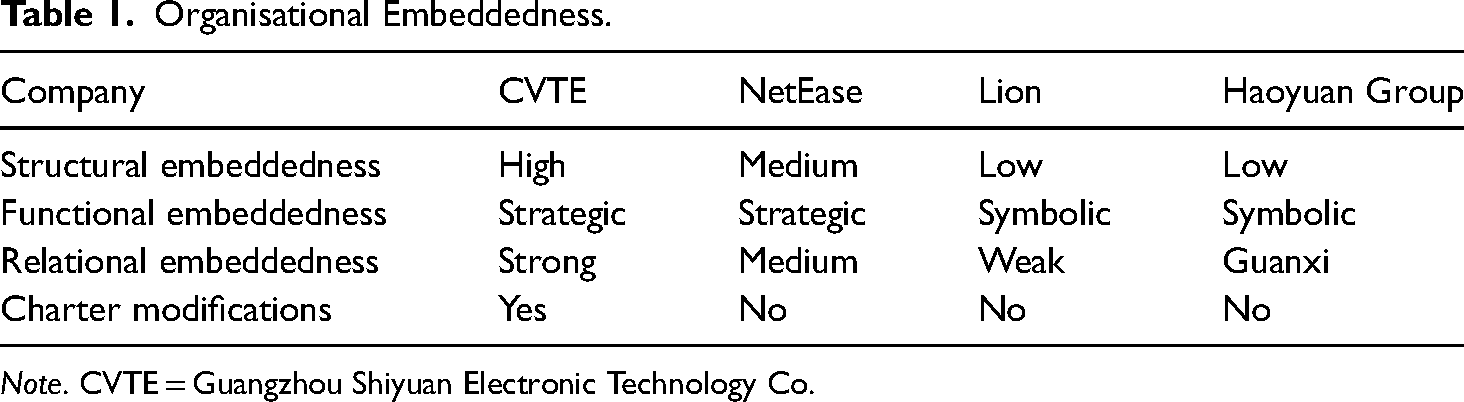
Note. CVTE = Guangzhou Shiyuan Electronic Technology Co.
This variation in party influence across POEs observed in our case studies also finds support when examining the wave of company charter amendments to include the party organisation formally into the charters of the listed POEs. According to our data on POE amendments from 2015 to 2022, about 50 per cent of POEs had amended their charters to include party organisations during this period. We observe that about 82 per cent of those amending POEs adopted the standard formulation based on the Company Law (State Council, 2023: Article 18). However, the remaining 18 per cent went beyond this standard and granted the party more extensive powers with a distinct variation across industrial sectors: 33 per cent of amending POEs in the finance sector and 27 per cent of enterprises in the real estate sector incorporated additional clauses to their articles. Conversely, fewer than 8 per cent of the amending POEs in the commerce sector opted to elaborate additionally on the role of the party within their companies.
CTVE has adopted the standard formulation, whereas NetEase, due to its listing in the USA, has been exempted from including the CCP in its company charter. As a subsidiary of a company headquartered in Singapore Lion TCR has also been able to waiver the requirement. At the time of our interviews, the same was true for Haoyuan Group.
Party-Led State Capitalism
The emergence of the private sector and the increasing role of market mechanisms have prompted scholars to attempt to place the analysis of the Chinese economic system within the “Varieties of Capitalism” framework (Carney et al., 2009; Hall and Soskice, 2001; Peck and Zhang, 2013; Witt, 2010). However, because the state continues to dominate critical economic sectors, the consensus is that China's economic system is neither a liberal market nor a coordinated market version of capitalism. In capitalism, the government typically plays a supportive or facilitating role as secondary stakeholder; in China, by contrast, the government is the primary stakeholder.
The “state capitalism” concept captures the mixture of private and state economic activity (Kurlantzick, 2016; Li and Shaw, 2013; Naughton and Tsai, 2015). It is a system that is functionally capitalist, yet systemically statist. However, this concept as applied to China fails to portray that behind the Chinese state – or rather inside the state – the party pulls the strings. Pearson et al. introduced the term “Party-state capitalism” to underscore the party's increasing appropriation of state functions (Pearson et al., 2020, 2021). Jude Blanchette (2020) concurs, emphasising that the party is the political sovereign in China, not the state. The core of this emerging “Party-led state capitalism” paradigm is the CCP’s expanded reach into every corner of the economy through the institutionalisation of party organs as within state-owned, private, and foreign enterprises alike (Beck and Brødsgaard, 2022; Blanchette, 2020; Koss, 2021; Pearson et al., 2021; Snape, 2024).
The ongoing deepening of CCP institutionalisation in corporate governance further bolsters this perspective. Currently, it manifests as an intensified party-building campaign, affecting all areas of the political economy, including the private sector. The focus is particularly on sectors with a large SOE presence – such as real estate, finance, manufacturing, and especially high tech – where private companies like CVTE have incorporated the party into their structures almost as fully as some SOEs. At the same time, neither enterprises nor the party have adopted a one-size-fits-all approach to party building, and we observe substantial variation in party integration in POEs (see Table 1).
In order to capture the nature of this system, we introduce the term, “variegated party-led state capitalism,” taking inspiration from a stream of literature on variegated capitalism in China (Peck and Theodore, 2007; Peck and Zhang, 2013; Zhang and Peck, 2016). This literature maintains that capitalist structures are distributed in a variegated pattern across the Chinese economy. We posit that the CCP's presence in Chinese business follows a similarly variegated pattern, a claim we substantiate empirically through our four case studies.
This formulation stresses the organisational and structural dimensions of the Chinese political-economic system rather than the notions of “communist capitalism” (Fang, 2016) or “authoritarian capitalism” (Carney, 2019; McGregor, 2012; Sallai and Snyder, 2021), which foreground ideological factors. Our findings indicate that the party-state's “expanded reach” is highly heterogeneous across the private business sector. Evidence presented here underscores the variegated character of party-state capitalism; the party-state's influence is unevenly applied across different private firms.
We also anticipate that future studies will find further variation of party integration in POEs across geographic regions. Dickson observes that there are “no systematic and standardized procedures for managing party organizations [in POEs]” (Dickson, 2010: 131). Our case studies provide contemporary support for this claim: implementation of party-building initiatives in private firms remains uneven. This finding mirrors the claim put forward by Zhang and Peck that the Chinese economy comprises an assemblage of regional economic systems, collectively reflecting a variegated rather than uniform structure (Zhang and Peck, 2016).
Conclusion
This article has examined the development of party organisations in private enterprises from two complementary angles. First, it analysed the evolving policy framework guiding party building within the business sector. Second, it undertook micro-level investigations of four companies based in Guangdong province, providing detailed insights into the ground-level implementation of these policies.
Our findings reveal an evolving CCP strategy that has shifted from a nominal presence in private enterprises to a more structured and integrated approach under Xi Jinping's leadership since 2012, intensifying after 2018. Analysis of central policies and regulatory changes shows that the party's approach to private-sector governance combines legalistic measures with a normative-ideological agenda, reflecting Xi Jinping's vision of aligning businesses with party priorities. Our examination of charter amendments in POEs from 2015–2022 highlights the party's concurrently expanding formal influence in corporate governance: nearly half of China's listed private firms revised their charters during this period. The extent and configuration of these amendments, however, varies across sectors, with financial and real estate companies showing much more extensive party integration than firms in the commerce sector.
The Guangdong case studies illustrate the heterogeneous nature of party–business relations. CVTE, an electronics manufacturer, exhibits an extensive party apparatus seamlessly integrated into the organisational matrix, aligning with the company's CSR strategies and ingrained corporate ethos and company culture. Moreover, the party organisation is formally codified in the company charter. NetEase, an internet services conglomerate, demonstrates a more limited party presence, though party members still overlap with the management team. This smaller presence could be attributed to the company's listings in the USA and Hong Kong, but not in Mainland China, and thus subjected to different regulations. Finally, in the small biotech venture, Lion TCR, and the family owned enterprise, Haoyuan Group, the party exerts minimal tangible influence on commercial decision-making, though party presence remains important for maintaining social license to do business.
These patterns underscore the party-building campaign's focus on the private sector as part of a broader strategy to strengthen party influence across the economy – and society more broadly. Snape (2024) calls this the “Rise of Party Law”. It is a process of the state retreating and the party advancing to fill the void. While “party-led state capitalism” appears to capture the nature and direction of this process better than “state capitalism,” neither portrays the substantial variations of party–business configurations in the Chinese private sector, depending on size, sector, industrial linkages, and ownership. In this sense, party-led state capitalism is variegated rather than uniform.
Limitations
Several limitations affect the generalisability of this study. First, all interviews were conducted in Guangdong province, which is known for its relatively liberal policies compared to inland provinces. Nonetheless, Guangdong is a major engine in China's economic development and insights and findings from this region provide valuable evidence about party integration in China's private sector. Second, repeated interviews over a longer time frame would have strengthened longitudinal insights. Third, the concept of “variegated party-led state capitalism” is developed from a limited number of case studies; further research is needed to assess whether this concept can explain patterns of party integration across the broader Chinese corporate sector. Despite these limitations, the study offers a novel empirical and conceptual contribution to understanding the heterogeneous presence of the CCP in China's private economy.
Footnotes
Acknowledgements
The authors want to thank the three anonymous reviewers for insightful and constructive comments and suggestions. We also gratefully acknowledge contributions by Nis Grünberg and Christian Göbel to an earlier seminar version of the paper presented at Sciences Po, Paris, in April 2025. The current version has been heavily and significantly revised.
Declaration of Conflicting Interests
The authors declared no potential conflicts of interest with respect to the research, authorship, and/or publication of this article.
Funding
The authors disclosed receipt of the following financial support for the research, authorship, and/or publication of this article: This work was supported by the European Union as part of the China Horizons project (Dealing with a Resurgent China), which has received funding from the European Union's HORIZON Research and Innovation Actions [Grant No. 101061700].
