



Abstract
This article examines how the Chinese political and academic discourses have constructed a narrative of China as a peaceful maritime power and the role that underwater archaeology has played in narrating China's rise. The ancient Chinese concept of tianxia (天下) is a central part of the Chinese elites’ discourse on maritime policy. This concept, translated as “all under heaven,” forms part of China's effort to produce historical statecraft using textual sources and underwater archaeological artefacts. In this narrative, the historical figure of Zheng He became a prominent representative of China's peacefulness, refuting concerns regarding the purposes of a more assertive Chinese foreign policy. Studying tianxia under the sea thus contributes to forming a better understanding of the production of narratives respecting China's rise. In particular, underwater archaeology is highlighted as an authoritative source of evidence underpinning and reinforcing narratives of China as an ancient and peaceful maritime nation.
Introduction
The growing research interest in the Chinese notion of “all under heaven” (天下, tianxia) and the role it plays in Chinese foreign policy (Callahan, 2007, 2023; Chu, 2022; Dreyer, 2015; French, 2017) have largely overlooked the maritime dimension of this ancient Chinese concept. While there has been a lively debate concerning maritime tianxia in Chinese discourse, this discussion has not spread to Western-language literature, with a few exceptions: tianxia as legitimisation for China's territorial claims in the South China Sea (Sun, 2023), tianxia as a concept of Chinese superiority in Southeast Asia (Chan, 2023), and tianxia as a meaning-making basis for the Belt Road Initiative (BRI) as a whole (Hlongwa, 2020).
China's aspiration to become a global maritime power is becoming increasingly evident (Fravel, 2020). Military bases (McCoy, 2016), China's fleet of fishing ships (Zhang and Wu, 2017), the Chinese Navy (Zheng, 2019), the Coast Guard (Guilfoyle and Chan, 2022; Zheng, 2019), and commercial shipping (Zheng and Smith, 2017) form visible manifestations for this claim. This article presents a cultural studies perspective to examine how China is giving meaning to its increasing maritime representation by using historical and archaeological evidence. It has been argued that political and academic actors seek to incorporate and re-interpret the traditional Chinese concept of tianxia in this meaning-making process. With the motto of “using the past to serve the present” (古为今用, gu wei jin yong) (Unger, 1993: 8), Chinese elites are implementing a new comprehensive perspective to narrating Chinese foreign policy using selective readings of the past – a practice in line with various academic and political attempts to construct the modern Chinese nation and its history (Hayton, 2020; Wang, 2001). It is evident that historical statecraft is particularly important for the context of the BRI (Mayer, 2018; Smith and Fallon, 2024), in particular with respect to how other countries, for example, Japan and South Korea, react to this approach (Nakano, 2023) and how the Chinese Communist Party (CCP) is integrating its selective memory politics to create measures for expanding its soft power (Ohnesorge and Owen, 2023; Qian, 2022).
Tianxia Under the Sea refers to a central element of the BRI. Announced in 2013 and 2014, the BRI is the flagship project of Xi Jinping's foreign policy (Benabdallah, 2021; Mayer, 2018a; Zhun, 2022). It forms part of his larger vision of a Community of Shared Future for Mankind (人类命运共同体, renlei mingyun gongtongti). The BRI was originally divided into two main routes: the Silk Road Economic Belt (丝绸之路经济带, sichou zhilu jingjidai) on land and the twenty-first century Maritime Silk Road (21世纪海上丝绸之路, 21 shiji haishang sichou zhilu) on water. In 2018, the Polar (冰上丝绸之路, beiji sichou zhilu) and Space (太空丝绸之路, taikong sichou zhilu) Silk Roads were announced to complement China's comprehensive approach to foreign policy. The use of the term Silk Road foregrounds the intended narrative links between the nostalgic sentiment for the ancient Silk Road and China's contemporary ambitions.
Despite the ambitious narrative that frames it, in practice, the BRI is a patchwork consisting of trade corridors and subregional, transnational and trans-local networks and infrastructure. Instead of presenting a coherent top-down strategy, multiple Chinese actors implement and “operate across the liminal central–local and domestic–international divides with varied strong impact on economic globalization” (Chen, 2022: 5). The maritime part of the BRI connects strategically important ports between China and Europe to build an economic and naval infrastructure that, in the eyes of many observers, presents a clear geopolitical idea (Blanchard and Flint, 2017). As international concern grew regarding China's global assertiveness, Chinese officials have pointed to the past to counter them. As such, tianxia can be interpreted as a form of soft power instrument to be used to positively shape China's domestic and international image (Callahan, 2007: 20; Ohnesorge and Owen, 2023). The narrative of “all under heaven,” accordingly, portrays China as a peaceful and cooperative country that has no colonial ambitions. However, this narrative is more than simply a strategy used to calm fears. Callahan argues that “all under heaven” also shows the ways in which China is “working to re-centre Chinese understandings of world order as a patriotic activity” (Callahan, 2007: 2).
Since the announcement of the BRI, Chinese political and academic actors have sought to define China's role as a maritime power, drawing on historical examples and narratives. Here, underwater archaeology is a central source of inspiration. This discipline, which has a very short history in China, receives lavish funding to rescue and preserve underwater cultural heritage (UCH). It was also elevated to a position of high national importance. Underwater archaeology, according to Li Qun, the Vice Minister of Culture and Tourism, is responsible for protecting Chinese culture and plays a significant role in “safeguarding national sovereignty, security and maritime rights” (Li, 2023). This politicisation of underwater archaeology is in line with the broader trend of using archaeology in China to enhance soft power, as the discipline's internationalisation often dovetails with the foreign policy goals of the Chinese state.
This article is structured as follows: first, archaeology's political significance in China for its crafting maritime narratives as historical statecraft is theorised. Next, the methodology followed here is explained, and the corpus of sources is determined. The following empirical analysis is divided into two parts to address the ways in which China substantiates its narrative as a historical sea power. First, this text examines Chinese research on the textual sources of maritime history and their contemporary interpretation. This analysis, then, focuses on the ways that underwater archaeology can be used to provide evidence to buttress prevailing policy narratives. Finally, the findings are interpreted with respect to the context of the current geopolitical debate on China's rise.
Excavating Narratives: The Role of Archaeology in Chinese Politics
Narrating History in Geopolitics
The narrative turn (Roberts, 2006) and the influence of (historical) narratives in international relations (IRs) are widely recognised by a growing body of scholarship. Over the past decade, much conceptual and theoretical work has been done to show how strategic narratives influence the field of IR (Miskimmon et al., 2014, 2017). Copeland argues that constructivist theories are “inherently an argument about how the past shapes the way actors understand their present situation” (Copeland, 2000: 210). Scholars have also argued for the importance of storytelling in bilateral relations (Gustafsson, 2011), territorial disputes (Hagström, 2012), and the rise of China as a global power (Carrai, 2021; Yang, 2021). In terms of a focus on China, historical narratives on the New Silk Road are most evident in the literature (Benabdallah, 2021; Winter, 2020).
A critical geopolitical approach deconstructs geopolitical arguments and critically scrutinises the ways in which powerful actors build storylines. In deconstructing geopolitical arguments, Ó Tuathail defines storylines as “sense-making organisational devices tying the different elements of a policy challenge together into a reasonably coherent and convincing narrative” (Ó Tuathail, 2002: 617). Storylines form broader narratives that then can serve as arguments within a debate or discourse. Unpopular ones are marginalised, but popular narratives, by contrast, can help to shape new discourses and semantic boundaries and distinctions. Likewise, in other political fields, Chinese actors follow the “use the past to serve the present” approach to producing these storylines.
Deconstruction of the products of historical statecraft is a promising approach to systematically capture this strategy. Historical statecraft describes the “manipulation of collective memories to legitimise foreign policy” (Mayer, 2018: 1218). In China's case, this means shaping public perceptions of China and its role in global history to replace Western-centric narratives (Mayer, 2018: 1218). Successful historical statecraft can produce historical memory featuring a selective reading of history and the fabrication of myths for the transfer of the past to the present. Smith and Fallon conceptualise historical statecraft as a narrative that uses history instrumentally for diplomatic purposes (Smith and Fallon, 2024: 4). Both authors borrow Miskimmon et al.'s definition of a strategic narrative as “a means for political actors to construct a shared meaning of the past, present and future of international politics to shape the behaviour of domestic and international actors” (Miskimmon et al., 2014: 2). These narratives refer to positive or affirmative and negative or traumatic experiences. For instance, in their work on negative historical statecraft, Smith and Fallon show that China's rise has been accompanied by accusations of historical bad behaviour by hostile powers (Smith and Fallon, 2024: 24). Moreover, China's reference to history is embedded in a global movement that emphasises alternative history “to destabilise western-centric, progressive, unidirectional understandings of ‘history’” (Mayer, 2018: 1219).
The concept of tianxia, originating in ancient China, is a compelling argument within China's strategic narrative. The CCP uses China's historical and cultural legacy, presenting the significance of its ancient heritage to other nations (Mayer, 2018: 1227; Winter, 2019). With deep roots in Chinese political and cultural history, “all under heaven” describes a historical, geopolitical, and cultural assumption concerning a divided world. On the one hand is the core region; on the other hand, there are surrounding, concentric zones of influence. On this assumption, states that did not subordinate themselves to the political and cultural supremacy of the centre, that is, the Chinese imperial court, thereby entering into a tributary system, were not only outside of the Chinese emperor's sphere of influence but also outside the realm of tianxia, of what is “under heaven,” meaning that such actors were considered barbarian.
Contemporary Chinese philosophers have revived the ideas of tianxia under the rubric of New Tianxiaism. These intellectuals have been developing new ideas of the international order with Chinese characteristics to replace the so-called US hierarchy. The spectrum of ideas seen here ranges from concepts that continue to insist on hierarchies in IRs (Zhao, 2021) to concepts of involving the overcoming of hierarchical structures to translate the historical tribute system into economic cooperation networks (Qin, 2012; Xu, 2018).
Archaeology with Chinese Characteristics
Materialising the past makes history tangible, and this is essential in developing nationalist ideology, imagery, and language (Smith, 2001: 447). People are surrounded by a material world in which memory is performed, mediated, and stored. Indeed, China is domestically building a memory infrastructure that is intended to materialise and solidify the collective memory and certain selective historical narratives concerning China and the CCP (Mayer and Pawlik, 2023). As a medium of remembrance and forgetting, historical artefacts possess an agency that shapes various identities (Munteán et al., 2016: 3–7).
Archaeology is a highly political field of science (von Falkenhausen, 1996: 196). It seeks to construct social memory, and the past often inspires political authority (Van Dyke, 2019). While archaeological research follows academic standards, different interest groups can influence the interpretation of specific outcomes through storytelling and manipulation. State-driven archaeology can become subject to manipulation to justify territorial claims or support dominance and control over neighbouring areas. One example of this would be the financial and institutional support for certain projects that serve a political agenda (Kohl and Fawcett, 1996: 5–7). Trigger distinguishes three kinds of politicised archaeology: (1) nationalist, (2) colonialist, and (3) imperialist. While nationalist archaeology boosts patriotic and political support, colonialist archaeology has direct ties to the history of colonialised people “by trying to demonstrate that they had been static in prehistoric times and lacked the initiative to develop on their own” (Trigger, 1984: 363). Imperialistic archaeology seeks to exert powerful cultural, political, and economic influence over neighbouring states (Trigger, 1984: 364).
In the Chinese case, archaeological artefacts are used to justify a nation's history and are crucial for developing nationalistic ideology and the nationalist imagination (Smith, 2001: 444) to legitimise territorial claims. Thus, it is not surprising that Chinese archaeologists tend to excavate artefacts, such as, for instance, from the South China Sea, that ultimately help prove political narratives conducive to political purposes of the presence.
Chinese archaeology's political character is obvious from the position of Chinese leadership as well. For instance, Perry shows that funding is overwhelmingly granted for pursuing politically preferred topics (Perry, 2020: 5). The selective and instrumental use of the scientific evidence to in support of narratives of China as an ancient maritime superpower illustrates the close ties that form between science and politics in China. Under the aegis of “Chinese characteristics,” Xi Jinping calls for archaeology to be established in the form of archaeology with “Chinese characteristics, style, and ethos” (Xi, 2020). The aim here is to strengthen Chinese discourse power throughout the international community and demonstrate China's significant contribution to humanity (Xi, 2020). Xi states that, even though the history of civilisation is written, these records need to be referenced, corroborated, enriched, and refined through the products of archaeological work (Xi, 2020). The reason for this is that “[h]eritage is a constructive factor in unifying the Chinese nation […], to support claims of sovereignty […] linked with ideas of nationality, identity, and place in the international family of nations” (Perez-Alvaro and Forrest, 2018: 391). In brief, the government seeks to use archaeology for the purposes of historical statecraft.
Data Sampling and Analytical Methods
This article examines Chinese narratives and analyses discourse samples to explore the idea that “discourses give legitimacy and meaning to social practices and institutions” (Halperin and Heath, 2012: 364). The categories that are in use here were determined inductively from the available material. Each category is based on aspects that are expected to strengthen the narrative argumentatively.
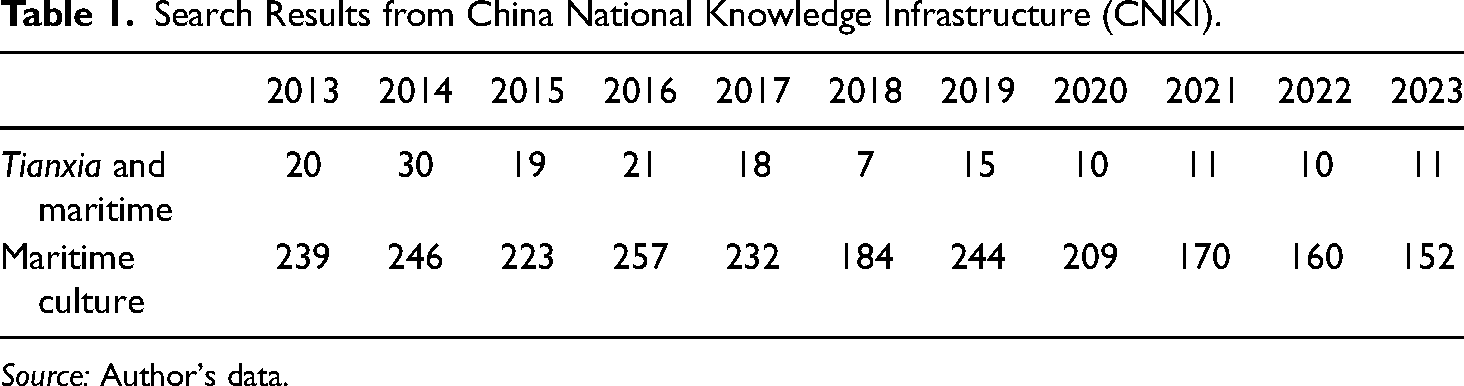
The text corpus was drawn from the China National Knowledge Infrastructure (CNKI), a privately run Chinese database of academic publications, and from other digital sources containing publications by academic authors. The author chose papers and articles from CNKI according to their rates of downloading and citation rates. The documents used were found through different online searches. The first searched the combination of the Chinese search terms “tianxia” and “maritime” (海洋, haiyang), and the second searched the Chinese search term “maritime culture” (海洋文化, haiyang wenhua). Table 1 shows the total number of relevant academic publications following Xi Jinping's assumption of office in 2012 to the end of 2023. Scholarly articles from the disciplines of the humanities and the social sciences were selected based on the appearance of corresponding search terms in their titles, keywords, and abstracts. These numbers quantitatively demonstrate the overall salience of maritime tianxia and maritime culture in Chinese discourse.
Search Results from China National Knowledge Infrastructure (CNKI).
Source: Author's data.
After the text corpus was built, relevant passages of the texts were categorised from specific aspects of argument for the narrative of China as a long-lasting maritime power: (1) historical evidence, (2) the philosophical foundation of maritime culture, (3) the superiority of a tianxia-based word order over the so-called western maritime order, and (4) Zheng He's legacy. Further, reports on excavations, presentations of archaeological findings, and political speeches were examined to create a holistic picture of the ways in which Chinese actors produce evidence through historical narratives to determine discourses on maritime power and China's role in it.
Proving the Narrative of China as a Maritime Power
Following a conference to celebrate the Seventieth anniversary of the founding of the Chinese Navy in 2019, Xi Jinping announced the concept of a Maritime Community of Common Destiny (海洋命运共同体, haiyang mingyun gongtongti). Similar to the overarching vision for the Community of Common Destiny (CCD; 命运共同体, mingyun gongtongti), maritime regions are not further defined. Instead, China postulates an alternative to a so-called US-centred hegemonic world order developed to maintain world peace in the twenty-first century. In an article published in Qiushi, a leading mouthpiece of the CCP, Xi is cited as stressing that the CCD is “consistent with the concept of the unity of the world [tianxia], which has always been upheld by the Chinese nation, and with the Chinese concept of the world [tianxia] as a place of tolerance and harmony among all nations” (Wang, 2020). Statements by Xi Jinping and articles in party-associated newspapers further support a link between (M)CCD and tianxia (Renmin ribao, 2020).
Leafing Through Books
As noted in the methodological section, four main storylines illustrating this link are identified within the text corpus to construct the narrative of a maritime tianxia: (1) historical evidence, (2) philosophical foundation of maritime culture, (3) the superiority of a tianxia-based word order over a so-called Western maritime order and (4) Zheng He's legacy.
Historical Evidence
Historical evidence forms an essential source for the Chinese narrative concerning its own maritime history. Scholars seek to stretch a historical line reaching back to ancient times to support the story of China as an ancient, historical maritime power.
The overall argument here is that China is and was not only a strong territorial power but also a great maritime power (Chen, 2019; Huang, 2018; Li, 2006, 2020; Liu, 2021; Qu, 2015; Zhang, 2012). These authors criticise the concept of Chinese history as purely territorial, calling it a misunderstanding (Chang, 1992; Wills, 1979). Zhang argues that the typical dichotomy between territorial and maritime interests should be eliminated in this context (Zhang, 2012: 13, 17). Making reference to ancient Greece and Medieval Europe, Chen indicates that European people also initially considered the European landmass to be the centre of the world, surrounded by seas and places that could not even be imagined (Chen, 2021: 39). Despite the ban on sea travel for several periods since the Ming Dynasty, Zou argues that China's status as a great maritime power is undeniable (Zou, 2015: 82).
The historical maritime Silk Road has had significant impacts on the coastal regions of China. According to some authors, China was among the first to use the sea for fishing, salt production, and shipping (Huang, 2018; Li, 2020: 59; Zhang, 2012: 13). Evidence of maritime contacts can be traced back to books and documents to the earliest history, namely, the Neolithic period. According to Zhang, traces of seafaring in Chinese territory go back to 7000 BC (Zhang, 2012: 16). The kingdoms of Qi and Wu already had knowledge of shipbuilding, and there was trade in the South China Sea in this time. Zhang reports that archaeological findings indicate that the Yue ethnic group is associated with the sea since the Xia Dynasty (Zhang, 2012: 13). Burial objects in the coastal regions of Yue areas include pigs, fish, turtles, and shells. According to Zhang, the maritime neighbourhood is also evident in the fact that many ethnic groups living in Southeast Asia and on the South Pacific islands show evidence of descent from members of the Yue ethnic group (Zhang, 2012: 14).
Descriptions of the sea have existed since the late Shang dynasty. The Book of Documents (尚书, shangshu) describes tianxia as “nine continents” (九州, jiuzhou) that are surrounded by rivers and “the four seas” (四海, sihai) that serve as borders (Liu, 2014a: 113). People's desire to overcome boundaries and expand into new living areas on land is considered inseparable from human history and also entered the sphere of myths and folklore (Li, 2006: 12). Liu argues that the limited perception of the world behind existing boundaries led to Chinese intellectuals’ gradual ideation of infinity (Liu, 2014a: 113). Folk songs underpin this process of imagination. Arguably, the lack of knowledge concerning maritime regions led to an imagined danger, recorded by folk songs, for example, the “Attack Soil Song” (击壤歌, jirang ge), which concerned fishermen praying for the Dragon King of the East China Sea (Li, 2006: 12).
As navigation technologies and capabilities improved, the understanding of the ocean deepened, increased, and changed (Li, 2020: 61). Scholars have collected textual evidence showing Chinese people have lived in over ten far-flung areas worldwide, dating to the time before the Tang Dynasty (Li, 2006: 12). The Tang Dynasty saw the heyday of maritime trade routes (Chen, 2021: 40; Huang, 2018: 180; Li, 2020: 61), which lasted until the Ming Dynasty and the expeditions of Admiral Zheng He. During the Tang Dynasty, several cities along the coastal area emerged as major links for maritime trade, leading to a better understanding of the maritime region in the South China Sea (Huang, 2018: 177).
Overall, historical discourses reveal a narrative of linear development towards maritime power. However, this interpretation is not uncontroversial. Schottenhammer doubts that text taken from classical Confucianist books could provide valuable information on shipbuilding, instead concluding that, until the Tang Dynasty, imperial China depended on foreign-built ships (Schottenhammer, 2012: 66–68).
Philosophical Foundation of Maritime Culture
One core question behind this narrative concerns the question how the sea can be conceptualised as part of tianxia through ancient Chinese philosophy. The textual corpus refers to different philosophical tianxia-related core concepts. In academic discourse, tianxia is described as an inclusive geopolitical imagination for an international order that is characterised by “great unity” (大同, datong). Datong, in turn, refers to an ancient Chinese utopia, a society of peaceful coexistence and joint development (Duan and Ren, 2021: 107). Tianxia and datong are commonly used in a symbiotic combination (Chen, 2021; Duan and Ren, 2021; Li, 2020; Liu, 2021; Qu, 2015). Other tianxia-associated slogans are as follows: “world feeling” (天下情怀, tianxia qinghuai), “world without outside” (天下无外, tianxia wuwai), “the world as one family” (天下一家, tianxia yijia), and “the world as a unit” (天下一体, tianxia yiti). Here, tianxia is used as a synonym for “world” in the place of the modern Chinese shijie (世界). Li further combines the motifs of cooperation and peaceful coexistence on a philosophical and political level, defining them as characteristics of maritime culture that are based on tianxia (Li, 2020: 65).
Hong and Hong show that Western and Chinese maritime cultures are based on different values. Both authors argue that Western maritime culture regulates the boundaries of national political identity with the nation-state, but China's concept of “all under heaven” follows a vision of unity, embodying the principle of “no outside” (无外, wuwai) and the idea of “the sea of the world” (天下之海, tianxia zhihai) and that “the four seas are one family” (四海一家, sihai yijia) (Hong and Hong, 2017: 66).
Focusing on tianxia, some authors describe Chinese maritime culture as a crucial pillar for China's “excellent cultural traditions” (优秀传统文化, youxiu chuantong wenhua), a political term commonly used by Chinese politicians and scholars to praise ancient Chinese culture. In her analysis of this excellent traditional culture, Kubat indicates that most of the thus praised cultural values fall within the Confucianist tradition (Kubat, 2018). Chen argues that China's rich maritime cultural heritage reflects the traditional understanding of the sea by the Chinese nation and integrates the essence of values in traditional Chinese culture (Chen, 2020: 60). Moreover, as Zhu notes, more than 2000 years of exchange in the East Asian seas have shown the cultural grasp of “one family in the four seas” (四海一家, sihai yijia) and “peace under heaven” (天下太平, tianxia taiping) (Zhu, 2019: 25).
The particular definition of tianxia implies the narrative of a ruling Western system of IRs that are rooted in opposite values and experiences to those of China. The vision of the CCD is seen as superior to the status quo because of the philosophical foundation of China's maritime history. This represents what Smith and Fallon call negative historical statecraft (Smith and Fallon, 2024).
The Superiority of a Tianxia-Based Word Order
Another storyline indicates that the CCP, as a vision for an alternative world order that is based on the Chinese “excellent traditional culture,” can solve maritime problems more successfully than the existing order can, being based on the United Nations (UN) Convention in the Law of the Sea. Wang and Wang consider fragmented goals and a lack of effective unification to be the main shortcomings of the present situation. At the same time, China's efforts to solve these problems are considered to form a contribution to the well-being of humanity (Wang and Wang, 2019: 100). Western colonial history is regularly brought up as an argument to set off the contrast of a peaceful and cooperative Chinese world order against a Western imperialist system (Chen, 2020: 58; Zhang, 2021: 29; Zhu, 2019: 24). As part of the tianxia conception, the maritime regions are therefore characterised by “benevolence and good-neighbourliness” (亲仁善邻, qinren shanlin) and tianxia datong, as mentioned in the last section (Duan and Ren, 2021: 107).
According to Liu, the Chinese people have always longed for peace. The idea of living in harmony with the environment “has become an important culture and gene engraved in the bones of Chinese people” (Liu, 2021: 37). Some Chinese authors have called for a new maritime order that follows up China's maritime history. Li introduces Mahan (1840–1914) to criticise the Western maritime order, where control of the sea determines the rise and fall of nations (Li, 2020: 60). Following the emergence of commercial shipping routes before World War II, the oceans have become a place of competition and conflict (Li, 2019). According to these arguments, tianxia is vital for securing peace and prosperity in maritime regions. While tianxia acknowledges a world that is an inclusive unit of all nations, Hong and Hong, in their conceptual contribution to Chinese maritime culture, stress that Western culture uses differentiated nation-states for regulating different political identities (Hong and Hong, 2017).
Zheng He’s Legacy
Zheng He's legacy forms the last narrative identified in the corpus. This serves as an underlying foundation that binds all storylines together, and it is a crucial part of the international ambitions for Chinese underwater archaeology. Zheng He was a Chinese admiral at the Ming court who undertook seven expeditions to the Pacific and Indian Oceans with large fleets between 1405 and 1433. His journeys exemplified the state-sponsored ambitions of the Ming court to exploit new countries, markets, and spheres of political influence (Lunde, 2005: 48).
Li characterises Zheng He's voyages as representing the highest level of friendly relations for the ancient Silk Road. He builds on the narrative that Zheng He never conquered any country, instead promoting civilisation and peace (Li, 2020: 61–62). Similarly, Zheng describes how the delegations visited overseas countries to share peace and universal harmony (Zheng, 2018: 117). According to Li, this demonstrated China's sincerity in its strengthening of peaceful and friendly exchanges with other countries (Li, 2020: 61–62). Zheng He's voyages are portrayed as having led to political, economic, and cultural exchanges with other Asian and even African countries (Zou, 2018: 1). As an ancient ambassador for friendship (Chan, 2019: 60), Zheng He's idea of maritime power is characterised by being based on values, harmony, friendly exchange, and peace (Hong and Hong, 2017: 66–67; Zhang, 2021: 23; Zheng, 2018: 117), aligning with the core principles of tianxia.
Zheng He is a patron saint in China's maritime history. As an ambassador for peace and cooperation in the maritime region, the historical person of Zheng He provides evidence of China's long maritime history reaching to the construction of a maritime CCD and the twenty-first century Maritime Silk Road. However, it should be mentioned that the peaceful role that Zheng He played in his voyages is contested by scholars, most of whom are not Chinese. Sen elaborates in multiple articles that Zheng He was also involved in military operations and was instructed to implement a tributary system under the rule of the Ming court (Sen, 2005, 2016, 2019). Wades assesses Zheng He's “voyages of friendship” as forming aggressive ambitions for a pax Ming in Asia (Wade, 2005: 37).
Underwater Archaeology and China’s Maritime Role
History is re-read and re-interpreted selectively to produce narratives to allow the past to serve the present. The arguments presented here in favour of China's position as a maritime power are based on textual interpretations. To make these narratives concrete and visible to the public, underwater archaeologists are instrumentalised to excavate and present UCH.
Protection of UCH
The first regulations for the protection of underwater heritage were established in 1989 as a direct consequence of the Geldermalsen issue. Geldermalsen, a Dutch East India Company ship carrying Chinese porcelain to Europe, sank in the South China Sea in 1751. After the excavation of the shipwreck by Hatcher, a British explorer and marine salvor, in 1985, more than 170,000 pieces of Chinese porcelain and other items were sold at an auction held by the auction house Christie's. Chinese governmental authorities failed to prevent the sale of these artefacts. It is reported that the Chinese government was shocked to learn that “there were no provisions in the Chinese legislation that addressed the salvage of UCH or to claim ownership of the UCH” (Liu, 2014b: 1–2).
In the aftermath of this incident, the Underwater Archaeological Research Center (UWARC), founded under the control of the Chinese National Museum, set about improving the protection of underwater heritage. In 1989, the People’s Republic of China introduced the Regulations for the People's Republic of China Concerning the Administration of the Protection of Underwater Cultural Relics (中华人民共和国水下文物保护管理条例, Zhonghua Renmin Gongheguo shuixia wenwu baohu guanli tiaoli) to manage definitions, ownership questions, protection zones, reporting, and reward mechanisms and penalties. These regulations cover any underwater artefact dated before 1911 or linked to an important historical or revolutionary event or to revolutionary or renowned persons. Articles 2 and 3 declare that (1) all cultural relics of Chinese, unidentified or foreign origin that remain in inland Chinese waters or territorial waters and (2) cultural relics of Chinese or of unidentified origin outside the Chinese territorial waters but under Chinese jurisdiction are under China's ownership. Further, the Chinese state has the right to declare ownership of all cultural relics of Chinese origin outside of territorial jurisdiction (State Council of the People's Republic of China, 1989).
After the establishment of the research institution and the corresponding regulations, enormous investments followed in underwater archaeology. Part of this funding flow was extensive investment in the training of underwater archaeologists. For the past twenty years, “hundreds of millions of dollars have been spent on training, equipment, engineering, transport, surveys, reconnaissance, recovery operations, monitoring, conservation, museum construction, foreign capacity building, and other items” (Adams, 2013: 264). By 2019, Chinese archaeologists had excavated approximately 2000 shipwrecks (Perez-Alvaro and Forrest, 2018: 378). The flagship project for governmental investment in underwater archaeology is the successful excavation of Nanhai No. 1 in 2007. In 1987, Nanhai No. 1 was discovered near the coast of the Guangdong province. According to Chinese sources, 50,000–70,000 artefacts of UCH were found within the shipwreck (Lin, 2007). The investment in this project is estimated to have been more than $150 million (Adams, 2013: 264).
In addition to the goal of protecting cultural heritage, Chinese underwater archaeology should also be understood to form an evidence-producing discipline for nationalism, as this quote from Liu, head of the Chinese government's Center of Underwater Cultural Heritage, clarifies: We want to find more evidence that can prove Chinese people went there and lived there, historical evidence that can help prove China is the sovereign owner of the South China Sea. (cited in Perez-Alvaro and Forrest, 2018: 376)
This quotation indicates that China seeks to use the development of underwater archaeological capabilities to support its political claims and goals, such as its territorial claims in the South China Sea, or even historical narratives. The latter is particularly manifest in archaeological research to uncover the artefacts remaining from Zheng He's voyages.
Zheng He and Networking Stories
The excavation of Chinese history is by no means solely an issue internal to one country. It is just as essential for international cooperation as Chinese archaeology abroad has become and just as necessary a part of networking strategies. As such, it has “the implicit goal […] to gradually rewrite the history of the ancient Silk Road with China as the historical driver of prosperity, peace, and political stability” (Storozum and Li, 2020: 284). Archaeology that concerns the life of Zheng He is vital for building narrative images of peaceful and stable IRs. Many exhibitions opened to celebrate the 600th anniversary of his first voyage in 2005, which also increased interest in maritime cultural heritage. Zheng He museums have been opened in Nanjing and Malacca (Malaysia), and an International Zheng He Society was established in Singapore. Zheng He's assumed Muslim origin is used in the Chinese narrative as evidence of Chinese openness and tolerance of other religions (Adams, 2013: 265).
Chinese archaeologists have joined various international excavations along the ancient Silk Road. China uses underwater archaeology to establish a basis for tangible historical links between China and the African continent (Chan, 2019: 59; Storozum and Li, 2020: 291). China sponsored a joint archaeological expedition with the National Museum of Kenya to strengthen bilateral relationships with Kenya and to deepen their historical connection. The three-year expedition (2010–2013) was intended to carry out several excavations at coastal sites where Zheng He's fleet is thought to have arrived and to find shipwrecks. It also analysed the provenance of Chinese porcelain on the Kenyan coast (Storozum and Li, 2020: 293). Chinese researchers also conducted interviews and focused on “oral histories [of the local population] who may have been descendants of Zheng He's followers who had swum ashore from the sinking ship and settled on the island” (Chan, 2019: 61). DNA research sought to identify descendants of Zheng He's crew members who left sinking ships and settled in today's Kenya. These DNA tests were conducted on Kenyans who claimed Chinese ancestry. One of these was Mwamaka Sharifu, who attracted attention after having been proclaimed a descendant of a Chinese person by Chinese authorities. Shortly after, she received a scholarship from the Chinese government and “became China's poster girl in its attempts to strengthen ties with Africa” (Chan, 2019: 69).
Questions regarding the peaceful nature of Zheng He's voyages to the African continent remain open. The fact that some African states were in a tributary relationship with the Chinese court in the early fifteenth century is not an obstacle for Chinese who seek to promote the idealised narrative that Zheng He never exploited or colonised African nations, unlike the European colonial powers (Chan, 2019: 59–61). While there is no direct evidence of military interventions during Zheng He's travels to the Kenyan coast, his voyages “were also instrumental in installing friendly regimes at several chokepoints in the Indian Ocean through military actions or the display of naval prowess” (Sen, 2016: 620).
By contrast with narratives of maritime peacefulness, ancient Chinese activities were by no means always oriented towards peace. The first Chinese sea battle was recorded in 485 BC, and during the Han Dynasty, the Chinese Empire expanded its influence over neighbouring territories with the use of naval force (Schottenhammer, 2012: 69–70). These were no occasional instances; instead, the maritime tianxia region was a place of military collisions in Chinese history. Other examples were naval attacks in Korea and Japan during the Mongolian Yuan Dynasty (1279–1368), maritime fighting during Kangxi's reign (1662–1722), and the conquest of Taiwan (Schottenhammer, 2012: 82).
Exclusive Archaeology
China participated in the negotiations for the UN Convention on the Law of the Sea (UNCLOS) in 1982 and ratified the Convention in 1996. Article 303 postulates that “[s]tates have the duty to protect objects of an archaeological and historical nature found at sea and shall cooperate for this purpose” (United Nations, 1982).
Taking the Chinese vision of cooperation and peaceful coexistence and the ratified UNCLOS into account, it is noteworthy that the Chinese navy massively suppresses and prevents underwater archaeological projects conducted by other states, including neighbouring states. This opposes the narrative of peaceful cooperation that is displayed in the maritime tianxia discourse and the maritime CCD, described as the practical implementation of maritime tianxia (Chen, 2019; Liu and Yin, 2021; Zhu, 2021).
In 2013, the Chinese Navy forced a joint expedition of French and Vietnamese underwater archaeologists to leave the area where they were working (Page, 2013). This incident raises questions about the reliability of Chinese underwater excavations and opens the question of which shipwrecks are found and which are not. China rejects any cooperation with other nations to locate and excavate their respective heritage. Staniforth, a marine archaeologist from Australia, states that China is known to have the largest navy and the ability to prevent other nations from researching and excavating underwater heritage; it is not interested in cooperation or collaboration on this matter (Page, 2013). Beijing even considers non-Chinese expeditions and excavations unauthorised and illegal (Perez-Alvaro and Forrest, 2018: 395). To clarify, Li, Vice Minister of Culture, asserts that “marine archaeology is an exercise that demonstrates national sovereignty” (Page, 2013).
This case shows the selective character of the Chinese state in reading historical evidence. China uses historical evidence for narrative work, and it claims historical ownership of disputed places in the South China Sea to be in its favour. UNCLOS defines international cooperation as an imperative (Zhong, 2020). China and “all the other participants agreed to [make] no mention of ‘historic rights,’ except in the very limited context of ‘historic bays’ close to a country's coast” (Hayton, 2016). However, UNCLOS has been unable to resolve disputes within the South China Sea due to China's interpretations. Cooperative behaviour may be seen as a challenge to the uniqueness of Chinese archaeological evidence, and it may no longer serve the historical strategy of statecraft.
Discussion: “Telling China’s Story Well”
In 2013, Xi replaced Deng Xiaoping's “keeping a low profile” formula for a passive foreign policy with “striving for achievements,” another saying of Deng Xiaoping's. This strategic turn to a more assertive foreign policy forms the starting point for geopolitical ambitions that contest the international principles that were established following World War II. In addressing how China uses history and underwater archaeology to make a narrative frame for its rise as a maritime power, this article contributes to the discussion of China's rise in IRs, in particular with respect to the role that historical narratives play (Agnew, 2012; Callahan, 2018; Carrai, 2021) and how Chinese politicians and intellectuals have attempted to obscure China's assertive foreign policy strategy and to suppress other nations’ concerns. To this end, a smoothing narrative was sought to accompany this change of strategy.
While the research design of this study has some limitations, the results may still be useful for understanding what types of arguments are used to represent the maritime character of Chinese history. To fully capture Chinese discourse, it is also important to evaluate press articles. However, due to constraints of space and time, this aspect was omitted. Future research can include this genre of sources to provide a more comprehensive picture. The question of a mutual influence between science and politics was not the primary orientation of this article but is worth mentioning. How affected states respond to Chinese discourses and their impact on the perception of China as a rising geopolitical power would be an interesting topic to explore as well.
Although the tianxia narrative casts China's approach as a peaceful alternative to a Western system characterised by hegemony and colonialism, scholars have noted that the Chinese history of maritime tianxia has not been purely peaceful. In addition to pursuing diplomatic and economic purposes, maritime regions have been sites of military clashes. Nevertheless, maritime tianxia has been presented as an alternative concept of the maritime order, based on a peaceful Chinese tradition, and actors in academic discourses rely on this perspective to present a narrative of China as a great maritime power that is traditionally peaceful and cooperative. They fit China's maritime history into a narrative of Chinese civilisation lasting for thousands of years. Scholars use historical sources to support their picture of a long history of peacefulness and economic cooperation. This is in line with the overall function of the tianxia discourse, serving as a pacifying narrative to reduce the emerging concerns of other nations, part of a call to “tell the Chinese story well” (讲好中国故事, jianghao Zhongguo gushi), an initiative that Xi Jinping introduced in 2013, calling on various actors to strengthen China's global image.
Underwater archaeology has the task of materialising theoretical claims of reifying maritime China for the public. Findings drawn from the seabed substantiate history and make it tangible. From the Chinese point of view, all of the necessary evidence has been provided, and its political interpretation is subject to a political agenda. Thus, China takes over the discourse of maritime China. This follows the approach of nationalist archaeology – one's history should not be questioned. However, Chinese archaeology goes beyond an exclusively nationalist approach. China also acts imperialistically through researching and writing the history of bilateral relations in terms of the evidence it produces and by influencing its foreign policy, for example, with respect to Kenya.
Conclusion
The presentation of a cultural studies perspective on visible manifestations of China shows how it is becoming a global maritime power, this article has shown how Chinese political and academic actors instrumentalise text-based discourses concerning the maritime past and archaeological findings to construct historical statecraft. China thus develops a strategic narrative of a historically legitimated authority that acts as a great maritime power through a self-perceived long-standing philosophical approach to “maritimeness.” They thus give meaning to China's growing maritime representation and are used to appease rising concerns regarding China's rise. This maritime tianxia tradition involves a constructed world order, in which China, in the form of imperial dynasties, appeared as the cultural, political, and economic centre of at least one region. Zheng He, the patron saint of China's maritime history, is a leading figure of identification who ties all geopolitical storylines into a coherent narrative. Finally, China presents itself as a peaceful alternative to the US-dominated Western hemisphere.
Footnotes
Acknowledgements
I would like to express my sincere gratitude to the members of the research team at the University of Bonn who contributed to the successful completion of this study, especially Maximilian Mayer and Anna Böhmer. I would also like to thank the editors for their friendly cooperation and interest in this article, as well as the two anonymous reviewers.
Declaration of Conflicting Interests
The author declared no potential conflicts of interest with respect to the research, authorship, and/or publication of this article.
Funding
The author received no financial support for the research, authorship, and/or publication of this article.
