




Abstract
This article examines the phenomenon of “runoff reversals” in presidential elections, where second-place candidates in the first round surpass frontrunners in the runoff and become president. Focusing on Ecuador's 2021 and 2023 presidential elections, it identifies two key factors behind these reversals: affective leader polarisation and opposition fragmentation. Analysing original survey data, election results, news articles, and social media posts, the article argues that the antagonistic divide between correístas and anti-correístas has been the most important cleavage in Ecuadorian politics. The supporters of Correa maintained their relative unity and cohesion, whereas his opponents remained ideologically, regionally, ethnically, and personally fragmented. This dual presence of polarisation and fragmentation explains how Correa-endorsed candidates performed relatively better in one-round parliamentary and local elections than in two-round presidential elections that required a plurality instead of a majority. The findings contribute to the literature on populism, polarisation, opposition, and democratic resilience in Latin America.
Introduction
After a decade in power, Rafael Correa passed the presidency to his handpicked successor and left the country, but his legacy has influenced party politics and electoral outcomes in Ecuador. In the 2021 presidential elections, Correa-endorsed Andrés Arauz finished the first round with 32.7 percent of the vote, ahead of Guillermo Lasso (19.7 percent). Despite the 13 percent deficit, Lasso pulled off a victory (52.3 percent) in the runoff. Two years later, Luisa González, received 33.6 percent support in the first round over Daniel Noboa (23.5 percent). Regardless, Noboa (51.8 percent) won the presidency in the second round. Correa's proxy candidates failed to maintain their leading position in both instances and lost the runoff elections. What explains these consecutive “runoff reversals” in the 2021 and 2023 presidential elections? Although they failed to regain the presidency, during the same period, the supporters of Correa (correístas) remained the largest bloc in the National Assembly. They won key races at the sub-national level. To address this puzzle, we also ask: in the post-Correa period, which factors explain the relative success of correístas in single-round parliamentary and local elections but their failure in two-round presidential elections?
By analysing election results, original survey data, news articles, and tweets, we generate two main explanations for this seemingly dual outcome: polarisation and fragmentation. We argue that the populist legacy of ex-President Correa is the main cleavage that shapes party politics in Ecuador. This personalistic cleavage has its roots in his presidency between 2007 and 2017. It remains the most important fault line that polarises political elites and the public between Correa's hardcore supporters and staunch opponents. The former (correístas) is a relatively cohesive group united around Correa's charismatic persona and the material achievements under his presidency. The latter (anti-correístas) consists of a loose coalition of ideologically, regionally, ethnically, and personally fragmented opposition actors who dislike Correa primarily for his populist leadership, authoritarian governance, and corruption.
Due to the historically fragmented nature of Ecuadorian party politics, anti-correístas typically field numerous candidates in the first round of presidential elections, in addition to running separate lists in the concurrent parliamentary elections. The dual presence of polarisation and fragmentation explains why Correa's proxies (Arauz and González) received a sizable plurality of votes in the first round of the 2021 and 2023 presidential elections. In the runoff elections, polarisation encouraged coalition building and strategic voting to prevent the return of correísmo to power, allowing the only remaining anti-correísta candidate to capitalise on negative sentiments and attitudes. In contrast, the fragmentation of anti-correístas helped the correísta camp in parliamentary and local elections. When anti-correístas could not overcome their fragmentation and competed against each other, in the absence of runoff elections, Correa-backed political actors managed to win key races with only a plurality of votes and retained their foothold in power.
Our framework to analyse the dynamics of Ecuadorian politics in the post-Correa era builds on the existing research that studies the relationship between populism and polarisation (Davis et al., 2024; Pérez-Rajó, 2024; Roberts, 2021). We also underline how populist leaders cultivate personalistic identities with their followers and continue to polarise their countries even once they are out of power (Andrews-Lee, 2021; Selçuk, 2024). Another set of literature we engage in is negative partisanship and anti-identities in Latin America (Haime and Cantú, 2022; Meléndez, 2022). Finally, we aim to contribute to emerging scholarship on opposition to populism, polarisation, and autocratisation (Ong, 2022; Tomini et al., 2023).
The rest of the article is organised as follows: The next section conceptualises runoff reversals, affective leader polarisation, and opposition fragmentation. Then, we provide a background on polarisation and fragmentation during the populist presidency of Correa. The following section begins with the analysis of the post-Correa period, focusing on polarisation and fragmentation under Moreno (2017–2021). Then, we unpack the continued relevance of polarisation and fragmentation under Lasso (2021–2023). The article concludes with a summary of our findings and discusses their implications for studying polarisation, populism, and opposition from a comparative perspective.
Runoff Reversals, Affective Leader Polarisation, and Opposition Fragmentation
Runoff Reversals
In democracies, popular elections determine who occupies which office, but the winners and losers are determined by electoral systems. Each country decides on the unique combination of its institutional design, and those choices influence the behaviour of elites and citizens. In parliamentary systems, citizens typically vote for a party, and the prime minister is chosen by the legislature, whereas in presidential systems, the head of government is popularly elected. The most common types of presidential elections are one-round plurality and two-round majority based on the number of valid votes. In the former, the candidate with the most votes (plurality) across the nation automatically becomes the president, regardless of the total percentage. In the latter, if no candidate reaches 50 percent plus one vote in the first round, the top two contenders compete in a runoff election, and the winner becomes the president. Runoff elections are not unique to presidential elections but could take place to elect senators, mayors, governors, and other offices if the district size equals one.
Scholars of Latin American politics discuss the (dis)advantages of instituting runoff elections, especially in presidential elections. The one-round plurality elections tend to reduce the number of candidates, but winning the presidency without an electoral majority could undermine democratic legitimacy. However, the two-round-majority system generally leads to several candidates throwing their hat in the ring (Mainwaring and Shugart, 1997; McClintock, 2018; Pérez-Liñan, 2006), especially in countries with low levels of party system institutionalisation. According to the Varieties of Democracy dataset (Coppedge et al., 2024), Ecuador has consistently stayed below the regional average of party system institutionalisation. The country experienced an uptick in this continuous index during the Correa decade and a substantial decline in the post-Correa period, coinciding with the runoff reversals in 2021 and 2023 (Figure 1).
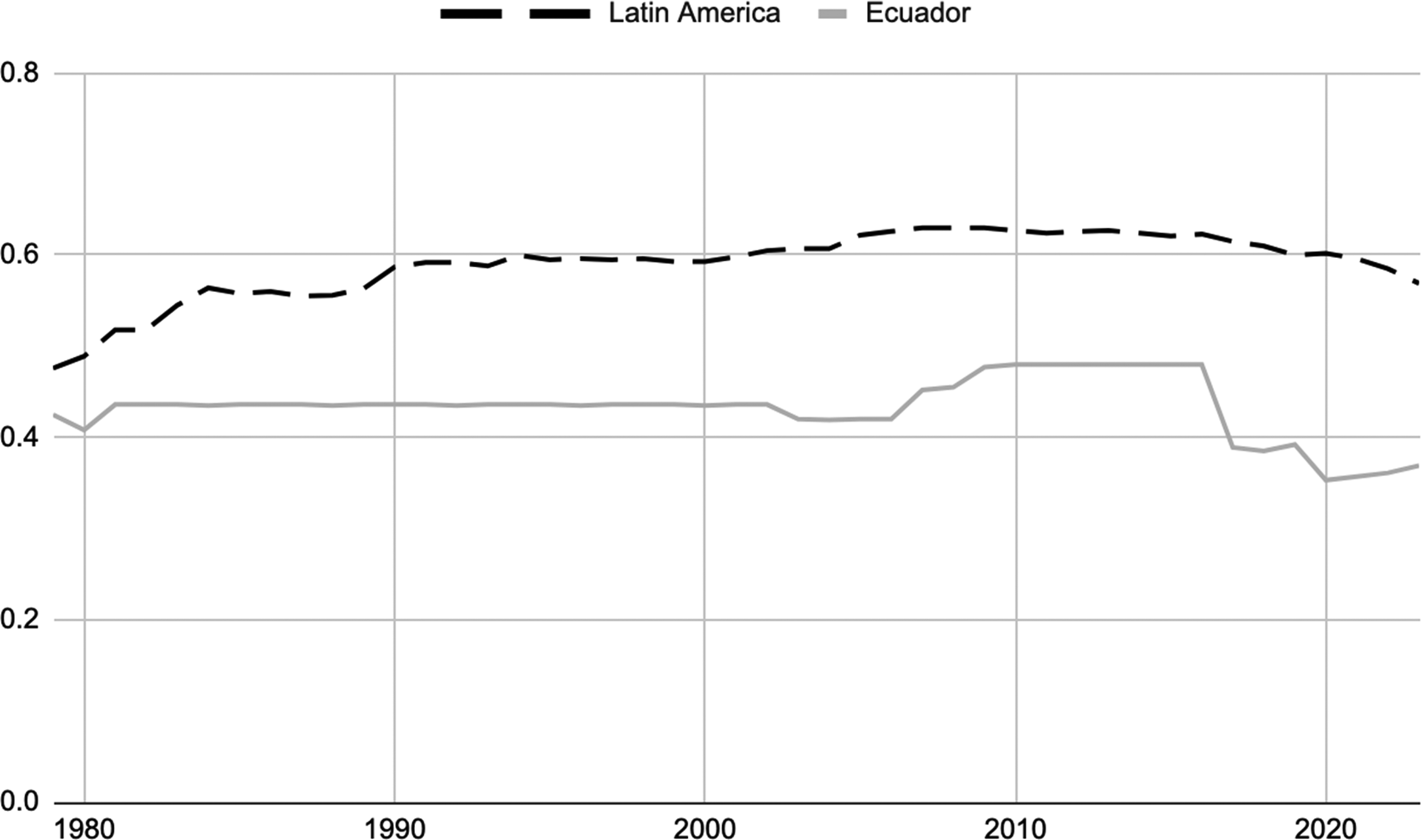
Party System Institutionalisation in Latin America and Ecuador. Source: Coppedge et al. (2024).
Between 1978 and 2024, 93 runoff elections took place in Latin America; however, only in 20 of them did the leading candidate in the first round lose in the second round (Table 1). Five of those runoff reversals occurred in Ecuador, when León Febrez Cordero, Ábdala Bucaram, Rafael Correa, Guillermo Lasso, and Daniel Noboa came from behind and became president. More strikingly, Ecuador is the only country in Latin America that experienced a consecutive runoff reversal in the most recent presidential elections, making it a regional outlier worth studying its hypothesised causes: affective leader polarisation and opposition fragmentation.
Runoff Reversals in Latin America (1978–2024).
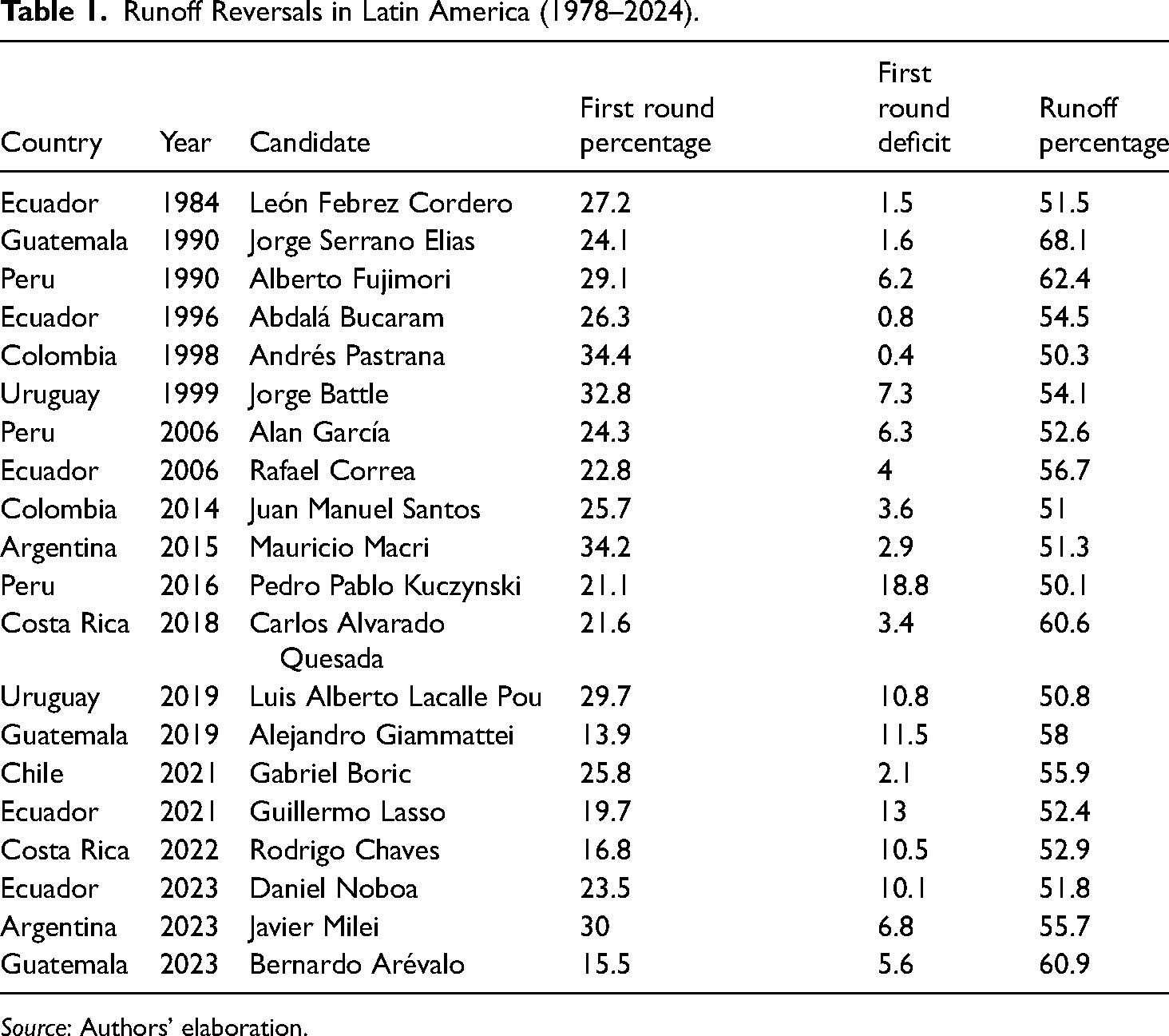
Source: Authors’ elaboration.
Affective Leader Polarisation
In their comparative study of two-round elections, Passarelli and Bergman (2023) explore multiple hypotheses and cannot provide a definitive explanation for runoff reversals. Instead, they suggest that “Polarization of political competition and voting behavior trends at country/region level might also affect the likelihood of comebacks” (Passarelli and Bergman, 2023: 619). We propose focusing on a specific type of polarisation that provides a potential explanation for runoff reversals: Affective leader polarisation occurs when “the elites and/or the citizens polarize over their levels of affection toward chief executives who personally dominate the political environment” (Selçuk, 2024: 28). In such countries, the political spectrum is divided between hardcore supporters and staunch opponents of the dominant leader at the elite and public opinion levels. The pro- and anti-leader identities become a political cleavage that shapes party politics, voting behaviour, and contentious events (Selçuk, 2024).
Affective leader polarisation differs from left-right ideological polarisation and affective partisan polarisation because of its emphasis on the dominant leader (Gidron et al., 2020; Iyengar et al., 2012). Affective leader polarisation is a form of identity-based polarisation between the members of the in-group and the out-group, who form two sizable but opposing groups in society. Because of its focus on an individual politician, affective leader polarisation is more likely to occur in candidate-centered presidential systems (Selçuk, 2024). Given the prevalence of presidentialism across the region, Latin America is fertile ground for affective leader polarisation. For instance, polarisation between the supporters and opponents of Juan Domingo Perón, also known as la grieta, has been one of the main dynamics of Argentinian politics (Andrews-Lee, 2021).
The primary explanation for affective leader polarisation is populism. Studying the linkage between populism and polarisation is becoming increasingly common. In Latin America, almost all polarising figures are also populist leaders. The exact mechanism of how populism polarises is open to discussion. Roberts posits that populists polarise “by drawing a line in the sand to separate insiders from outsiders, and by challenging the political legitimacy or authenticity of those who wield power” (Roberts, 2021: 6). Like de la Torre (2021), Selçuk (2024) emphasises how populist leaders dominate the political spectrum with their charismatic persona and omnipresence. By promoting antagonistic narratives and policies, populists cultivate a dichotomy of inclusion versus exclusion towards the members of the in-group versus the out-group. At the individual and country levels, a positive association exists between populist party identification and higher levels of affective polarisation. Polarisation in Western democracies is mainly driven by high degree of out-group animosity toward populist parties (Davis et al., 2024; Pérez-Rajó, 2024).
Animosity towards populists forms negative identities that have developed over time. In countries with an institutionalised party system, negative political attitudes could take the form of negative partisanship (Medeiros and Noël, 2014). In less institutionalised and more fragmented party systems, negative partisanship still exists (Haime and Cantú, 2022), but it could also take the form of anti-leader identities and attitudes (Andrews-Lee, 2021; Meléndez, 2022). To explain runoff reversals, the development of these negative identities and attitudes is crucial. In polarised contexts, voters who dislike the populist leader and their movement could cast a strategic vote in the runoff elections. Although the goal of the strategic vote is negative, to prevent populism from coming to or returning to power, it opens the path for second-place candidates to unexpectedly become presidents. This outcome does not happen due to their immense popularity but because of the dislike and fear of the alternative scenario. Runoff elections make it harder for polarising figures and their proxies to become presidents, members of the parliament, mayors, governors, and city council members.
Opposition Fragmentation
In polarised contexts, another factor that explains runoff reversals is the fragmentation of the anti-leader opposition. 1 When the pro-leader camp is more unified and consolidated, whereas the opposition is fragmented over ideology, ethnicity, regional identity, and personal rivalries, runoff reversals become more likely. This fragmentation incentivises parties to nominate their candidates and leaders to run independently in the first round and potentially endorse the only viable anti-leader opposition candidate in the runoff. In that sense, the two-round majority system discourages the formation of coalitions and alliances before the first round of the presidential elections. It reduces the anti-leader opposition's representation at the parliamentary level when the legislative elections are held on the same day as the first-round presidential elections. Each political party and movement's decision to run on its own may be a natural outcome of political pluralism, however, it fragments the opposition vote, diminishes its representation in the legislative branch, and limits its institutional ability to resist democratic backsliding (Gamboa, 2022). Especially in majoritarian electoral systems, a fragmented opposition ends up being underrepresented in the National Assembly because of wasted votes. Even when an opposition candidate wins the presidency in the second round, inter-branch conflict and poor governance are more likely to occur.
In single-round plurality systems, the incentives for coalition-building under polarisation are greater. Because the anti-leader opposition only has one shot, as the degree of polarisation increases, the number of viable presidential candidates should decrease. For instance, in Venezuela, a country that uses a single-round plurality system, the opposition parties put aside their differences and nominated joint presidential candidates in 2000, 2006, 2012, 2013, and 2024. Opposition coordination in Venezuela took place not only in the presidential elections but also in the parliamentary elections in 2010 and 2015, minimising intra-opposition rivalries (Jiménez, 2023). Besides the one-round elections, another factor that incentivised opposition coordination was autocratisation under populism in power. Venezuela's autocratic turn under Hugo Chávez and Nicolás Maduro brought together ideologically diverse opposition parties (Corrales, 2023).
One of the factors that bring together anti-leader opposition parties is the rise of the democracy-authoritarianism cleavage (Selçuk and Hekimci, 2020) when the populist leader steers the country in an authoritarian direction, or their movement is associated with past repressive practices. When the democracy-autocracy divide becomes the main axis, fragmented opposition parties are more likely to rally around a candidate in the first or the second round. Due to the focus on this regime cleavage, in the short run, the opposition parties may mute their ideological, regional, ethnic, and personal differences and search for the best strategy to maximise their power both in the executive and legislative branches (Ong, 2022). When the opposition actors publicly campaign on resisting autocratisation (Tomini et al., 2023), their level of fragmentation might decrease in the second round of presidential elections, becoming a potential explanation for runoff reversals. In that case, opposition supporters would strategically vote against the candidate representing a populist and authoritarian project. Argentina (2015) and Peru (2016) are examples of when candidates who were associated with Fujimori and Perón were leading in the first round but lost in the runoff. In Chile (2021), the polarising populist candidate, José Antonio Kast, could not maintain his lead over Gabriel Boric, and a runoff reversal occurred (Table 1).
Polarisation and Fragmentation Under Correa (2007–2017)
As we mentioned above, since the return to democracy, Ecuadorian politics has been marked by low levels of party institutionalisation, leading to political instability, ineffective governance, and the rise of populist outsiders. After a decade of instability, when democratically elected presidents could not complete their terms, Correa ran as a populist outsider and won 22.8 percent in the first round of the 2006 presidential elections. The leading candidate in the first round was Álvaro Noboa, with 26.3 percent. In the runoff, Correa (56.7 percent) managed to defeat Noboa. Correa benefited from an anti-establishment mood in Ecuadorian politics and portrayed Noboa as a member of the oligarchy (de la Torre and Conaghan, 2009). Correa's election immediately caused a governance crisis because the PAIS Alliance did not present any congressional candidates. One of Correa's chief campaign promises was to rewrite the constitution, and on the day of his inauguration, he called for a referendum and established a constituent assembly with “full powers.” The opposition to Correa during this period came from Jaime Nebot, the mayor of Guayaquil. Nebot's opposition to Correa involved elements of regionalism and neoliberalism. Nebot considered Correa's centralised political project a threat to the city's distinct identity and economic competitiveness (Eaton, 2011). Thanks to his immense popularity (Figure 2), Correa-backed candidates dominated the constitution-making process, while the opposition parties could not overcome their fragmentation.
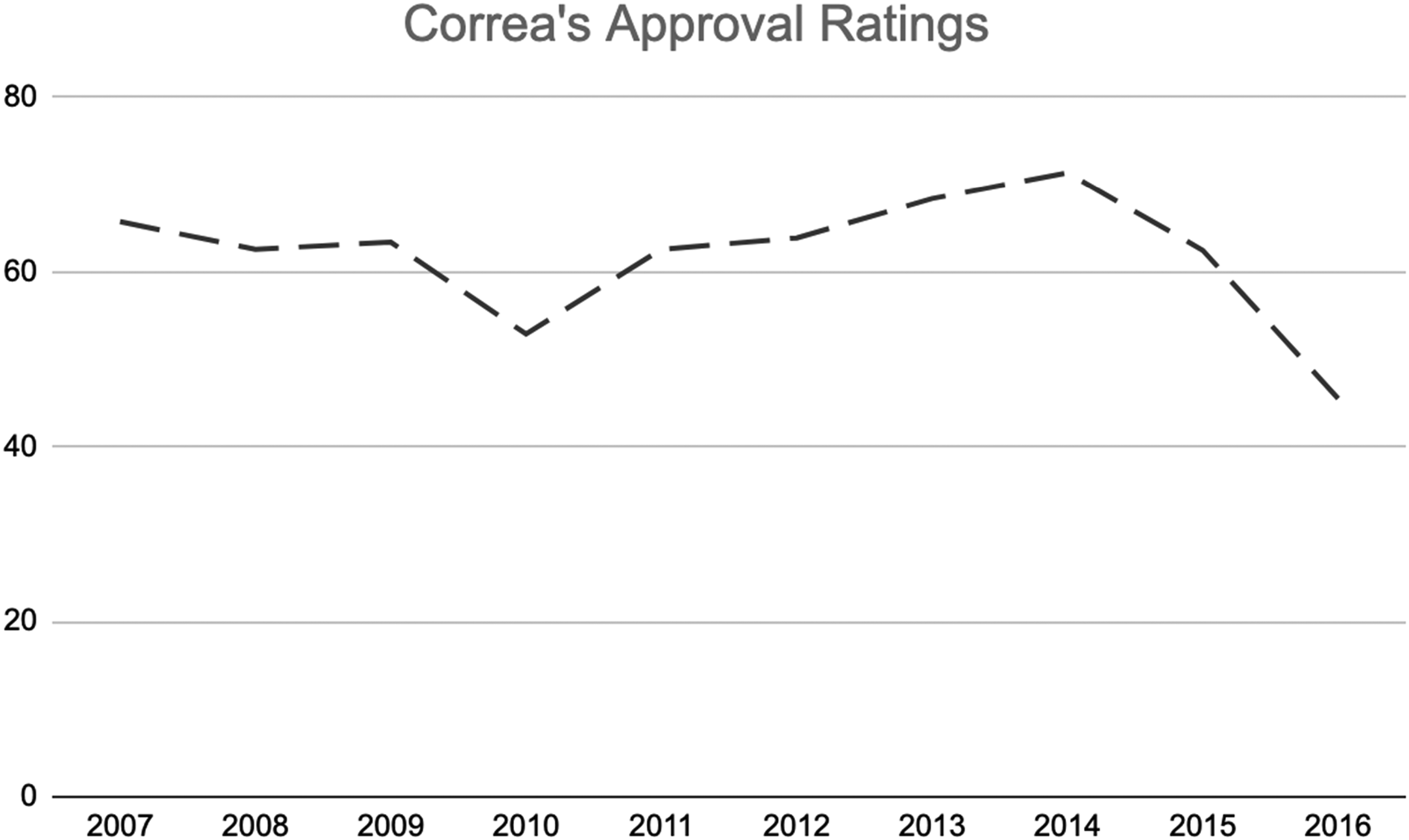
The Approval Ratings of Rafael Correa (2007–2016). Source: Carlin et al. (2023).
The adoption of the new constitution inaugurated a hegemonic period in Ecuadorian politics, characterised by Correa's dominance and the weakness of the opposition (Sánchez, 2022). In the 2009 presidential elections, Correa won 52 percent of the vote and became the first president to avoid a runoff since the transition to democracy. In the parliamentary elections that were held on the same day, the PAIS Alliance won 59/124 seats. The closest parties were Lucio Gutiérrez's Patriotic Society Party (PSP) with 19/124 seats and Nebot's Social Christian Party (PSC) with 11/124 seats (Table 2). Although Correa's party lacked a majority, thanks to the fragmentation of anti-correístas, it controlled a comfortable plurality of seats in the National Assembly. In the concurrent local elections, the PAIS Alliance won 72/221 municipalities, including Quito and Cuenca (Pachano, 2010).
Seat Distribution in the National Assembly (2009–2023).
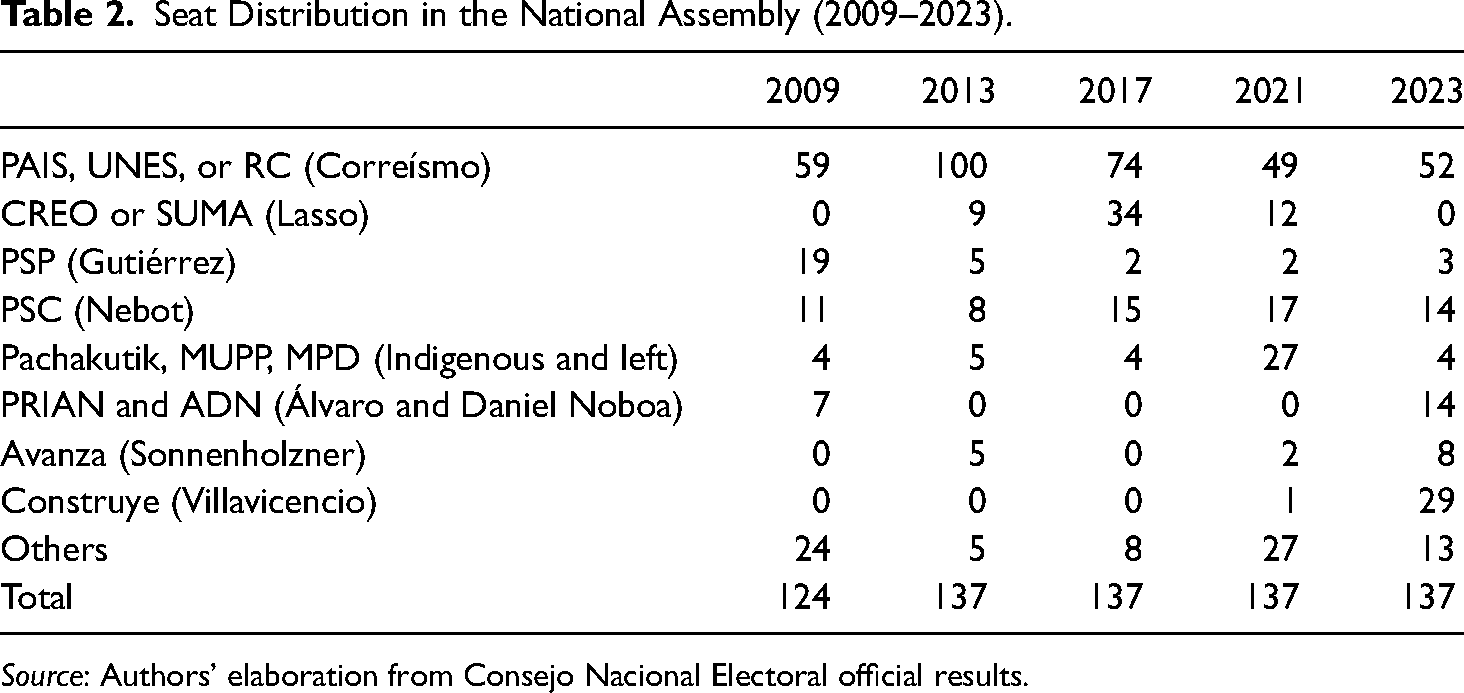
Source: Authors’ elaboration from Consejo Nacional Electoral official results.
Four years later, in the 2013 presidential elections, Correa (57.2 percent) won in a landslide and again avoided a runoff. The runner-up was the neoliberal candidate Guillermo Lasso (22.7 percent), whose support primarily came from right-wing anti-correísta voters (Freidenberg, 2013). The remaining field was divided between six other anti-correísta opposition candidates, including Gutiérrez (6.7 percent), Mauricio Rodas (3.9 percent), Noboa (3.7 percent), and Alberto Acosta (3.3 percent). Rodas was the candidate of a right-wing party called the United Society More Action Party (SUMA). In contrast, Acosta was a left-wing and ecologist critic of Correa as the former president of the Constituent Assembly. The ideological and organisational fragmentation of the anti-correístas was a bigger problem in the concurrent parliamentary elections. Due to a newly adopted majoritarian electoral system, the PAIS Alliance won a supermajority with 100/137 seats and 52.3 percent of the vote (Table 2), overcoming the historical regional divide in the country and consolidating its predominance over the party system. Lasso's party, Creating Opportunities (CREO) won 11 seats, followed by PSC (6 seats) and PSP (5 seats), as evidence of a fragmented and weak opposition (Eichorst and Polga-Hecimovich, 2013).
The dynamics of populism and affective leader polarisation in Ecuador depended on Correa's overall popularity, which remained high as long as the oil prices remained historically high. Parallel to the sharp drop in oil prices after 2014, Correa's approval ratings (Figure 2) started declining (Carlin et al., 2023), and the anti-correísta camp gained momentum (Burbano de Lara, 2016). The first sign was during the 2014 local elections, when opposition candidates, including Quito and Cuenca, won key mayorships. In Quito, Rodas won 58.5 percent of the votes and became the new mayor. Compared to the 2009 mayoral elections, the number of candidates declined from 14 to 6. For example, CREO did not field a candidate and rallied behind Rodas, reducing opposition fragmentation in single-round elections and maximising its electoral competitiveness (Ramírez Gallegos and Coronel, 2014).
As the anti-correístas showed signs of unity and gaining momentum, a right-wing protest movement in 2015 challenged the president. At first glance, the self-denominated “Black Flags” was mostly composed of the upper and middle classes. However, given the president's repressive practices against the left-leaning sectors, it also fuelled a larger series of protests from the left. The protests started in response to a proposed change in the inheritance and capital gains law. Later that year, the Confederation of Indigenous Nationalities of Ecuador (CONAIE), the Popular Unity Party (UP), and the United Front of Workers called for a national strike against a proposed constitutional amendment to abolish presidential term limits. Despite the protests, the PAIS Alliance moved forward with the constitutional amendment but added a provision that the change would not apply to the upcoming elections, meaning Correa could not run in 2017 (Vera Rojas and Llanos-Escobar, 2016).
Under those circumstances, in the 2017 presidential elections, Correa threw his support behind his former Vice President, Lenín Moreno as the candidate of correísmo. As Moreno's running mate, Correa picked Jorge Glas, the current vice president at the time. The first round of the 2017 elections had eight candidates in total (Figure 3). The Moreno-Glas ticket (39.4 percent) almost won the elections in the first round because of the rule that if a candidate wins 40 percent of the vote and has a 10 percent difference with the second-place candidate, they become president. The runner-up was Lasso (28.1 percent), followed by Cynthia Viteri (16.3 percent) from the PSC.
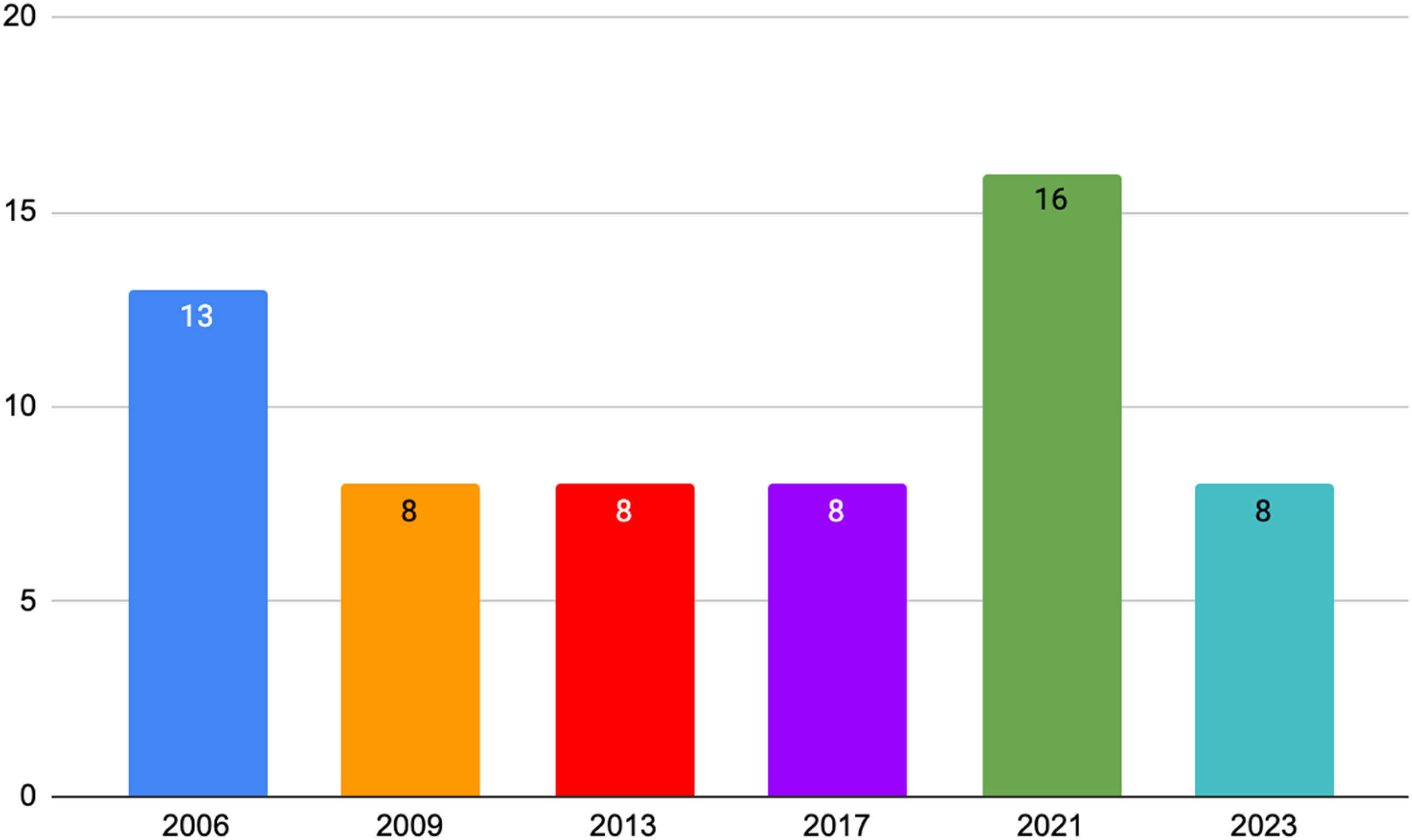
Number of Presidential Candidates (2006–2023). Source: Authors’ Elaboration from the CNE Website.
In the 2017 parliamentary elections, the PAIS Alliance lost its supermajority but retained a simple majority (74/137 seats). CREO and PSC won 32 and 15 seats, respectively, a significant improvement for the opposition compared to the previous elections (Table 2). The Democratic Left (ID) and Pachakutik (MUPP) each won four seats, pointing to the continued fragmentation of the anti-correístas along ideological lines. In the second round of the 2017 presidential elections, right-wing opposition parties coalesced around Lasso, who gained the endorsement of Viteri. As a unifying theme of anti-correístas, Viteri justified her endorsement “to change a totalitarian government through elections” (El Comercio, 2017). Center-left candidate Paco Moncayo (6.7 percent) also supported Lasso in the runoff. Moncayo said: “Lasso is the lesser of two evils, and it is necessary to recover democracy.” Moncayo also described the actions of correísmo as “fraudulent” and “deceitful” (El Universo, 2017a). In the runoff, mainly thanks to these endorsements, Lasso increased his support by 20.7 percent but failed to defeat Moreno, who received 51.2 percent of the vote. The 2017 presidential elections were anti-correísmo's best performance until then. As a result of a decade of autocratisation under Correa, the Moreno campaign benefited from disproportionate access to the media and state resources, whereas the opposition had more limited resources to compete on equal ground (Meléndez and Moncagatta, 2017).
During his 10-year presidency, Correa affectively polarised Ecuador between his supporters and opponents. Affective leader polarisation became more salient towards the end of Correa's populist rule coinciding with the end of the oil boom and his declining approval ratings (Figure 2). Right-wing opponents of Correa, including Lasso, Nebot, and Rodas, positioned themselves against the president mainly because of perceptions of authoritarianism, corruption, and socialism. Although Correa identified as a socialist, anti-correístas from the left challenged the president too. After initially aligning himself with indigenous and environmentalist groups, Correa engaged in repression and persecution against them later in his presidency. The clashes between Correa and left-wing anti-correístas were related to the capitalist exploitation and extraction of natural resources (Becker, 2013). Although the leftist anti-correístas were ideologically distant from the neoliberal opponents of the president, they both considered him as an authoritarian adversary that had to be constrained or defeated. The ideological diversity of the anti-correístas continued to play a key role in Ecuadorian politics even after Correa was out of office.
Polarisation and Fragmentation Under Moreno (2017–2021)
Soon after his election, President Moreno switched sides and allied with the anti-correísta parties, namely PSC and CREO. Under the framework of a national dialogue, Moreno pursued a more liberal outlook and heavily criticised Correa's authoritarian and corrupt practices (Moncagatta and Espinosa, 2019). Moreno's defection from the correísta camp also led to the implosion of the PAIS Alliance as a political party (Polga-Hecimovich and Sanchez, 2021). In this period, Ecuador's performance in global democracy indices slightly improved. In its 2018 report, Freedom House praised Moreno “due to reduced pressure on the media and civil society, as well as progress on anticorruption efforts” (Freedom House, 2018).
In a polarised context, from the perspective of Moreno and other anti-correístas, the primary way to protect the Ecuadorian democracy was to prevent Correa and his allies’ return to power. Once he cut ties with Correa, Moreno pursued exclusionary measures towards the ex-president and his allies in state institutions, especially in the judiciary and mechanisms of horizontal accountability (Burbano de Lara and de la Torre, 2020). In a highly polarising manner, Moreno initiated a referendum in 2018 that included seven questions ranging from environmental protection to child abuse (Wolff, 2018). Three of the questions were anti-correísta in nature: the elimination of indefinite re-election, restructuring of the Council for Citizen Participation and Social Control (CPCCS), and the disqualification of politicians who are found guilty of corruption. Given there were only two options (yes/no) in the referendum, the fragmentation of the anti-correístas did not matter if they opposed Correa. Therefore, the results were favourable to their agenda. Sixty-four percent of the voters supported the ban on indefinite re-election. Sixty-three percent of the voters approved the restructuring of the CPCCS. The support for disqualifying corrupt politicians was even higher at 74 percent. By reinstating presidential term limits, Moreno practically blocked Correa's potential return to the presidency. In the meantime, he removed Correa supporters from various state institutions through the CPCCS (Jaramillo, 2022).
During the process of “de-Correaization,” Moreno temporarily united the opponents of Correa but lacked an effective policy agenda to address Ecuador's macroeconomic instability and weak institutionality. Without a strong political party and legislative support that he could rely on, Moreno faced a significant backlash against his policies (Polga-Hecimovich and Sanchez, 2021). In 2019, an indigenous-led national strike undermined the president's ability to implement austerity measures. Moreno's mismanagement of the pandemic further contributed to the image of an ineffective and incompetent president. By the end of his 4-year term, Moreno's approval ratings reached as low as 4.8 percent (Carlin et al., 2023). Over time, Moreno lost his initial appeal among the opponents of Correa, who started to distance themselves from the highly unpopular president. By the end of his presidency, Moreno had lost the support of both correístas and anti-correístas.
Moreno's attempts to eradicate Correa and his movement from Ecuadorian politics proved unsuccessful. In an increasingly polarised setting, the supporters of Correa made a comeback in the 2019 local elections. Correa-endorsed candidates won the second and third-largest provinces of Ecuador. In Pichincha, where the capital Quito is located, Paola Pabón became the governor 2 with only 22.2 percent of the vote. This outcome occurred because anti-correístas were fragmented among multiple candidates. The second-place candidate, Juan Zapata from the Democratic Left (ID) received 20.7 percent of the vote, followed by sixteen other candidates. Similarly, in Manabí, a traditional stronghold of correísmo, Leonardo Orlando won the governorship with 28.5 percent of the vote, benefiting from the division of the right-wing anti-correísta vote among the candidates of CREO (25.7) and PSC (20.6). As we argue in this article, in all these local election races, the winning candidates of correísmo benefited from the one-round system and fragmentation of their opponents, unlike in presidential elections where the anti-correístas consolidate around a single candidate and attempt to defeat the correísta candidate in the runoff.
Runoff Reversal in the 2021 Presidential Elections
Ahead of the 2021 presidential elections, the supporters of Correa coalesced around a new coalition, Union for Hope (UNES). Because Correa was ineligible to run, UNES picked Arauz as a proxy candidate. During the campaign, Arauz aimed to capitalise on the discontent with Moreno's performance and promised a return to Correa's pro-poor policies. Arauz gained prominence in the campaign mainly because of his personal relationship with Correa. In a polarised setting, Arauz emerged as the sole candidate of correísmo, and the anti-correísmo movement could not fully overcome its ideological, regional, ethnic, and personal fragmentation. Fifteen other candidates ran for president in 2021 (Figure 3). Some of the prominent anti-correísta presidential candidates included Guillermo Lasso (neoliberal), Yaku Pérez (indigenous-left), and Xavier Hervas (center-left). Among these candidates, Lasso was backed by the PSC, a sign of greater unity among right-wing anti-correístas compared to the 2017 presidential elections. PSC justified its support for Lasso with a declared goal of “preventing the return of the irresponsible populists” (El Comercio, 2020).
From an ideological perspective, an initial look at the results of the first round revealed the rise of left-wing candidates in response to the rejection of Moreno's neoliberal policies. Receiving 32.7 percent support in the first round, Arauz secured a place in the runoff but fell short of the 40 percent threshold to achieve an outright victory. Thanks to Arauz's leading position in the first round, UNES won 49/137 seats in the National Assembly (Table 2). On the night of the election, the indigenous candidate, Pérez was about to make it to the second round, which could mean a runoff between two leftist and anti-neoliberal candidates. This scenario, however, did not take place, and Lasso (19.7 percent) narrowly surpassed Pérez (19.4 percent) in the following days. The fourth-place candidate Hervas received 15.7 percent of the votes. The aggregate total of three anti-correístas, Lasso, Pérez, and Hervas reached 54.8 percent.
In the legislative elections, Pérez's party Pachakutik (27/137), and Hervas’ party, the Democratic Left (ID) (18/137) won more seats than Lasso's CREO (12/137). PSC, which had backed Lasso in the presidential elections, won 18/137 seats. Even though UNES became the largest party in the National Assembly, the combined seat total of the three main anti-correísta parties (ID, CREO, Pachakutik, PSC) was more than UNES (49/137) (Table 2), allowing them to elect Guadalupe Llori from Pachakutik, an indigenous woman, for the National Assembly speakership (El Universo, 2021a).
After the first round, Pérez accused Lasso of electoral fraud and called his supporters to cast a null vote in the runoff (Galindo, 2021). At the same time, the indigenous candidate said “Perhaps the people are already tired of the violence and the extractivism of the populist left, which is not real. The authentic left is with the workers, with the teachers, with the indigenous class, with the open class, with those of us who were vilified, persecuted, and criminalized” (France 24, 2021). Conversely, Carlos Pérez Guartambel, president of the Confederation of Peoples of Kichwa Nationality stated: “We prefer a banker than a dictatorship” (El Universo, 2017b). Following Pérez's call, the percentage of null votes increased from 12 to 17 percent in the runoff (Consejo National Ecuador, 2021). Despite this increase, in the Amazon provinces where Pérez was the leading candidate in the first round, there was a clear shift of support to Lasso in the runoff, which cannot be explained by left-right ideology but rather the populist correísmo/anti-correísmo cleavage. For instance, in the Morona Santiago province, Lasso's percentage increased from 9.6 to 69.2 percent between the two rounds. Similar vote shifts occurred in the rest of the Amazon region (Table 3).
Vote Shifts from Peréz to Lasso in the Amazon Region.
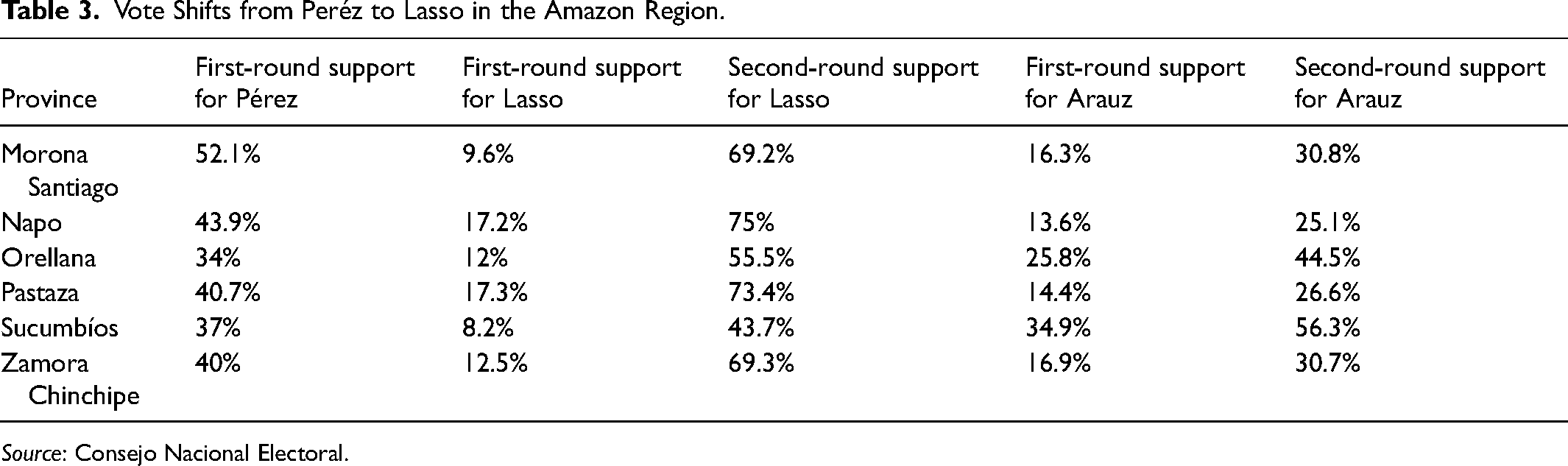
Source: Consejo Nacional Electoral.
Compared to Pérez's ambiguous position, Hervas openly backed Lasso in the runoff. Hervas indicated that he “would not be voting null or for the authoritarian model that had governed, divided, and spread hate in the country” (El Universo, 2021b). In other words, Hervas endorsed Lasso despite their ideological differences and because of their common opposition to Correa's populist movement. In the first round of elections, Hervas was the leading candidate (28.2 percent) only in the Carchi province, where Lasso increased his support from 16.7 to 63.6 percent (Consejo Nacional Electoral, 2021).
In the runoff, Lasso successfully formed an anti-populist coalition by appealing to the Indigenous movement, feminists, LGBTQ activists, and environmentalists (Moncagatta et al., 2023). Thanks to his ability to consolidate anti-correístas, Lasso (52.4 percent) came from behind and defeated Arauz. The fragmentation of the anti-correístas helped Arauz lead in the first round, while polarisation served Lasso in the runoff.
Polarisation and Fragmentation Under Lasso (2021–2023)
Despite winning the presidency, Lasso struggled to effectively govern Ecuador. While UNES remained unified, anti-correistas showed increasing signs of fragmentation parallel to Lasso's poor performance and declining approval ratings. Without decent support in the National Assembly, Lasso failed to stabilise the country, eventually forcing him to call early elections. In his first year of presidency, Lasso was implicated in a global corruption scheme, the Pandora Papers, weakening his credibility in anti-corruption efforts. Reminiscent of Moreno, Lasso also faced a significant indigenous uprising and a national strike in response to high fuel prices and growing citizen insecurity (Sánchez and Granados, 2023). Lasso's repressive response to the protests received criticism from international human rights groups (Amnesty International, 2022) and set him further apart from left-wing anti-correistas, whose main criticism of Correa was his suppression of dissent and indigenous voices.
Affective leader polarisation and the fragmentation of anti-correistas became even more apparent in the 2023 local elections and referendum, which were held on the same day. The results of the local elections indicated “the return of correísmo” to key municipalities and governorships such as Quito, Guayaquil, Pichincha, and Guayas (Consejo Nacional Electoral, 2023a). Like in 2019, correístas benefited from the absence of a runoff election, an institutional design that increases the salience of polarisation and hurts the populist movement. In Quito, the correísta candidate Pabel Muñoz only won 25.1 percent of the vote, followed by several anti-correísta candidates from the left and the right of the ideological spectrum. Without a runoff, the ideological diversity and fragmentation of anti-correismo helped the incumbent correista governor of Pichincha, Pabón, win re-election (27.7 percent).
The biggest upset to anti-correístas happened in Guayaquil, which was under the hegemony of the PSC for 31 years (Primicias, 2023). Because of the PSC's traditional strength in the coastal city, the field of candidates was less fragmented. The correísta candidate, Aquiles Álvarez, won the mayorship with 39.9 percent of the vote, followed by the incumbent mayor, Cynthia Viteri (30.4 percent). The third-place candidate was Pedro Pablo Duart (14.9 percent) from the right-wing SUMA. In the election for governor of the broader Guayas, the correísta candidate, Marcela Aguiñaga (34.3 percent), defeated Susana González (25.7 percent) from the PSC. In addition to the local elections, Lasso proposed eight items to address the country's crisis of governance. The questions on the referendum ranged from allowing the extradition of narcotraffickers to the reduction of the size of the National Assembly. Regardless of the content of the individual questions, correístas turned the referendum into a vote of no confidence against Lasso. The voters rejected all eight questions with an average of 55.3 percent.
After its victory in the local elections and the referendum, the correísta bloc in the National Assembly gained further momentum to remove Lasso from power. In 2022, UNES led an impeachment process against Lasso. The impeachment attempt failed by 12 votes, but showed the president's vulnerability (Al Jazeera, 2022). Surprisingly, one of the parties that supported the impeachment was the PSC, which had started to distance itself from the president. In an interview, Lasso shared his disappointment with the PSC in a personalised way: “Rafael Correa and Jaime Nebot, from the first day of my government, have been trying to destabilize Ecuadorian democracy. Nebot hates me because he did not have the balls to be a presidential candidate” (Periodismo en Llamas, 2022). In response to this accusation, Nebot released a statement and said: “I feel sorry for your emotional status. Forget about my ‘balls,’ and show yours when fighting crime” (Nebot, 2022). This exchange not only shows the prevalence of vulgarity and toxic masculinity in Ecuadorian politics but also the importance of the divisive personal rivalries within the anti-correísta camp.
Compared to their previous impeachment attempts, correístas were more successful in May 2023, when Lasso was impeached with 88 votes. The correísta assembly bloc, supported by PSC, Pachakutik, and independent members, accused Lasso of mismanaging public funds, particularly in the transportation of oil through public companies (BBC, 2023). Lasso's response to the impeachment was to invoke a constitutional mechanism called la muerta cruzada, the immediate dissolution of the National Assembly and renewal of the elections. After activating this process, Lasso governed the county by decree for another 6 months, but given his dismal approval ratings, chose not to run again. CREO did not participate in the parliamentary elections either. This scenario was ideal for correístas who blamed the security and economic crisis on Lasso's neoliberal policies and promised a return to “the prosperous Correa decade” (Zapata et al., 2021).
Runoff Reversal in the 2023 Presidential Elections
Lasso's eventual removal from office did not alter the main dynamics in Ecuadorian politics. Ahead of the early elections in 2023, affective leader polarisation and the fragmentation of anti-correístas remained key variables, leading to another “runoff reversal.” As in 2021, correísmo rallied around a single candidate, this time González. With the backing of Correa, González quickly gained name recognition and became the leading candidate in the polls (Marchante, 2023a). Other than González, seven other candidates ran for president, reducing the number of candidates between the elections from sixteen to eight (Figure 3). Once again, Correa's opponents chose to field multiple candidates. In addition to Pérez and Hervas, who aimed to build on their support in the 2021 elections, other anti-correísta candidates included Jan Topic (businessman), Fernando Villavicencio (investigative journalist), Otto Sonnenholzner (former vice president of Moreno), and Daniel Noboa (son of five-time presidential candidate Álvaro Noboa).
The first round of the elections was shaken by the assassination of Villavicencio in the aftermath of a campaign rally (Ospina Peralta, 2023). The murder of Villavicencio shocked the entire country and also made it to global headlines, consolidating Ecuador's reputation as the new hub in South America for narco-trafficking and gang violence. Villavicencio was an outspoken critic of the corruption schemes during the Correa decade (Delgado, 2023). Because of the public history of animosity and conflict between Villavicencio and Correa, some in the anti-correísta camp, including Villavicencio's successor, Christian Zurita, accused the ex-president of the murder (Swissinfo.ch, 2023). Correa denied all allegations and considered the assassination a conspiracy to discredit his movement and prevent its return to power (Cortés, 2023). González also rejected the claims and called for national unity (Luisa Gonzalez Presidenta on TikTok, 2023).
The assassination of Villavicencio initially helped the already surging candidacy of Topic, dubbed “the Ecuadorian Nayib Bukele,” about his tough-on-crime policy proposals. However, after his successful presidential debate performance, Noboa received a last-minute surge in popularity, surpassing all other anti-correísta candidates (Marchante, 2023b). The results of the first round of presidential elections were highly similar to the 2021 elections. The candidate of correísmo, González (33.6 percent), had more than a 10 percent lead ahead of the second-place candidate, Noboa (23.5 percent) but failed to reach the 40 percent threshold to win the presidency. The substitute candidate for Villavicencio, Zurita, won 16.4 percent, followed by other anti-correísta candidates, Topic (14.7 percent), Sonnenholzner (7 percent), and Pérez (4 percent). Once again, correísmo missed the opportunity to capitalise on the fragmentation of anti-correísmo in the first round and became vulnerable in the runoff due to its polarising legacy. In the National Assembly, correísmo remained the largest bloc with a plurality of seats (52/137), whereas anti-correístas were divided among smaller parties but managed to elect a speaker from the PSC. Table 2 summarises the seat distribution in the National Assembly between 2009 and 2023, illustrating the dominance of correísmo over time.
After the first round, like in 2021, the eliminated anti-correísta candidates started to rally behind Noboa, primarily to prevent the return of correísmo, which they associated with authoritarianism, corruption, and criminality. Two weeks before the runoff elections, Zurita (2023) pointed out González's close relationship with Correa, “a political mafia who belongs to a prison cell.” Because of her close relationship with Correa, Zurita concluded that González was not able to address pressing issues like organised crime and drug trafficking (Swissinfo.ch SWI, 2023). The third-place candidate Topic refrained from giving an official endorsement but announced that he would vote for Noboa in the runoff (CNN, 2023). Sonnenholzner clarified that “he had never voted for the Socialism of the 21st century, and he would not change his stance on that” (El Universo, 2023). Pérez, on the other hand, announced that he would not be supporting any of the candidates in the runoff and voting null. He criticised Noboa's neoliberal policy proposals and similarities with Lasso's but also talked extensively about correísmo's legacy of authoritarianism, criminalisation of protest, suppression of media freedom, and involvement in corruption scandals (Pérez Guartambel, 2023). Although he was not a candidate in 2023, ex-president Gutiérrez predicted that Noboa would win in the second round because of “the numerical strength of anti-correísmo over correísmo” (Lozano, 2023). Benefiting from the affective leader polarisation between the supporters and opponents of Correa, Noboa entered the second round as the favourite and increased his vote share from 23.5 to 51.8 percent (Consejo Nacional Electoral, 2023b).
On the night of the runoff, ex-president Moreno (2023), now a staunch anti-correísta, shared this message with his followers: As I said a few days ago, due to the serious damage it caused Ecuador, correísmo will never again return to power. For the third consecutive time, they have lost national elections: the 2018 referendum, and the presidential elections in 2021 and 2023. They must understand once and for all that Ecuador wants peace, democracy, freedom, institutionality, separation of power, freedom of expression, transparency, and fiscal restraint. Congratulations to the Ecuadorian people for a peaceful and democratic election!
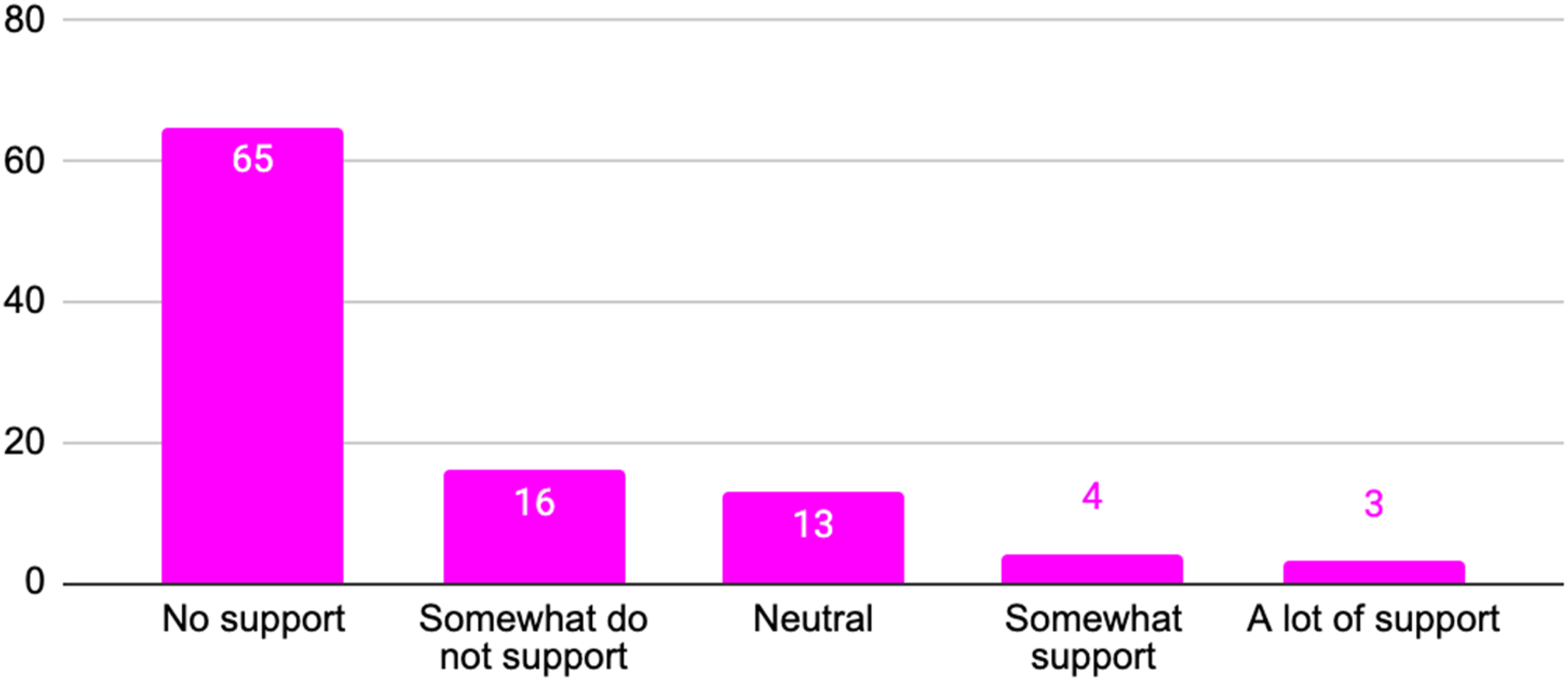
To provide further empirical evidence for polarisation, we analyse a nationally representative post-election survey of Clima Social. In the survey, respondents were asked to express their level of support for the Citizens’ Revolution Movement. On a five-point scale, the responses cluster in both poles, 37 percent expressing “no support” and 28 percent “expressing a lot of support,” indicating an asymmetrically polarised distribution over correísmo (Figure 4). When we use this item as a proxy measure of affective leader polarisation, we also see a clear inverse relationship with supporting Lasso in the 2021 and Noboa in the 2023 runoffs. Lasso received 57 percent support among the respondents who expressed “no support” for Correa's movement as evidence of his appeal among attitudinal 3 anti-correístas (Figure 5). The findings are slightly stronger for Noboa as he managed to capture 65 percent support in the runoff among anti-correístas. It is worth noting that Noboa only had 3 percent support among the strongest supporters of correísmo (Figure 6). The voting patterns based on the populist cleavage are similar between Arauz in 2021 and González in 2023. Arauz only received 6 percent of the vote among the respondents who expressed “no support” for the Citizens’ Revolution, and González received 5 percent with the same group. The percentage of votes for Arauz and González consistently increased along the five-point scale, reaching 69 and 86 percent support, respectively, among people who expressed “a lot of support” for the Citizens’ Revolution (Figures 7 and 8).
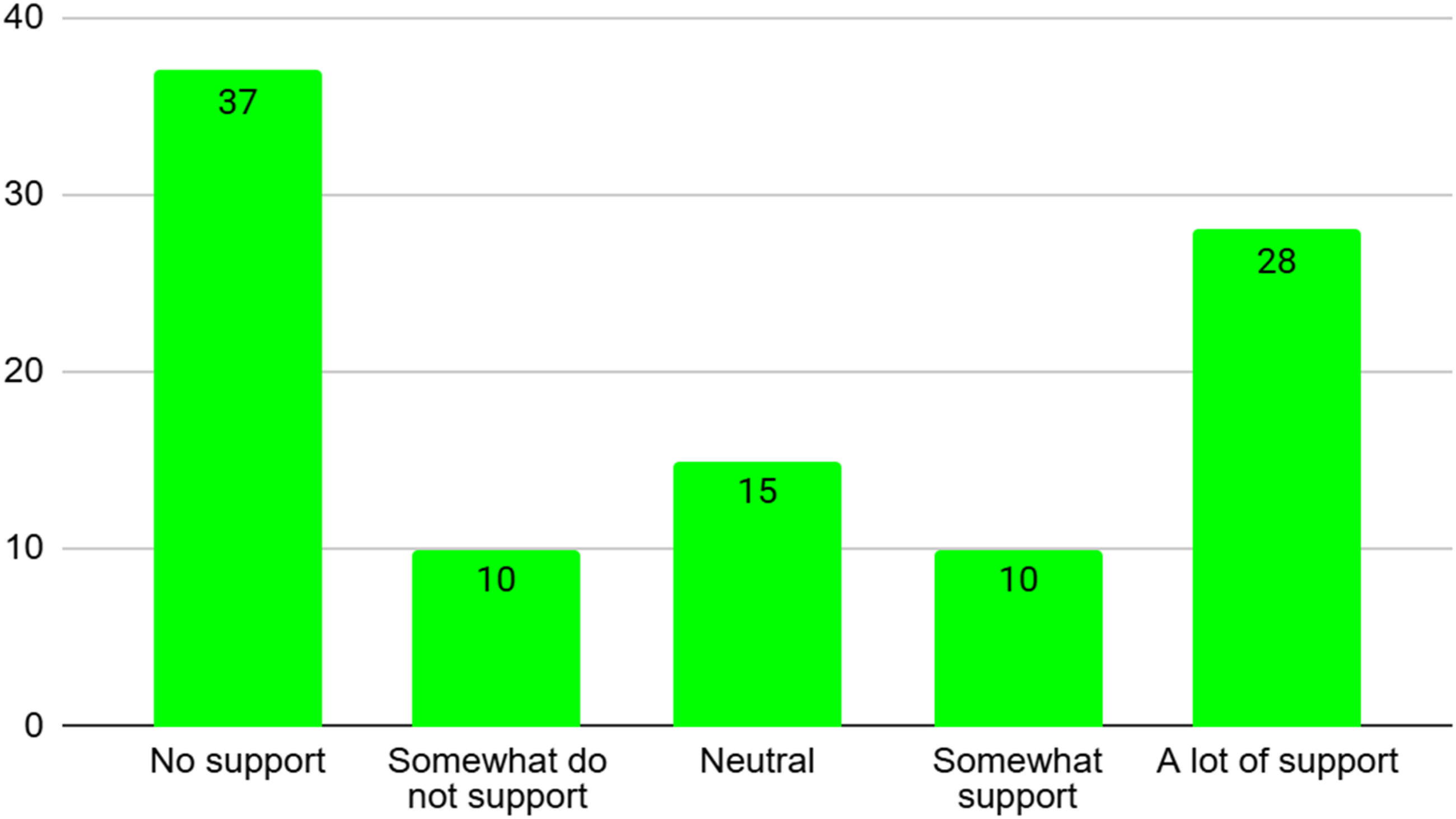
Support for the Citizens’ Revolution Movement. Source: Clima Social (2023).
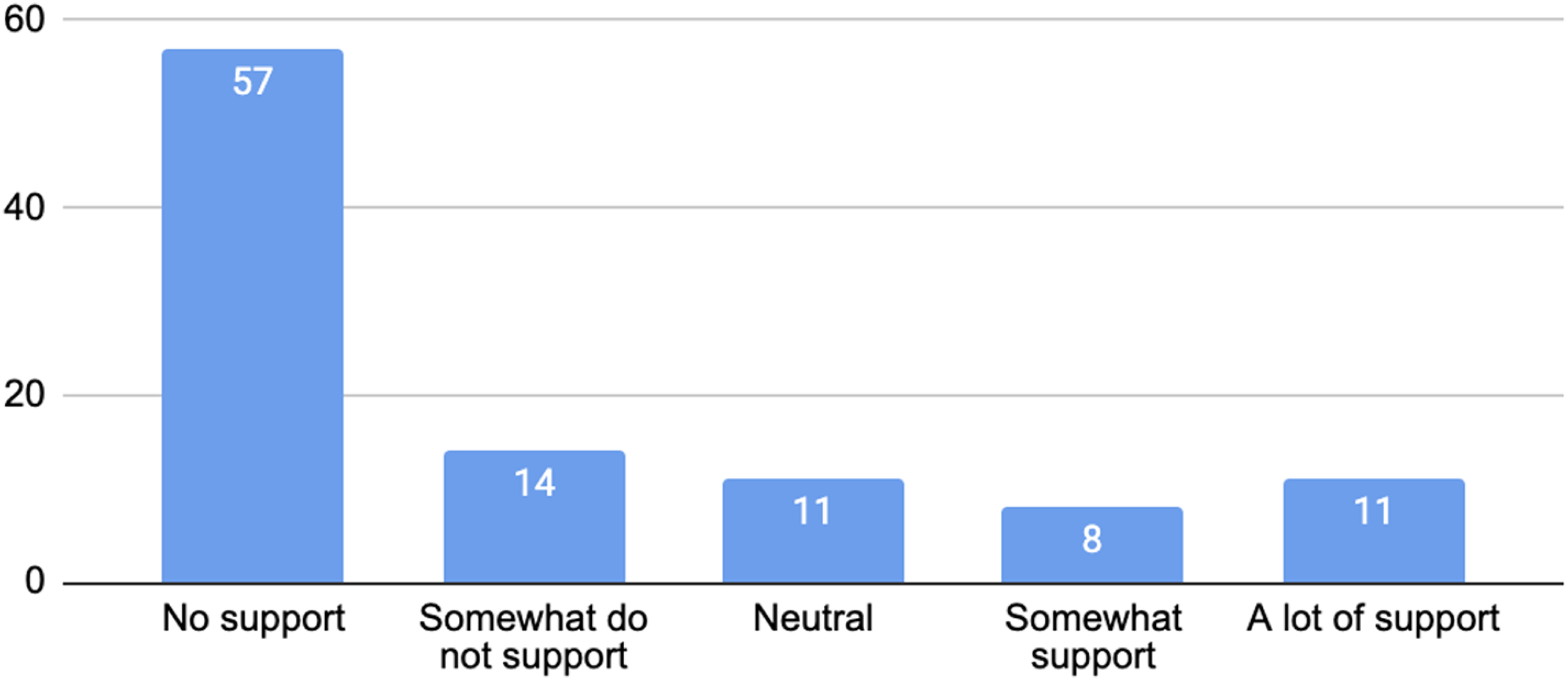
Vote Percentage for Lasso in the 2021 Runoff by Support for the Citizens’ Revolution. Source: Clima Social (2023).
Vote Percentage for Noboa in the 2023 Runoff by Support for the Citizens’ Revolution. Source: Clima Social (2023).
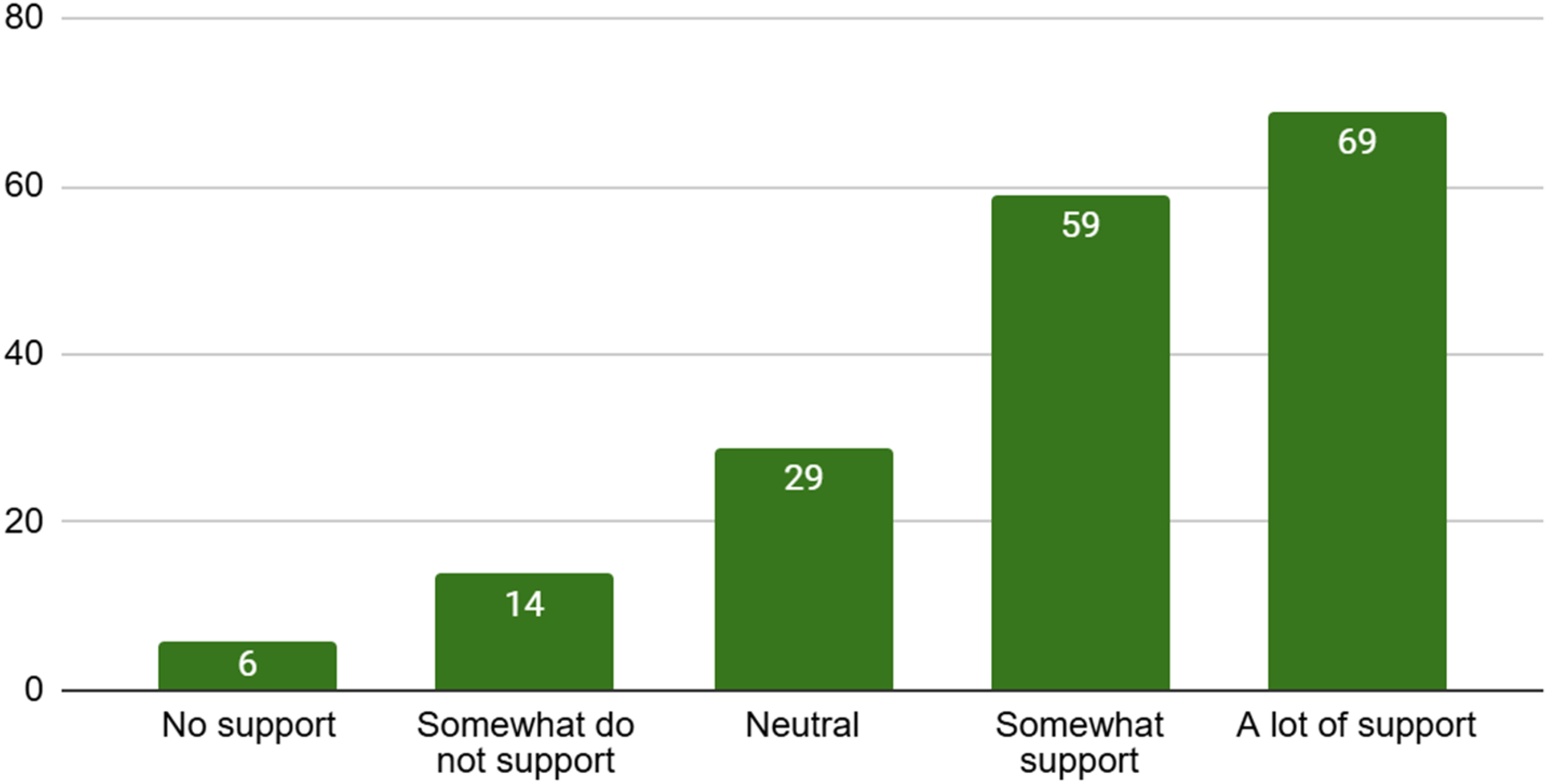
Vote Percentage for Arauz in the 2021 Runoff by Support for the Citizens’ Revolution. Source: Clima Social (2023).
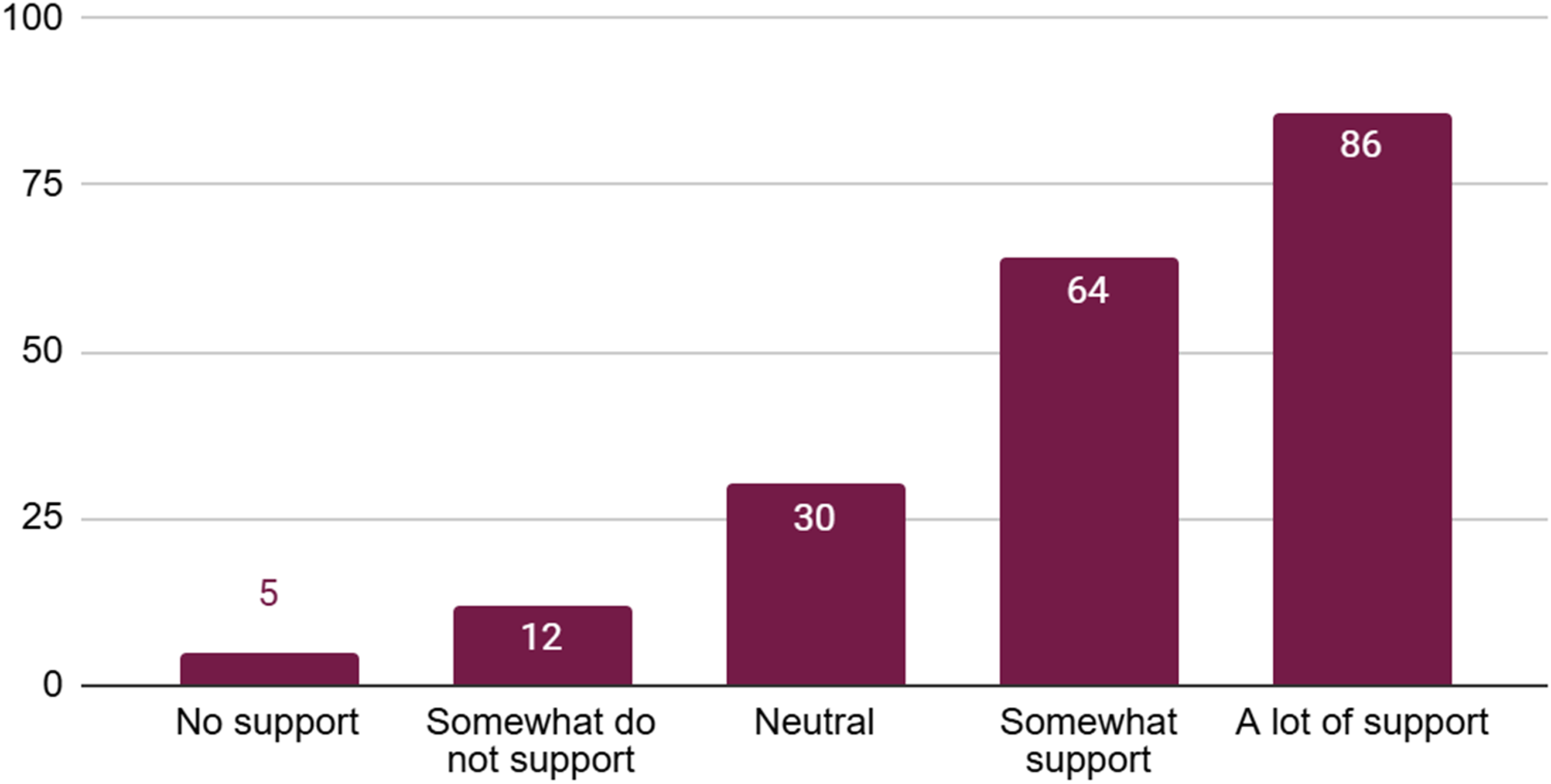
Vote Percentage for González in the 2023 Runoff by Support for the Citizens’ Revolution. Source: Clima Social (2023).
Analysing the results of the first-round vote in 2023, Noboa was not the only candidate who received a significant percentage of votes from anti-correísta voters. When we aggregate the percentage of “no support” and “somewhat do no support” categories, Topic, Sonnenholzner, Villavicencio (Zurita), and Hervas received between 66 to 93 percent of their first-round vote from people who did not support the Citizens’ Revolution (Figure 9). Between the two rounds, the vote transfer from these candidates to Noboa ranged from 61 to 77 percent (Figure 10), highlighting the importance of the anti-vote during runoff elections in polarised contexts. In the first and second rounds, the correísta and anti-correísta cleavage was a weaker predictor for supporting the indigenous candidate Pérez. While his voters displayed stronger anti-correísta than correísta attitudes (Figure 9) or broke in favour of Noboa (Figure 10), a higher percentage of his supporters chose either not to vote at all in the runoff or vote blank/null compared to the other candidates, illustrating the complexity of choosing between a neoliberal candidate and a proxy candidate associated with past repressive practices against the indigenous people.
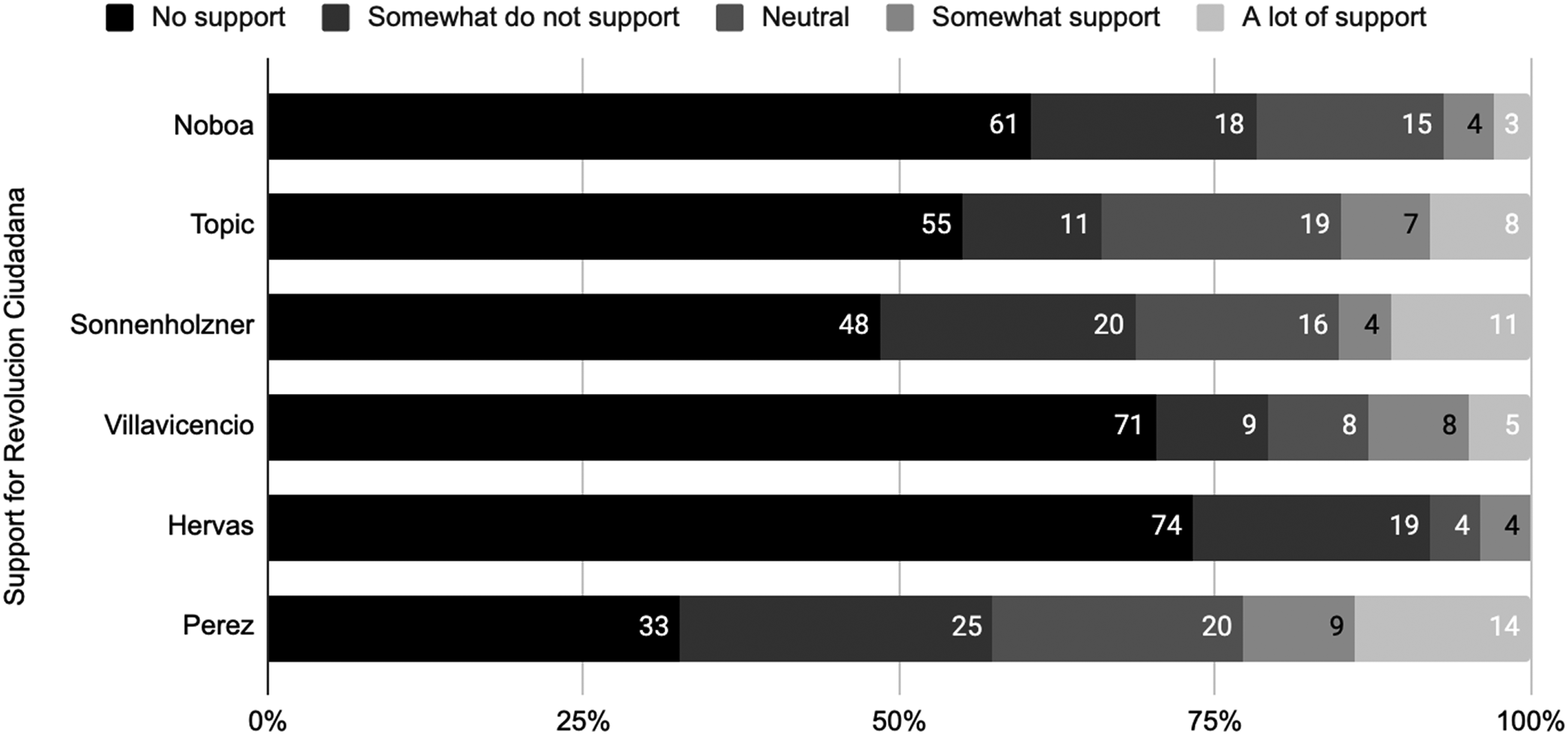
First-Round Vote Percentage in 2023 by Support for the Citizens’ Revolution. Source: Clima Social (2023).
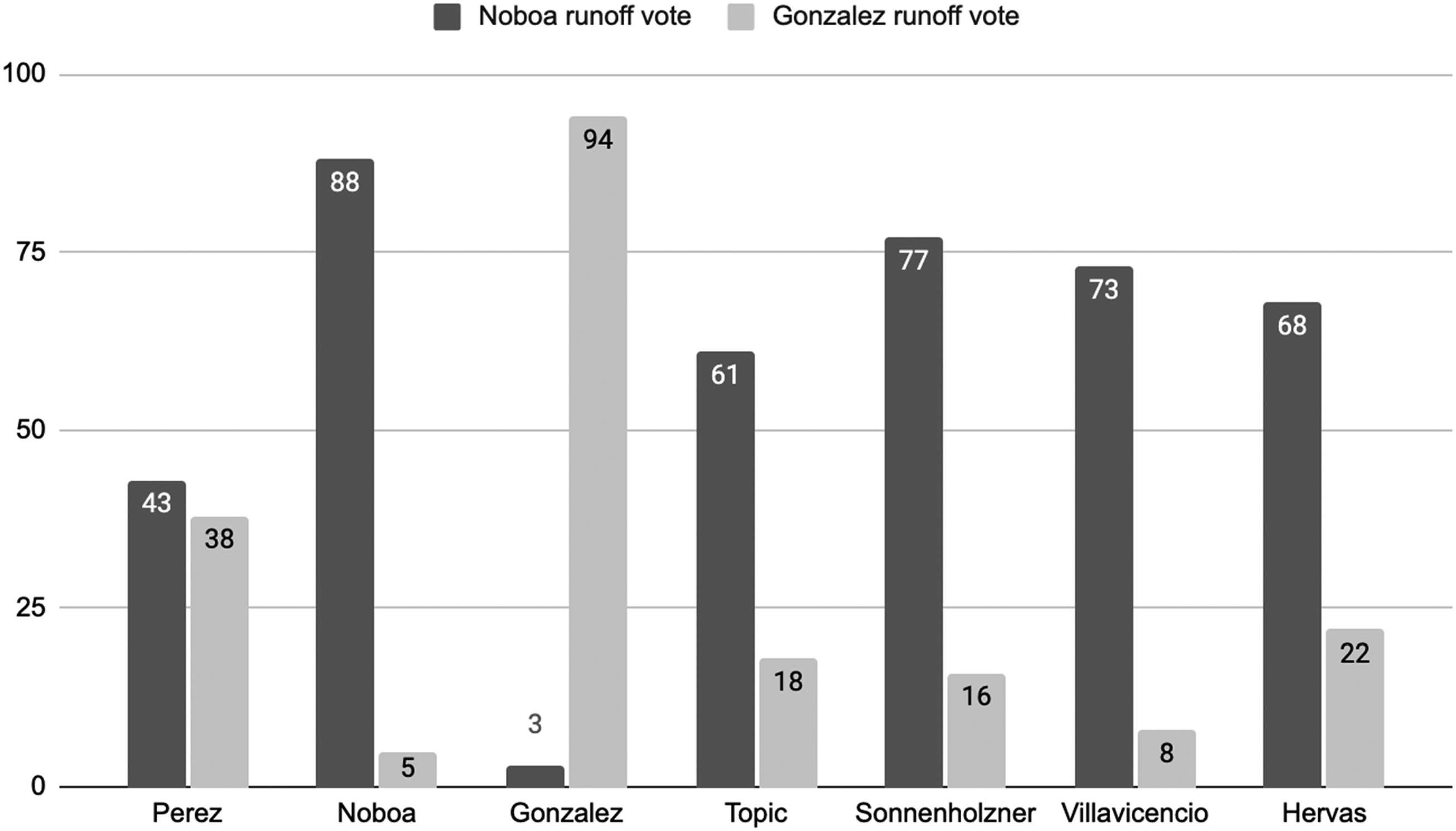
Vote Percentage Transfers to Noboa and González from the First to the Second Round. Source: Clima Social (2023).
Other survey data on the 2023 elections further support the relevance of polarisation and the negative or anti-vote. According to Comunicaliza's pre-election survey, on a five-point scale of correísmo (ranging from very correísta to very anti-correísta), the support for Noboa in the runoff positively correlated with individuals’ degree of anti-correísmo. Like the findings of the Clima Social survey, 89 percent of the people who identified as very anti-correísta expressed their intention to vote for Noboa. On the flip side, votes for González had a positive correlation with correísmo, and she had 84 percent support among the hardcore correístas (Figure 11). A CEDATOS (2023) survey that was conducted before the runoff elections, half of the respondents who disapproved of González mentioned her correísta identity as a detrimental factor affecting their vote choice (Figure 12). This is in line with our argument that González's close affinity with Correa was a blessing for her to cultivate support in the first round but a curse in the runoff.
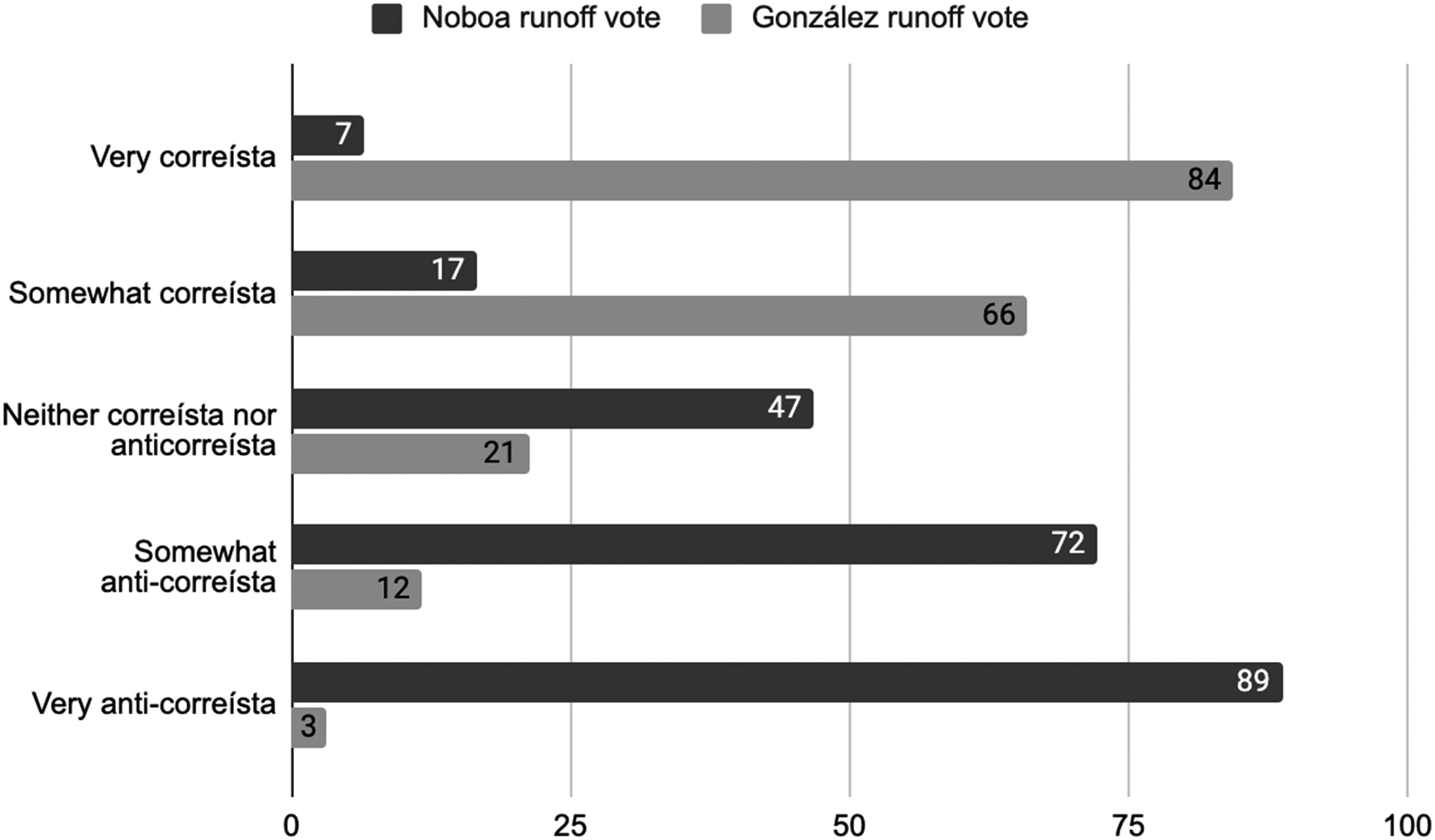
Noboa and González Vote Percentage by Level of Correísmo. Source: Marchante (2023b).
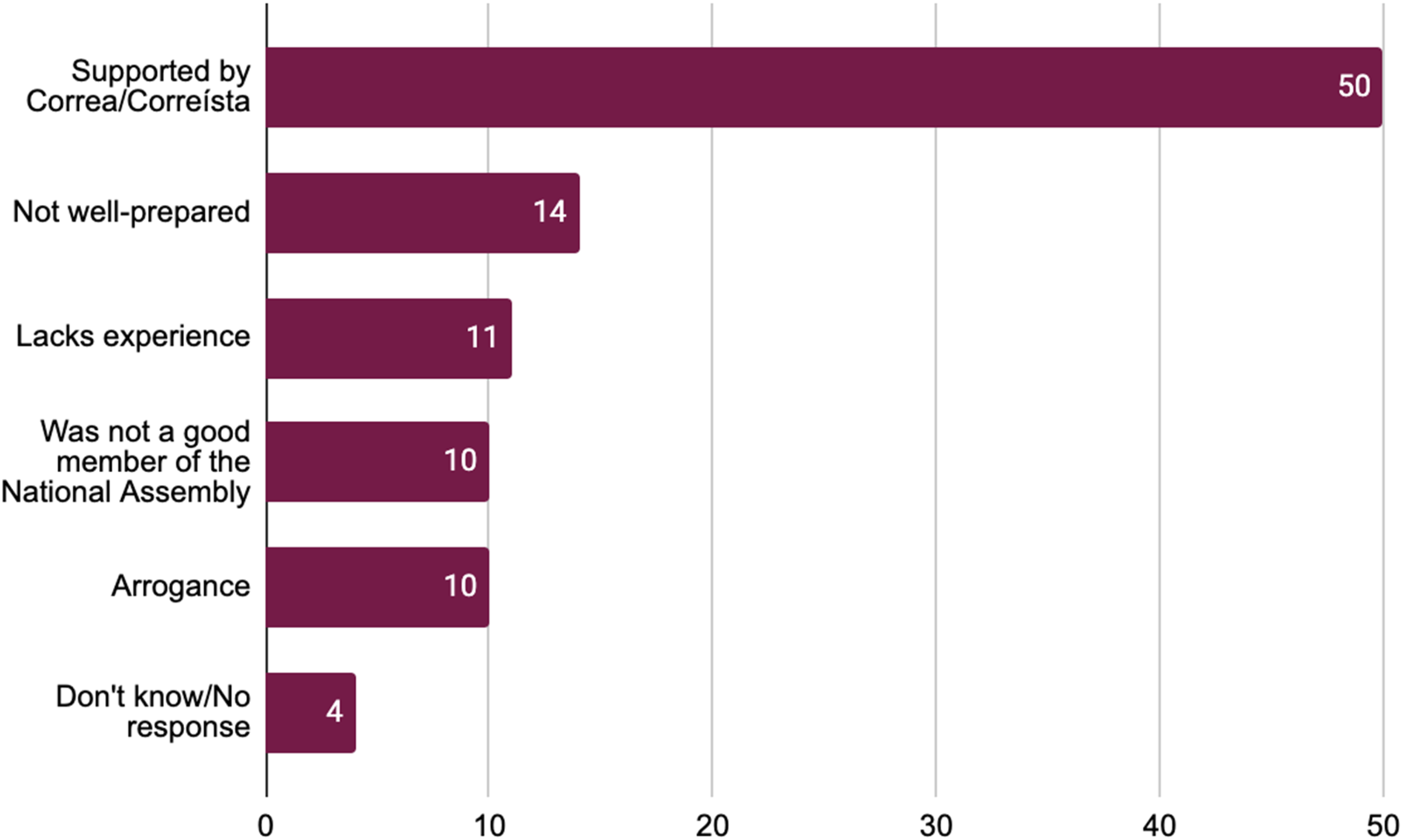
Reasons for Disapproving González. Source: CEDATOS (2023).
Conclusion
In this article, we have analysed how Rafael Correa's polarising legacy continued to shape the dynamics of Ecuadorian politics after he formally relinquished power. By tracing the key political developments during the presidencies of Moreno and Lasso, we have shown how the dual presence of polarisation and fragmentation continuously shaped electoral outcomes. In the first round of the 2021 and 2023 presidential elections, Correa's proxy candidates (Arauz and González) benefited from polarisation and their movement's internal cohesion, leading numerous anti-correísta candidates by a sizable margin. However, in both presidential runoffs, the second-place candidates (Lasso and Noboa) successfully consolidated support among the anti-correísta elites and citizens, becoming president. While the election of Lasso and Noboa through consecutive runoff reversals could be interpreted as a nationwide rejection of Correa's movement, the results of the parliamentary and local elections suggest a more complicated balance of power. In the absence of runoff elections, because of the ex-president's continued appeal among his followers and the chronic fragmentation of his opponents, the populist movement won a sizable plurality of seats in the National Assembly and key elections at the sub-national level.
As we indicated in the introduction, our findings on Ecuador have implications for studying populism, polarisation, opposition and autocratisation in Latin America. Correa's polarising populist legacy in Ecuadorian politics resembles José María Velasco Ibarra and Juan Domingo Perón's ability to leverage their charismatic influence from exile. In addition to his historical counterparts, affective leader polarisation in the post-Correa period is akin to Cristina Fernández de Kirchner and Álvaro Uribe whose personalistic legacies continued to polarise Argentina and Colombia after they were out of office. Another comparison to Ecuador could be the polarising legacy of Alberto Fujimori. The sustained presence of the pro- and anti-Fujimori divide provided some degree of predictability to the highly fragmented nature of Peruvian politics. Underlining the dual function of runoff elections is also relevant when researching negative partisanship and resisting autocratisation. Polarisation is generally considered harmful to democratic norms and practices, nevertheless, runoff elections in polarised countries may mobilise the anti-leader opposition and encourage coalition-building for democratic resilience, at least in the short term.
Footnotes
Declaration of Conflicting Interests
The authors declared no potential conflicts of interest with respect to the research, authorship, and/or publication of this article.
Funding
The authors received no financial support for the research, authorship, and/or publication of this article.
