




Abstract
An ugly manifestation of polarization is partisan dehumanization, a form of moral disengagement from and support for aggressive or even violent treatment of one's opponents. Brazil offers a useful case to explore the relative importance of in-group sympathy or out-group antipathy as sources of dehumanization, since its voters are polarized between supporters and opponents of a single party, the Partido dos Trabalhadores (Workers’ Party, PT). Using survey-experimental data from a convenience sample, we show that partisan dehumanization can stem from either in- or out-group bias. Both PT partisans, known as petistas, and PT opponents, known as antipetistas, dehumanize their opponents. For petistas, in-group favoritism drives dehumanization of their opponents. However, since the only thing that unites all antipetistas is their dislike for the PT, out-group animosity is the critical factor driving their dehumanization of petistas. We also find that dehumanization is associated with the intensity of positive or negative partisanship and perceptions of social and moral distance between opponents. However, perceptions of out-group threat and Social Dominance Orientation do not enhance dehumanization. Our findings contribute to understanding the roots of partisan dehumanization and polarization in Latin America and beyond.
Introduction
Political polarization increasingly characterizes voter attitudes and behavior across Latin America (Handlin, 2018; Mayka and Smith, 2021; Sarsfield et al., 2024). This is particularly true in Brazil, where deep political animosities divide voters (Hunter and Power, 2019; Layton et al., 2021; Nunes and Traumann, 2023; Ortellado et al., 2022; Rennó, 2020; Samuels and Zucco, 2018). A particularly disturbing manifestation of political polarization is partisan dehumanization, defined as the act of classifying one's opponents as if they were less than fully human (Haslam and Stratemeyer, 2016).
As is true in many countries, dehumanizing rhetoric and images pervade Brazilian politics. For example, in 2005, Brazil's most prominent conservative newsmagazine portrayed supporters of the country's largest leftist party, the Partido dos Trabalhadores (Workers’ Party, PT), as donkeys. 1 The word for donkey in Portuguese is burro, which also translates as “stupid.” In 2016, the same magazine portrayed the PT's leader – Brazil's current and former president Lula – on its cover as a pit viper. 2
Characterizing ones’ political enemies as dull-witted and stubborn donkeys or sly and cunning snakes is relatively tame, but such imagery is just the tip of the proverbial dehumanization iceberg in Brazil (Prado, 2021). For example, former Brazilian president Jair Bolsonaro – who throughout his career has nonchalantly demeaned both friend and foe – once pointed to an Afro-Brazilian supporter's hair and joked that it was likely a “cockroach nest.” 3 In another incident, stereotyping Afro-Brazilians as obese, Bolsonaro commented that the lightest person in an Afro-Brazilian community he had just visited must have weighed “seven arrobas.” Using arroba – instead of saying the equivalent weight of about 100 kilos (220 lbs.) - is doubly dehumanizing, because arroba is used today only to weigh cattle, but was used in the past to weigh enslaved people. 4
Brazilian conservatives hold no monopoly on dehumanizing rhetoric. During Brazil's 2022 presidential campaign, activists on both sides disseminated cartoons and memes picturing the other side's nominee as an inhuman monster such as a zombie or a creature mired in a metaphorical swamp of corruption. Voters on both sides also commonly call each other burro, jumento (another word for donkey but also figuratively meaning “jackass”) or gado, the word for cattle that carries the same implication as the portmanteau “sheeple” in US politics, suggesting that one's opponents lack the capacity to think for themselves and mindlessly follow a misguided political herd. (For a useful overview of the dynamics of the 2018 and 2022 elections, see Almeida and Garrido, 2022).
Dehumanization deprives others of their humanity, making it easier to stereotype, denigrate, and rationalize mistreatment of those identified as “less than fully human.” Although scholars of US politics have begun to explore partisan dehumanization (Cassese, 2021; Martherus et al., 2021), we know of no similar research in the study of Latin American political behavior. We suggest that partisan dehumanization should exhibit both similarities and differences from what scholars have observed in the USA. In terms of similarities, we expect partisanship to drive dehumanization in Brazil – and the intensity of partisan attachments to moderate the extent of dehumanization.
However, the distinctiveness of Brazilian politics offers some twists on the sources of partisan dehumanization. In contrast to the US two-party system, Brazil's party system is highly fragmented (Borges, 2021; Mainwaring et al., 2018) Even so, since the 1990s Brazilian voters have grown increasingly polarized between supporters and opponents of a single party – the Partido dos Trabalhadores (Workers’ Party, PT), which held the presidency between 2003 and 2016 and which returned to office in 2023 (Samuels and Zucco, 2018). PT supporters are known as petistas, while the party's opponents are known as antipetistas. Petistas express a positive partisan attachment in the traditional sense. By contrast, although all antipetistas dislike the PT, most do not consistently identify with any other party. That is, they are purely negative partisans (Mayer, 2017). This “asymmetric” polarization, between just one party's supporters and its opponents, offers an opportunity to explore the relative contribution of positive versus negative partisan affect to dehumanization and polarization.
Scholars of polarization in the USA have debated the relative importance of in-group favoritism or out-group animosity in shaping polarization (Abramowitz and Webster, 2016; Iyengar et al., 2019; Lelkes, 2021). Some regard negative affect as important, while others dismiss it as merely a function of in-group affect. In the US case it is difficult to disentangle the effects of positive and negative partisan attitudes because in- and out-group affect are highly correlated. That is, partisans of one party tend to dislike supporters of the other. Yet because most antipetistas do not identify with any party but only know which party they do not like (Samuels and Zucco, 2018), Brazil's “polarization with one party” highlights the potentially independent effect of purely negative partisan affect. Using evidence from a convenience-sample survey fielded in April 2023, we confirm that both petistas and antipetistas dehumanize their opponents, and that dehumanization is associated with the strength of positive (for petistas) and/or negative (for antipetistas) partisan attitudes.
As in the USA, we also find that dehumanization in Brazil is associated with a preference for out-group social and moral distance. Although Brazilians are not literally geographically “sorted” like American partisans (in the sense that municipal population density is not highly correlated with partisanship), they nonetheless perceive and desire greater figurative distance from their political opponents. However, confounding theoretical expectations, experimental evidence presented below suggests that manipulating the level of perceived out-group political threat does not enhance partisan dehumanization in Brazil. We suspect (but cannot prove) that this result derives from a ceiling effect. That is, existing levels of polarization may already be so high that triggering threat perceptions does not further enhance dehumanization. We also find that Social Dominance Orientation (SDO) (the degree to which voters prefer group-based hierarchies) is unrelated to dehumanization, because it is highly correlated with partisanship to begin with. That is, as observers of Brazil might expect, antipetistas and petistas differ widely on average levels of SDO, which weakens the relationship potential between SDO and dehumanization within each partisan group.
Finally, our findings highlight how partisanship undermines voters’ consciously professed ethical and policy commitments. Observers of politics (whether in Brazil or elsewhere) have good reason to expect right-wing populist leaders and parties will deploy dehumanizing rhetoric (on Brazil, see e.g., Lacerda, 2019; Lynch and Cassimiro, 2022; Porto, 2023). Preference for group inequalities is often part of right-wing populist appeals. Given this, we expect those who sympathize with such leaders or parties to dehumanize their opponents. However, given scholarly placement of Lula and the PT on the moderate left, whether in terms of populist rhetoric (Hawkins, 2009) or public policies (Huber and Stephens, 2012; Levitsky and Roberts, 2011; Weyland et al., 2010), observers may have weaker expectations about the degree to which PT leaders would use dehumanizing rhetoric, and thus weaker expectations that petistas would also dehumanize their opponents. After all, leftists typically advocate for social, political, and economic equality. Even so, research on dehumanization in the USA has found that Democrats dehumanize Republicans almost as much as vice versa (Cassese, 2021; Martherus et al., 2021), and we also find that petistas and antipetistas dehumanize each other to similar degrees. Thus, despite the PT's history as a grassroots left-wing party and despite petistas’ ostensible support for egalitarianism in all forms, the psychology of partisanship pushes petistas to dehumanize antipetistas almost as much as their opponents dehumanize them.
The rest of this paper is organized as follows. Using extant research as a starting point, the next section considers potential sources of partisan dehumanization given Brazil's context. Section three presents our study design, connecting our theoretical propositions to our dependent and independent variables. Section four describes our data and methods, Section five presents results, and the final section offers concluding thoughts and implications of our findings for the comparative study of partisan dehumanization and polarization.
Sources of Dehumanization in Brazil
Existing work suggests that dehumanization is rooted in partisanship, perceptions of moral and social distance, perception of political threat, and authoritarian worldview (Cassese, 2021; Martherus et al., 2021). We consider these hypotheses in turn, taking Brazil's context into account. In the subsequent section, we operationalize the hypotheses articulated in this section.
Partisanship
Partisanship is a form of social identity that shapes political attitudes and behavior (Greene, 1999; Huddy and Bankert, 2017). As noted, Brazilian voters have grown increasingly polarized in recent decades for or against the PT. Affective polarization is typically accompanied by ingroup favoritism and out-group bias, and Brazil is no exception – its growing political divide has been accompanied by frequent use of dehumanizing rhetoric and images. To understand patterns of partisan dehumanization in Brazil, let us first describe the “asymmetric” nature of polarization in its party system.
When scholars of US politics speak of polarization, they mean “animosity between Democrats and Republicans.” Yet polarization in Brazil means “animosity between petistas and antipetistas.” The PT is a leftist party founded in 1980 that seeks to reduce Brazil's overlapping economic, racial and cultural inequalities (Keck, 1992; Meneguello, 1989). It gradually became the largest party in Brazil's legislature, won four presidential elections in a row starting in 2002, and returned to power after a close election in 2022. No other Brazilian party has matched its growth, especially in terms of partisanship. By the mid-1990s the PT claimed the largest swath of supporters in the electorate, a position it has never relinquished (Barros, 2022). The percentage of Brazilians who identify with the PT peaked at 31% in 2012 (Samuels and Zucco, 2018); in a representative national survey one of us fielded in July 2022 (when the PT was out of office), 24% of Brazilians identified as petistas, while about 30 other parties split the remaining 14% of the population who affirmed a partisan attachment to a different party (IBPAD, 2022).
Although no party emerged to compete against the PT for voters’ hearts and minds, the PT's growth sparked a backlash against its principles and policies. As the number of petistas in the electorate grew, so did the number of antipetistas. Historically, over two-thirds of Brazilian voters who express antipathy for a party have said they disliked the PT (Samuels and Zucco, 2018: 27–28). Today that proportion is even larger: in that same July 2022 survey cited above, 29% of Brazilian voters identified as antipetistas, but only 2% of respondents chose other parties they disliked.
Petistas are partisans in the conventional sense: they express a psychological attachment over time to the PT, its candidates, and its principles. In contrast, as the name Brazilians have given to these voters suggests, the only thing that unites antipetistas is their antipathy towards the PT and its candidates and principles. Antipetistas do differ from petistas about various policies (Samuels et al., 2023), and tend to identify as political “conservatives.” However, ideological labels are a weak basis for in-group identity in Brazil, mainly because on surveys, a large proportion of participants do not respond to a standard “left-right placement” question - because they do not understand what the ends of the scale signify (Ames and Smith, 2010; Kearney and Machado, 2018). Given this, identifying voters as either supporters or opponents of the PT is a more useful heuristic for understanding the dynamics of Brazilian voter behavior than probing voters about the meaning of their ideological preferences.
In addition, ascriptive identities do not neatly divide petistas from antipetistas. In the USA, for example, 85% of African-Americans identify with the Democratic Party. Yet despite media coverage that connects evangelical Christianity to conservative voting in Brazil, the proportion of evangelicals (a religiously diverse group) who identify as an antipetista is only 46%, which means that over half of evangelicals are either indifferent to the PT (30%) or actually identify as a petista (20%). In terms of other potential demographic divides, again we see tendencies but not hard and fast divides. For example, there is no strong racial divide: 32% of whites (about 45% of the electorate) are antipetistas, while 28% of non-whites (about 55% of the electorate) are antipetistas. Meanwhile, 22% of whites are petistas, against 23% of non-whites. (Nearly half of both groups are non-partisans.) Likewise, there is no clear class divide: 31% of people in the top income group identify as petistas, against 27% who are antipetistas. (All data cited in this paragraph come from the 2022 IBPAD survey cited above.)
In short, antipetistas are negative partisans – they profess no positive partisan attachment. Their political sense of self is primarily defined by what they are not (a petista) rather than by shared positive affinity for a different party. This sort of polarization – between supporters and opponents of one party – offers insight into debates about the sources of partisan dehumanization and polarization. Scholars who leverage Social Identity Theory (SIT) to understand voter behavior typically assume that divisions between supporters of different parties generate psychological incentives for both in-group favoritism and out-group prejudice (Brewer, 1991; Hogg, 2005; Tajfel et al., 2004). Some scholars even assume that the formation of in-group sympathy is causally prior to – and thus a necessary condition for – the emergence of out-group antipathy (Brewer, 2007; Leonardelli et al., 2010; Tajfel, 2010; Turner et al., 1987; Zaller, 1992). If this is true, then out-group bias is merely a function of shared in-group attachments. Using this logic, Lelkes (2021) has even questioned the utility of the concept of negative partisanship.
Given petistas’ preference for the PT and their desire to distinguish themselves and fellow copartisans from those who oppose them, then despite their self-professed egalitarianism, petistas should dehumanize antipetistas. Likewise, because research also suggests that intergroup biases are strongest among those who posses the most intense attachments to their own group (Huddy et al., 2015; Iyengar and Westwood, 2015; Mason, 2015), we also expect stronger petistas to dehumanize antipetistas to a greater degree.
Yet what drives antipetistas’ dehumanization of petistas? Observers of Brazil would certainly predict antipetistas to dehumanize petistas. Confirming this intuition provides an opportunity to highlight the role of negative affect on partisan dehumanization. Although as mentioned above some scholars downplay the importance of negative affect, others draw attention to its importance (Abramowitz and Webster, 2016; Druckman et al., 2019; Klar et al., 2018; Mason, 2015). Some even suggest that out-group antipathy is more important than in-group sympathy (Goren et al., 2009; Nicholson, 2012; Soroka et al., 2015) as a source of polarization.
Zhong et al. (2008) provide a social-psychological explanation for the potentially independent effect of negative partisanship: Positive and negative social identities meet different psychological needs, and can emerge independently of each other and for different reasons. Positive partisanship, for example, can better meet individuals’ need for inclusion, by highlighting intragroup similarities. Negative partisanship, by contrast, can better meet individuals’ need for distinctiveness, by contrasting and differentiating the self from members of outgroups. For antipetistas, the desire to distinguish themselves from petistas derives from shared negative sentiments against the out-group relatively more than from shared positive feelings about an in-group. After all, as their name highlights, the concept of an in-group is unclear for antipetistas – particularly relative to the fact that the status of the despised outgroup is crystal clear. Given this, antipetistas satisfy their psychological need for distinctiveness by focusing on the party they oppose. And when an outgroup is the focus of attention, negational attitudes can lead to out-group derogation – to dehumanization. This need to distinguish themselves from petistas, rather than a need for inclusion, explains why antipetistas dehumanize petistas. As with petistas, we expect the intensity of opposition to the PT to mediate the degree of such antipathy.
Perceived Partisan Threat
The theory also suggests that dehumanization could be associated with heightened perceptions among partisans that the out-group represents an existential threat (Brewer, 1999; Esses et al., 2001). To the extent this is the case, triggering threat perceptions should enhance incentives for both petistas and antipetistas to denigrate their opponents.
Moral and Social Distance
Dehumanization signals reduced empathy for outsiders, and a willingness to accept their mistreatment (Ellemers and Van den Bos, 2012). This is because dehumanized groups are viewed as animalistic, irrational, less in control of their own actions, and thus more threatening. In turn, this suggests that dehumanization should be associated with a desire for social distance from a disliked out-group, as well as with a process of moral disengagement from and a sense of moral superiority over outsiders, both of which place others outside the boundaries of equal moral consideration. Meanwhile, classifying others (even strangers) as fully human encourages not just a sense of equality, but of empathy. As Cassese (2021, 33) writes, “A group's perceived humanity creates a moral obligation to extend a certain kind of conduct to the group,” while dehumanization “absolves one of this obligation.” We expect a correlation between a sense of social and moral distance and dehumanization.
Social Dominance Orientation
Political psychologists have considered multiple ways in which voters’ “worldviews” might shape partisanship – and thus drive dehumanization. To keep our survey tractable, we chose one such measure – Social Dominance Orientation (SDO), defined as the degree to which voters prefer group-based hierarchies and/or (in)equalities. In social psychology, attributes such as SDO emerge from underlying (i.e., pre-partisan) personality predispositions, and subsequently predict political attitudes. High levels of SDO are associated with conservative political values, and in the USA are correlated with Republican party preference (Pratto et al., 1994). Given this, we hypothesize that SDO (like authoritarian values more generally) should be associated with antipetismo.
However, if this is true, our prediction about the relationship between SDO and dehumanization grows weaker. On the one hand, since we expect antipetistas to dehumanize petistas and we expect people with high levels of SDO to dehumanize in general, we should also observe a relationship between SDO and dehumanization among antipetistas. Yet on the other hand, because (high) SDO may predict antipetismo, it may fail to have any additional effect among that group.
For petistas, we are faced with a similar issue. If SDO is correlated with partisanship, we expect petistas to exhibit lower levels of it. After all, PT ideology has always prioritized egalitarianism. However, just as with antipetistas, if a connection already exists between (low) SDO and petismo, then variation on SDO may be curtailed among petistas simply because people with high levels of SDO are unlikely to become petistas in the first place. As with antipetistas, the correlation between SDO and partisanship may attenuate any positive relationship between SDO and dehumanization among petistas.
In short, we expect partisanship, the intensity of partisanship, threat perceptions, and perceptions of/desire for moral and social distance to be correlated with dehumanization. However, we have weaker theoretical expectations about the impact of Social Dominance Orientation. In the next section we describe how we measure each of these variables.
Study Design
In this section, we describe how we measure our dependent and independent variables. The text of all questions can be found in the paper's Appendix.
Dependent Variable: Dehumanization
Following Cassese (2021) and Martherus et al. (2021), we use the measure of “blatant dehumanization” proposed by Kteily et al. (2015) as our dependent variable. This measure uses the (in)famous “Ascent of Man” image (Figure 1), which illustrates supposed evolutionary stages ranging from subhuman to fully human.

Ascent of Man Scale. Source: Kteily et al. (2015).
This approach asks participants to directly rate themselves and others as fully or less than fully human. To do so, we presented Figure 1 to participants with the following text, from Kteily et al. (2015): “People can vary in how human-like they seem. Some people seem highly evolved whereas others seem no different from lower animals. Using the image above, indicate using the sliders how evolved you consider the average member of each group to be.” We asked all participants to assess the following groups: petistas, antipetistas, and “Brazilians with no particular political views,” i.e., nonpartisans. Group order was randomized. Responses on the slider ranged from 0 (“least human”) to 100 (“most human”).
Independent Variables
Positive and/or Negative Partisanship
We hypothesize that the path to dehumanizing one's opponents begins with partisanship, and the Brazilian context suggests that dehumanization can flow from either positive and/or negative partisan attitudes. Petistas may develop in-group bias for “their own kind,” which - following Brewer (2001) - may be sufficient to generate incentives to denigrate antipetistas. For their part, although antipetistas lack a partisan in-group, dislike of a partisan outgroup fuels their political attitudes and engagement. To measure positive and negative partisanship, we begin with the same questions as Samuels and Zucco (2018: Ch.3). To identify petistas we asked, “Is there a party that represents how you think?” If the answer was yes, we followed up with a list of the seven largest parties. Petistas are those who answered yes and chose the PT. To identify antipetistas, we asked “Is there a party that you do not like?” If the answer was yes, we presented the same list of parties. Antipetistas are those who said yes and chose the PT as the party they did not like. 5
The Intensity of Partisanship
Once we have determined who is a petista and who is an antipetista, we can measure the intensity of partisanship. We do so in two ways. First, for participants who chose the PT as the party they liked or disliked, we then asked them about the strength of their attachment using a battery of questions derived from Huddy et al. (2015, 7) and Ahler and Sood (2018: 972). Likewise, if participants chose the PT as the party they disliked, they were then asked about the intensity of their animosity. Since choosing a party to identify with is a necessary prerequisite for measuring the relative intensity of such attachments, we did not ask these questions of respondents who did not choose the PT as the party they liked or disliked.
Do you consider yourself a petista [antipetista]? (A lot, yes, a little, no) Do people close to you describe you as a petista [antipetista]? (Always, frequently, rarely, never) When talking about the PT or petistas [antipetistas], how often do you use “we” instead of “they?” (All of the time, most, some, rarely, never)
Since all questions offered were on a 4-point Likert scale, we combined answers to form a single scale of partisan attitude strength (α = 0.75[0.66,0.82] for petistas, and α = 0.63[0.56,0.69] for antipetistas). Given our hypotheses above, we expect dehumanization to be correlated not only with positive and/or negative partisan attitudes but also with the strength of those attitudes: “strong” petistas should dehumanize antipetistas more than “weak” petistas, and vice versa.
“Lulistas” and “Bolsonaristas” - Embryonic Partisans
As suggested, we cannot ask people if they are “strong” or “weak” petistas or antipetistas if they did not choose the PT as the party they like or dislike to begin with. However, in contemporary Brazil we should consider a second measure of the intensity of partisanship, among so-called lulistas and bolsonaristas. Lulistas are voters who support Lula, but who do not identify as a petista (or supporter of any other party) when asked. Likewise, bolsonaristas are voters who support former president Jair Bolsonaro, but who do not choose the PT (or any other party) as a party they specifically dislike.
Petismo and lulismo overlap to some degree, but are distinct phenomena among Brazilian voters (Samuels and Zucco, 2014). Historically, Lula has been far more popular than the PT, receiving about twice as many votes as there are self-proclaimed petistas in the electorate. Thus while nearly all petistas typically vote for Lula, only about half of Lula voters typically say they are also petistas. Petismo and lulismo only partly overlap because Lula and the PT have historically derived support from somewhat distinct socioeconomic groups. Lula voters are on average poorer, less educated, more likely to be nonwhite, and less engaged in politics than petistas, who are more likely to have worked in the formal sector of the economy and more typically came from the organized and activist middle classes.
In addition, lulismo is rooted in voters’ attachment to Lula's personal qualities rather than a psychological attachment to the PT as a party. Crucially, the PT is not a “personalist” party. It is Brazil's best-organized party, has a far clearer programmatic profile than any of its rivals, and is deeply rooted in organized civil society. Petismo is a specifically partisan attachment, about voters’ affective attachments to the organization and its political project, not just to Lula as a charismatic leader. Given this, Samuels and Zucco (2014: 18) concluded that lulismo is an “embryonic” form of petismo. This suggests that while lulistas may dehumanize antipetistas, their animosity should echo what we see from relatively “weak” actual petistas.
The distinction between antipetismo and bolsonarismo is similar. Antipetismo predates Bolsonaro's rise by decades - it has existed since the PT first emerged in the 1980s and has grown in tandem with the party, in a symbiotic relationship. And just like Lula and petistas, Bolsonaro received far more votes than there are antipetistas in the electorate. Thus while nearly all antipetistas voted for Bolsonaro, only about half of Bolsonaro voters actually said they dislike the PT (Samuels and Zucco, 2018). That is, just like many lulistas lack a strong attachment to the PT, many bolsonaristas are attracted to their leader's personal qualities but do not particularly disdain the PT. Meanwhile, antipetistas dislike not just Lula, but Lula's party, its project, and its influence in Brazilian society. This suggests that just like lulismo is a weak form of petismo, bolsonarismo may constitute an embryonic form of antipetismo. In turn, this generates the same expectation for bolsonaristas as for lulistas, but in reverse: they should dehumanize petistas about the same as “weak” antipetistas.
Lulistas and bolsonaristas are like partisan “leaners” in the US electorate (Greene, 1999) – voters who have an affinity for either Democrats or Republicans, but who do not acknowledge a partisan identity when asked. In terms of incentive to dehumanize the other side, we expect such Brazilian “leaners” to behave like weak partisans.
We define lulistas as survey participants who voted for Lula in the first round of the 2022 election but did not identify as a petista. Likewise, bolsonaristas voted for Bolsonaro but do not identify as an antipetista. We include both lulistas and bolsonaristas as separate categories of voters (in addition to petistas and antipetistas) in the analysis that follows. This means that nonpartisans are those who neither like nor dislike any party and who did not vote for either Lula nor Bolsonaro in the first round of the 2022 presidential election. Since they exhibit no opinion at all for or against the PT, we expect nonpartisans to not dehumanize either petistas or antipetistas.
Perceived Partisan Threat
To test the hypothesis that out-group partisan threat should shape dehumanization, we experimentally manipulated the intensity of threat perceptions. Participants were randomly assigned one of two conditions: a control in which no threat was shown or a treatment that sought to heighten perceptions of out-group political threat. Petistas and lulistas were randomly assigned to the control or to the scenario in which Bolsonaro was the threat, while antipetistas and bolsonaristas were randomly assigned to the control condition or a scenario in which Lula and the PT were the threat. Nonpartisans were randomly assigned to one of these three potential conditions.
The text of the petista treatment was as follow:
Some people say that with Lula in the presidency again, the chances that he will undermine democracy, ignoring institutions such as Congress and the judiciary, are very real. These arguments suggest that Lula has told people close to him of his plans to maintain the PT in power indefinitely, and transform Brazil into another Venezuela. Some people say that if Bolsonaro decides to run again for president in 2026, the chances that he will undertake a coup and govern alone - with support of the military - would be even higher than in his first term. These arguments suggest that it's likely Bolsonaro would rip up the constitution and try to remain in power indefinitely, transforming Brazil into a dictatorship.
Meanwhile, the text of the antipetista treatment was as follows:
Research suggests that the threat treatment should cause partisans on both sides to dehumanize their opponents more than those not shown the threat treatment. Meanwhile, the treatment should not change the degree to which non-partisans dehumanize either petistas or antipetistas.
Perceived Partisan Social Distance
Our fourth hypothesis suggests that the more distance individuals perceive or desire between themselves and out-group members, the more they are likely to dehumanize the “other.” We asked participants how much social distance they prefer between themselves and an out-group. We derived this approach from Iyengar et al. (2012), and asked participants “How happy or unhappy would each of the following situations make you?”
A family member marrying a petista [antipetista]. Being assigned to work closely with someone who supports the PT [opposes the PT] and who enjoys discussing politics at work. A neighbor putting a “Lula for President” [“Bolsonaro for President”] sign in their window. Lula [Bolsonaro] receiving an award from a foreign organization for their work.
Responses to each question were measured on a 5-point Likert scale ranging from very happy to very unhappy. Answers were combined to form a single scale and coded such that higher scores correspond to a preference for greater social distance from the opposing group (α = 0.85[0.82,0.87] for petistas, and α = 0.75[0.69,0.8] for antipetistas). We expect to observe a correlation between desired social distance and dehumanization.
Perceived Partisan Moral Distance
We also explore the extent to which perceived moral distance between members of different groups is associated with dehumanization. Haidt (2012) inspired this approach, which was applied in Pacilli et al. (2016) and Cassese (2021). We asked respondents “how different” they thought petistas and antipetistas were on six traits: empathy for others, equality and/or equity, solidarity, respect for authority/traditions, impulsiveness, and self-sufficiency. Responses ranged on a 3-point Likert scale from “do not differ” to “differ a lot” and were combined to form a single scale (α = 0.87[0.85,0.89]). We expect to observe a correlation between perceived moral distance and dehumanization of out-groups.
Social Dominance Orientation
Our final hypothesis explores the relationship between dehumanization and Social Dominance Orientation (SDO), a set of attitudes that assess preferences for social hierarchy versus equality. To assess SDO we used the standard eight-item Scale from Pratto et al. (1994). Participants rated their agreement with each item on a 5-point Likert scale, ranging from 1 (strongly disagree) to 5 (strongly agree). Higher scores correspond to a preference for social dominance (α = 0.64[0.61,0.67]).
In addition to these measures, our survey included standard batteries of socio-demographic controls, which are included in the multivariate analyses (see appendix for more information).
Summary of Hypotheses
Partisan dehumanization can be rooted in-group favoritism – but it could also derive from out-group animosity. In Brazil, two parties do not face off against each other. This dynamic provides a useful real-world context to explore the extent to which positive and/or negative partisan attitudes –or both – can drive dehumanization.
Being a (positive) partisan implies that one believes that a contest exists between your group and its opponents, whoever they are. This suggests that positive partisanship should be sufficient to generate both in-group favoritism and out-group disdain. The intensity of partisanship should mediate this relationship, with stronger positive partisans dehumanizing opponents more. Similarly, for negative partisans, dehumanization should also be associated with both dislike for a particular party partisanship itself and the intensity of animosity towards the out-group. Experimentally triggering perception of partisan threat – on top of already-existing partisan attitudes – should also increase dehumanization, as should perception of or a desire for greater social and moral distance from one's opponents. Finally, theory suggests that Social Dominance Orientation should be associated with dehumanization.
Data and Methods
We tested our hypotheses, one of which relies on random manipulation, using data from an original online Qualtrics survey using a convenience sample fielded in Brazil in April 2023. Participants were recruited via advertisements on Facebook and Instagram. After removing outliers who took too much or too little time to complete the survey (outside two standard deviations of the average) as well as those who failed to finish, we obtained 1108 participants.
Our sample over-represented women (58%) and whites (49%, as compared to 43% in the population (IBGE, 2019)), and thus slightly under-represented non-whites (49%, against 56% in the population). The sample also over-represented antipetistas: 37% of participants expressed antipathy towards the PT (as compared against 29% in a national survey taken several months prior (IBPAD, 2022), while 18% expressed an affinity for the PT (versus 24% nationally in that same survey).
In particular, our survey attracted somewhat older (average age was 50) and higher socioeconomic status (SES) participants than average, who tend to be relatively more interested in politics. 6 On the one hand this sort of bias can be useful, since we are interested in the effect of partisanship, and historically both petistas and antipetistas tend to have higher SES and/or exhibit higher interest in politics than non-partisans. In any case, we recognize that as with other recent studies of partisan dehumanization that use a convenience sample (Cassese, 2021), our findings provide suggestive rather than conclusive evidence.
Results
Hypothesis 1: Do Partisans Dehumanize?
Our first hypothesis considers whether positive and/or negative partisans dehumanize their opponents. Do petistas and antipetistas rate their own group as significantly “more human” than their opponents, while nonpartisans rate neither group as significantly more or less human than they rate themselves? We also include lulistas and bolsonaristas here, as a first cut at exploring our hypothesis about the impact of partisan intensity.
To evaluate our hypothesis, we plot OLS coefficients for our dehumanization measure by group and sample. To facilitate comparisons, the dependent variable is standardized to a scale that ranges from −1 to 1, and we include 95% confidence intervals to provide a sense of whether differences in dehumanization across groups are statistically significant. A red dashed line is provided at zero, the midpoint of each scale. If participants see their own group as more human than their opponents, mean in-group ratings should fall below zero (suggesting less dehumanization), while mean out-group ratings should fall above zero (suggesting greater dehumanization). (For complete results, including controls, see the Appendix.).
Figure 2 shows mean values. The groups listed across the bottom are those rating the other groups. The dots refer to which group was “targeted” by the group doing the evaluating: the darkest dots refer to petistas, the light grey to antipetistas, and the dark grey to nonpartisans. Results follow expectations: petistas and antipetistas always rate their opponents as significantly less human (higher on the scale) than themselves. For petistas, the difference between in- and out-group ratings is .75, while for antipetistas the gap equals one full point. Results for lulistas and bolsonaristas also follow expectations. Both groups rate their opponents as less human than themselves, but to a lesser degree than petistas and antipetistas. For lulistas, the difference between petistas and antipetistas ratings is .62, while for bolsonaristas the gap is .68. Finally, as expected all groups rate nonpartisans in between their group and their opponents (i.e., as neither particularly human nor less than human), and nonpartisans also do not dehumanize either petistas or antipetistas relative to themselves.
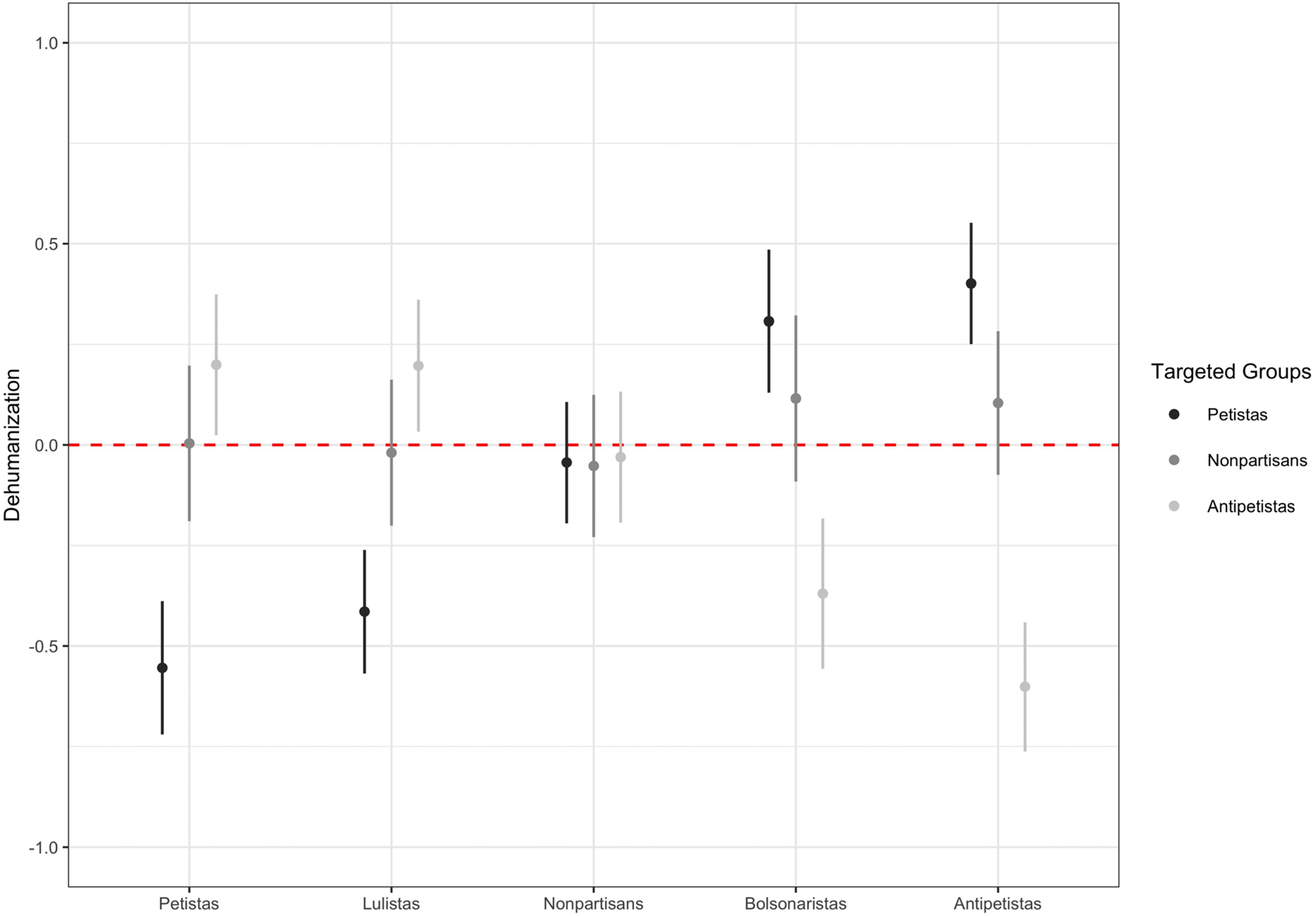
Dehumanization Measures. Source: Authors’ calculation.
The results in Figure 2 support our first hypothesis that Brazilians on both sides of the political spectrum who either like or dislike the PT dehumanize their opponents. Both partisans and “embryonic” partisans – lulistas and bolsonaristas – dehumanize, but dehumanization is somewhat more pronounced among those voters who explicitly like or dislike the PT. In the next section, we take a closer look at the effect of the intensity of positive and negative partisan attitudes, for petistas and antipetistas.
Hypothesis 2: Partisan Intensity and Dehumanization
Is the intensity of partisan affect associated with dehumanization? To evaluate this hypothesis, we estimated a series of OLS regressions that predict dehumanization as a function of partisan identity strength and a series of controls (see Appendix for full results). This analysis is limited to those respondents who explicitly stated that they either liked or disliked the PT.
In Figures 3 and 4, we plot predicted values of dehumanization by levels of partisanship for petistas and antipetistas. In these figures, the vertical bars provide 95% confidence intervals for our estimates. The gray line corresponds to the predicted levels of dehumanization of antipetistas, and the black line corresponds to the predicted levels of dehumanization of petistas. If the intensity of partisanship mediates the expression of dehumanization, the difference between in-party and out-party ratings should be smallest when partisanship is weakest and should increase as the intensity of partisanship increases.
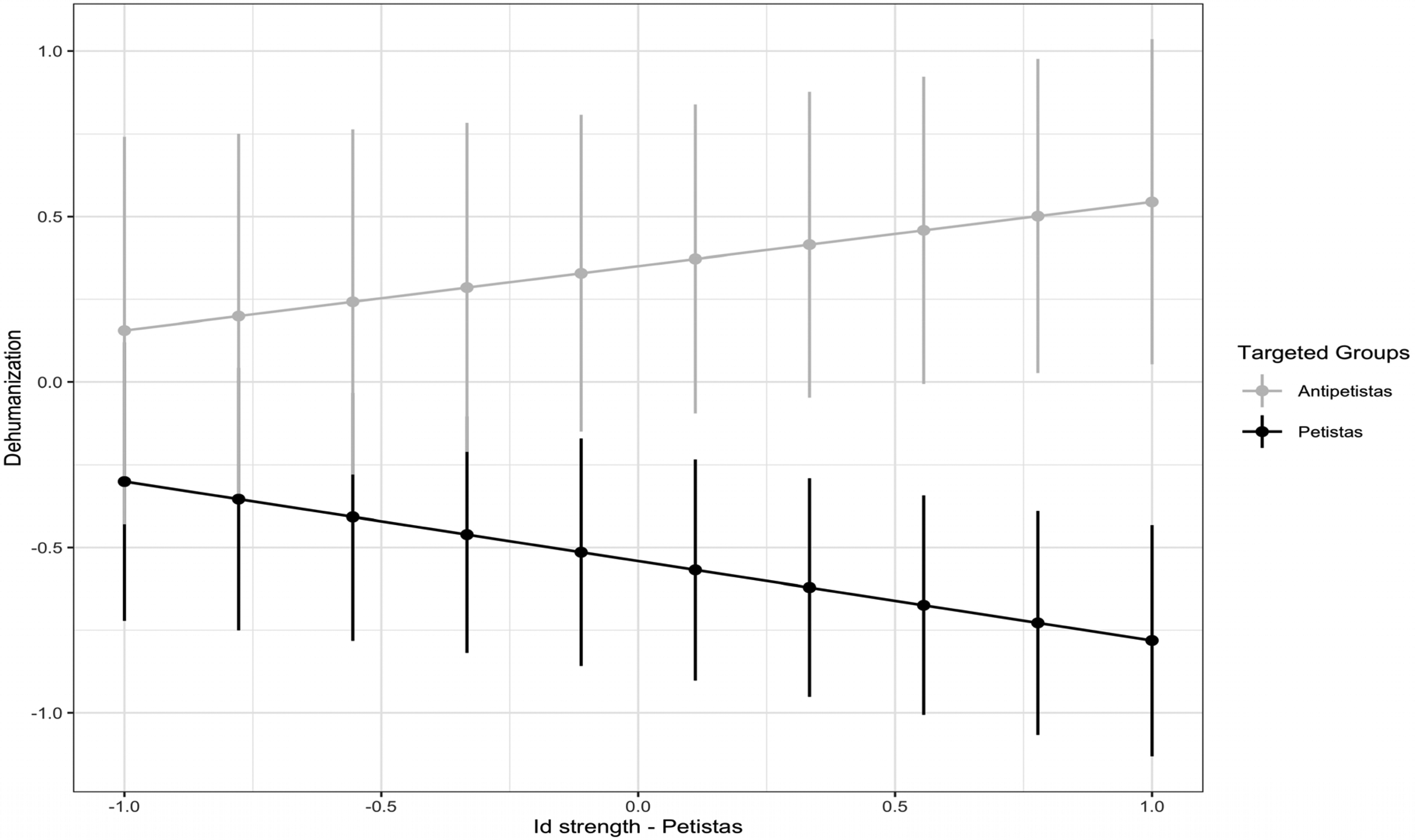
Evaluations by petistas. Source: Authors’ calculation.
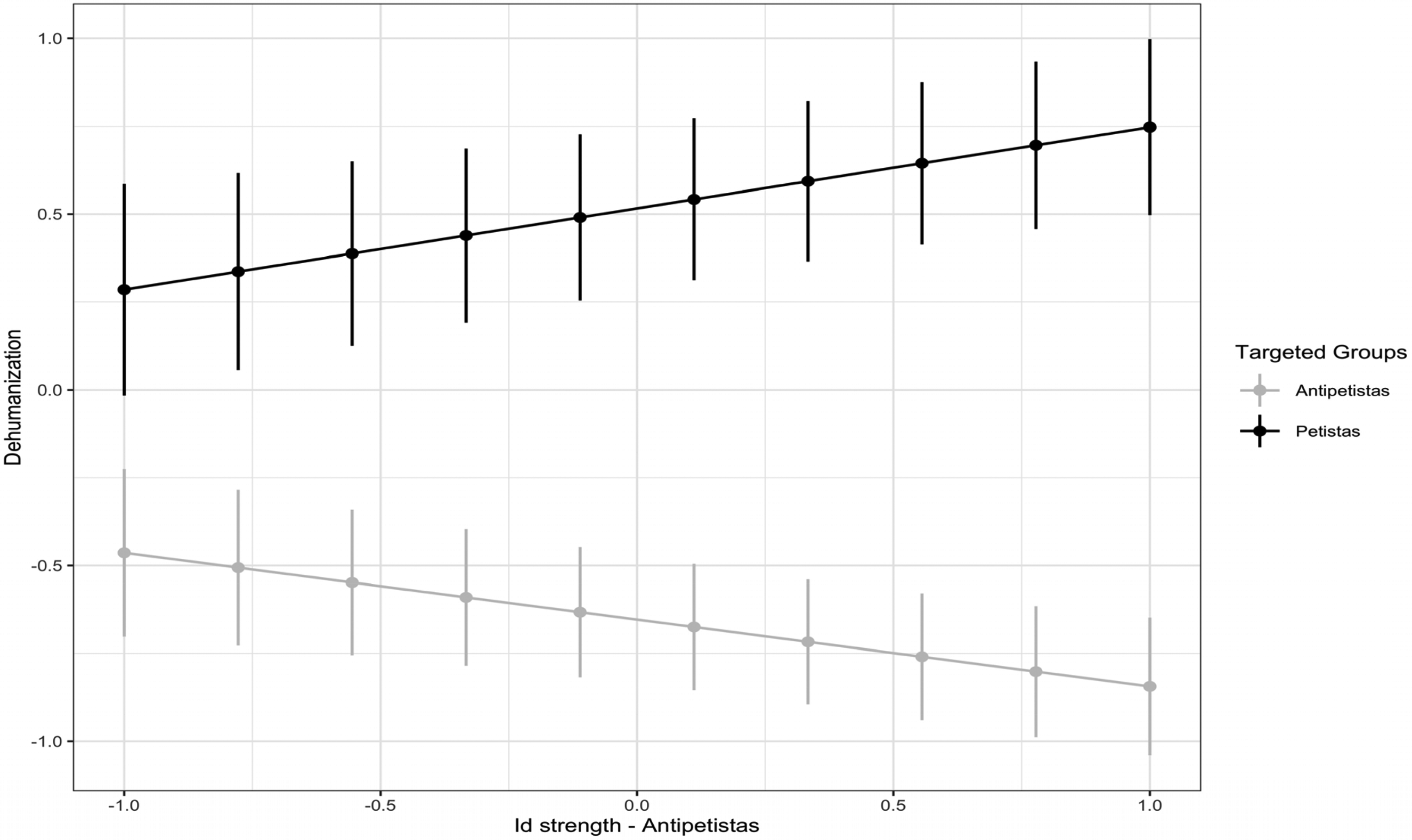
Evaluations by antipetistas. Source: Authors’ calculation.
Figure 3 explores predicted dehumanization by petistas as the strength of their partisanship increases, revealing strong support for our hypothesis. As the strength of petismo increases, petistas humanize themselves more (the darker dots) and dehumanize antipetistas more (the lighter dots). Results for evaluations of petistas by antipetistas are almost precisely the same in Figure 4, but flipped. Here, as the intensity of disdain for the PT increases, antipetistas increasingly dehumanize petistas and humanize themselves. 7 Overall, findings support the notion that dehumanization is a function of the intensity of either in or out-group bias.
Hypothesis 3: Does Perceived Partisan Threat Drive Dehumanization?
To evaluate whether triggering partisan threat enhances partisans’ propensity to dehumanize, we embedded an experiment in our survey. Figure 5 shows the effects of partisan threat on dehumanization. To establish the baseline, Panel 5A shows the “no threat” or control condition to which random members of all groups were assigned. As reported above, in the absence of a partisan threat, the difference between both petistas’ and antipetistas’ degree of self-humanization and dehumanization of opponents is somewhat less than one point on the [−1,1] scale for petistas, and about one point for antipetistas.
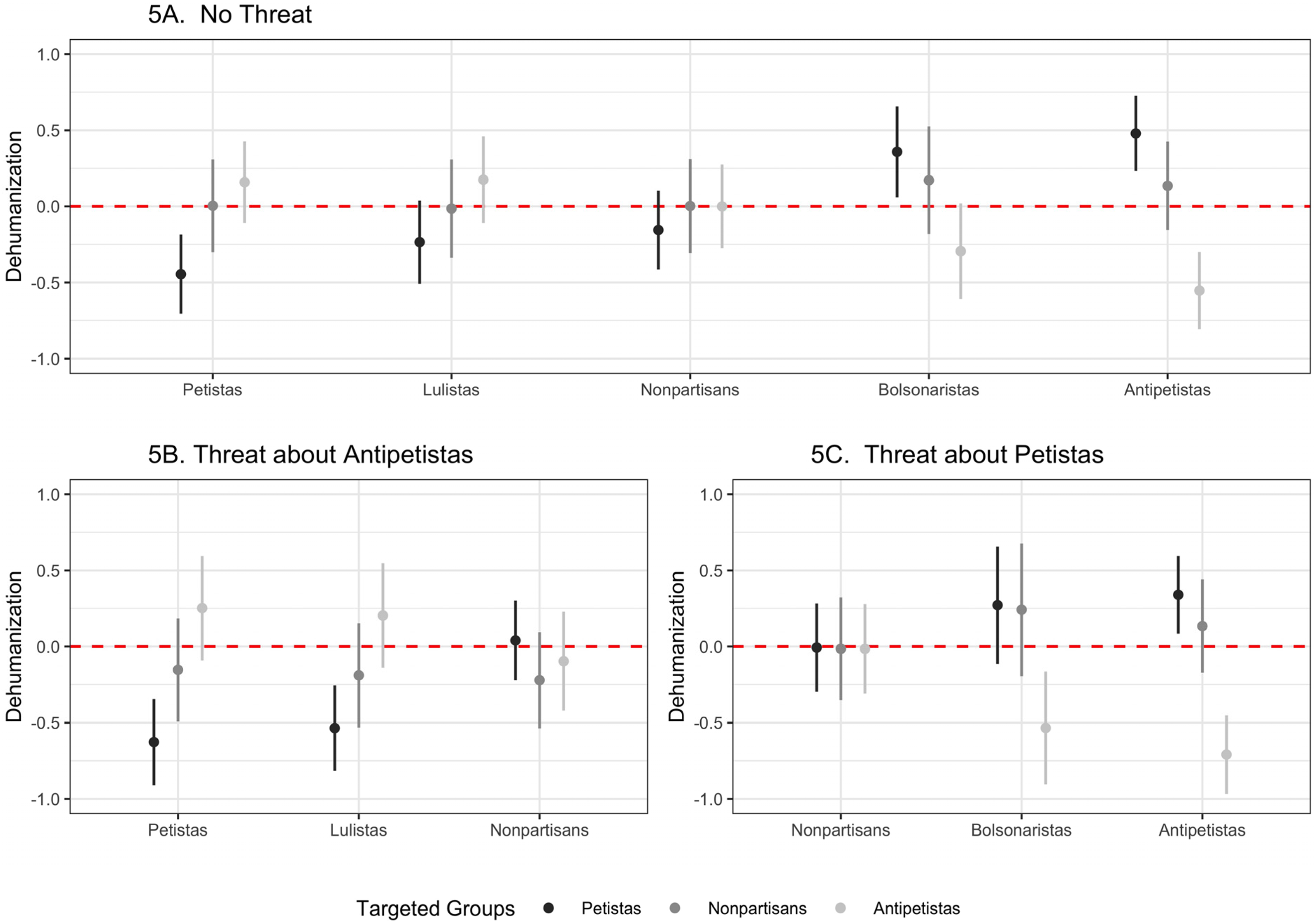
Partisan Threat Experimental Effects. Source: Authors’ calculation.
Panels 5B and 5C show the effect of the treatment. Contrary to expectations, there is no statistically significant difference between control and treatment conditions for members of any group. (For full results, see the Appendix). For example, for bolsonaristas and antipetistas, we see a slight increase in dehumanization of petistas from the control (Figure 6A) to the treatment (Figure 6C), but this could be due to chance. The same is true for lulistas and petistas. For non-partisans, the treatment also has no effect.
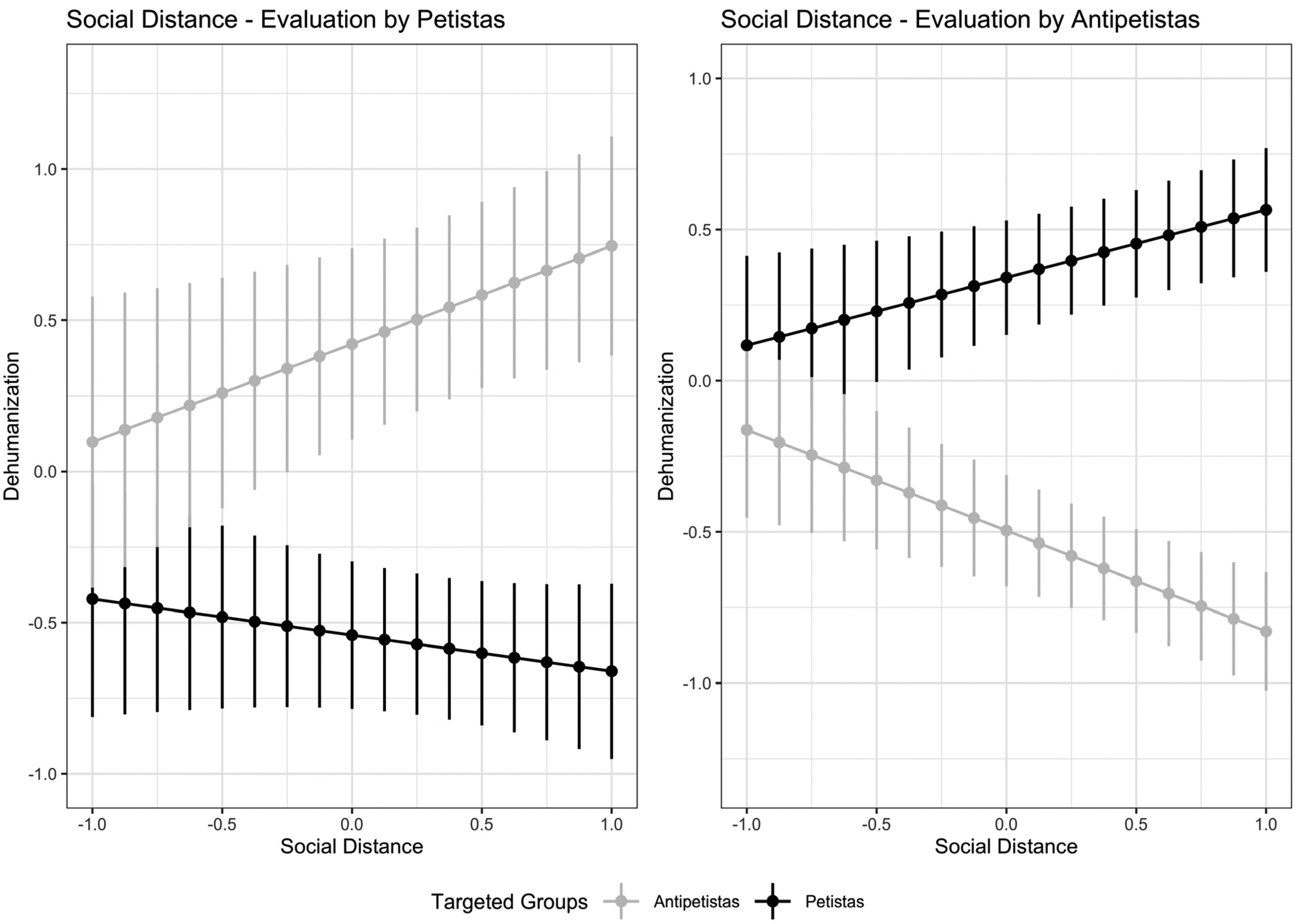
Social Distance. Source: Authors’ Calculation.
Our results do not support the hypothesis that triggering partisan threat enhances dehumanization. It is challenging to rule out alternative explanations for null results, but we suspect that our finding derives from Brazil's preexisting high level of partisan polarization. Support for this notion comes from the fact that we fielded this experiment three times over the course of a year, to consider whether the timing of our survey and/or the wording of our treatment mattered. We first fielded our survey in July 2022. However, we concluded that our treatments were not balanced and reran the survey with perfectly balanced treatments in December 2022, a few weeks after the second round of that year's presidential election. In response to comments from colleagues that those treatments (although balanced) were relatively weak and that the timing of our second survey could impact results, we reran the survey yet again in April 2023, using the treatments reported here. Regardless of treatment wording or timing, the treatment did not cause an increase in dehumanization.
Hypothesis 4: Dehumanization and Perceived Partisan Social Distance
We asked participants a series of questions about “How happy or unhappy” they would be if placed in different social situations with their political rivals, and assessed whether this sentiment was associated with dehumanization. Results support our expectations; Figure 6 plots the results. In the left panel, a desire for greater social distance from antipetistas by petistas (the dark grey line) is associated with both greater humanization of the in-group and dehumanization of the out-group. The right panel in Figure 6 considers antipetistas’ desire for social distance from petistas, and results mirror what we observed for petistas. In short, results for both partisan groups are consistent with expectations and with what we have observed thus far: both sides dehumanize, and dehumanization is more pronounced among partisans who desire greater social distance from supporters of the “other side.” 8
Hypothesis 5: Dehumanization and Perceived Partisan Moral Distance
We also asked participants how different they thought petistas and antipetistas were on several moral traits – empathy, equality, solidarity, respect for authority/traditions, impulsiveness, and self-sufficiency – and combined responses into a single scale. Results are presented in Figure 7. In the left panel, contrary to expectations, petistas’ dehumanization of antipetistas does not change no matter the level of perceived moral distance. However, results in the right panel for antipetistas’ dehumanization of petistas do support the hypothesis. 9
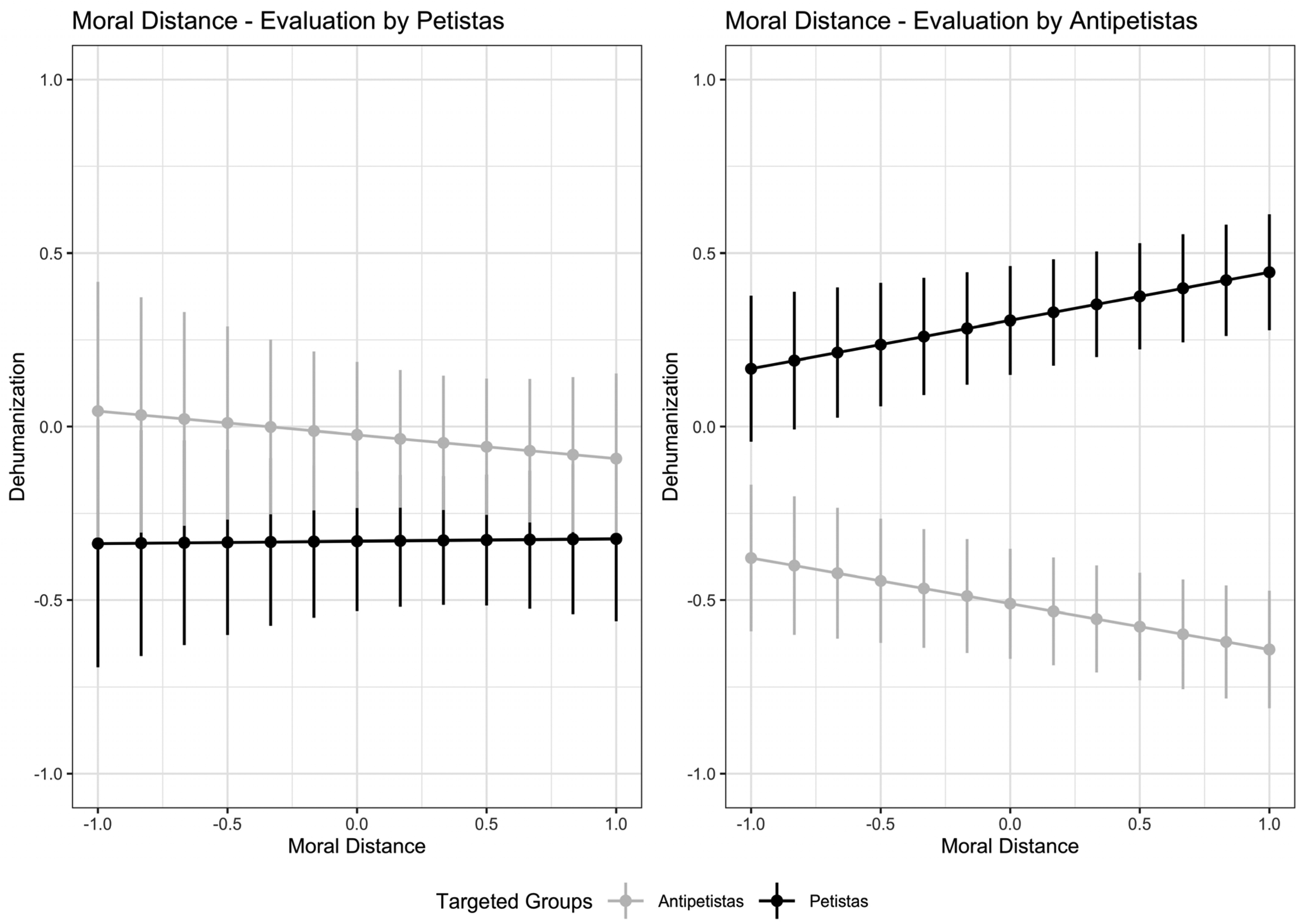
Moral Distance. Source: Authors’ Calculation.
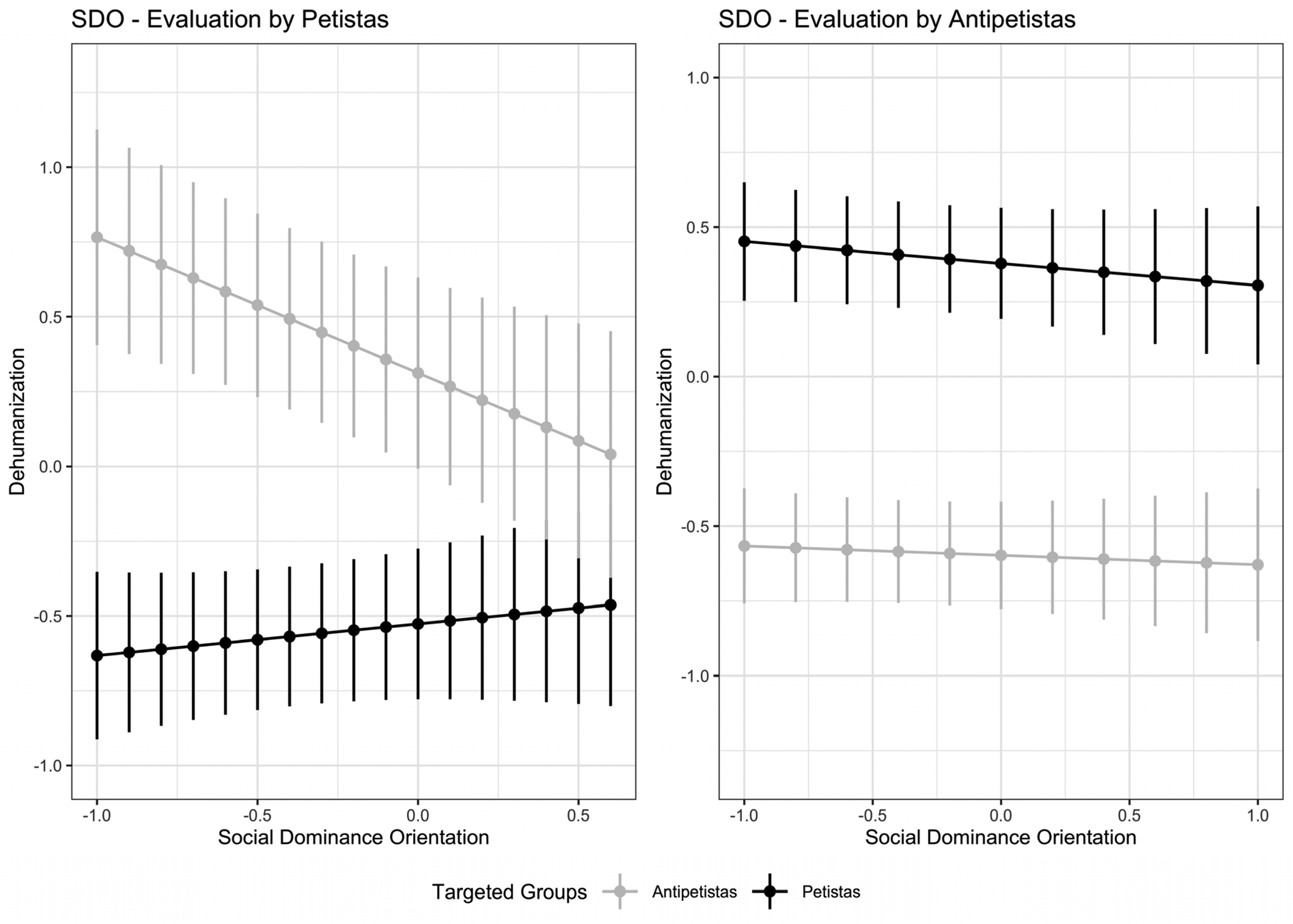
Social Dominance Orientation. Source: Authors’ Calculation.
Hypothesis 6: SDO and Dehumanization
Theory suggests that SDO should be higher among antipetistas than petistas, and that if SDO is correlated with dehumanization once partisanship is taken into account, it should be positively associated with dehumanization of petistas by antipetistas. However, we lack strong expectations about whether SDO will be correlated with petistas’ dehumanization of antipetistas.
To present results in Figure 8, we re-scaled Social Dominance Orientation onto a [−1,1] scale, where 1 indicates a preference for social dominance while −1 indicates more egalitarian values. As expected, petistas were the most egalitarian (SDO: −0.46, SD = 0.41) and antipetistas the least (SDO: −0.23, SD = 0.46), with nonpartisans exactly in the middle of the two groups (SDO: −0.32, SD = 0.36). The difference between petistas and antipetistas is statistically significant (p < 0.001). This pattern echoes findings for the USA, where we see an association between higher levels of SDO and Republican party identification (Martherus et al., 2021).
In the right panel, SDO is essentially unrelated to antipetistas’ propensity to dehumanize petistas. The slight tendency to humanize petistas as SDO increases is not statistically significant. Meanwhile, in the left panel, we see that petistas tend to humanize antipetistas as SDO increases. This suggests that although petistas generally tend to dehumanize antipetistas, a subset of petistas dehumanize antipetistas somewhat less – ironically, those petistas who score relatively high on SDO and who thus do not conform closely to their own party's egalitarian ideals. It is unclear why Brazilians who are ambivalent about the PT's core principles would nevertheless choose to identify with the party; we leave this for future research. In any case, as the widening standard error bars for petistas as SDO increases suggests, there are relatively few petistas with high SDO scores: Only 8% score more than one standard deviation (.43) above the full sample mean of −.32. In contrast, 27% of antipetistas score above that level. In the end, findings in this section do not support the idea that Social Dominance Orientation moderates Brazilian partisans’ tendency to dehumanize. Instead, partisanship itself is relatively more important predictor of dehumanization than SDO.
Our findings contribute to understanding the relationship between partisanship, SDO, and dehumanization - but only in the sense that they strongly suggest that petistas tend to exhibit low levels of SDO on average, while antipetistas exhibit strikingly higher levels. As a result, SDO may be related to dehumanization, but only because it is likely powerfully correlated with partisanship to begin with.
Conclusion
According to a recent literature review (Sarsfield et al., 2024), polarization in Latin America has yet to receive systematic scholarly scrutiny. Indeed, polarization received scant attention in fairly recent scholarly works on voter behavior in the region (see e.g., Carlin et al. (2015) or Nadeau et al. (2017)). However, the topic - including the question of how negative partisanship contributes to polarization - is not surprisingly gaining scholarly attention (Castro Cornejo, 2023; Haime and Cantú, 2022; Mayka and Smith, 2021; Meléndez, 2022).
Our paper makes several contributions to this emerging literature. First, we find that Brazilians on both sides of the country's political divide dehumanize their opponents. Although antipetistas dehumanize their opponents to a somewhat greater degree than petistas, partisans on both sides highlight their own tribe's “humanity” relative to their rival's.
Our results also echo findings from the USA that the intensity of partisanship correlates with dehumanization, and that dehumanization correlates with partisans’ perceptions of social and moral distance between groups. However, perhaps because Brazilian voters are highly polarized, we could not experimentally confirm that triggering perceptions of outgroup threat enhances polarization. Moreover, we found no relationship between Social Dominance Orientation and dehumanization, most likely because SDO predicts partisanship to begin with. For this reason, the lack of correlation between SDO and dehumanization among antipetistas is relatively unsurprising.
Our findings highlight the affective - emotional and psychological - nature of partisan polarization in Brazil, as opposed to its ideological or policy-based roots. Dehumanization is a manifestation of the moral dimension of partisan polarization in Brazil – on both sides. Petistas and antipetistas not only prefer greater social distance from each other and perceive significant moral distance between themselves and their opponents, they also believe that their opponents are less deserving of equal consideration. Mutual dehumanization suggests that partisanship in Brazil - whether positive or negative - serves a social function as a “moral anchor” (Ellemers, 2017), giving individuals a sense of superiority over outsiders regarded as morally deficient.
In this way, our findings also contribute to understanding the toxicity of politics in contemporary Brazil. Polarization is not simply about hot-button cultural issues such as gun control or LGBTQ rights (Lacerda, 2019; Lynch and Cassimiro, 2022). Instead, the act of denying one's opponents’ humanity crosses a line from policy disagreement to personal animus. It places one's opponents outside the bounds of acceptable morality and is associated with tolerance for and/or use of violence in politics (Haidt, 2012). This is not idle speculation, as partisan violence did occur sporadically during Brazil's 2018 and 2022 presidential campaigns. Bolsonaro supporters even invaded Brazil's Congress, Presidential Palace, and Supreme Court shortly after Lula's 2023 inauguration, mimicking the January 6, 2021, Washington DC US Capitol invasion. To the extent that polarization undermines norms of mutual toleration and respect, such violence may increase and the health of democracy decline (Levitsky and Ziblatt, 2018). The pervasiveness of dehumanizing rhetoric on both sides of Brazilian politics should concern observers worried about polarization's impact on the stability and quality of the country's democracy.
Brazil's “polarization with one party” also illustrates the independent impact of negative partisanship, with implications for the comparative study of voter behavior. Scholars of US politics continue to debate the relative importance of in-group sympathy versus outgroup antipathy (Abramowitz and Webster, 2016; Iyengar et al., 2019; Lelkes, 2021). Some regard negative affect as important, while others dismiss it as merely a function of in-group affect. Although petistas are partisans in the traditional sense, antipetistas are largely purely negative partisans. Given this, our results support the idea that dehumanization can stem from either positive or negative partisanship. A comparatively large proportion of Brazilian voters are negative partisans (Mayer, 2017; Medeiros and Noël, 2014). Given this, scholars should further explore the potential that both positive and negative partisan attitudes shape dehumanization and political polarization.
This study does have certain limitations. Just like other research on partisan dehumanization Cassese (2021), Kteily et al. (2015), and Landry et al. (2023), resource constraints forced us to rely on a convenience sample. Our results are highly suggestive, but cannot provide an accurate picture of the extent of partisan dehumanization across the entire electorate. Future research using a nationally-representative sample could further explore the nature and extent of partisan dehumanization in Brazil.
In addition, the experiment embedded in our survey only allows us to rule out the idea that partisan threat as we measured it causes increased dehumanization, independently of partisanship. For our other variables, we cannot definitively rule out reverse causality. Nevertheless, the consistently distinct findings for partisans versus non-partisans strongly suggest that positive and/or negative partisanship is the root cause of dehumanization, not vice versa. Additional research on both the sources and consequences of dehumanization would be welcome, but given the paucity of research on partisan dehumanization outside the USA, our project offers original and suggestive correlational and experimental evidence.
Finally, the null results on our experiment suggest that those who hope to reduce polarization in Brazil have their work cut out. Politics is already so divided that one apparently does not need to “trigger” political threat to observe considerable dehumanization on both sides. This implies that deliberately cueing the idea that either side does not represent a threat might also have no effect on dehumanization or polarization more. It is far from clear that either petistas or antipetistas have any incentive to reduce the perception that the other side represents a threat to Brazilian democracy. Additional work could explore whether efforts to reduce polarization in Brazil might prove fruitful, along the lines of Huddy and Yair (2021), Landry et al. (2023), Wojcieszak and Warner (2020) or Levendusky (2018).
Declarations
The authors have no competing interests to declare that are relevant to the content of this article.
This research was approved by the University of Minnesota Institutional Review Board for study 00015287, February 24, 2022.
Data Availability: Data and other replication files have been deposited at Samuels’ Dataverse, at https://doi.org/10.7910/DVN/TWRVZG.
Supplemental Material
sj-docx-1-pla-10.1177_1866802X241268648 - Supplemental material for Partisan Dehumanization in Brazil's Asymmetrically Polarized Party System
Supplemental material, sj-docx-1-pla-10.1177_1866802X241268648 for Partisan Dehumanization in Brazil's Asymmetrically Polarized Party System by David J. Samuels and Karine Belarmino in Journal of Politics in Latin America
Footnotes
Declaration of Conflicting Interests
The authors declared no potential conflicts of interest with respect to the research, authorship, and/or publication of this article.
Funding
The authors received no financial support for the research, authorship, and/or publication of this article.

Supplemental Material
Supplemental material for this article is available online.
Notes
Author Biographies
References
Supplementary Material
Please find the following supplemental material available below.
For Open Access articles published under a Creative Commons License, all supplemental material carries the same license as the article it is associated with.
For non-Open Access articles published, all supplemental material carries a non-exclusive license, and permission requests for re-use of supplemental material or any part of supplemental material shall be sent directly to the copyright owner as specified in the copyright notice associated with the article.
