




Abstract
Despite constant monitoring, we lack a good explanation for the 2018–2019 protest crisis in Nicaragua. The escalation of protests, repression, duration, and the death toll are surprising. Applying a novel political and economic cost framework, we benchmark Nicaragua’s historical and recent political protests and explain the Ortega administration’s responses, thus providing a rich case (with comparative data for context) that makes sense of this extraordinary period of protest. The empirical analysis buttresses our qualitative case study of protest motivations and tactics and extreme state violence that define four phases of the conflict. The combination of qualitative and quantitative analyses creates one of the first robust studies of protest–response dynamics of this protest crisis. We conclude that these protests are unique with respect to previous protests in the country and the region and that government repression was a logical response in some phases but was inconsistently applied.
Introduction
The April 2018 protests in Nicaragua morphed into a crisis, halting a period of solid economic growth, sustained poverty reduction, and political stability – unprecedented in the country’s recent history. Protests were sparked by proposed social security reforms, which had already proven contentious in 2013 when similar proposals led to widespread intense protests. Other violent protests had taken place in 2016 and 2017 against governmental plans for the cross-oceanic canal and in the aftermath of municipal elections, respectively. Yet, the virulence of the 2018 protests resulting in a death toll between 199 and 545 caught many by surprise (International Crisis Group, 2018). Protracted efforts of national dialogue failed to end the crisis. Human rights violations have been denounced amidst government allegations of a failed coup d’état. The US administration approved sanctions, but international mediation efforts never materialised in an effective way. Very pessimistic economic prospects loom around the banking sector (FUNIDES, 2019). The economy expectedly contracted by about 4 per cent in 2018 and might see a similar or even larger contraction in 2019 (World Bank, 2019), which will be exacerbated by the emergence and economic effect of COVID-19 in 2020. Poverty is estimated to have risen by + between 2 and 6.5 per cent in 2018 – depending on assumptions – which would de facto brush away the hard-fought gains in the last few years (Cuesta and Chagalj, 2019; FUNIDES, 2019; World Bank, 2019). While writing this manuscript, the resolution of the crisis remains highly uncertain more than two years since its onset, as already noted by other analysts (Martí i Puig and Serra, 2020). The effects that the approved reform to the social security law (end of January 2019), the Nicaragua Investment Conditionality Act (NICA Act), the lingering recession, and COVID-19 will have on the dynamics of protests remain anyone’s guess. 1
In response to protests, such as those in April 2018 that spurred the crisis, governments make strategic calculations about how to respond. In generalities, governments can repress, accommodate, or tolerate protests, and commonly implement a combination of these responses. The response decision is the product of strategic calculations of the short-term and long-term costs and benefits of different responses (Franklin, 2009; Pierskalla, 2010). Protest characteristics and dynamics create costs to the government, which are part of the calculation (Carey, 2006, Klein and Regan, 2018a; Moore, 1998, 2000). A response is not a simple causal arrow from dissent to repression, or even violent dissent to repression. Instead, the content of protesters’ demands and how protesters mobilise structure these costs. While the protests and resulting crisis in Nicaragua has been the subject of many reports monitoring events, there has been little empirical analysis of the events and assessments of the government responses. This article fills this gap by modelling the different costs associated to alternative responses to protests in 2018–2019 in order to better understand observed (and, could ultimately be used to predict) government responses. While this article provides a rich case (with comparative data for context) that makes sense of this extraordinary period of protest in Nicaragua, the theoretical approach used, based on Klein and Regan (2018a), can be used in protest elsewhere and over time. For example, this approach has been used to explain government response during the January 2018 protests in Iran (Klein and Regan, 2018b) and what was otherwise considered a surprising shift in response from repression to, at least minimal, concessions to protesters in Hong Kong in September 2019 (Klein, 2019).
In the remainder of the article, we first provide an in-depth qualitative description and analysis of different catalysts for the 2018–2019 Nicaraguan protests in the next section. Then, the third section introduces the methodology used in this article and shows how Klein and Regan’s (2018a) cross-national costs model can be adapted to one-country analyses and helps explain why protests in 2018–2019 resulted in high levels of repression. The fourth section “Global Protest Statistics” discusses the data used for the empirical analysis, the Mass Mobilisation Project (Clark and Regan, 2016) including updated data coding the Nicaraguan protests. The subsequent section benchmarks the 2018–2019 protest crisis with other Nicaraguan past protests with respect to other protests globally, regionally, and in countries of comparable political and economic development since 1990 and during 2018–2019. The benchmarking allows us to determine what this case shares with other protests and what is uncommon. The section that follows quantitatively analyses Ortega’s responses to the protest crisis and whether they align with the response behaviours predicted by the costs model. The last section summarises the main findings for Nicaragua and briefly reflects on how the framework applied to Nicaragua can be used and adjusted to explain other developing or ongoing protests elsewhere.
Description of the Recent Nicaraguan Crisis
The successive elections held in Nicaragua from 1990 through 2016 – with several initial electoral defeats by Ortega and transitions of the ruling party – should not be equated to a competitive election-based democracy. In fact, Martí i Puig (2019a) describes Nicaragua as an authoritarian electoral regime with multiple manipulations shaping elections since Ortega’s victory in 2006. Manipulations include the unconstitutional Ortega–Murillo’s President–Vice President tandem, explicitly banned by the Constitution (Article 147) for reasons of consanguinity or affinity. Other examples include, altering the shape of the Managua municipality in the municipal elections of 2011, eliminating the legal status of some parties, and access to media remains starkly unequal between Ortega’s apparatus and the opposition, with the President and close supporters owning seven radio and three TV stations (Bravo, 2015; Castro, 2014). The Electoral Supreme Court stripped 28 opposition legislators from their seats in 2016 (Martí i Puig and Serra, 2020). This long list of manipulations has led to a deterioration of the electoral process and, with it, an unrelenting decline in confidence in the political system 2 and the erosion in the quality of democracy in the country (Lührmann et al., 2018; Martí i Puig and Serra, 2020).
Ortega’s accession to power meant the de-institutionalisation of the Frente Sandinista de Liberación Nacional [Sandinista National Liberation Front] (FSLN), stripping the state from any control and accountability mechanism, and the drifting towards a patrimonial regime echoing Somoza’s “sultanic” regime (Martí i Puig, 2019a). With abundant financial resources from ALBA (the Bolivarian Alliance for the Peoples of Our America, ALBA in Spanish, conceived by Venezuela’s Hugo Chavez and Cuba’s Fidel Castro), the Superior Council for Private Enterprise – representing the economic elites – and Nicaraguan large corporations remained very close to Ortega. At the same time, Ortega also controlled historically combative trade unions through the FSLN party and maintained the support of the most disadvantaged through generous cash transfers (also financed through ALBA resources; see Martí i Puig and Serra, 2020). In addition, Ortega took personal control of the judiciary, the legislature, the National Police, the Army and the Supreme Electoral Court (Close, 2016). Ortega reinforced the political weight of the Vice President, changed regulations concerning the Army, and eliminated restrictions on re-election (Alvarez and Vintró, 2014; Cuadra Lira, 2016).
By several accounts, Ortega’s regime prior to the 2018 protests had reached a level of authoritarianism comparable to Somoza’s caudillista or strongman regime. The main difference was Ortega’s limited need to resort to force and repression (Cortés, 2020; Cortés et al., 2020; Jarquin, 2020; Lopez, 2020; Martí i Puig, 2019a , 2019b; Martí i Puig and Serra, 2020; Pineda, 2016; Thaler, 2017). As a result, the virulence of protests starting on 18 April 2018 caught many by surprise.
The protests were a direct reaction to Presidential Decree No. 03–2018 introducing a package of social security reforms. The Decree was suddenly announced by the government the day before and set to increase tax retentions by five percentage points. It also imposed a rise in contributions to a social security fund by employees of an additional 1.5 per cent of salaries and by employers of 2.5 per cent. The reform was urged by the International Monetary Fund as a necessary step to save the weak financial situation of the National Institute of Social Security (FUNIDES, 2019; International Monetary Fund, 2018). The need for reform was also acknowledged by the private sector (ICG, International Crisis Group, 2018). However, the private sector representative organisation, El Consejo Superior de la Empresa Privada [The Superior Council of Private Enterprise] (COSEP), denounced the proposed changes in the Decree because they had not agreed to them. The Decree marked the end of an increasing deterioration of the economic consensus model, which had been observed in the negotiations around minimum wages, anti-money-laundering laws, and the regulation of telecommunications (Cruz et al., 2018; Gonzalez and Lucydalia, 2018).
Adding to this increasing loss of trust from the private sector, the government had faced students’ protests demanding a rapid response to the fire of the natural reserve of Indio Maíz earlier in April of 2018 and protests in March of that year in front of the National Assembly on what had been perceived as restrictions to freedom of expression in the form of increased control on social media (GIEI, 2018). However, multiple analysts argue that none of these protests were sufficiently systematic nor had the necessary popular support to ignite the massive protests of April 2018 (Cruz et al., 2018; Martí i Puig, 2019b; Mosinger and Thaler, 2018). In fact, the lack of international pressure for institutional change, the implementation of social programmes, and the alliance forged with the private sector and religious groups all had contributed to a certain level of satisfaction among a large segment of citizens prior to the protests (Cabrales, 2020).
It is, however, hard to imagine that deteriorating trust and those previous protests did not have any influence in the response against social security reforms. A similar reform had been proposed and eventually halted in 2013. The levels of intensity of the protests and the force used to respond to them was much lower (and claimed no lives). The 18 April 2018 protests began when students led a march against reforms in the capital and two other cities, León and Matagalpa. These marches ended in clashes with Sandinista groups and riot police (ICG, 2018). Both the violence and the government repression immediately spiralled into intense clashes, which became increasingly violent. The government backed down on the social security reform announcing a six-month postponement on 22 April (Gonzalez and Lucydalia, 2018). Yet, violence increased immediately, and protests rallied a wider group of civil society composed of small-scale farmers, human right activists, political opposition, and former Sandinista figures who felt betrayed by the turning of the FSLN party into a dynastic party (ICG, 2018). The private sector and the church became visible figures of protest too. What had initially started as an economic protest turned into a “revolutionary” protest that demanded the change in regime (Cabrales, 2020: 88).
The government mobilised police and parapolice units, composed of armed pro-government groups. Cabrales (2018) reports some 197 protests during April 2018, which compares with the average monthly protests hovering around twenty between January 2016 and March 2018. Protests not only increased in number, but also participants and geographical scope, spreading to Chinandega, Granada, Masaya, Rivas, and Estelí, to cite some with the largest clashes. By 24 April 2018, the death toll reported by the Inter-American Commission of Human Rights (IAHCR) raised to twenty-five. By early June, the Comision Interamericana de Derechos Humanos (CIDH) reported that death toll had mounted to 143 (CIDH, 2018: 20); the traditional police repression had soared and included the active participation of paramilitary groups.
FUNIDES (2019) identifies a second phase in the crisis starting 12 June 2018, coinciding with the launch of Operación Limpieza (Cleanup Operation) by the government. It aimed at removing barricades and road blockades used by protesters (Cuadra Lira, 2019; Fiorella, 2019). Both the National Police and paramilitary groups took part in such raids. They continued through 24 July 2018. Protests at their peak in June amounted to 776 and then considerably reduced to 304 in July (Cabrales, 2018). The true effects of Operación Limpieza would be seen in September 2018: the number of monthly protests fell down markedly to total only nine in that month (Cabrales, 2018).
A third phase of the crisis started at the end of September (FUNIDES, 2019). Police declared any protest illegal on 28 September 2018. Since then, the CIDH (2018) reports that the government occupied public spaces to prevent new protests. Harassment and intimidation of opposition, media, and human rights leaders continued. The legal status of several civil society groups was revoked; and several high-profile journalists, including Miguel Mora and Ana Lucia Pineda, were arrested by December 2018. Repression that had taken place before in the streets reportedly became targeted to leaders of social movements, human rights activists, and opposition members. A considerable number of university professors, secondary school teachers, and health workers were fired during that period. Members of the Catholic Church were reportedly harassed too (Cabrales, 2020; FUNIDES, 2019).
On 21 February 2019, President Ortega proposed a start date to resume talks with the opposition, and the umbrella opposition group Civic Alliance for Justice and Democracy agreed to partake in the new talks. Resuming talks signals a fourth phase of the crisis. The Civic Alliance demanded the liberation of political prisoners, electoral reforms to guarantee free, fair, and transparent elections, some form of redressing the victims, and the presence of the international community in the negotiation table (Breda, 2019). Following some delays in the appointment of guarantors, the dialogue has taken place since March of 2019 and has led to the release of political prisoners, some fifty-nine on 11 June 2019. The day before, the National Assembly approved a controversial Amnesty Law (La Gaceta, 2019) that effectively revoked all sentences, stopped all ongoing investigations, and cancelled any future investigation on criminal and political charges. Opposition leaders and the UN Commissioner on Human Rights equated this law to immunity to those who perpetrated “crimes against humanity” (Navas, 2019).
Although early dialogue attempts between civil society groups and the government failed during the first three months after the onset of the crisis, both sides appeared to enter this round of talks and negotiations with the intent for legitimate dialogue. The previous breakdowns and failures in dialogue and negotiations can be attributed to multiple factors, namely, an overambitious agenda, the government’s lack of commitment, and an improvised methodology of negotiation and because the Catholic Church, a self-declared mediator, had lost any perception of impartially to the eyes of the government (ICG, International Crisis Group, 2018). Regardless of the balance of previous attempts, the March 2019 talks enabled the opposition and Government to reach agreement on two issues: the release of hundreds of political prisoners and a formal commitment by Ortega to respect citizens’ basic rights. Clearly, the talks succeeded in preventing the escalation of protests. Cabrales (2020) documents that the frequency of protests during the second half of 2019 returned to levels prior to the onset of the crisis. However, allegations of abuses have continued through the second half of 2019 and into 2020.
In September 2019 the UN Chief of Human Rights, Michelle Bachelet, appealed the Ortega administration to investigate reports of murders and the torture of demonstrators, and to restore freedom of expression and the right to peaceful assembly (UN News, 2019). Amnesty International (2020) denounced in September 2020 that the presentation of the Law for the Regulation of Foreign Agents and the Special Law on Cyber-Crime before Nicaragua’s National Assembly were overt efforts to silence those who criticised government policies and create a legal framework to begin a new phase of repression in anticipation for the 2021 Presidential elections.
Furthermore, the talks also failed to secure credible and possibly early elections, a reform of the Supreme Electoral Court, and the establishment of a Truth Commission composed of both opposition and government-appointed representatives, potentially with international expert participation (ICG, International Crisis Group, 2019). At its results, it remains an open question whether the crisis can be declared to have concluded or rather, as described by some, it is in a stage of “diffused” conclusion (Cabrales, 2020: 83). This fuzzy conclusion reflects that protests have subsided to pre-crisis levels but demands remain systematic and alive by a latent social movement (Cabrales, 2020).
The role of the international community during the crisis deserves further attention. Delegations from the European Parliament, Amnesty International, and Sociedad Interamericana de la Prensa visited Nicaragua at different points in time during the crisis. Numerous reports were presented on the situation of the country, the evolution of violence, and reported violations of human rights from grupo interdisciplinario de expertos independientes (GIEI), a Oficina del Alto Comisionado de las Naciones Unidas para los Derechos Humanos [The Office of the United Nations High Commissioner for Human Rights] (OACNUDH), and Amnesty International. These reports all coincide in accounts of serious violations of human rights, sectary detentions, and abuses. The permanent council of Organization of American States (OAS) met seven times between April 2018 and January 2019, condemning the violence, repression, abuses from the government, and calling for a non-violent solution. In October 2018, the OAS council met to discuss the possible use of the mechanism known as carta democrática (democratic chapter), which would have implied expelling Nicaragua from OAS had it been approved. Similar calls are produced by the High Commissioner of the European Union and the UN Security Council. In November 2018, President Trump signed an executive order allowing the US Treasury the capacity to impose sanctions on persons close to President Ortega. The first sanctioned targeted the First Lady and Ortega’s security advisor. The US Senate also approved the so-called Nica Act, which imposed the blockage of the financing of multi-lateral organisations where the United States takes part, meaning the halt of new financial operations from, for example, the World Bank and Inter-American Development Bank.
If the immediate trigger of the protest, the social security reform itself, the objective economic performance of the country, or the previous culture of protests and repression cannot explain the disproportional response of the government, what then can it be blamed on? In the next section, we briefly review motivations for responding to the protests with repression and identify an analytical framework based on the costs of protest for analysing when governments will respond to protests with repression.
Government Repression of Protests
Mass protests have led to the ousting of Presidents in office in many countries. In Latin America alone, fifteen Presidents in nine countries were ousted from office between 1992 and 2016 (see Pérez-Liñán, 2014; Sánchez et al., 2017; and literature cited there). 3 Martí i Puig and Serra (2020) argue that Nicaragua did not combine the three conditions commonly observed in those fall-from-office episodes: a legislative minority of the President’s party, a media scandal, and widespread protests calling for the President’s resignation. In fact, protesters asking for Ortega’s resignation were the only common element with other presidential ousting. Ortega has been argued to control the legislative power, the army, the media – which consistently maintained a discourse denying the crisis (Martí i Puig and Serra, 2020). Furthermore, the opposition capacity has been questioned given its lack of cohesion, well-defined discourse, visible leadership, and common interests – beyond Ortega’s leaving office. In fact, the opposition amalgamated and mobilised unsatisfied Sandinistas and anti-Sandinistas (Martí i Puig and Serra, 2020).
What would have then been the response to be expected from Ortega? When governments feel threatened by protests, they will use any tool at their disposal to remain in power and maintain the status quo (Carey, 2010; Regan and Henderson, 2002). Sometimes governments pick the tool of repression, other times the tool of concession, and yet other times a combination. Governments’ responses to dissent reflects the potential costs of the policy options and impact on future dissent (Franklin, 2009; Sullivan, 2016). To understand how and why governments respond to protests, we start by considering protests as an opening move in a bargaining environment in which governments assess the costs and benefits of different responses (Gurr, 1970; Tarrow, 1994, Tilly, 1998).
Governments are anticipated to repress protesters in an attempt to maintain authority if dissent is assessed as costly or threatening. This relationship is so well theorised and evidenced, it is referred to as the Law of Coercive Responsiveness (Davenport, 2007). Yet, repression is not an automatic response to protests, even violent ones, because it is a risky and costly tool (Pierskalla, 2010). Sometimes repression works and dissidents yield (Regan and Norton, 2005); sometimes repression backfires and civilians mobilise in support of those already in the streets (Carey, 2006). Sometimes governments find these risks acceptable.
If protesters are violent, the likelihood of repression increases and governments are expected to follow a somewhat linear path by meeting protester violence with state violence (Carey, 2006; Franklin, 2009; Gurr and Lichbach, 1986; Moore, 1998, 2000), but they could also consider other protest attributes like the power in numbers or number of participants (Biggs, 2018; DeNardo, 1985; Earl et al., 2003; Tilly, 1998), the nature of demands (Regan and Henderson, 2002), or variation in protest tactics or from ‘normal’ dissent (Davenport, 1995). The list of protest attributes that informs response decision-making is massive, extending beyond what we mention (see Carey, 2006; Hill and Jones, 2014). But this colossal nest of attributes can be boiled down to two parameters – concession and disruption costs. Dissidents generate concession and disruption costs through their protest behaviours, choices, and tactics (Klein and Regan, 2018a). Concession costs capture protests’ political threat(s) and are defined by protesters’ demand(s), violence, and demand recurrence, whereas disruption costs represent the public disorder and potential economic costs and are defined by protests’ location, duration, and size (Klein and Regan, 2018a). These costs inform governments’ response decision calculus producing generalised choices of repression, accommodation, policing, a combination of these responses, or tolerating the protests (Klein and Regan, 2018a).
The multi-faceted nature of the costs simultaneously accounts for traditional action–reaction (Davenport and Moore, 2012; Lichbach, 1987; Moore, 1998, 2000) and threat perception theories and measurements (Carey, 2010; Danneman and Ritter, 2014; Davenport, 1995, 1996; Gartner and Regan, 1996; Gurr, 1986; Nordås and Davenport, 2013; Pierskalla, 2010; Ritter, 2014). Reflecting the underlying mechanism of action–reaction, Klein and Regan’s (2018a) costs model includes a measure of protest violence with the expectation that protesters’ violence increases the likelihood of reciprocal government behaviour. Threat perception is also incorporated through the inclusion of violence. Additional components of these costs parameters reflect the diversity in threat perception indicators; protest size measures threat through power in numbers (Biggs, 2018; DeNardo, 1985; Earl et al., 2003; Tilly, 1998) and protesters’ demands, and the regularity in which demands are made measure threat and risks to the ruling elite (Regan and Henderson, 2002).
Categorising costs into two measurable parameters condenses the strategic decision-calculus into analytical units that vary across time and space, and therefore, strengthen the ability to critically and empirically analyse government response to protests. Klein and Regan (2018a) show that when protesters push the political threat and costs to the government (concession costs) too high, then repression is more likely; whereas, high disruption costs are found to increase the probability of accommodation but do not alter governments’ use of repression (Klein and Regan, 2018a).
The protest history of Nicaragua demonstrates that a repressive government response is not a path-dependent process. Over the past few years, protests have been recurrent, and the government’s response has not been the brutal repression witnessed during the 2018–2019 protests. Something different occurred beginning in Gonzalez and Lucydalia (2018).
First, as can be seen through event data records and reporting (see next two sections that follow), repression was a sustained response, which suggests it was the chosen response by Ortega’s regime. The continued use of repression, or effectively doubling-down on the tactic, points to a strategic calculation by the government that repression was the best response to protesters. And the evidence points to a strategic calculation to repress rather than reactionary dynamics of action–reaction models (Moore, 1998, 2000) because the historical context and previous interactions between dissidents and the government were less violent, and the onset of the 2018 protests was non-violent, which suggests the state’s repressive response was not a reaction to protesters’ violence. Ortega’s government faced protests about social security reform in 2013, and the response was not brutal violence. Perhaps repression in 2018 was an evolution in response because other responses in 2013 did not prevent future social security reform protests, even though the protests were initially non-violent.
By focusing analytical attention on proximate protesters, or event-specific, behaviours, the costs model (Klein and Regan, 2018a) improves empirical predictions of governments’ response behaviours. Instead of using institutional or structural measures to explain behavioural outcomes, the model maps the effect of behaviour-based variables, which can capture variation in behaviours across time, on behaviour-based outcomes. This is particularly relevant in long and widespread protests, as it is the Nicaragua case, and provides an opportunity to identify multi-phased protests with shifting behaviours across phases.
We use the costs model as an empirical tool to analyse and assess the “interrelated strategic decisions of rational actors” (Pierskalla, 2010: 135) in Nicaragua. We apply the model to the 2018–2019 protests to evaluate the strategic logic of Ortega’s response and show that even in a case where the protest intensity was surprising to country monitors, once the protests started, the government response was mostly predictable and aligned with expectations with a few small deviations from expectation by Ortega.
Global Protest Statistics
The costs model uses the Mass Mobilisation Project v1.0 (Clark and Regan, 2016) [hereafter MM Data], which included protest event data in 161 countries from 1990 to 2014. 4 We use the original dataset and model from Klein and Regan (2018a) to estimate government response and then predict probabilities of Ortega’s responses based on information from the 2018–2019 protests using updated MM Data provided to us. We replicate Klein and Regan’s (2018a) formulas to calculate the cost parameters for protests, globally, in the updated data. The updated MM Data we use are not publicly available yet but will be soon (at time of writing); version 3.0 is the most recent public data. 5
Concession Costs
Concession costs is an additive function of three components: protesters’ demand(s), demand recurrence, and violence and ranges from 1 to 5. In the updated data, concession costs are calculated for 15,068 protests. Demands are coded from 1 to 3, respectively, as low (2,982 protests, 19.6 per cent), medium (10,383 protests, 68.2 per cent), or high threat (1,871 protests, 12.3 per cent); 26.5 per cent of protests (4,034 events) were violent. And in 68.9 per cent of protests (10,382 events), the demands were the same as in the previous protest. The mean value of concession costs is 2.88, with a standard deviation of 0.94, and a mode of 3 (47.7 per cent).
Disruption Costs
Disruption costs is an additive function of three component factors: protest location, size, and length (duration) and ranges from 1 to 9. In the updated MM Data, disruption costs are calculated for 15,204 protests. Location is coded from 1 to 4, respectively, as rural (1,046 protests, 6.9 per cent), urban (3,963 protests, 26.1 per cent), capital (8,241 protests, 54.2 per cent), or nationwide (1,954 protests, 12.9 per cent). Size ranges from 50 to 7 million participants (mean of 16,889 and median of 400) and is coded from 0 to 3, respectively, as 50–99 participants (3,428 protests, 22.5 per cent), 100–999 participants (4,821 protests, 31.6 per cent), 1,000–9,999 participants (4,477 protests, 29.4 per cent), and ≥10,000 participants (2,511 protests, 16.5 per cent). Length, or duration, is coded from 0 to 2, respectively, as one day (13,200 protests, 86.6 per cent), two–seven days (1,433 protests, 9.4 per cent), and > seven days (604 protests, 4.0 per cent). The mean value of disruption costs is 4.3, with a standard deviation of 1.5, and a mode of 4 (25.9 per cent).
Government Responses
Governments have a plethora of response tactics and strategies, but, for coding purposes, MM Data restricted responses to accommodation, arrests, beatings, crowd dispersal, ignore, killings, and shootings. Klein and Regan (2018a) further reduced government responses into four categories: disregard (ignore), crowd control (arrests and crowd dispersal), accommodate, and repression 6 (beating, shooting, and killing). We follow this procedure and find in the updated MM Data that governments disregarded 52.5 per cent of protests (7,990 events), in 26.2 per cent of protests (3,986 events) the government used crowd control, in 8.9 per cent of protests (1,349) accommodations were offered, and in 12.4 per cent of protests (1,883) the government repressed.
To account for protests where governments deployed multiple responses that varied between or among the three non-disregarding behaviours, Klein and Regan (2018a) expanded their analysis to account for mixed response, which includes any combination of crowd control, accommodate, and repression. Disregard remains unchanged because any response behaviour precludes disregarding protesters. In the updated data, governments exclusively used crowd control in 25.7 per cent of protests (3,904 events), accommodation in 5.8 per cent of protests (885 events), repression in 3.4 per cent of protests (522 events), and in 12.5 per cent of protests (1,907 events) governments used a mixed response.
We next move to describing the concession and disruption costs and government responses in Nicaragua.
Benchmarking Nicaraguan Protests
The updated MM Data record eighty-nine protests in Nicaragua from 1990 to 2019; there are sixty-nine protests recorded before the 2018–2019 events. Our benchmark exercise separates historical trends and the 2018–2019 protests to assess similarities and differences. MM Data recorded no protests in Nicaragua during 2017 and two protests in early April 2018 unrelated to the protests we qualitatively described in an earlier section (“Description of the Recent Nicaraguan Crisis”) and now empirically analyse. We first summarise Nicaragua’s concession and disruption costs and then compare them to the remaining global MM Data and to similar geo-political (Latin America and Central America separately), economic (Low Middle Income), and democratic countries.
Historical Trends (January 1990 to 8 April 2018)
Nicaragua’s historical concession and disruption costs have means of 2.81 and 4.62, respectively, which are similar to the global averages of 2.83 and 4.27, respectively. Figure 1 shows that concession costs are similarly distributed globally and in Nicaragua, but disruption costs are not. The modal disruption costs in Nicaragua are slightly higher, and the proportion of low disruption costs protests is lower. These differences are caused by significant variation in the components of each parameter.
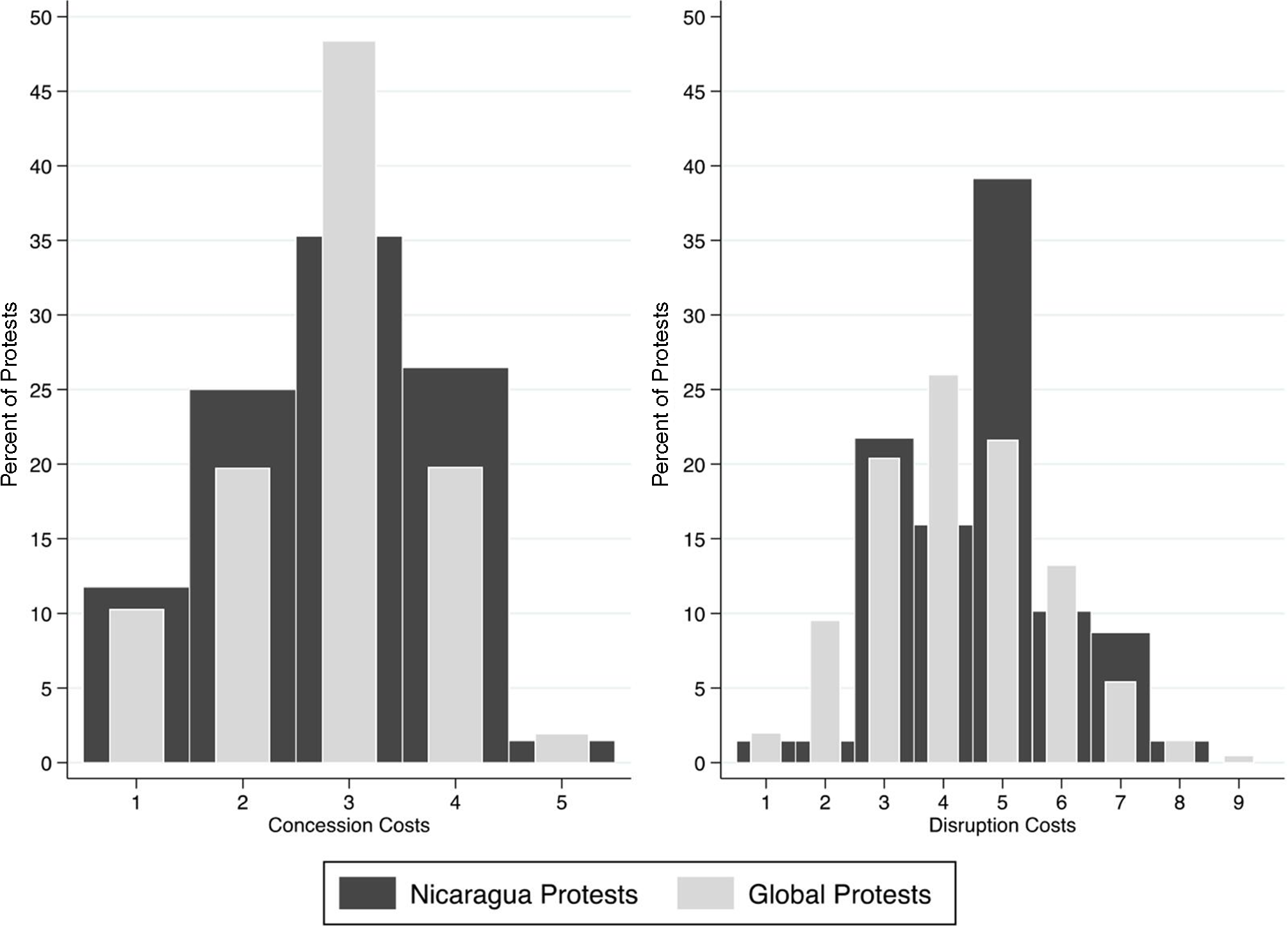
Costs Parameters Distribution Globally and Nicaragua.
In Nicaragua, for the sixty-nine recorded protests, disruption costs are based on the following: 5.8 per cent of protests were rural, 5.8 per cent were urban, 79.7 per cent in the capital, and 8.7 per cent were national; protest size ranged from fifty to 60,000 participants – 20.3 per cent had 50–99 participants, 29.0 per cent had 100–999 participants, 40.6 per cent had 1,000–9,999 participants, and 10.1 per cent had ≥10,000 participants; and 78.3 per cent lasted one day, 13.0 per cent lasted two–seven days, and 8.7 per cent lasted > seven days. Compared to the global sample, protests in Nicaragua lasted longer, concentrated in the capital, and were more likely to mobilise thousands of participants.
Concession costs are based on the following: 30.4 per cent of protests are low threat, 62.3 per cent are medium threat, and 7.3 per cent are high threat; 55.9 per cent of demands were the same as in the previous protest; and 47.8 per cent of protests were violent. Compared to the global sample, protests in Nicaragua were lower threat, less recurrent demands, but more violent.
We also benchmark Nicaragua’s yearly averages against global, regional, and similar political-economic countries’ trends. For these benchmarks, we end the comparison in 2017 so as to not be misleading in the visualisation that 2018 would have only included data up until 17 April instead of the entire year. There were no protests recorded in MM Data in Nicaragua in 1991, 2007, and 2017. The first benchmark in Figure 2 is between Nicaragua and the global MM Data.
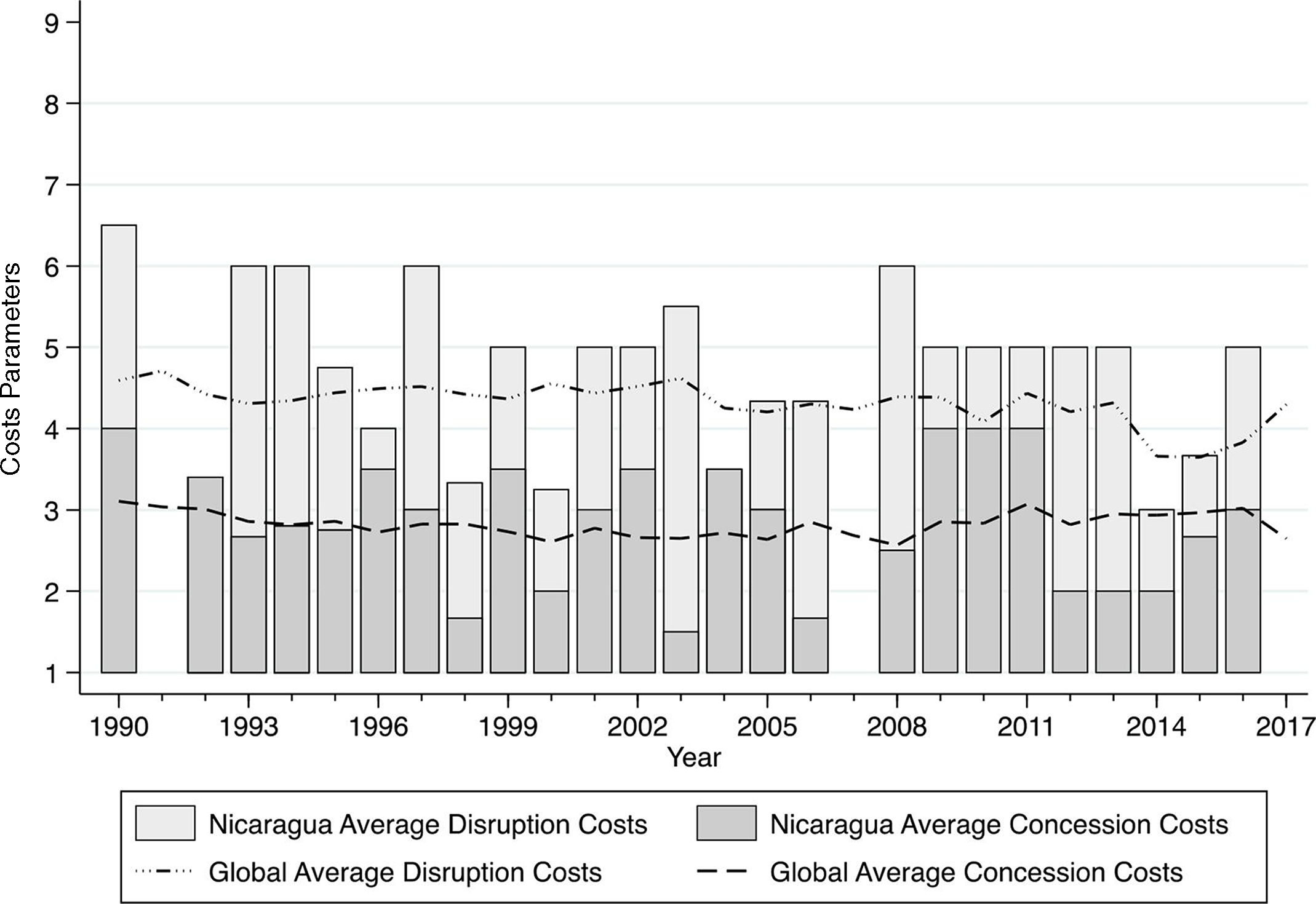
Global Averages versus Nicaragua Averages, 1990–2017.
The global averages are stable across years. Nicaragua experienced much more variation. The fluctuations are largely due to the variance in the number of protests per year, ranging from one to six, in Nicaragua, but this cannot explain everything. For example, in 2005, MM Data record six protests in Nicaragua, and the country’s average concession and disruption costs closely resemble the global averages, yet in 1994 when there were five protests recorded, we observe tremendous deviation in the global and country average disruption costs. Nicaragua’s average yearly disruption costs tend to trend higher when deviating from the global averages. Concession costs deviations are more variable, both higher and lower, than the global averages. Beginning in 2014 both costs in Nicaragua began a steady increase culminating in the maximum costs during Phase 1 of the 2018–2019 crisis (see below).
In Figure 3, we compare Nicaragua to Latin America because regional protest, rebellion, and conflict histories may play an influential role in how current activists organise, mobilise, and engage in collective action (Bell and Murdie, 2018). In Latin America, disruption costs trend slightly higher and concession costs trend slightly lower than the global average. Nicaragua’s average disruption costs better resemble Latin America’s than the global averages. And the increasing trend in Nicaragua’s disruption costs is more clearly reflected in Latin America. Nicaraguan protests’ disruption costs in 1994 were higher than the regional trend, but the 2005 protests’ disruption costs were slightly lower than the regional average. Concession costs in Latin America and Nicaragua continue to vary and do not show a distinct shared pattern.
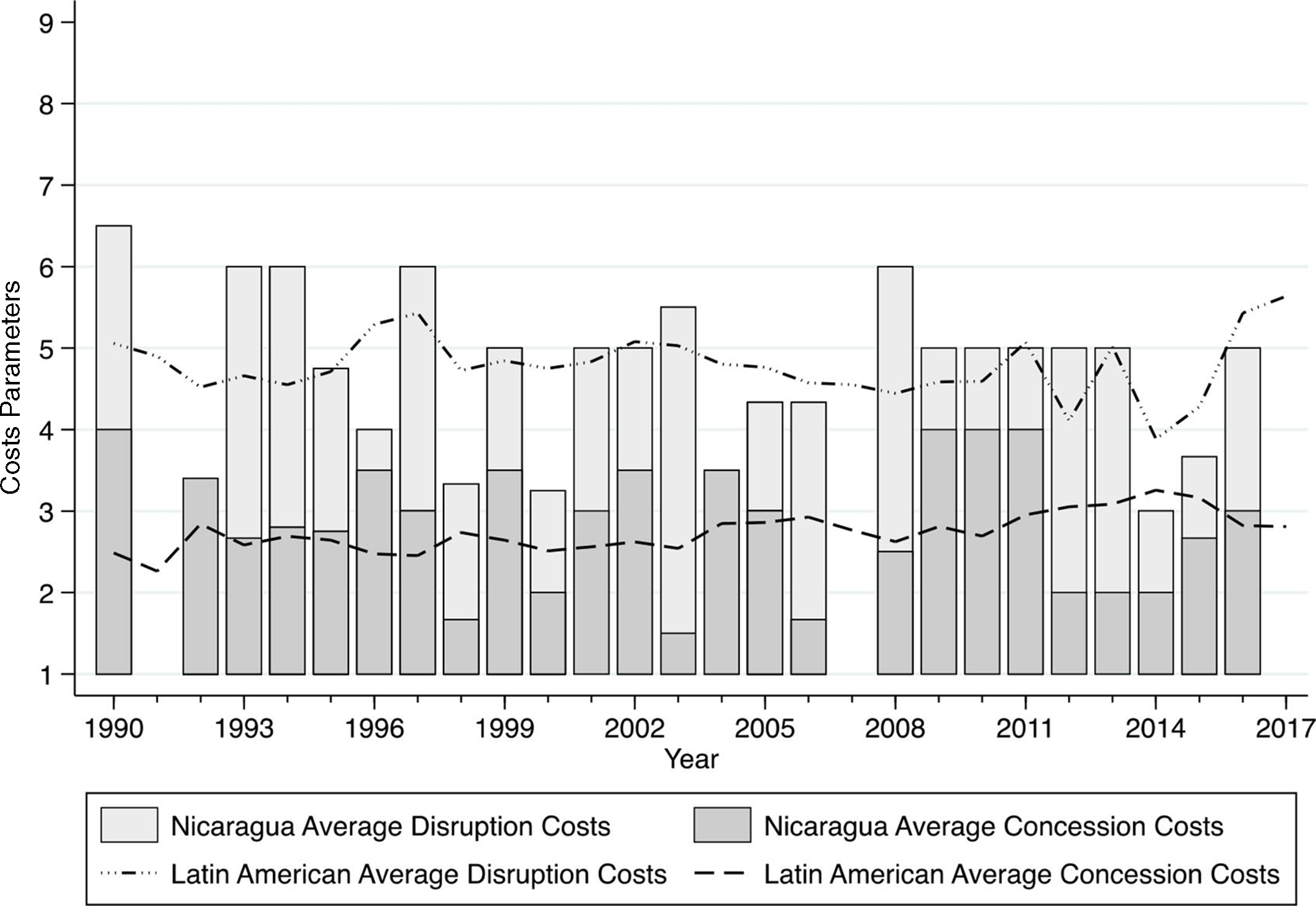
Latin America Averages versus Nicaragua Averages, 1990–2017.
In Figures 4 -6, Nicaragua is compared to Central America, a more restricted geographical region; other Lower-Middle Income countries; and countries with the same PolityV score (Marshall and Jaggers, 2018). PolityV ranges from −10 to 10, where higher values correspond to greater democracy. From 1990 to 2017, Nicaragua changed PolityV; from 1990 to 1994, it was a value of 6, in 1995 the value increases to 8, increases to 9 in 2007, and then returns to 6 in 2016. For each of these PolityV-regimes, in Figure 6 we benchmark Nicaragua’s protests against protests in countries with the same PolityV value. The exercise shows that Nicaragua’s concession costs did not closely follow the Central American or Lower-Middle Income countries. The upward trend in disruption costs Nicaragua experienced is steeper in Central America. Nicaragua is also different than other Lower-Middle Income countries.
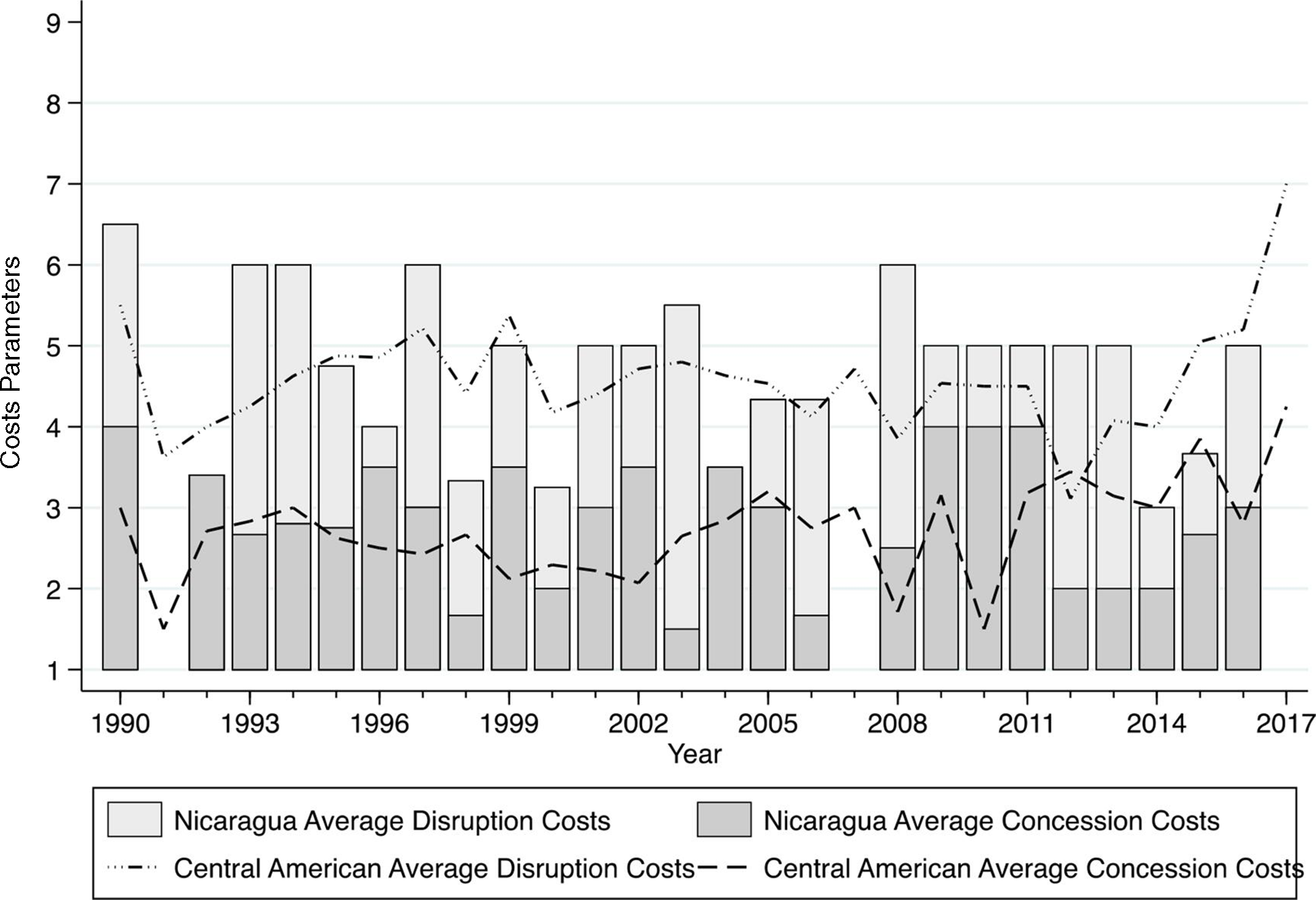
Central America Averages versus Nicaragua Averages, 1990–2017.
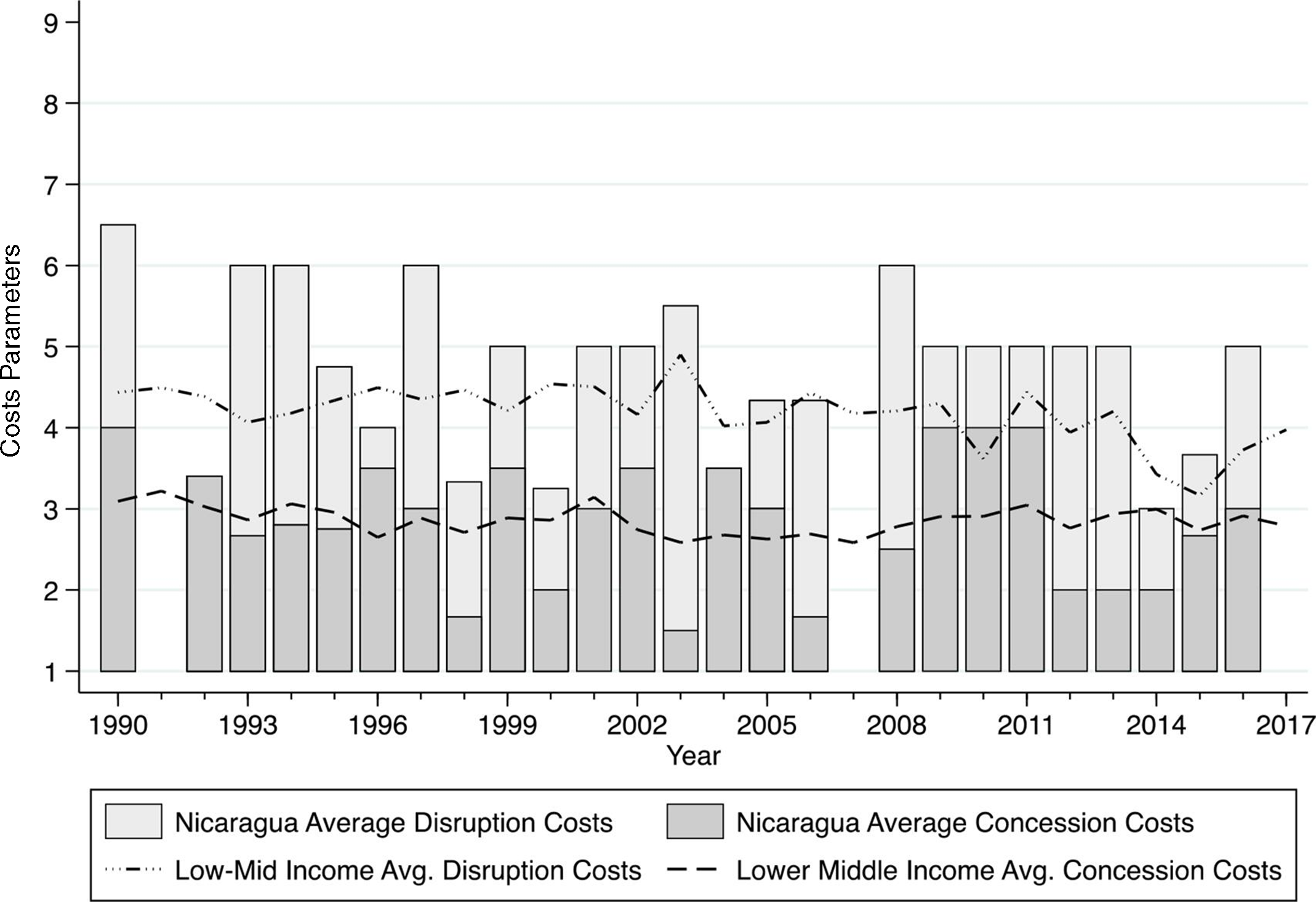
Low-Middle Income Countries versus Nicaragua Averages, 1990–2017.
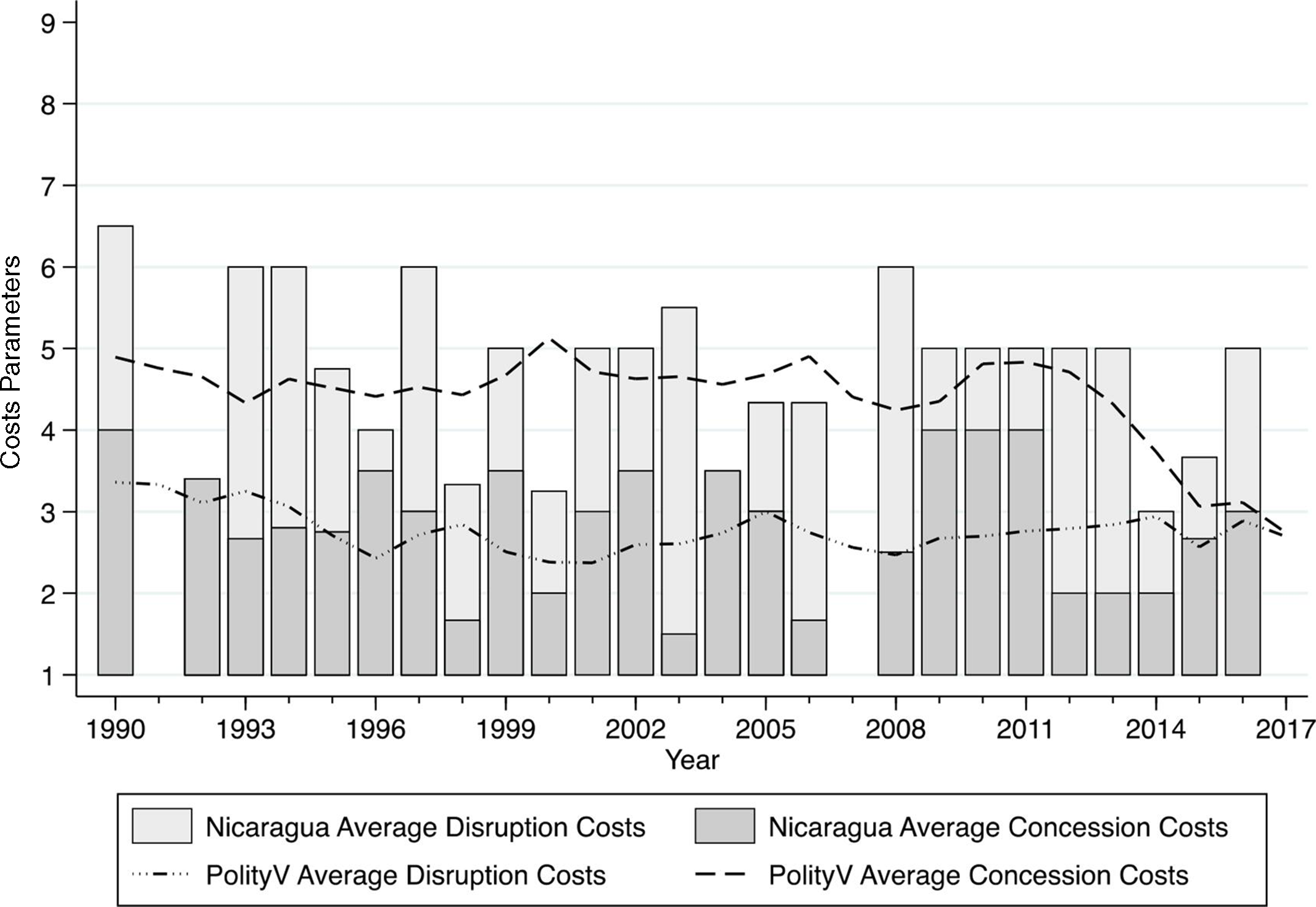
Similar PolityV Scores Averages versus Nicaragua Averages, 1990–2017.
Across PolityV-regimes, Nicaragua looks different. Nicaragua’s disruption and concession costs are again more variable across time. From 2010 to 2014, disruption costs in Nicaragua and PolityV = nine countries are nearly identical, but the upward trend in Nicaragua’s disruption costs is not matched; instead PolityV similar countries slightly decrease. Again, there is far more variation in concession costs with peaks and valleys in the two trends that do not overlap.
Protest Crisis (17 April 2018 to 21 September 2019)
To analyse the protest–response dynamics for the 2018–2019 protest crisis, we use the updated MM Data that record twenty protest events during the crisis. These protests looked different; the average concession costs increased, but disruption costs resembled the historical pattern. To better frame these differences, we first compare the cost parameters of protest events during the crisis to previous protest in Nicaragua. In Figure 7, protest events are plotted by their concession and disruption costs and weighted by the frequency of protests with those costs. The larger the grey circle, the more protests with those cost parameters are recorded in MM Data.
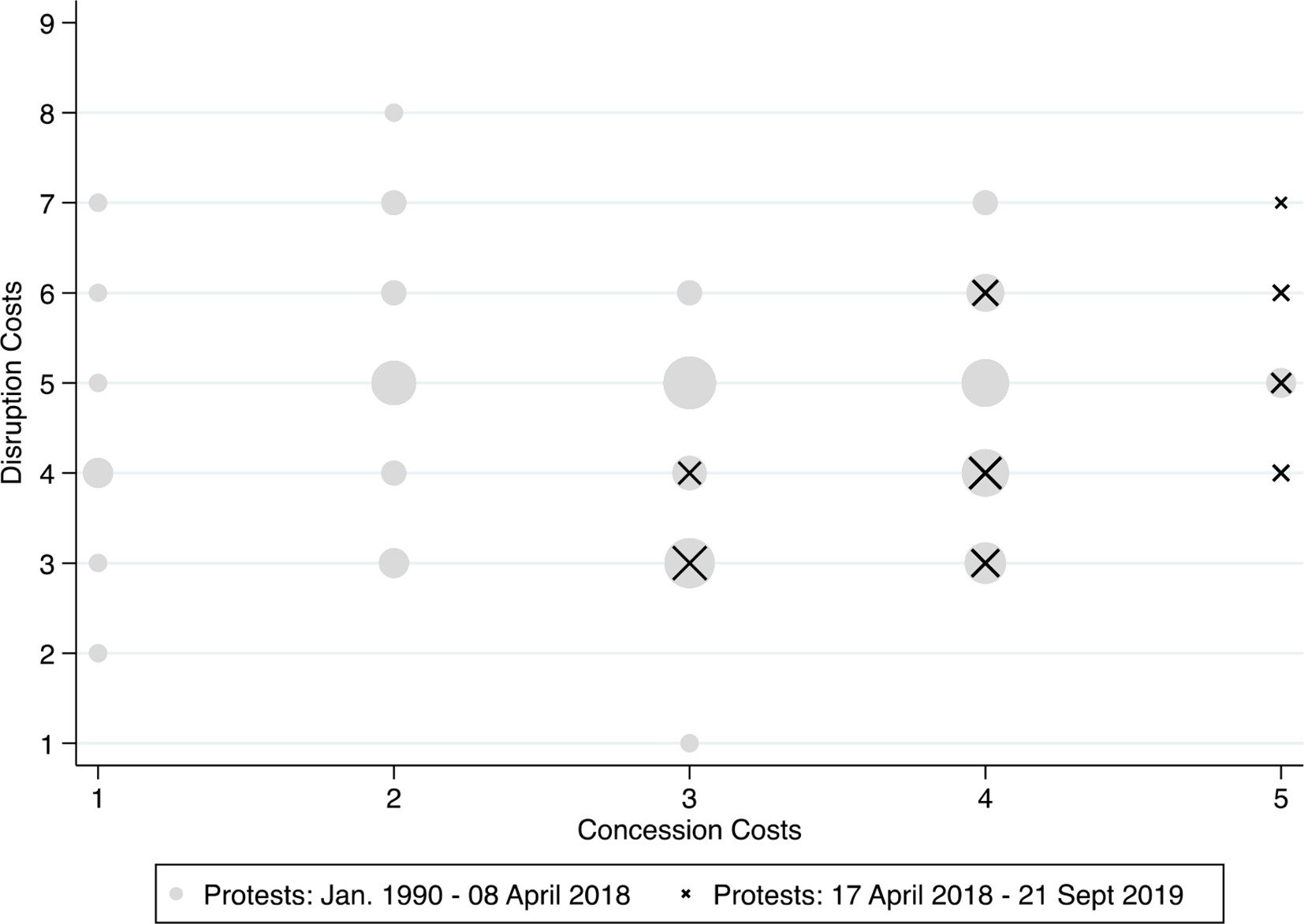
Distribution of Protest Costs in Nicaragua before and during the Protest Crisis.
Second, in Table 1, we summarise how concession and disruption costs of the Nicaraguan protest crisis compare to global, regional, and politico-economic similar countries in 2018 and 2019 (excluding Nicaragua in the comparison categories) and then compare them to the historical data on protests in Nicaragua. 7
Benchmarking 2018 Protest Crisis Events.
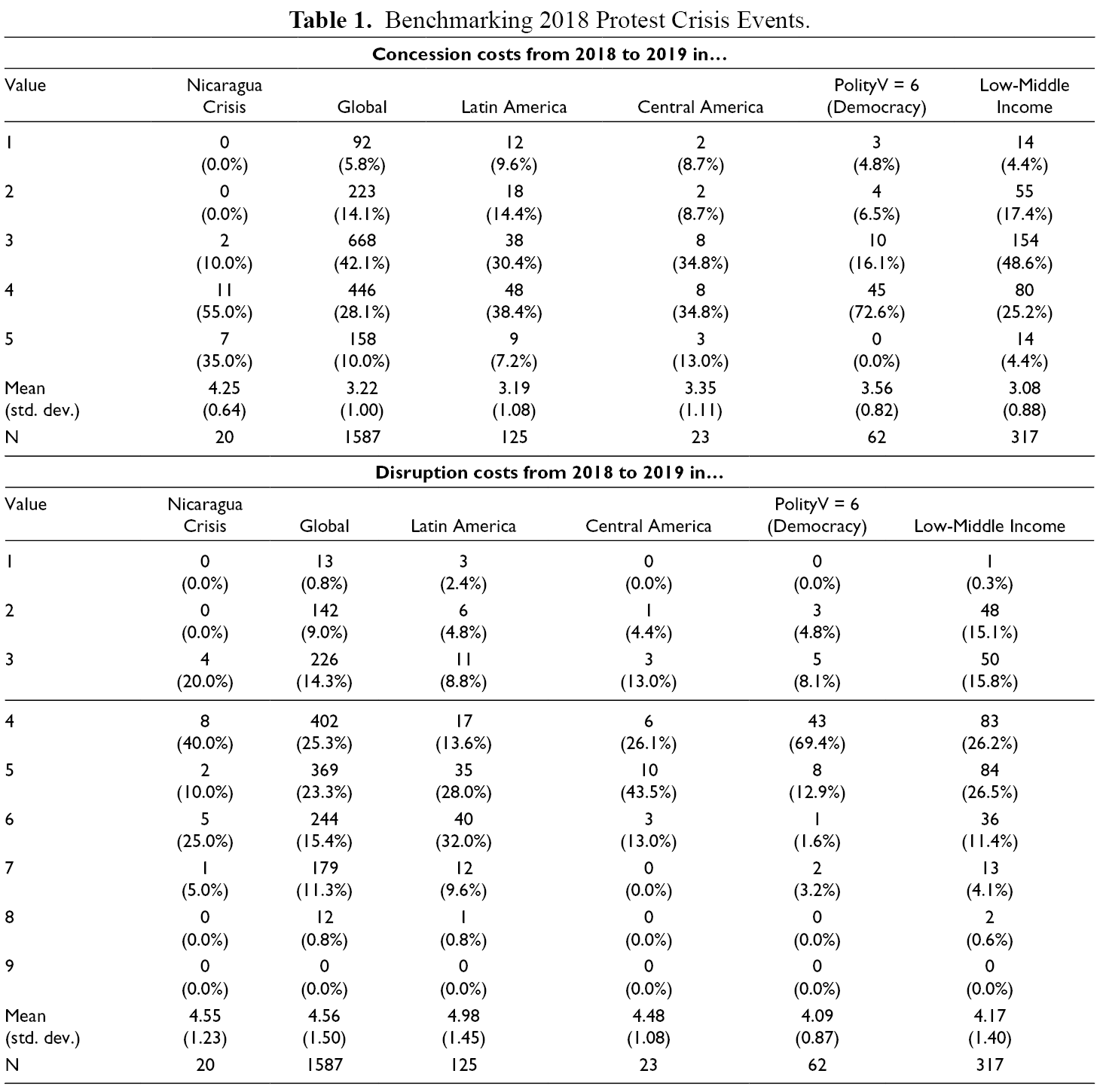
From Table 1, it is evident that the 2018–2019 protests in Nicaragua produced concession costs that were higher than comparison groups around the world in the relevant temporal span. The disruption costs were more closely aligned with the trends; while higher than comparison averages, it is still well within one standard deviation. This suggests that the 2018-2019 Nicaragua protests were different than protests in other countries. It underlines the benefit of analyzing whether Ortega’s response could be predicted (which we do in the next section) or if the world is left waiting to see how the regime responds.
Assessing Protest Responses in Nicaragua 2018–2019
To assess protest responses aligned with the qualitative description in the second section, we aggregate the updated MM Data into the identified four phases, calculate the concession and disruption costs per phase, and then compare the predicted responses to these costs with Ortega’s actual responses. Phase 1 includes eight events from 18 April to 11 June, Phase 2 includes four events from 12 June to 27 September, Phase 3 includes two events from 27 September to 31 January 2019, and Phase 4 includes six events from 27 February to 21 September 2019.
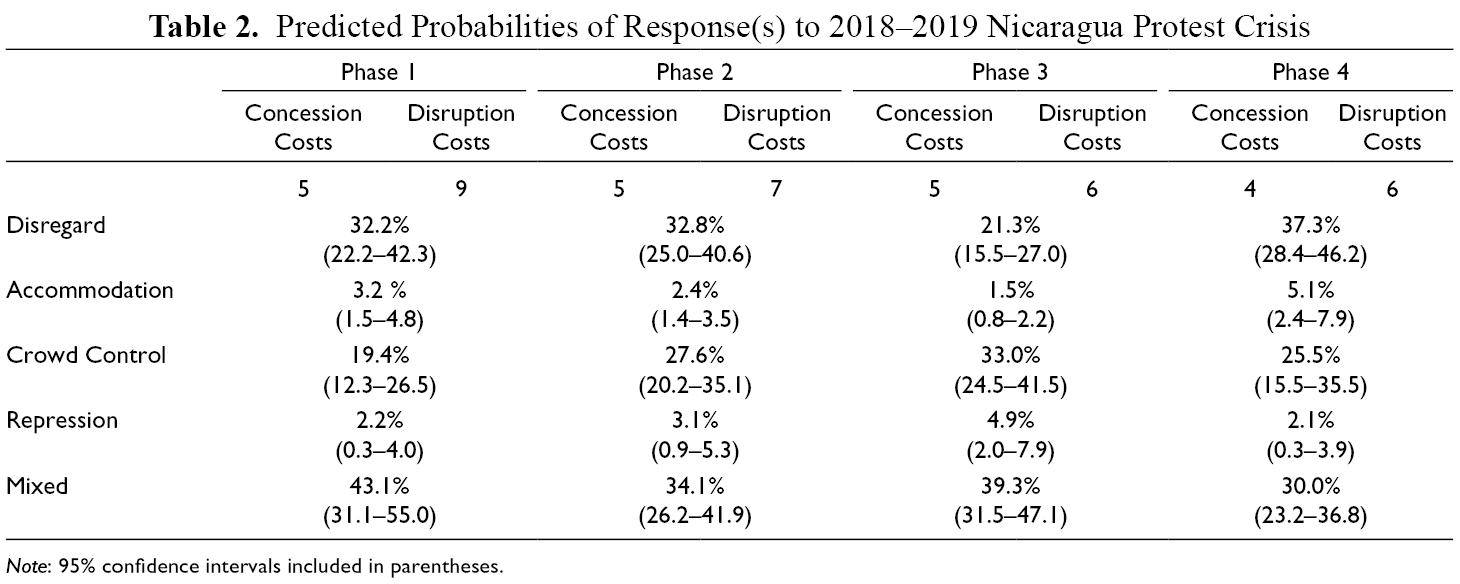
We evaluate the logic or strategic behaviour of Ortega’s responses by inserting updated cost parameters per phase and updated control variables for 2018 and 2019 data into the predicted probability equations produced by Klein and Regan’s (2018a) original model (protests from 1990 to 2014). 8 We briefly describe the model and estimation technique; for a more detailed description, see Klein and Regan (2018a). The dependent variable is government response measured as a categorical variable (disregard, crown control, accommodation, repression, and mixed). The predictor variables are concession costs and disruption costs we describe in The Global Protest Statistics, Historical Trends, and Protest Crisis sections. The model includes a battery of control variables – GDP per Capita, Polity and Polity Squared, Youth Bulge, Previous (Protest) Violence, and Number of Protester Demands. The predicted probabilities are generated replicating Klein and Regan’s (2018a) multi-nomial logit regression analysis with robust standard errors clustered by country. 9 We report the predicted probabilities generated by the model using the phase specific cost parameters in Table 2 with 95 per cent confidence intervals.
Predicted Probabilities of Response(s) to 2018–2019 Nicaragua Protest Crisis
Note: 95% confidence intervals included in parentheses.
In Phase 1, concession (5) and disruption (9) costs reached their maximum values. Based on the predicted probabilities, a strategy of mixed responses was most likely. This is what is observed in Nicaragua. According to the MM Data, when protests started on 18 April, Ortega initially tolerated them, but within days protesters were arrested, beat, and shot. The escalation of repression in Phase 1 is verified by the qualitative reporting. In Phase 1, Ortega’s response aligns with the model’s predictions.
In Phases 2 and 3, concession costs remained at the maximum, but disruption costs were lower, 7 and 6, respectively, because fewer people participated in the protests. MM Data record thousands of protesters in Phase 2 and hundreds during Phase 3. The reduced size suggests that Operación Limpieza and government banning of protests worked as deterrents to collective action, respectively. The government deterrent efforts, which help define Phase 2, may be why when dissidents still mobilised to protest in Phase 2, they were met with a government response that does not align with the model’s predictions. The most likely governments responses predicted by the models in Phase 2 are mixed or crowd control, but the government responded with the single strategy of repression – a predicted probability of 3.1 per cent. Perhaps Ortega weighed the potential costs and backlash from repression with the desire to reiterate his protest deterrent with violence. The lower disruption costs of Phase 3 result in nearly equal predicted probabilities of crowd control or a mixed response. Ortega chose to, at least nominally, de-escalate by only using crowd control mechanisms, but maintained a single response perhaps to reinforce his message that protests must end.
Ortega’s response again aligns with the model in Phase 4. Although concession costs declined to 4 as protesters took a non-violent approach (according to MM Data), Ortega remained steadfast in applying crowd control and repression reflecting the mixed response the model predicts at 30.0 per cent. The empirical data show he did not wade into the waters of negotiation and consider accommodation, which reaches the highest predicted probability in Phase 4, as a possible response, even in light of protesters’ de-escalation in violence.
The consistent heavy-handed response to the protest crisis, which at times aligns and diverges from empirical predictions, may reflect a desire, or need, within the ruling elite to reinforce the 2016 presidential elections that were criticised by opposition parties as an unfair contest. Yet, even if motivations for the government’s response extended beyond protest costs, Klein and Regan’s (2018a) model of protest–response dynamics from 1990 to 2014 proved valuable in assessing the strategic logic of Ortega’s response to protests in 2018–2019.
Conclusions
Frequent low-intensity protests were familiar to Nicaragua’s recent history, also during the Ortega administration prior to 2018. In fact, several authors argue that despite the increasing de-democratisation of Nicaragua, Ortega had only occasionally used violence. This is why the rapid escalation of protests, the extent of repression, the duration, and the death toll of the 2018–2019 protests, to what originally was a routine and rather mundane political event in Nicaragua, caught the world by surprise. The subject matter of the initial protests, social security reform, had caused clashes years ago, but without claiming lives. And, prior to the escalation of violence, Nicaragua enjoyed a socioeconomic performance marked by several years of sustained economic growth, poverty reduction, and a co-operative model with the private sector.
We reviewed multiple sources closely monitoring the events, but only a very few (and very recent) have tried to explain the protests’ origins. These sources also struggled to assess strategic rationales for the government’s response to the protests (being, however, more compelling in explaining why Ortega did not fall from office). We argue that the costs model, which internalises interactive strategic calculations to expectations, measured by threats and costs of protests, is well placed to help us understand Ortega’s protest response decision-making and its alignment with cross-nationally verified strategic rationale.
Armed with this model, this article provides a deep-dive case study (with comparative data for context) that makes sense of this extraordinary period of protest. More concretely, our contribution is three-fold. We first consider the baseline protest and government behaviours globally and compare them with those in Nicaragua, both historically and specific to 2018–2019. As a result, we can assess whether these events constituted a protest crisis or resembled the country’s norm. Second, we evaluate Ortega’s logic or strategic behaviour in response to the protests within the framework of concession and disruption costs. Third, by combining the qualitative description and empirical data, we provide one of the first complete analyses of protest–response dynamics of this protest crisis.
We conclude that the 2018–2019 protests in Nicaragua were unique from historical protests in Nicaragua (1990–2017). The average concession costs in Nicaragua are similar to the crisis, but the average disruption costs are historically much lower – thus constituting the 2018–2019 events a protest crisis. The uniqueness remains when compared to protests outside of Nicaragua’s recent history. Across the distribution of global protests from 1990 to 2019, the maximum disruption costs protesters generated in Phase 1 is a distinct outlier. Compared to Latin American protests, which also tend to have high disruption costs, the events look less of an outlier. But the protest crisis is still a unique case for Central America, countries with similar political development, and lower-middle income economies.
Historically, government responses to protests also differ between Nicaragua and the global sample, with repression being applied at a significantly higher rate in Nicaragua. Perhaps suggesting repression in 2018 was more likely than protesters, dissident organisers, and event observers would have liked to believe. Even so, applying the costs model framework and predicted probabilities, we conclude that the Ortega administration’s responses were typically aligned with the logical responses based on the concession and disruption costs. And while Ortega applied extensive repression more consistently than the model suggests he should have; his response was well within the model’s expectations. His zealotry for repression is most evident in Phase 2 when, if the government only uses one method of response, which Ortega did (in the MM Data), the model predicts crowd control tactics, Ortega chose to use repression instead.
While our assessment of the protest crisis using the costs model is specific to Nicaragua, its application can be done to protests elsewhere and in other historical contexts. This is especially true for long-lasting protests, where differentiated phases are observed and the balance of perceptions, expectations, threats, and costs are likely to change. Our analysis shows the advantages of benchmarking episodes against one country’s own history and against other protests globally. It also allows us to understand whether decisions are well-aligned or misaligned with costs. And we show that the much useful monitoring work that is quickly set up to follow protests in real time can be complemented with relatively unsophisticated analytics.
Supplemental Material
Online supplementary file 1 - Supplemental material for The Nicaragua Protest Crisis in 2018–2019: Assessing the Logic of Government Responses to Protests
Supplemental material, Online supplementary file 1, for The Nicaragua Protest Crisis in 2018–2019: Assessing the Logic of Government Responses to Protests by Graig R. Klein, José Cuesta and Cristian Chagalj in Journal of Politics in Latin America
Footnotes
Acknowledgements
The authors are thankful to Michael Weintraub for reading an early version of this project and to the editors and anonymous reviewers for their helpful comments.
Authors’ Note
Dr Cuesta contributed to this research on his personal capacity. The views expressed are his own and do not necessarily represent those of the World Bank nor its Board of Directors.
Declaration of Conflicting Interests
The author(s) declared no potential conflicts of interest with respect to the research, authorship, and/or publication of this article.
Funding
The author(s) received no financial support for the esearch, authorship, and/or publication of this article.

Supplemental Material
Supplemental material for this article is available online.
Notes
Author Biographies
Email:
Email:
Email:
References
Supplementary Material
Please find the following supplemental material available below.
For Open Access articles published under a Creative Commons License, all supplemental material carries the same license as the article it is associated with.
For non-Open Access articles published, all supplemental material carries a non-exclusive license, and permission requests for re-use of supplemental material or any part of supplemental material shall be sent directly to the copyright owner as specified in the copyright notice associated with the article.
