



Abstract

After four years of negotiations between the Colombian government and the Revolutionary Armed Forces of Colombia (Fuerzas Armadas Revolucionarias de Colombia, FARC), a peace agreement was signed in 2016. This accord ended a five-decade-long conflict that has touched almost every Colombian in some way. Over these decades, the FARC has been an omnipresent actor who most citizens reject. Yet a minority of Colombians who have lived under the FARC’s influence may still see them as a substitute for a distant state. Understanding how the Colombian public views the FARC as a political and social actor is not only important for understanding this intriguing case, but it also potentially holds lessons for other conflicts whose resolution will take place in the context of democratic politics.
The purpose of this introduction is threefold. First, it seeks to contextualise the recent peace agreement historically. Second, it provides descriptive public opinion data on the 2016 accord, the FARC, and peace, underscoring elites’ influence in these areas. Third and finally, this introduction gives thumbnail sketches of the articles in this special issue and outlines their main contributions.
Peace Talks in Colombia, 1982–2016
Prior to the 2012–2016 peace process, various governments sustained negotiations, and even reached agreements, with the FARC. However, such attempts failed to put to an end the conflict between the state and this guerrilla. In the early 1980s, the Belisario Betancur administration (1982–1986) and the FARC reached an agreement to transform the guerrilla group into a political party. Out of this process, the FARC formed the Unión Patriótica (UP) party. This political organisation competed in elections with relative success, but it was short-lived. FARC guerrillas did not abandon armed struggle, and thousands of UP members were assassinated by right-wing paramilitaries with plausible state agents’ complicity (Dudley, 2004).
During the Barco and Gaviria administrations (1986–1994), the Colombian government signed peace agreements with various other guerrilla groups, most notably M-19 and Popular Liberation Army (Ejército Popular de Liberación, EPL). But the FARC was not involved in these negotiations. Instead, in 1991, the government launched a major offensive against the FARC. In 1999, after years of a bloody conflict between the Colombian government and the left-wing guerrillas, and the consolidation of right-wing paramilitary groups, President Andrés Pastrana initiated a new cycle of peace talks with the FARC. At the same time, this administration launched the US-funded Plan Colombia counterinsurgency initiative. After three years of infertile talks, the negotiations ended in early 2002. Following this failure, the new government led by Álvaro Uribe initiated eight years of an aggressive counterinsurgency strategy that debilitated, but did not defeat, the FARC and the remaining guerrillas.
The FARC and the Colombian government returned to peace talks in 2012. President Santos’s government surprised the country with the announcement of a “road-map” (General Agreement for ending the conflict and building a stable and long-lasting armed conflict and building a stable and long-lasting peace / Acuerdo General para la terminación del conflicto y la construcción de una paz estable y duradera) structured around six issues with which they would deal sequentially: rural development policy, political participation, end of the conflict, solutions to the problem of illicit drugs, victims, and the implementation, verification, and referendum to put the deal in place. In May 2013, negotiating teams representing each side announced an agreement on the issue of political participation. Over the next three years, the negotiating teams worked through the remaining points. In September 2016, the government and the FARC reached a final pact and President Santos announced that, one month later (2 October), a plebiscite would take place so citizens could express their voice regarding the settlement and the government could have access to special powers to implement the agreement. A slight majority of those who voted in the plebiscite rejected the agreement, forcing Santos to call meetings with the opposition to discuss their objections to the accord. Later, the two negotiating teams met once again to renegotiate the agreement. A new deal between the FARC and the Colombian government was then announced that included some modifications reflecting the points highlighted by the opposition. It was officially signed by the parties in late November and approved by Congress (Matanock and García-Sánchez, 2017).
The backbone of the agreement between the government and the FARC comprises its political participation and transitional justice components. Yet they are among the least supported by the mass public (Figure 1) and have been bitterly attacked by the opposition led by Álvaro Uribe. On political participation, the FARC is legally recognised as a new political party and has access to certain benefits. From 2018 to 2026, for example, regardless of the number of votes the FARC party obtains, it will retain its legal recognition despite election laws that require political parties to pass a threshold of 3 per cent of valid votes in both legislative chambers in order to be recognised. Additionally, the FARC party will be guaranteed to receive five seats in the Senate and five seats in the House of Representatives during this period. The original 2016 accord went even further. It included a provision to guarantee political representation to territories most affected by the conflict, which also overlap with areas of FARC influence, through the creation of a special transitory “peace district” in the House of Representatives, consisting of sixteen seats. Moreover, only “significant groups of citizens” and social organisations would be allowed to win those seats, since existing parties would be banned from competing in these districts (Melo, 2016). The special districts were discussed in Congress in 2017 but failed to pass by one vote. When reintroduced in the Senate in 2018, senators from Centro Democrático, Álvaro Uribe’s party, left the chambers to avoid quorum necessary to hold another vote on the special district. The discussion about this disctict is still open.

Support of Different Components of the Peace Agreement, 2018.
On transitional justice, the agreement revolves around three components: truth, justice, and reparation. On the first dimension, the pact established the creation of a Truth Commission. Justice is handled by a special jurisdiction (Justicia Especial de Paz, or JEP) that studies crimes against humanity and war crimes committed by all parties involved in the internal conflict. This jurisdiction can impose sanctions of up to eight years of restrictions on freedom of movement on those responsible. These benefits are only available to the convicted who recognise their crimes and reveal the truth about the events. The agreement also established that former FARC combatants are granted amnesty for their political offences, a broad category of legally codified crimes. Finally, reparation considers moral and economic compensations to individual and collective (communities) victims (Melo, 2016).
Public Opinion towards the FARC, Negotiated Peace, and the Peace Agreement
After decades of civil conflict, a wide majority of Colombians distrust the FARC, according to public opinion surveys. In the nationally representative samples collected annually by the AmericasBarometer at Vanderbilt University and the Observatorio de la Democracia at Universidad de los Andes, less than 4 per cent of those interviewed claimed to trust the FARC between 2005 and 2014 (Figure 2). Public trust in the FARC jumped to 6.2 per cent in 2016 and remained in that range in 2018. This could reflect a massive shift in the political context. Namely, citizens may feel far more comfortable expressing their true opinions due to the end of open conflict between the FARC and the Colombian government (Gálvis Ramírez et al., 2017). This positive movement could also be linked to general support for the 2016 peace agreement among the Colombian public (Carlin et al., 2019).

Trust in the FARC 2005–2016 and FARC Party 2018.
Indeed, between 2004 and 2018, more than 50 per cent of those interviewed by the AmericasBarometer supported ending the conflict through a negotiated peace with guerrillas as opposed to the use of military force. Support for a peaceful solution of the internal conflict reached its highest level in 2018, probably as a consequence of signing the peace agreement (Figure 3).
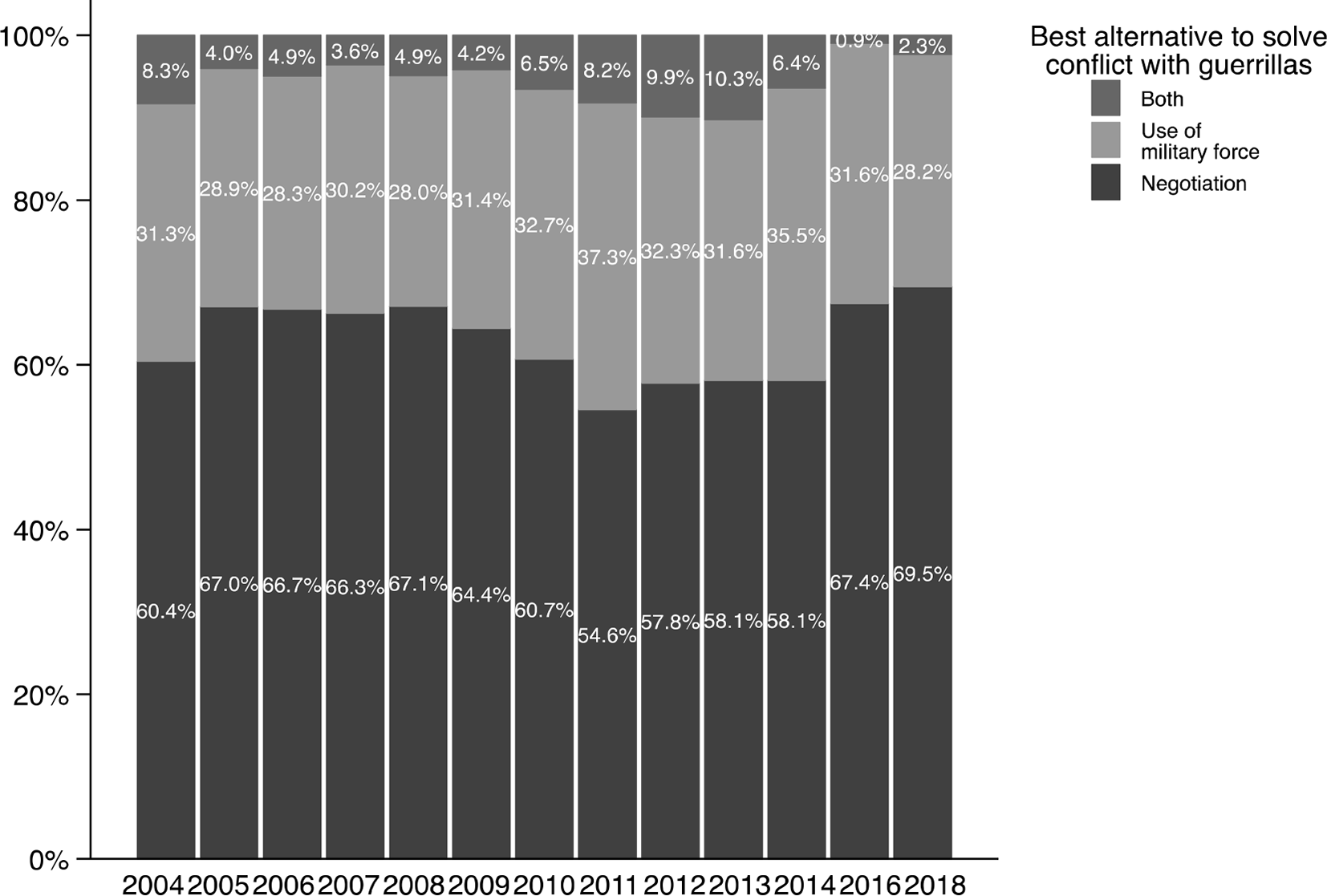
Support of a Negotiated Peace with Guerrillas, 2004–2018.
In 2013 and 2014, levels of support for the peace talks between the Colombian government and the FARC (Figure 4) were very similar to levels of public approval of a negotiated peace (Figure 3). Once the content of the pact was revealed in 2016, it was clear that a peaceful solution to the armed conflict would imply a trade-off with their preferences for more traditional, and more punitive, forms of retributive justice (see Montoya and Tellez, Botero, and Carlin et al., this issue). After that point, support for the (now known) peace agreement fell from levels in the 50 per cent range to the 40 per cent range in 2016 and 2018 (Figure 4).

Support for the “Peace Talks” (2013–2014) and the “Peace Agreement” (2016–2018).
Regarding support for the FARC’s ability to participate in electoral politics, Colombians’ opinions are very negative. Only 15 per cent of those interviewed by the AmericasBarometer between 2013 and 2016 supported the FARC forming a political party (Figure 5). Similarly, in 2016 and 2018, less than 16 per cent of Colombians supported the FARC party presenting candidates to elections (Figure 6). These numbers indicate that, despite relatively high popular support for a negotiated solution to the internal conflict, Colombians reject the core of a peace agreement with this insurgent organisation: the transformation from guerrillas – Fuerzas Armadas Revoluncionarias de Colombia – to a political party – Fuerza Alternativa Revolucionaria del Común – and their subsequent participation in politics. Colombians want peace but appear unwilling to make political concessions to the former rebels.

Approval of the FARC Forming a Political Party, 2013–2016.
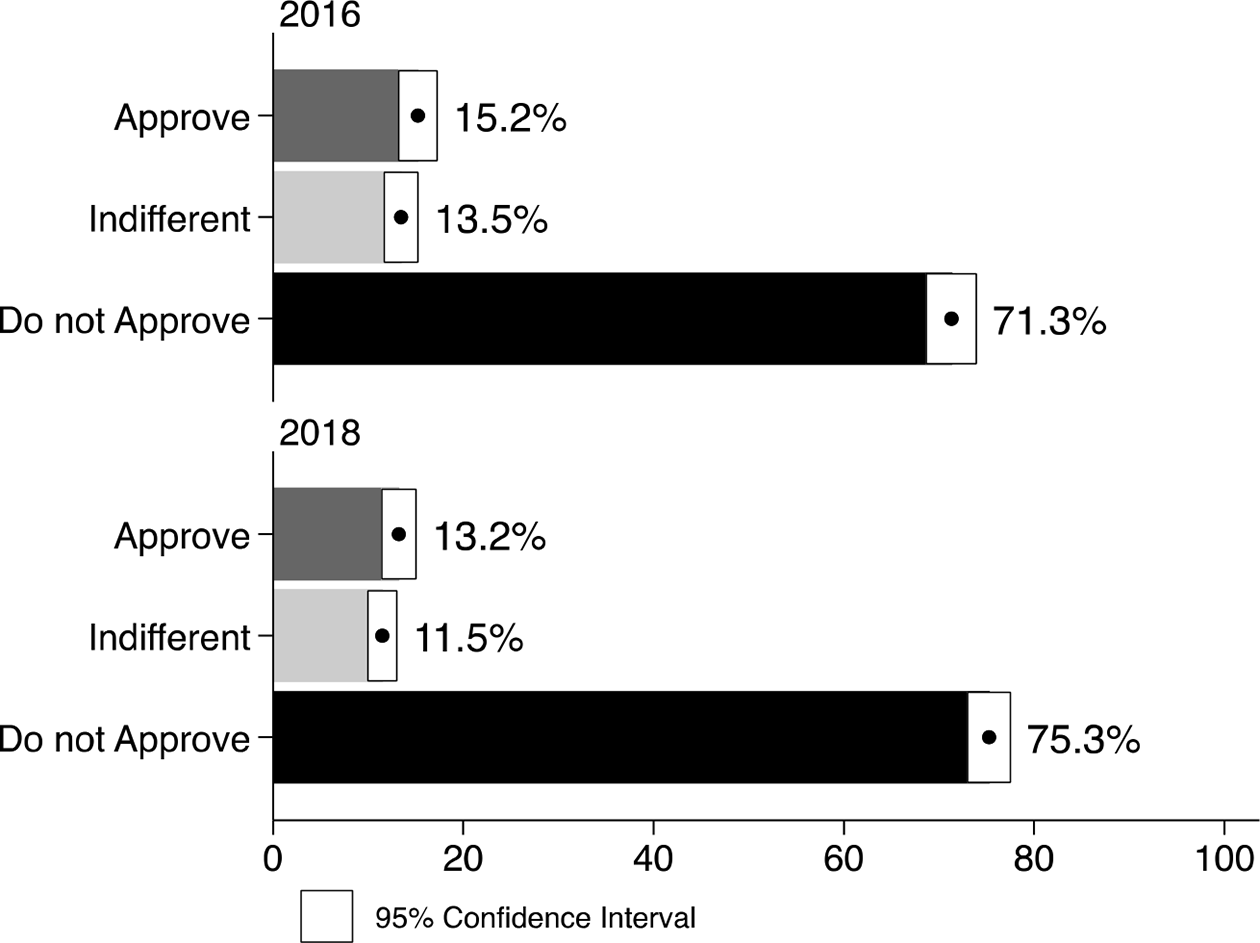
Approval of the FARC Party Presenting Candidates to Elections 2016–2018.
Elite Divisions
In order to understand the opinion of Colombians about peace and the 2016 peace agreement, one must factor in the opinions of elites and their divisions. As mentioned previously, in 2010 Juan Manuel Santos was elected to continue the hard-line security polices promoted by Álvaro Uribe. However, after a few months into his government, Santos started to distance himself from his predecessor. For instance, the new president re-established diplomatic relations with Venezuela despite Uribe’s opposition. When Santos announced peace talks with the FARC in 2012, it triggered the definitive rupture between Santos and Uribe. This political dispute polarised most Colombian politicians between supporting President Santos or former president Uribe, now the leader of a bitter opposition to the government he contributed to elect. This cleavage has persisted from 2012 to the present.
The elite division is mirrored in public opinion. For almost two decades, Colombian politics and public opinion have been largely articulated by two conflicting political camps: those who support Uribe and those who oppose him. However, as Matanock and García-Sánchez (2017) show, after Santos distanced himself from Uribe and the former president increased his criticisms of the government and the peace process, a gap opened between a political camp led by Uribe and a second camp that brings together all those political groups who oppose Uribismo. For instance, after the feud between Santos and Uribe became public, support for a negotiated peace among uribistas decreased significantly while it grew in the other political camp (Figure 7). Elite-led divisions in public opinion are also evident regarding other aspects of the peace agreement, such as forgiveness, reconciliation, justice outcomes, and political participation of the FARC (Carlin et al., 2019). It is important to mention that there is no opinion gap between the two political camps on issues that these sparring political elites are not debating (e.g. economic issues or social values).

Support of a Negotiated Peace with Insurgents by Political Camp, 2006–2016.
Colombia and Beyond
Public opinion is a crucial component for the initiation and success of peace talks between conflicting parties and for the successful implementation and stability of a peace agreement. Citizens’ attitudes matter because sometimes they are asked to vote to validate peace agreements, and because they are always involved in the implementation phase, even if citizens are not asked to cast a vote. Settlements that lack civilian co-operation and support are likely to fail. Evidence from the Colombian case presented in this symposium can shed light on other cases that embark in peace talks in the context of democratic politics.
What the foregoing evidence makes clear is that even if governments manage to broker a peace deal with guerrillas or other warring factions in internal conflicts, it does not guarantee the deal’s public legitimacy. In democratic contexts, this has two main implications. First, popular sovereignty dictates that democratic actors must strive to enact policies that the voters support. If a peace agreement lacks support, subsequent elections might usher in actors bent on dismantling it piecemeal or altogether. Second, any peace deal that seeks to incorporate warring actors into formal politics must consider how public support will influence their electoral viability. Thrusting them headlong into elections, as happened with the UP party, or artificially inflating guerrillas cum politicos’ roles in legislative politics, as the Colombian current peace accord allows, are fraught propositions. By analysing these questions in the Colombian case, we seek to inform scholars and practitioners in other democracies seeking to resolve internal conflicts.
Plan for the Special Issue
In order to understand the public’s political role in a peace process and in sustaining peace in Colombia after the 2016 agreement, this special issue seeks to investigate the drivers of public opinion towards these delicate but essential issues. Four teams of authors contributed four original, path-breaking articles. Here we briefly preview them and outline their key contributions.
In the issue’s first piece, Montoya and Tellez explore the factors that fuel Colombians’ preferences for a classic (if potentially false) dichotomy to ending the conflict: through negotiation or by military force. Whereas the other articles in this special issue seek causal explanation, Montoya and Tellez’s aim is prediction. By leveraging an extraordinarily rich twelve-year rolling cross-section of annual surveys from the AmericasBarometer/Observatorio de la Democracia, the authors determine the strongest predictors of Colombians’ support for holding peace negotiations with the FARC using the Random Forest algorithm. Based on this supervised machine-learning approach, Montoya and Tellez identify living in the conflict zone, support for extra-legal means of punishing criminals, and trust in state institutions as the most predictive covariates of support for negotiated peace over military force. Altogether, their analysis suggests that attitude formation towards conflict termination is shaped by basic questions surrounding the geography of conflict, prepolitical social preferences, and Colombians’ relationship to the state.
This analysis nicely sets the table for the rest of this issue. Understanding what moves Colombians to embrace negotiated instead of military solutions is a crucial first link in a much longer chain of public opinion towards the resolution of conflict between the government of Colombia and the FARC. As the other articles in this issue will show, the factors that predict the negotiation/military force dichotomy need not be the same ones that drive attitudes towards other links in this chain, such as the FARC becoming a political party, the JEP, the 2016 referendum, or the peace process overall. A major take-away from this special issue is that, indeed, Colombians have real attitudes and sophisticated belief systems about the conflict that has pervaded every aspect of Colombian society for decades. As such, Montoya and Tellez’s analysis serves as an excellent starting point for this discussion and it should shape broader debates surrounding the role of public opinion in conflict resolution.
Since Colombia ultimately chose the negotiated peace route, a logical next link in this chain is to understand why Colombians reject or welcome the FARC’s participation in politics. Miguel García-Sánchez and Juan Camilo Plata-Caviedes’ contribution views this question through the lenses of citizens’ victimisation and partisan profiles. Their evidence suggests victims are not systematically less supportive of the FARC’s participation in politics than non-victims – regardless of which group, they are victims. Victimisation only has an impact among those with strong partisan allegiances – that is to say, victims who espoused a close identification with former president Álvaro Uribe’s Centro Democrático party showed significantly less support for the FARC’s political participation. The finding is most pronounced not among FARC victims but, rather, among Colombians who have been caught in the “crossfire” of multiple groups. García-Sánchez and Plata-Caviedes conclude that when political parties make conflict resolution part of their electoral platforms, citizens can take elite cues about how to interpret victimisation and whom to blame.
From a theoretical point of view, these findings hint at the processes by which citizens form attitudes towards conflict resolution. Despite first-hand experience with the conflict, adjudicating between policy options aimed at resolving it is highly complex. For victims of multiple groups, basic tasks of assigning blame and responsibility are cognitively demanding; assessing the viability of competing policy responses adds another layer of complexity. García-Sánchez and Plata-Caviedes’ results thus resonate with what we know about how individuals make complex political decisions in low-information environments. Specifically, they tend to rely on cognitive heuristics/information shortcuts, and political parties and leaders provide some of the most commonly referenced sources of such cues. In this sense, García-Sánchez and Plata-Caviedes make a more general contribution to our understanding of attitude formation in the context of conflict resolution.
Another major pillar of the peace process deals with justice for war crimes and crimes against humanity. Sandra Botero’s article examines what shapes Colombians’ support for the JEP, the centrepiece of the transitional justice regime created to deal with such crimes. In the tradition of Easton, Botero argues that support for the JEP can be “diffuse” – how much the public trusts it as an institution – or “specific” – how much the public approves of particular rulings. Distrust in the JEP and discontent with its rulings could stymie the peace process, she reasons. To test these expectations, Botero employs a vignette about a hypothetical man who confesses to homicide before the JEP and experimentally varies two elements of his profile: (1) whether the man is a former guerrilla combatant or a solider in the Colombian military and (2) whether the JEP sentences him to a reduced sentence that includes either jail time or house arrest and working to clear landmines. Botero finds no effect vis-à-vis the defendant as an ex-guerrilla or a Colombian solider. However, more restorative/less punitive forms of justice damage (specific) support for the sentence but not (diffuse) trust in the JEP.
Theoretically speaking, these results offer insight into the relationship between specific and diffuse support at the onset of institutional creation. Easton (1975) theorised that institutions must rely on specific support until their performance, over time, fills a reservoir of goodwill, that is, diffuse support, upon which they can draw. Botero’s analysis shows that performance only affects specific, but not diffuse, support, perhaps because the JEP is still building its “track record,” and citizens have very little experience with it. Such findings help illuminate a theoretical grey area. Lessons for the JEP and similar tribunals elsewhere are potentially chilling – namely, that such courts may never earn broad public trust because they receive “a mandate to hand down decisions that the public finds particularly unpalatable” (Botero, this issue p. XX). Whether and how citizens’ trust in the JEP grows could be crucial to understanding the viability of the peace process in Colombia.
Proceedings from the Havana peace talks were reported regularly in the press and debated widely among political leaders and pundits. Therefore, even before the peace deal was signed, citizens had a fairly good idea of what elements the 2016 referendum would feature. The aforementioned contributions focus on support for two such areas – FARC political participation (García-Sánchez and Plata-Caviedes) and transitional justice (Botero). In the final piece in this symposium, Carlin, Love, McCoy, and Subotic examine how provisions in these two areas influence the legitimacy of the peace process and voting intentions in the 2016 referendum. They propose that resolving conflict in democratic contexts, such as Colombia, should heighten the importance of ex-guerrilla participation in the formation of attitudes towards the peace process. Carlin et al. (this issue) test this proposition by triangulating evidence collected prior to the 2016 referendum on the AmericasBarometer/Observatorio de la Democracia survey, a vignette-based experiment administered in two waves, and a conjoint experiment. Their results are unequivocal: the legitimacy of the Colombian peace accords – hammered out in Havana and rejected in the October 2016 referendum – were linked to how Colombians evaluated the FARC participating in politics. By comparison, effect sizes are on par with (if not larger than) those related to their feelings towards the various provisions in the transitional justice regime.
Carlin et al.’s (this issue) most substantial theoretical contribution is to insert support for ex-combatant integration into democratic politics more squarely into the debates about public support for conflict resolution. Most of the success stories of political integration come from transitional contexts (e.g. El Salvador, South Africa) and thus did not threaten to destabilise a long-standing democratic equilibrium. Post-referendum events in Colombia are suggestive of the importance of public support for political integration provisions. Namely, the legislation the Santos administration ultimately shepherded through the Colombian Congress and the Constitutional Court eliminated special electoral districts perceived to benefit the fledgling FARC political party. As more democracies seek to end internal conflicts, policymakers may consider the implications for the overall legitimacy of the peace process.
The four pieces included in this special issue reveal that citizens’ opinions towards the broad issue of peace are multi-dimensional and very complex. They cannot be framed in a pro/anti peace duality, as the public has real attitudes and sophisticated belief systems about the conflict that has pervaded every aspect of Colombian society for decades. That complexity can be seen through the main lessons derived from this special issue. First, the factors that predict public support for negotiated peace are not the same ones that drive attitudes towards the main components of the peace agreement and vote choice in the 2016 referendum. Second, peace agreements are complex policies about which citizens have low information. Hence, to form their opinions on key provisions, citizens tend to rely on cognitive heuristics – cues from polarising political elites – more than on their experiences with conflict. Third, transitional justice tribunals face high barriers to earning broad public trust. They immediately act on a mandate to hand down decisions that the public finds hard to swallow and lack a reservoir of diffuse support on which to draw. Fourth, the overall legitimacy of the Colombian peace accords cannot be de-linked from how Colombians felt about the FARC participating in politics. Most of the lessons from this special issue are particularly relevant to understand the Colombian case; however, at a time in which scholarly interest on these topics is increasing, we believe that the pieces included here contribute new ideas to better understand the sources of the legitimacy of peace processes and peace agreements worldwide.
Footnotes
Acknowledgements
We thank the Latin American Public Opinion Project (LAPOP) of Vanderbilt University and Observatorio de la Democracia of Universidad de los Andes for making the data available. We also thank The Colombian Institute of Educational Credit and Technical Studies Abroad (ICETEX) for partially funding the author's workshop "The Peace Agreement Under the Gaze of Public Opinion: Negotiation, Political Participation and Transitional Justice" held at Universidad de los Andes in August 2019. We also thank María Carolina Mesa for helping us to organize the Author's Workshop and Juan Camilo Núñez for his research assistance.
Declaration of Conflicting Interests
The author(s) declared no potential conflicts of interest with respect to the research, authorship, and/or publication of this article.
Funding
The author(s) received no financial support for the research, authorship, and/or publication of this article.
Author Biographies
E-mail:
E-mail: