




Abstract
Some observers claim that conditional cash transfer programmes limit the stigma of taking welfare and thereby promote social inclusion for beneficiaries. This article uses data from the 2014 AmericasBarometer to test these claims in relation to Brazil’s Bolsa Família programme (BFP). The results show that, despite the programme’s innovative design, beneficiaries encounter the stigmatisation and negative self-stereotypes that characterise more traditional anti-poverty programmes. Many Brazilians, recipient and non-recipient alike, endorse explicitly negative stereotypes of Bolsa Família assistance recipients. Moreover, the level to which respondents endorse these stereotypes strongly predicts their level of support for the BFP. These results highlight the pervasive nature of negative stereotypes towards the poor, even in the context of the developing world, and are consistent with the predictions of social psychological theories of system justification.
Keywords
Introduction
There is compelling evidence that people have a strong tendency to stereotype and engage in discriminatory behaviours against the poor, particularly when the poor receive targeted assistance from the state (Cozzarelli et al., 2001; Walker et al., 2013; Walker, 2014; Withorn, 1996). Although poverty is a complex phenomenon that results from the interaction between individual and societal choices, stereotypes of welfare recipients often revolve around perceived individual character “flaws” (e.g. the “undeserving” poor [Gilens, 1999; Hancock, 2004; Kinder and Kam, 2009; van, 2000 ; Petersen et al., 2011; Petersen, 2012; Seccombe, 1999]). In this way, privileged individuals can justify their social standing and the social system that has produced their advantages (Jost and Banaji, 1994). These patterns are evident across numerous social contexts, including both developed and developing countries, and may complicate policy-makers’ efforts to implement necessary anti-poverty policies. Still, based in part on this knowledge, conditional cash transfer (CCT) programmes, pioneered in Brazil and Mexico in the 1990s, ostensibly seek to combat stigmatisation. The question I address here is whether the beneficiaries of these programmes escape the seemingly universal tendency to discriminate against welfare recipients and whether there are observable correlations between perceptions of beneficiaries and support for social assistance programmes.
Conditional cash transfer programmes, which provide poor families with regular cash benefits on the condition that they invest in the human capital development of their children, have been a crucial component of Latin America’s turn towards more targeted aid for the poor over the last several years (Oorschot and van, 2010; Barrientos and Santibáñez, 2009; Cecchini and Madariaga, 2011; Dion, 2009, 2010; Fiszbein and Schady, 2009; Handa and Davis, 2006; Huber and Stephens, 2012; Valencia Lomelí, 2008; Rawlings, 2005; Sewall, 2008). These programmes represent an innovative attempt to move anti-poverty efforts beyond “ad-hoc and mostly in-kind transfers intermediated through various service providers, nongovernmental organizations, and local governments” towards a more technocratic, programmatic, and inclusionary pattern of anti-poverty policy (Fiszbein and Schady, 2009: 10-11). They also represent a significant expansion of the welfare state in developing countries and are now important tools in the global effort to eradicate extreme deprivation.
Conceptually, the conditions attached to receiving benefits under CCT programmes serve a dual purpose: not only do they aim to ensure that the poor invest in the long-term well-being of their children and families at a higher rate than they might otherwise but they also presumably serve to help ensure that a sceptical non-recipient public is more willing to support the implementation of the programmes (Fiszbein and Schady, 2009: 8-11; Handa and Davis, 2006: 523). Thus, according to the conceptual logic of these programmes, by requiring CCT recipients to engage in “good behaviors” like ensuring that their children attend school and receive basic vaccinations as a prerequisite to receiving their benefit, sponsoring agencies can frame the programmes as more than mere “handouts” to the poor; rather, they can argue that these programmes explicitly seek to help poor families build their long-term human capacity and develop economic autonomy. Consequently, policy-makers from many ideological backgrounds can more plausibly frame a CCT programme as a social investment that will limit the need for future redistributive efforts.
Taking the argument one step further, some scholars claim that the conditions, or “co-responsibilities,” of CCT programmes limit or even negate the stigma of taking welfare and empower beneficiaries through social inclusion (Oorschot and van, 2010; Hunter and Sugiyama, 2014). Yet, even whilst recognising the value of this evidence in terms of providing insight to the lived experiences of beneficiaries, it is essential to note that these findings ignore the crucial question of whether the non-recipient public stigmatises recipients. In short, independent of whether beneficiaries feel shame for accepting the benefit, intergroup discrimination may still prove costly to programme recipients if non-recipients are unwilling or unable to perceive them as their social equals. After all, it is society’s advantaged groups that predominantly structure and distribute power and the corresponding costs and benefits of public policy (Schneider and Ingram, 1993). What is more, other scholars have been more critical of the CCT approach and point to important ethical concerns with “conditionalities,” including the possibility that conditions may increase the stigma that (van, 2000)beneficiaries confront (Ladhani and Sitter, 2020). The level of self-esteem amongst the poor is certainly important, but if the non-poor stigmatise the recipients of benefits, economic, social, and political opportunities will likely remain constrained for those who are disadvantaged no matter what they think of themselves.
In this article, I develop and empirically test the argument that, despite the efforts of well-intentioned policy-makers, CCT recipients experience negative social stereotypes, including those of indolence, licentiousness, and material self-indulgence. What is more, I present evidence that there are significant political costs associated with the endorsement of these stereotypes in terms of public support for CCTs. In particular, I test the argument that CCTs activate intergroup discrimination through a system justification response (Jost and Banaji, 1994), and that stereotyping amongst both non-recipients and recipients is associated with a lower likelihood of supporting government efforts to expand or maintain the CCT programme in question.
To test my argument, I draw on nationally representative survey data from the 2014 round of the AmericasBarometer in Brazil in which I included an original battery of questions that measure the country-specific content of stereotypes of beneficiaries of Brazil’s Bolsa Família programme (BFP). The results presented here are consistent with predictions derived from system justification theory and show that a significant portion of the non-recipient population in Brazil endorses explicitly negative stereotypes of Bolsa Família assistance recipients and that non-recipient respondents who endorse the negative stereotypes are also significantly less likely to support the further expansion or maintenance of the programme. What is more, many respondents in recipient households endorse negative self-stereotypes and subsequently report attitudes that likewise reflect an unwillingness to further expand the programme, which similarly corresponds with the predictions of system justification theory.
These results suggest that, all else equal, the innovative structure of CCT programmes is insufficient to counter social tendencies to stigmatise the welfare-eligible population and that such stigmatisation may entail substantive political costs for policies that aid the poor. This is further evidence of the universality and entrenchment of the stigma of poverty, even in the context of developing countries. Consequently, even innovative and relatively effective CCT programmes face hurdles to empower beneficiaries. Amidst these challenges, recipients who self-stereotype may be less likely to defend the further expansion of social benefits, thereby potentially perpetuating cycles of poverty and the social vulnerability of prospective recipients who have yet to benefit from the programme. Thus, this article contributes to a broader comprehension of the barriers to enacting social assistance policy that promotes social inclusion and highlights the pervasive nature of negative stereotypes towards the poor.
Attitudes towards the Poor
Poverty is arguably most reasonably understood as the culmination of a complex interaction between individual attitudes and behaviours and societal structures and norms. Yet prior research has shown that, despite the complex causes of poverty, attitudes about the poor themselves are largely driven by beliefs centred on individualistic explanations for poverty (Cozzarelli et al., 2001; Furnham, 1983, 1985; Lemieux and Pratto, 2003; Walker et al., 2013; Walker, 2014). Of particular interest to the argument here, work in the field of social policy (e.g. Walker et al., 2013; Walker, 2014) shows that the relationship between poverty and shaming is evident in diverse contexts, crossing both the urban and rural divide and the divide between developed and developing countries. Crucially, people tend to draw stark distinctions between the “deserving” and “undeserving” poor (Gilens, 1999; Hancock, 2004; Kinder and Kam, 2009; Petersen et al., 2011; Petersen, 2012; Seccombe, 1999; van, 2000). Thus, stereotypes about the poor tend to reflect perceived negative attributes of the poor, including racial or ethnic minority characteristics where these out-group identities are salient in society, rather than the negative attributes of society that also contribute to the perpetuation of poverty. These effects are often amplified by portrayals of the poor in the media (e.g. Bullock et al., 2001; Gilens, 1999). As a result, the poor confront strong negative social constructions that carry heavy costs for them in terms of their economic, social, and political standing and well-being.
According to social psychology’s System Justification Theory (SJT), negative stereotypes, like those directed against the poor, “justify the exploitation of certain groups over others, and[…]explain the poverty and powerlessness of some groups and the success of others in ways that make these differences seem legitimate and even natural” (Jost and Banaji, 1994: 10). Moreover, social stereotypes can be framed at the individual, group, or system level. At the individual level, “the probability of stereotyping poor people as lazy and therefore deserving of their plight is correlated positively with one’s socio-economic status, which suggests that those occupying high positions in society need to justify themselves by denigrating others who are less fortunate” (p. 4). Similarly, at the group level, “stereotypes serve intergroup functions of rationalizing or justifying the in-group’s treatment of the out-group” (p. 6). Finally, SJT posits that “stereotypes follow from social and political systems in that certain systems lead people to stereotype themselves and others in such a way that their status, role, and the system in general are explained and justified. In this way, stereotypic beliefs both reflect and justify existing social arrangements” (p. 13). Even more perversely, SJT claims that these social processes of system justification may cause relatively weaker actors to develop a “false consciousness” whereby they hold “beliefs that are contrary to one’s personal or group interest and which thereby contribute to the maintenance of the disadvantaged position of the self or the group” through a process of self-stereotyping (Jost and Banaji, 1994: 3, 13). Thus, not only do more advantaged individuals and groups tend to actively work to ensure their continuing social dominance but the poor may also adopt attitudes about themselves that serve to undercut their civic, political, or social empowerment and that simultaneously uphold the status quo of the system under which they live.
System Justification Theory further hypothesises that “system justification levels will be higher in societies in which social and economic inequality is more extreme rather than less extreme,” both because the advantaged have to justify their position and because the disadvantaged seek to rationalise their condition by justifying the system in which they exist thereby reducing “ideological dissonance” and any consequent threats to the system (Jost et al., 2004). In this way, SJT may help to explain why acquiescence as opposed to competition or revolt is the predominant political strategy used by disadvantaged groups (Jost et al., 2004). The relevant implication of SJT here is that both CCT recipients and the non-recipients alike may contribute to undermining political support for these policies, especially in countries with high levels of inequality.
Thus, social conflicts tied to power differentials that cut along racial, ethnic, gender, or, perhaps most significantly for this article, class lines tend to spark discriminatory (or ethnocentric) attitudes and behaviours. Taken together, each of these motives point to the strong tendency people have to form in-groups and out-groups in their social relationships and to subsequently perpetuate those divisions and respective identities through both conscious and unconscious action, all of which can have a profound impact on opinions and support for policies that are important for combating social conditions like poverty.
Arguably, the most important distinguishing factor that can serve as the basis for identifying the disadvantaged in terms of class relationships is whether an individual or household can provide for their basic needs through their own labour, or whether they require additional sustenance from public assistance or private charitable sources to meet those needs. Prejudices form along this social divide as those with more resources in society tend to cognitively distance themselves from those in need (Lott, 2002), thereby creating what Lemieux and Pratto (2003) describe as “a barrier that helps to prevent powerful people from entering into close relationships with members of stigmatized groups or needy others.” Moreover, as Bullock (2014) notes, these barriers “include a complex mix of attitudes, beliefs, and behaviours that devalue people who are poor. Individual-focused attributions for class position equate economic security with personal merit and effort, and poverty with laziness and a lack of interest in self-improvement.” In turn, these barriers help to perpetuate the social, political, and economic structures that contribute to poverty in society, thereby making it more difficult to address destitution through collective social action.
In the realm of public policy, need-based and targeted assistance policies arguably provide a point of focus for the ire of those who hold prejudices against the poor. In fact, Rothstein (1998: 158) presents the view that “the very act of separating out the needy almost always stamps them as socially inferior, as ‘others’ with other types of social characteristics and needs, and results most often in stigmatization.” Although, as has been shown, stigmatisation of the poor may well exist in human society independent of any state action, the involvement of the state in redistributive efforts imbues what is otherwise perhaps largely a social or economic condition with starkly political tones. Consequently, those who already have a predisposition to dislike the poor will potentially have further self-interested motives to express dissatisfaction with any assistance programmes that are adopted to benefit a stigmatised target population.
Even when an assistance programme is not directly and causally responsible for the emergence of negative attitudes towards that programmes’ beneficiaries, the underlying, latent societal tendency to stereotype the poor may nonetheless emerge in expressions of negative stereotypes against assistance recipients and then, in turn, affect support for the policy in question. Indeed, in a test of the psychological mechanisms of attitude formation related to social policy, Petersen (2012) uses experiments embedded in nationally representative web surveys to show that both Danish and American respondents rely on a “deservingness” heuristic based on the perceived laziness of potential recipients to form their opinions about social welfare policy. Thus, the endorsement of stereotypical attitudes towards the poor and the social psychological effects of poverty are largely generalisable and seem to be based on fundamental psychological processes embedded in human cognitive and social functions. What is more, these latent attitudes may have important consequences in the political realm that are reflected in the level of popular support, or the lack thereof, for pro-poor social assistance policies.
Conditional Cash Transfers and the Promise to Defeat Prejudice
Why might CCT programmes provide the means to defeat such hardwired tendencies to stigmatise and discriminate against the poor in human society? Some observers argue that “beneficiaries themselves may prefer the ‘hand up’ approach, with less stigma and more dignity attached to a program in which they have ‘co-responsibilities’” (Oorschot and van, 2010). As noted in the introduction, Hunter and Sugiyama (2014) provide empirical evidence to support this notion regarding the beneficiaries. Yet the question remains as to whether non-recipients attach stigma to these programmes.
What features of CCT programmes might defeat stigmatisation amongst the non-recipient population? Firstly, CCT programmes arguably have a strong track record in terms of their economic outcomes. Over the course of the first decade of the twenty-first century, Latin America experienced marked declines in both poverty and inequality (López-Calva and Lustig, 2010) and observers credit at least some of that success to the adoption of CCT programmes by nearly every country in the region. As Huber and Stephens (2012) argue, “the decline in inequality of disposable income was furthered by increases in targeted transfers, most notably conditional cash transfers, by increases in the minimum wage that pushed up transfers that were linked to the minimum wage, and by increased progressiveness of other transfers.” Likewise, Soares et al. (2010) claim that the fact that Brazil’s CCT programme is so well-targeted towards the poor has helped the programme have a meaningful impact on poverty rates, especially given the sheer size of the beneficiary population. To the extent that other CCT programmes have had at least as much of an impact, they may help to lessen the stigmatisation of programme beneficiaries. After all, if the non-poor perceive that the programme is successfully achieving its anti-poverty objectives, they may be less inclined to oppose it or to adopt negative perceptions of its beneficiaries. Conversely, any perceived negative performance in a programme, including any possible distortions of benefits or official corruption in its administration, might reflect poorly on beneficiaries, thereby undercutting its potential stereotype-reducing impact.
Secondly, the conditions in CCT programmes are highly important. As Fiszbein and Schady (2009: 10) explain, “the same people who object to targeted transfers as ‘pure handouts’ might support them if they are part of a ‘social contract’ that requires recipients to take a number of concrete steps to improve their lives or those of their children.” Thus, these programmes, by their very design, may undercut broader conservative objections to social assistance programmes by targeting both short- and long-term poverty objectives for beneficiary families. Perhaps by addressing some of the conservative constituency’s core concerns, CCT programmes can overcome negative stereotyping of beneficiaries. Of course, requiring conditions also provides considerable leverage to those tasked with monitoring compliance by granting these officials some measure of discretion over benefit receipt. As Hanlon et al. (2010: 133) point out, “any program that increases administrative discretion is open to corruption and influence, and this needs to be taken into account.” Consequently, adopting programmes with conditionalities may prove to be yet another double-edged sword in relation to prejudice against the poor in Latin America if the public perceives that they are a mechanism to perpetuate political capture of the beneficiary population.
Thirdly, it is of interest to note that rightist, centrist, and leftist incumbents have all been responsible for adopting CCT programmes across the region, and many have benefitted electorally from their adoption (Dion, 2009; Layton and Smith, 2015). Thus, there is no clear ideological division on the adoption of these programmes in the Latin American context. What may be more important in terms of non-beneficiary support of the programme is whether their pre-existing partisan sympathies link them to an incumbent who is responsible for enacting a CCT. Through the related mechanisms of motivated reasoning and partisan framing, it could be that such pro-enactor sympathies may translate into lower levels of prejudice against the poor beneficiaries of the CCT programme. Conversely, these same mechanisms might lead non-sympathisers to activate their latent prejudices at an even higher level. Accordingly, it is not clear what the net effect of partisanship will be in terms of promoting or inhibiting the endorsement of negative stereotypes of the poor.
It is important to note that despite these explanations for how CCTs may reduce stigma, targeted programmes require eligibility screening, which can be invasive and demeaning for potential beneficiaries (Rothstein, 1998; Soss, 2000). Adding conditions may prove to be more stigmatising and no more effective than if policy-makers simply extended unconditional cash benefits to recipients; consequently, there are potential ethical concerns with the programme design (Hanlon et al., 2010; Krubiner and Merritt, 2017; Ladhani and Sitter, 2020; Lunze and Paasche-Orlow, 2013). Thus, although there may be several reasons to believe that CCT programmes will be able to undercut social tendencies to stereotype and stigmatise assistance beneficiaries, whether they do so is an open empirical question. This article provides an analysis of these attitudes in the context of Brazil, which operates one of the most consolidated and longest-running CCT programmes in Latin America: Bolsa Família.
Bolsa Família and Brazilian Attitudes towards the Poor
The BFP represents a significant social investment to combat poverty, with around 14 million beneficiary families and a monthly transfer of benefits of over R$2 billion as of January 2018 (Layton, 2018). As with most other CCT programmes in the region, Bolsa Família provides these benefits on the condition that families enrol their school-age children in school with targeted attendance rates and that they make use of public health facilities to monitor their compliance with vaccination schedules and to monitor early childhood growth and development. There are hard limits on the number of per-child benefits each family can receive and the average monthly household benefit is typically under R$200, which is a fraction of the monthly minimum salary in Brazil. Households receive their transfers directly, typically by means of a debit-style card linked to their personalised accounts. These crucial design features are meant to maximise public support for the programme, allow for expansive coverage under the programme, and limit the potentially negative stereotypes that might otherwise emerge (Campello, 2013).
The programme is highly visible to the public, particularly in affiliated lottery house or federal bank offices where programme recipients can receive their benefit payments. These locations typically display printed materials explaining the programme and providing crucial information such as the schedule of dates to receive payouts. In fact, according to 2010 AmericasBarometer data, nearly half of Brazilians claim to know someone who was a Bolsa Família recipient in the previous three years. Evidence from the AmericasBarometer also indicates that a majority of Brazilians support expansion or maintenance of the programme, although there is also evidence of growing discontent with the programme, especially amongst the non-recipient population (Layton, 2018). Still, through the BFP and associated federal, state, and local programmes, the Brazilian state has committed significant resources to anti-poverty efforts.
These efforts align well with public opinion. Brazilians are highly supportive of state action to address poverty and inequality in their society. Between 2008 and 2014, the AmericasBarometer surveys in Brazil asked respondents to what extent they agree with the following statement: “The Brazilian government should implement strong policies to reduce income inequality between the rich and the poor.” Recoding responses from 0 to 100, the average Brazilian respondent scored 81.78 in 2008; 83.53 in 2010; 82.06 in 2012; and 78.26 in 2014. Across these four waves of the AmericasBarometer, Brazilians always rank in the top half of the Latin American and Caribbean countries surveyed in terms of their level of support for government intervention to reduce income inequality. Furthermore, there is evidence that even Brazilian elites perceive that poverty and inequality are serious problems in the country and that failures of the state are largely responsible for the level of poverty observed in Brazil (Reis, 2005). More importantly, Reis shows that elites also largely endorse a strong role for the state in efforts to eradicate poverty, though the preferred mechanism of state action differs depending on which subgroup of elites answers the question.
These reports are remarkable given that Brazil has a long history of prejudice against the poor and remains amongst the countries with the highest income inequality in the world. Perhaps most illustrative of this point is the fact that illiterate Brazilians only gained the right to vote with the promulgation of the 1988 Brazilian Constitution (Bethell, 2000). This does not mean that the poor are entirely powerless in Brazilian society; indeed, Perlman (1975), Perlman, 2010) takes issue with policy-makers and social scientists who perceive and portray impoverished residents of Brazilian favelas as “marginal,” arguing that such portrayals are not only inaccurate, they are damaging to the efforts of the poor to achieve further empowerment in society. Yet the fact remains that negative stereotypes of the poor in Brazil are readily available in both public and private discourse. Rego and Pinzani (2013: 46-50), for instance, discuss the double standard in Brazilian society where those who are unemployed and economically dependent on state assistance are shamed and considered social “parasites,” but those in the business community who depend on state subsidies and tax incentives and exemptions to turn a profit do not face similar stigmas. Moreover, in his argument against the adoption of racial affirmative action policies in Brazilian universities, Kamel (2006) makes the claim that Brazilians are not racist, they are “merely” classist. Although arguments against the reality of racism in Brazil are quite weak in the face of more systematic evidence (Layton and Smith, 2017; Telles, 2004), it is admittedly difficult to disentangle race-based prejudice from class-based prejudice. Still, that is, in its own way, illustrative of the key point for the argument here, which is that the poor in Brazil, whatever their race, face significant social barriers to inclusion.
Even so, there is limited systematic evidence on the breadth of stereotyping in Brazilian society. In fact, much of the available evidence from national surveys suggests that Brazilians rarely express explicit stereotypical views about the poor to interviewers. For example, in 1991, the World Values Survey asked Brazilians about the causes of poverty in their country and found that 40.3 per cent of Brazilian respondents attributed domestic poverty to “injustice in our society”; 27.1 per cent attributed poverty to “laziness and a lack of will power” (presumably on the part of the poor); 17.8 per cent claimed that poverty existed because “it is an inevitable part of modern progress”; and 12.7 per cent said that the poor were “unlucky.” In 2010, the AmericasBarometer asked about the causes of poverty amongst Afro-Brazilians and found that 76.9 per cent of respondents attributed poverty amongst blacks to “unjust treatment”; 12.2 per cent attributed it to a “lack of schooling”; 8.6 per cent claimed that blacks “do not want to change their culture”; 1.7 per cent said that blacks “do not work enough”; and 0.7 per cent claimed that blacks are “less intelligent.” These findings arguably demonstrate that Brazilians typically blame poverty on structural concerns over individualistic concerns.
Nevertheless, attributions about the causes of poverty and opinions about the desirability of government action against poverty are not the same thing as one’s feelings towards the poor welfare recipients in one’s society. Conceptually, one might be willing to accept that poverty exists because of structural problems, but still endorse negative stereotypes of the poor. Along these lines, in the 2012 AmericasBarometer, interviewers asked Brazilians to what extent they agreed with the statement that “those who receive assistance from government social programs are lazy” on a scale from 1 to 7. 1 The survey showed that 18.6 per cent of respondents scored a 6 or 7, which represent strong agreement with the stereotypical statement. Conversely, 41.2 per cent scored a 1 or 2, which represent strong disagreement with the statement. Recoding the variable on a 0–100 scale, the average respondent in Brazil scores 39.4. Thus, although these results highlight the fact that a minority of the population is willing to endorse explicit individualistic negative stereotypes, the average Brazilian respondent seems to shy away from endorsement of such attitudes.
Given the general social psychology theories about the pervasive nature of negative stereotypes targeted towards out-groups, these survey-based findings are surprising. Still, in 2012 and 2014, I conducted several focus group interviews in Manaus and Brasília where I attempted to tease out the content of popular stereotypes against the poor. 2 Importantly, I found that people rarely described the poor as “lazy.” Rather than referring to welfare recipients as preguiçosos (lazy), people were much more likely to say acomodados (comfortable/complacent). To say that the poor, “ficam acomodados,” or “get comfortable,” connotes the characteristics of laziness and lack of ambition on the part of recipients without resorting to the harsher sounding use of preguiça. As one public school teacher explained, “People are getting comfortable. For them it does not matter if they have a terrible diet or if it is a sub-standard life (subvida), it does not matter. They are comfortable. They have a little money. They will not look for work, or go to school, or better themselves, nothing. It [Bolsa Família] just stimulates population growth. The more kids I have, the more I receive. 3 ” Participants offered similar characterisations of the recipients of Bolsa Família across multiple focus group interviews; this suggests that asking questions about “preguiça” as the direct translation of “laziness” may be inappropriate in the context of Brazil, where the popular lexicon uses other language to describe the poor.
The same interviews also provided insight into the complementary stereotypes that accompany the indigence stereotype, including the perception that welfare recipients have more children to get more welfare and that recipients spend their assistance benefits on the wrong things (e.g. perfume, fake jewellery, and cell phones rather than food, clothing, and school supplies). Thus, rather than attempting to measure attributions of poverty, or measure whether people think that the poor are “lazy,” I have chosen to focus on these three primary stereotypes that emerged from my interviews: Bolsa Família recipients are “getting comfortable/complacent”; recipients are incentivised to have more children; and recipients waste their monetary benefits on frivolous expenditures. Importantly, a Brazilian report marking the ten-year anniversary of the BFP identified similar myths about the programme and noted that the programme’s proponents wanted to debunk those myths during its implementation (Campello, 2013). Measuring the incidence of these negative stereotypes should provide a more accurate picture of the level of explicit stereotyping that exists in Brazilian society and may provide the means to assess whether the programme’s proponents were successful in their objectives. 4
Measuring Welfare Recipient Stereotypes
I draw on the nationally representative 2014 AmericasBarometer survey in Brazil, with a sample size of 1,500, to address whether people hold negative stereotypes of Bolsa Família recipients and whether those opinions may have any political consequences in terms of support for the policy. 5 This dataset provides a unique opportunity to descriptively assess the presence of stereotypes against the poor and to test their associations with political attitudes. The AmericasBarometer includes a question asking respondents whether they or anyone in their household participate in the BFP. In 2014, 25.4 per cent of respondents affirmed their household’s participation in the programme. 6
What is more, in this round of the survey, respondents had the chance to answer three questions regarding their endorsement of negative stereotypes of Bolsa Família recipients. The first question asks: “Some people say that Bolsa Família recipients get comfortable/complacent when they receive their benefit. To what extent do you agree or disagree with this statement?” The second question asks: “The Bolsa Família Program encourages recipients to have more children. To what extent do you agree or disagree with this statement?” Finally, the third question asks: “Bolsa Família recipients spend the money they receive on the wrong things. To what extent do you agree or disagree with this statement? 7 ” Responses are given on a seven-point scale that ranges from values of “1,” which signifies “strongly disagree,” to “7,” which signifies “strongly agree.” Across the full sample, 40.6 per cent of respondents reported a “6” or “7” signifying strong agreement with the indolence statement (26.4 per cent scored a “1” or “2” signifying strong disagreement); 39.5 per cent strongly agreed with the licentious statement (29.3 per cent strongly disagreed); and 34.6 per cent reported strong agreement with the self-indulgence statement (27.2 per cent strongly disagreed). Crucially, agreement is not limited to non-recipient respondents. When I restricted the analysis to respondents living in Bolsa Família recipient households, 38.8 per cent of respondents expressed strong agreement with the indolence statement (35.2 per cent strongly disagreed); 36.7 per cent strongly agreed with the licentious statement (37.2 per cent strongly disagreed); and 25.0 per cent strongly agreed with the self-indulgence stereotype (37.6 per cent strongly disagreed). Figure 1 shows the average response to each of the items relative to the “neutral” midpoint of the seven-point scale. Across the full sample, the average Brazilian respondent falls on the side of endorsing each of the three negative stereotypes of welfare recipients.
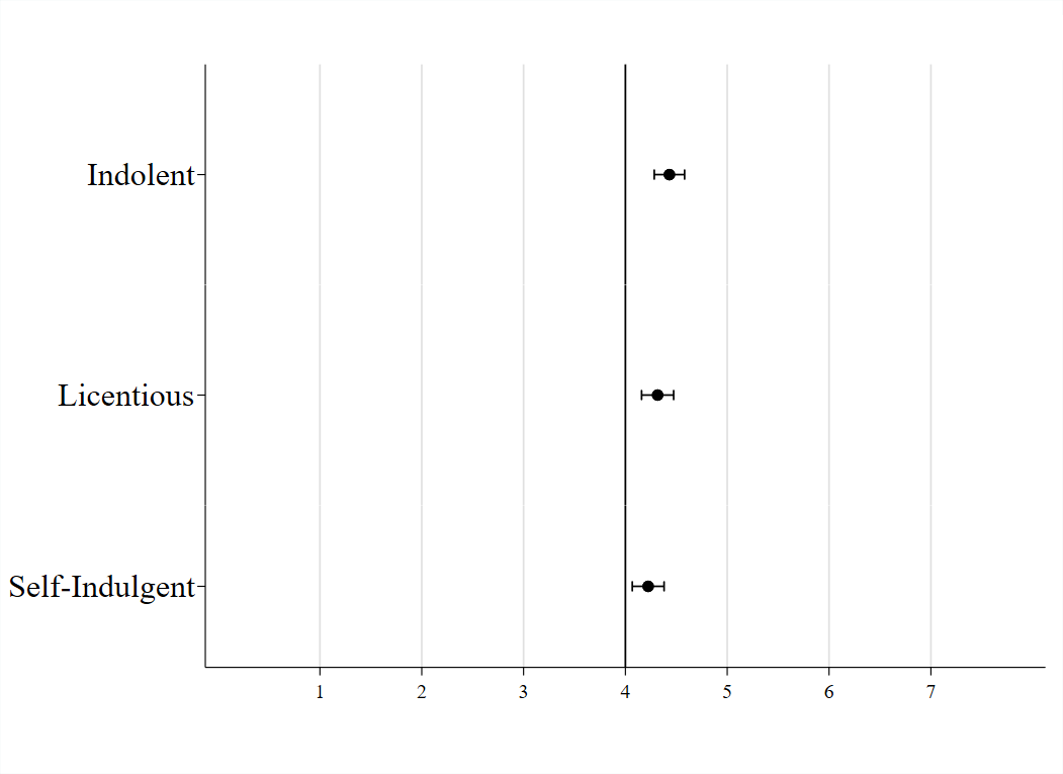
Mean Endorsement of Three Welfare Stereotypes, Brazil 2014.
I combine responses to these questions in an additive index that I call the Welfare Recipient Stereotype Index that I rescore from 0 to 1 and that has a Cronbach’s alpha reliability score of 0.75. The mean score for the index is 0.55 for the full sample, which is significantly above the neutral midpoint of 0.5. Figure 2 shows the mean stereotype index score for respondents by their Bolsa Família recipient status. What is immediately apparent is that the average non-recipient scores on the higher end of the index (0.58), which is significantly above the neutral midpoint. By contrast, the average respondent in a recipient household holds a neutral attitude (0.48), which is statistically indistinguishable from the 0.5 midpoint. The 9.3 percentage point difference between the two groups is statistically significant (p < .001).
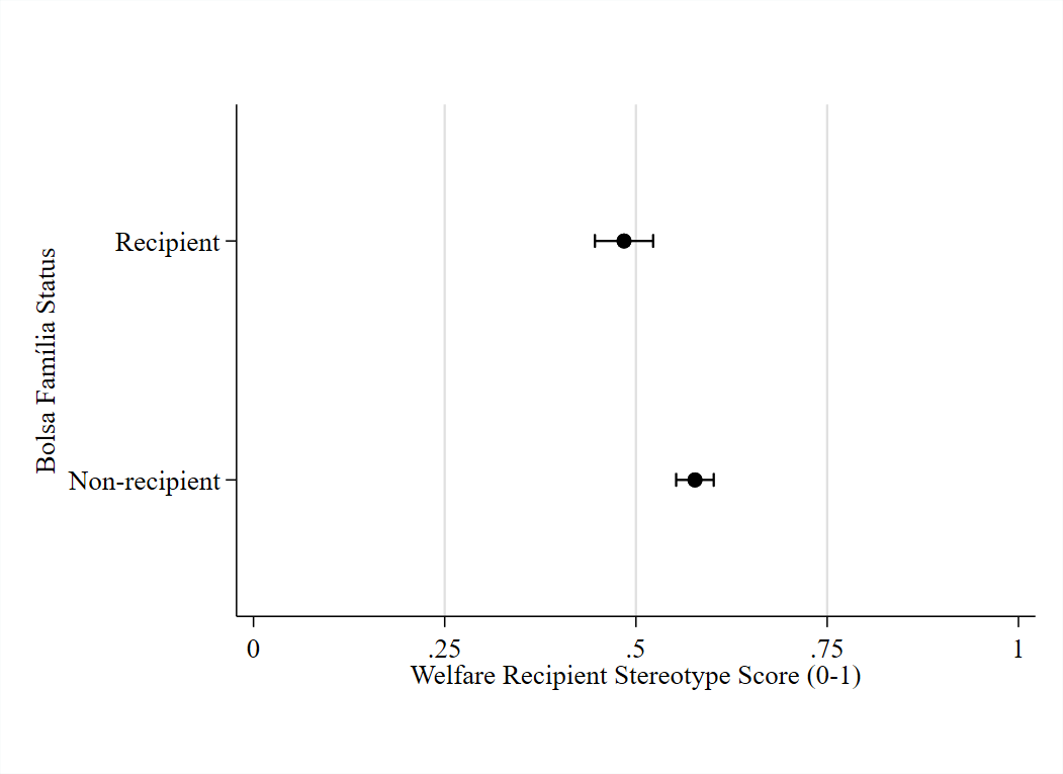
Mean Welfare Recipient Stereotype Score by Recipient Status, Brazil 2014.
These results show that sizeable portions of Brazilian society endorse negative stereotypes against Bolsa Família recipients. This is consistent with the general theoretical expectations of stereotype formation found in the previous social psychological research. The results amongst Bolsa Família recipient households are consistent with the predictions of system justification theory given that it is evident that many respondents from that group report strong agreement with negative self-stereotypes, even if, as would be expected, the average score is lower than amongst the non-recipient population.
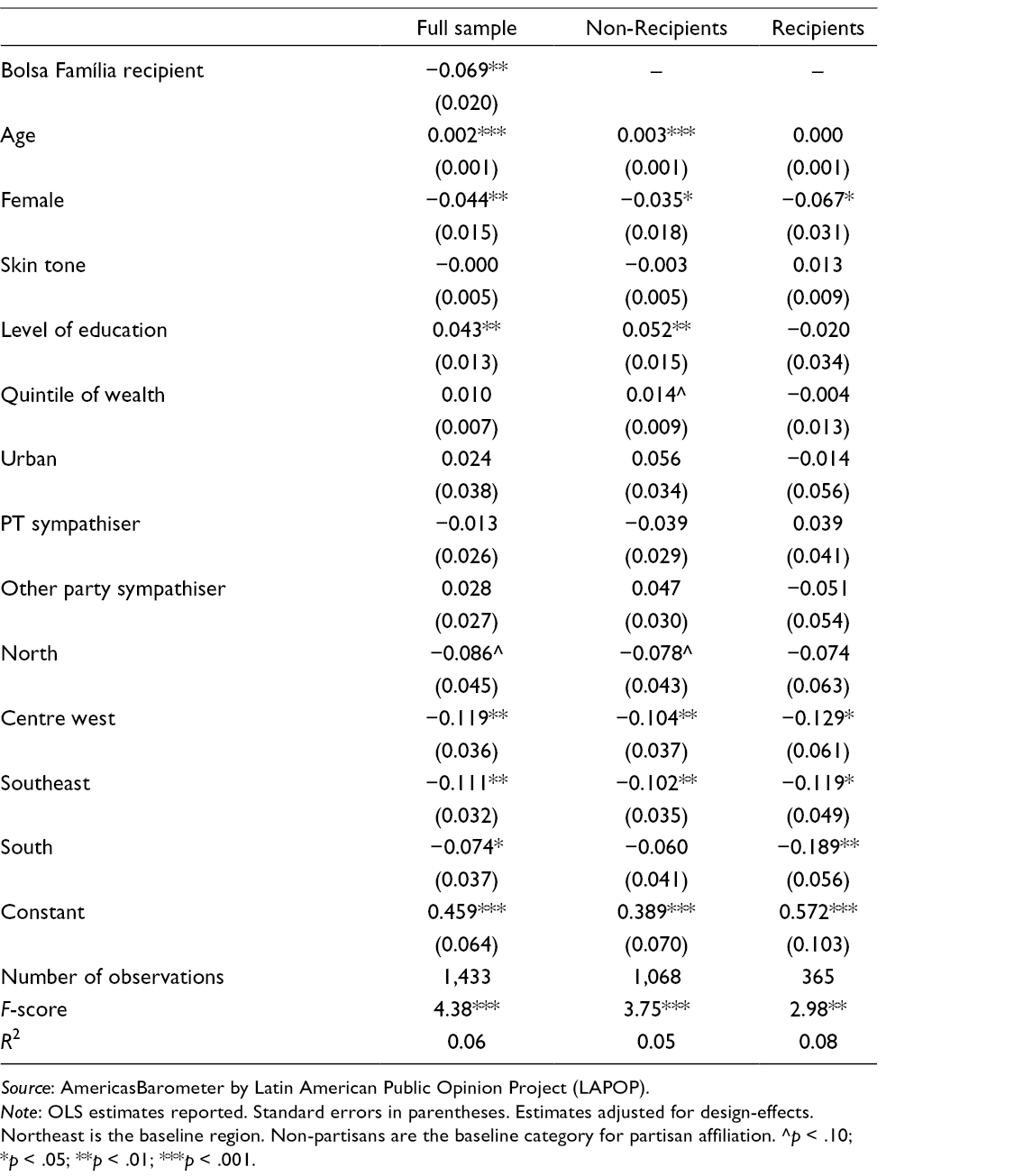
Are there any systematic patterns that would help to predict which individuals endorse negative stereotypes of Bolsa Família’s recipients? To answer this question, I regress individual Welfare Recipient Stereotype Index scores on background characteristics like age, gender, skin tone, level of education, household wealth, 8 urban/rural residence, and region of residence. I also include Bolsa Família recipient status and partisan identification (Workers’ Party [Partido dos Trabalhadores, PT] sympathisers and other party sympathisers compared to respondents without partisan identification) in the model. Table 1 presents the results from the full sample and then from split samples defined by the Bolsa Família recipient indicator to clarify whether there are important group differences. 9
Predictors of Welfare Recipient Stereotype, Brazil 2014.
Source: AmericasBarometer by Latin American Public Opinion Project (LAPOP).
Note: OLS estimates reported. Standard errors in parentheses. Estimates adjusted for design-effects. Northeast is the baseline region. Non-partisans are the baseline category for partisan affiliation. ^p < .10; *p < .05; **p < .01; ***p < .001.
I limit the following discussion of the results to focus on the statistically significant coefficients. The results based on the full sample show that, all else equal, respondents in households with Bolsa Família recipients score 0.069 points lower on the stereotype score than non-recipients. What is more, older respondents endorse negative stereotypes at a significantly higher level than younger respondents (the estimated maximum difference between the youngest and oldest respondents is 0.161 points), women endorse negative stereotypes at a lower level than men (a difference of 0.044 points), and those who have completed higher levels of education endorse negative stereotypes more so than those who have completed lower levels of education (all else equal, the estimated difference between a respondent with no education and a college educated respondent is 0.128 points). In addition, residents of Brazil’s relatively impoverished northeast endorse negative stereotypes at a significantly higher level than residents of the more prosperous centre west and southeast (the statistical significance of the differences with residents of the north and south regions are more ambiguous as they hover around the standard threshold for significance: p = .058 and p = .049, respectively).
Restricting the model to non-beneficiaries produces very similar results: older, male, and higher educated non-recipient respondents endorse negative stereotypes of Bolsa Família recipients at a higher level than younger, female, and lower educated respondents. Respondents who reside in the northeast again score significantly higher on average on the stereotype index than residents of the centre west and southeast. Finally, amongst non-beneficiaries, the average PT sympathiser scores 0.086 points lower on the stereotype index than other partisan sympathisers which is a statistically significant difference (p = .02).
Restricting the model to Bolsa Família recipients shows few significant relationships between background characteristics and endorsement of welfare stereotypes. Notably, women in recipient households are significantly less likely than men to endorse negative stereotypes of fellow recipients. Once again, the average resident of the northeast scores significantly higher on the stereotype index than residents of any other region, apart from the north. In this model, the 0.090-point difference in stereotype scores between PT sympathisers and other partisan sympathisers does not meet the standard threshold for statistical significance.
Taken together, these initial results confirm that CCT recipients are subject to stigmatisation. This appears to be consistent with a system justification perspective, given the fact that SJT predicts that vulnerable groups will adopt externally determined stereotypes. After all, with the notable exception of the gender finding, there are few individual-level background characteristics that are systematically related to the level of endorsement of negative stereotypes in beneficiary households. Given the reported frequency of endorsement of these attitudes, it is surprising to find so few systematic patterns to the responses amongst that population, although it may be important to draw further attention to the regional differences. The fact that negative stereotypes are concentrated amongst respondents from the northeast where there is a higher concentration of BFP recipients as well as Afro-Brazilians is perhaps suggestive of exposure effects, implicit racial attitudes, or, possibly, systematic differences in the programme in that region, all of which would warrant further research. The gendered aspect of these attitudes also warrants further attention. It is remarkable that male respondents who are BFP beneficiaries or who live in homes with a BFP beneficiary endorse negative stereotypes at a higher level than women. Breaking out the component pieces of the index (see Online Appendix) shows that this is largely driven by male attitudes about beneficiary indolence, rather than the other two items, which raises questions for further research about the effect of the programme on a household’s division of labour (Cookson, 2018). In any case, this leaves the question about the relationship between these attitudes and support for the programme. I address whether holding attitudes reflective of negative stereotypes is associated with respondent support for the BFP in the next section.
The Policy Costs of Welfare Recipient Stereotypes in Brazil
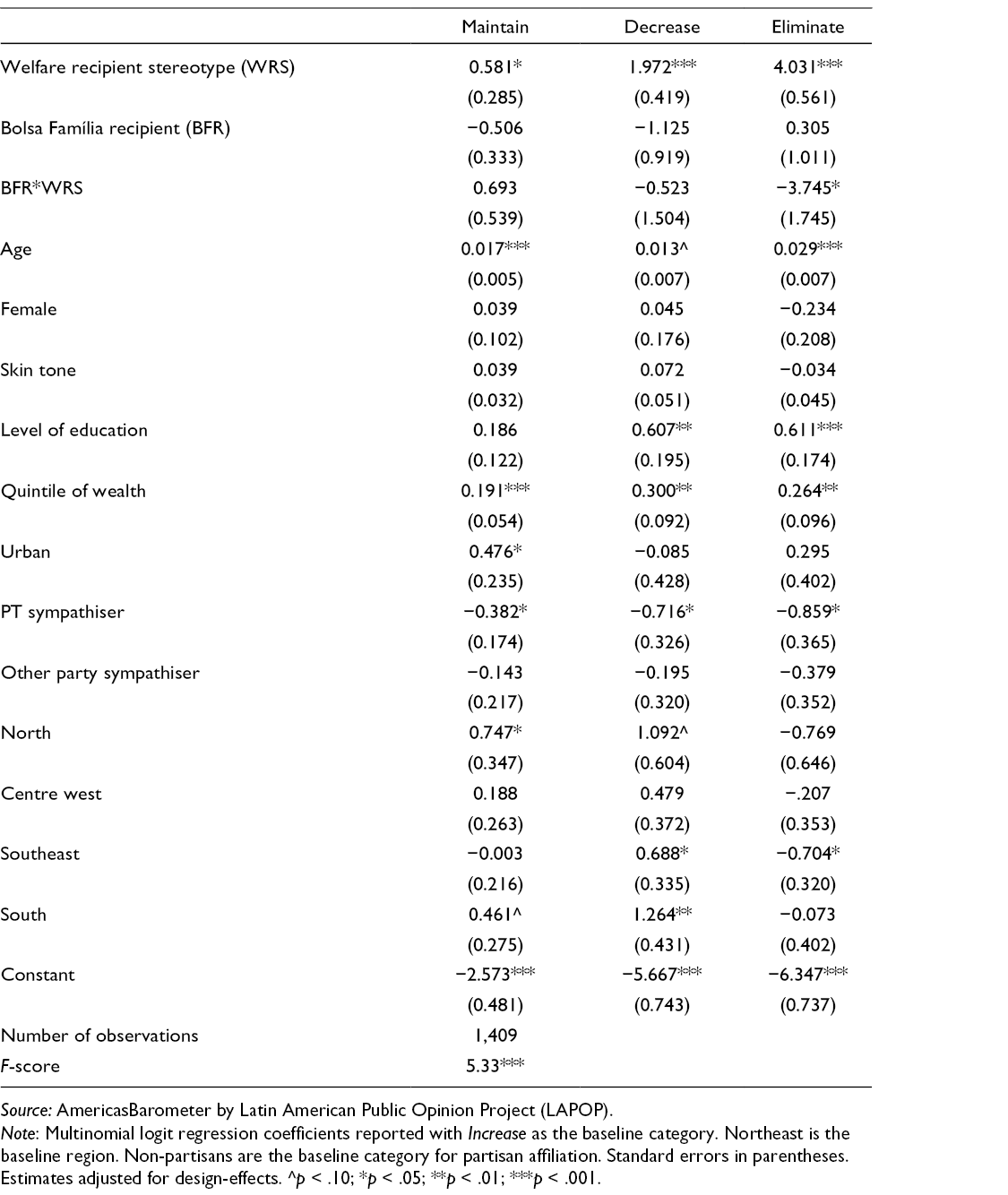
Are respondents’ stereotypes of Bolsa Família recipients related to their support for the policy in a systematic fashion? To answer this question, I model responses to a policy support question in a multinomial logit regression. The relevant question asks respondents: “Do you think that the government should increase the number of families receiving Bolsa Família, keep it as is, reduce or eliminate the Bolsa Família Program? 10 ” The model includes a series of predictors including welfare recipient stereotype (WRS) scores, household Bolsa Família recipient status (BFR), and, because I want to test the conditional relationship of these two factors, an interaction term between these two variables (BFR*WRS). I also include a series of individual-level control variables including age, gender, skin tone, level of education, household wealth, urban/rural residence, partisan sympathy (PT sympathiser or other party sympathiser, with non-partisans as the baseline category), and region of residence.
Table 2 presents the results of this regression analysis where the Increase category is the baseline category for the sake of comparisons. There are several statistically significant results. Looking first at statistically significant effects amongst the control variables, older respondents prefer all options over increasing the number of families receiving Bolsa Família, more educated respondents prefer to either decrease the number of recipients or eliminate the programme, wealthy respondents prefer all options over increasing the number of recipients, and urban respondents tend to prefer to maintain the programme more so than rural respondents. In addition, PT sympathisers prefer increasing the number of families receiving benefits above all other options, whereas other partisan sympathisers have no clear preference between categories. Finally, there is also evidence of significant regional differences.
Multinomial Logit Predictors of Policy Support for Bolsa Família Programme (Increase = Baseline), 2014.
Source: AmericasBarometer by Latin American Public Opinion Project (LAPOP).
Note: Multinomial logit regression coefficients reported with Increase as the baseline category. Northeast is the baseline region. Non-partisans are the baseline category for partisan affiliation. Standard errors in parentheses. Estimates adjusted for design-effects. ^p < .10; *p < .05; **p < .01; ***p < .001.
In terms of the principal independent variables of the model, including welfare recipient stereotype scores, household Bolsa Família recipient status, and the interaction term, there are several statistically significant relationships to unpack. To help interpret the findings from the model, Figure 3 presents predicted probabilities of preferences to increase, maintain, decrease, and eliminate the BFP. Predicted probabilities are calculated for recipients and non-recipients at the minimum, maximum, median, and interquartile range values of the stereotype score and then are graphed for the sake of comparison. In the figure, dashed lines with circular markers indicate non-recipient probabilities; solid lines with triangular markers indicate recipient probabilities. Taken collectively, the combined figure illustrates the point that welfare stereotypes carry steep political costs in terms of support for the BFP in Brazil.
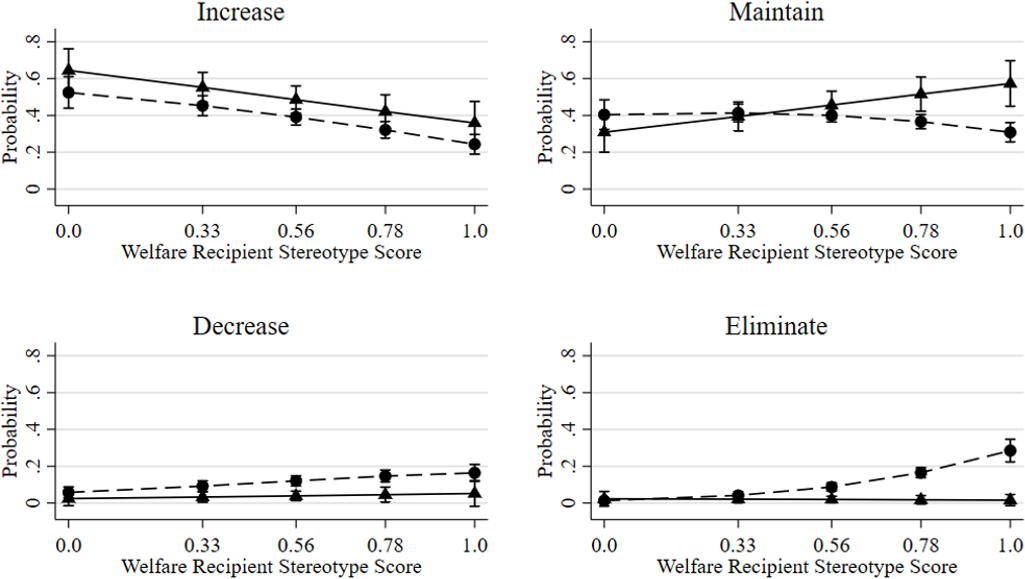
Predicted Probabilities of Support for Bolsa Família by Recipient Status and Welfare Stereotype Score, Brazil 2014.
Beginning with the effects on households with Bolsa Família recipients, it is perhaps unsurprising that recipients are highly unlikely to prefer to decrease the number of recipient families or to eliminate the programme; however, recipients who endorse negative stereotypes of recipients like themselves are significantly less likely to prefer to increase the number of beneficiary families. Rather, they are significantly more likely to prefer to maintain the programme as it currently stands. Thus, at the very least, they are less enthusiastic about the programme than their non-stereotypical peers. Again, this is consistent with the predictions of system justification theory.
Amongst non-recipients, the effects of holding negative stereotypes of Bolsa Família recipients are even starker and have more potential to be directly politically costly. Not only are stereotyping non-recipients significantly less likely to support increasing the number of beneficiary families than their non-stereotyping peers, they are also significantly less likely to support maintaining the programme at current levels. Rather, compared to non-stereotyping respondents, they are more likely to prefer to decrease the number of families or to eliminate the programme. In substantive terms, non-recipients who hold the strongest negative stereotypes of Bolsa Família recipients have an estimated predicted probability of preferring to eliminate the programme of 0.28 and an estimated combined predicted probability of preferring to decrease the number of programme beneficiaries or eliminate it equal to 0.45. By comparison, non-recipients who report the lowest level of stereotype have an estimated combined predicted probability of preferring to decrease the number of programme beneficiaries or eliminate it equal to 0.07. Thus, whilst the average non-recipient who holds strong negative stereotypes of the poor may have a little better than even chance of actually supporting the increase or maintenance of the programme, those odds are significantly and substantively much worse than for the average non-stereotyping non-recipient. What is more, the estimated predicted probabilities show that there are statistically significant differences between individuals at median values of the stereotype score and the two extremes. Thus, the interpretation of these results is not just about predictions at extreme values; even at more representative values of stereotypical attitudes, there are important differences between the more stereotypical and less stereotypical respondents. These findings are consistent with the predictions of work in social psychology regarding the impact of more advantaged groups’ negative stereotypes against the poor.
Discussion and Conclusions
The findings presented here provide systematic evidence that negative stereotypes of beneficiaries of the BFP are strongly entrenched in Brazilian society, not only amongst non-recipients but also amongst beneficiary households. Indeed, there is a sizeable group of older, more educated, and male Brazilians who, on average, are much less supportive of the government’s policy efforts for the poor than their peers. What is more, even some of those who live in households that directly benefit from Bolsa Família hold negative stereotypes about their fellow recipients; those who do are also much less vigorous defenders of the programme on average. Notably, these findings persist even after controlling for other individual-level factors, including partisanship. The results are consistent with the system justification theory perspective of intergroup relations, particularly given the otherwise unexpectedly high level of negative stereotype endorsement amongst Bolsa Família beneficiaries.
These findings call into question prior research that argues that programmes like Bolsa Família empower their beneficiaries (Hunter and Sugiyama, 2014). Whilst it may be true that Workers’ Party governments were willing to signal their prioritisation of social inclusion for the poor, this has not automatically translated into widespread popular acceptance of the beneficiaries of the government’s transfer programmes. Given these findings, it is plausible that the BFP will face important political challenges to the extent that such negative stereotypes of its beneficiaries endure and are exploited to further the ambitions of political candidates.
That said, these results only speak to the potential for political elites to frame policy decisions around the negative stereotypes of beneficiaries. Latin America has witnessed the implementation or expansion of CCT programmes under many different ideological banners (Dion, 2009; Layton and Smith, 2015) and it is possible that the self-interested strategic calculations of elected officials will preclude appeals to scale back these programmes in contexts with sizeable beneficiary populations. Indeed, although the number of beneficiaries of the BFP has now declined by nearly 1 million households since its peak, Jair Bolsonaro’s conservative government has looked for ways to expand the benefits of the programme, as seen in the announcement to give beneficiaries the equivalent of a thirteenth month of benefits (décimo terceiro) in December 2019. 11 Further research is needed to understand what the critical tipping point would be, if it exists, where elites are comfortable with the strategic decision to exploit pre-existing negative stereotypes of vulnerable populations and to seek the wholesale restructuring or elimination of such programmes. It would also be important to consider whether the stereotypical attitudes addressed in this paper shape vote choice, which could potentially have more far-reaching consequences for the government’s approach to anti-poverty policy. After all, whilst some governments might be willing to expand a highly visible programme like Bolsa Família, there might be other, less publicised changes in policy that a government could implement to restructure other benefits in ways that result in a relatively high net loss for the poor. Such research could help to properly contextualise the degree of threat to vulnerable populations represented by the results reported here.
In broader terms, the findings presented here provide further systematic evidence of the generalisability of theories of intergroup relations and the political importance of social psychological processes that tend to produce intergroup conflict. These findings also have implications for public policy efforts to promote social inclusion amongst the poor, given that they suggest that such an effort is enormously complicated. The mere act of providing social assistance creates group identities and social divisions between recipients and non-recipients that did not previously exist and that have political consequences. In a more globalised world, this may be true even if a proposed programme is ostensibly unconditional or universal. Although the results presented here cannot speak to that explicit comparison, there will always be a group designated to be outside the category of “deserving.” Indeed, given enough time and strong salience of the benefits provided, it is possible that any social programme will contribute to the production of political cleavages that may come to define generations of political competition in Brazil and elsewhere.
Supplemental Material
Supplementary Material 1 - Supplemental material for Welfare Stereotypes and Conditional Cash Transfer Programmes: Evidence from Brazil’s Bolsa Família
Supplemental material, Supplementary Material 1, for Welfare Stereotypes and Conditional Cash Transfer Programmes: Evidence from Brazil’s Bolsa Família by and Matthew L. Layton in Journal of Politics in Latin America
Footnotes
Acknowledgements
Thanks to Elizabeth J. Zechmeister, Mitchell A. Seligson, Jonathan Hiskey, Lúcio R. Rennó, Wendy Hunter, Camille Burge, Cindy Kam, and the anonymous reviewers for their contributions. Previous versions of this paper were presented at the 2015 and 2019 Annual Meetings of the Midwest Political Science Association.
Declaration of Conflicting Interests
The author(s) declared no potential conflicts of interest with respect to the research, authorship, and/or publication of this article.
Funding
The author(s) disclosed receipt of the following financial support for the research, authorship and/or publication of this article: This study was supported by grants from the Fulbright-Hays Doctoral Dissertation Research Abroad Fellowship (Award# P022A130053) and the Vanderbilt University College of Arts and Sciences Social Science Dissertation Fellowship.

Notes
Author Biography
E-mail: