




Abstract
Charisma has long been considered a powerful tool for leaders worldwide to rise to greatness. Yet we have given less attention to the way in which charismatic leaders develop deep, unmediated emotional bonds with their followers. I propose a compact theory that explains how charismatic attachments form, overwhelm alternative linkage types, and facilitate the development of powerful and potentially enduring political movements. To illustrate the theory, I turn to Hugo Chávez’s Bolivarian movement in Venezuela. Firstly, the analysis of a 2007 survey from the Latin American Public Opinion Project demonstrates the disproportionate influence of charisma on citizens’ attachments to Bolivarianism relative to competing factors. Next, six original focus groups conducted with Bolivarian followers in 2016 illustrate the mechanisms underlying the followers’ surprisingly resilient loyalty, not only to the leader but also to his overarching movement. The results suggest that affective political attachments can help sustain charismatic movements after their founders disappear.
Introduction
Charisma has long been a powerful tool for leaders to rise to greatness, as exemplified by Perón, Chávez, Fujimori, Atatürk, de Gaulle, and Gandhi. Indeed, the deep, unmediated emotional bonds these leaders cultivated with millions of followers were crucial in allowing them to consolidate transformative political movements. For example, in Argentina, Perón won the hearts of millions of workers as Secretary of Labor, paving the way for his presidency and granting him virtually unchecked power during his rule. In Venezuela, Chávez won the 1998 presidential elections in a landslide and used his tremendous charismatic appeal to ratify a new constitution, propelling his Bolivarian Revolution. Similarly, in 1958, de Gaulle leveraged his overwhelming presidential victory and reputation as a liberator of France to found the Fifth Republic. In each of these cases, the “personalistic” or “charismatic” ties that leader forged with his followers were central to his ability to profoundly change the political landscape. 1
Yet while personalistic attachments between leaders and followers help shape formidable movements across the globe, scholars widely consider this type of citizen–politician linkage rare and ephemeral (Eatwell, 2006; Hawkins, 2010; Jowitt, 1992; Kitschelt et al., 2010; Shils, 1965; Weber 1978 [1922]). Indeed, scholars contend that, to survive, such attachments must lose their charismatic nature by “routinising” into attenuated impersonal ties. Consequently, it remains unclear how these linkages influence charismatic leaders’ ability to consolidate political movements and impact party systems over time.
This article sheds light on how personalistic attachments form and facilitate the development of charismatic movements. Using Venezuela as an illustrative case, I combine insights from classic studies of charisma with empirical analyses of voters devoted to Chávez and his Bolivarian movement. Specifically, I develop and test a clear, compact theory of personalistic attachments that offers two contributions. Firstly, I demonstrate how the mechanisms underlying such linkages shape citizens’ identification, not only with the individual leader but also with the larger movement. In doing so, I also indicate the relative unimportance of programmatic and organisational factors for movement identification. Secondly, I show that citizens’ ties to these movements have the potential to endure in their raw and deeply emotional state rather than routinising into depersonalised linkages, as existing literature would argue (Jowitt, 1992; Madsen and Snow, 1991; Shils, 1965; Weber 1978 [1922]; Willner and Willner, 1965). The findings suggest the potential for charismatic movements to live on in their original, personalistic state after their founders disappear.
To test my theory, I first use an important survey conducted by the Latin American Public Opinion Project (LAPOP) in 2007, at the height of Chávez’s rule, to demonstrate the overwhelming influence of personalistic rather than programmatic or organisational factors on citizens’ attachments to Bolivarianism. Next, I turn to six original focus groups with Bolivarian followers conducted in 2016, three years after Chávez’s death, to analyse how citizens’ attachments can retain their personalistic core rather than transforming into depersonalised ties after the leader’s death. The results indicate that deep, resilient attachments to charismatic movements can survive and shape citizens’ relationship with politics in the long term. I conclude by discussing avenues for future research, including possible long-term implications of these linkages for democratic politics and party-system development.
A Theory of Personalistic Attachment
How do leaders foster deep, unmediated emotional attachments with voters to generate loyalty to their movements? Scholars indicate that a leader’s charisma – defined by Weber (1978 [1922]: 241) as “supernatural, superhuman, or at least specifically exceptional powers or qualities” – plays a central role in the cultivation of these ties. Importantly, it is not the objective existence of these characteristics, but rather the followers’ perception of them in the leader that cultivates personalistic attachments (Madsen and Snow, 1991; Merolla and Zechmeister, 2011; Weber 1978 [1922]; Willner and Willner, 1965). Studies highlight different dimensions of charisma that foster personalistic bonds between leaders and followers, including the leader’s magnetic personality and extraordinary political skills (Eatwell, 2006; Pappas, 2011); the followers’ material and psychological needs (Madsen and Snow, 1991; Weber 1978 [1922]); contextual problems such as severe crisis (Madsen and Snow, 1991; Merolla and Zechmeister, 2011; Weyland, 2003; Weber 1978 [1922]); and discourse that glorifies the leader, demonises the opposition, and promises societal transformation (Willner and Willner, 1965; Zúquete, 2008). Taken together, these studies highlight important features of charismatic ties. Yet while they emphasise voters’ affinity with individual leaders, they overlook how these ties can foster an enduring identification with a leader’s overarching movement.
I propose a compact theory of personalistic attachment that rests on three conditions. For each condition, contextual factors combine with the leader’s behaviour to shape citizens’ attraction to the leader and, more importantly, their deep, emotional identification with his movement. The first condition involves the leader’s direct recognition of and appeals to citizens who have suffered severe feelings of exclusion, deprivation, and hopelessness. The theory of “proxy control” developed in social psychology suggests that people who have experienced these feelings are likely to seek out a charismatic “saviour” to recognise their suffering, take control of their seemingly unmanageable situation, and combat the “evil” forces blamed for their problems (Bandura, 1982; Madsen and Snow, 1991: 12–15). This recognition is asymmetrical: the leader directly grants recognition to the followers, such that the latter feel indebted to, rather than empowered by, the former. Contextually, a severe crisis overseen by a low-performing government motivates citizens who feel excluded to seek out a hero to rescue them from their situation (Madsen and Snow, 1991: 143; Weyland, 2003: 843). Using this crisis, the leader recognises and vows to personally resolve citizens’ suffering and perceived exclusion to gain their support.
Secondly, to prove his extraordinary ability to “save” the people from their misery, the leader aggressively attacks the “enemies” held responsible for their suffering and implements bold, initially successful reforms to improve their condition (Pappas, 2011: 4–5; Weber 1978 [1922]: 242). These impressive initiatives confirm the followers’ exalted perceptions of their leader but lack programmatic coherence and sustainability. Instead, the leader’s early success is most likely tied to his appearance following a period of crisis or at the cusp of favourable economic conditions, such as rising oil prices or a commodity boom. Nonetheless, many voters experiencing swift, tangible relief due to his policies will perceive the leader as extraordinary.
The third condition involves the construction of a symbolic narrative that glorifies the leader alongside other historical protagonists as a hero, vilifies opponents as enemies, and stresses the transformative character of the movement. Crucially, to legitimate the narrative and integrate it with the followers’ everyday lives, the leader tailors it to the particular cultural setting in which he arises. For instance, in framing politics as an existential struggle between good and evil, the leader ties himself to “sacred figures, divine beings, or heroes” who already form part of the followers’ cultural identity (Willner and Willner, 1965: 82). Equally important, he associates his opponents with familiar, epic foes. Integrating these commonly understood prototypes of good and evil permits the leader to reinterpret well-known historical events “within a salvation framework” (Smith, 2000: 103–104). Because the followers are familiar with the themes of heroism, villainy, and salvation evoked by the narrative, they perceive the leader as more authentic and therefore feel closer to him (Gauna, 2018: 40). Through this mechanism, the leader converts his support into an intensely personal form of “political religion” (Zúquete, 2008: 91).
To spin a convincing narrative that the followers come to internalise as part of their daily lives, the leader draws on personal appeal; achieves constant, direct contact with voters; and broadcasts “contentious performances” in which he inexhaustibly repeats the central components of his transformative mission – including the central heroes, enemies, and stories of redemption (Gauna, 2018: 42; Michelutti, 2017: 233–237). Additionally, the leader dominates public spaces with images, words, music, and other symbols to help reinforce the power and moral superiority of him and his movement (Plotkin, 2002: 24; Zúquete, 2008: 93–103). Through these strategies, the leader successfully transforms “seemingly secular social and political life” into a sacred quest for salvation (Michelutti, 2017: 234).
Together, these factors consolidate citizens’ perceptions of the leader’s charisma. Consistent with existing scholarship, I claim that these perceptions foster deep emotional bonds between the leader and followers (Eatwell, 2006; Madsen and Snow, 1991; Pappas, 2011; Shils, 1965; Weber 1978 [1922]; Willner and Willner, 1965; Zúquete, 2008). Direct recognition of people’s exclusion and suffering makes followers feel indebted to the leader; bold, initially successful reforms deliver tangible improvements to the followers’ lives and appear to substantiate the leader’s exceptional capacities; and the symbolic narrative solidifies the leader’s role as the ultimate saviour. Yet while these conditions are essential to foster personalistic connections in the first place, I go a step further to argue that the symbolic narrative can transform these ties into a deeper and more resilient identification with the movement by sustaining the leader’s core promise of redemption – even after his death.
Specifically, I argue that the narrative sustains the movement through the followers’ cherished, intimate memories of the founder and through timeless symbols that reinforce his glorified status. Research in social psychology suggests the relevance of a “death positivity bias,” in which citizens’ inflate their positive perceptions of leaders after the leaders die (Allison et al., 2009: 116). More specifically, a recent study indicates that citizens tend to view leaders whom they considered to be “morally virtuous” in life as more charismatic in death (Steffens et al., 2017: 532). This literature casts doubt on the notion that charismatic bonds routinise or fade away when the leader dies. Indeed, it suggests that, because such attachments can endure and even intensify, followers are likely to continue worshipping the deceased founder and reinforcing his symbolic narrative for years, even across generations. Thus, over time, these attachments transform into a durable political identity that shapes the followers’ worldview, sustains their loyalty to the movement, and shapes their expectations of future politicians (Abdelal et al., 2009; Hogg, 2001; Vugt and Hart, 2004).
In short, unlike scholars of charisma who argue that symbols associated with the founder help diffuse his charisma and depersonalise attachments (e.g. Jowitt, 1992; Shils, 1965; Weber 1978 [1922]), I contend that the symbolic narrative helps sustain the followers’ deeply emotional bonds as well as a fervent hope that a new leader will pick up the founder’s baton and save them from their suffering. The hope that a worthy successor will sooner or later take the founder’s place is crucial because it sustains citizens’ support for the movement until conditions permit the rise of such a leader.
Chávez’s leadership in Venezuela strongly reflects all three components of the personalistic mechanism, suggesting that it underlies citizens’ steadfast loyalty to his movement. Firstly, he personally recognised and symbolically incorporated masses of impoverished citizens who had suffered from decades of socioeconomic and political exclusion under the preceding Punto Fijo regime.
2
A speech by Chávez on 10 January 2003 illustrates how he claimed personal responsibility for poor and excluded groups: […] Make no mistake about Hugo Chávez […] in accordance with the Constitution of the Republic and my powers as Chief of State and my responsibilities as President of the Republic, I cannot permit that people die of hunger; I cannot permit that children die because there isn’t medicine or there isn’t milk; I cannot permit that the people drown of hunger and death. Above all things it is my responsibility in front of God and the flag to defend the Venezuelan people, above all things and as dictated by the Bolivarian Constitution! (Chávez, 2003, author’s translation)
Secondly, the daring nature and initial success of Chávez’s reforms confirmed his image in the hearts and minds of his followers as a hero who would save them from the malevolent “political class.” One such reform was his bold yet unsustainable approach to constitutional reform. During his 1998 presidential campaign, Chávez vowed to enact a new constitution to break with the Punto Fijo regime, protect Venezuelans’ socioeconomic rights, and enhance their direct participation in politics. In June 1999, the constitutional referendum passed with 72 per cent support, validating Chávez’s ability to deliver on his promises. In the long run, however, Chávez failed to realise many of the ambitious visions outlined in his new constitution. For instance, his regime never developed the political infrastructure necessary to expand and guarantee citizens’ new rights to healthcare, work, education, social security, and housing (Maingon, 2004: 54–55). Rather than addressing these failures, Chávez reformed the constitution again in his second term through executive decrees and “organic laws” rushed through the National Assembly (López, 2003). As before, the sweeping changes these reforms promised were scarcely fulfilled. Nevertheless, Chávez’s audacity to propose and ratify them through referenda or executive decree appeared unprecedented, impressive, and even miraculous (Hawkins, 2010: 35).
Thirdly, to stress the transformative power of his movement, Chávez constructed a vivid narrative with “missionary” rhetoric that glorified his image and tied him to classic heroes, including Simón Bolívar, Venezuela’s nineteenth-century liberator; Ezequiel Zamora, the hero of Venezuela’s Federal War; Guiacaipuro, an indigenous Venezuelan chief who fought against the Spanish Conquest; and even Jesus Christ (Martínez and de Lustgarten 2014: 19–21; Michelutti, 2017: 237–238; Zúquete, 2008: 97). More than merely associating himself with these legends, Chávez portrayed himself as sharing “divine kinship” with them; most notably, “he cultivated the notion that he was Bolívar’s true heir,” suggesting that he, like Bolívar, should be worshipped “like a Catholic saint” (Michelutti, 2017: 237). By depicting himself as the true son of Venezuela’s most celebrated and tragic hero, Chávez tapped into several preexisting identities relevant to his followers, ranging from popular Christianity to mestizaje to Santería, and thus initiated his own “process of deification” (Michelutti, 2017: 234–236). 3
In addition to confirming his godlike status, Chávez used his symbolic narrative to demonise his opponents. While he affectionately called his followers “patriots” and “soldiers,” he referred to his critics as “enemies,” “coup-plotters,” and “imperialists” (Gauna, 2018: 47). As with the protagonists in his narrative, Chávez tied these adversaries to Venezuela’s historical foes, especially imperial powers – such as Spain, the United States, Britain, and France – and the “antipatriots” descended from the “Empire,” who constituted the country’s the white upper and middle classes (Zúquete, 2008: 104). Finally, the narrative promised his followers salvation from these enemies through a dramatic societal transformation – a “Moral Revolution” – that would vanquish evil and reclaim peace and prosperity for Chávez’s righteous people (Gauna, 2018: 48).
To build his symbolic narrative, the founder established constant, direct communication with his followers through speeches and other performances that dominated media outlets. The extreme frequency of his contact with his followers and the repetition of the central themes of his narrative mattered as much as the content of any particular speech. As the star of his own weekly television show, he spoke directly into the camera for hours. He frequently interrupted radio and television programmes to make “emergency” announcements and travelled tirelessly around the country. Finally, Chávez tightened control over the media and saturated public spaces with symbols that glorified him and his movement. When combined with his recognition of previously excluded citizens and his implementation of bold reforms, the omnipresence of Chávez’s narrative transformed Bolivarianism into “a charismatic form of political religion” to which his followers became deeply attached (Zúquete, 2008: 92).
Assessing the Relevance of Alternative Linkage Types
The preceding section outlined the conditions under which personalistic attachments form and demonstrated the role of these ties in Chávez’s Bolivarian movement. Yet evaluating the impact of charisma also requires analysis of competing linkage types. The present section assesses the development of programmatic and organisational ties – two prominent, alternative types of political attachment – and demonstrates how personalistic ties won out in Venezuela.
The Programmatic Mechanism
Firstly, a programmatic mechanism suggests that citizens’ attachments rest on the substantive coherence of the leader’s ambitious programmes. Grounded in long-standing studies of issue preferences, retrospective and prospective economic voting, and partisanship, most scholars assume that this mechanism forms the natural and proper core of party and electoral politics. To develop programmatic ties, citizens must have well-formed issue preferences that align with the leader’s policies (Key, 1966: 7–8). In addition, the leader must consistently and successfully carry out these policies to earn voters’ approval and establish a clear programmatic trademark that is distinct from that of other parties (Fiorina, 1981: 66; Lupu, 2013: 60). In contrast to bold, shortsighted reforms, whose initially impressive performance casts the individual leader in a heroic light, the programmatic trademark rests on the substantive content and steady functioning of social and economic policies. Citizens “constantly update” their attachment to the movement based on the leader’s adherence to this trademark (Kitschelt et al., 2010: 846). If the leader fails to implement distinctive and effective policies, citizens punish him and they reduce their attachment to the movement (Achen, 2002: 151). In turn, if the leader implements policies inconsistent with the trademark, the trademark becomes diluted and blends with the platforms of opposing parties, diminishing citizens’ loyalty (Lupu, 2013: 50).
Several scholars claim that Chávez developed a programmatic trademark that emphasised state-centred economics and redistributive social programmes called missions. To begin, Chávez attempted to increase the state’s role in the economy. For instance, he tightened his control over the state-run oil company, Petróleos de Venezuela (PDVSA), by ratifying the New Organic Hydrocarbon Law in 2001 (Parker, 2005: 44). Shortly thereafter, he nationalised dozens of non-oil companies and implemented a sweeping Land Reform Law. He also eventually imposed strict currency exchange and price controls to counteract inflation and keep consumer goods affordable (Corrales and Penfold, 2015: 64).
However, Chávez did not stake out a clear position on economic policy until late 2001, well after he had consolidated widespread popular support. Upon taking office, he confirmed his centre-right predecessor’s minister of finance, Maritza Izaguirre, and appeased the International Monetary Fund by cutting the state’s budget by 7 per cent and strengthening the Investment Fund for Macroeconomic Stabilization (Corrales and Penfold, 2015: 48–55). Despite these economically liberal policies, which diverged fundamentally from his later turn to “socialism of the twenty-first century,” Chávez’s movement cultivated impressive popular support: in 1999 and 2000, between 38 and 41 per cent of Venezuelans claimed to identify with the movement and 75–84 per cent approved of Chávez’s performance (Consultores, in press).
By late 2001, Chávez began to advertise and implement state-centred policies that achieved impressive results at the outset. But the performance of these policies soon dropped, providing little foundation for programmatic support. For example, though booming oil prices from late 2003 to 2008 allowed for substantial economic growth, his protectionist policies failed to stimulate investment and instead invited rampant corruption (Corrales and Penfold, 2015: 70; Ellner, 2010: 88–91). As a result, production in non-oil sectors declined, leading to sharp rises in imported goods; investment in infrastructure lagged, generating electricity and water shortages; and price and exchange controls caused increasing inflation, a rising black-market exchange rate, consumer goods shortages, and capital flight. The economy contracted by 3.3 per cent of GDP when oil prices fell in 2009, and in 2010, Chávez was forced to devalue the local currency sharply. The ultimate failure of these policies and the resulting inflation and shortages disproportionately affected low-income citizens, many of whom were strong supporters of Bolivarianism. This suggests that these citizens’ loyalty to Chávez over the course of his presidency was not fundamentally rooted in the substantive content and consistent performance of his economic programmes (Corrales and Penfold, 2015: 63–70).
In addition to state-centred economics, the Bolivarian programmatic trademark advocated redistributive social “missions.” Beginning with their launch in 2003, Chávez poured billions of petrodollars into these programmes and oversaw the construction of at least 50, in areas ranging from healthcare to information technology (Maingon, 2016: 20). The most prominent missions sought to reduce poverty and inequality through better provision of food, healthcare, education, and housing. Through these programmes, Chávez appeared to prioritise equality and social justice over individual rights.
Yet like his economic policies, Chávez’s social missions suffered from serious problems. The missions sprang up via presidential decree in a rapid, improvisational, and politicised manner that undercut their sustainability. Consequently, they failed to perform favourably after their first few years of operation. While poverty declined from 2003 to 2006, the trend stagnated from 2007 to 2012 and began to reverse thereafter (Aponte, 2014: 153; Ellner, 2011: 433–438; Maingon, 2016119–120). By 2014, poverty had risen to 48.4 per cent, surpassing 1998 levels by over 3 percentage points (España, 2014: 4). Finally, despite the missions’ rapid initial growth, a 2014 survey indicates that a mere 10 per cent of citizens report having benefitted from them, suggesting a failure to sustainably reduce poverty and protect Venezuelans’ socioeconomic rights (Aponte, 2014: 168; España, 2014: 8). Thus, it is more likely that followers’ fervent approval of Chávez’s programmes throughout this period arose from “lingering beliefs in [his] charisma” than from the substantive integrity of his policies (Kitschelt et al., 2010: 865; Merolla and Zechmeister, 2011: 29).
In sum, the superficial nature and volatile performance of Chávez’s socioeconomic policies indicate his preference for dramatic reform over stable programmatic development. Though he promised to establish economic and social justice in Venezuela, his policies’ delayed implementation and ultimately negative performance made for a weak programmatic trademark. Most importantly, the bold, hasty application and short-lived success of these policies prioritised the establishment of Chávez’s saviour-like image at the expense of medium- and long-term effectiveness. Consequently, while deepening followers’ affective ties to Chávez, these policies held little appeal for programmatically principled voters. Moreover, the delayed application of Chávez’s policies cannot account for the movement’s widespread support during his first three years in office. These factors demonstrate how personalism infused Chávez’s policy agenda and compromised the development of programmatic linkages.
The Organisational Mechanism
The organisational mechanism suggests that political attachments rest on the ties people cultivate with each other through local involvement in movement-affiliated activities and groups. Through these ties, citizens foster an enduring group identity that is maintained via involvement in the movement’s social clubs, neighbourhood associations, and political organisations (Granovetter, 1973; Green et al., 2002). Building this type of bond requires the followers’ widespread and regular participation. The movement’s organisations must also be sustained and strengthened over time and must maintain a “horizontal” rather than hierarchical character to inspire group members’ feelings of efficacy (Ellner, 2011: 430–431; Rhodes-Purdy, 2015: 423–424). Unlike personalistic attachments, in which followers’ sense of belonging comes directly from the leader, the organisational mechanism suggests that the followers ease their feelings of exclusion in a bottom-up fashion by interacting with each other.
Chávez promoted the organisational dynamic of Bolivarianism and even enshrined citizen participation in the 1999 constitution as a necessary condition for democracy. Early in his presidency, he launched several community-based organisations aimed at placing governance into the hands of the people, including Urban Land Committees, Health Committees, Technical Roundtables for Water, and Bolivarian Circles (Aponte, 2014: 252–263). In 2006, he appeared to strengthen this initiative by establishing the Communal Councils (CCs). Officially registered, neighbourhood-level groups consisting of 200–400 families, the CCs were intended to be self-governing: they would elect representatives, run their own meetings, and solicit funds directly from the government to resolve problems (Aponte, 2014: 264; García-Guadilla, 2012).
In practice, however, this network failed to cultivate genuine organisational ties to the movement. Firstly, citizen participation in the CCs was neither widespread nor regular. A 2005–2007 survey of poor Venezuelans by Universidad Católica Andrés Bello suggests that only 29 per cent had ever participated in a community event, while only 7 per cent had participated in a CC (Aponte, 2014: 260). Among the few citizens who participated in CCs, a 2008 survey by Centro Gumilla indicates that less than 50 per cent regularly attended meetings (Machado, 2009: 48-9). Secondly, the poor infrastructure of these groups compromised followers’ ability to develop a strong grassroots network. Chávez’s sluggish and haphazard institutionalisation of the CCs reflects this weakness: he did not legally recognise them through the Law of CCs until 2006, and he neglected to establish a government ministry to oversee them until 2010 (Aponte, 2014: 264). By 2012, in a famous speech titled “Changing Course” (Golpe de Timón), Chávez angrily acknowledged the weakness of his movement’s grassroots spirit (Chávez, 2012). Thirdly, much evidence indicates that the CCs functioned in a hierarchical fashion. In many CCs, a mere handful of members remained active, and leaders often served as party bosses rather than local representatives, usurping control over projects and funds at the expense of other residents (García-Guadilla, 2012: 227–235). Perhaps as a result, a 2009 survey by Centro Gumilla suggests 76 per cent of Venezuelans perceived CCs as corrupt, while 77 per cent agreed that CCs did not involve most members of their community (Aponte, 2014: 271; Machado, 2009: 37).
Ultimately, the evidence suggests that the CCs did not foster genuine grassroots empowerment. While Chávez extolled the virtues of participatory democracy and made dramatic (if irregular) efforts to establish community organisations, these groups suffered low participation rates and severe institutional weaknesses. Outspoken leaders dominated many CCs and bred distrust rather than a genuine participatory spirit. Furthermore, citizens’ feelings of recognition and inclusion depended more on their devotion to Chávez than involvement in community affairs. It is, therefore, unlikely that swaths of followers developed strong attachments to Bolivarianism based on an organisational mechanism.
Bolivarian Attachments After Chávez
Since Chávez’s death in March 2013, Venezuela has fallen into even greater disarray. The economy has collapsed, and Bolivarian social programmes have failed to meet citizens’ basic needs. The movement’s fragile network of CCs has further eroded, and the movement’s charismatic figurehead has been replaced with Nicolás Maduro, an inadequate and unsavory successor. Owing to these factors, several scholars argue that Bolivarian loyalty is fading (Denis, 2015; e.g., López, 2014). This claim reflects conventional understandings of charisma developed in political science and sociology: after the leader’s death, citizens’ deep ties to the individual either fade away or transform into depersonalised attachments that rest on robust political programmes and institutions (Jowitt, 1992: 107; Madsen and Snow, 1991: 24; Weber 1978 [1922]: 246).
Yet polling in the years since Chávez’s death suggests that citizens’ attachments to Bolivarianism have remained impressively resilient, reflecting the insights from social psychology that citizens idealise charismatic leaders and intensify their attachments to them after the leaders die (Allison et al., 2009; Steffens et al., 2017). Indeed, while support for President Maduro has dropped to about 15 per cent, over 30 per cent of Venezuelans – about the same proportion as in 2012, just before Chávez’s death – have continued to express strong identification with the movement years later (Briceño, 2015; GBAO Strategies, 2019). In light of deteriorating Bolivarian programmes and organisations as well as Maduro’s failed leadership, I argue that the followers’ loyalty to the movement has persisted due to their deeply affective bonds with the charismatic founder.
The ways in which supporters have upheld Chávez’s symbolic narrative demonstrate how they have managed to sustain personalistic attachments to the movement in his absence. Indeed, followers have continued to worship Chávez as an immortal spirit by constructing shrines dedicated to him in their homes, donning tattoos and necklaces of his eyes to watch over them, and replaying recordings of his speeches and television shows. Moreover, supporters have remained committed to the overarching mission of salvation enshrined in his narrative. Because this “scripture” hinges on the heroic power of a leader, it gives the followers hope that an impressive successor – a true heir of Chávez – will eventually rise and carry the movement forward. This faith in a better future delivered by a new, charismatic leader serves to strengthen rather than undermine citizens’ personalistic attachments to the movement.
Maduro’s behaviour as president further illustrates how the symbolic narrative reinforces citizens’ support for Bolivarianism. Instead of enacting desperately needed policy reforms or revamping the institutional structure of the movement, the new president has focused relentlessly on Chávez’s mission to transform society and vanquish the movement’s enemies. He has also stressed his quasi-religious connection to the founder to keep citizens’ affective attachments alive and vicariously garner support. For example, after becoming president, Maduro started referring to himself as “the son of Chávez” (Michelutti, 2017: 244). 4 He even claimed that, after death, Chávez had returned to Earth reincarnated as a bird to offer a personal blessing to Maduro (Scharfenberg, 2013). In 2016, he developed a hologram of Chávez that walked the streets of Caracas to celebrate the “Day of Loyalty and Love for our Commander Hugo Chávez Frías” (Alvarado, 2016). By reconstructing the founder’s image, Maduro has leveraged citizens’ personalistic bonds to defend the contemporary regime and decry all who oppose it as traitors to Chávez’s legacy. Consequently, he has sustained crucial support for a strikingly long time, given the deplorable performance of his regime (Taub and Fisher, 2017).
To be sure, Maduro’s symbolic tactics alone cannot sustain followers’ continued support, especially as the economic crisis deepens. Indeed, the opposition’s sweeping 112-seat victory in the December 2015 legislative elections (the Bolivarian regime won just 55 seats), as well as the president’s unabashedly authoritarian tactics, suggests that Maduro’s legitimacy is fading. However, his personal decline does not necessarily imply that the movement is doomed to fail. In fact, while many followers disapprove of Maduro, they remain loyal to Chávez and deeply committed to his transformative mission. They are also deeply suspicious of opposition leaders. As two opposition candidates in the 2015 parliamentary elections emphasised in interviews with the author, steadfast devotion to the Bolivarian narrative makes it exceedingly difficult to construct alternative narratives to win followers’ support. 5
In short, despite Maduro’s deplorable performance, the preservation of Chávez’s symbolic narrative has helped prop up his regime and, more importantly, has helped sustain citizens’ deep, emotional loyalty to the movement. This underscores the continued relevance of personalistic attachments. The following sections marshal evidence to examine the impact of personalism on citizens’ lasting commitment to the movement.
A Quantitative Test of the Personalistic Mechanism
I draw from a nationally representative survey conducted by LAPOP to quantitatively investigate the impact of personalism on citizens’ Bolivarian attachments relative to programmatic and organisational factors (The AmericasBarometer by the Latin American Public Opinion Project). The survey contains relevant questions for all aspects of my analysis, including Bolivarian attachment (dependent variable); evaluation of economic and social policies (programmatic independent variables); participation in the Bolivarian CCs (organisational independent variable); and perceptions of Chávez’s charisma (personalistic independent variable). In addition, the survey was fielded in 2007, shortly after Chávez’s second reelection. By that time, voters had several years to experience and evaluate both programmatic and grassroots components of Chávez’s movement, including the social missions and CCs. The survey thus allows for an important analysis of the personalistic mechanism’s relative strength at a crucial point during Chávez’s rule.
The Dependent Variable
I construct the dependent variable – attachment to Bolivarianism – using a question on respondents’ party identification. Political scientists have long understood party identification as a genuine expression of membership in or attachment to a political group (Campbell et al., 1960; Green et al., 2002; Lupu, 2013). Venezuelans’ identification with Bolivarian parties, therefore, captures their self-perceived political ties more adequately than vote choice, which can result from a range of factors extending beyond attachment to the movement. I create a dichotomous measure of attachment where citizens who identify with one of three parties associated with Chávez’s Bolivarian movement – Movement of the Fifth Republic, Fatherland for All (PPT), or the United Socialist Party of Venezuela (PSUV) – are considered “attached” while citizens who do not are considered “not attached.” Twenty-three per cent of all respondents express attachment to Bolivarian parties, while just under 9 per cent identify with non-Bolivarian parties. Due to the weakly institutionalised nature of Bolivarianism, measuring identification with associated parties likely underestimates the number of Venezuelans attached to the broader movement. Nevertheless, I use this measure because the survey does not ask about attachment to the movement per se – and I assume that citizens who identify with affiliated parties have genuine attachments to the movement as well. 6
The Independent Variables
I select several survey items as independent variables to represent the three mechanisms. For personalism, I incorporate a five-question battery on perceptions of Chávez’s charisma developed by Merolla and Zechmeister (2011). 7 This focus on citizens’ perceptions of the leader, rather than “objective” personality traits, captures the essence of charismatic authority (Weber 1978 [1922]: 242). Additionally, the factors underlying the personalistic mechanism – direct recognition, bold reforms, and the symbolic narrative – increase perceptions of the leader’s charisma, suggesting the validity of the measure. Though many successful leaders are perceived as charismatic, scholars have stressed that, relative to other Latin American presidents, perceptions of Chávez’s charisma were uniquely high throughout his tenure (Hawkins, 2010: 37–38; Merolla and Zechmeister, 2011: 37–38; Weyland, 2003: 822; Zúquete, 2008: 91). Furthermore, while related to party attachment, leader approval, and vote choice, charismatic perceptions remain a theoretically and empirically distinct concept. 8
The questions in the charisma battery ask respondents to report on a four-point scale the extent to which they agree that: “Chávez articulates a compelling vision of the future,” “Chávez instills pride in being associated with him,” “Chávez’s actions build my respect for him,” “Chávez considers the moral and ethical consequences of his decisions,” and “Chávez goes beyond his own self-interest for the good of the group” (Merolla and Zechmeister, 2011: 37). I add and rescale these items to create a continuous score of Chávez’s charisma ranging from zero (not at all charismatic) to one (very charismatic). 9
For the programmatic mechanism, I first include survey items that gauge respondents’ perceptions of Chávez’s economic performance. Following Merolla and Zechmeister (2011), I combine four questions – on current and retrospective evaluations of the economy at the national and personal levels – into a single variable using factor analysis, then rescale the variable to range from zero (bad) to one (good). It is important to note that this indicator does not exclusively reflect the programmatic mechanism. Indeed, citizens could give positive evaluations because they approve of the regime’s economic programmes or because they perceive Chávez as a saviour who makes good on his promise to rescue the people. As Merolla and Zechmeister suggest, “individuals who perceive Chávez as highly charismatic see Venezuela’s economy […] through rose-colored glasses” (2011: 31). In other words, charismatic perceptions of Chávez may cause respondents evaluate the economy more favourably. To examine this possibility, I run one set of models in which economic evaluations and charismatic perceptions are independent and a second set of models in which they are interacted. The interaction term will shed light on whether and how charismatic perceptions impact the effect of economic evaluations on citizens’ attachments to Bolivarianism.
In addition to economic performance, I incorporate two questions on respondents’ assessments of Chávez’s two largest social programmes to measure the strength of the programmatic mechanism – the health mission (Barrio Adentro) and the food mission (Mercal). I add these evaluations and rescale the sum to range from zero (bad) to one (good). Incorporating these variables cuts the sample size by over half (N = 641) because only about 50 and 70 per cent of respondents report having used the health and food missions, respectively. To address this issue, one set of models examines whether respondents accessed these missions in the first place, while a second set explores the subsample of respondents who report having used both missions. Whereas the former variable measures access to the missions, which tends to be restricted based on partisanship (Hawkins et al., 2011), the latter more closely reflects citizens’ substantive evaluation of those programmes.
To measure the influence of participation in movement-affiliated organisations on Bolivarian attachment, I incorporate a question about respondents’ involvement in CCs. Because the CCs represent the movement’s central network of participatory organisations, respondents with organisational ties should report extensive involvement in these groups. I rescale a four-point scale in which one is “never” and four is “every week” to range from zero (low) to one (high).
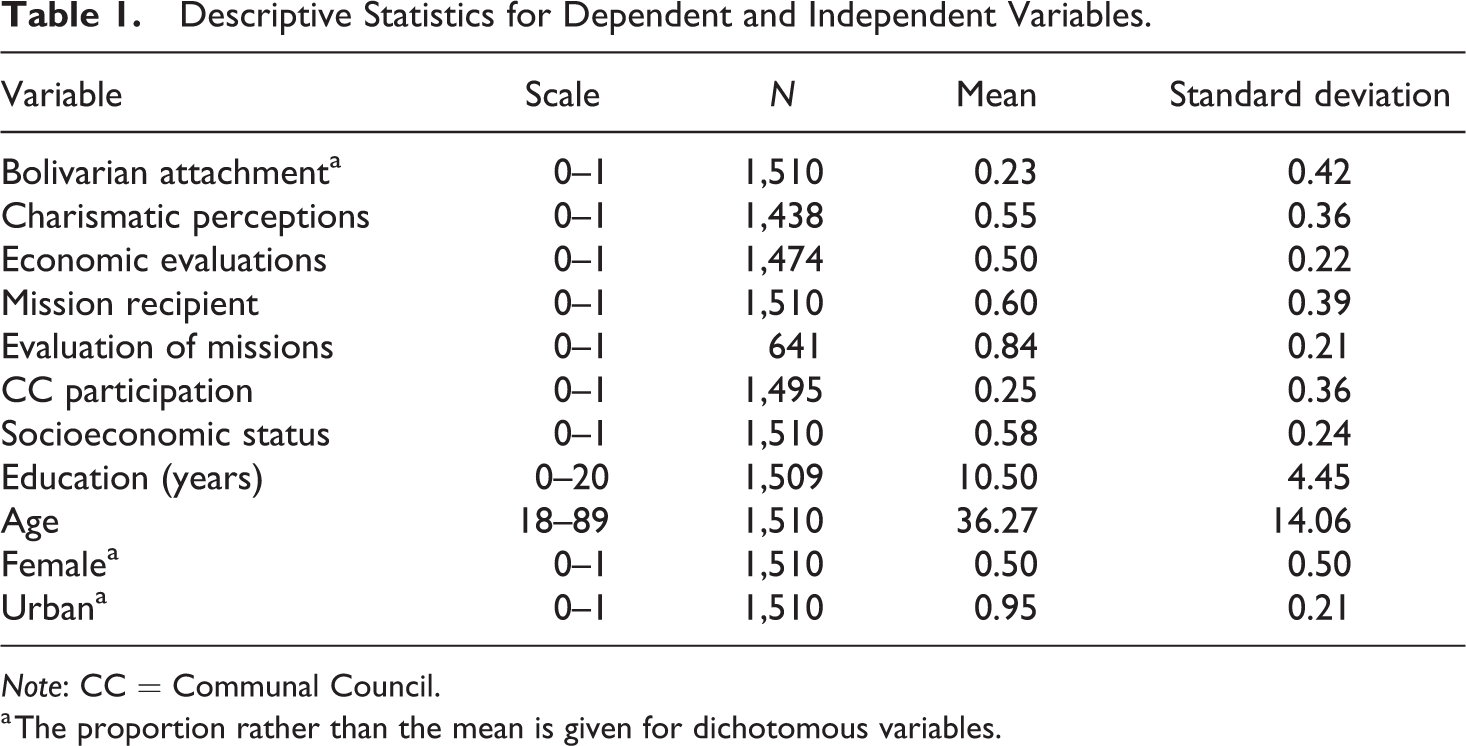
Finally, I incorporate four control variables thought to influence citizens’ identification with Bolivarianism: socioeconomic status, education, age, and gender. 10 Table 1 displays descriptive statistics for the key-dependent and key-independent variables for both surveys. Additional information on the survey can be found in the Online Supplemental Appendix.
Descriptive Statistics for Dependent and Independent Variables.
Note: CC = Communal Council.
a The proportion rather than the mean is given for dichotomous variables.
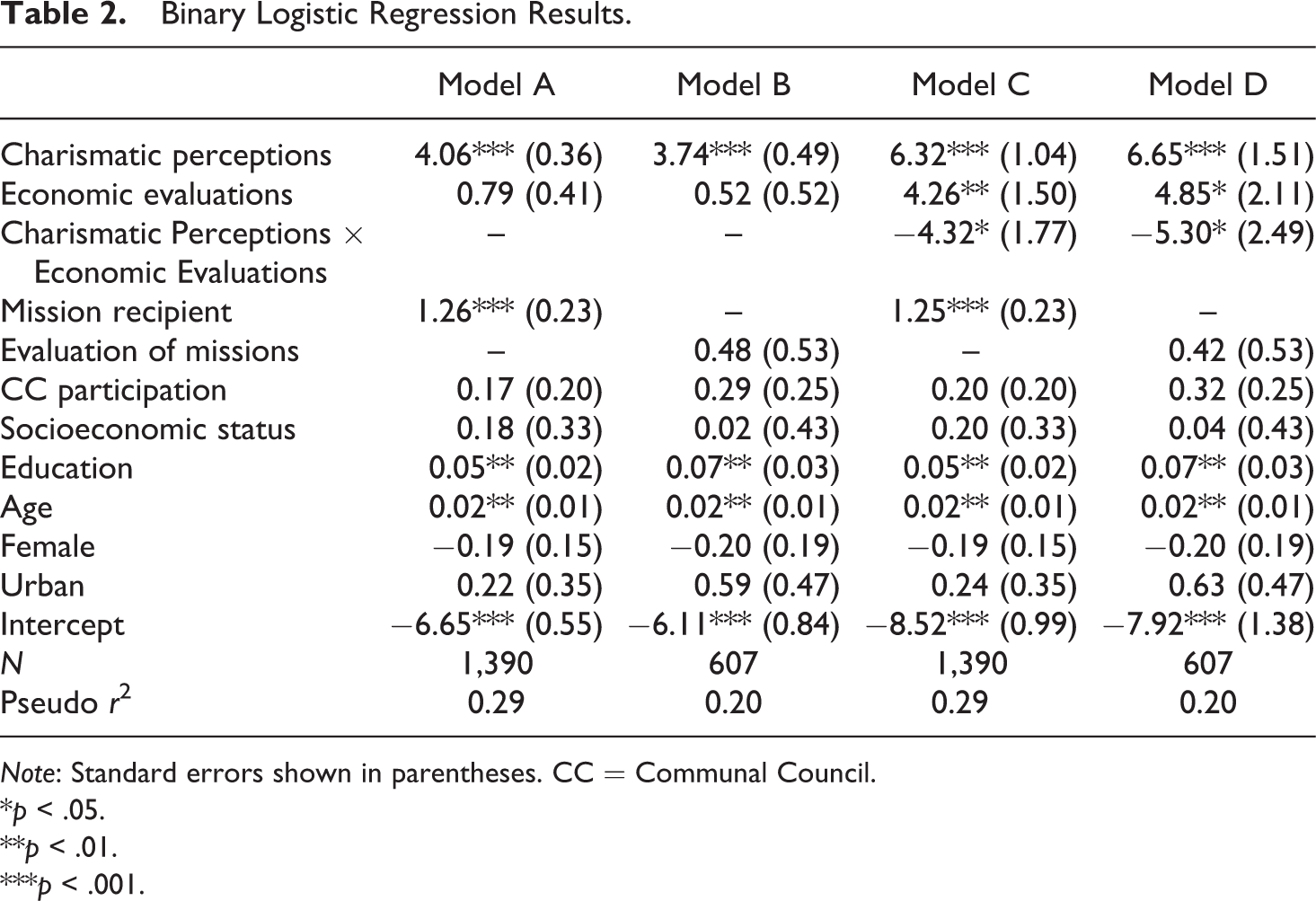
In total, I analyse four binary logistic regression models. Models A and C include the variable on access to the missions and thus include most respondents (N = 1326). Models B and D replace this variable with one on substantive evaluation of the missions among those who accessed them (N = 579). Finally, models A and B treat charismatic perceptions and economic evaluations independently, whereas models C and D interact the two variables. The next section discusses the results based on these four models.
Results
The results (see Table 2) suggest the uniquely strong influence of personalism on citizens’ attachments to Bolivarianism. Models A and B suggest that charismatic perceptions have a statistically significant and substantively large impact on Bolivarian ties. In the unrestricted sample (model A), respondents who perceive Chávez as extremely charismatic (score of one) are 47 percentage points more likely to express attachment than those who find Chávez extremely uncharismatic (score of zero), holding the remaining independent variables constant at their means. Among mission users (model B), this figure rises to 58 points (see Figure 1).
Binary Logistic Regression Results.
Note: Standard errors shown in parentheses. CC = Communal Council.
*p < .05.
**p < .01.
***p < .001.
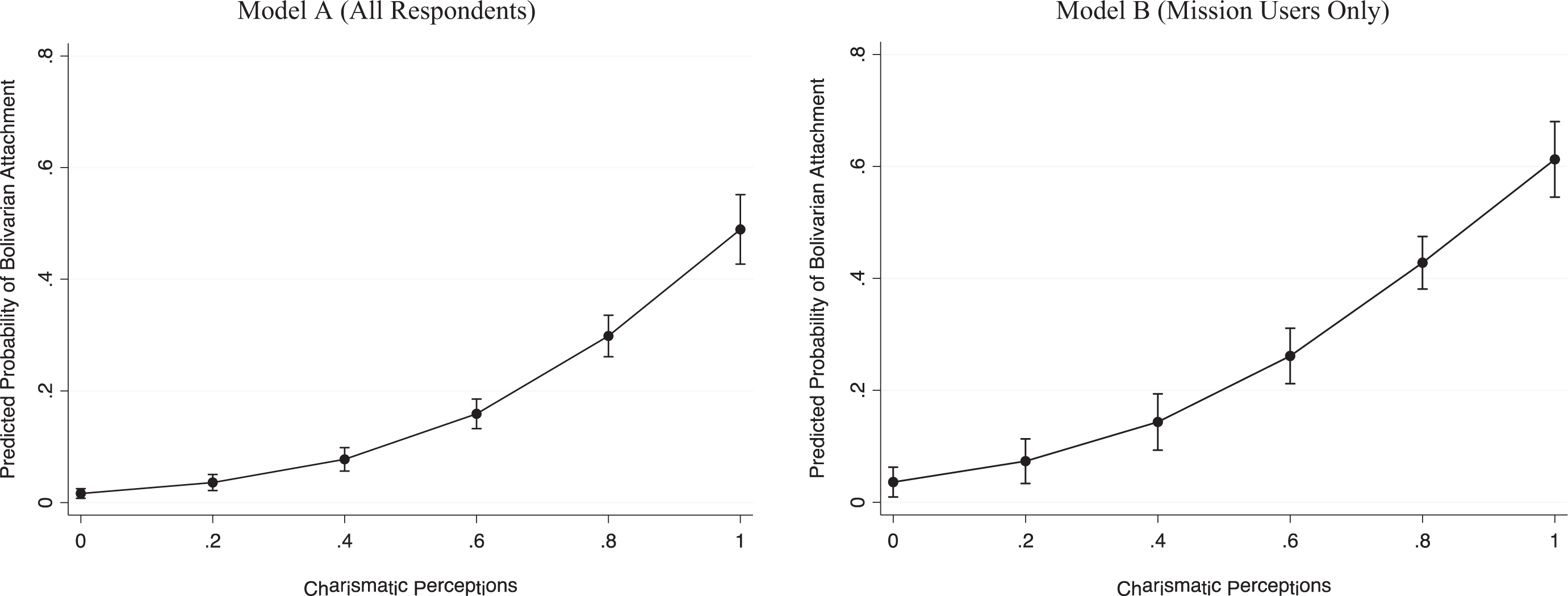
Predicted Probability of Bolivarian Attachment at Different Levels of Charismatic Perceptions.
In contrast, the programmatic and organisational variables are only weakly associated with attachments to the movement. Models A and B suggest that economic performance does not have a significant, independent impact on Bolivarian attachment. Models C and D examine the potential interactive effect of charismatic perceptions and economic evaluations on attachment. Interpreting this effect requires visual examination of predicted probabilities, as the statistical significance of interactions in nonlinear regression does not necessarily indicate a substantively meaningful effect (see Figure 2) (Brambor et al., 2006: 73–74). Model C suggests no meaningful interactive effect: at different levels of charismatic perceptions, the influence of economic performance evaluations on attachment does not change significantly. However, model D suggests that the interactive effect may have a small, negative effect among mission users: as charismatic perceptions of Chávez increase, the effect of performance evaluations on Bolivarian attachment decreases slightly. While this interaction appears significant, its negative sign suggests that higher charismatic perceptions dampen the influence of performance evaluations, further indicating the power of personalism on citizens’ loyalty to the movement.
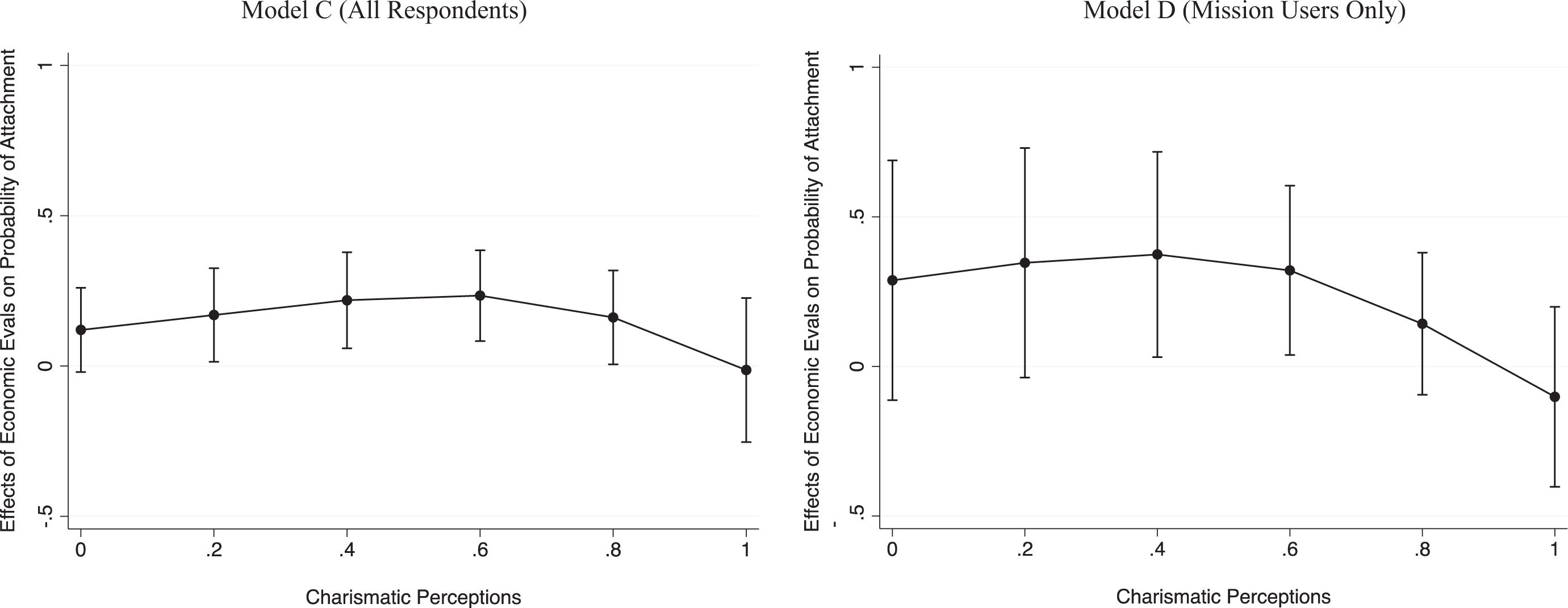
Effect of Economic Evaluations on Probability of Bolivarian Attachment at Different Levels of Charismatic Perceptions (Interactive Models).
In terms of social programmes, accessing benefits from one or both missions significantly increases the probability of expressing attachment to the movement. However, as discussed above, this does not necessarily suggest that the programmatic mechanism is at work. In fact, among mission users (model B), substantive assessments of the missions have no significant effect, suggesting that the quality of these programmes does not influence respondents’ attachments. Finally, in both models, participation in the CCs has no significant association with attachment. These data indicate the relative weakness of the programmatic and grassroots mechanisms while further highlighting the strong effects of personalism on loyalty to the movement. Taken together, the four models suggest the relative insignificance of programmatic and organisational factors on Bolivarian attachments while highlighting the disproportionate influence of charismatic perceptions of Chávez.
To ensure the validity of the results, I explore two alternative explanations for the underwhelming effects of programmatic and organisational factors. Firstly, in the additive models (A and B), multi-collinearity between charismatic perceptions and the other independent variables could artificially inflate the significance of the former and depress that of the latter. However, the variance inflation factor (VIF) for charisma for both models is low (1.66 and 1.48, respectively), suggesting that multi-collinearity does not account for the results. 11 Secondly, preference falsification may explain the insignificance of these variables. Specifically, respondents could feel pressured to evaluate Chávez’s charisma more highly than they otherwise might. Yet citizens generally do not hesitate to express dissatisfaction with Chávez’s regime. In fact, 17 per cent of respondents perceive Chávez as completely uncharismatic and 56 per cent rate his performance as mediocre, poor, or very poor. One would expect substantially higher approval ratings if preference falsification were at play. The remaining explanation suggests that citizens’ intense perceptions of Chávez’s charisma are intimately linked with their attachment to his movement, while programmatic and organisational factors have notably weaker effects.
Personalistic Attachment in the Words of Followers
The models analysed above demonstrate the overwhelming impact of personalism on citizens’ attachments to Bolivarianism in 2007, partway through Chávez’s rule. I now turn to focus groups conducted in March 2016 to investigate the evolution of these bonds and the status of the movement three years after his death. Focus groups provide several unique advantages: whereas surveys limit the depth and individual interviews limit the breadth of citizens’ insights, focus groups allow for thought-provoking discussion among participants and reflect both their individual experiences and collective understandings of the movement (Cyr, 2016). Furthermore, the timing of the focus groups allows me to gather information on citizens’ affective ties during Chávez’s rule and explore whether those bonds have remained salient. Given the context, in which Chávez’s handpicked successor has overseen a severe crisis and deteriorating grassroots organisations, signs of persistent loyalty to the leader and his movement would indicate the resilience of the personalistic mechanism.
I partnered with Consultores 21, a Caracas-based public opinion firm, to conduct six focus groups, each with six to eight self-identified Bolivarian followers from lower- and lower-middle-class neighbourhoods in and around Caracas. While not a nationally representative sample, the characteristics of followers in these neighbourhoods reflect those of followers from around the country. Participants were divided into focus groups based on two dimensions: Bolivarian orientation (supportive of/opposed to Maduro) and age (18–24, 25–39, and 40–55). 12 Given Venezuela’s polarised political landscape, dividing participants in this way allowed them to speak openly about their impressions of and relationships to the movement. An experienced moderator led the discussions, which focused on participants’ memories of Chávez; perceptions and anecdotes related to Bolivarianism during Chávez’s lifetime; experience of Bolivarianism after Chávez’s death; and thoughts and feelings about the movement’s future. 13
The discussions revealed insights regarding how citizens’ charismatic identification with the movement is sustained after Chávez’s death. 14 Firstly, consistent with the movement’s symbolic narrative, the participants praised Chávez not as a past leader but as an immortal hero whose spirit continues to watch over them and offer protection. As one participant stated, “What we have is an affective connection. What other leaders could have done will stay in the past. But with Chávez the connection will live on in each person.” A second proclaimed, “For me, Chávez was, and will always be, my hero.” A third stated, “I am Chavista because I believe in Chávez. Because I believe in what he says […] that’s the way it is and the way it will be. I believe in him and that’s why I’m Chavista.” These visions of Chávez as an everlasting leader indicate that he remains the central focal point of the movement in death. Furthermore, consistent with social psychology research, the statements suggest that his death has generated “permanent positive remembrances” in followers’ minds (Allison et al., 2009: 118). Indeed, the participants’ use of the present and future tenses to describe him suggests that their bonds to the movement have the potential to survive and remain emotionally intense in the future.
Secondly, participants shielded Chávez’s sanctified image from the regime’s poor performance under Maduro, reinforcing that their loyalty to the movement remains tied to the founder. As those critical of the handpicked successor stated, “Maduro is a bad Chavista”; “We are more Chavista than Maduro is.” Followers sympathetic to Maduro further clarified that their loyalty is anchored in Chávez. One participant stated, “There is a misunderstanding. You know that when Maduro comes to power […] he comes to power with Chávez, as the son of Chávez, and that’s why we call him Chavista […]. I defend [Maduro] but we aren’t Maduristas […] we are Chavistas.” That followers’ identification with the movement remains rooted in Chávez regardless of their feelings towards Maduro attests to their ongoing closeness to the leader and the resilience of their devotion to him, validating the presence of post-mortem charisma (Steffens et al., 2017: 532). It also suggests that the movement has the capacity to survive, even during periods of weakness.
Thirdly, participants expressed ongoing commitment not only to the spirit of Chávez but also to his mission to “free” righteous people from the malevolent opposition and achieve both physical and spiritual transformation. The way in which participants expressed this sentiment reflects the cultural frame of national liberation from conquest that the founder emphasised so fervently over the course of his rule (Gauna, 2018: 47; Michelutti, 2017: 237–238). One participant explained, “Chávez awakened his people, who were in darkness and gloom.” Another stated, “Chávez gifted us a country that he wanted to be free. Where am I? I am here with him and his people. We are the country, we are his people.” Yet another declared, As the people, we have to awaken and we have to maintain a vision of everything Hugo Chávez Frías did […]. He was a national leader, a global leader. And why do I say he is still a leader today? Because even though he isn’t with us physically, his legacy continues, just like he thought it would, with us as his people giving the movement continuity.
Finally, participants demonstrated intense faith that a new, more inspiring leader would eventually come to power, draw “divine inspiration” from Chávez, and resume the founder’s mission of salvation (Michelutti, 2017: 237). Specifically, they expressed clear expectations that a new leader would appear who is “charismatic,” “strong,” “extraordinarily capable,” “incorruptible,” and “100 per cent Chavista.” This hope for a new saviour suggests that the followers’ understanding of the movement remains fundamentally personalistic and indicates that future politicians would do well to use charisma to garner support.
In sum, the focus group participants clearly demonstrated that their attachments to Bolivarianism remain strong and anchored to its founder’s charismatic legacy rather than to his substantive policies or participatory organisations. As illustrated across all six focus groups, followers continue to express intense, affective attachments to Chávez as an immortal spirit, even three years after his death. They also remain committed to his mission to combat evil forces and express faith that they will emerge victorious with the help of a new charismatic leader capable of resuming his legacy. The persistence of this hope is remarkable in light of Venezuela’s severe crisis and attests to the capacity of charismatic bonds to shape followers’ worldview and carry the movement forward, even in the absence of effective policies or strong organisations.
Discussion and conclusion
This article challenges the conventional wisdom that charisma is ephemeral. By investigating the mechanisms through which personalistic attachments form and overpower alternative forms of citizen–politician linkages, I demonstrate its potential to consolidate resilient support for charismatic leaders and their weakly institutionalised movements. Recognition of historically marginalised citizens, daring yet short-lived policies, and a compelling symbolic narrative of redemption that incorporates familiar cultural themes solidify personalistic bonds and lead citizens to perceive the founder as intensely charismatic. Leaders who fulfil these conditions foster quasi-religious attachments with voters and simultaneously undermine programmatic and grassroots linkages: bold policies compromise effectiveness and sustainability while unmediated, top-down recognition of excluded sectors undermines genuine grassroots participation. Furthermore, these bonds can survive beyond the leader’s lifetime in their original, personalistic state, which helps perpetuate the movement without the development of strong party institutions.
I illustrate my argument using Venezuela’s Bolivarian movement. With data from the 2007 LAPOP survey, I show that voters’ perceptions of the leader’s charisma provide a stronger, more consistent foundation for attachment than traditional political ties based on programmatic evaluation and participation in Bolivarian organisations. Though Chávez proclaimed state-centred economics, redistributive social programmes, and grassroots organisations as central to his movement, the results suggest his personal appeal eclipsed these factors. Indeed, most programmatic and organisational elements of Bolivarianism had no significant relationship with attachment to the movement; in contrast, citizens’ perceptions of Chávez’s charisma were strongly associated with Bolivarian ties.
In-depth insights from focus groups with Chávez’s followers further illustrate the personalistic nature of Bolivarian attachments. The dependence of these bonds on deeply held emotions and cherished memories also suggests their potential to remain strong despite Chávez’s death and unfavourable contextual circumstances. Indeed, these attachments have persisted in the face of devastating economic crisis overseen by Chávez’s handpicked successor indicates their remarkable resilience and casts doubt on claims that Bolivarianism has disintegrated.
To further investigate the staying power of charisma, future research should develop more precise measures of attachment that refer to the larger movement (e.g. “Bolivarianism” or “Chavismo”) rather than institutionalised parties (e.g. “PSUV”). In addition, scholars should examine whether the survival of charismatic ties incentivises future politicians to engage in personalistic rather than programmatic or grassroots strategies to garner support and should explore the potential consequences for democratic representation and party institutionalisation. Finally, analysis of similar movements in other contexts such as Argentina, where Peronism has survived for decades, and Peru, where Fujimorismo sustains a larger and more coherent base of support than any other political force, will help further generalise the theory and shed light on the potential of new leaders to reactivate voters’ bonds after the charismatic founder disappears.
Supplemental material
Online_Appendix - The Power of Charisma: Investigating the Neglected Citizen–Politician Linkage in Hugo Chávez's Venezuela
Online_Appendix for The Power of Charisma: Investigating the Neglected Citizen–Politician Linkage in Hugo Chávez's Venezuela by Caitlin Andrews-Lee in Journal of Politics in Latin America
Footnotes
Acknowledgements
I thank Kurt Weyland, Raúl Madrid, Bethany Albertson, and Daron Shaw; Mollie Cohen, Matthew Layton, and my fellow panelists at the 2017 Midwest Political Science Association Conference; the participants in the Student-Faculty Latin America Working Group at the University of Texas at Austin; and several anonymous reviewers for their insightful comments on this article. I also thank the Latin American Public Opinion Project (LAPOP) and its major supporters (the United States Agency for International Development, the Inter-American Development Bank, and Vanderbilt University) for making the data available. Finally, I am grateful to Gerardo González and Consultores 21 for conducting the focus groups.
Declaration of Conflicting Interests
The author(s) declared no potential conflicts of interest with respect to the research, authorship, and/or publication of this article.
Funding
The author(s) disclosed receipt of the following financial support for the research, authorship and/or publication of this article: The author received funding from a University Graduate School Continuing Fellowship from the University of Texas at Austin to conduct the fieldwork and focus groups referenced in this article.
Supplemental material
Supplemental material for this article is available online.
Notes
References
Supplementary Material
Please find the following supplemental material available below.
For Open Access articles published under a Creative Commons License, all supplemental material carries the same license as the article it is associated with.
For non-Open Access articles published, all supplemental material carries a non-exclusive license, and permission requests for re-use of supplemental material or any part of supplemental material shall be sent directly to the copyright owner as specified in the copyright notice associated with the article.
