




Abstract
Focusing on the relatively longstanding experience of neighborhood councils in the Uruguayan capital of Montevideo (1993–), this research note seeks to analyze how sustainable democratic innovation is and to explain subsequent results. Sustainability is assessed through the evolution of citizens’ participation in elections and through the number of candidates who apply to become neighborhood councilors. For both indicators, a consistent decline in the levels of participation over time is found. This is deemed to be a consequence of an institutional design that seriously limits the performance of neighborhood councils in terms of their influence in the decision-making process and their acquisition of legitimacy and political capital.
Introduction
The program of participatory decentralization promoted in Montevideo by the Frente Amplio (FA) since 1989 1 is considered to be one of the most successful and longstanding practices of participatory democracy in Latin America (Portillo 1996; Schugurensky 2004). 2 Similar to other leftist parties that have had success in local elections during recent decades, the FA decentralized the city administration and opened up new channels in order to give citizens a voice in local government (Goldfrank 2002). Through these instruments, the FA expected to deliver more responsive, effective services and foster greater citizen involvement. Although there is substantial evidence that the city's decentralization program has led to service improvements and achievements (Portillo 1996; Chavez 2005), the results with regard to citizens’ engagement are not that clear cut. Thus, this paper 3 deals with the following question: What makes democratic innovation successful? Focusing specifically on the neighborhood councils that have been operational since 1993, we explore the extent to which this key element of the new participatory wave in Montevideo can be regarded as a consolidated participatory practice and the extent to which it can be deemed a sustainable and “good” example of formal citizen participation.
Montevideo was the first city to experience a leftist government in Uruguay. The FA has won all six elections since 1989.
Uruguay is also the most well-known and stable country with direct democratic instruments in Latin America (see Serdült and Welp 2012).
A first version of this paper was presented in the ECPR Joint Sessions of Workshops at the University of Warsaw, 29 March–2 April 2015. We thank the participants for all their very useful comments. This work was part of the program “Democratic Innovation: What Europe can learn from Latin America”, financially supported by the Avina Stiftung. The study was conducted by the Centre for Democracy Studies Aarau (ZDA) at the University of Zurich, the Instituto de Estudios del Desarrollo Regional y Local (IDEL) of the Universidad Católica del Uruguay, the Instituto de Ciencia Política de la Universidad de la República and the Defensoría del Vecino de Montevideo. The field work was carried out by Paula Ferla and Alejandra Marzuca.
In her pioneering work, Pateman (1970) characterizes the participatory model as one where maximum input (participation) is required, and where output includes not only policies but also the development of the social and political capacities of each individual. 4 Fung and Wright (2003), in what they define as experiments of empowered deliberative democracy, stress three fundamental principles: (i) a focus on specific, tangible problems, (ii) the involvement of ordinary people affected by these problems and officials close to them, and (iii) the deliberative development of solutions to these problems. These principles are related to contexts of:
We should mention, however, that under the label of democratic innovation, mechanisms of control and accountability such as recall can be found (see Welp and Serdült 2014).
devolution of public decision-making authority to empowered local units; the creation of formal linkages of responsibility, resource distribution, and communication that connect these units to each other and to superordinate, more centralized authorities; and the use and generation of new state institutions to support and guide these decentered problem-solving efforts rather than leaving them as informal or voluntary affairs (Fung and Wright 2003: 17).
The literature generally emphasizes this combination of influence on policy making, quality of deliberation, and citizen engagement (Avritzer 2002; Baiochi and Ganuza 2014; Geissel and Newton 2012). We can therefore argue that a successful institution of citizen participation is one that (i) provides a channel of influence in policy making, (ii) engages citizens in a process of deliberation and public communication, which in return provides legitimacy to the institution, and (iii) is able to attract a constant or increasing number of participants.
This paper is organized into four sections. In section 2 we will introduce the case study – namely, the city of Montevideo and its neighborhood councils. In section 3, we then proceed to evaluate (a) whether neighborhood councils actually do have a certain influence on policy making or not, (b) whether citizens engage in a process of democratic deliberation, and (c) to what degree the institutional set-up of participatory mechanisms is able to attract participants. We present our conclusions in section 4.
On 28 February 1990, only a few days after taking mayoral office, Tabaré Vásquez 5 signed a decree initializing the decentralization of the city of Montevideo (Resolution 133). However, the implementation was not straightforward and political opposition by two parties, the Partido Colorado and the Partido Nacional, lead to a period of tension and blockage. To resolve the standoff, the new government agreed to call for a joint committee on decentralization, referred to as the “Mixed Commission” (18 April 1990), which included experts and representatives of the major political parties (Goldfrank 2002; Veneziano 2005). As a result of this process, three local institutions were installed in each of the 18 newly created zones:
After serving as the mayor of Montevideo (1990–1994), Vásquez was also elected president of Uruguay twice (2005–2010; 2015–).
Community centers (centros comunales zonales, CCZs)
Local executive boards (juntas locales, JLs)
Neighborhood councils (concejos vecinales, CVs)
The community centers (CCZs) have the mandate to manage services and administrative procedures for their corresponding zones. Each operates under the responsibility of a director who is a civil servant with technical staff at her or his disposal. CCZ staff consists of public servants employed by the city government.
In the original charter, the local executive boards (JLs) supervised the CCZs and developed plans and services for their respective areas. However, they did not have their own financial resources and were not allowed to take out loans. JLs are composed of five representatives recruited from political parties. The mayor appoints the representatives to these honorary positions from a list submitted by each political party running in the municipal elections. Of the five seats, three are allocated to the winning party and the remaining two are distributed among the other parties based on the number of votes they receive (Canel 2001: 30). Neighborhood councils (CVs) also consist of honorary positions, 6 which are filled by elected residents living in the respective zone. CVs (a) serve as a bridge between the needs, demands, and suggestions of the zone's citizens and the governmental authorities, (b) stimulate citizen participation, (c) promote solidarity among local residents, (d) assess governmental acts; and (e) generate initiatives geared toward improving public management. The institutional design of CVs does not allow them to intervene in decision-making directly, but provides a forum for deliberation and a mechanism to inform those in power. In some respects the CVs have the autonomy to define both their way of working and their composition. For example, CVs have determined that they must consist of between 15 (25 until 2011) and 40 members; include plenary meetings and thematic commissions in their internal procedures; and establish an executive board that articulates, coordinates, and plans the institution's activities. Decisions are usually made by a simple majority vote. CV candidates must reside or work in the zone in which they are running and have either the support of local organizations or an endorsement from 20 neighbors.
Decree No. 26.019, 1 July 1993, modified and later repealed (including all modifications) by Decree No. 28.119, 2 July 1998. New version by Decree No. 30.660, 10 March 2004. Then modified with regard to (i) the age of eligibility (from 18 to 16 years old) (Decree No. 32.492, 15 May 2008); (ii) the number of signatures needed as a candidate (from 10 to 20) (Decree No. 33.478, 1 July 2010); and finally (iii) regarding the minimum number required to form a council (from 25 to 15) (Decree No. 33.908, 15 September 2011).
From 1995 to 2005 CVs played a key role in leading the process of participatory budgeting (compromisos de gestión). During that time, they were in charge of receiving, analyzing, and prioritizing citizens’ proposals – for example, regarding streetlights, green areas, public transport, or public spaces – in direct consultation with locals and the mayor. In 2005 control over participatory budgeting was taken away from the CVs, which saw their status decrease. This came after Montevideo's municipal government created the position of neighborhood ombudsman in 2003 – an institution that was perceived by the CVs to overlap their own functions. Naturally, the CVs opposed the creation of this position but were unable to prevent it (Bica 2008).
The institutional rules for the newly created bodies at the zonal level have undergone some crucial changes over the last two decades. In the first series of reforms, we can observe that at least some administrative tasks and services were passed down to a lower state level. However, the decentralization process in this early phase was still very much in the hands of political parties and provided only limited scope for citizen participation (Veneziano 2005; Schneider and Welp 2011). This set-up was maintained until 2010, when the Law of Political Decentralization and Citizen Participation 7 entered into force, creating municipal governments throughout the country and thus replacing the JLs in Montevideo. The creation of this third level of government throughout the country represented an important step in the decentralization process in Uruguay and helped to improve political legitimacy at the local level. Directly elected by the people, these municipal governments consist of a mayor and four city councilors and have the authority to manage a budget and to incur debt. Montevideo was a special case in that it went through a period of transition in which the 18 zones defined in 1993 were partly merged and then regrouped into eight municipalities. Nonetheless, the new law did not change the existing 18 neighborhood councils, leading to a situation in which some Montevideo municipalities now operate with more than one CV in their territory. 8
Law No. 18.567 and later adjustments (Laws No. 18.644, 18.653, and 18.659) (enacted 2009–2010). The law introduced further changes such as the elimination of the secretary, a position appointed by the mayor to mediate between the city government, JL, and the Department of Decentralization.
Although the impact of these territorial rearrangements of the CV do not form part of this analysis, they can be consulted in Decrees No. 33.209, 33.227, and 33.310 on the political and administrative decentralization of Montevideo.
We base our assessment on (i) extensive fieldwork that includes semi-structured interviews with neighborhood councilors, local authorities, and civil society organizations, (ii) participatory observations during site visits, (iii) documentary analysis of legal regulations and official reports, and (iv) secondary analysis of council election results. This section is based on fieldwork that was carried out during 2010 and focused on 6 out of the 18 zones (1, 3, 8, 9, 13, and 17) (for details, see Ferla et al. 2012 and 2014).
Influence on Decision-Making
CVs exert either a direct or indirect influence on the definition of those programs, governmental policies, and measures that affect their respective territories by advising representatives of departmental and local government or by generating proposals. It is, however, the government that decides whether or not to consult with CVs and take into account their advice. So how does the relationship between the CVs and the governmental authorities work in practice?
According to the councilors we interviewed, the few occasions where the executive consulted with CVs on issues affecting their territories show that the relationship is far from ideal. Most councilors claim that (a) the government is generally not held accountable for its decisions, (b) that councilors’ proposals are not taken into account, and (c) that the government has difficulties in fulfilling its commitments. In several interviews the term verticalazos (a colloquial expression that refers to those bypassed in the decision-making process by a higher authority and confronted with facts that cannot be changed) is used to describe the way the executive treats CVs. Furthermore, the CVs’ relationship with the legislature is also limited to a few specific instances and is marked, in most cases, by conflict. An example of such a conflict was the creation of the neighborhood ombudsman, an office strongly rejected by the CVs.
The relationship between CVs and JLs (the local political body at the time of conducting fieldwork) provides a crucial gateway for accessing information and influencing council decisions. For CV members, having access to required information and believing that JLs consult with them on relevant issues and value their advice are the main criteria for a positive relationship between local governments and councils. In the following quote, a councilor we interviewed describes his experience of a negative relationship:
Decisions are made once every thousand years and in general go against the council's opinion. When we would like to pave this street, they pave the other, when you give priority to one thing, they prioritize the other […]. I feel a bit frustrated. The highest body is the neighborhood council, however, some issues don't pass before the council. They are executed elsewhere and the councilor is left out but gets the blame and the beating from the residents because they think he has an important role to play.
Whether a CV is consulted by a JL during a decision-making process seems to depend on the personal relations between members of both institutions as well as on their respective interpretations of what the CV stands for (rather than its formal competences). Based on the interviews we conducted, the relationship attributed (close or distant) depends on the experience they may have acquired in the past when they were councilors or social activists. One councilor noted that “for the Junta Local, the Consejos Vecinales present more problems than solutions. They are like a stone in your shoe, complaining all day, demanding things and not giving much in return.” Another councilor said, “As we have no power at all, what we do is complain and complain like any other neighbors. It makes no sense if we don't have more power.” Our analysis is based on the period prior to the establishment of the eight municipalities (see above). Currently, given that more than one CV belongs to each municipality CVs negotiation capacities can be expected to be even weaker, unless new mechanisms of association between them are developed.
In short, we observe that CVs are not considered major players per se, but some of them could manage to become recognized partners over time. This is also reflected in the perception of the concrete achievements of the CV.
The councilors interviewed had difficulties in identifying the achievements of their CVs. Some made rather general statements such as “a strengthening of the participatory space,” “better proposal-writing capabilities,” or “preserving the integration of the commissions.” Others mentioned issues such as the actual achievements of the government – for example “90 percent street lighting in the area” or “the renovation of the sports plaza.” This confusion regarding their own tasks is explained by the advisory functions they fulfill and also by the fact that some measures are the result of coordination among various actors. Our observations show that CVs’ main achievements are related to giving advice on the execution of public works and services, mainly with regard to cultural, housing, gender, and health policies. Meanwhile, some CVs appear to be more proactive in launching their own initiatives to address local issues. Some positive examples of this include supporting the reopening of a hospital, creating a health clinic, opening new schools, boosting housing cooperatives, setting up a drug rehabilitation center for users and their families, and establishing a center for rural workers. 9 Are these achievements enough to maintain the general high regard for the institution and to attract public participation?
Many of these proposals are channeled through the participatory budgeting process and occasional opportunities for councilors to interact with various groups in the neighborhood.
The process of deliberation should contribute to the development of civic virtues such as tolerance, trust, and a sense of responsibility (Schugurensky 2004), which together with their influence in policy making should legitimize the role of the CV in public matters. Our fieldwork helped us to identify the forms of tension between the individualistic logic of the respective councilors (who are members of an organization, district, or subzone community center) and the communitarian logic (which is expected to take priority when the problems and needs of several territories – often with limited financial resources – are considered).
A balance needs to be created between direct demands, the needs of several jurisdictions, and the government's agenda. Not only is such a balance possible when developing the global vision required to establish the CV as a representative, it tends to be the result when councilors undertake processes of accountability and provide their relevant collective with information. According to most of the councilors interviewed, the expectations of the neighbors and organizations who supported them often become an obstacle to considering other arguments and developing a form of inclusive work. This aspect affects the legitimacy of the CV in the eyes of other, mainly local, political and administrative actors given that the community's expectation of clear outcomes undermines the ability of the CV to play its role of “social agent” or “voice box” (caja de resonancia).
The mechanisms by which topics make their way on to the agenda of CVs reflect the CVs degree of autonomy. This is because, on the one hand, there are governmental requests (meetings that councilors are invited to attend, forms they have to sign, or information on programs or particular policies or proposals they need to know) and, on the other hand, there are the councilors’ definitions of topics. Our study showed that the most autonomous CVs were those that managed to develop their own agenda, having not only the government but also the people and other institutions as interlocutors.
CVs are usually open to the participation of citizens who are not council members (in commissions, plenary meetings, or “open councils” in particular). However, analysis of the form and frequency of the relationship between neighbors, CVs, and organizations indicates that there is discontinuity and a lack of concrete procedures, resulting in CVs’ low degree of integration into local society. Although there are cases where specific strategies of contact with the local community have been implemented or where some CV committees have developed in-depth work within the community, these practices are exceptions.
In general, the relationship between CVs and local residents occurs through the individual actions of the councilors. Summarizing the view of many, a civil servant stated the following:
Residents ignore the neighborhood council; they do not need it and are not interested in it. They neither believe in the council nor perceive it as an important organ. They do, however, recognize the leaders and activist councilors for their charisma as neighbors and neighborhood representatives. There are personal relationships because they know each other, but without institutional planning (Interview 9/2/2010).
Organizations and residents attend council meetings infrequently and only in specific situations. All our interviewees noticed that CVs spend most of their time on administrative tasks, which is detrimental to maintaining dialogue with locals and social organizations. One councilor had the following to say:
We do not have much time to devote to the neighborhood; we have to participate in thematic commissions, workshops, go to the IMM [Municipality of Montevideo], etc. It is impossible to cover everything and integrate into the organization and complete the work that each one has (Interview 6/10/2009).
This produces a way of working that is isolated from local residents and alienates existing social organizations (including those to which CVs belong). It also does nothing to encourage CVs’ local involvement. In general, locals do not know what CVs are, what functions they have, what issues they address, what things they have achieved, or even who the CV councilors are.
One of the main difficulties CVs face in their relationships with the neighborhoods they represent is that communities expect them to resolve problems even though they do not have the competencies to do so. According to one councilor, “the council does not attract people; if it does not play a role providing solutions we [councilors] are just like any other neighbor” (Interview 18/12/2009). This vicious circle produces legitimacy and efficiency problems, resulting in CVs being perceived as meaningless. 10 Is this situation translated to the levels of participation?
A social network analysis confirms that CVs together with businesses in the area are perceived to have least amount of influence. In all but one of the areas studied, CVs had a very low level of influence on area-relevant public policies (see Ferla et al. 2012).
Several studies have shown that institutions of participatory democracy attract only a small portion of the electorate. Goldfrank (2011) notes that the most successful Latin American experiences hover around a participation rate of 10 percent. For some scholars, it opens a debate on the legitimacy and representativeness of these institutions. Although these low numbers matter to opponents of participatory democracy, its defenders emphasize its role in complementing and strengthening representative democracy by giving a voice to those who would otherwise never receive a chance to be heard (Goldfrank 2011). Approaching this issue requires an exploration of the evolution of participation and the profiles of the participants as well as a qualitative analysis of both the perceptions of those involved and the incentives or disincentives faced by citizens to vote and/or integrate into CVs.
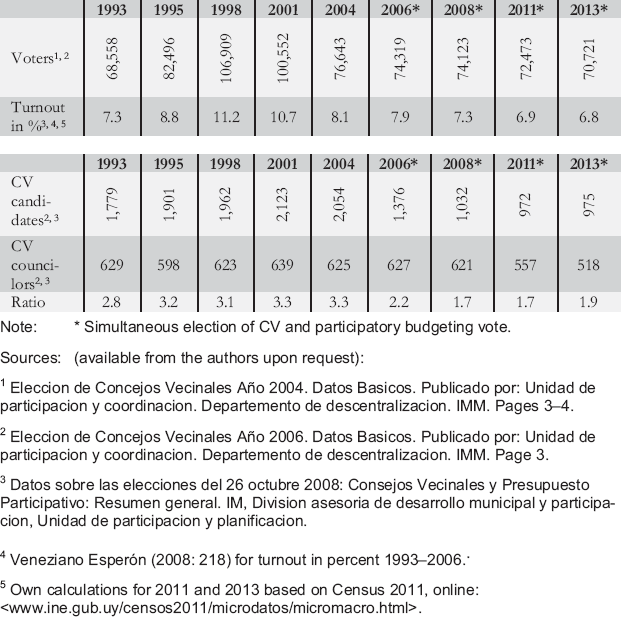
On average, 82,000 citizens voted in each of the nine CV elections (1993–2013), representing a turnout of between 7 and 10.8 percent of the electorate. The first year had the lowest participation rate (with 68,558 voters). A considerable increase was observed between 1995 and 1998 (up to 106,909 voters), but since then there has been a steady decrease in voter numbers. On three occasions participatory budgeting voting was merged with councilor elections, but there appeared to be no clear effect on the level of participation (see Figure 1).
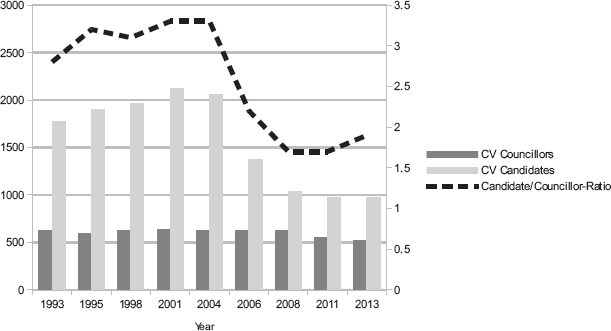
Number of Candidates, Number of Councilors, and Candidate– Councilor Ratio for CV Elections in Montevideo, 1993–2013
During the last six elections, the number of candidates went down by more than half, from 2,123 in 2001 to 975 in 2013 – stakeholder numbers also declined accordingly. Although the average total number of elected councilors stands at 604, the 518 elected last time around are a record low. 11
As an aside, we as researchers also realized how difficult it is to receive reliable statistics on each of the CV elections listed in the Annex. Depending on the source, the indicated figures vary slightly but do not change our main interpretation of the data. It is, however, indicative of the general situation. Despite the fact that elections in Uruguay should be supervised by the Electoral Court, they are in fact handled de facto by the municipality. In addition, we could not find an easily accessible, transparent publication with detailed election results worthy of a democratic procedure. A detailed official publication indicating the total number of the electorate in a gazette simply does not seem to exist.
To deal with the decreasing number of candidates, some CVs reduced the number of required seats. Following changes to departmental regulations, CVs have been able to work with a minimum of 15 members (previously 25) since 2011. The government argues that this reduction reflects changes in the territorial boundaries, which have established new municipalities. Others, however, have pointed out that there were fewer candidates than positions to fill during recent elections (especially when considering that for each councilor a replacement needs to be elected) during recent elections. 12
Meanwhile, the average number of councilors per CV for the period 1993–2013 is 34. In 2011 only 5 of the 18 CVs elected 40 councilors. In fact, only one CV (the 18th) has maintained the maximum membership during the eight elections. Less than half the CVs (seven) secured the number of councilors they originally decided on, while the rest reduced the number of members by as few as 2 to as many as 18 throughout this period.
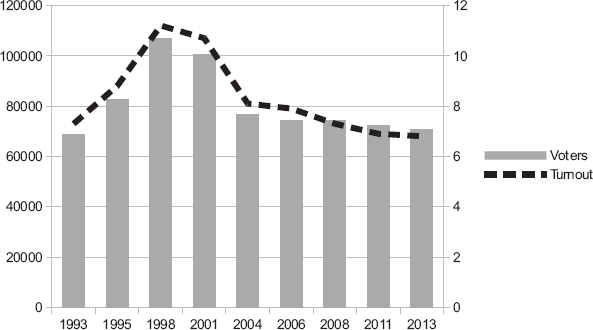
Number of Voters and Turnout for CV Elections in Montevideo, 1993–2013
Finally, our observations do not suggest that the underrepresented sectors of the population are main participants of the CVs. In Montevideo the majority of the participants in CVs are middle-class adults (the youth population is underrepresented). 13 According to data on six CVs obtained during our focus group interviews (conducted between 2009 and 2010), the majority of councilors were men (58 percent). Of the CV members analyzed, only 9 percent were below 40 years of age, 43 percent were between 40 and 60, and 45 percent were older than 60. In terms of highest level of education, 49 percent attended secondary school, 23 percent only attended primary school, and 26 percent attended university. At the time of our study, 66 percent of respondents were working. Moreover, 45 percent say that this is not their first term as councilor.
This is based on the profiles of the CV members working during the fieldwork period.
The number of participants in CV elections, even if below 10 percent of the electorate, is considered satisfactory when compared to similar experiences in the region (Goldfrank 2011). During the period immediately following the establishment of CVs, citizen interest in CV councilor roles and the level of permanence in the exercise of their functions were relevant features of the Montevidean experience. It also appears that there was an important endorsement of social organizations, which is now declining. Also the drop in interest in participating must be investigated. Since 2004 there has been a steady downturn in the number of candidates and in the level of permanence in office. In the interviews and informal exchanges conducted, we noted that participants agreed there was an increase in the number of candidates standing as individuals without the support of social organizations. This is related to changes in incentives and motivations to participate as a councilor.
One of the councilors we interviewed mentioned that this could be down to, on the one hand, the difference between “what councilors are expected by the council to achieve and what is possible and effectively achieved” and, on the other hand, the consolidation of new institutions that are able to address public problems that were more difficult to resolve before the process of decentralization. Moreover, it is noted that for many participants, CVs have served as a stepping-stone to a political career. In fact, the governing political party itself has treated CVs as hotbeds for candidates. For some, this has had a positive impact to the extent that it has helped the government apparatus incorporate more prominent personalities to respond to locals, while others point out that this strategy devaluates CVs (Bica 2008; Veneziano 2005).
The institution of the CV in Montevideo was launched with high hopes on the part of both citizens and elected councilors. Based on qualitative and quantitative data, we found evidence of a clear downward trend for this participatory decentralization initiative. CVs have become increasingly excluded from decision-making processes, much to the frustration of a significant number of councilors. Despite several rescue operations, such as bundling CV elections and participatory-budgeting voting, fewer citizens are motivated to stand as candidates or participate in elections. Despite the fact that the municipality of Montevideo ran a campaign to attract candidates and mobilize voters to participate in the 2013 CV elections, we observed a constant decline in interest in this institution among both candidates and the electorate, with participation rates dropping to record lows.
Although the political will for reforms by the Frente Amplio was of course key to the creation of decentralized mechanisms for civic participation in Montevideo, we saw that CVs underwent institutional design changes that were detrimental to their functioning. Uncoupling their functions from participatory-budgeting voting and overlooking them in decision-making processes have made CV members appear powerless vis-à-vis citizens; as a consequence, they have lost credibility. Given these circumstances, the institution of the CV in Montevideo stands at a crossroads. With even less candidates and participants in the next elections, it will be difficult to justify their existence. Based on our assessment, the direction in which the institution should move regarding its degree of formalization is an open question that involves certain tradeoffs. One option is to return responsibility for the participatory-budgeting process back to CVs and formalize their role in decision-making. Such a move would most likely enhance the reputation of the CV and see CVs become more politicized. Nonetheless, such a move is unlikely within the current context, while turning the CV into a more formalized political body may not be beneficial. Alternatively, transforming into neighborhood associations without directly elected members could help CVs’ increase their legitimacy vis-à-vis citizens. Such a strategy could allow them to engage with locals and to play a role in community politics more freely.
Footnotes
Annex
Turnout for CV Elections and Ratio of Candidates per CV Councilor
| 1993 | 1995 | 1998 | 2001 | 2004 | 2006 * | 2008 * | 2011 * | 2013 * | |
|---|---|---|---|---|---|---|---|---|---|
| Voters1, 2 | 68,558 | 82,496 | 106,909 | 100,552 | 76,643 | 72,473 | |||
| Turnout in %3, 4, 5 | 7.3 | 8.8 | 11.2 | 10.7 | 8.1 | 7.9 | 7.3 | 6.9 | 6.8 |
|
|
|
|
|
|
|
|
|
|
|
| CV candi-dates2 3 | 2,054 | 972 | 975 | ||||||
| CV councilors2 3 | 629 | 598 | 623 | 639 | 625 | 627 | 621 | 557 | 518 |
| Ratio | 2.8 | 3.2 | 3.1 | 3.3 | 3.3 | 2.2 | 1.7 | 1.7 | 1.9 |
Note: Simultaneous election of CV and participatory budgeting vote. Sources: (available from the authors upon request):
Eleccion de Concejos Vecinales Año 2004. Datos Basicos. Publicado por: Unidad de participacion y coordinacion. Departemento de descentralizacion. IMM. Pages 3–4.
Eleccion de Concejos Vecinales Año 2006. Datos Basicos. Publicado por: Unidad de participacion y coordinacion. Departemento de descentralizacion. IMM. Page 3.
Datos sobre las elecciones del 26 octubre 2008: Consejos Vecinales y Presupuesto Participativo: Resumen general. IM, Division asesoria de desarrollo municipal y participacion, Unidad de participacion y planificacion.
Veneziano Esperón (2008: 218) for turnout in percent 1993–2006.
Own calculations for 2011 and 2013 based on Census 2011, online: <www.ine.gub.uy/censos2011/microdatos/micromacro.html>.