



Abstract
In this paper we bring together institutional, contextual, and behavioral perspectives in a comprehensive model that explores determinants of executive and legislative approval based on economic performance in Brazil and Chile. Our main question is, do voters attribute responsibility for the state of the economy to their representatives in the Legislative Branch as they apparently do to officeholders in the Executive Branch? We search for answers to this question with an eye on how active the distinct branches of government are in economic policy-making and voters’ levels of political sophistication. Our main hypothesis is that less sophisticated voters will blame politicians indiscriminately for the state of the economy, independent of how influential each branch of government is on economic policy. More sophisticated voters will better discern the role each branch plays in economic policy-making and will not blame representatives in the Legislative Branch for the state of the economy when Congress is not active in economic policy-making. The cases of Brazil and Chile under Cardoso and Lagos offer the perfect opportunity to test this hypothesis, which is confirmed by our data.
Introduction
In this paper we bring together institutional, contextual, and behavioral perspectives in a comprehensive model that explores determinants of executive and legislative approval based on economic performance. 1 Despite an impressive amount of research conducted on the topic in recent decades, 2 economic voting theory devotes less attention to the impact of economic performance on legislative approval among citizens in new democracies and in a comparative perspective, then it does to executive branch approval in consolidated democracies. 3 Furthermore, null findings for economic effects on legislative evaluations are also fairly common in the extant literature. 4 Our study revisits this debate and points out, based on Brazilian and Chilean public opinion data, that voters link the economy to the evaluation of the Legislative Branch especially when it is a salient political actor in influencing economic policy (Duch and Stevenson 2005).
We would like to thank the two reviewers and the editor of the Journal of Politics in Latin America, Jorge Gordin, for their excellent and constructive criticism and suggestions. A preliminary version of this paper was presented in the Joint Session of the European Consortium for Political Research at Nicosia in 2007. We thank all participants for helpful comments.
See Kramer (1971); Goodman and Kramer (1975); Abramowitz and Segal (1986); Abramowitz (1985); Brown and Woods (1991); Romero and Stambough (1996); and Lockerbie (1991).
For an exception, see Gomez and Wilson (2006).
See Jacobson (1989); Marra and Ostrom (1989); Erikson (1990).
Latin America, where legislative institutions have gained more prominence in the policy-making process after the recent wave of democratization (Johnson and Crisp 2003), is a fertile ground to explore how institutional, contextual, and behavioural factors combine to explain citizens ability to blame their representatives. Presidents are usually the main policy-makers in the land, rendering the Legislative Branch a more reactive role (Cox and Morgenstern 2001). Still, final decisions, in most policy areas, require the approval of the Legislative Branch, increasing the possibility of shared responsibility. Nevertheless, as we claimed, voters may perceive the role of the Legislative Branch differently, depending on their levels of political sophistication and on the characteristics of the political context. 5 Do voters blame Congress when they should: That is, when Congress is an active participant in the policy process? Furthermore, does blame attribution vary by how informed voters are about the political system?
We follow Luskin's classic work, measuring political sophistication through levels of political information held by voters (1987, 1990).
We answer these questions using individual level data, with an eye on the institutional and contextual factors that may influence voters’ evaluations. By adopting a broad theoretical perspective we can specify under what conditions the Legislative Branch is more likely to be blamed for the state of the economy and if such responsibility is deserved.
We advance the general hypothesis that under some situations, certain political actors may be blamed unjustly for economic outcomes. For instance, when Congress is active in the economic policy-making process, it should be held accountable for its role in economic outcomes. This is the case in Brazil in the period studied here. On the other hand, if Congress is blamed for economic outcomes, when it is not responsible for significant policy change in the area – as in the case of Chile in the period we study – then blaming Congress may vary by how aware and informed voters are about the political system. Therefore, political sophistication, coupled by contextual political characteristics, should affect the impact of economic evaluations on legislative and executive branch assessments.
Whereas we control for contextual variation by selecting cases that are similar in many regards, but distinct on how active Congress is in economic policy – Brazil and Chile – we measure voters’ levels of political sophistication at the individual level. Following Gomez and Wilson (2006), we assume that not all voters attribute responsibility in the same manner and that political sophistication is a key factor influencing the impact of economic evaluations of the Legislative and Executive Branch. Differently from them, however, we find a distinct pattern of how political sophistication interacts with legislative and executive evaluations in Latin America.
We find that low political sophisticates blame Congress and the President indiscriminately; independent of how active each is in the policy process and without differentiating among them. It seems that for low political sophisticates in Latin America separation of powers is more obscure: voters blame everyone. Political sophisticates, on the other hand, do attribute blame differentiating between the two branches and imputing responsibility to Congress when it is an important actor in the economic policy-making process.
In sum, our main claim is that institutions alone are not sufficient to explain outcomes in the evaluation of legislatures. Political context, defined by how active the Legislative Branch is in economic policy, is more influential in increasing Congress’ visibility in the policy process (Duch and Stevenson 2005). Furthermore, voters’ levels of political sophistication also influence the evaluations of the branches of government, especially the Legislative Branch. 6 Therefore, we merge Gomez and Wilson's work with that of Duch and Stevenson's to try to explain when Latin American voters will and will not attribute blame discriminately to the distinct branches of government.
In this way, we agree completely with Gomez and Wilson, but we find a distinct situation in Latin America from that of their cases.
Our cases offer a good opportunity to test such hypothesis because Brazil and Chile are relatively similar when it comes to the predominance of the Executive Branch over the policy-making process, but provide variation in contextual factors, especially regarding the actors involved in the decision-making process on economic policy. We claim that in Brazil, the Legislative Branch actively participated in the discussion of economic, administrative, pension, and tax reforms from 1994 onward, whereas in Chile, most of these reforms occurred in the previous authoritarian period, which ended in 1991. Therefore, the size of the legislative agenda regarding economic reform during the recent democratic period, which we study here, was much greater in Brazil than in Chile. We find that as a consequence, politically sophisticated voters in Brazil attribute responsibility to the National Congress for economic policy. We do not find similar results for Chile. Whereas, in both cases, less politically sophisticated voters blame everyone: In Chile, sophisticates do not blame Congress for the state of the economy. Ultimately, blaming everyone, especially when one of the actors has very little responsibility for decisions on the specific policy area being evaluated, may be prejudicial to democratic institutions in general, and Congress in particular.
In sum, we contribute to the ever-growing literature on economic voting in Latin America by, first, focusing at the individual level, based on survey data and second, by contrasting the impact of retrospective economic voting on approval of the Legislative and Executive Branch. Both of these tasks have not been sufficiently undertaken in the new presidential democracies of Latin America and contribute to better understand relations of accountability between voters and elected representatives in the Legislative and Executive Branches. 7
For studies on retrospective economic voting in Latin America using aggregate data, see Stokes (2001); Samuels (2004); Spanakos and Renno (2006a, 2006b, 2009).
The paper is organized in three parts. First, we offer a brief discussion about our theoretical expectations derived from previous research on economic voting and its interaction with political institutions and political contexts (at the systemic level) and political sophistication (at the individual level). We also discuss the cases of Brazil and Chile in light of the main conclusions of this literature. The second part discusses the surveys used and presents the empirical model. In the third section, we analyze the data and through simulations using predicted probabilities we estimate the differential impact of retrospective economic assessments on executive and legislative evaluations in the two cases. Finally, we conclude by arguing that blaming everyone may hinder vertical accountability in Latin America and contribute to the crises of democratic representation in the region (Hagopian and Mainwaring 2005; Mainwaring, Bejarano, and Pizarro Leongómez 2006).
Institutions, Political Context, and Political Sophistication
The theory of economic voting is an applied perspective of vertical accountability. The main hypothesis underlying this body of research is that citizens punish governments for hardship and reward them for good economic performance (Key 1958, 1968). After more than three decades of research, the dominant evidence is that political behavior (at the macro and micro levels) is usually influenced by national economic conditions (Lewis-Beck 1990; Nannestad and Paldam 1994; Norpoth 1996; Lewis-Beck and Paldam 2000; Dorussen and Palmer 2002). 8 This influence, nevertheless, is limited or conditioned by systemic as well as individual factors. There are many situations where the punishment-reward function may not fit or may have a limited or even distorted impact. 9 Considering Latin America in particular, we find that institutional and contextual settings as well as individuals’ levels of political sophistication may influence the causal attribution of responsibility between distinct political actors and generate heterogeneous patterns of attribution among individuals.
There is scarce evidence that personal financial circumstances have some predictive power over political behavior, (see, for instance, Sanders 1991 among other works, Nannestad and Paldam 1993, 1997). Scholars have also stressed that there are theoretical problems in connecting political behavior with a myriad of events that may influence personal financial assessments and expectations, such as getting married or having children, but are not induced by the government (Kramer 1983; Fraile 2005; Jones and McDermott 2004).
Previous studies have pointed out that economic voting may be limited or conditioned by the programmatic preferences of the political party in the government (Hibbs 1979; Norpoth 1996; Carlsen, 2000), by the absence of credibility regarding the opposition party (Sanders 2000; Fraile 2005), by political leadership (Clarke, Ho, and Stewart 2000; Sanders 2000), by the real economic conditions (Stevenson 2002), by the clarity of responsibility given by political and economic institutions (Powell and Whitten 1993; Anderson 2000; Kiewiet 2000; Chapell and Veiga 2000; Alvarez, Nagler, and Willette 2000; Nickelsburg and Norpoth 2000), and by the political sophistication of individuals (Aidt 2000; Paldam and Nannestad 2000; Duch 2001; Dorussen and Palmer 2002), among others.
Our central theoretical claim, therefore, is twofold. First, voters will attribute responsibility to a political actor contingent upon how influential such actor is in affecting economic policy (Duch and Stevenson 2005, 2008). Second, the ability to impute responsibility will vary according to levels of political sophistication (Jones and McDermott 2004; Gomez and Wilson 2003, 2006). Hence, our task is doubled: we need to derive a) a systemic/contextual/institutional and b) an individual level hypotheses from the extant literature to test in Brazil and Chile; even though we believe that both institutional and individual explanations go hand-in-hand. Institutional context may create incentives that influence distinct voters differently. Furthermore, we can better evaluate if the mechanisms of vertical accountability are working properly if we take into consideration the differential role of the distinct branches of government in influencing policy. If the Legislative Branch, for instance, was not responsible for certain policies and it is receiving blame for something it did not do, then equivocated vertical accountability may lead to unfair punishment. This poses the intriguing situation that blame attribution may not be beneficial to democracy: We argue that it is only favorable when blame is attributed correctly. That is, when who deserves blame receives it and who is not responsible for political outcomes is not considered to be.
Thanks to Powell and Whitten's pioneering contributions, institutions can play a very significant role in blurring the lines of vertical accountability. According to Powell and Whitten (1993), institutions provide different levels of clarity of responsibility regarding who is in control of the economy and, therefore, who is responsible for economic performance. By analyzing aggregate data for 19 industrialized democracies, they concluded that “the greater the perceived unified control of policy-making by the incumbent government, the more likely is the citizen to assign responsibility for economic and political outcomes to the incumbents” (1993: 398).
There is a lot of convergence between the above claim with that of Duch and Stevenson (2005), who add that the concentration of authority in a single party increases the ability to impute causality for economic outcomes. According to them, “when executive power is shared, economic voting for every party is diminished” (Duch and Stevenson 2005: 390). A more equal distribution of responsibility between parties weakens cognitive shortcuts the economy may provide to voters.
These studies focus mostly on parliamentary systems, where the issue is not necessarily the division of powers between the Executive and Legislative Branch, but how many parties compose the governing coalition. However, in most presidential systems, the issue is regarding responsibility attribution to distinct branches of power, instead of just political parties. The level of complexity, therefore, is higher.
Jones and McDermott (2004), for instance, have made the claim that Americans form opinions about Congress independently from the President. In such case, voters are able to punish and reward representatives in Congress for the track record of the Legislative Branch. However, this varies according to voters’ levels of political sophistication. As Gomez and Wilson claim, “low sophisticates centre credit or blame for the national economy on the President, ignoring other relevant actors such as the US Congress” (2006: 132). Hence, the result is heterogeneous attribution based on political sophistication.
Still, further complications can ensue from the institutional configuration. In the US, for instance, the issue can be who is to blame in Congress for poor economic performance: Incumbents in general, the President's party or members of the majority party (Gomez and Wilson 2003)? According to Gomez and Wilson, only sophisticates blame the majority party in Congress for the national economic situation (2003: 274). Therefore, there are deeper levels of heterogeneity among voters.
As if the US case was not already quite convoluted, politics in the USA may still seem simple when compared to the institutional maze of some Latin American countries, which combine presidentialism with multiple parties and at-large electoral districts. Differently from the USA, in Latin America, government is mostly divided. In this sense, it faces issues similar to parliamentary systems, as discussed by Powell and Whitten and Duch and Stevenson. Furthermore, in most of Latin America district magnitude is high, presidents are ultra powerful, and transitions from authoritarian regimes are recent. Can voters attribute blame in these systems to actors other than the President?
The existing evidence, coming exclusively from a recent article by Samuels finds no relationship between GDP growth and the percentage change in vote for the incumbent President's party in non-concurrent elections both for executive as well as legislative races (2004). Under non-concurrent polls, he said, “executive elections do not clearly enhance clarity of responsibility for the economy” (2004: 430). Nevertheless, “when elections are concurrent voters treat the incumbent executive and his or her legislative supporters as a team and judge them as such” (2004: 433).
Samuels’ work, albeit providing some fresh insight about blame attribution in Latin America, is still confined to institutional explanations. We add to this debate that blame attribution depends on how active the Legislative Branch is in policy-making. Therefore, it is more likely that politicians from the two branches will be equally blamed not just on concurrent elections, but also in between elections if both are active in the policy-making process and responsible for the outputs of government. Our cases, in particular, hold constant the concurrence of elections, as well as other political institutions, and allow for variation in political contexts defined by how active the Legislative Branch is in economic policy making. As will be shone, we find significant differences between the two cases.
Consider Brazil and Chile, two countries that have almost equivalently weak Legislative Branches and strong Presidents. One would expect similar results regarding the clarity of responsibility attribution; the President should be blamed for most of economic reforms and the Legislative should be more affected by local level demands. However, given variation in how influential Congress has been in defining economic policy in both countries, the visibility of Congress for retrospective economic evaluations should be quite distinct in Brazil and Chile.
In Brazil, reforms came during the democratic government of Fernando Henrique Cardoso, when Congress played a significant role in negotiating, approving and rejecting economic reforms. In Chile, reforms took place mostly during the authoritarian period, with minor participation of Congress. Consequently, the size of the economic agenda in Congress during the recent Chilean democratic period was much smaller than in Brazil. Congress had less say on economic issues in Chile.
Therefore, we hold institutional configuration relatively constant and allow for variation in political context. When one considers such contextual issues, it becomes clear that the process of responsibility attribution may be less linked to institutional design and more to how clearly different actors influenced economic reforms.
A word of caution is necessary here. Obviously this is not a perfect experimental situation. There is a clear difference in electoral systems between Brazil and Chile. Brazil has an open-list proportional representation system for its legislative elections, whereas Chile holds a plurality system with equal district magnitudes of two seats per district, the sistema binomial. Furthermore, Chile can be seen as a de facto two party system, whereas Brazil has much higher levels of party fragmentation.
What one expects, therefore, is less complexity in Chile, hence more clarity in responsibility attribution. The differences between the two cases should increase voters’ ability to correctly attribute responsibility in Chile, possibly decreasing the impact of political sophistication heterogeneity. Therefore, our empirical analysis may allow us to provide a first test of Duch and Palmer's (2002) hypothesis that political institutions that offer more clarity of responsibility may overcome problems of social heterogeneity. As they suggested, “institutional features might significantly attenuate heterogeneity in certain contexts by making accountability for economic outcomes very transparent” (2002: 141).
Chile's apparently simpler electoral rules should mitigate the impact of contextual variation, based on the saliency of Congress’ performance on economic issues. It poses, therefore, an even harder test for the hypothesis that contexts and not institutions matter.
In sum, this paper innovates by separately assessing executive and legislative approval for economic performance in new democracies with powerful presidents and multiple political parties. We wish to better comprehend the potential targets of economic voting in such systems, which do increase the complexity of the political process and may hinder accountability. Presidentialism is a system of “dual democratic legitimacy” (Linz 1994), and because parliaments under this regime usually have important constitutional rules they are also co-responsible for conditions of governability and policy outputs. If this is right, do people blame (reward) legislatives in the same way they blame (reward) executives for economic distress (joy)?
Based on the literature and on the specifics of our cases, the first hypothesis, therefore, is that in Brazil during the Fernando Henrique Cardoso administration, the more prominent role of Congress in debating and approving economic reforms increased citizens’ ability to attribute responsibility to both branches of government for economic output. In the Chilean case of the Concertacíon government under Ricardo Lagos, the absence of important economic reforms in the legislative agenda lead to an asymmetrical exposure of Congress towards the President, enhancing the impact of economic evaluations on presidential approval and reducing its impact on legislative branch assessments.
However, contextual explanations do not suffice to investigate how responsibility attribution may be affected by voters’ individual traits. We should also consider the possibility that some voters do not respond in the same fashion to the institutional environment. More specifically, we must take into account that different levels of political information and sophistication cause different types of behavior (Zaller 1992; Luskin 1987; Duch 2001; Ray 2003; Dalton 2004).
As underscored by Sniderman, Glaser, and Griffin (1990), the tendency to accentuate dissimilarities between political actors is a mark of the well-informed voter. In a recent work, Dalton (2004) argued that citizens’ ability to process political information and to deal with the complexities of politics has increased (in the USA) in the last years through the higher levels of education and the decrease of costs to acquire political information. Nonetheless, he said, this growing ability is not a common feature among citizens, and the “homogenized model of citizen choice appears to violate the reality of how citizens think and act” (2004: 16). Gomez and Wilson, in the same vein, criticize the fact that citizens are treated as monolithic, as if they attribute responsibility in the same way (2006).
Social inequalities, especially regarding income and education, are usually at the roots of the problem of information asymmetry in Latin America (Renno 2007). Both cases analyzed here display strong social heterogeneity. In fact, Brazil and Chile are the top two most unequal societies in Latin America. 10 If Dalton's cognitive mobilization hypothesis is correct, we should expect that less informed citizens have a fuzzy image of institutions, while better informed citizens will behave more compatibly with the contextual settings of their political systems.
See Human Development Report 2003.
Hence, our second hypothesis is that less informed citizens behave in the same fashion in Brazil and Chile, blaming the Executive and Legislative branches indiscriminately for economic policy, while better-informed citizens diverge in both countries. In Brazil, they should punish or reward both the Legislative and Executive Powers, as both were involved in processes of economic adjustment and reforms, while in Chile they should apply the economic evaluations just against the Executive, given the minor role played by Congress in economic policy in that country.
Brazil and Chile are interesting cases to test the hypotheses above. Both are new democracies, 11 which faced long periods of military rule, 12 and experienced transitions to democracy classified as transactions. 13 Regarding institutional settings, both are presidential systems, where presidents are directly elected under a ballotage system, and have bicameral and symmetrical legislatives characterized by multipartism. 14
Brazil had its first presidential direct election in 1989, while Chile had it in 1990.
The Brazilian authoritarian regime extended from 1964 to 1985 (from 1985 to 1990 the Presidency was held by an indirect elected civilian government), while the Chilean military regime extended from 1973 to 1989.
This type of transitions may be characterized by a gradual process of aperture and the presence of (at least some) old actors in the new democratic regime (Colomer 2004).
In Brazil, the effective number of parties during the 1990s was 7.3, while in Chile it was 5.1.
Nonetheless, Brazil is a federal state, with important “demos constraining” characteristics (Stepan 2001), while Chile is a unitary state, with just a modest process of administrative decentralization. Besides, Brazil has been seen as a textbook example of a political system with numerous veto-players (Ames 2001), while in Chile the governments of the Concertación coalition enjoyed a rather stable majority in Congress (Aleman and Saiegh 2007). The Chilean Legislative Branch, regardless of being a symmetrical bicameral power (Llanos and Nolte 2003), has reduced powers in comparison with other Latin American Congresses (Alcántara, García Montero, and Sánchez López 2005), which tends to give more prominence to the Executive Branch. Still, both Brazilian and Chilean legislators have reasonable powers to influence economic policy, being able to affect public debts, public financial transactions, nominations to the Central Bank's board of directors, taxation, budget targets, and international agreements, among other issues.
Surveys, Data, and Variables
The results reported here are based on public opinion analysis of executive and legislative approval in Brazil and Chile. Data was kindly provided by Datafolha Instituto de Pesquisas (Brazil) and Universidad Diego Portales/ICCOM (Chile). Both surveys were conducted independently and have distinct questionnaire designs and sample sizes, albeit both using Proportional Probabilistic Sampling techniques. Given that there are no other cross-national projects that include our variables of interest, especially Congress’ performance evaluation, we rely on these two distinct data sets and attempt to increase their comparability. 15 Overall, our strategy in doing so is two-pronged: first, we chose questionnaire items that were worded identically or were functionally equivalent and recoded variables identically in both countries. Second, we tested our claims using interaction terms for political sophistication and economy assessments. We ran the regressions separately for each country because we wanted to compare the effect of political sophistication under distinct contextual characteristics. Another reason for running regressions separately for each country is to explore partisanship impacts appropriately. Given that parties are different in each country, it makes no sense to combine samples and exclude partisan variables. Finally, we standardized the presentation of results by doing simulations using marginal effects. 16 With this, we hope to clearly contrast the impact of economic assessments conditioned by levels of political sophistication under distinct political contexts.
A data bank that could approximate our interests is the Comparative Study of Electoral Systems (CSES), used by Samuels (2004). However, there is no data on retrospective economic voting on legislative elections for the Brazilian module of CSES. The Latinobarometer, another important source of comparative survey data in Latin America, could also be a possibility, but we did not have access to this data set at the time of the analysis. Future studies could try to replicate these findings using the Latinobarometer.
Given the differences in sample size in the two country samples, which could lead to distortions in our findings if we examined only the statistical significance of coefficients, we believe that by simulating changes in predicted probabilities, we can get better evidence about the magnitude of the differences and, therefore, tell a more complete story about how political sophistication, context and economy evaluations interact in affecting executive and legislative approval.
Our statistical model was derived from the literature discussed above, but (as usual) it is limited by the variables available in each data set. Comparative survey studies containing all the variables we need are rare, so we relied on functionally equivalent variables, albeit worded slightly differently. These constrictions left us with a narrow but a theoretically relevant model to explain executive and legislative approval.
As stated before, our dependent variables are executive and legislative approval; coded as “1” for responses displaying satisfaction with the performance of each power, and “0” for all other answers (these include negative opinions, as well as no responses). The economic predictors we used are retrospective and prospective evaluations of national economic conditions 17 and personal or family financial situations. 18 All these economic variables are coded as “1” for negative evaluations “2” for neutral responses and “3” for positive evaluations. These are our central explanatory variables.
It must be said that the retrospective sociotropic variable has different wordings in each questionnaire. In Brazil, respondents were asked about their evaluations about the efficacy of the economic plan (Plano Real), while in Chile the question referred to past economic conditions without mention to any government policy. Therefore, we should expect a stronger relationship between executive/legislative approval and retrospective economic evaluations in Brazil, as the “policy version” of the retrospective sociotropic variable carries some endogeneity (Lewis-Beck 1990). In spite of that, we think that this difference does not prevent our comparison, as we are going to focus on contrasting each branch of government in each country and we have no reason to believe that the President and Congress should be affected differently by evaluations of the policy reform.
This variable is a proxy for retrospective pocketbook evaluation.
Another very important variable in our analysis is voters’ political sophistication. Following the literature, we use an index of political awareness questions available in both data sets that are functionally equivalent (three for the Brazilian case and five for the Chilean one) to measure voters’ levels of political knowledge. 19 We coded these variables as dummies, differentiating between those who were not aware of any issue, receiving value “0” and those who were aware of at least one issue, receiving value “1”. We expect that political sophistication will condition the impact of the economic evaluation variables in affecting presidents’ and Congress’ evaluations. Hence, this variable is central to test hypotheses about voter heterogeneity.
In Brazil, political awareness items include attention to news about possible existence of an offshore bank account for Brazilian authorities, the firing of Minister Luiz Carlos Mendonça de Barros, one of Cardoso's closest aids in government, and the reform of the pension system. In Chile, the items include attention to five distinct reform processes: the penal process reform, family courts, new labor courts, youth legal responsibility act, and the child protection agencies.
Finally, the model applies controls for voters’ party preferences and socio-economic characteristics. We expect that sympathizers of political parties that belonged to the coalition governments of Cardoso and Lagos had greater probabilities of approving of the Executive Branch, while sympathizers of opposition parties had lower probabilities. We used independents as a reference group for this categorical variable. Regarding the relationship between party preferences and legislative approval, we have two different expectations. First, that sympathizers of parties that had more seats in the parliament displayed higher probabilities of legislative approval. Second, the sympathizers of parties that had important roles during democratization in both countries showed higher probabilities of legislative approval, due to the importance of this branch as a democratic guarantee. The final four demographical controls are: education and income (both in quartiles from the sample), gender (coded as “1” for woman), and age (continuous). 20
See appendix for more details of each questionnaire.
Analysis
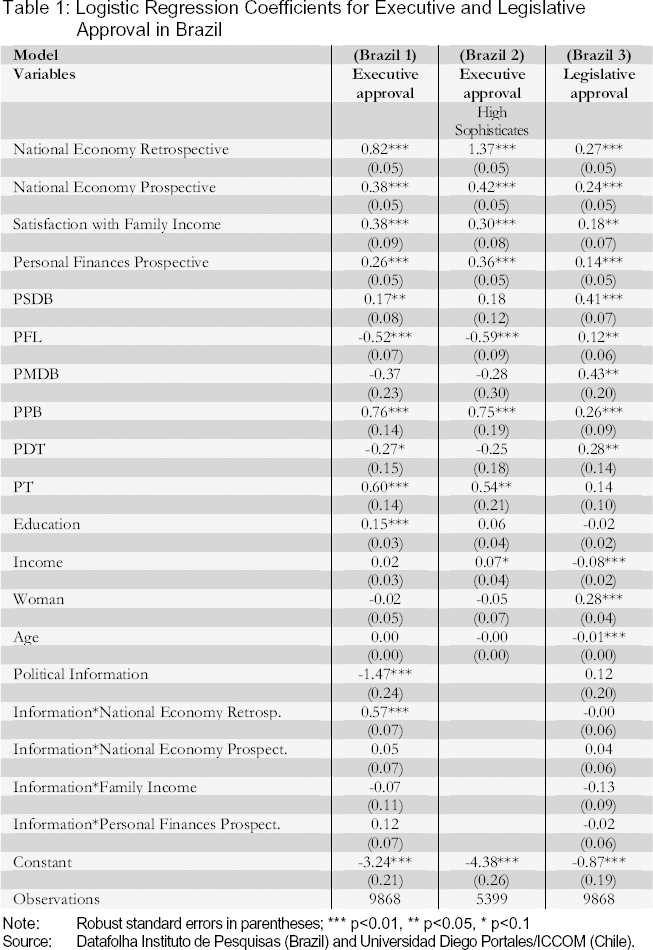
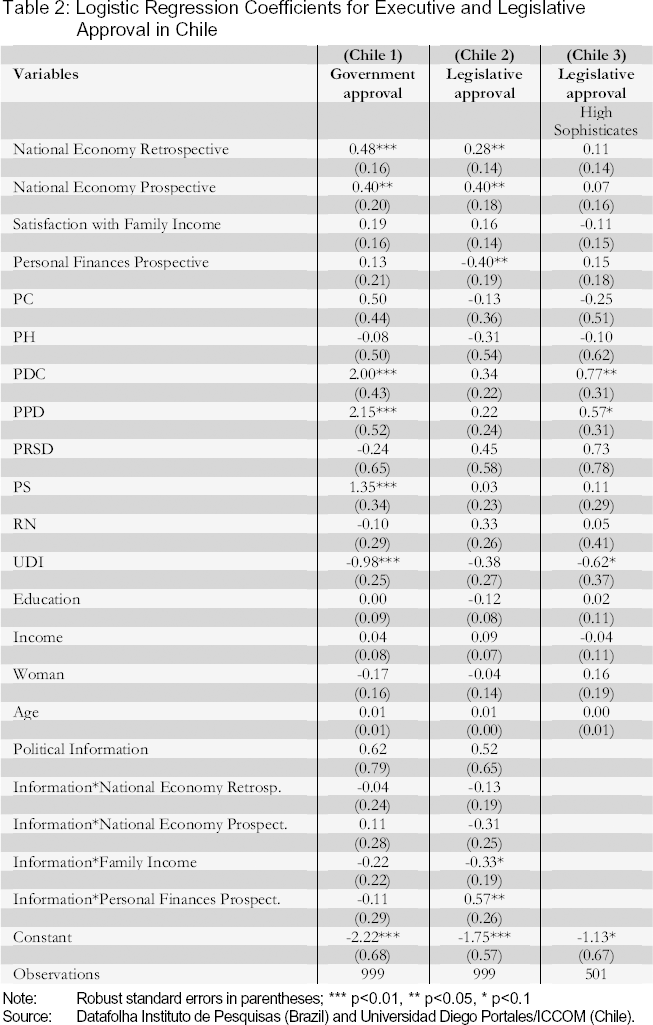
Tables 1 and 2 display the logistic coefficients of executive and legislative approval for each country. The models for each country include the entire sample and interaction terms for our main dependent variables: executive and legislative branch evaluations. We then include more models for each country depending on the statistical significance of the interaction terms.
Logistic Regression Coefficients for Executive and Legislative Approval in Brazil
Note: Robust standard errors in parentheses;
p<0.01
p<0.05
p<0.1
Source: Datafolha Instituto de Pesquisas (Brazil) and Universidad Diego Portales/ICCOM (Chile).
Logistic Regression Coefficients for Executive and Legislative Approval in Chile
Note: Robust standard errors in parentheses;
p<0.01
p<0.05
p<0.1
Source: Datafolha Instituto de Pesquisas (Brazil) and Universidad Diego Portales/ICCOM (Chile).
First, it is clear that there are differences between Brazil and Chile especially when it comes to evaluations of the Legislative Branch. In Brazil, all voters, independent of levels of political sophistication are able to evaluate both the President as well as the Legislative Branch. In Chile, assessments of the economy only affect legislative approval among less sophisticated voters, and this only for a few variables. Political sophisticates do not blame Congress for the economy, as is seen in model 3, albeit the interaction term for the difference between high and low sophisticates is not statistically significant. Hence, context matters in influencing the impact of economic assessments on legislative approval, confirming our first hypothesis.
Our second hypothesis refers to a differential impact of economic voting based on voters’ cognitive level. This examination was made through some simulations estimated in order to better understand the real impacts of the logistic coefficients (King 1989; Menard 1995; Pampel 2000). 21
Our simulations kept at their sample means those variables that we were not interested in, while values of those predictors that are central to our theoretical discussion changed. In Brazil, simulations used the following constant values: “1” in the “satisfaction with family income” variable, “2” in the personal finances prospective” variable, “2” in the “education” variable, “2” in the “income” variable, “1” in the “woman” variable, and “37” in the “age” variable. In Chile, we used “2” in the “satisfaction with family income” variable, “2” in the personal finances prospective” variable, “2” in the “education” variable, “2” in the “income” variable, “1” in the “woman” variable, and “44” in the “age” variable. In both cases, we used independents in the “party preference” variable, because they were the modal category.
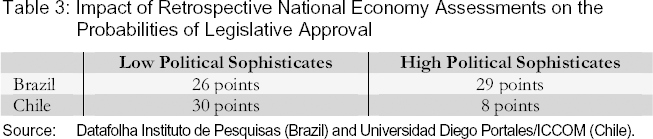
In Brazil, a less informed citizen who displayed average values in the independent variables had a change of 26 points in her probability of approving the Legislative Branch if her negative assessments of retrospective and prospective national economy changed to positive opinions. This same change from negative to positive opinions regarding retrospective and prospective national economy conditions would have led an average and better informed Brazilian to improve his or her probability of approving the Legislative in 29 points. So as to say, low as well as better informed Brazilians punish their Legislative for hardships.
In Chile, an average and less informed citizen who had negative assessments of retrospective and prospective national economy had a probability of 17 percent of approving the Legislative, while if holding positive assessments on these two predictors the probability jumped to 47 percent: a difference of 30 points resulting from the impact of retrospective and prospective economic voting. On the other hand, an average and better informed citizen who had negative assessments of retrospective and prospective national economy had a probability of 37 percent of approving the Legislative, while if holding positive assessments constant the probability increases to 45 percent. The difference here is just 8 points and suggests a sort of immunity of the Chilean Legislative to the national economic conditions among better-informed citizens.
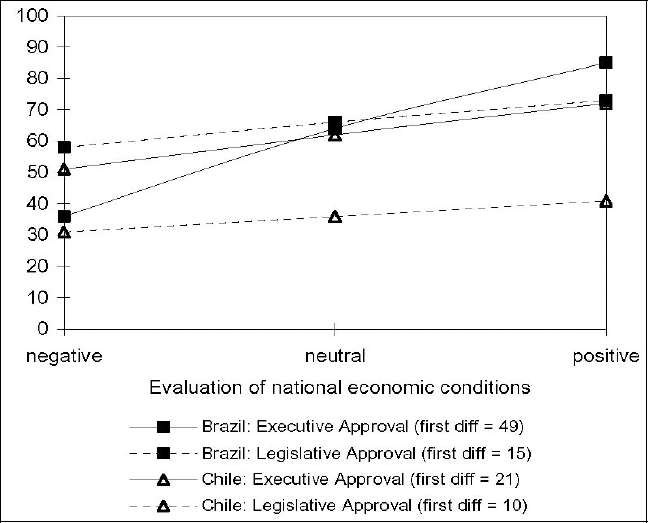
Probability of Executive and Legislative Approval in Brazil and Chile
Impact of Retrospective National Economy Assessments on the Probabilities of Legislative Approval
Source: Datafolha Instituto de Pesquisas (Brazil) and Universidad Diego Portales/ICCOM (Chile).
Overall, the findings above confirm our theoretical expectations that better-informed citizens are more aware of the role of the Legislative Branch and attribute responsibility to Congress when the Legislative Branch is playing an especially important role in economic reform. In Brazil, better-informed individuals punished and rewarded both the Executive and Legislative, while in Chile evaluations of the Executive Branch are the ones mostly affected by assessments of the economy, and sophisticated voters in Chile do not attribute blame to the Legislative Branch indiscriminately.
Less informed citizens, nevertheless, seem to blame both powers for economic dissatisfaction regardless of the political context. This result signals that less informed voters may have a fuzzy image of executive and legislative powers due to their limited inputs to better comprehend the rather complex mechanisms of presidentialism. This result sheds light on Samuels (2004) findings; treating the Executive and Legislative as a team may be a sign of equivocated vertical accountability, depending on the political context. At the individual level, political sophistication plays a significant role in affecting economic voting for different branches of government, especially in environments where the visibility of the Legislative Branch is high. Hence, even though Chile's electoral system could attenuate voter heterogeneity, by being less complex than the Brazilian open-list proportional representation system, it does not seem to be the case. Heterogeneity was greater in Chile due to political context.
Finally, in relation to the party preference variables, both Brazilian and Chilean parties seem to have a fair influence on the opinions of their sympathizers, enhancing the probabilities of their followers to behave in the expected direction. In Brazil, citizens who preferred parties that supported Cardoso's government displayed higher probabilities of approving the Executive. In Chile we see a similar relation: respondents who preferred parties belonging to the Concertación coalition had higher probabilities of approving the Executive.
Discussion
The empirical exploration of our theoretical expectations demonstrates that context and political sophistication are important intervening factors in affecting clarity of responsibility. We find that in times of more congressional activity, like the case of Brazil analyzed here, Congress becomes more visible. In moments of less congressional activity, only certain voters can clearly differentiate the roles distinct branches of government play in policy-making and punish or reward them accordingly. Hence, the impact of economic evaluations, especially on legislative approval, is also conditional on political sophistication. Political sophisticates are more likely to perceive the salience of Congress and the institutional separation of power between the Executive and Legislative. The same is not true for less informed voters: they simply seem to blame everyone.
This conclusion may help explain previous studies (based on aggregate data) that found a significant influence of institutions on the strength of economic voting (Powell and Whitten 1993; Anderson 2000), a noninfluence (Chappel and Veiga 2000), or a mixed output (Samuels 2004). Looking at the micro level, we can more clearly disentangle the causal vectors between institutions, the context of congressional visibility, voters’ political sophistication, and economic evaluations. In this study we find that the institutional context is not the only factor that influences responsibility attribution. The characteristics of the political context and of voters are central in explaining how evaluations of the economy affect the assessment of both the Legislative and Executive Branches.
Our findings also pose a dilemma that future research should address: are there situations in which blaming everyone can be detrimental to democratic governance? Less sophisticated voters seem to blame politicians indiscriminately, independent of their role in economic policy-making. In times of raising criticism of and decreasing credibility of democratic institutions (Power and Jamison 2005; Hagopian and Mainwaring 2005; Mainwaring, Bejarano, and Pizarro Leongómez 2006), indiscriminate “finger pointing” may cause more harm than good for the new democracies of Latin America.
Footnotes
Government Approval
Brazil: Na sua opinião o presidente Fernando Henrique Cardoso está fazendo um governo: ótimo, bom, regular, ruim ou péssimo? [“1” excellent, good, fair; “0” bad, terrible, do not know, no answer]
Chile: ¿Ud. aprueba o desaprueba la forma en que el Presidente Lagos se ha desempeñado como Presidente de la República? [“1” approve; “0” disapprove, do not know, no answer]