




Abstract
Purpose:
We aimed to analyze frequently searched questions through Google’s “People Also Ask” feature related to four common treatments for developmental dysplasia of the hip (DDH): the Pavlik harness, rhino brace, closed reduction surgery and open reduction surgery.
Methods:
Search terms for each treatment were entered into Google Web Search using a clean-install Google Chrome browser. The top frequently asked questions and associated websites were extracted. Questions were categorized using the Rothwell classification model. Websites were evaluated using the JAMA Benchmark Criteria. Chi-square tests were performed.
Results:
The initial search yielded 828 questions. Of 479 included questions, the most popular topics were specific activities that patients with DDH can/cannot do (32.8%), technical details about treatments (30.9%) and indications for treatments (18.2%). Websites were commonly academic (59.3%), commercial (40.5%) and governmental (12.3%). There were statistically significant more specific activity questions about Pavlik harnesses than about rhino braces (χ2 = 7.1, p = 0.008), closed reduction (χ2 = 56.5, p < 0.001) and open reduction (χ2 = 14.7, p < 0.001). There were statistically significant more technical details questions about Pavlik harnesses than about closed reduction (χ2 = 4.1, p = 0.04).
Conclusions:
This study provides insights into common concerns that parents have about their children’s DDH treatment, enabling orthopaedic surgeons to provide more effective and targeted consultations. This is particularly important for DDH because affected patients are often diagnosed within the first few months of life, leaving parents overwhelmed by caring for a newborn child and simultaneously coping with this diagnosis.
Keywords
Introduction
Globally, patients turn to the internet and search engines to explore possible etiologies of their symptoms, better understand their diagnoses and learn about medications, procedures, or surgeries that may be used for treatment or improvement of quality of life. 1 Indeed, approximately 72% of adult internet users in the United States have used the internet to source answers for health-related inquiries. 2 Within the specialty of orthopaedic surgery, 66% of patients have used the internet to learn about their diagnoses, with 90% regularly using the internet in this manner.3,4
Given the increasing accessibility and minimal cost of internet search engines, it is unsurprising that patients frequently utilize these tools to gain a better understanding of health information. However, the wide range of content that is available on the internet raises concerns regarding the quality and comprehensibility of resources accessed by patients. Previous literature has investigated information accessed by orthopaedic patients, finding that quality is variable and that readability of both professional society and practice-based websites is far higher than that which is recommended given the average health literacy of the United States population.5 –8 Further, the rise of social media as an information source, with an estimated 3.6 billion users in 2020, 9 has only exacerbated the variability in the reliability of internet information sources.
To better understand the online information accessed by patients, it is critical to analyze the questions patients seek answers to on the internet. Previous studies have investigated the People Also Ask feature (PAA)10 –12 on Google, the most widely used search engine in the world. 13 Several self-report studies have shown that parents primarily use Google to search for online health information.14 –17 It has been suggested that Google has surpassed other search engines because of its speed, use of a wider range of webpages, relevance of results and simplicity of interface. 18 PAA is particularly powerful because it uses Google’s machine learning algorithms to provide users with frequently asked questions that are related to their original searches, thereby allowing them to expand the breadth of their searches. Within orthopaedics, PAA has been investigating in the context of procedures, including total joint arthroplasty and spine surgery.1,11,19
PAA has yet to be analyzed in the context of developmental dysplasia of the hip (DDH). DDH includes a spectrum of both physical and imaging findings, ranging from mild instability to frank dislocation. The overall relative risk of DDH in children is 11.5/1000 live births. 20 Given the rise of early detection of DDH, often within the first month of an infant’s life, it is likely that many parents of children with DDH turn to internet search engines, such as Google, to better understand treatment options for this condition. 21
As such, we aimed to analyze the most frequently searched questions related to four commonly used treatments for DDH: The Pavlik harness, the abduction (Rhino) brace, closed reduction surgery and open reduction surgery. We hypothesized that distinct patterns in online search queries would emerge for each treatment, providing insights into parents’ concerns and interests about DDH.
Materials and methods
Data extraction
The methodology first described by Shen et al. 11 was adapted for this study and data collection followed standard protocols for web scraping and automation. A Python programming language tool for automated extraction was developed and utilized by RR to extract the top 200 questions and corresponding websites returned by the PAA feature on Google for an entered search term. The algorithm was tested for reliability by manually entering each search term and checking the first eight PAA responses. Google uses language processing algorithms to analyze billions of indexed web pages to suggest ones most relevant to the search term. Google then eliminates low-quality spam websites and assigns each search query a link to a website that “answers” the question. 12 Search terms for each treatment (“developmental dysplasia of the hip Pavlik harness,” “developmental dysplasia of the hip rhino brace,” “developmental dysplasia of the hip closed reduction,” and “developmental dysplasia of the hip open reduction”) were each entered into a new incognito browser and data was extracted on March 18, 2024.
Question and website classification
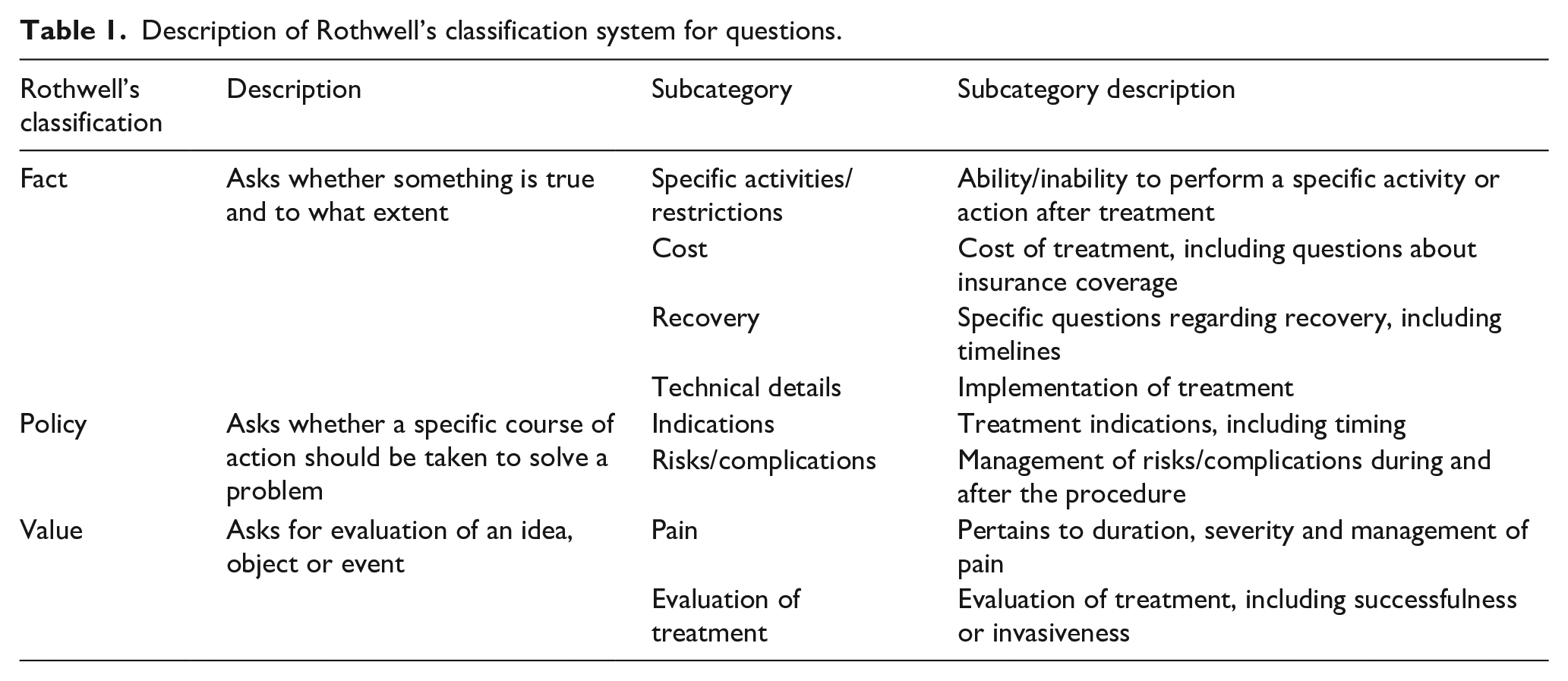
Questions were categorized by topic using the Rothwell classification model, utilized by similar studies. The classification model characterizes questions as Fact, Policy and Value. 1 Questions under fact ask whether something is true and to what extent; those under policy ask whether a specific course of action should be taken to solve a problem; and those under value ask for evaluation of an idea, object, or event (Table 1).
Description of Rothwell’s classification system for questions.
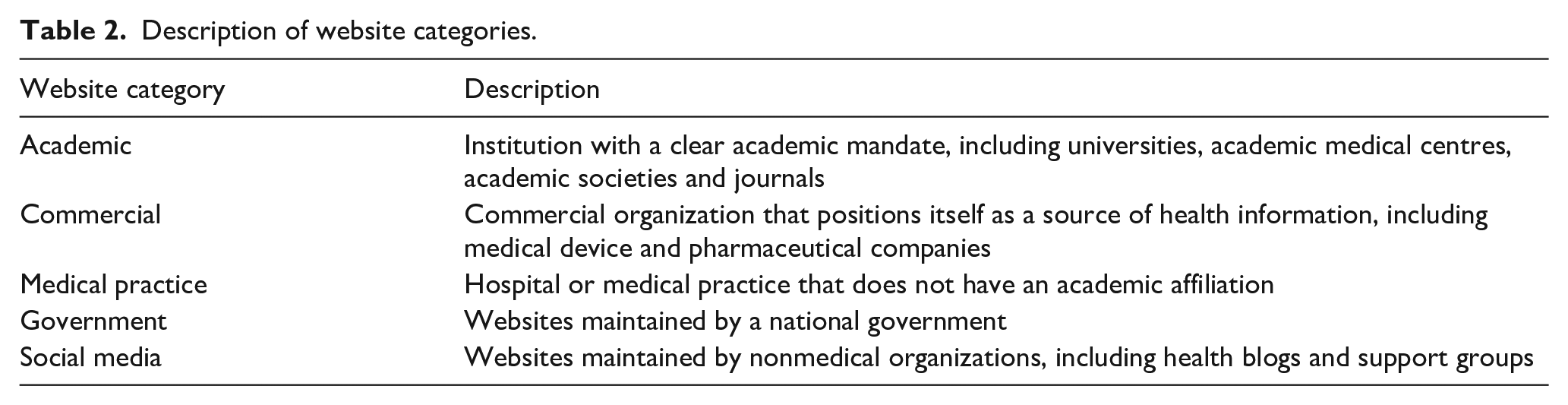
Websites were categorized by source: Academic, Commercial, Medical Practice, Government and Social Media. 1 Further descriptions of website categories are available in Table 2. The credibility of websites was evaluated using the JAMA Benchmark Criteria, which is composed of four categories: Authorship, Attribution (references), Disclosures and Currency (date), with final scores ranging from 0 to 4. 22 Classification of these questions and websites were performed by two independent reviewers, with discrepancies settled by a third independent reviewer.
Description of website categories.
Statistical analysis
Chi-square tests were performed to compare JAMA Benchmark Criteria scores. Statistical analysis was performed in R (version 2024.04.1+748).
Results
Classification
From the initial search, yielding 828 questions, 349 terms were excluded for not discussing the queried treatment, discussing a condition other than DDH or discussing a non-paediatric population. Of the 479 included questions, the majority for each treatment were categorized as “Fact” under Rothwell’s system (Pavlik harness: 64.9%, rhino brace: 64.5%, closed reduction: 36.8%, open reduction: 65.7%; Figure 1).
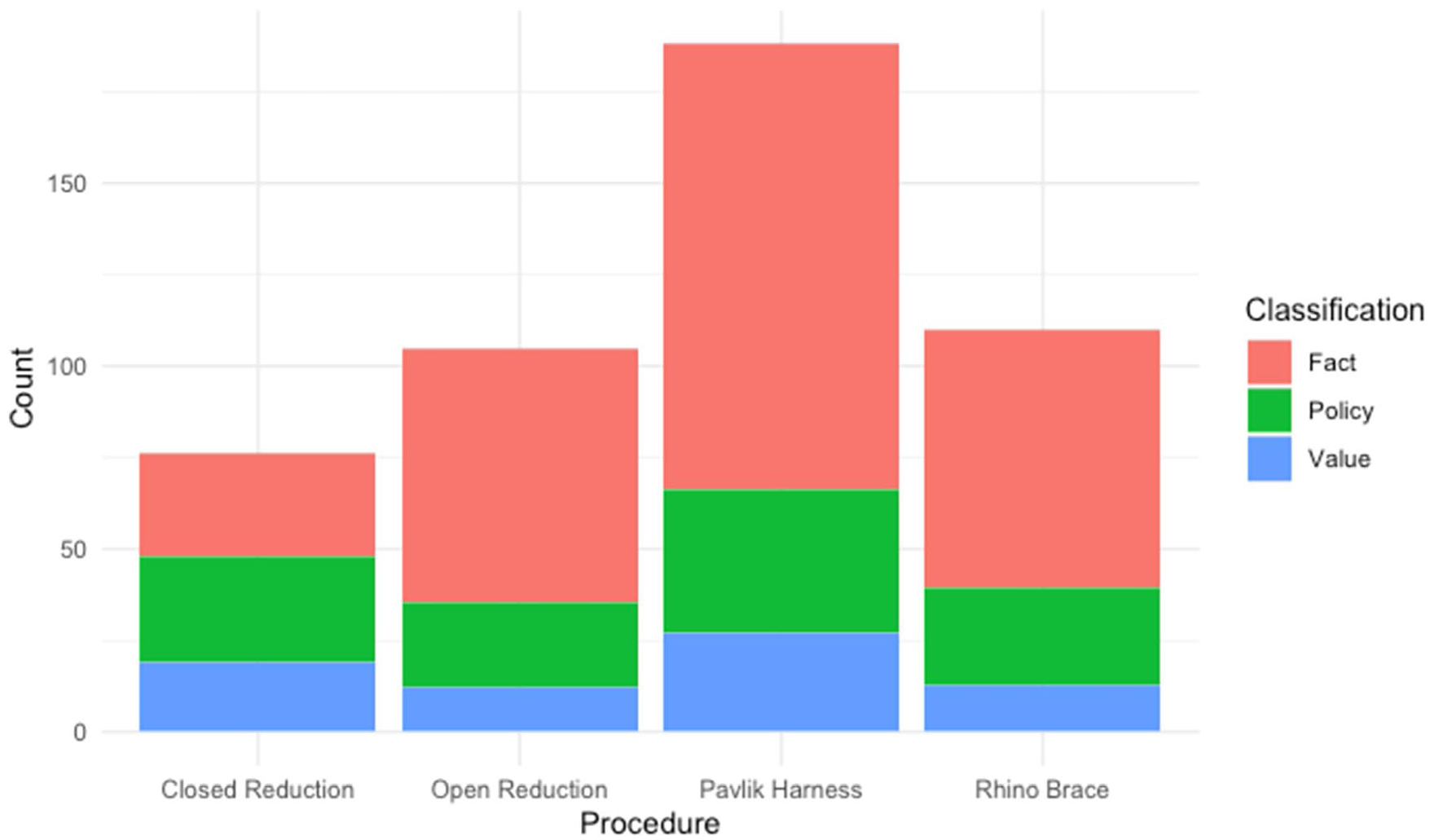
Rothwell’s classification of questions for four DDH treatments.
Overall, the most popular subcategories included specific activities that patients with DDH can or cannot do (32.8%) (e.g., can a baby crawl with hip dysplasia?), technical details about DDH treatments (30.9%) (e.g., how often should a Pavlik harness strap be adjusted?) and indications for specific treatment courses (18.2%) (e.g., how do you fix hip dysplasia in newborns?) (Figure 2). In the Pavlik harness group, the most common subcategories were specific activities (34.8%), technical details (18.2%) and recovery timeline (11.8%). In the rhino brace group, the most common subcategories were specific activities (34.9%), technical details (20.2%) and indications (20.2%). In the closed reduction group, the most common subcategories were technical details (26.7%), indications (21.3%) and evaluation of the procedure (19.7%). In the open reduction group, the most common subcategories were technical details (28.8%), specific activities (26.9%) and indications (14.4%).
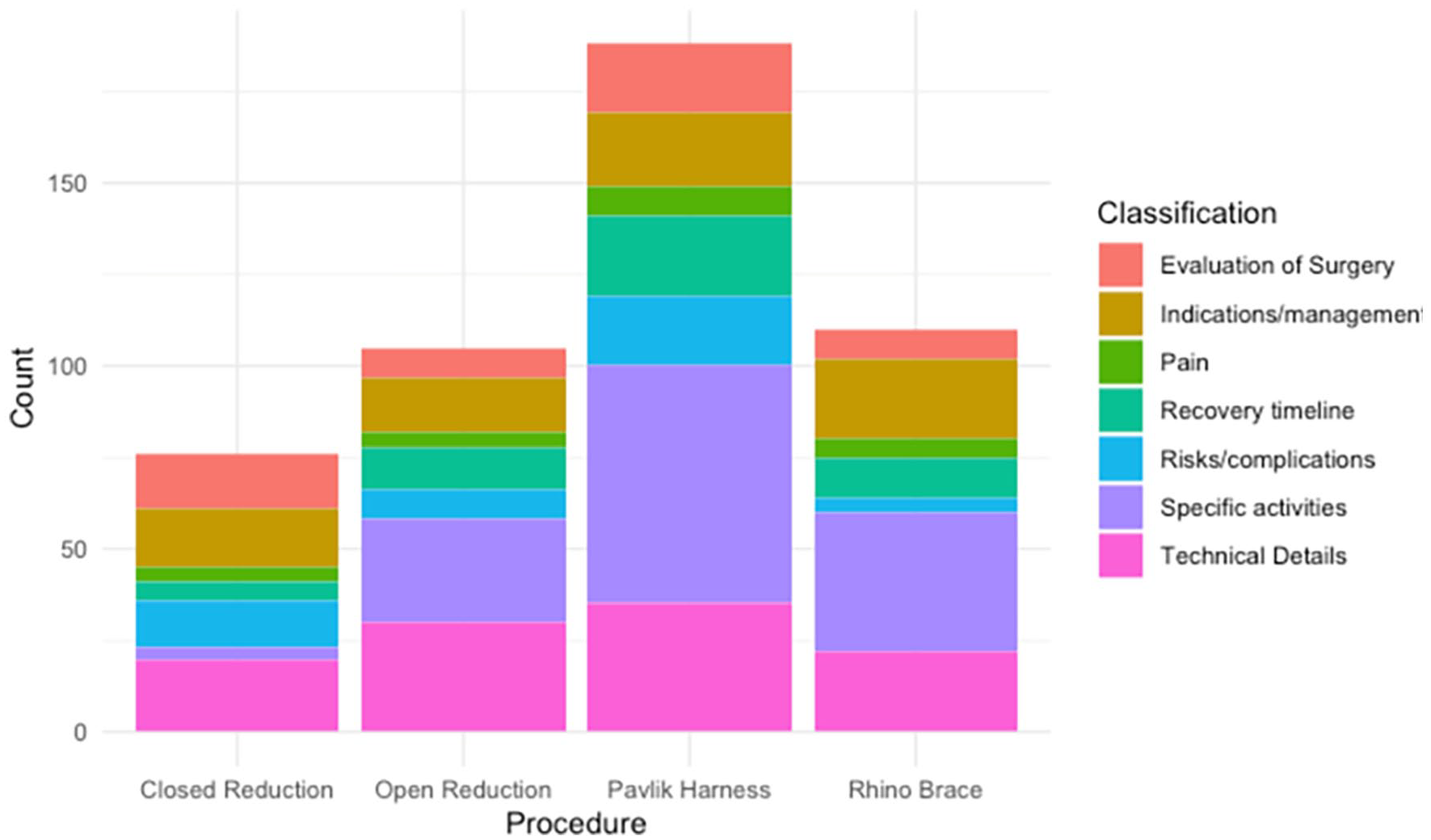
Subcategory breakdown of question classification for four DDH treatments.
Website types
The most common websites linked to these questions were academic (59.3%) (e.g., Mayo Clinic), commercial (40.5%) (e.g., International Hip Dysplasia Institute) and governmental (12.3%) (e.g., PubMed). The average JAMA Benchmark Criteria score was 2.1 ± 1.4, indicating partially sufficient data, with authorship being the most commonly missed category (39.2% of websites provided this information). In the Pavlik harness group, the most common website types were academic (59.4%), commercial (24.1%) and government (8.02%). In the rhino brace group, the most common website types were academic (54.5%), commercial (25.5%) and government (11.8%). In the closed reduction group, the most common website types were academic (54.7%), government (17.3%) and medical practice (14.7%). In the open reduction group, the most common website types were academic (56.7%), commercial (22.1%) and government (13.5%).
Comparison between treatments
There were statistically significant more specific activity questions about Pavlik harnesses than about rhino braces (χ2 = 7.1, p = 0.008), closed reduction (χ2 = 56.5, p < 0.001) and open reduction (χ2 = 14.7, p < 0.001). There were statistically significant more technical details questions about Pavlik harnesses than about closed reduction (χ2 = 4.1, p = 0.04), but not about rhino braces (χ2 = 3.0, p = 0.09) nor open reduction (χ2 = 0.4, p = 0.5). There were no statistically significant indications for treatment questions for rhino braces than for Pavlik harnesses (χ2 = 0.1, p = 0.8), closed reductions (χ2 = 0.9, p = 0.3), or open reductions (χ2 = 1.3, p = 0.2).
Discussion
This study analyzes the most frequently asked questions on Google using the PAA section, which captures questions asked by millions of patients. The strength of this study, therefore, lies inherently in its ability to capture what patients are curious about, including information they have not asked their provider about or sought additional information about beyond what has been given to them by their provider.
We found that the majority of questions asked about all four treatment options were categorized as “fact” based. This is consistent with previous literature investigating questions asked about surgical and non-surgical treatment options.1,10 –12,23 Studies of satisfaction with DDH treatment report that parents and caregivers face a significant burden as their children undergo treatment, 24 with much of this dissatisfaction stemming from feeling as though insufficient information had been provided about the process. 25 Our identification of patient question topics through search analytics helps to elucidate where this information mismatch may lie. Across the four treatments, most questions fell under Rothwell’s “Fact” category, suggesting that parents are most curious about what DDH treatment entails. Rothwell’s “Value” category was the least prevalent, indicating that questions about the pain experienced by patients and evaluation of the success of treatment options may be sufficiently answered elsewhere, such as during visits with surgeons.
In this study, the majority of websites were academic in nature, suggesting that the information accessed by parents is likely accurate. Adequate information provision is one of the most important elements of patient-centred care. 26 However, 40% to 80% of medical information that is conveyed by healthcare providers is immediately forgotten and 50% of this information is incorrectly remembered. 27 Given that parents likely reference online information after appointments with their child’s orthopaedic surgeon to solidify their understanding of information about treatment options, it is encouraging that much of this information comes from academic sources.
However, we found an average JAMA Benchmark Criteria score of 2.1 ± 1.4, indicating partially sufficient data. As such, it remains important for all online medical information sources to continue to optimize their content by including information such as authorship, references, disclosures and dates. 22 Doing so can help to enable patients to evaluate the quality of the information they are receiving.
While Pavlik harnesses, rhino braces, closed reduction and open reduction share several characteristics, there were notable differences in the most asked question subcategories. Gibbard et al. found that many parents of children diagnosed with DDH are left to navigate treatment options independently, relying mostly on online resources to answer their questions. 24 The present study adds to the findings of Gibbard et al., providing orthopaedic surgeons with information that can enable them to be more targeted in answering parents’ questions about the treatment option best suited for their child. Our findings may be used for quality improvement within the field of orthopaedics and could be utilized by providers to preemptively answer questions or develop educational materials to better facilitate information sharing with parents when discussing a child’s diagnosis of DDH.
This study’s limitations are consistent with that of previous literature using this type of data. First, while we used a clean-install Google Chrome browser for each search term, Google may personalize PAA search results based on a user’s past search history. To mitigate the effect of this on our results, we used a large sample size of questions with associated websites. Second, PAA results change over time, responding to new questions about the topic, which means that our findings may not remain static over time. Third, our categorization system is inherently subject to review bias. To address this, we used two independent reviewers for each question and website, with a third independent reviewer addressing disagreements. Fourth, we did not verify the accuracy of the information, only using the website category and JAMA Benchmark Criteria as proxy indicators. Fifth we only used English search terms and included English data points in this study. Future studies should be performed to evaluate the results of PAA in languages other than English, as questions asked and resulting websites may differ in quality. Finally, we only analyzed results from Google, given its widespread use in the status quo. However, with the rise of artificial intelligence, the information sources that parents utilize may differ. Tharakan et al. compared ChatGPT with Google in investigating commonly asked patient questions regarding total shoulder and elbow arthroplasty, finding that ChatGPT provided a greater number of academic references, while Google more commonly referenced medical practices. 28 Future studies may compare Google and other artificial intelligence programmes in the setting of questions regarding DDH and may also compare the comprehensibility of results by parents.
This study provides paediatric orthopaedic surgeons with insights into common concerns that parents have about their children’s DDH treatment. This can enable clinicians to provide more effective and targeted consultations. This is particularly important for DDH because affected patients are often diagnosed within the first few months of life. As such, parents are often overwhelmed by caring for a newborn child and simultaneously coping with this diagnosis. Thus, orthopaedic surgeons can use this information to best support families coping with a DDH diagnosis for their child.
Supplemental Material
sj-pdf-1-cho-10.1177_18632521241310318 – Supplemental material for What are patients asking and reading online? An analysis of online patient searches about treatments for developmental dysplasia of the hip
Supplemental material, sj-pdf-1-cho-10.1177_18632521241310318 for What are patients asking and reading online? An analysis of online patient searches about treatments for developmental dysplasia of the hip by Uma Balachandran, Renee Ren, Camila Vicioso, Jiwoo Park, Katrina S Nietsch, Brittany Sacks, Rodnell Busigo Torres and Sheena C Ranade in Journal of Children’s Orthopaedics
Footnotes
Acknowledgements
None.
Author Contributions
Uma Balachandran contributed to idea development and writing. Renee Ren, Camila Vicioso, Jiwoo Park, Katrina S Nietsch, Brittany Sacks and Rodnell Busigo Torres assisted with data analysis and manuscript editing. Sheena C Ranade contributed to idea development and manuscript editing.
Declaration of conflicting interests
The author(s) declared no potential conflicts of interest with respect to the research, authorship and/or publication of this article.
Funding
The author(s) received no financial support for the research, authorship and/or publication of this article.
Institutional Review Board
Approval is not required for this study. This study does not involve human subjects.

Supplemental material
Supplemental material for this article is available online.
References
Supplementary Material
Please find the following supplemental material available below.
For Open Access articles published under a Creative Commons License, all supplemental material carries the same license as the article it is associated with.
For non-Open Access articles published, all supplemental material carries a non-exclusive license, and permission requests for re-use of supplemental material or any part of supplemental material shall be sent directly to the copyright owner as specified in the copyright notice associated with the article.
