



Abstract

Guided growth for flex knee flexion deformity (FKFD): historical perspective and insights:
Guided growth for the correction of FKFD is not a novel procedure. It was devised as an alternative to extension osteotomy and first reported 2001. 1 Owing to the rare but unpredictable occurrence of staple migration, the technique was altered to include the insertion of a tension band plate on either side of the sulcus (non-articular), as reported in 2007.2,3
The parents and physical therapists need to understand from the outset that, while it is minimally invasive, guided growth is accompanied by discomfort and crepitus. However, this pales in comparison to bilateral osteotomies and the symptoms subside relatively quickly.
While percutaneous screws are simple to insert, they may prove difficult to retrieve. In addition to leaving the screw heads proud, it is important to use, large diameter (to avoid bending), fully threaded, cancellous screws.
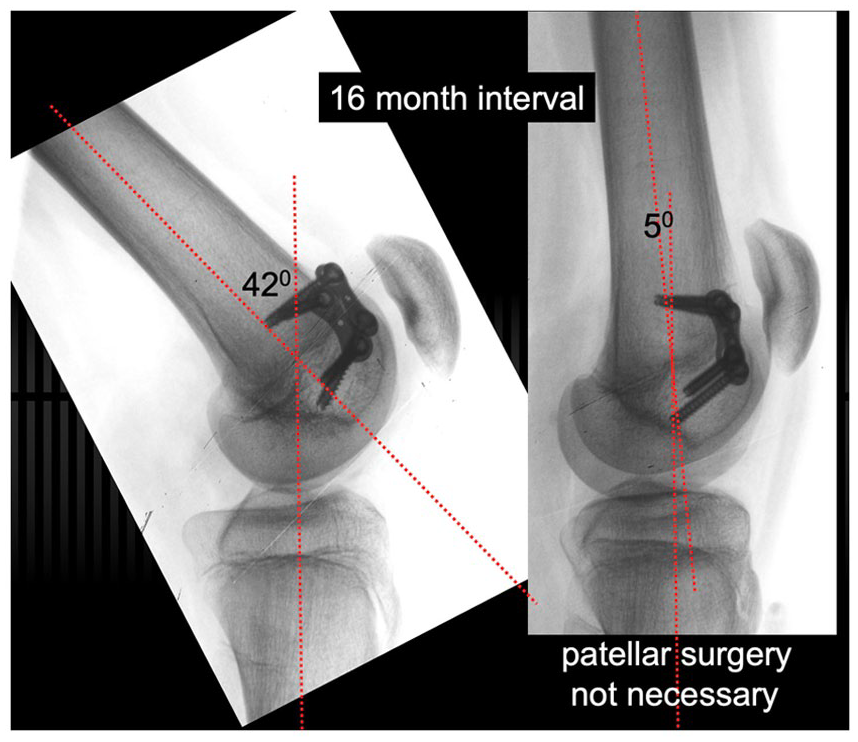
Employing gait analysis following guided growth for FKFD, the delayed benefits were documented in a pilot study. 4 Secondary procedures such as patellar advancement may not be necessary, once full extension is gained.
Footnotes
Declaration of conflicting interests
The author(s) declared no potential conflicts of interest with respect to the research, authorship, and/or publication of this article.
Funding
The author(s) received no financial support for the research, authorship, and/or publication of this article.
