This study deals with the roles of a magnetic field and circular rotation of a circular cylinder on the dissemination of solid phase within a nanofluid-filled square cavity. Two wavy layers of the non-Darcy porous media are situated on the vertical sides of a cavity. An incompressible smoothed particle hydrodynamics (ISPH) method was endorsed to carry out the blending process concerning solid phase into nanofluid and porous media layers. Initially, the solid phase is stationed in a circular cylinder containing two open gates. Implications of a buoyancy ratio (N = −2: 2), Hartmann number (Ha = 0: 100), rotational frequency , Darcy parameter , Rayleigh number , nanoparticles parameter , and amplitude of wavy porous layers on the lineaments of heat/mass transport have been carried out. The results revealed that the diffusion of the solid phase is permanently moving toward upward except at opposing flow mode toward downward. The lower Rayleigh number reduces the solid-phase diffusions. A reduction in a Darcy parameter lessens the nanofluid speed and solid-phase diffusions in the porous layers. A reduction in from to diminishes the maximum of streamlines by 13.19% at , by 46.75% at , and by 74.75% at .
Convective flows through porous structures are received several research studies and the reason for their numerous industrial and technological purposes. Applications are not restricted to the building’s insulation, thermal insulation, fibrous insulation, grain storage, packed sphere beds, fuel cells, solar collectors, and geothermal energy systems. Moreover, convective flows from double diffusion in porous media have several applications including soil pollution and nuclear waste disposal. In this context, Lewis1 studied multiphase flow in deformable cracked porous media. Angirasa et al.2 researched adjoined heat/mass transport on vertical surface contained porous media. Cheng3 studied the transmission of heat/mass in an undulating surface contained a porous medium. The numerical/experimental research studies on heat transport in a vertical enclosure moderately filled by a porous medium have been introduced by Ramadhyani and Viskanta.4 Beckermann et al.5 examined the presence of a porous layer on natural convection in the interior of an enclosure. Singh et al.6 analyzed heat/mass transport in a mixture cavity contained fluid/porous medium layers.
In recent years, many attempts were performed for the thermosolutal of nanofluids. Generally, the applications of nanofluids are not restricted to the following: solar techniques,7-9 automotive,10,11 heat exchangers,12,13 and heat transfer devices14. Kuznetsov and Nield15 studied thermosolutal of nanofluid inside a boundary layer flow. Dastmalchi et al.16 examined the thermosolutal of nanofluid within a porous cavity. Aly17 examined the impacts of embedded two circular cylinders on nanofluid flow in the interior of a porous enclosure. Aly18 showed the magnetic inspirations on thermosolutal convection inside a nanofluid-filled cavity containing an oscillating pipe. Sarkar et al.19 researched free convection in a semi-elliptical enclosure containing a bottom-heated. Selimefendigil et al.20 introduced numerical investigations for the turbulent flow conditions on the three-dimensional convective drying process at several porous moist blocks. Selimefendigil et al.21 handled the motion of the porous moist object during heat/mass transmission in a 2D channel. Selimefendigil and Oztop22 studied the effects of hot dry air on the transmission of heat/mass for several porous humid objects.
The study of a rotating cylinder is an attempt to boost heat transfer and to help flow movement within a cavity. Because of the many applications of convective flows around a rotating element like the chemical mixing devices, fuel pole in nuclear reactors, and turbomachinery, there are many studies on this problem that can be found in references.23-34
In the current study, the influences of a turning circular cylinder on blending solid and fluid phases within a cavity filled by porous media and nanofluid have been simulated by the ISPH method. Non-Darcy porous media were in a form of two wavy layers on the vertical sides of a cavity. The circular cylinder is contained solid phase and it has a uniform circular rotation. Impacts of the key physical parameters including buoyancy ratio, rotational frequency, Darcy parameter, Rayleigh number, Hartmann number, nanoparticles parameter, and amplitude of wavy porous layers on heat and mass transport and flow speed have been discussed in detail. The performed simulations proved that the orientation of the dispersions of solid phase is reliant on the buoyancy ratio parameter and flow modes. A decrease in Ra declines buoyancy forces within a cavity, so the solid-phase dispersions are decreasing. The Darcy parameter acts as a significant element in controlling the solid-phase dispersions inside the porous layers.
Mathematical formulation
Figure 1 describes the primary model and its particle pattern. The solid phase is initially stationed in an embedded circular cylinder and carries and . Otherwise, sidewalls are cooled at with quiet concentration . The inner circular cylinder and horizontal walls are adiabatic. The two wavy partial layers are located on the vertical cavity sides with variable amplitude and saturated by the non-Darcy porous media. The nanofluid is consisting of host fluid (water) and nanoparticles (copper). The mixture density is handled by a Boussinesq approximation, and the thermal equilibrium is utilized among a nanofluid and a porous matrix.
Initial model of the current problem and particles model. (i) Initial physical model and (ii) initial particles model.
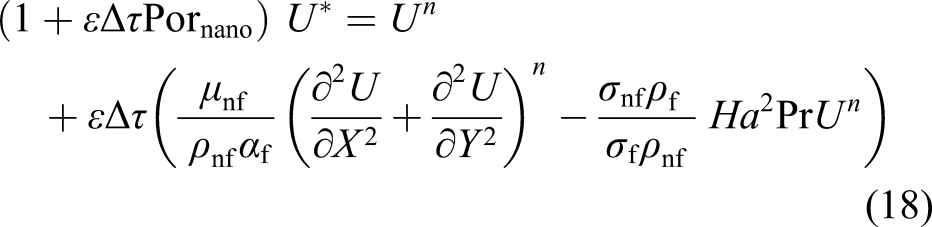
The partial differential equations in a dimensionless form are expressed as35-37
Darcy parameter is , Prandtl number is , and Rayleigh number is . is a capacity ratio. Hartmann number is , Lewis number is , and buoyancy ratio parameter is .
The following dimensionless quantities are used
The boundary conditions are:
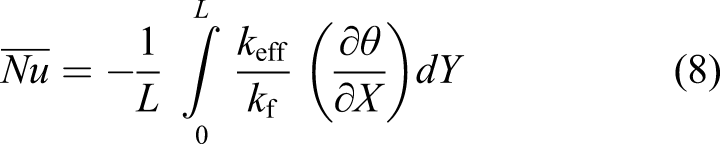
The mean Nusselt number and Sherwood number are
Nanofluid properties
The nanofluid is handled by one-phase model. Table 1 signifies the nanofluid characteristics.
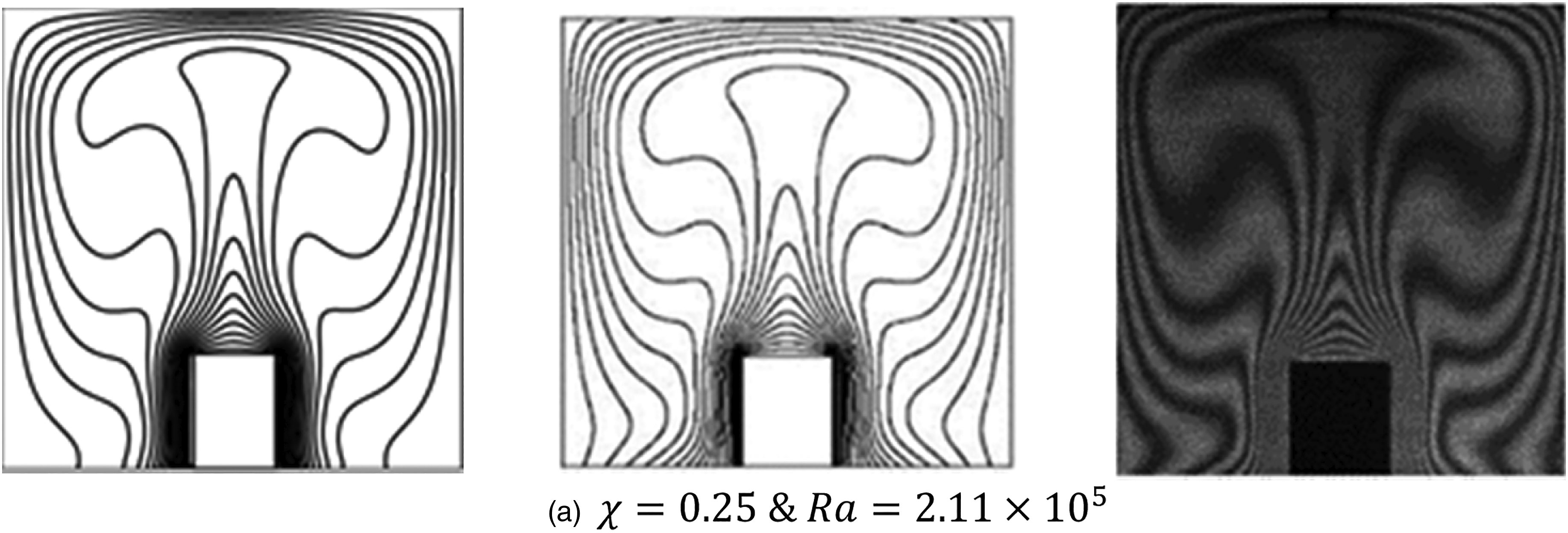
To validate the ISPH method, the numerical test of free convection for a heater inside an air-filled cavity was introduced. The comparison between the results of the ISPH method and numerical/experimental results from Paroncini and Corvaro45 has been introduced in Figure 2. The results of the ISPH method agree with the given numerical/experimental data.
Isothermal lines ISPH method (left), Paroncini and Corvaro45 numerical results (center), and experimental results (right). (a) .
Results and discussion
The numerical simulations on implications of a buoyancy ratio , Hartmann number , rotational frequency , Darcy parameter , Rayleigh number , nanoparticles parameter , and amplitude of wavy porous layers () on the lineaments of heat/mass transport have been discussed. Fixed parameters are , , porosity , speed frequency of a circular cylinder , and undulation number of wavy porous layers .
Figure 3 presents the variations of the buoyancy ratio and Darcy parameter on tracking solid phase, streamlines, isotherms, and isoconcentration for different buoyancy ratio and Darcy parameter at , , , and . In this figure, it is seen that regulates the blending of solid phase within a nanofluid. At (opposing flow), the solid phase is shifting downward, and when (aiding flow), the solid phase is shifting upward. As increases from 0 to 2, the solid-phase dispersions are increasing. Physically, the increase in powers the buoyancy forces in a cavity and accordingly the fluid movements are powered. On other hand, a decrease in shrinks the distribution of the solid phase in the interior of the nanofluid flow. Physical reason returns the higher permeability which grows the porous resistance at a lower . Further, the highest values of a maximum of an absolute stream function are obtained at . A decrease in powers the porous resistance, accordingly it slows down the fluid speed and then reduces . A reduction in from to , reduces by 13.19% at , by 46.75% at , and by 74.75% at , respectively. Mainly, the streamlines contours are affected by the buoyancy ratio and Darcy factors. The isotherms and isoconcentration below the variations on the buoyancy ratio and Darcy parameters are conducted. The contours of the isotherms and isoconcentration have received clear variations below the variations of . It is remarked that the isotherms and isoconcentration are following the solid-phase positions.
Tracking solid phase, streamlines, isotherms, and isoconcentration for different buoyancy ratio and Darcy parameter at , , , and .
The solid-phase positions below the impacts of different angular frequencies at two various values of and are introduced in Figure 4. It is remarked that an increase in an angular frequency increases the rotational velocity of an open circular cylinder and it changes the blending of solid phase within nanofluid. The solid-phase dispersions are decreasing as the Darcy parameter reduces. Here, the contours of the streamlines under the variations in an angular frequency at two different values of a Darcy parameter are introduced. It is observed that an angular frequency augments the absolute value of the stream function’s maximum and a decrease in reduces . An angular frequency changes the mixing processes of the solid phase within the mixture of the nanofluid. As a result, the contours of the isotherms and isoconcentration were varied under the variations on angular frequency.
Tracking solid phase, streamlines, isotherms, and isoconcentration for the different angular frequency at , , , and .
The effects of a Hartmann number on the solid-phase tracking within the mixture of the nanofluid have been shown in Figure 5. A growth in reduces the solid-phase blending in a mixture of the nanofluid. The results are returning to an extra augments the Lorentz force which decelerates down the velocity speed. Therefore, an augmentation in reduces the values of . Because of the Lorentz force which declines the convection flow, an increase in declines the intensity of the contours of the isotherms and isoconcentrations inside a cavity.
Tracking solid phase, streamlines, isotherms, and isoconcentration for different Hartmann number at , , and .
Effects of nanoparticles parameter on the solid-phase diffusion, streamlines, isotherms, and isoconcentration have been shown in Figure 6. It is found that adding nanoparticles concentration until 6% has slight changes on the solid-phase dispersions in a cavity. Therefore, the is slightly varied following the variations on . Besides, the isotherms and isoconcentration are receiving slight changes under the changes of .
Tracking solid phase, streamlines, isotherms, and isoconcentration for different nanoparticles parameter at , , , and .
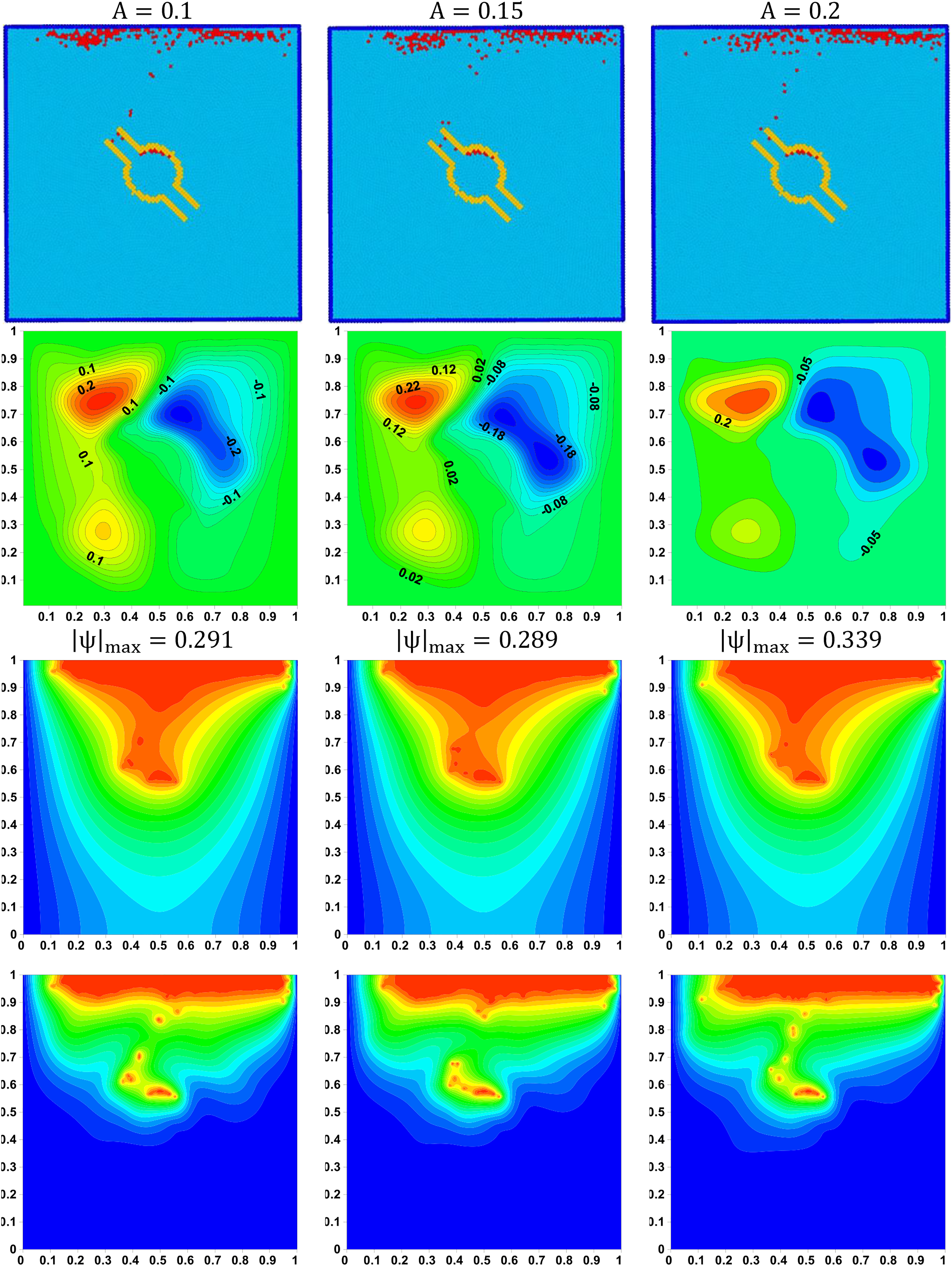
Figure 7 introduces the tracking of the solid phase into a mixture of the nanofluid, streamlines, isotherms, and isoconcentration under the effects of an amplitude parameter of the wavy porous layers at , , , and . An augmentation on a wavy porous amplitude is trying to reduce the diffusion of the solid phase within the porous layers. Therefore, the streamlines vertical cells are shrinking when an undulating porous amplitude equals . The values of are increasing as increases from to . The intensity of the isotherms and isoconcentrations contours is slightly decreasing according to an increase in amplitude parameter of the wavy porous layers.
Tracking solid phase, streamlines, isotherms, and isoconcentration for different amplitude parameter at , , , and .
The impacts of a Rayleigh number on the solid-phase tracking have been indicated in Figure 8. At a similar time instant , the solid-phase diffusion is greatly dependent on the Rayleigh number. When , little solid phase is spreading from the embedded circular cylinder, while as increases to and , the solid phase is completely spreading upward. Due to the existence of the solid phase in the top area of a cavity, is fluctuating. The isotherms and isoconcentrations contours are concentrating nearby the top wall of a cavity. The higher values of are generating higher buoyancy forces that are causing the above observations.
Tracking solid phase, streamlines, isotherms, and isoconcentration for different Rayleigh number at , , and .
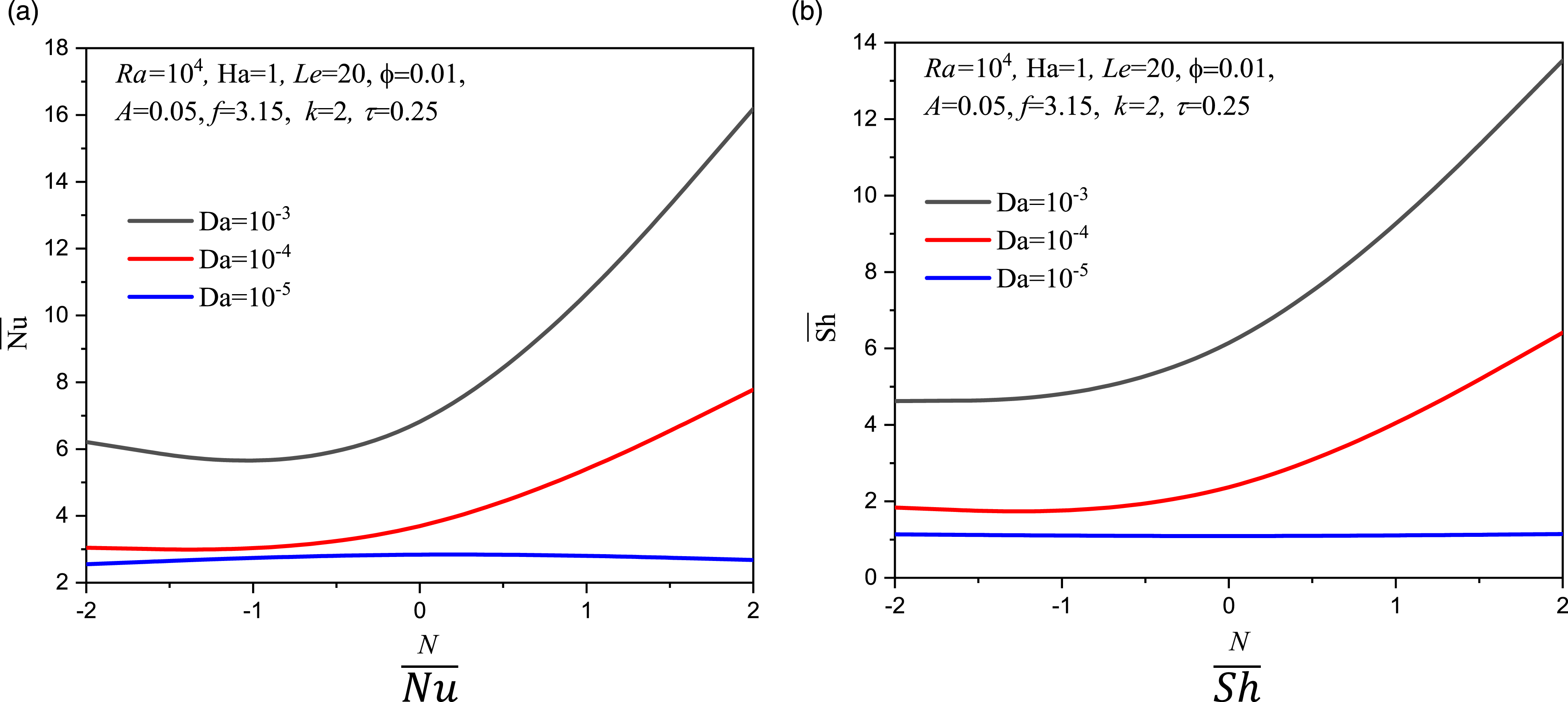
Figure 9 represents the values of and below the influences of buoyancy ratio with Darcy parameter. Lower in a Darcy parameter creates the smallest values of and . An incrementation in a buoyancy ratio parameter augments and at higher Darcy parameter , while there are roughly no alterations on and below the impacts of a buoyancy ratio at a lower Darcy parameter .
Values of and below the influences of a buoyancy ratio with Darcy parameter at , , , and . (a) and (b).
Conclusion
The ISPH method is utilized for simulating the diffusion of the solid phase within a nanofluid flow and undulating porous layers in a cavity. Moreover, the influences of a rotating circular cylinder with variable speed frequencies in the solid particle’s diffusion were conducted. The main results concluded that the solid-phase diffusion is always upwards when the mode of flow is aiding. The solid-phase diffusion is moving in downward at opposing mode. A decline in is reducing the buoyancy forces and it reduces the solid-phase diffusion. The lower Darcy parameter diminishes the diffusion of the solid phase within the porous layers. Hartmann number augments Lorentz force that declines nanofluid speed and consequently the solid-phase diffusion decreases. A reduction in a Darcy parameter diminishes and . The variations of a buoyancy ratio on and are appearing at a higher Darcy parameter , and when the buoyancy ratio parameter boosts, the values of and are improving.
Footnotes
Declaration of conflicting interests
The author(s) declared no potential conflicts of interest with respect to the research, authorship, and/or publication of this article.
Funding
The author(s) disclosed receipt of the following financial support for the research, authorship, and/or publication of this article: The authors would like to extend their appreciation to the Deanship of Scientific Research at King Khalid University, Abha, Saudi Arabia, for funding this work through the Research Group Project under grant number (RGP. 2/17/42). This research was funded by the Deanship of Scientific Research at Princess Nourah Bint Abdulrahman University through the Fast-track Research Funding Program.
ORCID iD
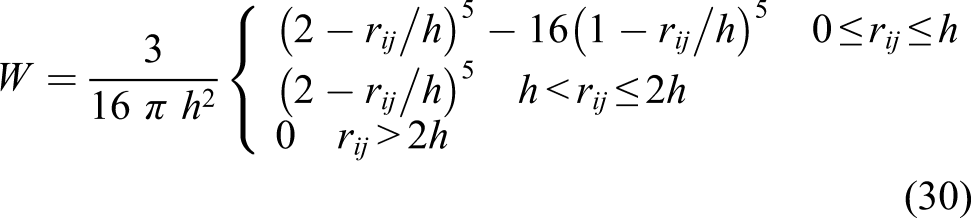
Abdelraheem Mahmoud Aly Abd Allah
Appendix
References
1.
LewisRWGhafouriHR. A novel finite element double porosity model for multiphase flow through deformable fractured porous media. Int J Numer Anal Methods Geomechanics1997;21(11):789–816.
2.
BuongiornoJHuLWApostolakisG, et al.A feasibility assessment of the use of nanofluids to enhance the in-vessel retention capability in light-water reactors. Nucl Eng Des2009;239(5):941–948.
3.
ChengC-Y. Combined heat and mass transfer in natural convection flow from a vertical wavy surface in a power-law fluid saturated porous medium with thermal and mass stratification. Int Commun Heat Mass Transfer2009;36(4):351–356.
4.
RamadhyaniSViskantaR. Natural convection flow and heat transfer between a fluid layer and a. porous layer inside a rectangular enclosure. J Heat transfer1987;109:363.
5.
BeckermannCRamadhyaniSViskantaR. Natural convection flow and heat transfer between a fluid layer and a porous layer inside a rectangular enclosure. J Heat Transfer1987;109:363–370.
6.
SinghAKPaulTThorpeGR. Natural convection due to heat and mass transfer in a composite system. Heat Mass Transfer1999;35(1):39–48.
7.
MahianOKianifarAKalogirouSA, et al.A review of the applications of nanofluids in solar energy. Int J Heat Mass Transfer2013;57(2):582–594.
8.
WangYLiuQLeiJ, et al.Performance analysis of a parabolic trough solar collector with non-uniform solar flux conditions. Int J Heat Mass Transfer2015; 82: 236–249.
9.
KhanaferKVafaiK. A review on the applications of nanofluids in solar energy field. Renew Energ2018;123:398–406.
10.
MolanaM. On the nanofluids application in the automotive radiator to reach the enhanced thermal performance: a review. Am J Heat Mass Transfer: Adv Process Model2017;4(4):168–187.
11.
KakavandHMolanaM. A numerical study of heat transfer charcteristics of a car radiator involved nanofluids. Heat Transfer-asian Res2018;47(1):88–102.
12.
MolanaM. A comprehensive review on the nanofluids application in the tubular heat exchangers. Am J Heat Mass Transfer: Adv Process Model2016;3(5):352–381.
13.
DiglioGRoselliCSassoM, et al.Borehole heat exchanger with nanofluids as heat carrier. Geothermics2018;72:112–123.
14.
SajidMUAliHM. Recent advances in application of nanofluids in heat transfer devices: A critical review. Renew Sustain Energ Rev2019;103:556–592.
15.
KuznetsovAVNieldDA. Double-diffusive natural convective boundary-layer flow of a nanofluid past a vertical plate. Int J Therm Sci2011;50(5):712–717.
16.
DastmalchiMSheikhzadehGAAbbasian AraniAA. Double-diffusive natural convective in a porous square enclosure filled with nanofluid. Int J Therm Sci2015; 95: 88–98.
17.
AlyAM. Natural convection over circular cylinders in a porous enclosure filled with a nanofluid under thermo-diffusion effects. J Taiwan Inst Chem Eng2017; 70: 88–103.
18.
AbdelraheemMA. Incompressible smoothed particle hydrodynamics for MHD double-diffusive natural convection of a nanofluid in a cavity containing an oscillating pipe. Int J Numer Methods Heat Fluid Flow2019;30(2):882–917.
19.
SarkarUKBiswasNÖztopHF. Multiplicity of solution for natural convective heat transfer and entropy generation in a semi-elliptical enclosure. Phys Fluids2021;33(1):013606.
20.
SelimefendigilFÇobanSÖÖztopHF. Investigation of time dependent heat and mass transportation for drying of 3D porous moist objects in convective conditions. Int J Therm Sci2021;162:106788.
21.
SelimefendigilFCobanSOÖztopHF. Numerical analysis of heat and mass transfer of a moving porous moist object in a two dimensional channel. Int Commun Heat Mass Transfer2021;121:105093.
22.
SelimefendigilFÖztopHF. Three dimensional unsteady heat and mass transport from six porous moist objects in a channel under laminar forced convection. Appl Therm Eng2021;183:116100.
23.
HayaseTHumphreyJACGreifR. Numerical calculation of convective heat transfer between rotating coaxial cylinders with periodically embedded cavities. J Heat Transfer1992;114(3):589–597.
24.
FuW-SChengC-SShiehW-J. Enhancement of natural convection heat transfer of an enclosure by a rotating circular cylinder. Int J Heat Mass Transfer1994;37(13):1885–1897.
25.
MisirliogluA. The effect of a rotating cylinder on the heat transfer in a square cavity filled with porous medium. Int J Eng Sci2006;44(18):1173–1187.
26.
KimBSLeeDSHaMY, et al.A numerical study of natural convection in a square enclosure with a circular cylinder at different vertical locations. Int J Heat Mass Transfer2008;51(7):1888–1906.
27.
CostaVAFRaimundoAM. Steady mixed convection in a differentially heated square enclosure with an active rotating circular cylinder. Int J Heat Mass Transfer2010;53(5):1208–1219.
28.
SelimefendigilFÖztopHF. Numerical study and identification of cooling of heated blocks in pulsating channel flow with a rotating cylinder. Int J Therm Sci2014;79:132–145.
29.
LiaoC-CLinC-A. Mixed convection of a heated rotating cylinder in a square enclosure. Int J Heat Mass Transfer2014;72:9–22.
30.
ChamkhaAJSelimefendigilFIsmaelMA. Mixed convection in a partially layered porous cavity with an inner rotating cylinder. Numer Heat Transfer, A: Appl2016;69(6):659–675.
31.
KhanaferKAithalSM. Mixed convection heat transfer in a lid-driven cavity with a rotating circular cylinder. Int Commun Heat Mass Transfer2017;86:131–142.
32.
AlsaberyAITayebiTChamkhaAJ, et al.Effect of rotating solid cylinder on entropy generation and convective heat transfer in a wavy porous cavity heated from below. Int Commun Heat Mass Transfer2018;95:197–209.
33.
AlyAMRaizahZ. Simulations of a sloshing circular cylinder inside an enclosure filled with nanofluids. J Thermophys2020;35:1–16.
34.
RaizahZAlyAM. Double-diffusive convection of a rotating circular cylinder in a porous cavity suspended by nano-encapsulated phase change materials. Case Stud Therm Eng2021;24:100864.
35.
AlyA.M.. Double-diffusive natural convection in an enclosure including/excluding sloshing rod using a stabilized ISPH method. Int Commun Heat Mass Transfer2016;73:84–99.
36.
NguyenMTAlyAMLeeS-W. Effect of a wavy interface on the natural convection of a nanofluid in a cavity with a partially layered porous medium using the ISPH method. Numer Heat Transfer, Part A: Appl2017;72(1):68–88.
37.
RaizahZAAlyAM. ISPH method for MHD double-diffusive natural convection of a nanofluid within cavity containing open pipes. Int J Int J Numer Methods Heat2019;30(7).ahead-of-print(ahead-of-print)
38.
KefayatiGR. FDLBM simulation of mixed convection in a lid-driven cavity filled with non-Newtonian nanofluid in the presence of magnetic field. Int J Therm Sci2015;95:29–46.
39.
XuanYRoetzelW. Conceptions for heat transfer correlation of nanofluids. Int J Heat Mass transfer2000;43(19):3701–3707.
40.
MahapatraTRSahaBCPalD. Magnetohydrodynamic double-diffusive natural convection for nanofluid within a trapezoidal enclosure. Comput Appl Maths2018;37(5):6132–6151.
41.
LindSJXuRStansbyPK, et al.Incompressible smoothed particle hydrodynamics for free-surface flows: A generalised diffusion-based algorithm for stability and validations for impulsive flows and propagating waves. J Comput Phys2012;231(4):1499–1523.
42.
SkillenALindSStansbyPK, et al.Incompressible smoothed particle hydrodynamics (SPH) with reduced temporal noise and generalised Fickian smoothing applied to body-water slam and efficient wave-body interaction. Comp Methods Appl Mech Eng2013;265:163–173.
43.
NguyenMTAlyAMLeeS-W. ISPH modeling of natural convection heat transfer with an analytical kernel renormalization factor. Meccanica2018;53(9):2299–2318.
44.
NguyenTMAlyAMLeeS-W. Improved wall boundary conditions in the incompressible smoothed particle hydrodynamics method. Int J Numer Methods Heat Fluid Flow2018;28(3):704–725.
45.
ParonciniMCorvaroF. Natural convection in a square enclosure with a hot source. Int J Therm Sci2009;48(9):1683–1695.