



Abstract
In this work, an attempt is done to apply the Kirchhoff plate theory to find out the vibrational analyses of a nanoplate incorporating surface irregularity effects. The effects of surface irregularity on natural frequency of vibration of nanomaterials, especially for nanoplates, have not been investigated before, and most of the previous research have been carried for regular nanoplates. Therefore, it must be emphasized that the vibrations of irregular nanoplate are novel and applicable for the nanodevices, in which nanoplates act as the main structure of the nanocomposite. The surface irregularity is assumed in the parabolic form at the surface of the nanoplate. A novel equation of motion and frequency equation is derived. The obtained results provide a better representation of the vibration behavior of irregular nanoplates. It has been observed that the presence of surface irregularity affects considerably on the natural frequency of vibrational nanoplates. In addition, it has been seen that the natural frequency of nanoplate decreases with the increase of surface irregularity parameter. Finally, it can be said, the present results may serve as useful references for designing oscillators and nanoscale devices, in which nanoplates act as a structural component for most prevalent nanocomposites structural element.
Introduction
Due to its outstanding properties, applications of nanoplates in nanodevices are very useful nowadays. The most widely utilized type of nanoplates is graphite, which exist in the form of layered materials. 1 Graphene nanoplates are not only known for an excellent combination of high electrical and thermal conductivity, optical transparency, flexibility, robustness, and environmental stability, 2 –5 but also they demonstrate unusual nonlinear dynamics. 6,7 To date, various studies are carried out about the vibrational analysis of regular nanoplates, as can be seen from the examples of the literature. 8 –18 Murmu and Pradhan 19 who they have discussed the small-scale impacts on the vibration of nanoplates using the nonlocal elasticity theory. Ansari et al. 20 have reported a new results of the free vibrations of single-layered graphene sheets using the nonlocal plate model. Wang and Wang 21 applied the nonlocal continuum model to study the effects of surface energy on the vibration of nano scale plates. Murmu and Adhikari 22 have investigated the vibration of bonded double-nanoplate-systems using nonlocal continuum theory. Malekzadeh et al. 23 have reported new results of the effects of the small-scale on free vibration of orthotropic nanoplates. The vibration characteristics of nonlinear nanoplates under thermal conditions have studied by Shooshtari and Rafiee 24 Ke et al. 25 have investigated the free vibration of size-dependent Mindlin microplates using couple stress theory. Wang et al. 26 have studied the free vibration of size-dependent circular microplates using couple stress theory. Shahrbabaki and Alibeigloo 27 have studied the free vibration of carbon nanotube-reinforced composite plates using Ritz method. Biswal and Rao 28 have analyzed the thermo-mechanical vibration of micro-nano circular plate. Ebrahimi and Hosseini 29 have reported the results of the impacts of thermal stress on nonlinear vibration of viscoelastic nanoplates. Recently, Zur et al. 30 have studied the free vibration and buckling of magneto-electro-elastic functionally graded material (FGM) nanoplates. Gao et al. 31 have studied the wave propagation in functionally graded porous plates. Turbulator involving nanomaterial turbulent regime has been investigated by Sheikholeslami et al. 32 and Sheikholeslami and Farshad. 33,34 The above studies show that the nanoplate is very important nanomaterial and it is growing rapidly, and numerous kinds of research are done about the mechanical and electrical properties of nanoplates. Irregularities in the constructions of nanoplates may occur as consequence of a mismatch between the material behaviors of nanoplates. Irregularities in the constructions of nanoplates may occur as consequences of mismatch between the material properties of nanoplates. Therefore, studying the impacts of surface irregularity on the vibration of nanoplates will help the engineers to best designing of the proper nanodevices with irregular shapes. Astonishing mechanical, electrical, and physical properties of nanoplates are suggesting them for a diverse range of applications. Therefore, nanoplates would be suitable nanomaterials for the building block of nanodevices and nanodrives. Some potential application of nanoplates would be in conveyors of nanoscale belts and high-speed nanotapes. For such applications, the effects of surface irregularity on vibration of nanoplates should be realized. In addition, it is very important to conduct research and reveal theoretical results on the vibrational analysis of nanoplates. From our best knowledge, the effects of surface irregularity on the vibrational analysis of nanoplates have not yet been investigated. In this sense, the present work reports on the implantation of Kirchhoff plate model and the effects of surface irregularity on the natural frequency of vibrational nanoplate. The numerical results are plotted in graphs for different values of surface irregularity parameters and have been compared with the case of uniform nanoplate. In this work, the obtained frequency equation and numerical results may give a useful reference to predict the natural frequency of vibrations of nanoplates to estimate the expected experimental values for potential applications of irregular nanoplates in designing of nano-oscillators and nanodevices.
The article is organized as follows: the “Formulation of the problem” section describes the mathematical formulation, the geometry and coordinate systems of the problem, the vibration equation for the irregular nanoplate, the governing equation of the nanoplate, and the stress–strain relations of the nanoplate; in the “Solution method” section, the solution of governing equation is presented, the angular frequency and the natural frequency of the nanoplate are analyzed and discussed; in the “Results and discussion” section, the numerical results for vibration of the simply supported nanoplate under the effects of surface irregularity are carried out using the simulation parameters and the results obtained are analyzed and discussed; the “Conclusions” section summarizes the main results of the present work and provides the useful information for future studies.
Formulation of the problem
The geometry and coordinate systems used for describing the effect of surface irregularity on vibration analysis of the irregular nanoplate are shown in Figure 1. The displacements of the nanoplate are indicated by u, v, and w in the direction of x, y, and z axes, respectively. The nanoplate has a thickness h, length a, and width b.

Geometry and coordinate systems of an irregular nanoplate.
In case of parabolic surface irregularity, the boundary surface may be described by: 35

where
The density, Poisson's ratio and elastic modulus of the considered nanoplate are indicated by
To investigate the vibrational analysis of nanoplates based on the Kirchhoff model, we could write the displacement components as a function of the transverse displacement as follows 36,37

where (w) is the transverse displacement.
The strain components in Cartesian coordinate are expressed as 38

The vibration equation for the nanoplates can be expressed as 11,39,40

In which


Based on Hook’s law, the constitution relations of the nanoplate can be written as:



where
From equations (5), (6), (7), (8), (9) and (10) the bending moment, can be expressed as:



where
Using equations (11) to (13), the vibration equation of the nanoplate (4) becomes

Solution method
The problem, in which mathematical formulation is expressed in the previous subsection, is a governing equation for the nanoplate. In the investigation of this problem, for the simply supported boundary condition, the analytical solution of equation (14) can be in the following form 13

where

In the present study, we suppose that all four edges of the plate are assumed to be simply supported with no in-plane displacements, so the axial wave number
The natural frequency of the nanoplate is given from the relation
From the above equation, it can be observed that, if the surface irregularity is ignored

which agrees with the result of Kitipornchai et al. 41
Results and discussion
In this section, numerical results for vibration of the simply supported nanoplate under the effects of surface irregularity are computed using the parameters presented in Table 1.
41,42
The natural frequency (Hz) as a function of half-wave numbers m and surface irregularly parameter
Simulation parameters.

Firstly, to show the effectiveness of surface irregularity on the natural frequency of the nanoplates, the results in case of uniform nanoplate

Variations of natural frequency of irregular nanoplate versus axial half-wave number at (ε = 0).
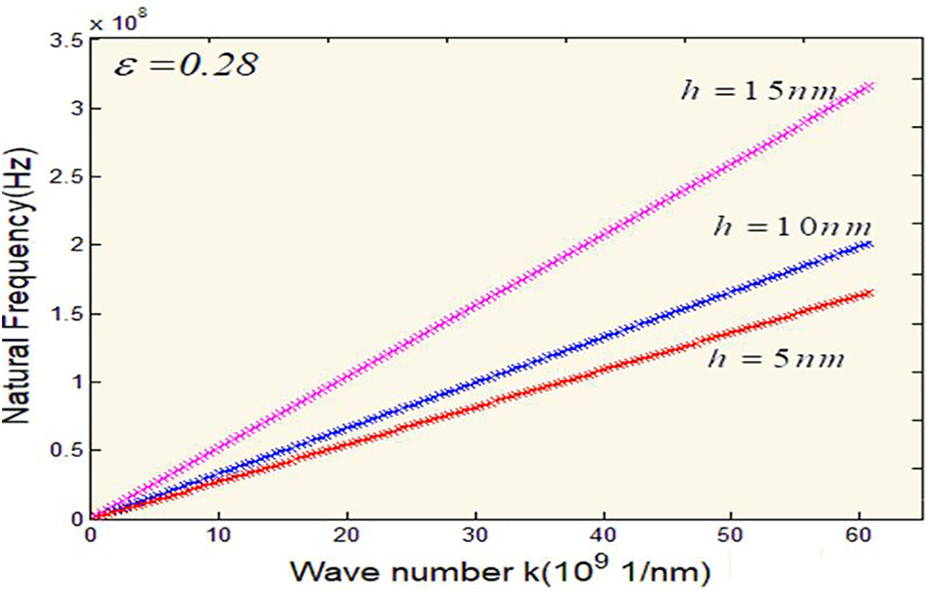
Variations of natural frequency of irregular nanoplate versus half-wave number at (ε = 0.28).
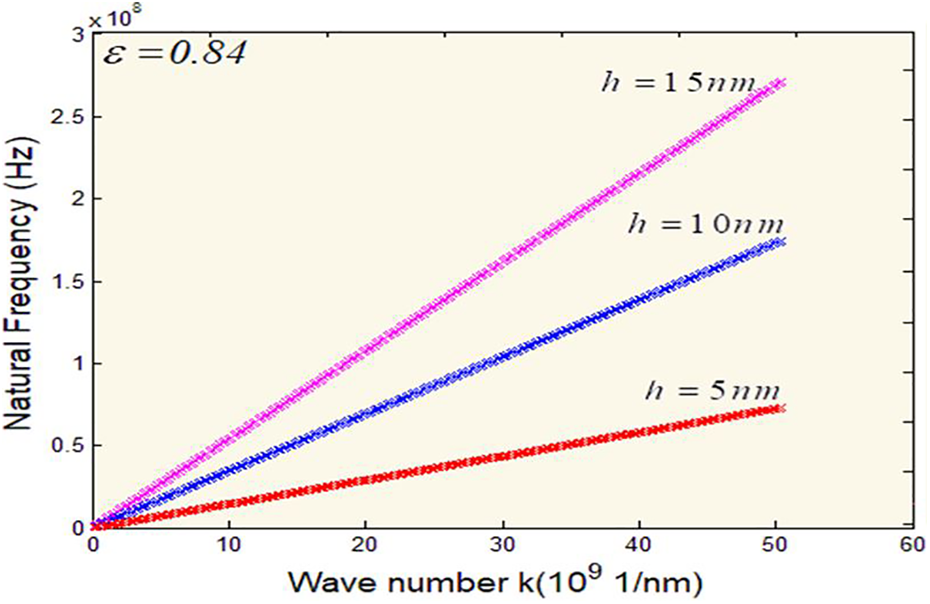
Variations of natural frequency of irregular nanoplate versus half-wave number at (ε = 0.84).
Figure 2 shows the change of natural frequency of the uniform (ε = 0) nanoplates due to the change of half wavenumber in x-direction. It is clearly seen from the figure the natural frequencies of the nanoplates change in the range 0–4 × 10⁸ Hz. In addition, it can be seen that, the values of natural frequency are different over any arbitrary thickness. Also, it can be observed that, the natural frequencies of the nanoplate at the thickness (h = 15 nm) are more than that of the nanoplate with thicknesses (h = 5 or 10 nm). Moreover, the sensitivity of natural frequency to the thickness change of the nanoplates is much higher for near the higher values of half wave number.
Next, it is tried to show the vibration behavior of nanoplate with different values of the surface irregularity parameter
The effects of surface irregularity become obvious at the higher values of irregularity’s parameter
Conclusion
In this work, a novel frequency equation of irregular nanoplates based on Kirchhoff plate model has been reported. The worth mentioning components of the present analysis are to examine the effects of surface irregularity on the natural frequency of vibration of nanoplates. The numerical results have been shown graphically and the dependence of the vibration characteristics of the nanoplate on the surface irregularity parameter is investigated. It has been detected that the presence of surface irregularity in the nanoplate has notable effects on the natural frequency of vibration. The obtained numerical and analytical results show that the increase of surface irregularity parameter decreases the natural frequency of the vibration of nanoplates. Thus, it can be concluded that the investigation presented may provide useful information for the next generation studies and accurate designs of nanodevices, nano-oscillators, and nanosensors.
Supplemental material
Supplemental Material, sj-pdf-1-nax-10.1177_18479804211001148 - Vibrational analysis of nanoplate with surface irregularity via Kirchhoff plate theory
Supplemental Material, sj-pdf-1-nax-10.1177_18479804211001148 for Vibrational analysis of nanoplate with surface irregularity via Kirchhoff plate theory by Mahmoud M Selim and Taher A Nofal in Nanomaterials and Nanotechnology
Footnotes
Acknowledgments
(Taher A. Nofal) Taif University Researchers Supporting Project number (TURSP-2020/031), Taif University, Taif, Saudi Arabia. The first author would like to acknowledge the supports provided by the Deanship of Scientific Research of Prince Sattam bin Abdulaziz University during this research work.
Declaration of conflicting interests
The author(s) declared no potential conflicts of interest with respect to the research, authorship, and/or publication of this article.
Funding
The author(s) received no financial support for the research, authorship, and/or publication of this article.

Supplemental material
Supplemental material for this article is available online.
Appendix 1
References
Supplementary Material
Please find the following supplemental material available below.
For Open Access articles published under a Creative Commons License, all supplemental material carries the same license as the article it is associated with.
For non-Open Access articles published, all supplemental material carries a non-exclusive license, and permission requests for re-use of supplemental material or any part of supplemental material shall be sent directly to the copyright owner as specified in the copyright notice associated with the article.
