




Abstract
Developing low cost and highly active fuel cell is one of the high-priority research directions for fuel cell commercialization, whereas durable electrodes and electrolyte membranes are keys for its optimization. Herein, a novel nanocomposite electrolyte membranes for direct methanol fuel cell were prepared from eco-friendly polymer blend composed of poly(vinyl alcohol) (PVA) and iota carrageenan (IC). Sulfated titania (SO4TiO2) nanotubes are synthesized by impregnation–calcination method and incorporated as doping agents into the polymer matrix with different percentage ranged between 1 wt% and .5 wt%. The PVA/IC/SO4TiO2 nanocomposite membranes exhibited reduction in water and methanol uptake compared to that of undoped membrane, while the thermal properties and oxidative stability increased as the doping agent content increased. Methanol permeability of PVA/IC/
Keywords
Introduction
Fuel cell technologies are new, attracting more attention as energy conversion tools targeting elimination of the fossil fuel pollution, 1,2 whereas fuel cell gives electricity with efficiency above 50% and can provide high power density for a long time at low operating temperatures. 3 Direct methanol fuel cells (DMFCs) are polymer electrolyte fuel cells having some advantages, such as methanol, as fuel has high hydrogen to carbon ratio (4:1), the simple design of the DMFC, and its eco-friendly impact. 4
Generally, in DMFC, membrane acts as a separator between cathode and anode compartments in addition to allowing hydrogen ions (H+) transfer from anode to cathode effectively and hindering the methanol crossover effect. 3,5 However, there are two essential types of membranes according to the type of transferred ion charge classification, such as cation-exchange membranes (CEMs) for cation transfer and anion-exchange membranes (AEMs) for anions transfer. 3,6 Nafion membranes are commercial CEM that always employ in polymer electrolyte fuel cells but they are costly and need complex processing. For that reason, many researchers are concerned about developing cost-effective and eco-friendly membranes based on green synthesis. 7
Metal oxides, such as silicon dioxide (SiO2), zirconium dioxide, and titanium dioxide (TiO2), are the most used doping agents to design new nanocomposite membranes due to their ability to tailoring its structure and easy accessibility. Meanwhile, adding that metal oxides improves the chemical and mechanical stability, reduces the fuel permeability, and enhances the ionic conductivity, which, in turn, enhance the fuel cell performance. 7 However, the current trend in fuel cell polymeric membrane synthesis is to incorporate doping agents in the polymer matrix to produce functionalized polymer. 8,9
TiO2 is a cost-effective inorganic material with versatile features, 10 –12 as it is incorporated in the polymeric matrix, and it enhances thermal stability, mechanical strength, corrosion resistance, and nonflammability. 13 However, using TiO2 in energy applications, such as batteries and fuel cells as cocatalysts, or as a doping agent in polyelectrolyte membranes enhances the electrodes and the membrane performance. 13,14 In polymer electrolyte membranes, TiO2 functionalization has become a more common approach and has the aim of adding more charge groups into the membrane to provide interconnecting ionic channels to facilitate ion transfer by Grotthuss mechanism, 7 also TiO2 can lower the fuel permeability and improve the mechanical stability without drastically reducing the conductivity of the nanocomposite membranes. However, functionalized TiO2 nanotubes (NTs) have high hydrophilicity, high specific surface area, and good proton conductivity (approximately 102–103 mS cm−1) at high relative humidity, making them a promising candidate to be used as a doping agent in polymer electrolyte membranes. 15 Modification of TiO2 with sulfate anion groups by acid treatments allows the incorporation of acidic groups into TiO2 that is expected to improve the water adsorption, ionic conductivity, and the ion exchange capacity (IEC) while reducing the fuel permeation through membrane. 16,17
From previous studies, nanocomposite membranes of polybenzimidazole doped with TiO2 gave superior hydrophilicity and ionic conductivity when compared to the undoped membrane. 9 Polyether-based polymers doped with TiO2 nanoparticles exhibited a higher ionic conductivity more than that doped with SiO2 or Al2O3. 18 Furthermore, particles of TiO2 added into a sulfonated polysulfone membrane structure had a good impact on the fuel cell performance. 19
Fuel crossover resistance and ion conduction were increased in a nanocomposite membrane containing amino acid-functionalized TiO2 powder and sulfonated poly(ether ketone) polymer. 20
Natural polymer, such as iota-carrageenan (IC), is a water-soluble, eco-friendly polysaccharide extracted from red algae. Three types of carrageenan are known as kappa carrageenan, IC, and lambda carrageenan. They differ in the position and number of sulfonate groups on the galactopyranose units. The presence of sulfonate and hydroxyl groups produced polyelectrolyte carrageenan solution with good film-forming ability. IC was doped with ammonium bromide (NH4Br) for fuel cell application and exhibited that the ionic conductivity of undoped IC is 1.46 × 10⁻⁵ S cm−2 while the incorporation of different concentrations of NH4Br improves the conductivity to 1.08 × 10⁻³ S cm−2. 21 Polyvinyl alcohol (PVA) is a cheap widespread basic polymer with good hydrophilicity and chemical stability that allows easy film formation but it has low ionic conductivity. 9 To overcome this disadvantage, PVA could be functionalized to sulfonated poly(vinyl alcohol) (SPVA) using 4-sulfophthalic acid (SPA) as an ionic cross-linker and sulfonating agent simultaneously. 22 Furthermore, the importance of using environmentally friendly, simple, and available basic polymer, such as PVA, in membrane formation must consider the advantages of their easy industrial processing and widespread commercialization rather than designing new complex polymers which means more industrial efforts. 23
Herein, the acid–base blend method, using acid polymer (IC) and basic polymer (PVA), is an easy approach providing cost reduction, flexible design, easy processing and synergetic effect of new composite membranes, and facilitate ion transport through the membrane by Grotthuss mechanism. However, to the best of our knowledge, there is nearly no information in the literature regarding sulfonated PVA blended with IC polymer and doped with functionalized TiO2 NTs as a green alternative polyelectrolyte membrane for fuel cell application. Furthermore, in this study, using of doping agent as (SO4TiO2) is necessary to form a compatible and miscible blend as a result of hydrogen bonds existing between (–OH) side groups of PVA and IC and acid groups of inorganic doping agent and IC, whereas sulfate group considered as additional functional group has oxygen, which enhances the nanocomposite membrane properties.
Materials and methods
Materials
PVA medium MW, 99% hydrolysis, and IC-V type were purchased from Sigma-Aldrich. Glutaraldehyde (50 wt% in water, Alfa Aesar) and SPA (99.9 wt% in water, Sigma-Aldrich) were used as a cross-linker. Titanium (IV) oxide rutile powder (TiO2, <5µm, ≥99.9 wt%, Sigma-Aldrich), sulfuric acid (H2SO4, 98 wt%, Spectrum Chemical MFG Corp.).
Preparation of
-TiO2 NT doping agent
SO4-TiO2 NT was synthesized using impregnation–calcination method, 24,25 whereas TiO2 particles were mixed with 200 mL of 10 M sodium hydroxide (NaOH) in a closed container and stirred at 110°C for 24 h. The resulting paste was filtered, neutralized with 0.1 M HCl, and then washed several times. The TiO2 NT (1.0 g) was mixed with H2SO4 (5 mL) and the solution was kept at 110°C for 24 h and then calcinated at 450°C in a muffle furnace.
Preparation of PVA/IC/SO4TiO2 NT membrane
The nanocomposite membranes were prepared on four steps. First, dissolving each polymer separately (10 g) of PVA in 100 mL deionized water at 90°C and 2 g of IC in 100 mL deionized water at 80°C for complete dissolving and blending the two polymers with ratio PVA:IC (95:5) wt%. Second, cross-linking the two polymers using glutaraldehyde (3 g, 50 wt%) as a cross-linker for covalent bond formation 26 and SPA (3 g, 99.9 wt%) as an ionic cross-linker and sulfonating agent for PVA to obtain SPVA simultaneously. 27,28 Third, the cross-linking step was followed by developing the organic–inorganic nanocomposite proton conductors by adding different concentrations of SO4TiO2 NT. The wt% of SO4TiO2 NT was 1, 2.5, 5, and 7.5 wt% with respect to PVA and the membrane formed with these concentrations was named PVA/IC/SO4TiO2 NT-1, PVA/IC/SO4TiO2 NT-2.5, PVA/IC/SO4TiO2 NT-5, and PVA/IC/SO4TiO2 NT-7.5, respectively. Finally, the formed membranes were dipped in a certain concentration of glutaraldehyde for 2 min to increase the hydrophobic properties of membrane surface.
The possible structure of the membrane, where PVA and IC were cross-linked covalently by acetal reaction between –OH groups of PVA and IC and –CHO groups of glutaraldehyde and also ionically cross-linked by esterification reaction between –COOH groups of SPA and –OH groups of PVA and IC in addition to hydrogen bonds formed between the two polymers and the doping agent, can be seen in Figure 1. 26

Possible structure of the PVA/IC/SO4TiO2 NT membrane. PVA: polyvinyl alcohol; IC: iota carrageenan; SO4TiO2: sulfated titania; NT: nanotube.
Membranes characterization
Characterization apparatus
SO4TiO2 NTs and TiO2 particles have been followed by monitoring the characteristic functional groups using Fourier transform infrared spectrophotometer (Shimadzu FTIR-8400, Japan), while their structures were investigated using X-ray diffractometer (Shimadzu 7000, Japan). Thermal changes of PVA/IC/SO4TiO2 NT membranes traced using thermogravimetric analyzer (Shimadzu TGA-50, Japan), the temperature range was set at 25–800°C, and the heating rate was at 20°C min−1 under nitrogen atmosphere. While the enthalpy changes were explored using differential scanning calorimetry (DSC) (Shimadzu DSC-60, Japan) at temperature range between 25°C and 300°C. Morphological change of the PVA/IC/SO4TiO2-7.5 membrane surface was investigated using a scanning electron microscope combined with energy-dispersive X-ray analysis (EDX) (Jeol JSM 6360LA, Japan).
Sorption test (water and methanol uptake)
Water and methanol uptake was measured by soaking the membranes in water or in methanol at ambient temperature for 3 h. In certain times, the swollen membranes were removed, and the excess of adhered water or methanol on the surface was removed using tissue paper and then weighted. The liquid uptake (water or methanol) was estimated using the following equation

where W d is the dry and W w is the wet weights of membrane samples. The measurements were taken each 10 min, and then, after 50 min, the samples were taken each 60 min.
Ion exchange capacity
The IEC of prepared membranes was determined using acid–base titration. 29 The weighted samples were placed in 50 cm3 of a 2 M NaCl solution for 2 days, and then, the mixture was titrated with a 0.01 N NaOH solution. IEC was calculated as follows

where V NaOH, C NaOH, and Wd are the volume of NaOH consumed in titration, the concentration of NaOH solution, and the weight of the dry membrane sample, respectively.
Tensile strength test
A tensile strength test, that is, the mechanical stress until membrane breaking, was evaluated in the dry state at room temperature using Lloyd Instruments LR10k. An average value was determined after three measurements of each membrane. 28
Methanol permeability measurements
The methanol permeability of the membranes was determined using a diaphragm diffusion cell method. 30 Basically, a glass cell consisted of two reservoirs each approximately 100 mL, separated by a vertical membrane. The membrane was fixed and clamped between both reservoirs. Initially, one reservoir (V A) was filled with 100 mL of 2 M methanol solution in distilled water, and the other reservoir (V B) was filled with 100 mL of pure deionized water. Methanol permeates across the membrane by the concentration difference between the two reservoirs. We can measure the concentration of methanol by High Performance Liquid Chromatography (HPLC) analyzer. The methanol concentration in the receiving reservoir as a function of time is given by the following equation

where the product of methanol diffusion coefficient (D) through the membrane and the partition coefficient (K) defines the methanol permeability coefficient P, that is, P = DK. C B is the concentration of methanol in the water compartment (B) at time t. C A is the initial concentration of methanol in the compartment (A). A is the membrane working area. L is the membrane thickness. V B is the volume of the water compartment. “t” is the time lag, which is linked with the methanol diffusion coefficient (D) according to the following formula: (t 0 = L2/6D). The methanol permeability (P) is obtained from the slope of the linear relationship between the concentration of methanol in the water compartment (C B) and the time (t).
Thermal oxidative stability
The thermal oxidative stability was tested by measuring the weight loss of the membrane samples (1.5 × 1.5 cm2) in Fenton’s reagent (3 wt% H2O2 containing 2 ppm FeSO4) at 68°C for 24 h. 27
Result and discussion
Material characterization for SO4TiO2 NT and PVA/IC/SO4TiO2 membranes
It can be observed from Table 1 that the mass content values of S in SO4-TiO2 measured by EDX and inductively coupled plasma are similar, which confirms the successful functionalization of TiO2 with acid groups.
ICP and EDX data of SO4-TiO2.

ICP: inductively coupled plasma; EDX: energy-dispersive X-ray analysis; SO4-TiO2: sulfated titania.
The X-ray diffraction patterns of original TiO2 and SO4-TiO2 doping agents can be seen in Figure 2. The typical peaks of rutile TiO2 at 2θ values of 28°, 36°, 41°, and 54° can be observed. 31 Inclusion of sulfate in the titanium dioxide lattice changed the rutile crystalline phase. The diffractograms reveal that SO4-TiO2 has a different structure when compared to the original TiO2 rutile phase, despite being submitted to the same calcination temperature, which can be related to the different synthesis steps. 32 The intensity of the peak of rutile TiO2 at 28° is reduced in the SO4-TiO2 diffractogram. The other peak at 54° of the pure rutile TiO2 is absent in the diffractogram of SO4-TiO2.

XRD analysis of TiO2 particles and SO4-TiO2 nanotube. SO4TiO2: sulfated titania; XRD: X-ray diffraction.
The FTIR spectra of SO4TiO2 and TiO2 are compared in Figure 3. TiO2 bands located at 750 and 1026 cm−1 are attributed to Ti–O bonds, and the bands at 3387, 1622, and 1396 cm−1 correspond to O–H bonds due to the moisture sorption on the powder surface. 24 In the case of SO4-TiO2, a strong band at 1153 cm−1 is attributed to sulfate ion coordinated to the Ti4+ metal cation. The bands at 3390 and 1651 cm−1 are due to O–H bonds from moisture sorption on the TiO2 surface and became wider as SO4-TiO2 is more hydrophilic than pure TiO2. 33

FTIR analysis of TiO2 and SO4-TiO2 nanotube. SO4TiO2: sulfated titania; FTIR: Fourier transform infrared.
However, NT morphology of prepared SO4-TiO2 NT was confirmed from transmission electron microscopic image, as shown in Figure 4(a), whereas the length of NT ranging between 100 nm and 275 nm and a diameter ranging between 8 nm and 11 nm are shown in Figure 4(b). The morphologies of blend membranes with and without doping agents are displayed in Figure 4(c) and (d). The undoped membrane (Figure 4(c)) has a smooth surface. However, in the PVA/IC/SO4TiO2-7.5 (Figure 4(c)) composite membrane, SO4-TiO2 NT doping agent is clearly observed under the surface of the membrane with good distribution, and there is no visible sign of voids and pores.

(a) TEM image and (b) frequency distribution plot of tube diameter (D) and length (L) of SO4-TiO2 nanotubes, SEM images of PVA/IC membrane (c) without and (d) with SO4-TiO2 nanotubes doping agent. TEM: transmission electron microscope; SEM: scanning electron microscope; PVA: polyvinyl alcohol; IC: iota carrageenan; SO4TiO2: sulfated titania.
Thermal analysis for PVA/IC/SO4TiO2 membranes
It can be seen from Figure 5(a) that the weight loss% up to 150°C of PVA/IC, PVA/IC-SO4-TiO2-1, PVA/IC-SO4-TiO2-2.5, and PVA/IC-SO4-TiO2-7.5 membranes is 5.6%, 5.5%, 7%, and 11%, respectively, and that is related to evaporation of moisture content, 32 which increase by increasing the amount of the hydrophilic SO4-TiO2 NT. The second weight loss is the stage of decomposition of the functional groups on the membranes (extends up to 200°C), which is caused by the degradation of oxygen-containing functional groups. Above 200°C, the next decomposition state of the polymer backbone and chains, as well as of the doping materials, started. 32 While the 50% weight loss of PVA/IC, PVA/IC-SO4-TiO2-1, PVA/IC-SO4-TiO2-2.5, and PVA/IC-SO4-TiO2-7.5 membranes is at 346, 350, 370, and 395°C, which means as the SO4-TiO2 content increased, the thermal stability of the membranes increases and that could be returned to the inorganic nature of doping agents. 26 Furthermore, from DSC curves (Figure 5(b)), the appearance of one endothermic peak gives an evidence of complete miscibility of all membrane components but the disappearance of this peak at SO4TiO2-2.5 wt% may be referred to the formation of strong hydrogen bonds. The melting temperature of PVA/IC membrane decreased with the increase of doping material content in the membranes. As known, SO4TiO2 and PVA chains could exert interaction by hydrogen bonds, 26,32 and the interactions partially destroy the crystallinity, which, in turn, decrease the melting point.
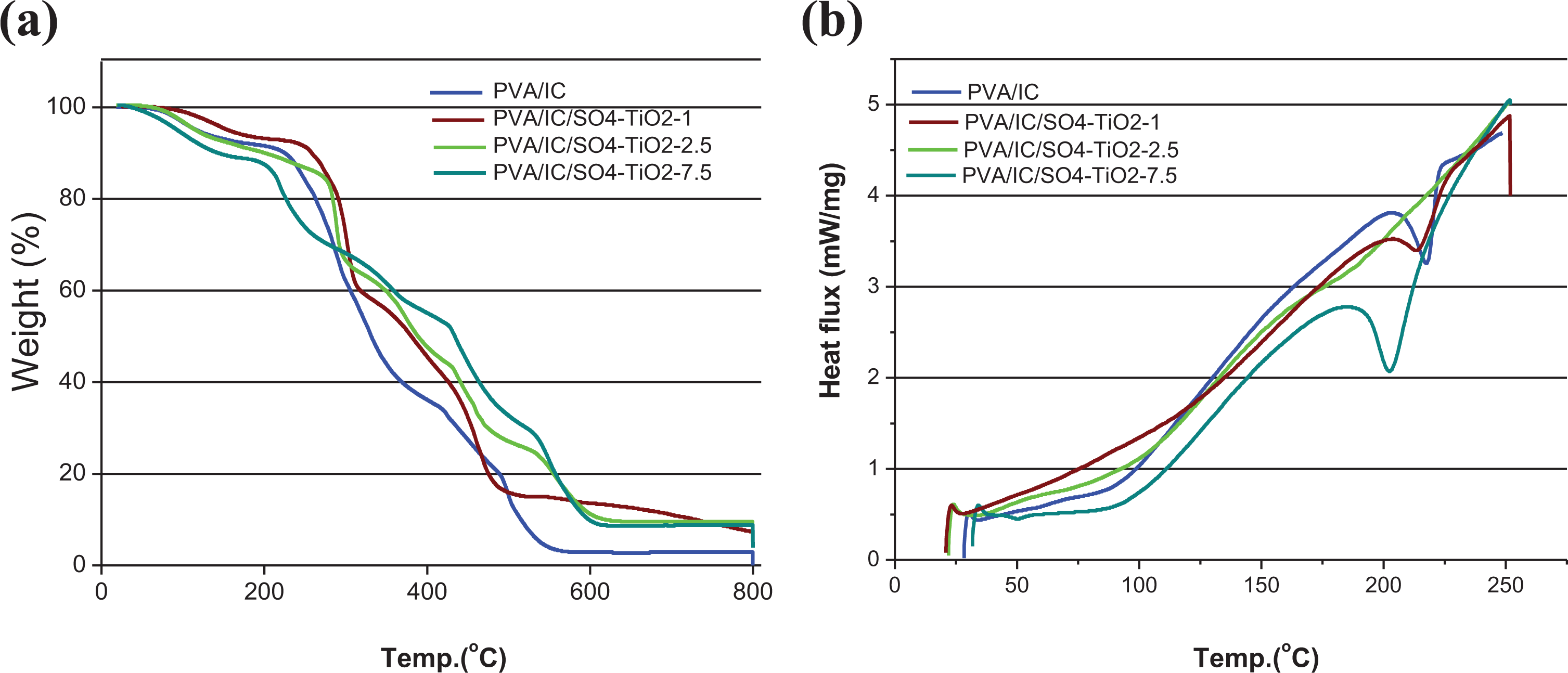
(a) TGA and (b) DSC curves for nanocomposite membranes with different ratios of SO4TiO2 NT. SO4TiO2: sulfated titania; NT: nanotube; TGA: thermogravimetric analysis; DSC: differential scanning calorimetry.
Effect of
-TiO2 content on physical properties of prepared membranes
From Figure 6(a), it is clear that the addition of

(a) The effect of
From Table 2, it was noticed that, by increasing the amount of
Physical properties of PVA/IC/

PVA: polyvinyl alcohol; IC: iota carrageenan; SO4TiO2: sulfated titania.
Effect of
TiO2 on methanol permeability, IEC and thermal oxidation stability
Concerning the membranes’ permeability, it is known that CEMs have the ability to transport cations while preventing the fuel crossover that causes the membrane fouling, thus leading to reduced efficiency of the fuel cell. The methanol permeability of the membranes with and without SO4TiO2 NT was determined using a diaphragm diffusion cell method. As shown in Figure 7 and illustrated in Table 3, the methanol permeability of the PVA/IC/SO4TiO2-7.5 membrane is 0.62 × 10⁻⁷ cm2 s−1, which is much less than that of Nafion®117 and Nafion®115 membranes (26.9 × 10⁻⁷ and 48.84 × 10⁻⁷ cm2 s−1), respectively, 34 and this may be referred to that the doping agent is considered as the methanol diffusion barriers and increases the tortuosity path for the methanol diffusion. Furthermore, the doping agent hinders the methanol crossover as the result of forming more hydrogen bonds between the doping agent and polymer matrix; in addition, it is known that TiO2 can reduce membrane permeability to different fuels. 31,35

(a) Methanol permeability of PVA/IC/SO4 TiO2-7.5 membranes and (b) stress versus elongation% curves of the prepared membranes. PVA: polyvinyl alcohol; IC: iota carrageenan; SO4TiO2: sulfated titania.
Methanol permeability of different prepared nanocomposite membranes.

PVA: polyvinyl alcohol; IC: iota carrageenan; SO4TiO2: sulfated titania.
The IEC, as shown in Figure 8(a), increases dramatically from 0.3 mmol g−1 to 2.25 mmol g−1 with increasing

The effect of
Conclusion
The commercialization of fuel cell is the most important target for researchers to replace fossil fuels in different energy uses and this study concerns about that by developing nanocomposite polymer electrolyte membranes for DMFC based on the costly, green, and simple synthesis, whereas organic–inorganic nanocomposite membranes based on blended eco-friendly polymers as PVA and IC doped with SO4-TiO2 NTs were synthesized and physicochemically characterized. Prepared nanocomposite membranes have shown higher oxidative stability and lower methanol permeability compared to the undoped membrane and Nafion®117. However, the addition of SO4-TiO2 NTs as doping materials enhanced the membrane’s IEC, tensile strength, thermal stability, and lowering water uptake. All the previous results recommended that the developed nanocomposite membranes have potential applications in DMFCs.
Footnotes
Declaration of conflicting interests
The author(s) declared no potential conflicts of interest with respect to the research, authorship, and/or publication of this article.
Funding
The author(s) received no financial support for the research, authorship, and/or publication of this article.
