




Abstract
In this study, the cooling performance of nanofluids in car radiators was investigated. A car radiator, temperature measuring instrument, and other components were used to set up the experimental device, and the temperature of nanofluids passing through the radiator was measured by this device. Three kinds of nanoparticles, γ-Al2O3, α-Al2O3, and ZnO, were added to propylene glycol to prepared nanofluids, and the effects of nanoparticle size and type, volume concentration, initial temperature, and flow rate were tested. The results indicated that the heat transfer coefficients of all nanofluids first increased and then decreased with an increase in volume concentration. The ZnO-propylene glycol nanofluid reached a maximum heat transfer coefficient at 0.3 vol%, and the coefficient decreased by 25.6% with an increase in volume concentration from 0.3 vol% to 0.5 vol%. Smaller particles provided a better cooling performance, and the 0.1 vol% γ-Al2O3-propylene glycol nanofluid had a 19.9% increase in heat transfer coefficient compared with that of α-Al2O3-propylene glycol. An increase in flow rate resulted in a 10.5% increase in the heat transfer coefficient of the 0.5 vol% α-Al2O3-propylene glycol nanofluid. In addition, the experimental temperature range of 40–60°C improved the heat transfer coefficient of the 0.2 vol% ZnO-propylene glycol nanofluid by 46.4%.
Introduction
Cooling systems affect vehicle power and fuel economy, which are important for the engine, and the automotive radiator is an essential part of the cooling system. Many techniques have been used to optimize the structure of the heat exchanger, such as increasing the number of pipes and changing the shape of the fins 1,2 ; however, the structural design has now been stretched to its limits. 3 The operational speed of the engine is related to cooling efficiency, and therefore, the cooling performance of car coolants must be further improved. With the existing technology and conditions, changing the formulation of traditional coolants to increase their thermal conductivity is a promising avenue.
At present, there are two kinds of coolants: water–ethylene fluid and water–propylene fluid. Considering the boiling point, freezing point, corrosion resistance, and especially environmental hazards, propylene glycol (PG) coolants are more favorable. 4 Owing to the low thermal conductivity of PG, nanoparticles must be added to the fluid. Although only a small amount of nanoparticles is added, the addition greatly improves the heat transfer performance of the solution.
Since the concept of nanofluids was proposed, research on nanofluid properties has been continuous. Many types of nanoparticles such as metal and metal oxide have been added to fluids. Xuan and Li 5 prepared a Cu-water nano-suspension and measured its thermal conductivity by hot-wire. When the volume concentration was 7.5%, the thermal conductivity of the nanofluid was 1.78 times that of the base fluid. Some nanoparticles will increase fluid viscosity. For instance, Sandhya and Nityananda 6 used a one-step method to prepare a cuprous oxide nanofluid, and their analyses showed that the thermal conductivity of the nanofluid increased linearly with an increase in concentration. Nguyen et al. 7 found that the viscosity of water increased by 210% upon addition of 13 vol% Al2O3 particles. Some other nanoparticles will decrease the viscosity. In a study by Zennifer et al., 8 1 vol% CuO nanoparticles at 26°C reduced the viscosity of an ethylene glycol (EG) fluid by 13% and increased the thermal conductivity by 11%. The CuO nanoparticles disperse well in EG and combine with the hydrogen bonds in the fluid, which destroys the original hydrogen bonding grid and leads to a decrease in viscosity. 9,10 In other studies, CuO nanoparticles increased the fluid friction coefficient. 11 Satti et al. 12 measured the specific heat of five different PG aqueous solution-based nanofluids. The size of the Al2O3 nanoparticles had little effect on specific heat, but it decreased with an increase in volumetric concentration. The effect of nanometer-sized silicon dioxide on frictional behavior was studied by He et al. 13 who showed that when the mass fraction of nanoparticles was 0.3 wt%, the friction coefficient of grease decreased by 26%.
Nanoparticles can significantly improve the physical properties of a base fluid, and thus the heat transfer performance of nanofluids has also been investigated. Bakhshan et al. 14 analyzed five different nanofluids and found that the specific heat capacity of MgO-EG decreased by up to 9% and increased as temperature increased. The fluid flow and heat transfer behaviors in microtubes and microchannels were studied by Salman et al. 15 using SiO2-EG, ZnO-EG, CuO-EG, and Al2O3-EG nanofluids. The Nusselt number of the SiO2-EG nanofluids was the largest, and it increased with increasing volume concentration and decreasing particle diameter. Vinodhan et al. 16 conducted experiments in U-shaped microtubes with a CuO-water nanofluid and determined the convective heat transfer performance. They concluded that the nanoparticles can effectively increase the performance properties of the fluid, such as the Nu and heat transfer rate. At a low flow rate, the performance enhancement was obvious; the heat transfer coefficient of a 0.05 wt% nanofluid increased by 34%, which was higher than those at 0.025 and 0.1 wt%.
Since the heat transfer performance of a fluid can be effectively improved by the addition of nanoparticles, nanofluids as car radiator coolants have been progressively studied. Ali et al. 17 added Al2O3-water nanofluids to a Toyota Yaris 2007 cooling system and studied their performance with different concentrations and loads. The results showed that the heat transfer improved with increasing nanoparticle addition until the concentration reached 1%. Ali et al. 18 experimentally investigated a ZnO-H2O solution and showed that a 0.2 vol% nanofluid enhanced the heat transfer rate by 46%, but only a 4% increase in heat transfer rate was achieved when the inlet temperature was increased from 45°C to 55°C. Hussein et al. 19 added SiO2 to water and found that the friction coefficient and heat dissipation increased with an increase in nanoparticle concentration. Compared with the base solution, the friction coefficient of the 2.5 vol% nanofluid increased by 22%, while the Nu increased by 40%. Furthermore, when the volume flow and initial temperature of the solution increased, the friction coefficient decreased. A 2 vol% ZnO-PG nanofluid was observed by Suganthi and Rajan, 20 who found that its heat transfer rate had an increment of 4.24% with increasing nanoparticle concentration. The effect of initial temperature on the cooling performance of nanofluids is notable. Elias et al. 21 carried out experiments with an alumina nanofluid and showed that, as temperature rises, the thermal conductivity and specific heat increase, whereas viscosity and density decrease. Therefore, the cooling performance of the nanofluid at a higher temperature is greater.
Godson et al. 22 and Xuan and Roetzel 23 believed that there are two reasons for the improvement of heat transfer performance caused by nanoparticles. One is that the thermal conductivity of the fluid is increased by the suspended particles. Another is that the irregular motion of the particles increases the fluctuation of fluid and turbulent flow, which intensifies the heat exchange process. However, Sarkar, 24 Mohammed et al., 25 and Haddad et al. 26 thought it too early to come to such conclusions and that more research on nanofluids would be necessary. They raised doubts about the fluid heat exchange phenomenon and the increase in thermal conductivity.
At present, there have been few studies reported on the heat transfer performance of PG nanofluids in automobile radiators, and most have focused on the influence of volume concentration, temperature, and velocity. To analyze the influence of particle type and particle size on the heat transfer performance of nanofluids, ZnO, α-Al2O3, and γ-Al2O3 particles were used to prepare nanofluids with particle sizes of 30, 30, and 10 nm, respectively. A simulation study was also carried out. By comparing the simulation results with experimental results, the influence of particle motion on heat transfer performance can be analyzed. This addresses a lack of existing established research.
Experimental rig and principles
The type and size of the nanoparticles in a fluid affect the enhancement of its thermal conductivity. 27 In these experiments, γ-Al2O3, α-Al2O3, and ZnO nanoparticles were used to prepare nanofluids. The nanoparticles were obtained from Shanghai Fuchen Chemical Reagent Company, and their physical properties are listed in Table 1. A two-step method 28 was used as the preparation process. First, the nanoparticles were added to PG, and the fluid was continuously stirred. Then, a suspension was prepared by ultrasonic oscillation method. The frequency of the ultrasonic oscillator was 40 kHz, and the oscillation time lasted 10 h to ensure that the particles were separated from each other. Due to the small particle sizes and long ultrasonic oscillation times, the nanofluids were stable. Thus, there was no need to add surfactant to the fluids, as proved by Nemade and Waghuley. 29
Basic nanoparticle properties.

To measure the heat transfer performance of the nanofluids, the experimental device shown in Figure 1 was used. The device includes a car radiator, fan, flow meter, temperature measuring instrument, water pump, water reservoir, temperature controller, and heater. The output flow of the pump is variable within the range of 5–40 L/min; regulating the valve between the pump and flow meter controls the rate of flow into the radiator. On both sides of the radiator middle tube, thermocouples were used to measure the wall temperature. Of course, the temperatures of the inlet and outlet should also be measured. The measuring instrument can simultaneously display these four temperature measurements with an accuracy of ±0.1°C. The heater is immersed in the water reservoir to heat the nanofluid. The controller measures the temperature of the fluid in the reservoir by the probe, and then decides whether to supply power to the heater. The tubes are all heat-insulated pipes, which reduce the loss of temperature along the way. Therefore, the temperature remains stable during the experiment.
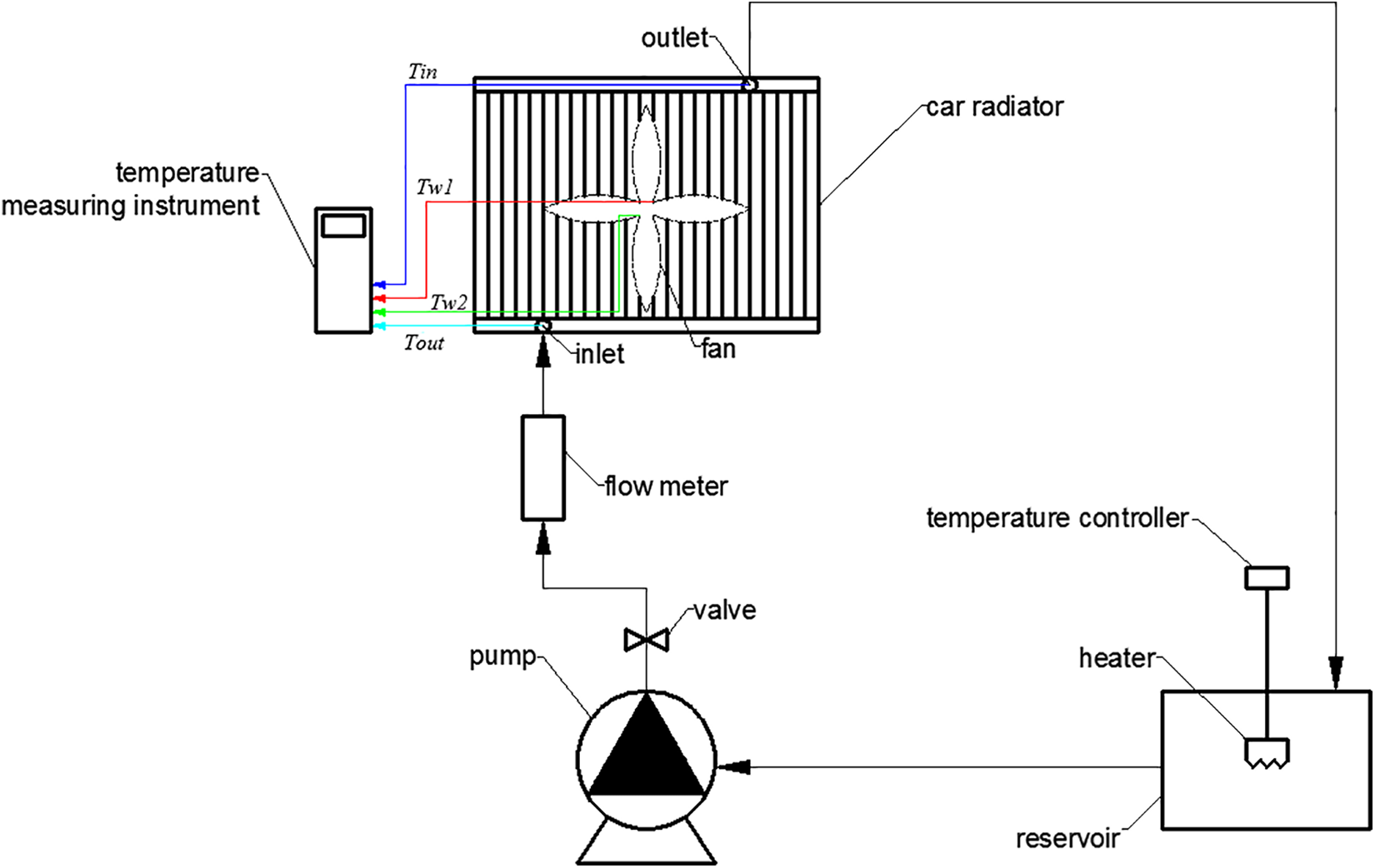
Experimental device structure and principles.
Experiments were carried out at 10, 12, and 15 L/min and 40°C to analyze the influence of flow rate. In addition, the impact of inlet temperature was measured in a range of 40–60°C at 10 L/min. The three kinds of nanofluids were used in all cases, and their heat transfer coefficients were compared.
Data processing
In the series of studies described herein, several formulas were used to estimate the physical properties of the nanofluids. For example, the density of a nanofluid can be calculated by the following formula derived by Pak and Cho 30 :

Xuan and Roetzel 23 proposed a similar formula to calculate specific heat:

By analyzing a large number of experimental data, Corcione 31 established formulas for calculating thermal conductivity and viscosity:



According to the calculated physical properties and measurement results, the cooling performance of the nanofluids in the car radiator can be calculated. The formulas for h, Q, Re, and Nu are as follows, and the parameters of the tube are listed in Table 2.


Tube parameters.

Uncertainty analysis
Due to the measurement error, tests were repeated three times to increase the reliability of test results.
Table 3 summarizes the experimental uncertainty. And the total uncertainty = square root of {(uncertainty of mass)2 + (uncertainty of volume)2 + (uncertainty of temperature)2 + (uncertainty of flow rate)2 + (uncertainty of length)2} = square root of {0.12 + 12 + 0.52 + 12 + 12} = 1.806%.
Uncertainties and experimental measurement techniques.

Reliability verification
The reliability of the experimental device must be verified before measuring the cooling performance. Through the verification test, the Nusselt number of pure water in the radiator was obtained. This was then compared with the theoretical value for turbulent convective heat transfer, which was calculated by Dittus and Boelter 32 :


Figure 2 shows the comparison between theoretical and experimental values, which illustrates that the experimental results are in agreement with the Dittus–Boelter formula. The maximum disparity between the two results is 8% at a flow rate of 10 L/min. The verification test was carried out several times, and the results were stable, which proved that the device is reliable.

Comparison between experimental results and theoretical values of pure water.
Stability analysis
The stability of a nanofluid has a great influence on the experimental results. All nanofluids were divided into two parts, where one was tested immediately and the other was tested 15 days later. The contrast of the two kinds of 0.2 vol% ZnO-PG nanofluids are shown in Figure 3 and the results were almost identical.

Comparison between ZnO-PG nanofluids and that after 15 days. ZnO-PG: zinc oxide–propylene glycol.
The heat transfer rates of the fresh and aged fluids were also obtained experimentally. As shown in Figure 4, the heat transfer rate of all nanofluids decreased slightly after 15 days. The largest decreases were by 2.15%, 2.518%, and 1.909% as shown in Figure 4(a) to (c), respectively. The results prove that all the nanofluids were stable, and the stability of the γ-Al2O3-PG fluid was the highest. Thus, according to the reliability of the experimental device and the stability of the nanofluids, the experimental results are credible.

Comparison of heat transfer rates between original fluids and 15 days aged fluids. (a) ZnO-PG, (b) α-Al2O3-PG, and (c) γ-Al2O3-PG. PG: propylene glycol.
Experimental results and computational fluid dynamics simulations
Results
Figure 5 shows the h values of the nanofluids at different concentrations with an inlet temperature of 40°C and flow rate of 10 L/min. The heat transfer coefficient was effectively enhanced by nanoparticle addition; it first increased then decreased with increasing volume concentration. From the graph, we find that the h value of the 0.3 vol% ZnO-PG nanofluid has a maximum value of 9028 W/m2 K, which is an increase of 122.6% compared with that of the base liquid, and the best concentration of the Al2O3-PG nanofluid is 0.2%. An increase in fluid volume fraction from 0.3% to 0.5% resulted in a decrease in heat transfer coefficient of the ZnO-PG nanofluid by 25.6%.

The h values of nanofluids with different volume concentrations.
The heat transfer coefficient can be expressed as the ratio of thermal conductivity to the thickness of the boundary layer, 33 that is, h = k/δ. The addition of nanoparticles increases the heat transfer specific surface area and heat capacity of the fluid, enhances the interaction between liquid molecules, and significantly increases the thermal conductivity of the fluid, thereby increasing the heat transfer coefficient. However, the viscosity of the nanofluid also increases with an increase in nanoparticle concentration, resulting in an increase in the thickness of the fluid boundary layer, which leads to a decrease in the heat transfer coefficient. Therefore, the heat transfer coefficient of the nanofluids increases first and then decreases.
Under the same conditions, the improvement of the ZnO-PG nanofluid h value was higher than that of the α-Al2O3-PG nanofluid, where the minimum disparity between the two was 6.8%. Define the concentration at which the heat transfer coefficient reaches a maximum value as the critical point. The critical points of ZnO-PG and α-Al2O3-PG occurred at 0.3 and 0.2 vol%, respectively. This is because the thermal conductivity of ZnO-PG is greater than that of α-Al2O3-PG, and their viscosity is the same. Therefore, ZnO-PG has a larger heat transfer coefficient and higher critical point. A smaller nanoparticle size will improve the thermal conductivity enhancement and increase the heat transfer area, 34 and thus the heat transfer coefficients of γ-Al2O3-PG and α-Al2O3-PG followed the same trend. However, the value of the former was obviously larger with a disparity of 19.9% at 0.1 vol%.
Figure 6 illustrates the effect of inlet temperature. With an increase in initial temperature, the thermal conductivity and specific heat of the fluid increased, and the viscosity sharply decreased. A high temperature promotes Brownian motion, which accelerates the heat transfer of the fluid and thereby improves the cooling performance. The h values of all the fluids increased with increasing temperature; h increased by 46.4% (ZnO), 50.6% (α-Al2O3), and 34.8% (γ-Al2O3) at 0.2 vol% when the temperature was raised from 40°C to 60°C. The change trend also shows that the effect of temperature on high concentration fluids was more significant. The heat transfer coefficient of 0.5 vol% α-Al2O3-PG increased by 96.7%. This is because the increase in temperature weakens the effect of viscosity on the heat transfer performance.
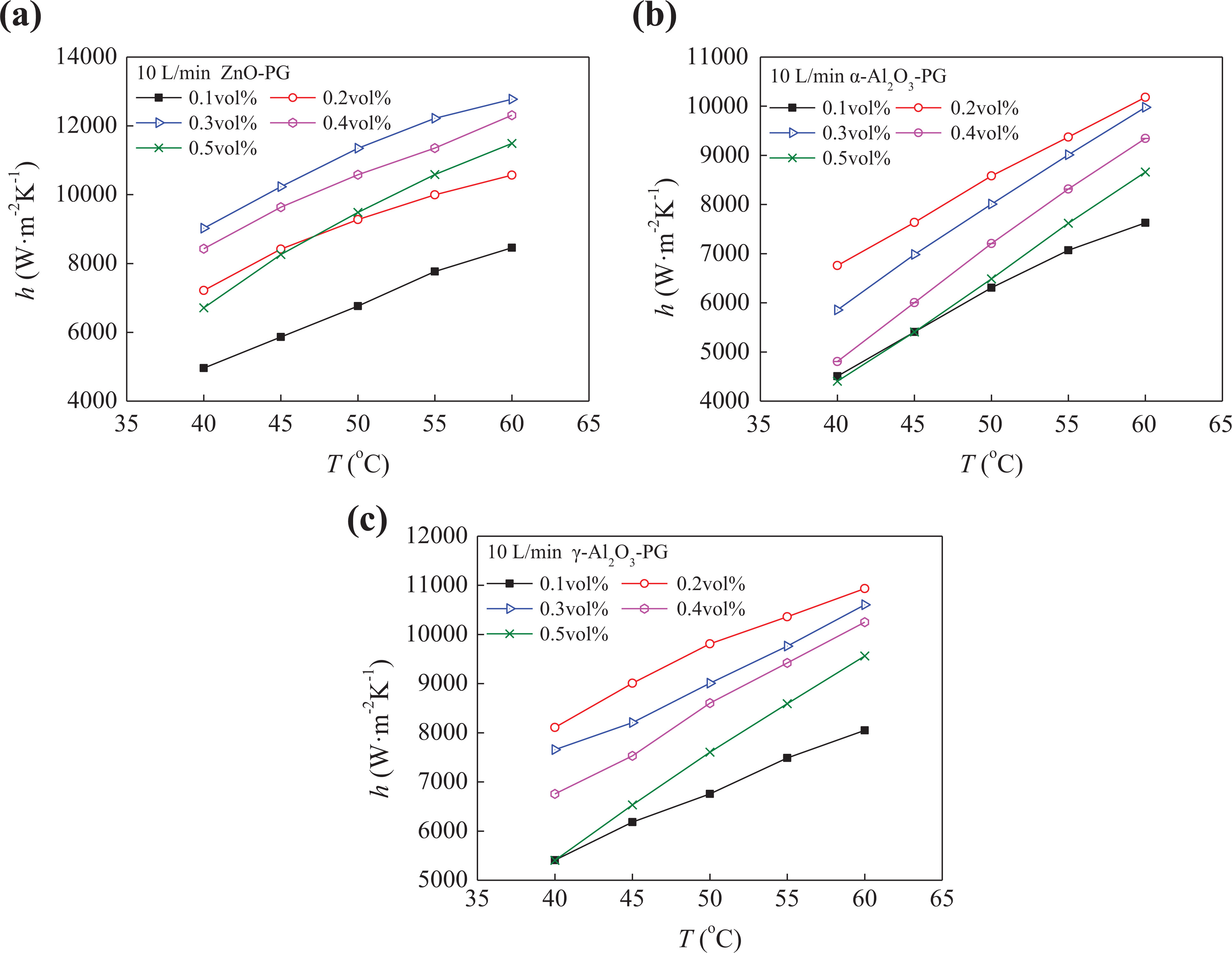
The h values of nanofluids at different temperatures. (a) h of ZnO-PG nanofluids, (b) h of α-Al2O3-PG nanofluids, and (c) h of γ-Al2O3-PG nanofluids. PG: propylene glycol.
Flow rate affects h, and their relationship is shown in Figure 7. The coefficient increased by 20% at 15 L/min compared with that at 10 L/min for the 0.1 vol% α-Al2O3-PG nanofluid. The more nanoparticles that are present, the smaller the impact of the flow rate; an increase of only 10.5% occurred at 0.5 vol%. This is because the enhancement of the heat transfer is related to Re. 35 When the volume concentration of nanoparticles increases, the viscosity of the fluid also increases, which leads to a decrease in Nu and Re and thereby reduces the enhancement of h.

The h values of nanofluids at different flow rates. (a) ZnO, (b) α-Al2O3, and (c) γ-Al2O3.
Figure 8 shows the relationship between Nu and Re at different concentrations of the α-Al2O3-PG nanofluid. The trend of Nu is similar to that of h, which decreased with increasing volume concentration and reached a maximum value at 0.2 vol%. Re was slightly reduced with increasing concentration, and under all conditions, the Re of the nanofluids was less than 2300, indicating that the nanofluids experienced laminar flow in the heat sink.

Relationship between nanofluid Nu and Re at different concentrations and flow rates.
Computational fluid dynamics simulation
According to the experimental structural parameters, a flat tube model of the automobile radiator was built in the CATIA software, then imported into HyperMesh for mesh division. Computational fluid dynamics (CFD) simulations were performed using the Fluent software, with a total number of approximately 744,599 and section size of 96 × 12.
Because the Re of the nanofluids is less than 2300, the flow of the fluid was considered to be steady, three-dimensional viscous incompressible, and Newton laminar flow in the calculations. In the Fluent software, the governing equations were selected as the continuity equation and momentum conservation equation. The thermal conductivity, viscosity, and other parameters of the heat transfer material were set according to the calculated physical properties of the nanofluids. The inlet temperature was 313 K, and the mass flow was calculated according to the flow rate and density. The outlet condition was set to a constant pressure of 101,325 Pa. For the wall, the material was set as aluminum with a thickness of 0.3 mm.
A grid independence test was performed before the CFD analysis. The section grid was refined to 192 × 24 and 384 × 48, and the thermal properties were set according to the 0.1 vol% ZnO nanofluid. Figure 9 shows the simulated temperature distributions under the three different grids. Although the numbers of grids were different, the distributions were almost the same. According to the simulation data, the outlet temperature was 312.1369 K at Figure 9(a) and 312.1313 K at Figure 9(c). Therefore, the temperature distribution was independent of the grid number.

Temperature distributions with different grid numbers: (a) 96 × 12, (b) 192 × 24, and (c) 384 × 48.
Figure 10 shows the temperature distributions of the remaining concentrations of ZnO-PG nanofluids in the tube. With an increase in volume concentration, the temperature distribution map showed obvious changes, where the outlet temperature first decreased then increased. Comparing the outlet temperatures for all concentrations, the lowest temperature occurred at 0.3 vol%, which represents the best heat transfer performance.

Temperature distributions of ZnO-PG nanofluids in pipes with different concentrations. PG: propylene glycol.
According to the temperature distribution, the heat transfer rate of the nanofluid in the tube can be calculated by formula (9). A comparison was made between simulation results and experimental results at different flow rates, as shown in Figure 11, which showed that the latter is larger. For ZnO-PG nanofluids, when the flow rate was 10 L/min, the disparity between the two results was 2.5% at 0.1 vol% and 10.1% at 0.5 vol%. The maximum deviation was 12.6% at 15 L/min, which proved that the increased flow rate raised the disparity. In the simulation, the nanofluid is considered as a fluid rather than a solid liquid mixture. Thus, only the influence of nanoparticles on thermal properties is considered, whereas the influence of particle motion on heat transfer is neglected. As a result, the CFD simulation results are lower than the experimental results. Therefore, when the flow rate and nanoparticle concentration increase, CFD cannot simulate the increase in heat transfer that is caused by particle motion, and the disparity increases.

Comparison of CFDS and EXPS at different concentrations and flow rates. (a) ZnO-PG, (b) α-Al2O3-PG, and (c) γ-Al2O3-PG. CFDS: simulation results; EXPS: experimental results.
Figure 11 illustrates that the differences between CFDS and experimental results (EXPS) for γ-Al2O3-PG were high, where the disparity was approximately 16.5% at 15 L/min. The reason for this is that γ-Al2O3 improves the heat transfer area, but this cannot be simulated. Figure 12 shows the increase of experimental values to simulation values under the influence of temperature. Under the conditions of 0.5 vol% and 10 L/min, the figure shows an upward trend. According to the characteristics of Brownian movement, an increase in temperature will cause the nanoparticles to move faster, and this acceleration of particle motion will enhance the heat transfer performance of the nanofluid. Therefore, with an increase in temperature, the difference between CFDS and EXPS becomes larger.

The increase of EXPS to CFDS at various temperatures. CFDS: simulation results; EXPS: experimental results.
In addition, the simulation results followed the same trend as the experimental results. This proved that whether the effects arise from physical properties or particle motion, the fluid performance will show a similar increasing trend.
In this article, the effects of volume fraction, particle type, particle size, temperature, and flow rate on the heat transfer performance of nanofluids were analyzed, which is more comprehensive than the existing articles. In future research, we will consider the effects of coupling among these factors to further study the heat transfer properties of nanofluids.
Conclusions
In this study, the cooling performance of three kinds of nanofluids was investigated. After the analysis of the results, the effects of nanoparticle type and size, volume concentration, flow rate, and inlet temperature on the heat transfer performance were obtained, and the following conclusions were made. Nanoparticles can effectively improve the cooling performance of PG. When the nanoparticles were added to the fluid, the h value first increased then decreased. The optimum concentration of ZnO-PG nanofluid was 0.3 vol% and the h value of the Al2O3 nanofluid reached a maximum value at 0.2 vol%. A decrease in particle size can greatly improve the heat transfer of the nanofluid. The diameter of the γ-Al2O3 particles was smaller than 20 nm, unlike the α-Al2O3 particles, and the h value of the γ-Al2O3-PG nanofluid increased by 19.9% compared with the α-Al2O3-PG nanofluid at 0.1 vol%. Under the same conditions, the ZnO nanoparticles had a greater effect on the base fluid. The h values of the ZnO-PG nanofluid were larger than those of the α-Al2O3-PG nanofluid at all concentrations, with a minimum disparity of 6.8%. With an increase in initial temperature, the specific heat increases and the viscosity decreases, which causes the heat transfer coefficient to increase rapidly. When the inlet temperature increased from 40°C to 60°C, there was an increase in h for the ZnO-PG nanofluid of up to 46.4%. In addition, the boiling point of the nanofluid is high, which meets the increasingly stringent requirements of the automotive industry. Upon increasing the flow rate from 10 L/min to 15 L/min, the heat transfer coefficient of 0.1% α-Al2O3-PG nanofluid increased by 20%. Furthermore, the impact of flow rate on heat transfer weakened with larger numbers of nanoparticles. The simulation results of the ZnO-PG nanofluid were lower than the experimental results, with a maximum disparity of 12.6%. The reason for this is that Brownian motion is ignored in CFD. However, the simulation results followed the same trend as the experimental results, which proved that the physical properties and particle motion affect the heat transfer.
Nomenclature

Footnotes
Declaration of conflicting interests
The author(s) declared no potential conflicts of interest with respect to the research, authorship, and/or publication of this article.
Funding
The author(s) disclosed receipt of the following financial support for the research, authorship, and/or publication of this article: This work was supported by the Guangxi Key Laboratory of Manufacturing System & Advanced Manufacturing Technology [grant no. 15-140-30S006], the Natural Science Foundation of Guangxi [project Outstanding Young Scholarship Award, grant no. 2014GXNSFGA118005], and the Guangxi Science and Technology Development Plan [grant nos. 1598007-44 and 1598007-45].
