




Abstract
In this article, we report the measurement of underwater aerophobicity, through the captive-bubble method, for different polymeric coatings employed to protect microscale and nanoscale flexible electronic devices for seawater applications. Controlling the morphology and wettability of the coating, in particular with the incorporation of nanoparticles of fluorinated polymers, allows to adjust the hydrophilic/hydrophobic (aerophobic/aerophilic) character of the surface in order to achieve a more insulating and antibiofouling behavior. Morphological analysis (roughness) and wettability measurements in sessile-drop and captive-bubble methods were provided for some properly selected polymeric coatings. We found that parylene C decorated with poly(vinylidene fluoride) nanoparticles at a higher dispersion concentration (5 mg/mL) exhibits the best compromise between morphology, hydrophobicity, and underwater aerophobicity, with sessile-drop water contact angle of 95.1 ± 2.9° and captive-air-bubble contact angle of 133.1 ± 5.9°.
Keywords
Introduction
Microscale and nanoscale electronic devices that are aimed at being employed in harsh environments, such as underwater, must be protected with electrically insulating coatings. Moreover, for applications involving flexible materials, it is important that the external coating has some specific characteristics: it should be conformal, lightweight, not fragile, and insulating. 1 –3 Furthermore, one of the main issues related to submerged objects is the accumulation of microorganisms and macroorganisms on the solid surfaces, that is, biofouling, which could negatively affect the mechanical performance of the devices, especially in the field of MEMS micro-fabricated systems. 4 As a proof, Figure 1 shows a scanning electron microscope (by FEI Helios NanoLab 600i DualBeam) micrograph of a kapton-covered silicon substrate which we dried after 10 days of submersion in seawater: the surface is clearly populated by plenty of microorganisms, in particular bacteria (approximately 1 µm) and diatoms (approximately 10 µm), aggregating in complex chain-like structures.

Biofouling on a kapton-covered silicon substrate after 10 days of submersion in seawater. Two kinds of microorganisms can be individuated, that is, bacteria (approximately 1 µm) and diatoms (approximately 10 µm).
Therefore, in order to contrast the rapid deposition of microbial organisms on micro-devices which have to work underwater, one commonly adopted technique is to control the physical and chemical character of the surface by modifying the morphology and the wettability. 5
Materials employed for insulating and antibiofouling coatings are mostly polymeric. The preferable choice for microscale electronic device with movable or flexible parts includes different types of polymers: (i) polyacrylates, (ii) elastomers, (iii) fluoropolymers, and (iv) poly-para-xylylenes (also known as parylenes).
Among polyacrylates, poly-methyl methacrylate (PMMA) is a transparent thermoplastic polymer generally used as a lightweight alternative to glass, but also for other various applications, such as inks and coatings, or for microfabrication processes as sacrificial layer. It possesses remarkable physical properties and also a good degree of compatibility with human tissues. 6 Coan et al. 6 reported the development of composite coatings of PMMA with hexagonal boron nitride as filler, for metal surface protection against corrosion. Movahedi et al. 7 proposed an approach for antifouling coatings with physicochemical and electrochemical study of ternary system of copper, PMMA, and microparticles of copper-coordinating poly(tris[(benzyltriazol)methyl]amine: by tuning absorption and release, the aim was to optimize the flux of copper across the coating/water interface for efficient preventing of marine fouling, 7 even though copper-based coatings are banned because of environmental risks. 8
Concerning elastomers, these are thermosetting polymers among which rubbers are well-known and commonly used for everyday applications. Poly-dimethyl siloxane (PDMS) is the most widely used silicone-based organic polymer because of its rheological, optical, and nontoxic properties. 9 Generally, it is formed as a viscous bicomponent thermosetting mixture between a matrix component and a curing agent, and applied by spin-coating, 10 dip-coating, 11 or spray-coating. 12 PDMS could also be incorporated, at different contents, into coatings based on other polymers, such as polyurethane, in order to enhance their antibiofouling properties, as reported in Zhang et al. 13
Poly(para-xylylenes) are thermoplastic semicrystalline polymers discovered by Michael Szwarc in the late 1940s and commercialized in 1965. These polymers are synthesized by chemical vapor deposition (CVD) and have very attractive properties, in particular, low sticking coefficient at room temperature, and conformality to different types of substrates. Moreover, the polymerization/deposition process (Gorham route) that is currently adopted to synthesize parylene is very efficient and allows complete control of the deposition parameters: the process basically consists of pyrolizing the precursor dimer and polymerizing the resulting monomers during deposition onto the substrate. 14 –16 Several different kinds of parylene may be synthesized, depending on the functional groups bonded to the backbone of the precursor (2,2-para-cyclophane): these substituents are not modified during the CVD process, making possible to tailor chemical, mechanical, electrical, and optical properties of parylene thin films and, therefore, to introduce diverse functionalities into the coated surfaces. 14 Parylene has been used as protective layer for implanted biomedical devices or for devices in contact with water or wet environments, due to its insulating and moisture barrier properties. 17 –19 Moreover, Goda et al. 20 reported an example of photoinduced grafting of a biomimetic phospholipid polymer, that is, poly(2-methacryloyloxyethyl phosphorylcholine), on parylene film in order to induce lubrication and an antibiofouling character.
Although several works have been published about external polymeric coatings for insulating/antibiofouling purposes, 21,22 the relationship between these properties and the surface morphology/wettability is still scarcely understood, in particular for seawater environments. In this work, we have investigated the surface character of different polymeric coatings which were selected especially for the ease of applicability, conformability, low cost, and compatibility with flexible microfabricated devices: parylene-C (pC; a chlorine atom substituted a hydrogen atom in the backbone of the polymer), PMMA, and PDMS. The PDMS coating was used both in the neat form and mixed with a powder of a fluoropolymer, that is, poly-vinylidene fluoride (PVDF), to combine the conformality of the elastomer and the hydrophobic character of the fluoropolymer, which was expected to confer higher chemical inertness and water repellence to the coating. 23,24
Furthermore, since previous articles in literature reported the surface functionalization or decoration of parylene by physico/chemical treatments, 25 –27 besides the pristine pC coating deposited by CVD, a new combination was taken into account: the pC surface was decorated with PVDF nanoparticles (NPs) through sonication in methyl-ether-ketone (MEK) solvent. Sonication is a well-known method for decorating a substrate with NPs, 27,28 but to the best of our knowledge, there are no previous works related to decoration of organic (polymeric) surfaces with PVDF NPs.
We analyzed the wettability of the aforementioned coatings by measuring the water contact angle (c.a.) and comparing the classical sessile-drop method (in air) with the captive-air-bubble method (for substrates submerged in seawater), in order to evaluate the underwater aerophobicity of the surfaces. 29 –31 Additionally, atomic force microscope (AFM) measurements provided further information in terms of surface morphology. Finally, bacterial cultures in LB broth and agar were performed to assess the microbial adhesion on the selected coatings.
Materials and methods
Materials
The raw materials for preparing the coatings were supplied by different providers.
PMMA 950 in anisole e-beam resist (anisole 80–100%, PMMA 1–20%) was purchased from MicroChem Corp (Westborough, MA, USA). PDMS (Sylgard 184 Silicone Elastomer) was supplied by Dow Corning Corporation (Midland Michigan) in two compounds: a viscous uncured prepolymer and a curing agent. Granular pC was provided by Specialty Coating Systems (Indianapolis, IN, USA) in a form of dimer powders. PVDF powder (average M w approximately 534,000 by GPC) and 2-butanone (MEK) solvent were supplied by Sigma Aldrich (Via Gallarate, Milano). As substrates for the coatings, we used glass microscope slides (75 × 26 mm2) divided into two halves with a smarCUT Plate Cutter (CAMAG, Wilmington, NC, USA).
Preparation of coatings
PMMA-based coating was prepared by dip-coating the substrates in the PMMA viscous mixture, then they were heated in an oven at 180°C for 10 min.
PDMS coating was prepared in a similar way: the prepolymer was mixed with the cross-linker (10:1 wt) and left 30 min for degassing; then it was applied on the substrates by dip-coating and heated in an oven at 90°C for 15 min.
The combination of PDMS with PVDF powder was achieved by mixing the PDMS uncured prepolymer with PVDF powder in a 3:1 (wt) ratio. The mixture was heated in an oven at 200°C, above the PVDF melting point (177°C), and stirred every 5 min. After cooling at room temperature, it was mixed with the curing agent with ratio 10:1 (wt) with respect to the PDMS portion. Finally, it was applied onto the substrate by dip-coating and cured in the oven at 90°C for 15 min. The resulting PDMS-based coatings presented a good homogeneity, as reported in the optical micrographs in Figure 2 (a) and (b).

Optical micrographs of coatings based on PDMS (a) and PDMS-PVDF (b) (the dark line separates the uncoated and coated regions of substrates). TEM images of PVDF NPs dispersed in MEK, 1 mg/mL (c), 5 mg/mL (d). PDMS: poly-dimethyl siloxane; PVDF: poly-vinylidene fluoride; TEM: transmission electron microscope; NP: nanoparticle; MEK: methyl-ether-ketone.
pC deposition process was performed by a RT-CVD machine (PDS 2010 Labcoater system model; Specialty Coating Systems). This system deposits pC according to the Gorham route: the powdered dimer vaporizes at a temperature in the range of 100–150°C and at a pressure of 1 torr to undergo a pyrolysis and be reduced in monomers; then, the temperature is raised up to 650–700°C at a pressure of 0.5 torr to allow the polymerization of the gaseous monomers; and the gas enters the deposition chamber at 20–25°C and 0.1 torr and a conformal polymeric coating deposits on the substrate. To deposit a 1-μm thick layer of pC, an amount of about 1 g of dimer powder is required and the process lasts approximately 1 h.
Concerning the formation of PVDF NPs, PVDF powder was dispersed in MEK solvent at two concentrations, 1 and 5 mg/mL, respectively (in literature, 5 mg/mL is reported as the maximum limit concentration above which no NPs can be obtained 23 ). Figure 2 (c) and (d) shows the transmission electron microscope (TEM) micrographs of the NPs at the two used concentrations, after 5 h of stirring.
Parylene-coated substrates were decorated with PVDF NPs through sonication in PVDF/MEK dispersion for 30 min using a probe sonicator (LABSONIC Ultrasonic Homogenizer).
Sample characterization
The thickness of the coatings deposited on the glass substrates was measured by means of a profilometer (Bruker Dektak Xt).
The PVDF NPs were investigated with a TEM JEOL JEM1011 (JEOL, Inc., Peabody, Massachusetts, USA).
Morphological analysis of the coating surface was performed by means of an AFM (CSI nano-observer AFM) in noncontact mode.
In order to evaluate the microbial adhesion on the coatings, cultures of Staphylococcus aureus were grown in LB broth/agar and on the coated samples. In particular, freeze-dried (lyophilized) strains were rehydrated and mixed with 25 mL of LB broth (tryptone 10 g/L, yeast extract 5 g/L, sodium chloride 5 g/L). This mixture was incubated at 37.5°C overnight with gentle shaking at 150 r/min until the stationary phase was reached to obtain the microbial suspension (M), which was serially tenfold diluted in 10 mL of LB broth, from 10−1 to 10−6. Two hundred microliters 200 µL of the diluted suspensions were streaked on LB agar plates (15 g/L of bacteriological agar added into the LB broth) and incubated for 24 h at 37.5°C. By counting the bacterial colonies on the agar plates, the actual starting cell number was calculated, yielding (4.51 ± 2.08) × 10 11 CFU/mL for the suspension M and (3.49 ± 0.56) × 106 CFU/mL for the 10−5-diluted suspension (M1). The experiments were conducted in sterile rectangular cell culture dishes where the coated glass substrates were placed and a few 50 µL droplets of the M1 suspension were spotted on them; some hydrophilic imbibed cotton was positioned the dishes to maintain humidity and avoid the dehydration of the droplets. The dishes were incubated at 37.5°C for 24 h to make the biofilm form, and, after that, the broth droplets were removed. The samples were washed with droplets of PBS three times to remove any residue of culture medium; the adhered cells were finally fixed with 4% PFA for 20 min and then washed again with PBS to remove residues of fixative. After staining with DAPI (1:100 in distilled water) for 30 min, the adhered bacteria were imaged through a fluorescence microscope (EVOS FLCell Imaging System) in order to compare the surface densities.
Results and discussion
This study was focused on analyzing different selected types of polymers to be employed as external coating for flexible MEMS devices in seawater environments. The selection was made on the basis of specific properties, especially flexibility, ease of application onto the substrates by traditional methods, and conformability. Furthermore, a water repellence character is often reported as a way to contrast biofouling, thus tuning hydrophobicity was one of the crucial aspects to be addressed during the selection of the coatings.
As already discussed, pC, PMMA, PDMS, PDMS-PVDF, and pC decorated by sonication with PVDF NPs at two different concentrations in the sonication dispersion were selected as materials to be tested and characterized.
The thicknesses of the coatings were 2.7 µm for parylene, approximately 3 µm for PMMA, and approximately 100 µm for PDMS and PDMS-PVDF, whereas the dimension of the PVDF NPs was approximately 200 nm and it did not change remarkably with concentration. It is worth noticing that pC was applied by CVD while all the others by dip-coating, so the thickness of the resulting coating was less controllable in the second case. Moreover, from TEM images of PVDF NPs, it is clear that at higher concentration, the resulting NPs are much more wrapped by an organic matrix which makes the contours more undefined and indistinct: this is also the reason why for higher concentrations, NPs tend to combine forming microscale aggregates.
The AFM three-dimensional topography images and the results of wettability measurements are reported in Figure 3, whereas Figure 4 includes summarizing plots for the values of surface roughness as well as the values of seawater c.a. in air (sessile drop) and of air bubble c.a. underwater (captive bubble).

AFM images (3-D topography) (a) and wettability measurements in sessile-drop (b) and captive-bubble (c) modes, for the selected coatings. AFM: atomic force microscope; 3-D: three-dimensional.
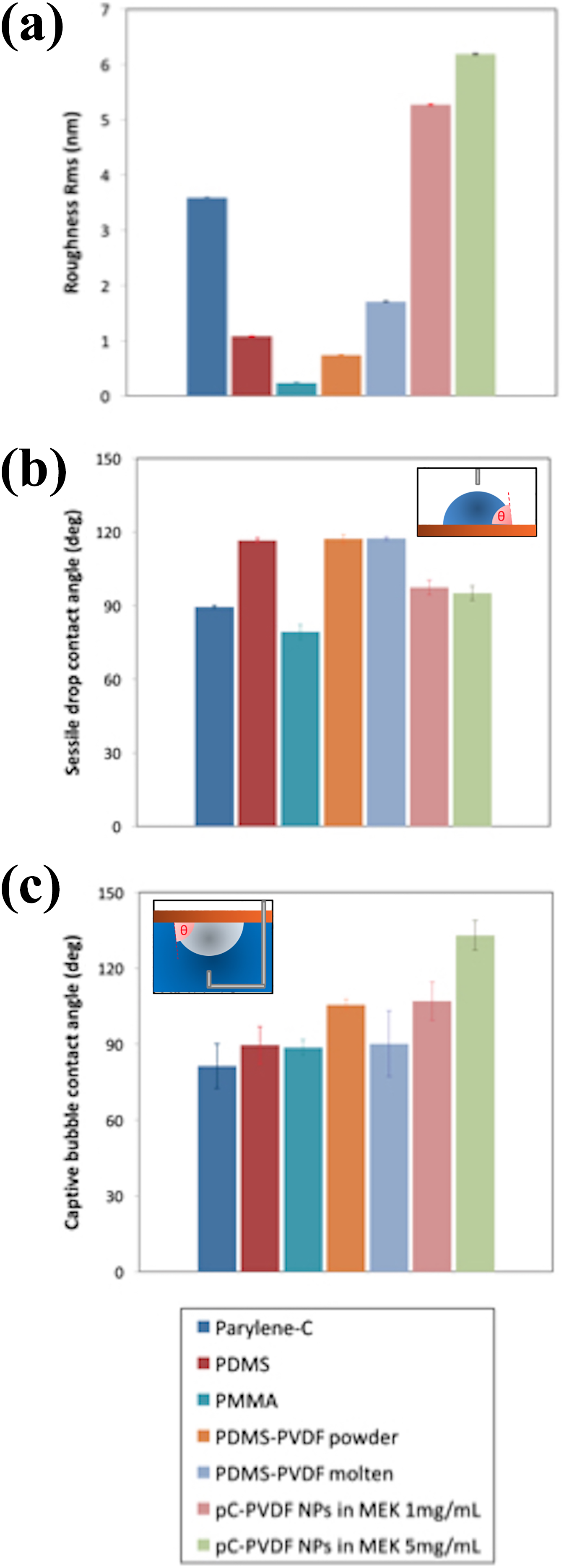
Average values of roughness (a), sessile-drop water c.a. (b), and captive-air-bubble c.a. (c) for the selected coatings. The sessile-drop and captive-bubble c.a.s are defined as inside angles, respectively, as illustrated in the schematic inserts on the plots. c.a.: contact angle.
pC exhibits higher roughness (3.59 nm) than PMMA (0.24 nm) and PDMS-based coatings which present comparable values, that is, 1.08 nm (PDMS), 0.74 nm (PDMS/PVDF powder), and 1.71 nm (PDMS/PVDF molten). Thus, the incorporation of PVDF powder into the PDMS matrix does not compromise the surface smoothness of the coating. This does not hold true anymore for decorated pC coatings because in that case the addition of PVDF NPs regards the surface so the morphology is remarkably modified: this is evident from the analysis of surface roughness of the last two coatings, in fact, it is higher than for pristine pC and it increases with the concentration of NPs in the sonication dispersion (5.27 nm for 1 mg/mL and 6.19 nm for 5 mg/mL, respectively).
The increase in roughness is accompanied by an increase in underwater aerophobicity, that is, in the captive-air-bubble c.a. pC exhibits a c.a. of 81.4 ± 8.8° which is approximately comparable to the values for the other parylene-free coatings, such as PDMS (89.7 ± 7.3°) or PMMA (88.7 ± 3.1°). The incorporation of PVDF into PDMS produces an increase of underwater aerophobicity: 105.6 ± 2.1° (PDMS/PVDF powder) and 90.2 ± 12.9° (PDMS/PVDF molten). In the case of decorated pC coatings, the adsorption of PVDF NPs leads to an increase of captive-air-bubble c.a., to a higher extent when a higher concentration of NPs in the sonication dispersion is used: in fact, pC/PVDF NPs exhibit values of 107.0 ± 7.5° and 133.1 ± 5.9° for concentrations of 1 and 5 mg/mL, respectively. Therefore, the decoration of pC surface with NPs of a fluorinated (thus hydrophobic) polymer increases both the surface roughness (due to the mechanism of physical adsorption) and the underwater aerophobicity (due to the chemical nature of the adsorbed polymer), with respect to the pristine pC.
It is worth noticing that the two wettability measurement methods (sessile drop and captive bubble) are expected to be correlated. Basically, the three phases present in the system under analysis are the same, that is, air, seawater, and the solid substrate; thus the values of hydrophobicity and underwater aerophobicity might be considered as complementary. Actually, a detailed comparison of the plots of Figure 4 (b) and (c) shows that pristine pC exhibits a water c.a. of 89.5 ± 0.6° and a captive-air-bubble c.a. of 81.4 ± 8.8°, so its “wettability behavior” in air remains somehow unchanged when it is submerged in seawater. This holds true for PMMA as well, with water c.a. of 79.3 ± 3.0° and air c.a. of 88.7 ± 3.1°. PDMS-based coatings present c.a. values (sessile drop) of 116.6 ± 0.9° (PDMS), 117.3 ± 1.8° (PDMS/PVDF powder), and 117.4 ± 0.7° (PDMS/PVDF molten): these values indicate a hydrophobic character which corresponds to a slight underwater aerophobicity, with air c.a. of 89.7 ± 7.3° (PDMS), 105.6 ± 2.1° (PDMS/PVDF powder), and 90.2 ± 12.9° (PDMS/PVDF molten). Thus, in these cases, there is a distinct behavior of the coatings in air rather than underwater. Finally, concerning pC decorated with PVDF NPs, water c.a.s were of 97.4 ± 3.1° and 95.1 ± 2.9° for 1 and 5 mg/mL, respectively. The effect produced by NPs adsorption is to increase both hydrophobicity and aerophobicity, to a higher extent for the second; furthermore, an increase of NPs concentration causes a slight decrease in hydrophobicity but a remarkable increase in underwater aerophobicity, indicating the real possibility of modifying the wettability behavior of parylene surface in a seawater environment.
Achieving the controllable underwater wettability of gas bubbles is of great importance and is progressively finding application in several fields, such as of gas collection, underwater drag reduction, and wastewater treatment. 32,33 In particular, in the present work, the usefulness of the wettability measurements in seawater rather than in air lies in the context of structuring antibiofouling surfaces: depending on the specific nature of settling microorganisms, a surface capable of entrapping air microbubbles among its morphological features (more aerophilic surface) could be more difficult to be colonized by biofoulers. 5 Actually, there are also works that highlight the importance of more aerophobic surfaces for achieving antibiofouling properties because the more abundant presence of water molecules near the solid surface should impede the attachment of bacteria. 5 This holds true especially for aerobic microorganisms for which the presence of entrapped oxygen-rich air bubbles on the solid surface would be beneficial.
Figure 5 reports the fluorescence micrographs of S. aureus bacteria adhered on the coated samples, after staining with DAPI: although the microbial attachment is unavoidable, the adhesion is differently mediated by the polymeric coatings. In more detail, the surface of pC, PMMA, and the combinations of PDMS with PVDF were characterized by higher densities of adhered bacteria, whereas PDMS and parylene decorated with PVDF NPs showed a remarkable reduction of adhesion, similar to that of the glass sample. This may be indicative of the fact that the surface decoration is more effective to reduce bacterial adhesion, with respect to the incorporation of powders into a polymeric matrix. Furthermore, the sample decorated with the highest concentration of PVDF NPs showed a decreased density of adhered cells.

Fluorescence micrographs of S. aureus bacterial cells adhered on the surface of the selected polymeric coatings, after fixation in 4% PFA (20 min) and staining with DAPI (30 min): (a) glass slide, (b) pC, (c) PDMS, (d) PMMA, (e) PDMS/PVDF powder, (f) PDMS/PVDF molten, (g) pC/PVDF NPs 1 mg/mL, and (h) pC/PVDF NPs 5 mg/mL. pC: parylene-C; PDMS: poly-dimethyl siloxane; PMMA: poly-methyl methacrylate; PVDF: poly-vinylidene fluoride; NP: nanoparticle.
Therefore, from the analysis of the roughness and wettability results, we deduced that the decoration of pC with PVDF NPs increased the roughness of neat parylene coating but also the character of underwater aerophobicity, in accordance with the Wenzel equation, 34,35 together with an optimal reduction of bacterial adhesion, to a larger extent for higher concentrations of NPs in the sonicated dispersion, revealing the possibility of tailoring the hydrophobic/aerophobic properties of the coating.
Conclusions
These preliminary experimental results demonstrated that the PVDF NPs-decorated pC coatings show the best combination of a rougher surface (to reduce biofouling) and a higher aerophobicity. The underwater aerophobicity is shown to be related to the adhesion of bacterial cells and may be tuned by changing the concentration of NPs in the sonication solution; in fact, higher surface concentrations of PVDF NPs provide higher aerophobicity.
Footnotes
Authors’ note
The findings within this article were previously presented at Trends in Nanotechnology’s 19th Annual Conference, Lecce 2018.
Declaration of conflicting interests
The author(s) declared no potential conflicts of interest with respect to the research, authorship, and/or publication of this article.
Funding
The author(s) received no financial support for the research, authorship, and/or publication of this article.
