




Abstract
Recently there has been a large interest in achieving metasurface resonances with large quality factors. In this article, we examine metasurfaces that comprised a finite number of magnetic dipoles oriented parallel or orthogonal to the plane of the metasurface and determine analytic formulas for their resonances’ quality factors. These conditions are experimentally achievable in finite-size metasurfaces made of dielectric cubic resonators at the magnetic dipole resonance. Our results show that finite metasurfaces made of parallel (to the plane) magnetic dipoles exhibit low quality factor resonances with a quality factor that is independent of the number of resonators. More importantly, finite metasurfaces made of orthogonal (to the plane) magnetic dipoles lead to resonances with large quality factors, which ultimately depend on the number of resonators comprising the metasurface. In particular, by properly modulating the array of dipole moments by having a distribution of resonator polarizabilities, one can potentially increase the quality factor of metasurface resonances even further. These results provide design guidelines to achieve a sought quality factor applicable to any resonator geometry for the development of new devices such as photodetectors, modulators, and sensors.
Keywords
Introduction
A large variety of optical behaviors, such as flat lenses, beam converters, Huygens’ sources, and holograms, 1 –12 can be obtained using metasurfaces, or two-dimensional arrays of subwavelength resonators. In general, these structures exhibit broad spectral resonances with low quality factor (Q), and the generation of narrow spectral resonances with high Q is a challenging task. High-Q metasurfaces would open new avenues in optical modulation, sensing, and spectral filtering.
Recent works based on the concepts of “electromagnetically induced transparency” and “Fano resonances” have reported high-Q metasurfaces. 13 –20 In particular, Campione et al. 20 showed a monolithic resonator design that achieves ultrahigh Q, thanks to the “perturbed” resonators composing the arrays; for details about perturbation theory, refer to the literature. 8,10,21,22 The perturbation was used to induce mode mixing between the bright, in-plane electric dipole mode px , and the dark longitudinal magnetic dipole mode mz . While the px dipole was subject to both radiative and non-radiative decay processes, the mz dipole was subject to only non-radiative decay and high Q values could be achieved using low loss dielectric materials. Campione et al. 20 highlighted the possibility that parallel or orthogonal (to the plane) magnetic dipole arrays may exhibit very different resonant properties.
Thus, we aim to attain in this article a more in-depth understanding of Q properties of finite-size metasurfaces composed of magnetic dipoles, including the dependence of the Q on the number of dipoles as well as their orientation. These magnetic dipoles are a good approximation of dielectric resonators, for example, experimentally achievable dielectric cubic resonators, at the magnetic dipole resonance. We derive analytical formulas for the Qs exhibited by various finite-size metasurfaces featuring parallel or orthogonal (to the plane) magnetic dipoles, which ultimately indicate in a succinct manner the strategies to achieve high-Q resonances in all-dielectric metasurfaces at the magnetic dipole resonance. While it is well-known from antenna theory that we can decompose the antenna pattern into an array factor times an element pattern, 23 what we are after is finding the radiated power when the element pattern is arranged to minimize the radiation. Previous work on infinite arrays 24 has concentrated on parallel (to the plane) dipoles, while work on finite arrays 25 has concentrated on arbitrary arrangements for boosting directivity, but no discussion was reported regarding orthogonal dipoles. Other metamaterials work 26 discussed array truncation effects. We note that by properly modulating the dipole array to have a distribution of polarizabilities, one can potentially increase substantially the Q of metasurface resonances. This modulation could be achieved by employing active metasurfaces, 6,27 where the distribution of dipole moments can be, in principle, chosen at will.
The article is structured as follows. We investigate a finite-size metasurface of cubic all-dielectric resonators at the magnetic dipole resonance in the second section, reporting the distribution of dipole moments along the array that will be necessary for the analytical portion of this work. We then in the third and fourth sections report analytical expressions for metasurfaces with uniform and nonuniform distributions of dipole moments, respectively. Derivations of these formulas are reported in Appendix 1.
Finite metasurface composed of cubic all-dielectric resonators at the magnetic dipole resonance
Consider the case of a metasurface made of lead telluride dielectric cubic resonators with side

(a) Schematic of a metasurface made of dielectric cubic resonators. (b) The magnetic polarizability
We assume near-normal incidence illumination with a set of plane waves (four) to have a normal magnetic drive with negligible phase variation over the array (alternatively, by broken symmetry, this drive can be set up due to the structure of the resonator,
20
which could also be tapered with position to generate a desired distribution of dipole moments) and negligible transverse magnetic field on the array. Each resonator may then be modeled as a vertical magnetic dipole at the magnetic resonance, provided the resonators are sufficiently subwavelength. Note that the first mode of these dielectric resonators is typically the magnetic dipole mode. The magnetic dipole moment

where


where the fitting parameters are
An effective dipole polarizability
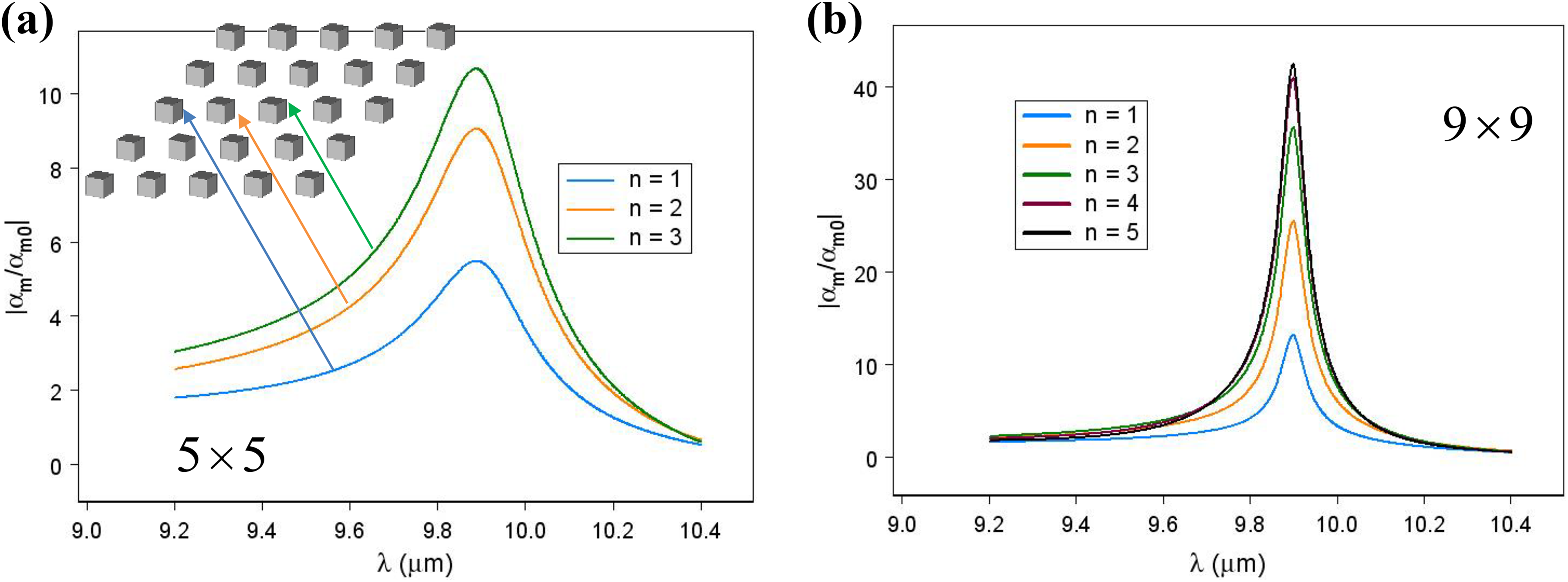
Effective polarizability
We then show the distribution of the magnitude of

Distribution of the magnitude of
In the subsequent sections, we develop analytical formulas to compute the resonance Qs of finite-size metasurfaces composed of magnetic dipoles.
Theory of Qs of finite metasurfaces with uniform distribution of dipole moments
Consider the finite array of orthogonal (to the plane) magnetic dipoles in Figure 4(a) or of parallel magnetic dipoles in Figure 4(b), with periods dx
and dy
along the x and y directions, respectively. These schematics represent dipole approximations of cubic resonator arrays as shown in Figure 1(a). Assume there are M dipoles along the y direction and N dipoles along the x direction, so that the array is composed of

A finite array of (a) orthogonal (to the plane) and (b) parallel magnetic dipoles.
We first estimate the radiation from a finite array of magnetic dipoles oriented in the orthogonal direction to the array as shown in Figure 4(a), representing dielectric resonators with sizes

where mz
is the strength of the vertical magnetic dipoles. The approximate theory based on perfect magnetic conductor side walls for a lossless dielectric cubic resonator gives the resonant frequency for the first transverse mode based on the transcendental equation

where

Consider now the radiation from a finite square array of magnetic dipoles oriented in the parallel direction to the array as shown in Figure 4(b), representing dielectric resonators with sizes

The electrical energy can be written in terms of mx similar to equation (5), through which we can define the Q as

Looking at equations (6) and (8), one can note a striking difference between the two metasurface topologies (parallel vs. orthogonal dipoles). The Q of a finite array of small dipoles oriented in the orthogonal direction to the array is linearly dependent on the number of resonators N. In contrast, the Q of a finite array of small dipoles oriented in the parallel direction to the array does not depend on the number of resonators in the array. This is because the horizontal array approximately radiates a certain power per unit area per resonator, and therefore, the Q of a particular cell is nearly the same as the Q of the array. This is clearly observed in Figure 5, showing the Q versus number of resonators N for arrays of parallel and orthogonal magnetic dipoles, assuming

Theory of Qs of finite metasurfaces with nonuniform distribution of dipole moments
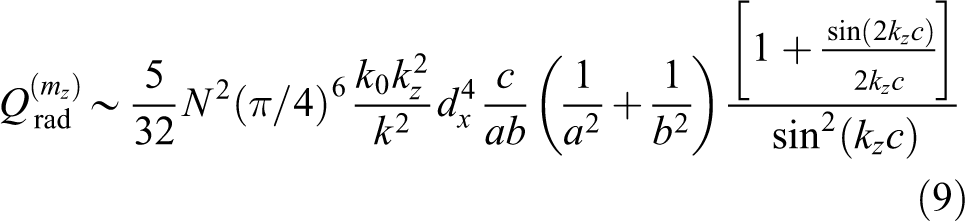
Consider again the finite arrays of orthogonal magnetic dipoles in Figure 4(a) or of parallel magnetic dipoles in Figure 4(b), but now with a more realistic, nonuniform distribution of dipole moments in the array. Under a parabolic distribution of the dipole moments as determined in the second section and following the steps reported in Appendix 1, the Q for orthogonal dipoles is
and for parallel dipoles is (this is given for comparison purposes with equation (9), even though we did not expect to obtain this result without tapering

Note the electrical energy now has an extra factor of
Looking at equations (9) and (10), compared to equations (6) and (8), one can note that the Q of a finite array of small magnetic dipoles oriented in the orthogonal direction to the array is quadratically dependent on the number of resonators N because of the parabolic distribution of dipole moments. This can be clearly observed in Figure 6, showing the Q versus number of resonators N for arrays of parallel and orthogonal magnetic dipoles, assuming the same parameters, as shown in Figure 5. Again, thanks to this analytical model, we conclude that arrays comprising small orthogonal magnetic dipoles are good candidates for high Q resonances. We also compared the Qs to the results computed from the matrix solution in Figure 2 and observed very good agreement with our formulas, as shown in Figure 6.
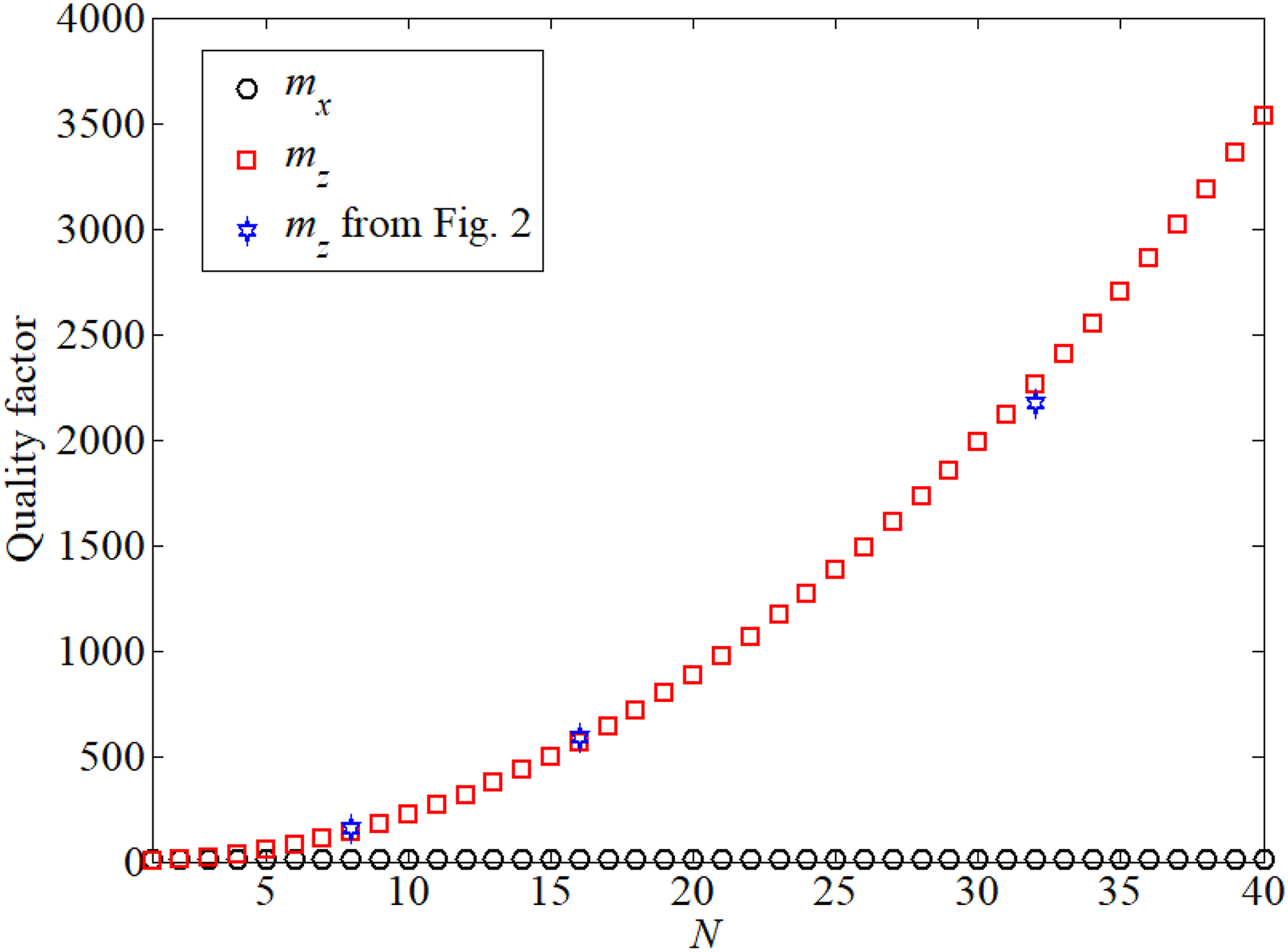
In this section, we developed analytical formulas to compute the resonance Qs in the absence of dielectric losses. By comparing the results of Figures 5 and 6, it is clear that the distribution and orientation of dipole moments along the array dramatically affect the Q of metasurface resonances. While for parallel (to the plane) dipole moments, Qs are independent on the number of resonators in the array, for orthogonal dipoles, we have observed a linear (for uniform distribution) or quadratic (for parabolic or trigonometric modal distribution, which here is a natural distribution for a uniform excitation of the array) dependence on the number of resonators. Inherently, this points to the fact that a different distribution of dipole moments could result in different, and potentially larger, Qs. However, we note that this Q dependence on the dipole moments is limited by the presence of losses. If dielectric losses were present, the overall Q is approximately given by
Conclusion
In this article, we examined metasurfaces with a finite number of magnetic dipoles oriented orthogonal or parallel to the plane of the metasurface and determined analytic formulas for their resonances’ Qs. Finite metasurfaces made of orthogonal (to the plane) magnetic dipoles are very good candidates for achieving resonances with large Qs, which ultimately depend on the number of resonators in the metasurface. We have found that the distribution of dipole moments along the array, which for a uniform excitation ends up being parabolic or trigonometric (but could be modified by modulating the intrinsic polarizabilities of the resonators), affects substantially the Q of metasurface resonances. These results provide design guidelines to achieve a sought Q applicable to any resonator geometry.
Footnotes
Acknowledgments
Sandia National Laboratories is a multimission laboratory managed and operated by National Technology and Engineering Solutions of Sandia, LLC, a wholly owned subsidiary of Honeywell International, Inc., for the U.S. Department of Energy’s National Nuclear Security Administration under contract DE-NA-0003525. This article describes objective technical results and analysis. Any subjective views or opinions that might be expressed in the article do not necessarily represent the views of the U.S. Department of Energy or the United States Government.
Declaration of conflicting interests
The author(s) declared no potential conflicts of interest with respect to the research, authorship, and/or publication of this article.
Funding
The author(s) disclosed receipt of the following financial support for the research, authorship, and/or publication of this article: This work was supported by the Laboratory Directed Research and Development program at Sandia National Laboratories.
