




Abstract
The pressure-sensitive cement-based composites added with multiscale carbon materials, that is, carbon blacks, carbon fibers, and carbon nanotubes are investigated. In the article, the sensing property of cement-based composites with seven different proportions of carbon blacks, carbon fibers, and carbon nanotubes under cyclic loading is discussed and then the optimized formula among these seven proportions is chosen to investigate the influences of temperature and saturation degree on its sensing properties. In addition, the maximum perceivable frequency of multiscale carbon-admixtures–enhanced cement-based composite is obtained from the experimental results. The results indicate that the fractional change in resistance of the cement-based sensing composites increases at first and then decreases with the increase of temperature, but decreases with the increase of humidity. Additionally, the fractional change in resistance has a decrease with the increase of loading frequency, and the cement-based sensing composites prepared can perceive the biggest loading frequency of 0.5 Hz.
Introduction
When some conductive materials are added into cement-based composites, their resistivity will have a change along with the change of stress state, which is called the pressure sensitivity. Therefore, carbon-based cement composites can be made into the sensing material, to judge the stress state and damage degree of structures, or to realize self-diagnosis of concrete structures. 1 –10 Since the 1990s, many researches concerning the pressure-sensitive properties of cement-based material with carbon fibers (CFs), carbon blacks (CBs), and carbon nanotubes (CNTs) have been widely conducted. 1,2,11 –16
Recently, the experimental results conducted by Wen and Chung showed that the partial replacement (as much as 50%) of CFs by CBs that added into cement-based composite lowers the cost and increases the workability but is detrimental to the strain sensing. 17 Han et al. found that the piezoresistivity of cement-based material with both CF and CB has better repeatability and linearity than that of cement-based material with only CF, 18 and further, they used a type of embedded piezoresistive cement-based strain sensors that is made by adding CF and CB into cement-based material to monitor local compressive strain of concrete structures. 19 Azhari and Banthia developed the conductive cement-based composites with CFs and CNTs and found that the hybrid sensor containing CFs and CNTs had a better repeatability about the sensing property. 20 Ding et al. took nano-carbon black (NCB) and CF into concrete to monitor the internal damage of concrete by the relationship between damage degree and resistance. 21 These researches 17 –21 show the hybrid addition contributes to improve the electrical conductive property and the repeatability of the sensing property. Especially with the presence of multiscale carbon materials, there is a huge space to improve the properties of these carbon/cement-based composites, for example, electrical conductivity, pressure sensitivity, electrothermal effect, electromagnetic shielding effect. Therefore, multiscale carbon materials, that is, CFs, CBs, and CNTs were added into cement-based material to investigate its pressure sensitivity in the article. Additionally, the influence of temperature, humidity, and loading frequency on the pressure sensitivity are discussed, respectively.
Experimental
Raw materials and preparation method
Portland cement produced by Harbin Cement Factory was used. The properties of CFs, CNTs, and CBs are shown in Table 1, which were produced by Qiushi Chemical Co. Ltd (China), Lishuo Composites Co Ltd (China), and Shenzhen Nano-carbon Co. Ltd (China), respectively. The dispersant of the conductive fillers, the defoamer to reduce the air bubble in cement paste, and the water reducer to improve the flowability of the cement paste were polyvinylpyrrolidone (PVP), tributyl phosphate, and polycarboxylate superplasticizer, respectively.
Property of CFs, CNTs, and CBs.

CF: carbon fiber; CB: carbon black; CNT: carbon nanotube.
Seven kinds of mix proportions given in Table 2 were adopted. Water cement ratio was 0.5. First, CFs, CNTs, PVP (PVP/CNT = 0.2), water-reducing agent (1.0% by weight of cement), and defoamer (0.3% by weight of cement) were mixed into water. An ultrasonic cell crusher (the model number is JY99-IIDN) produced by NingBo Scientz Biotechnology Co., Ltd (China) was used to disperse the mixture, and to improve the dispersion effect of the mixture, ice cubes were used to cool and the ultrasonic cell crusher had a rest for 30 s after the 30 s of work until the cumulative working time was 30 min. Afterward, CBs were added into the dispersed solution. A blender was used, cement was gradually added into the mixture during the stirring process and then again stirred for approximately 4 min. Then, the fresh paste was poured into the oiled mold (1.8 × 2.0 × 2.4 cm3), and the vibration was conducted for 30 s to reduce air bubbles when the mold was filled half and fully, and the fabricated fresh paste was sealed. After 24 h, the specimens were demolded for 24 h and then were accelerated to cure at a 60°C thermostat water bath for 3 days. Afterward, the specimens were dried to a constant weight at a 50°C drying oven, and the surface of specimens was polished with 80, 240, and 600 grit silicon carbide paper. Then, the copper foils were bonded to both ends of the specimen by ZB2562® silver conductive adhesive (resistivity: 10−2–10−3 Ω·cm). The distance between the electrodes is approximately 24 mm. To accurately measure the strain of specimen when loading, two strain gauges were tightly attached on the two surfaces of specimen.
Seven types of proportions.

CF: carbon fiber; CB: carbon black; CNT: carbon nanotube
Testing equipment and methods
Cyclic compressive experiment with load control was performed using a hydraulic mechanical testing system with an elastic loading range of 0.5–3.5kN and a loading frequency of 0.008 Hz. The loading form was triangular and a total of nine cycles were applied.
A standard resistor that was close to the resistance of the tested specimen was connected to the specimen in series. The direct current (DC) through the specimen is the same with that of the standard resistor. On the other hand, the voltage between both ends of the specimen can be obtained. Thereby, the resistance of the specimen can be easily determined by Ohm’s law. The voltages of the resistance and the specimen are simultaneously collected by the ADAM4117 card and AdamApax.NET Utility software that are produced by Advantech Co. Ltd. (China). It is noted that the applied DC voltage is as low as possible to reduce the polarization effect, approximately 2 V. Fractional change in resistance (FCR) can be expressed as FCR = ΔR/R 0 = (R − R 0)/R 0, where R 0 is the initial resistance before loading, R is the variable resistance during the loading process. Load plan and resistance signal acquisition schematic are shown in Figure 1.
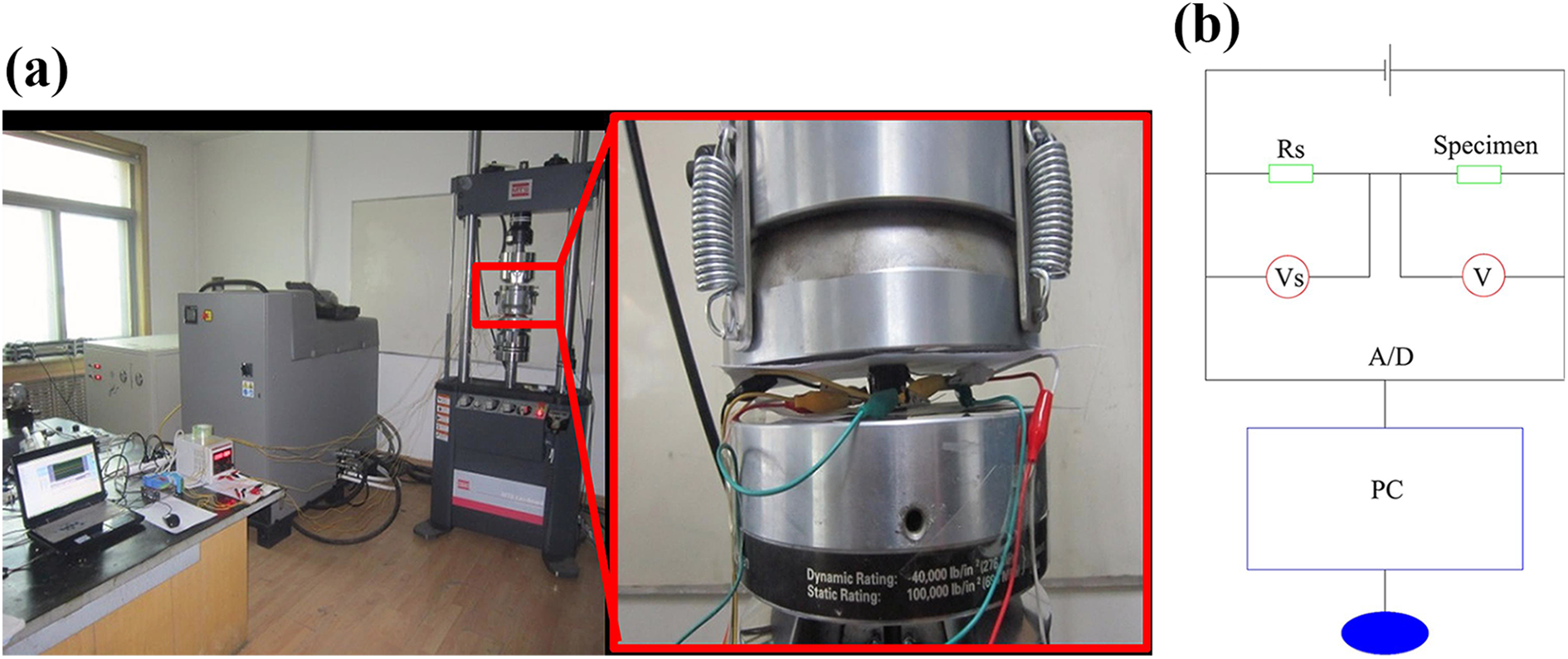
(a) Load plan; (b) resistance signal acquisition schematic.
The specimens with different saturation degrees were used to investigate the effect of humidity on the pressure sensitivity. The specimens were immersed in NaCl solution with 3.5% mass fraction until the change of its weight is lower than 0.1% every 12 h, and the specimen was assumed to be fully water-saturated. Then, the saturated specimens were dried for 1 h, 3 h, and 7 h at 50°C, and their saturation degrees were 100%, 79.26%, 58.50%, and 35.07%, respectively.
The environments of −40°C, −20°C, 0°C, 20°C, 40°C, 60°C, and 80°C were used to investigate the effect of temperature on the pressure sensitivity. The environments of −40°C, −20°C, 0°C, and 20°C were achieved in an insulated box by liquid nitrogen cooling, and the environments of 60°C and 80°C were achieved by electric heating, which is illustrated in Figure 2.

Test equipment used to investigate the effect of temperature on the pressure sensitivity.
Results and discussions
Comparison of pressure-sensitive properties
Figure 3 plots the relationship between compressive strain and FCR of multiscale carbon-admixtures–enhanced cement-based composite. Under cyclic loading, the changing trend of FCR of all types of the specimens has a good agreement with that of strain. In each cycle, FCR decreases with the increase of strains, FCR reaches to the most negative value when the compressive strain increases to the peak. When unloading, FCR tends to be zero with the decrease of strain. Therefore, FCR of multiscale carbon-admixtures/cement-based composite can reflect the state of compressive strain. Pressure sensitivity of cement-based conductive composite is caused by the percolation and tunneling conduction effects; compressive strain leads to the variation of the contact resistances between conductive fillers and between conductive fillers and cement matrix. 22 In loading stage, the probability of links among conductive fillers increases with the increase of compressive strain, so the conductive paths are further established. Simultaneously, the compressive strain decreases the potential barrier and increases the probability of electronic transition improving the tunneling effect, so the electrical conductivity of the specimens has an increase and FCR has a decrease with the increase of compressive strain.

FCR of cement-based material with CF, CB, and CNT under cyclic compressive load: (a), (b), (c), (d), (e), (f), and (g) denote F02T15B1, F02T20B1, F02T25B1, F03T15B1, F03T15B2, F03T15B3, and F04T15B1, respectively. FCR: fractional change in resistance; CF: carbon fiber; CB: carbon black; CNT: carbon nanotube.
In addition, CBs in cement matrix have less winding or clustering phenomenon since they are nanoparticles, so CBs are easier to disperse in cement matrix, and the addition of CBs can perfect the conductive network in cement matrix. When loading, the probability of electronic transition has an increase, and further, tunneling effect has an increase. Therefore, it is found from Figure 3(d) to (f) that FCR has an increasing trend with the increase of CB content, and the increase of CB content can strengthen pressure-sensitive effect. However, FCR of F03T15B3 has a big fluctuation in Figure 3. This is because the content of CB is high, hindering the hydration of cement, which causes great decrease of the compressive strength of cement. 16 At the end of the testing, it was found that F03T15B3 was cracked. Therefore, the content of CBs should be lower than 3%.
Comparing seven types of multiscale carbon-admixtures/cement-based composites, the pressure sensitivity of F02T15B1 and F03T15B2 are found to be the best and the stability and repeatability are very good, and their FCRs are approximately 9.5% and 7.7%, respectively. Sensitivity coefficients (the ratio of FCR and strain, namely FCR/ε) of F02T15B1 and F03T15B2 are approximately 2250 με and 1900 με, respectively. The sensitivity coefficient of strain gauge is used to measure the strain of concrete and is generally approximately 2. Thus, the sensitivity coefficients of two types of multiscale carbon-admixtures/cement-based composite are more than 20 times that of general strain gauge.
Influence of temperature
Based on the cyclic loading test results, the mix proportion of F02T15B1 that has a good pressure-sensitive performance was chosen to study the pressure-sensitive performance under different temperatures. Cyclic loading was adopted and the number of loading cycles was five cycles. The tests were conducted under −40°C, −20°C, 0°C, 20°C, 40°C, 60°C, and 80°C, respectively.
Figure 4 plots the relationship between compressive strains and FCR of F02T15B1 under different temperatures. It can be seen from Figure 4 that the changing trend of FCR has still good agreement with that of the strain when the temperature was 20°C, 40°C, 60°C, and 80°C. Among them, the pressure-sensitive property at the case of 20°C and 40°C has the best stability and repeatability. The stability and repeatability of pressure-sensitive performance become slightly worse at the case of 60°C and 80°C. When the temperature is lower than 0°C, the corresponding relationship between FCR and strain become much worse and has a certain delay to perceive strain, and the stability and repeatability of the pressure-sensitive performance is inaccurate.

Pressure-sensitive performance of F02T15B1 under different temperatures: (a), (b), (c), (d), (e), (f), and (g) denote that the temperature −40°C, −20°C, 0°C, 20°C, 40°C, 60°C, and 80°C, respectively.
When the environmental temperature increases, the potential barrier height is reduced and the probability of electronic transition increases, enhancing the tunneling effect. Thus, the pressure sensitivity of multiscale carbon-admixtures/cement-based composite becomes better with the increase of the temperature in Figure 4. However, the rise of the temperature causes the expansion of cement matrix and conductive fillers, which causes the negative effect for the pressure sensitivity of multiscale carbon-admixtures/cement-based composite, and thus, the pressure sensitivity become worse when the temperature is 80°C in Figure 4.
Influence of saturation degree
Figure 5 shows the relationship between compressive strains and FCR of F02T15B1 under different saturation degrees. It can be found that FCR has a decrease with the increase of load in each cycle under different saturation degrees, and FCR reaches to the minimum when the load gets the peak; FCR has an increase when unloading, and FCR reaches to the maximum when the load decreases to the valley. The changing trends of FCR and strain are coincident. But comparing with the case of the dry state (Figure 3(a)), the stability and repeatability are much worse. This is because the increase of saturation degree enhances the polarization effect. 9,23,24 Moreover, it is observed in Figure 5(d) that the circulations of FCR reduce gradually, which is caused by the residual strain.

Pressure-sensitive performance of F02T15B1 with different saturation degrees: (a), (b), (c), and (d) denote that saturation degrees are 35.07%, 58.50%, 79.26%, and 100%, respectively.
Influence of loading frequency
Five kinds of loading frequency were chosen, that is, 0.05, 0.1, 0.2, 0.5, and 1 Hz. A total of 50 cycles were applied at each case. Figure 6 plots the relationship between compressive strains and FCR of F02T15B1 under different loading frequencies. It can be seen in Figure 6 that the cyclic changing trend of FCR are very obvious when the loading frequency is 0.05, 0.1, and 0.2 Hz. When loading frequency increases to 0.5 Hz, the cyclic changing trend begins to degrade. When loading frequency further increases to 1 Hz, the cyclic changing trend becomes disorderly and irregular, completely losing the sensing performance. When the loading frequency exceeds to a certain value, the FCR of the specimen has no timely response. Therefore, the maximum loading frequency is 0.5 Hz for the multiscale carbon-admixtures/cement-based composite.

Pressure-sensitive performance of F02T15B1 under different loading frequencies: (a), (b), (c), (d), and (e) denote 0.05 Hz, 0.1 Hz, 0.2 Hz, 0.5 Hz, and 1 Hz, respectively.
Conclusions
The pressure sensitivity of cement-based composites with multiscale carbon-admixtures has been investigated, and the influences of temperature, saturation degree, and loading frequency on pressure-sensitive performance are discussed, respectively. The results show that F02T15B1 has a better pressure sensitivity, and its sensitivity coefficient is about 42. The pressure-sensitive performance of F02T15B1 has an increase from −20°C to 40°C and then has a decrease with the increase of temperature. Saturation degree has a terrible influence on the sensing performance. With the increase of loading frequency, the pressure sensitivity of the composite has a decrease, and even loses, and the biggest loading frequency that can be perceived by multiscale carbon-admixtures is 0.5 Hz.
Footnotes
Declaration of conflicting interests
The authors declared no potential conflicts of interest with respect to the research, authorship, and/or publication of this article.
Funding
The authors disclosed receipt of the following financial support for the research, authorship, and/or publication of this article: This work was financially supported by the Nature Science Foundation of China (NSFC) (Project No.: 51578190 and 51378156), the National Basic Research Program (973 Program) (Project No.: 2011CB013604 and 2013CB036305), the Special Fund for the Innovative Talents in the Field of Science and Technology in Harbin (Project No.: RC2014QN012014), Provincial Science and Technology Projects in Guangdong (Project No.:2013B090500018), the Fundamental Research Funds for the Central Universities (Project No.: HIT.BRET III.2012 33), Shenzhen Technology Innovation Program-Technology Development Projects (Grant No.: CXZZ20140904154839135), and Special funds of independent innovation industry development of Shenzhen Nanshan District (Project No.: KC2015ZDYF0009A).