




Abstract
Although the nano modification has been considered as a promising approach to enhance the mechanical properties of cement-based concrete, the investigation of low dosage nano modification on lightweight cement-based concrete is still very limited. In this study, the lightweight concrete, which was modified with low dosage nano-silica particles, were investigated. Non-prewetting and prewetting methods were used to prepare the lightweight concrete samples. The compressive and flexural strengths were tested to evaluate the modification effects of low dosage nano-silica on lightweight concrete. The microstructure analyses demonstrate that the hydration process of the cement paste can be changed with addition of nano-silica, and new types of hydration products have been observed in nano modified cementitious matrix. The interface between the lightweight aggregates and the cement paste can be reinforced by low dosage of nano-silica due to the new types of hydration products. However, relatively high dosage of nano-silica will reduce the modification effect because of the internal stress, which is resulted from the volume expansion of the new types of hydration product, at the interface of the lightweight aggregates and the cement paste. This study not only shows the possibility of low dosage nano modification on the mechanical properties enhancement of lightweight concrete but also provides potential modification mechanisms, which help to design and fabricate high-performance lightweight concrete materials.
Keywords
Introduction
Lightweight aggregate concrete (LWAC) has observable benefits, including the reduction of early age shrinkage because of the internal curing effect, 1,2 reduction in dead loads implying savings in foundations and reinforcement, 3,4 improvements of thermal insulation properties, 5 enhancement of fire resistance, 6 cost savings from transportation of precast units on site, 7 and reduction in formwork and propping. 8 As a result, LWAC has a great potential to be used in many places, such as lightweight bridge decks, 9,10 lightweight structures, 11,12 lightweight foamed concrete, 13,14 lightweight concrete blocks, 15,16 or thermal isolation constructions. 17,18
Although the noteworthy benefits promise the potential application possibility of LWAC in above-mentioned areas, the bottleneck problem, namely the conflict between the density and the strength, stiffness, toughness, is always the greatest challenge of the wide applications of LWAC in fields, because of the low strength and stiffness of the lightweight aggregates and the weak bonding strength between the cement paste and the lightweight aggregates. 19,20 It was claimed that the stiffness of the lightweight concrete was governed by various factors, including the stress type, specimen size, specimen geometry, and aggregate types. 21 In addition to strengths, the interfacial transition zone (ITZ) impact, bleeding and segregation are also fundamental problems that have to be considered before the field applications. 22 As a result, various approaches, such as fiber and fine particle reinforcement, were applied to improve the properties of lightweight concrete.
The most widely used method to enhance the mechanical properties of LWAC was using various types of fibers as reinforcement materials. Steel fiber has been used to reinforce the LWAC for several decades. It was found that, with the addition of steel fiber, the compressive and flexural strengths of LWAC can be significantly improved. 23 Apart from the strengths, the toughness can also be significantly enhanced with addition of steel fibers. 24 As demonstrated in this study, the flexural toughness can be significantly enhanced with addition of steel fibers. The optimal content of steel fiber was 2.0% according to the enhancement degree. The key factors that determine the reinforcement effects are volume fraction and aspect ratio of steel fibers. It was found that the low volume fraction has little positive reinforcement effect on the compressive strength but can significantly improve the flexural strength and the toughness. 25 Apart from the steel fibers, other fibers, including polymer fibers, 26 glass fibers, 27 carbon fibers, 28 and hybrid fibers 29 were used to mitigate the strength problem of LWAC for applications.
Although the inclusion of fibers is helpful to the mechanical properties enhancement, the workability, however, will be significantly decreased, 30 which largely limited its broad applications. Considering the workability reduction due to the addition of fibers, or the water absorption by lightweight aggregates, 31 various additives including superplasticizer, fine aggregates, fly ash, mineral admixtures, and air-entraining agents were used to mitigate this problem. However, using these admixtures, the mechanical properties will inevitably be sacrificed because of the compatibility problem between the cement types and the admixtures. 31 –33 As a result, how to effectively enhance the mechanical properties but without the sacrifice of other performances are always the greatest challenges before the wide applications of LWAC.
In recent years, the use of nanomaterials to enhance the mechanical properties of cementitious composites has been considered as a promising approach. 34 –36 Several nanomaterials, including Silica, 37 titania, 38 alumina, 39 iron oxide, 40 nanoclay, 41 nano-kaolinite, 42 carbon nanotubes 43 –45 or nanofibers, 46,47 and graphene oxide, 48 were used as modifiers to enhance the performances of cement-based materials. Although previous studies have demonstrated that the addition of nanomaterials has positive effects on the mechanical properties enhancement of cementitious composites, however, the weight fractions of the nano modifiers were ranged from 3 to 10 wt%, which largely limited their applications in civil infrastructures because of the relatively high cost of nanoparticles.
Therefore, to realize the cost-effective preparation, it is necessary to find out whether the nano modification can be reached with low dosage addition of nanomaterials. Furthermore, to the best of our knowledge, only limited studies have been conducted to investigate the nano modification effects on LWAC, especially with low dosage addition of nanoparticles. Based on this understanding, an effective way, which can balance the mechanical properties and the production costs, needs to be discovered to prepare high-performance LWAC.
Experimental program: Materials and methods
Ordinary Portland cement (P.O 42.5) was used as the binder material and the expanded shale ceramsite, with density of 0.45 g/cm3 and water absorption ratio of 2.5% by weight, was used as lightweight aggregate in this study. Commercially available nano-silica (SiO2) (provided by Hefei Liangziyuan Co. in Anhui Province) was chosen as modifier. The average size of the nano-SiO2 was about 30 nm with specific surface area of 80 m2/g. The transmission electron microscope (TEM) morphology and the selected area electron diffraction (SAED) of SiO2 are shown in Figure 1.

TEM morphology of nano-SiO2 and the corresponding SAED pattern. TEM: transmission electron microscope; SiO2: silica; SAED: selected area electron diffraction.
The water-to-cement ratio (w/c) was 0.45 and the dosage of the nano-SiO2 was 0, 0.05, 0.1, 0.2, 0.5, and 1.0 wt% of cement. The mix design of the nano modified concrete is listed in Table 1. Two methods were used to prepare the LWAC. The first one is called non-prewetting method, in which the nano-SiO2 were premixed with water and sonicated with frequency and power of 40 kHz and 200 W for 30 min followed by mixing with cement paste and lightweight aggregates. The second one is named as prewetting method, in which the nano- SiO2 were premixed with water and then the lightweight aggregates were soaked into the nano-SiO2/water solution with sonication for another 30 min. After this step, the cement was mixed with this mixture to prepare the LWAC samples.
Mix design of the nano modified lightweight concrete.

Nano SiO2: nano-silica.
After mixing for 5 min, the concrete mix was placed into steel molds to form samples with size of 100 × 100 × 400 mm3. During the first 24 h of curing, the concrete specimens were placed on a rigid surface and stored at room temperature. Next, the specimens were demolded and cured in a moist curing room at 25°C and relative humidity of 95% for 27 days.
The compressive and flexural strengths of the lightweight concrete samples were determined using GBT50107-2010. To minimize the potential variables (e.g. operator and time of the day) on the measured results, the order of preparing and testing the concrete specimens was randomized, and the final results are the average value from three samples.
To clearly demonstrate the nano modification mechanism, the fracture surface of laboratory fabricated LWAC samples and nano SiO2 modified cement pastes were examined by an FEI-Quanta 200, Thermo Scientific Quanta scanning electron microscope (SEM) and JEM-1200EX transmission electron microscope (TEM), respectively. To avoid the damage of microstructures during the preparation process, the samples for TEM analysis were carefully cut from hardened nano-SiO2 modified cement paste and followed by sandpaper polishing and ionic sputtering, rather than using the ground powders of the hardened cement.
Results and discussion
Figure 2 provides the compressive and the flexural strengths of non-prewetting LWAC samples as a function of the dosage of nano-SiO2 after 7 and 28 days curing. As shown in Figure 2(a) and 2(b), the compressive and the flexural strengths were not linearly increased with increasing dosage of nanomaterials. With 0.05 wt% nano-SiO2, the 7 days compressive strength was about 24.5 MPa, which is not distinctively increased by comparing with the control sample (25.2 MPa). Similarly, the flexural strength, with value of 3.5 MPa, is also approximately the same as the control sample (3.3 MPa). The peak values of the 7 days compressive and the flexural strengths both occurred at a nano -SiO2 addition of 0.1 wt%. By comparing with the control sample, the 7 days compressive and flexural strengths reached 34.8 MPa and 3.9 MPa, which correspond to an increase of 40 and 18%, respectively.

Mechanical properties (7 and 28 days) of non-prewetting lightweight concrete as a function of dosage of nano- SiO2 (a) compressive strength and (b) flexural strength. SiO2: silica.
By increasing the dosage of nano-SiO2, the 7 days compressive and flexural strengths were fluctuated at the point of 0.2 and 0.5 wt% and finally show a decrease in correspondence of 1 wt% nanoSiO2 addition. The 7 days compressive and flexural strengths, with the dosage of 0.2 wt%, were 31.3 and 3.5 MPa, which increased to 24 and 6% compared to the control samples. However, if compared with the dosage of 0.1 wt%, both of them decreased about 11%. With the dosage increased to 0.5 wt%, the 7 days compressive and flexural strengths were slightly increased again and reached to 32.4 and 3.6 MPa, respectively. As the dosage reached 1 wt%, however, the 7 days compressive and flexural strengths were reduced to 23.3 and 3.4 MPa, which are approximately the same as the values of the control samples.
Compared with the 7 days properties, the compressive and flexural strengths after being cured for 28 days show a similar variation trend. Same as the 7 days properties, the mechanical properties were not linearly increased with increasing the dosage of nano-SiO2. With the dosage increased to 0.05 wt%, the compressive and flexural strengths were 30 and 4.5 MPa, which are about the same as the control samples. The highest compressive and flexural strengths, with values of 35 and 5.9 MPa, were reached at the dosage of 0.2 wt%. With the dosage increased to 1 wt%, the 28 days compressive and flexural strengths were decreased to 26 and 3.9 MPa, respectively.
Figure 3 gives the compressive and flexural strengths of prewetting LWAC samples as a function of the dosage of nano-SiO2 after being cured for 7 and 28 days. As demonstrated in this figure, the variation trends of the 7 days compressive and flexural strengths are the same as the non-prewetting samples. The compressive and the flexural strengths were not linearly enhanced with increasing the dosage of nano- SiO2. With 0.05 wt% nano-SiO2, the 7 days compressive strength was about 23.1 MPa, which is similar to the control sample (25.2 MPa). The flexural strength, with value of 3.0 MPa, is also the same as the control sample (2.9 MPa). The peak values of the 7 days compressive strength and the flexural strengths also appeared at the point of 0.1 wt%. By comparing with the control sample, the 7 days compressive and flexural strengths reached 35.7 and 4.1 MPa, which increased to 40 and 41%, respectively.
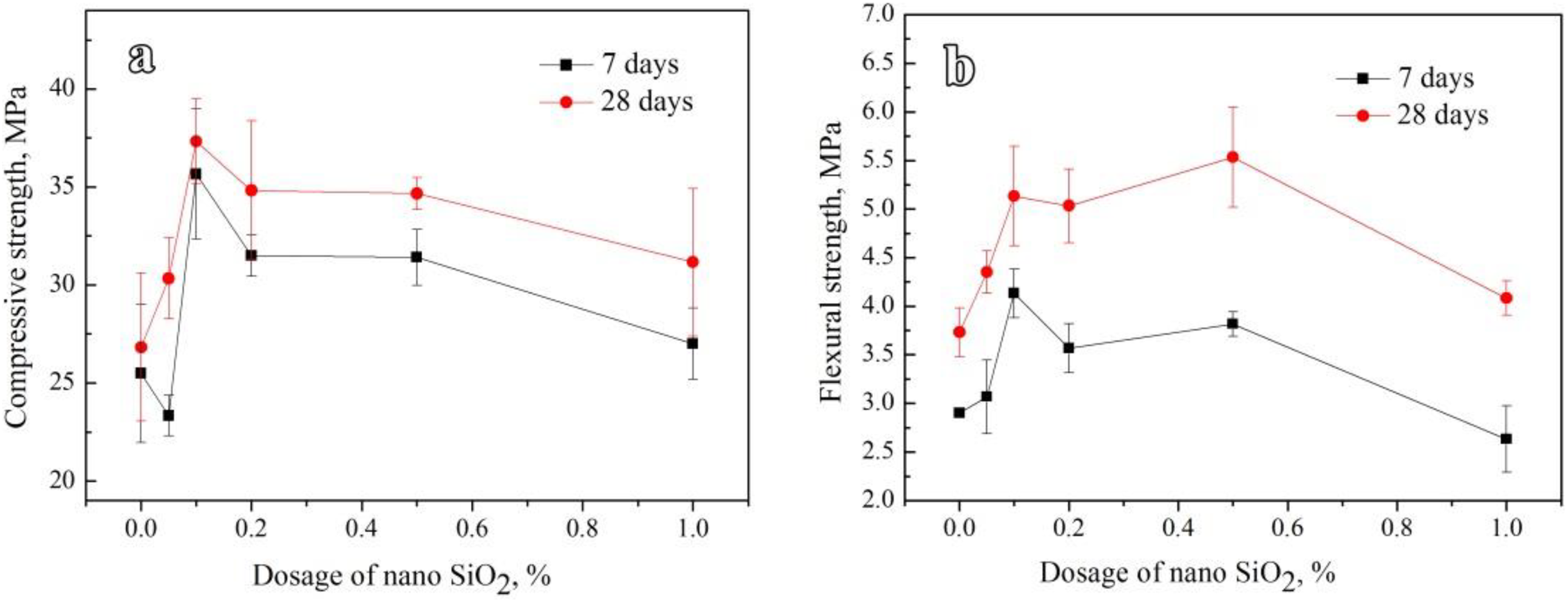
Mechanical properties (7 and 28 days) of prewetting lightweight concrete as a function of dosage of nano SiO2 (a) compressive strength and (b) flexural strength. SiO2: silica.
With increasing dosage of nano-SiO2, the 7 days compressive and flexural strengths at the point of 0.2 and 0.5 wt% show similar variation trends as the non-prewetting samples. The fluctuation occurred in this area as well and finally considerably decreased at the point of 1 wt%. The 7 days compressive and flexural strengths, with the dosage of 0.2 wt%, were 31.5 and 3.6 MPa, which increased both about 24% compared to the control samples, but both decreased about 14% compared to the dosage of 0.1 wt%. With the dosage increased to 0.5 wt%, the 7 days compressive and flexural strengths were both increased again and reached to 31.4 and 3.8 MPa, respectively. As the dosage reached 1 wt%, the 7 days compressive and flexural strengths were reduced to 26.5 and 2.8 MPa, which are approximately the same values as the control samples.
For the prewetting LWAC samples, the 28 days compressive and flexural strengths as a function of the dosage of nano-SiO2 are shown in Figure 3. As demonstrated in Figure 3(a), the average compressive strength of the control sample was about 26.8 MPa, while it has increased to 30.3 and 37.3 MPa with the dosage of nano-SiO2 increased to 0.05 and 0.1%, respectively. Subsequently, with the increasing dosage of nano-SiO2 to 0.2%, the compressive strength has reduced to 34.8 MPa and remained this value when the dosage increased to 0.5%. With increasing the dosage of nano-SiO2 to 1.0%, the compressive strength reduced to 31.2 MPa. Similarly, the flexural strength shows fluctuation with increasing dosage of nano-SiO2 as well. The flexural strength of the control sample was about 3.7 MPa, while after nano modification, the flexural strengths have increased to about 4.4 and 5.1 MPa corresponding to the dosage of 0.05% and 0.1 wt%, respectively and maintained approximately the same value when the dosage reached 0.5 wt%. When the dosage of nano SiO2 reached 1.0%, the flexural strength has reduced to 4.1 MPa.
Figure 4 shows the low and high magnification SEM morphology of fracture surfaces of the interface sections between the aggregates and the cement paste in the LWAC with or without nano modification. It can be seen from this figure, the interface of the sample without nano modification is quite smooth and rare observable fiber shape hydration products can be detected. For the samples with low dosage of nano modification, small size hydration products can be detected, while with the relatively high dosage, however, considerable fiber shape hydration products can be observed in the lightweight aggregate and cement paste interface area. The high magnification SEM image (Figure 4(d)) clearly demonstrates that a large quantity of fiber shape hydration products have grown at this area. This phenomenon is well agreed with previous studies that the addition of nano modification process and modification mechanisms in the previous report. 34,38
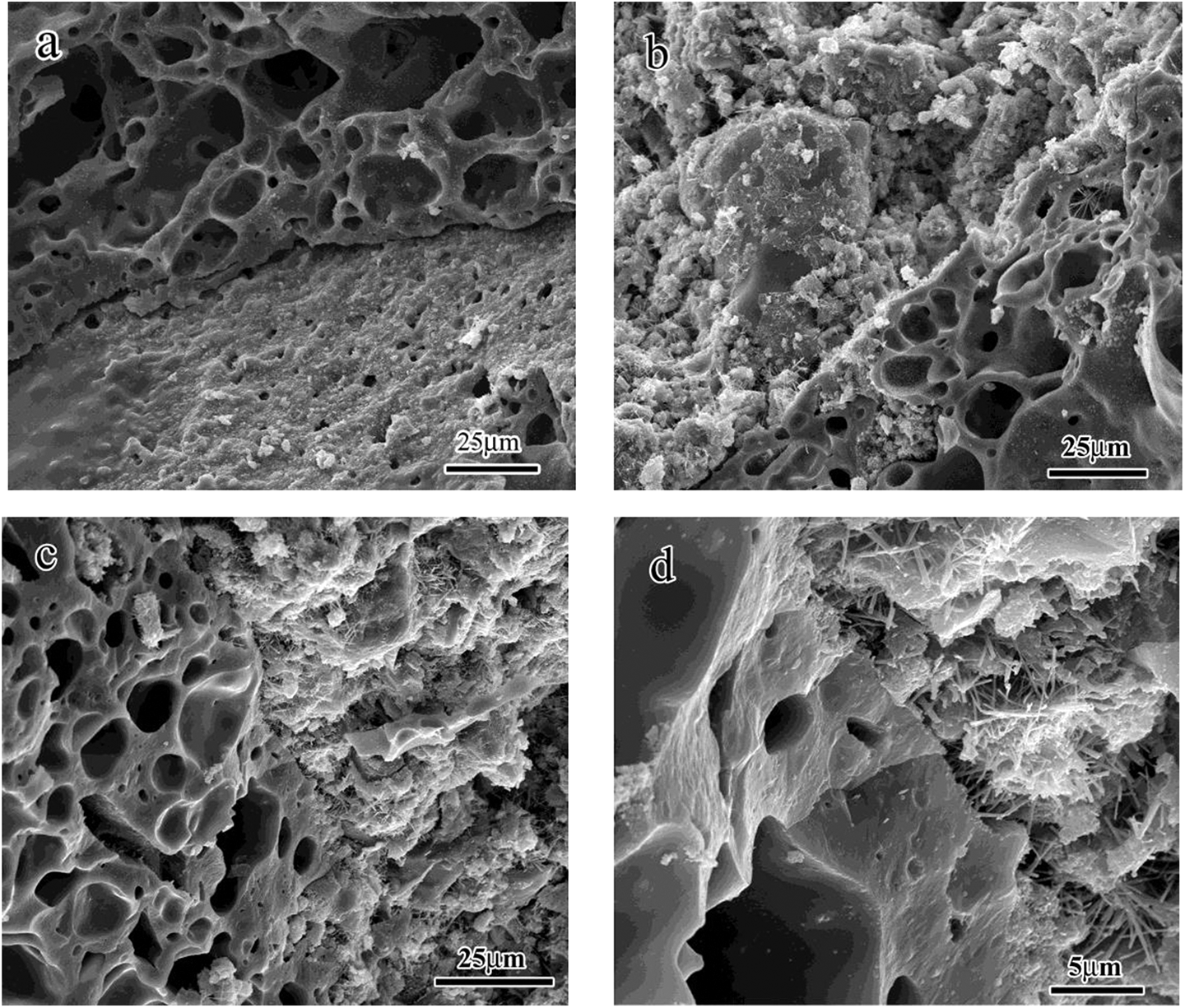
Low and high magnification SEM morphology of fracture surfaces of the interface sections between the aggregates and the cement paste in the LWAC with or without nano modification. (a) without nano modification, (b) with low dosage of nano modification, (c) with relatively high dosage of nano modification, and (d) high magnification image of high dosage of nano modification. SEM: scanning electron microscope; LWAC: lightweight aggregate concrete.
Although several researchers had investigated the microstructure of the hydration products through TEM, 49,50 to the best of our knowledge, very limited studies have shown the chemical composition and crystallography of cement hydration products modified with nanomaterials through TEM analysis. Corresponding to the SEM results, the TEM image of the fiber-shaped hydration product phase in the nano modified cement and its corresponding SAED pattern are shown in Figure 5(a) and (b). As can be seen in Figure 5(a), the diameters of the needle-shaped hydration products range from 50 to 100 nm, and the SAED pattern shows typical amorphous diffraction rings. Figure 5(c) and (d) shows the TEM image and its corresponding SAED pattern of the typical calcium silicate hydrate (C–S–H) phase without nano modification. As can be seen from Figure 5(c) and (d), without nano modification, the C–S–H phase is composed of pores, with the size ranged from several nanometers to tens of nanometers, and amorphous solid phases.

TEM image of (a) fiber-shaped hydration product phase in the nano modified cement and (b) corresponding SAED pattern, and (c) the normal hydration product phase without nano modification and (d) corresponding SAED pattern, and (e) and (f) the EDS results corresponding to (a) and (c). TEM: transmission electron microscope; SAED: selected area electron diffraction; EDS: Energy-dispersive X-ray spectroscopy.
The Energy-dispersive X-ray spectroscopy (EDS) results are shown in Figure 5(e) and (f) corresponding to Figure 5(a) and (c), respectively. It demonstrates that the chemical compositions of the fiber-shaped phase, which belongs to the nano modified specimen, are Si, Ca, and a large amount of Al, while the one without nano modification shows mainly Si and Ca. From the EDS results, it can be claimed that this fiber shape hydration product is different from the ettringite because the ettringite is a crystal with a chemical composition of 3CaO•Al2O3•3CaSO4•32H2O, which means that little Si should be detected and distinctive diffraction spots of the ettringite crystal should be observed in the SAED pattern corresponding to the TEM images. These two conditions were neither satisfied in this TEM results.
Previous studies have assumed that the mechanisms of nano modification on cementitious materials can be divided into three categories. First, the nanoparticles can serve as nuclei to change the microstructure of C–S–H phase, second, they will help to produce denser C–S–H phase, and third, well dispersed nanoparticles can fill the nanosized pores in cement paste, which can block the permeation of aggressive elements. By combining with the mechanical testing results, it can be claimed that the mechanism of the nano SiO2 modification mainly resulted from the in-situ grown hydration products. The fiber-shaped hydration products will act as the reinforcement phase that can bridge the micro cracks in the cement paste (shown in Figure 4), which helps to increase the strengths and the decrease the permeability of aggressive agents in concrete.
Conclusions
This work investigated the effects of low dosage nano SiO2 on the mechanical properties of LWAC materials. It was found that the mechanical properties of LWAC can be considerably enhanced by mixing with low dosage nano- SiO2. Critical points can be observed at the dosage of 0.1 wt%, which means that the modification effect can be reached with only small amount of nano- SiO2. Microstructure analysis suggests that the modification mechanism of the nano- SiO2 on the LWAC consists the formation of new type of fiber-shaped hydration products at the interfaces between the lightweight aggregates and the cement paste, which contributes the local toughening of the LWAC. The EDS result demonstrates that the chemical compositions of the fiber-shaped phase, which belongs to the nano modified specimen, are Si, Ca, and a large amount of Al, while the one without nano modification shows mainly Si and Ca. The dosage of the nano SiO2 higher than a critical point will lead to a reduction of the reinforcement effects.
Footnotes
Declaration of conflicting interests
The author(s) declared no potential conflicts of interest with respect to the research, authorship, and/or publication of this article.
Funding
The author(s) disclosed receipt of the following financial support for the research, authorship, and/or publication of this article: This work was financially supported by the National Natural Science Foundation of China (No. 51772128 and 51761145023), National High Technology Research and Development Program (“863 Program,” 2015AA034701), the Project of Shandong Province Higher Educational Science and Technology Program (J17KA003-A), the Lianyungang Scientific Plan-Joint Project of Industry-Academia-Research (CXY1522).