




Abstract
Elastic modulus is an important mechanical index for the cement-based materials, which has a significant effect on the static and dynamic response of the concrete structure. To investigate the compressive behavior of nano metakaolin cement mortar, the effects of dispersion conditions, water to binder ratios, and mineral admixtures on the compressive strength of nano metakaolin cement mortar were examined. The elastic modulus of nano metakaolin cement mortar under different water to binder ratios and mineral admixtures was obtained. Based on the theory of micromechanics of composite materials, a theoretical model was deduced to calculate elastic modulus of nano metakaolin cement mortar. Based on the experimental results, an influence coefficient was introduced into simplified model to estimate the elastic modulus of nano metakaolin cement mortar. The results demonstrate that the application of ultrasonic dispersion and long-duration dispersion time (no more than 15 min) can effectively improve the compressive strength of nano metakaolin cement mortar. Compressive strength of nano metakaolin cement mortar mixed with ground granulated blast furnace slag, fly ash, and attapulgite clay is 33.38%, 17.65%, and 6.45% higher than that of the ordinary mortar, respectively. Compared with the experimental results, the calculated error of theoretical model is no more than 5%, while the calculated error of the simplified model is no more than 10%.
Introduction
With the development of nanotechnology, nanomaterials have been used in many industries extensively. It has been reported that nanomaterials can improve the mechanical properties, 1 chloride ion impermeability, 2 and frost resistance 3 of cementitious materials. The incorporation of nanomaterials in cementitious materials can promote the hydration degree of cement, while do not generate new hydration products. Nanomaterials with small size effects can fill the internal voids in the cementitious materials, which increase the density of cementitious materials. 4 Nano metakaolin (NMK) has a high volcanic ash activity, which caused widespread concerns in the civil engineering. Elastic modulus of cement-based materials is an important parameter not only for designing concrete structures but also for characterizing the damage state of the concrete. The compressive behavior of nano metakaolin cement mortar (NKCM) is one of the most important indices for its application in the practical civil engineering. Therefore, it is necessary to discover the compressive behavior of NKCM.
In recent years, it has been proved that the incorporation of NMK can improve the flexural and compressive strength of the cement mortar. 4,5 The small dosage of NMK will change the mesostructure of NKCM and it has a great influence on the elastic modulus of specimen. In addition to the experimental and numerical study, it is a hotspot to estimate the elastic modulus from the view of microscopic point. The effective modulus of the composites can be obtained by various methods, such as sparse method, Mori–Tanaka method, self-consistent method, differential method, Reuss–Voigt model, generalized self-consistent method, and so on. 6 –9 Wu et al. 10 considered the cement paste is a three-dimensional microscopic model, and the cement slurry modulus values, the mineral composition of the various materials, and the content of cement paste must be constants to calculate the elastic modulus using this model. Ren et al. 11 studied that based on the Reuss–Voigt model, the elastic modulus model of the random short fiber composite was established, and the elastic modulus, Poisson’s ratio, and size of each constituent material must be known to predict the elastic modulus of specimen. According to the change of composition at each time point, the relationship between the elastic modulus of cement paste and the degree of hydration was derived, and a laminated model of hardened cement slurry was established. 12 Wang and Li 13 used the Mori–Tanaka method to investigate the elastic modulus of wet concrete by microstructure. To estimate the elastic modulus of composite materials, the above methods require the multiple parameters such as elastic modulus of each part of composite material, Poisson’s ratio, and so on. The calculation equation is more complex and difficult to apply in practical engineering. Studies have been reported that the elastic modulus of cement-based material can be estimated by the compressive strength. 14,15 Comparing with the traditional composites, the mechanical properties of nanocomposites must consider not only for the content, properties, and distributions of admixtures but also for the surface effect. Until now, few researches are devoted to focusing on the elastic modulus of NKCM.
The objective of this article is to investigate the compressive behavior of NKCM. The effects of dispersion conditions, water to binder ratios, and mineral admixtures on the compressive strength of NKCM are analyzed. The porosity and elastic modulus of NKCM under different water to binder ratios and mineral admixtures are discussed. The total pore area and microstructure of NKCM are evaluated through mercury intrusion porosimetry (MIP) and scanning electron microscopy (SEM) methods. Based on the theory of micromechanics of composite materials, a theoretical model is established to calculate the elastic modulus of NKCM. Based on the experimental results, an influence coefficient is introduced into simplified model to estimate the elastic modulus of NKCM.
Materials and methods
Materials
Ordinary Portland cement of type 42.5 R and the NMK were used in this study. The technology indices of NMK are listed in Table 1, and the morphology of NMK obtained by SEM and transmission electron microscope (TEM) is shown in Figure 1. Ground granulated blast furnace slag (GGBS) is S95 grade produced by Dalian Jinqiao ultra-fine powder company. Dalian Huaneng Power Plant I grade fly ash (FA) was used (the density is 2548 kg m−3). The calcination temperature of attapulgite clay (ATT) is 650°C. The ISO standard sand was used. The chemical compositions of cement, NMK, GGBS, and ATT are listed in Table 2.
Technology indices of NMK.

NMK: nano metakaolin.
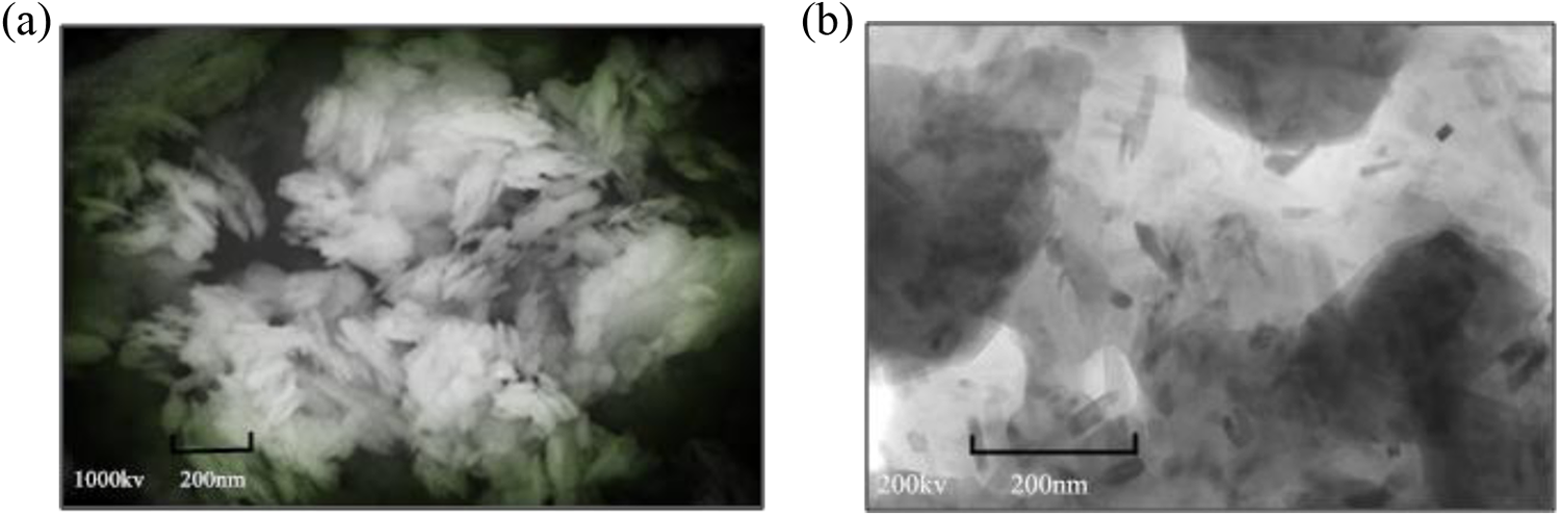
SEM and TEM micrograph of NMK. (a) SEM micrograph. (b) TEM micrograph. NMK: nano metakaolin; SEM: scanning electron microscopy; TEM: transmission electron microscope.
Chemical compositions of cementing material.

NMK: nano metakaolin; GGBS: ground granulated blast furnace slag; FA: fly ash; ATT: attapulgite clay.
Specimen fabrication
To achieve a well disperse of NMK in cement mortar, 15 prism specimens with the dimension of 40 × 40 × 160 mm3 were prepared to test compressive strength of NKCM at the age of 3, 14, and 28 days. At the same time, five prism specimens with the dimension of 40 × 40 × 160 mm3 were prepared to test total pore area of NKCM at the age of 28 days. The water to binder ratio of 0.5 was used in all mixes and 3% of cement was replaced by NMK. The mass ratio of water, cement, standard sand, and NMK is 1:1.94:6:0.06. The samples were divided into five groups, which noted as F1, F2, F3, F4, and F5 (shown in Table 3; F1 is the ordinary specimen).
Disperse condition of NMK cement paste.

NMK: nano metakaolin.
To study the effects of water to binder ratios and mineral admixtures on the compressive strength, porosity, and microstructure of NKCM, 48 cement mortar specimens with the dimension of 40 × 40 × 160 mm3 were cast. Mix proportions of NKCM are listed in Table 4, and the NMK was dispersed in the water by ultrasonic vibration of 10 min.
Mix proportions of NKCM.

NKCM: nano metakaolin cement mortar; NMK: nano metakaolin; GGBS: ground granulated blast furnace slag; FA: fly ash; ATT: attapulgite clay.
The fabricated specimens were demolded after 24 h and then cured in the standard condition (the temperature is 20°C ± 3°C and the relative humidity is 95%) until the prescribed periods.
Methods
Compressive test
To test the compressive strength of NKCM at the age of 3, 14, and 28 days, compressive tests were complied with the current Chinese standard (JTGE-30.2005). 16
MIP
MIP test is the popular method to examine the porosity characteristics of cement-based material. The total pore area of the NKCM was measured by IV 9500 high-performance automatic mercury porosimeter.
Evaporation of water content test
The porosity is obtained indirectly by the water loss of the saturated specimen under specific conditions. The evaporation of water content method was used to evaluate the porosity of NKCM at the age of 28 days. 17 The porosity of p is calculated by

where m is the mass of the saturated specimen, g; v is the volume of the saturated specimen, ml; and m 1 is the mass of the dried specimen, g, and the drying temperature is 105°.
SEM
SEM is an effective method to offer useful information about the microstructure of material. The cross section (the specimens of B0 and B0.5) was examined by a JSM-6360LV SEM system at the age of 28 days.
Results and discussions
NKCM under different dispersion conditions
Compressive strength
The compressive strength of NKCM with different dispersion methods and dispersion time is shown in Figure 2. It can be seen that the incorporation of NMK cannot improve the compressive strength of cement mortar at the age of 3 days. The increase in compressive strength at the age of 14 and 28 days induced by the dispersion conditions was in the order of U-15 > U-10 > M-10 > U-5. Compared with the ordinary mortar, the compressive strength of NKCM at 28 days was increased by 7.76% and 10.81%, respectively, when the mechanical dispersion and ultrasonic dispersion were used for 10 min. The compressive strength of NKCM with U-10 and U-15 is 4.06% and 7.46% larger than those with U-5, respectively. Therefore, it can be seen that the distribution of NMK in cement mortar with U-10 and U-15 has high homogeneity.

The relationship between compressive strength and curing age.
Total pore area
Total pore area of the specimens under different dispersion methods and dispersion time was obtained by the MIP, as shown in Table 5. It is obvious that the single NMK particles can increase the total pore area of the specimen more than the NMK agglomerates when the total amount of NMK is same. That is to say the dispersion of NMK in cement mortar improves with the increase of total pore area. The effect of the dispersion conditions on the total pore area of the cement mortar was in the order of U-15 > U-10 > M-10 > U-5. Therefore, the ultrasonic dispersion method can improve the dispersibility of NMK in cement mortar more than mechanical dispersion, and the dispersion of NMK in cement mortar improves with the increase of ultrasonic dispersion time.
Total specific pore volumes and most probable diameters of specimen.

Relation between total pore area and compressive strength
The relationship between total pore area and compressive strength of the NKCM under different dispersion conditions is shown in Figure 3. It can be seen that a linear relation exists between total pore area and the compressive strength of NKCM.

Relation between total pore area and compressive strength.
NKCM under different mineral admixtures
Compressive strength and porosity
The compressive strength, porosity of NKCM with different water to binder ratios, and mineral admixtures are given in Table 6. It can be found that the compressive strength of NKCM is the largest when the water to binder ratio is 0.5, and the compressive strength is 7.69% higher than that of the water to binder ratio is 0.4. Mineral admixtures to enhance the compressive strength of NKCM were in the order of GGBS > FA > ATT. The compressive strength of NKCM mixed with GGBS, FA, and ATT was 33.38%, 17.65%, and 6.45% higher than that of the ordinary mortar, respectively. The porosity of NKCM is the smallest when the water to binder ratio is 0.5, and its porosity is 18.92% lower than that of water to binder ratio is 0.4. Mineral admixtures to improve the porosity of NKCM were in the order of GGBS > FA > ATT.
Experimental results of compressive strength and porosity.

GGBS: ground granulated blast furnace slag; FA: fly ash; ATT: attapulgite clay.
Relation between compressive strength and porosity
The relation between compressive strength and porosity of NKCM is shown in Figure 4. It can be drawn that the compressive strength linearly decreases with the increase of porosity.
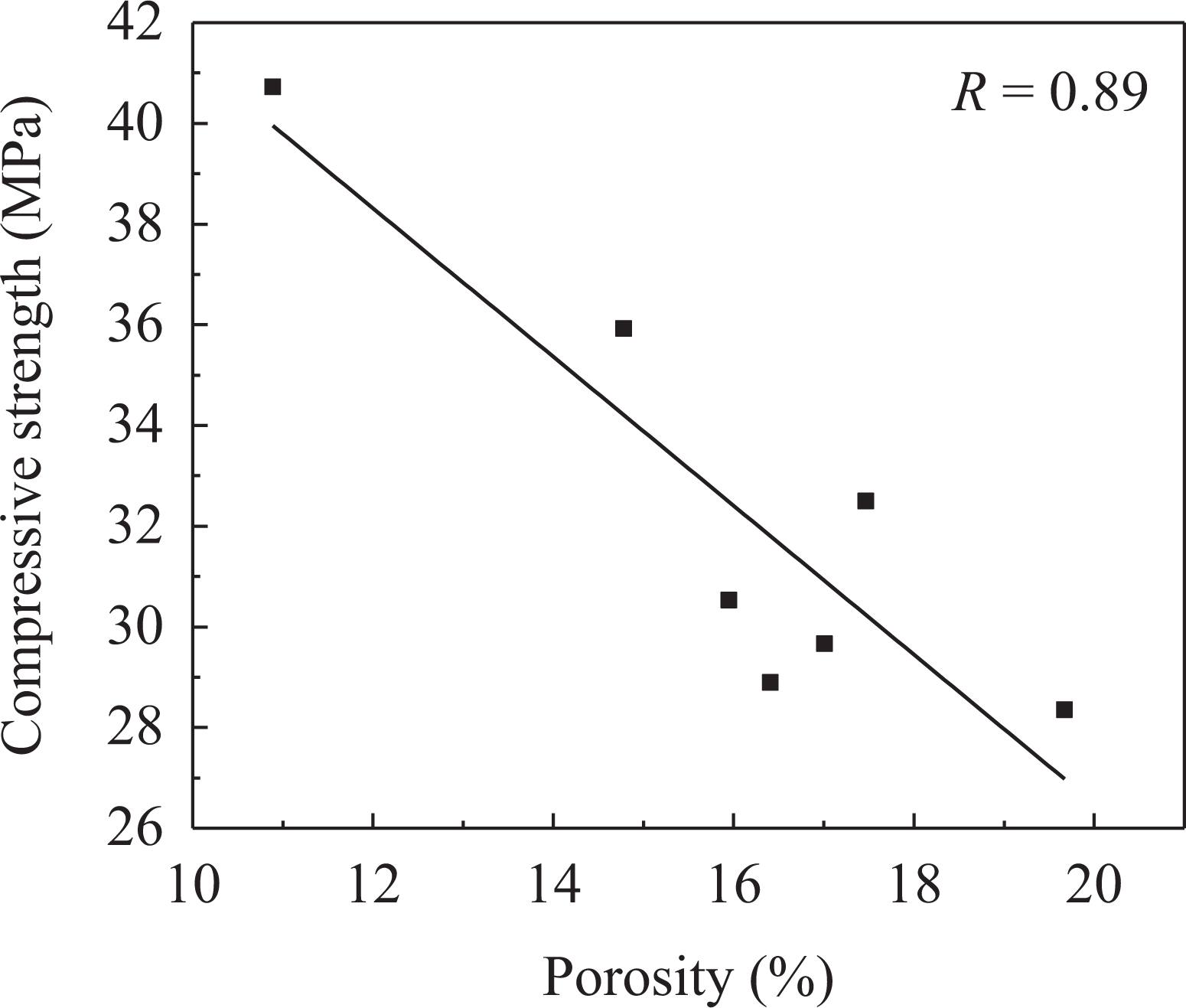
Relation between compressive strength and porosity.
The elastic modulus of NKCM
Experimental result
The deformation modulus and the original elastic modulus of cement mortar are approximately equal to each other when the cement mortar stress is less than half of the compressive strength. 18 The relationship between secant modulus and original elastic modulus can be expressed as

where Eg is the secant modulus, MPa; vc is the elastic characteristic coefficient whose value is 0.85 based on CEB-FIP Mode Code; and Ey is the original elastic modulus, MPa.
The elastic modulus of cement mortar under different water to binder ratios and mineral admixtures is obtained from the stress–strain curve (Figure 5), as shown in Figure 6. The elastic modulus of ordinary cement mortar decreases with the increase of water to binder ratio. The elastic modulus of NKCM is the smallest when the water to binder ratio is 0.4, because the actual water to binder ratio of NKCM decreases for the small size of NMK. The hydration reaction of cement is affected for the limitation of moisture, so the elastic modulus of NKCM is lower. The mineral admixture to increase the elastic modulus of NKCM is in the order of GGBS > ATT> FA.

The stress–strain curve of NKCM. NKCM: nano metakaolin cement mortar.

The elastic modulus of cement mortar.
A theoretical model
The NKCM is regarded as two-phase composite material of NKCM mixed with voids. The NMK has the filling effect on mortar pores due to the small size effect, which can improve the macroscopic properties of NKCM. The microstructure of B0 and B0.5 is shown in Figure 7. It can be seen that the calcium silicate hydrate (C–S–H) gel of ordinary mortar mainly exists in the form of needle or fiber, and its structure is looser. The C–S–H gel of NKCM is granulated and piled up, and its structure is denser.

SEM micrograph of NKCM. (a) B0. (b) B0.5. NKCM: nano metakaolin cement mortar; SEM: scanning electron microscopy.
To build up the theoretical model for calculating the elastic modulus of NKCM, the following basic assumptions are proposed in advance:
1) Assuming that NKCM is a kind of isotropic material. The relationship between the bulk modulus, shear modulus, compressive elastic modulus, and Poisson’s ratio is expressed as

2) Since the internal structure of NKCM is more compact than ordinary mortar, the voids in the NKCM are considered as the needle-shaped.
According to the micromechanics of composite materials, the relationship between two independent elastic constants of macroscopic isotropic materials can be expressed as follows 19

where k 0 and k are the bulk modulus of the matrix and the composite material, respectively; u 0 and u are the shear modulus of the matrix material and the composite material, respectively; and c 0 and c 1 are the void content of the matrix material and the composite material, respectively, which are available from the porosity of experimental results. The p and q values are constants. It is reported that the two constants can be calculated by the following equation 20

where v 0 is Poisson’s ratio of NKCM, which is 0.3. From equations (3) to (5), it can be derived


where E 0 is the compressive elastic modulus of ordinary cement mortar, MPa, and E is the compressive elastic modulus of NKCM under different water to binder ratios and mineral admixtures, MPa.
Corrected by the elastic modulus of ordinary mortar, the elastic modulus of NKCM under different water to binder ratios and mineral admixtures can be expressed as

A simplified model
Based on many experimental results in the practical engineering, an empirical equation of the elastic modulus has been obtained by statistical analysis. 21 To estimate the elastic modulus of NKCM, an influence coefficient is introduced into simplified model, and its expression is as follows

where Ec is the elastic modulus of NKCM, MPa; fcu, k is the compressive strength of NKCM, MPa; and a is influence coefficient, whose value is 0.46 based on the experimental.
Comparison of the two elastic modulus models with the experimental results
The experimental results are obtained by the stress–strain curve. The calculation results of elasticity modulus are obtained by equations (8) and (9). The relationship between the calculated results and the experimental results of elastic modulus is shown in Table 7. It is obvious that the calculated error of theoretical model is less than 5% and the calculated error of the simplify model is less than 10% in comparison with the experimental results. On one hand, the calculated error of the simplify model is bigger than that of theoretical model; on the other hand, the calculation equation of simplify model is simple and it is convenient to apply in practical engineering.
The relationship between calculation results and experimental data of elasticity modulus.

Note: Error = ( | experimental results−calculated results/experimental results) × 100%.
GGBS: ground granulated blast furnace slag; FA: fly ash; ATT: attapulgite clay.
Conclusions
The effects of dispersion method, dispersion time, water to binder ratio, and mineral admixture on the compressive strength of NKCM were analyzed. The elastic modulus of NKCM under different water to binder ratios and mineral admixtures was discussed. The following conclusions can be drawn: The dispersion of NMK in cement mortar can be improved using ultrasonic dispersion and prolonging the dispersion time (no more than 15 min). The compressive strength of NKCM mixed with GGBS, FA, and ATT is 33.38%, 17.65%, and 6.45% higher than that of the ordinary mortar, respectively. Based on the theory of micromechanics of composite materials, a theoretical model is deduced. Based on the experimental results, an influence coefficient is introduced into simplified model. Compared with the experimental results, the calculated error of theoretical model is no more than 5% and the calculated error of simplified model is no more than 10%.
Footnotes
Declaration of conflicting interests
The author(s) declared no potential conflicts of interest with respect to the research, authorship, and/or publication of this article.
Funding
The author(s) disclosed receipt of the following financial support for the research, authorship, and/or publication of this article: This research was supported by the National Natural Science Foundation of China (grant no 51578099).