




Abstract
Nanometer-silicon dioxide encapsulated in lithium grease is prepared, and the frictional behavior of the lithium grease and nanometer-silicon dioxide–contained lithium grease is compared with respect to the additive content, load, and frictional temperature in this article. The structure and morphology of nanometer-silicon dioxide is characterized by X-ray diffraction and scanning electron microscopy, respectively. Friction and wear tests were conducted on a four-ball friction and wear tester. The morphology of worn steel surface is analyzed by scanning electron microscopy and three-dimensional surface profiler. Results show that the addition of nanometer-silicon dioxide in grease can markedly improve the friction-reducing performance and anti-wear ability of base grease. When the nanometer-silicon dioxide in grease is 0.3 wt%, the friction coefficient and wear scar diameter decrease by 26% and 7% compared with base grease, respectively. The nanometer-silicon dioxide (0.3 wt%)–contained grease exhibits the lowest average friction coefficient at the load of 342 N, which decreases by 39% as compared with that of base grease. The worn surface is quite smooth with few shallow furrows and the wear scar diameter decreases under the lubrication of the grease containing 0.3 wt% nanometer-silicon dioxide. Moreover, it was found that the nanometer-silicon dioxide have been incorporated into the surface protective and lubricious layer by energy dispersive spectrometer analysis.
Introduction
The problem of improving machine efficiency and performance, which reflects on the quality of products, is closely linked to the development and introduction of high-efficiency lubricants. 1 –5 Lubricating greases are used in many types of machinery. Therefore, nanomaterials such as carbon nanotubes, grapheme, and metallic oxide were added into the lubricating oil or grease to improve its extreme pressure, anti-wear, and friction reduction properties. 6 –12
Development in the field of nanotechnology has led to the growth of nanoparticles as lubricant additives. 13 –15 Nanomaterials have attracted great attention in various research fields because of their unique physical and chemical properties. Nano additives can play a significant role in lubricating grease. For instance, the addition of nanoparticles in lubricating grease could reduce the interfacial friction and improve the load-bearing capacity of the parts. 16 –18 These primarily include enhancing the existing desirable properties and imparting new mechanical, physical, and chemical properties. Performance of lubricants was shown to be strongly dependent on their behavior under nanoscale confinement, including stiffness, melting point, surface energy, and viscosity, all of which can be different in ultrathin shearing film in tribological applications. 19 –22 Thus, they have been regarded of great potential as lubricant additives.
In this article, the tribological behavior of lithium-based greases with nanometer-silicon dioxide (nano-SiO2) was studied. And the frictional and lubricate properties of lithium grease containing nano-SiO2 were investigated through friction and wear test. The influence of temperature on tribological performance of base grease and additives-contained grease was carried out with a high temperature reciprocating friction and wear tester. The friction coefficient (COF), wear scar diameter (WSD), and worn morphology were analyzed in detail. We hope that our researches could make a reference in the utilization of the grease additives and in the application of this grease on large-scale production in the future.
Experiment details
Materials
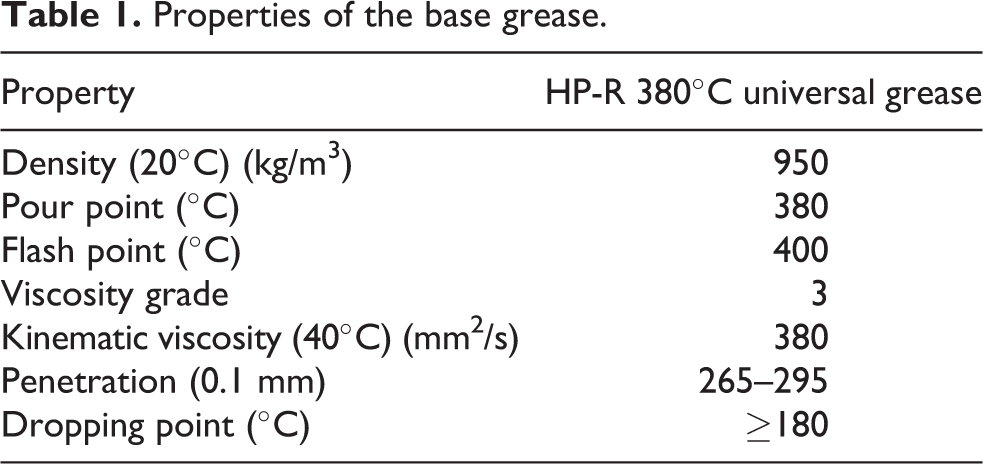
HP-R 380 °C universal grease (Royal Mfg. Co., Tulsa, USA) was used as base grease in friction tests. Table 1 records the typical characteristics of base grease. This value was measured according to the GB/T 7324-1994 standard. Nano-SiO2 is purchased from manufacturer and used without further purification. Figure 1 presents the grain size distribution curve and the X-ray diffraction (XRD) pattern of nano-SiO2. The grain size of 90% nano-SiO2 was no more than 100 nm, which was measured by laser particle size analyzer. The characteristic peaks and troughs in XRD spectra are not obvious, indicating that the nano-SiO2 was amorphous. Figure 2 shows the scanning electron microscopy (SEM) image of nano-SiO2, and the typical character of the nanoparticles is good dispersion and distribution uniformity.
Properties of the base grease.

The grain size distribution curve and XRD pattern of nano-SiO2. XRD: X-ray diffraction; nano-SiO2: nanometer-silicon dioxide.
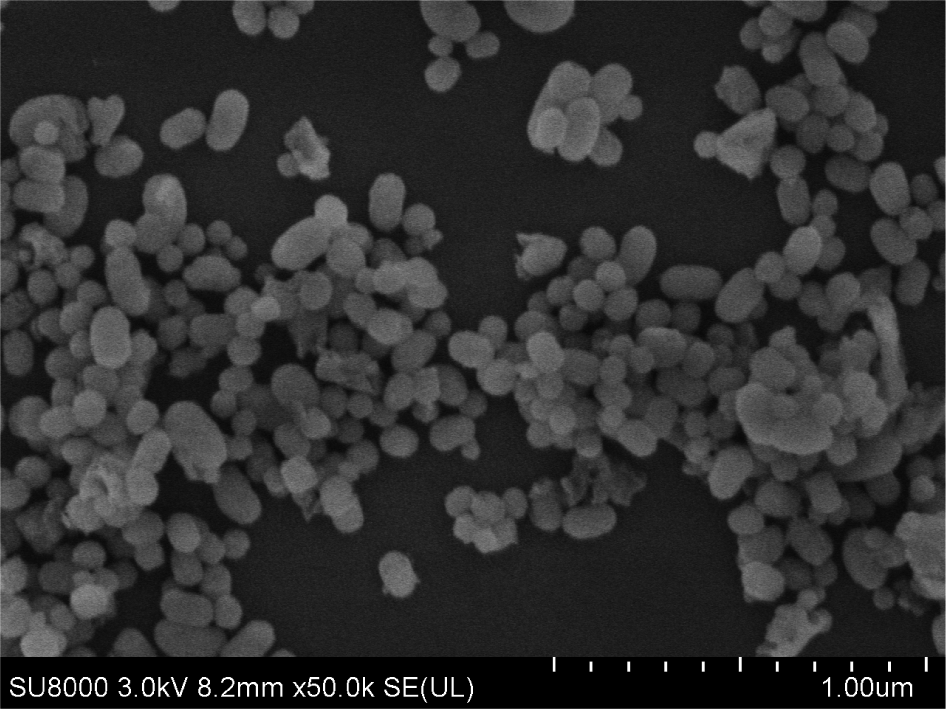
SEM image of nano-SiO2. SEM: scanning electron microscopy; nano-SiO2: nanometer-silicon dioxide.
Preparation of the modified greases
According to previous researches, different additive contents contained greases were prepared. Briefly, the base grease and 0.1, 0.3, 0.5, 0.7, and 0.9 wt% nano-SiO2-contained greases were prepared and marked as M0–M5, respectively.
The nano-SiO2-contained greases (see Fig. 2S) were synthesized following the procedures below. First, all the experiment appliances were cleansed by alcohol solvent. Second, the base grease (50 g) and corresponding nano-SiO2 additives were poured into the reaction vessel with evenly agitating. In order to ensure that base grease was blended homogenously with the nano-SiO2 additives, the mixture was scattered in ultrasonic dispersion instrument for 15 min and vibrated in ultrasonic cleaning machine for 10 min. Finally, the greases were obtained after refined grinding three times and homogenization periods by a three-roller mill. Additionally, the thermal behaviors of nano-SiO2, base grease, and nano-SiO2-contained greases were measured by thermogravimetric analyzer.
Tribological tests
Friction and wear tests (Fig. 1S) were conducted on a four-ball friction tester (Zhongke Kaihua Technology Development Co., Ltd, Lanzhou, China). The COF was evaluated automatically by a computer connected to the tester which monitored the change of friction force dynamically and in real time. The mean COF is calculated and obtained from the ratio of the sum of COF value to the total number of data collected. Throughout the test, the upper ball (GCr15 steel, diameter 12.7 mm, hardness 59–61 HRC) was pressed down to contact the lower fixed three balls (GCr15 steel, diameter 12.7 mm, hardness 59–61 HRC). According to Chinese National Standard GB/T 3142-82, all the experiments were operated with load of 392 N, rotational speed of 1200 r/min, and a period of 60 min. Before and after every friction test, all the balls were cleansed in petroleum ether for 10 min utilizing an ultrasonic cleaner. The WSD and worn surface on the one of bottom balls were measured by optical microscope and SEM (SHIMADZU, SSX-550, Japan), respectively. Moreover, the worn surface was analyzed by NANOVEA three-dimensional profilometer (NANOVEA ST400, Irvine, CA, USA). Every experiment was repeated three times and the standard deviation which was determined from three experiments was found to be less than 1.0%.
Results and discussion
Tribological characteristics of the greases
The tribological characteristics of greases with additives were analyzed by three aspects including additive content, load, and temperature.
Influence of additive content
Figure 3(a) demonstrates the variation of the COF for the greases at different additive contents with test time. Original COF data were fitted by sine function. As shown in the figure, the COFs of all nano-SiO2 additive–contained greases are lower than that of base grease, indicating that nano-SiO2 can improve the friction reduction ability of base grease. The COF curves for M0–M5 grow over time and the values of COF stabilize at the end of experiments. The mean COF and WSD of grease with different contents of nano-SiO2 are presented in Figure 3(b). Results illustrated that the average COF and WSD of all nano-SiO2-contained greases are lower than those of base grease, indicating that nano-SiO2 can effectively improve the friction reduction and anti-wear properties of base grease. With increasing addition of nano-SiO2 into base grease, the mean COF decreases dramatically at first and then increases when the additive content is more than 0.3 wt%. The mean COF reaches a minimum value of 0.096 at a nano-SiO2 content of 0.3 wt%, which decreased by 26% as compared with the value (0.130) of base grease. The trend of variation in WSD is similar to that of average COF. The WSDs of nano-SiO2-contained greases reduce from 1.09 to 1.01 mm as the nano-SiO2 contents increase from 0 to 0.3 wt%. The main reason for the decrease of COF is the Si–O bond in nano-SiO2 possessed of large activity. 23 This kind of Si–O bond is easy to form oil film on the worn surface, and this film contributes to improved friction-reducing performance. Moreover, nanoparticles also have rolling effect, which means nanoparticles would roll instead of slide between the contact interfaces. 24 When the nano-SiO2 content is more than 0.3 wt%, the COF and WSD rise significantly. Excessive adding of additives can lead to the increase of grease viscosity and incomplete dispersion of nanoparticles in base grease. The growth in COF can be attributed to the influence of agglomerated nanoparticles to the movement of balls during the frictional process. Therefore, excessive addition of nanoparticles cannot improve the friction reduction ability of base grease and thus proper adding proportion of additive should be studied.

(a) The variation of the COF for the greases at different additive contents with test time (fitted by sine function) and (b) mean COF and WSD of the greases at different additive contents (mean COF: the ratio of the sum of COF value to the total number of data collected). COF: friction coefficient; WSD: wear scar diameter.
Influence of load
Figure 4 presents the average COF and WSD of base grease and modified grease with 0.3 wt% nano-SiO2 at multiple loads. The results illustrated that the average COFs of all nano-SiO2-contained greases are much lower than that of base grease at multiple loads. The nano-SiO2-contained grease exhibits the lowest average COF at the load of 342 N, which decreased by 39% as compared with the values of base grease. And the WSDs with approximately 0.92–1.01 mm of all nano-SiO2 greases are smaller than those of base grease and increase as the load growing, indicating that the nano-SiO2 particles are capable of performing better friction-reducing performance and anti-wear capacity than base grease at all loads.

Average (a) COFs and (b) WSDs at 292, 342, and 392 N for the greases at 75°C. COF: friction coefficient; WSD: wear scar diameter.
Influence of temperature
The influence of temperature (25°C, 50°C, 100°C, and 150°C) on tribological performance of base grease and nano-SiO2-contained grease was carried out with a high temperature reciprocating friction and wear tester. According to previous results, grease with 0.3 wt% nano-SiO2 was selected as experimental object compared with base grease, owing to its excellent tribological performance. Figure 5 shows the thermal behaviors of grease and nano-SiO2. It can be found that the heat loss of base grease (Figure 5(a)) and 0.3 wt% SiO2 (Figure 5(b)) added greases starts at 260°C and 280°C, respectively. The further thermal degradation of base grease and 0.3 wt% SiO2 added grease leads to no residue at high temperatures. Therefore, the grease is stable and plays a role in lubrication when the temperature is below 260°C. As shown in Figure 5(c), the decomposition process between 0°C and 150°C with 6% weight loss, which is mainly attributed to the release of inert gas (H2O) during the thermal decomposition of nano-SiO2. Tables 2 and 3 demonstrate the variation of the average COFs and wear widths of base grease and 0.3 wt% nano-SiO2-contained grease with increasing test temperature. It can be seen from Tables 2 and 3 that base grease and grease with 0.3 wt% nano-SiO2 both possess the lowest average COF and wear width at 50°C. Base grease and 0.3 wt% nano-SiO2-contained grease show good thermal stability and the curve of average COF varies slightly as increasing temperature. However, temperature has an obvious effect on the value of wear width. As for the grease with 0.3 wt% nano-SiO2, wear width on the worn surface grows significantly from 0.22 to 0.39 mm as temperature increasing from 50°C to 150°C. The variation of wear width of base grease is similar to that of 0.3 wt% nano-SiO2-contained grease. Moreover, the average COF and wear width of 0.3 wt% nano-SiO2-contained grease decrease by 16% and 12% as compared with the values of base grease at 50°C, respectively. All these results demonstrate that nano-SiO2 can markedly improve the friction reduction and anti-wear properties of base grease, and the best performance details can be obtained at 50°C.

The thermal behaviors of (a) base grease, (b) 0.3 wt% SiO2 added greases, and (c) nano-SiO2. Nano-SiO2: nanometer-silicon dioxide.
Average COFs for the greases at different additive contents.

COF: friction coefficient; nano-SiO2: nanometer-silicon dioxide.
Wear widths for the greases at different additive contents.

Analysis of worn surface
SEM micrograph and three-dimensional image can provide information about morphology of worn surface. Figure 6 presents the SEM micrographs and three-dimensional morphologies of worn surfaces lubricated by different grease samples. It can be seen that the worn steel surface lubricated by base grease alone is quite rough and shows wide and deep furrows as well as grooves along the sliding direction. Contrary to the above, the worn steel surface lubricated by grease containing 0.3 wt% nano-SiO2 nanoparticles is smooth and shows few furrows and grooves, which well corresponds to the good anti-wear ability of the nano-SiO2 nanoparticles. It can be seen that the nano-SiO2 nanoparticles form film on the friction surface, and this film contributes to improved friction-reducing performance. When the additive content is more than 0.3 wt%, there are some plastic deformations and deep furrows on the worn surface and this kind of surface has the characteristic of abrasive wear. Obviously, the diameter and height of wear scar are smaller than those of base grease when nano-SiO2 is added into lithium grease. The worn surface is quite smooth with few shallow furrows, and the WSD decreased under the lubrication of the grease containing 0.3 wt% nano-SiO2. In contrast, severe wear appears with increasing addition of nano-SiO2 into base grease. There are some plastic deformations and deep furrows on the worn surface and this kind of surface has the characteristic of abrasive wear, which might be caused by the agglomeration of additives. Figure 7 demonstrates the maximum height and average height of grinding marks. It can be seen from Figure 7 that both the maximum height and average height of grinding mark decrease dramatically and reach a minimum value as the additive contents increase from 0 to 0.3 wt%, which decreased by 30% and 28% as compared with the value of base grease, respectively. Then, the maximum height and average height increase when the additive content is more than 0.3 wt%. All these results demonstrate that nano-SiO2 can markedly improve the anti-wear ability of base grease. Therefore, it can be deduced that nano-SiO2 is conducive to enhance the tribological ability of lithium grease.

SEM micrographs and three-dimensional morphologies of worn surfaces lubricated with different grease samples: M0: base grease; M1: grease containing 0.1 wt% SiO2; M2: grease containing 0.3 wt% SiO2; M3: grease containing 0.5 wt% SiO2; M4: grease containing 0.7 wt% SiO2, and M5: grease containing 0.9 wt% SiO2. SEM: scanning electron microscopy; SiO2: silicon dioxide.

Maximum height and average height of grinding marks of the greases at different additive contents.
Anti-wear mechanism of nano-SiO2 as lubricate additive
Figure 8 shows the energy dispersive spectrometer (EDS) of the worn steel surfaces lubricated by 0.3 wt% nano-SiO2-contained grease (four-ball tester; load: 392 N; rotational speed: 1200 r/min; time: 60 min; temperature: 75°C). It can be seen that, under the lubrication of the nano-SiO2-contained grease, silicon and oxygen element are detected by EDS on the worn steel surface. This implies that the inorganic compound SiO2 has been incorporated into the surface protective and lubricious layer through adsorption or deposition, thereby leading to reduce the friction and wear of tribo-pairs. The iron, manganese, and chromium elements detected by EDS are assigned to the GCr15 steel substrate. Additionally, the EDS data of the worn steel surface lubricated by base grease and 0.3 wt% nano-SiO2-contained greases are shown in Table 4. The element composition well fits to the EDS analysis abovementioned.

EDS spectra of the worn steel surfaces lubricated by 0.3 wt% nano-SiO2-contained grease (applied voltage: 30 kV). EDS: energy dispersive spectrometer; nano-SiO2: nanometer-silicon dioxide.
EDS data of the worn steel surfaces lubricated by base grease and 0.3 wt% SiO2-contained greases (applied voltage: 30 kV).

EDS: energy dispersive spectrometer; SiO2: silicon dioxide.
It is generally known that nanoparticles as the ultrafine particles possess many advantages, such as surface effects, quantum size effect, and so on. Therefore, the nanoparticles are so small that they can easily adsorb or deposit on the blemish surface. When the nano-SiO2 is added into the lithium grease, they can be easily transferred into the metallic surface and even the worn area of tribo-pairs during the frictional process. Under the mixed or boundary lubricating conditions, the SiO2 additives could share some of compressive stress and thus form a self-laminating protective film in solid state to micro-polish and self-mend the friction surface. 25 Therefore, the nano-SiO2 improves the friction-reducing performance and anti-wear ability of base grease significantly.
Conclusions
A comparative investigation on the tribological behavior of lithium grease at different additive contents was carried out in this work. Nano-SiO2 could markedly improve the friction-reducing performance and anti-wear ability of base grease. When the additives content is 0.3 wt%, the nanoparticles-contained grease exhibits the lowest COF and WSD. The nano-SiO2 grease exhibits the lowest average COF at the load of 342 N, which decreases by 39% as compared with the values of base grease. Temperature has a great influence on the tribological properties of grease. Base grease and grease with 0.3 wt% nano-SiO2 both possess the lowest average COF and wear width at 50°C. Moreover, EDS analysis demonstrates the nano-SiO2 has been incorporated into the surface protective and lubricious layer and thus leading to reduce the friction and wear of tribo-pairs.
Footnotes
Declaration of conflicting interests
The author(s) declared no potential conflicts of interest with respect to the research, authorship, and/or publication of this article.
Funding
The author(s) disclosed receipt of the following financial support for the research, authorship, and/or publication of this article: This research project was supported by the National Natural Science Foundation of China (51105002), the National Science and Technology Major Project (2012ZX04005-021), the Natural Science Foundation of the Henan Province (152102210196), and the Foundation of the Henan Educational Committee (16A460001).
Supplementary material
Supplementary material for this article is available online
References
Supplementary Material
Please find the following supplemental material available below.
For Open Access articles published under a Creative Commons License, all supplemental material carries the same license as the article it is associated with.
For non-Open Access articles published, all supplemental material carries a non-exclusive license, and permission requests for re-use of supplemental material or any part of supplemental material shall be sent directly to the copyright owner as specified in the copyright notice associated with the article.
