



Abstract
In this article, electromechanical buckling behavior of size-dependent flexoelectric/piezoelectric nanobeams is investigated based on nonlocal and surface elasticity theories. Flexoelectricity represents the coupling between the strain gradients and electrical polarizations. Flexoelectric/piezoelectric nanostructures can tolerate higher buckling loads compared with conventional piezoelectric ones, especially at lower thicknesses. Nonlocal elasticity theory of Eringen is applied for analyzing flexoelectric/piezoelectric nanobeams for the first time. The flexoelectric/piezoelectric nanobeams are assumed to be in contact with a two-parameter elastic foundation which consists of infinite linear springs and a shear layer. The residual surface stresses which are usually neglected in modeling of flexoelectric nanobeams are incorporated into nonlocal elasticity to provide better understanding of the physics of the problem. Applying an analytical method which satisfies various boundary conditions, the governing equations obtained from Hamilton’s principle are solved. The reliability of the present approach is verified by comparing the obtained results with those provided in literature. Finally, the influences of nonlocal parameter, surface effects plate geometrical parameters, elastic foundation, and boundary conditions on the buckling characteristics of the flexoelectric/piezoelectric nanobeams are explored in detail.
Keywords
Introduction
In recent decades, prominent developments of nanoelectromechanical systems are carried out by various researchers. Possessing high electromechanical coupling, piezoelectric nanostructures have gained remarkable application in nanosensors, nanoresonators, and nanogenerators. Exerting a uniform mechanical strains leads to an electrical polarization in piezoelectric materials and vice versa. It has been reported by several studies that the elastic and piezoelectric constants of piezoelectric materials are size-dependent when their characteristic size reduces. Thus, it is of great significance to explore the underlying mechanisms of this size dependency in order to accurately describe the electromechanical coupling of such nanoscale structures.
It has been reported that the performance of some piezoelectric materials with their characteristic size scales down to the nanoscale is very different from that at the macroscale, such as the size-dependent effects and the greatly enhanced piezoelectric effect. 1 It is believed that these effects have relation with the inhomogeneous strain. Flexoelectricity is one of the important effects induced by the nonuniform strain. Based on such definition, it is implied that flexoelectric effect, in principle, exists in all dielectrics including isotropic continuum. However, such an effect is usually negligible for many materials due to the low flexoelectric coefficient. Moreover, surface effects are of great importance to describe the size dependency of material properties and nanostructures. Based on the surface elasticity theory introduced by Gurtin and Murdoch, 2 the mechanical characteristics of small size structures have been extensively studied. 3 –7
Up to now, several investigations are performed to incorporate the surface effects in analysis of piezoelectric nanostructure. Examination of surface effects on static and dynamic behaviors of nanoscale piezoelectric beams is carried out by Yan and Jiang. 8 Also, Yan and Jiang 9 explored vibrational and stability behaviors of piezoelectric nanoplates considering surface effects and in-plane constraints. A two-dimensional theory of surface piezoelasticity of plates is presented by Zhang et al. 10 Also, Zhang et al. 11 researched wave propagation of piezoelectric nanoplates considering surface effects. Also, Zhang et al. 12 investigated the influence of surface piezoelasticity on the buckling behavior of piezoelectric nanofilms subjected to mechanical loadings. Recently, Li and Pan 13 presented bending analysis of a sinusoidal piezoelectric nanoplate with surface effects. As a shortcoming, the nonlocality of stress field is not considered in these papers. Recently, modeling of nanostructures using the nonlocal elastic field theory of Eringen 14,15 has received wide importance. The potential of nonlocal elasticity to describe the size-dependent behavior of nanoscale structures has been clearly stated in many scientific studies. 16 –29 The nonlocal elasticity introduces a scale parameter to capture the stiffness reduction mechanism observed in nanoscale systems. 30 –32
Effect of nonlocality on the mechanical behavior of smart nanoscale structures has been reported by several researchers. Here, some of these investigations are reviewed. Thermo-electromechanical vibration analysis of nanobeams made of piezoelectric materials considering nonlocal effects is performed by Ke and Wang. 33 Wang and Wang 34 researched the electromechanical coupling behavior of a piezoelectric nanowire incorporating both surface and nonlocal effects. Also, Liu et al. 35 presented vibration analysis of piezoelectric nanoplates exposed to thermo-electromechanical loads based on the nonlocal theory. Asemi et al. 36 explored the influence of initial stress on vibrational behavior of double-piezoelectric-nanoplate systems under different boundary conditions. Zang et al. 37 investigated axial wave propagation of piezoelectric nanoplates considering surface and nonlocal effects. Liu et al. 38 studied buckling and post-buckling behaviors of piezoelectric Timoshenko nanobeams under thermo-electromechanical loadings. Ke et al. 39 reported vibration response of a nonlocal piezoelectric nanoplate considering various boundary conditions. Liu et al. 40 presented large amplitude vibration of nonlocal piezoelectric nanoplates under electromechanical coupling. Asemi et al. 41 researched the nanoscale mass detection using vibrating piezoelectric ultrathin films subjected to thermo-electromechanical loads. Li and Hu 42 analyzed the critical flow velocity of a fluid-conveying pipe made of magneto-electroelastic materials. Ebrahimi and Barati 43,44 investigated dynamic behavior of nonhomogenous piezoelectric nanobeams under magnetic field. Wang et al. 45 investigated vibration response of piezoelectric circular nanoplates considering surface and nonlocal effects. Ebrahimi and Barati 46 presented buckling analysis of nonlocal third-order shear deformable piezoelectric nanobeams embedded in elastic medium. Ebrahimi and Barati 47 studied buckling behavior of smart higher order piezoelectric functionally graded nanosize beams subjected to the electromagnetic field. Liu et al. 48 studied nonlinear vibration of piezoelectric nanoplates using nonlocal Mindlin plate theory.
Incorporation of flexoelectric effect in analysis of piezoelectric nanostructures is carried out by few researchers. Investigation of flexoelectricity effect on static and dynamic behaviors of nanoscale piezoelectric plates is carried out by Zhang et al. 49 Liang et al. 50 showed the influences of surface and flexoelectricity on a piezoelectric nanobeam. Zhang and Jiang 51 investigated bending behavior of piezoelectric nanoplates due to surface effects and flexoelectricity. Yang et al. 52 examined electromechanical behavior of piezoelectric nanoplates with flexoelectricity under simply supported boundary conditions. Liang et al. 53 presented buckling and vibration behaviors of piezoelectric nanowires due to flexoelectricity. It is obvious that buckling analysis of flexoelectric nanostructures is very rare in the literature. Only in one paper, Liang et al. 54 examined buckling and vibration of flexoelectric nanofilms under simply supported boundary conditions. But, they did not consider the effects of surface piezoelasticity, nonlocality, and other kinds of boundary conditions in their model.
In the present article, buckling analysis of flexoelectric nanobeams embedded in elastic medium under various boundary conditions is investigated based on nonlocal and surface elasticity theories. Inclusion of nonlocal stress field parameter is conducted using nonlocal elasticity theory of Eringen. Applying Hamilton’s principle, the governing equations are derived based on classical plate theory and an analytical approach is implemented to solve these equations for various boundary conditions. Obtained results indicate the effects of flexoelectricity, nonlocality, surface stresses, aspect and side-to-thickness ratios, elastic medium, and boundary conditions on the buckling characteristics of nonlocal flexoelectric nanobeams.
Nonlocal elasticity theory for the piezoelectric materials with flexoelectric effect
Suppose a nanobeam made of PZT - 5H piezoelectric material, as shown in Figure 1. According to the nonlocal elasticity model 14 which contains wide range interactions between points in a continuum solid, the stress state at a point inside a body is introduced as a function of the strains of all neighbor points. The influence of flexoelectricity due to the elastic polarization Pi induced by strain gradient, and the elastic stress created by electric field gradient, can be expressed by 49
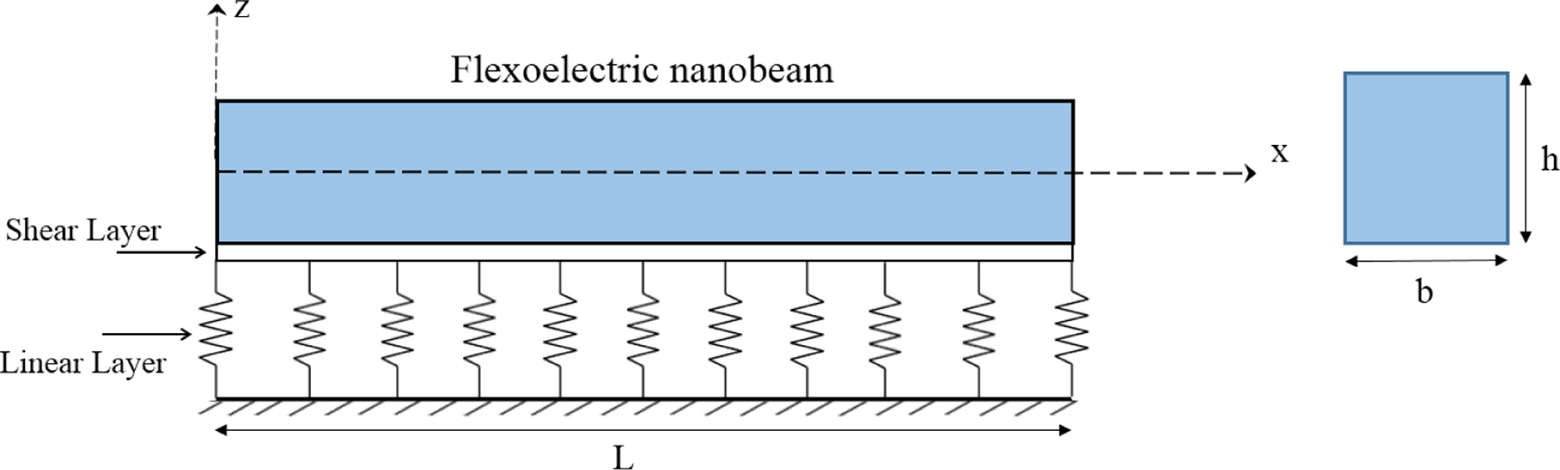
Geometry and coordinates of flexoelectric nanobeam.


where σij, ∊ij, and Ek denote the stress, strain, and electric field components, respectively; Cijkl, ekij, and kik are elastic, piezoelectric, and dielectric constant, respectively. Also, χij is the relative dielectric susceptibility and fijkl is the flexoelectric coefficient. Also, e0a is nonlocal parameter which is introduced to describe the size dependency of nanostructures. The effect of flexoelectricity is involved using the following expression of the electric enthalpy energy density was as follows

Finally, the constitutive relations incorporating nonlocal and flexoelectricity effects can be expressed by 49


in which τijl denotes the moment stress tensor due to the converse flexoelectric effect, Di is the electric displacement vector, and Q ij denotes the electric quadrupole density due to flexoelectricity, respectively. The size-dependent phenomena in piezoelectric nanostructures due to flexoelectricity involved in equations (4) to (7) is reported in analysis of nanowires, nanobeams, and nanoplates. Taking into account the surface effects, that is, the residual surface stress, the surface elasticity, and the surface piezoelectricity, the surface internal energy density Us can be defined by the surface strain and the surface polarization as 49

in which Γ
αβ
denotes the surface residual stress tensor,


where
Theoretical formulation
Here, the classical beam theory is employed for modeling of a piezoelectric nanobeam with surface, nonlocal, and flexoelectric effects. The displacement field at any point of the nanobeam can be written as


where u is the displacement of the mid-surface and w is the bending displacement. Nonzero strains and strain gradients of the present beam model are expressed as

Through extended Hamilton’s principle, the governing equations can be derived as follows

where Π S and Π W are strain energy and external forces work, respectively, and Π K is kinetic energy. The strain energy can be written as

Substituting equation (13) into equation (15) yields
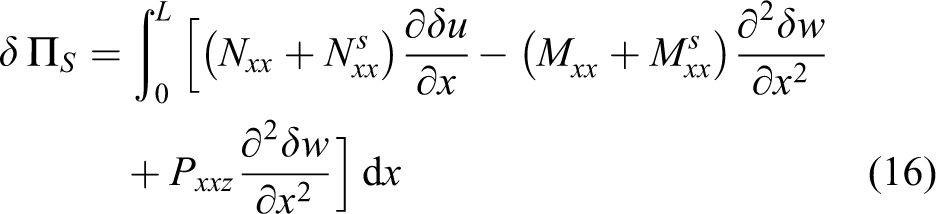
in which the variables introduced in arriving at the last expression are defined as follows

In this study, the nanobeam is subjected to an in-plane axial magnetic field. Hence, to derive the exerted body force from longitudinal magnetic field H = (Hx, 0, 0), the Maxwell relations are adopted

where

The work done by applied forces can be written in the form

where N0 is axial load and kw,kp are elastic foundation parameters. The following equations are obtained by inserting equations (15), (16), and (20) in equation (14) when the coefficients of δu, δw are equal to zero


where σ0 is the residual surface tension under unconstrained conditions. Also, the associated boundary conditions



For a piezoelectric nanobeam with the flexoelectric effect, the nonlocal constitutive relations for the bulk may be written as




where φ is the electrostatic potential and

Under the open-circuit condition, the electric displacement on the surface is zero. Therefore, one can obtain the electric field and electric field gradient as

Finally, the electric field gradient can be written as

Using equation (31) and (32), the nonlocal constitutive relations for the bulk and surface can be expressed by the following form

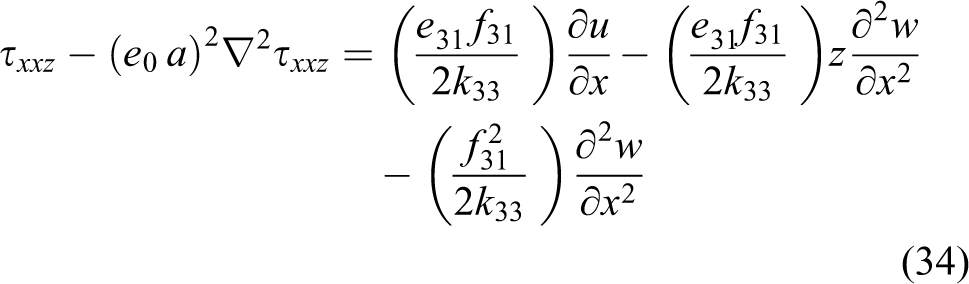

Therefore, by integrating equations (33) to (35) over the beam’s cross-sectional area, the force and moment stress resultants can be rewritten in the following form



and the cross-sectional rigidities are defined as

And the force and moment stress resultants due to surface piezoelasticity may be expressed as


in which

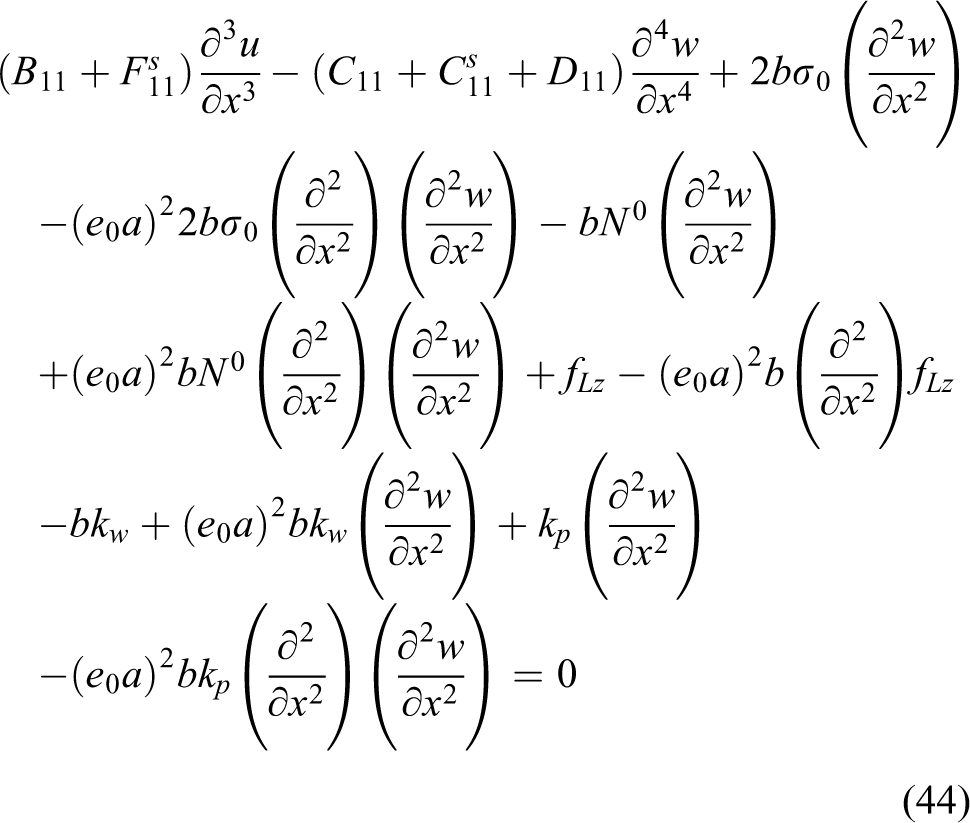
The nonlocal governing equations of a piezoelectric nanobeam with surface and flexoelectric effects in terms of the displacement can be derived by substituting equations (36) to (41), into equation (20) as follows

Solution procedure
In this section, Galerkin’s method is implemented for solving of the governing equations for buckling of a flexoelectric nanobeam having simply supported (S) and clamped (C) boundary conditions is presented, which they are given as
Simply supported (S)

Clamped (C)

To satisfy abovementioned boundary conditions, the displacement quantities are presented in the following form


where (Um, Wm) are the unknown coefficients. Inserting equations (47) and (48) into equations (43) and (44), respectively, leads to

where
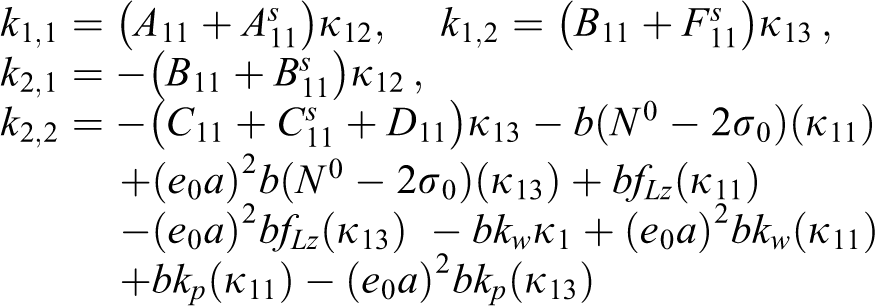
in which

By finding determinant of the coefficients of above matrix and setting it to zero, we can find buckling loads. The function Xm for different boundary conditions is defined by
S–S:

C–C:

C–S:

Numerical results and discussions
This section is devoted to examine nonlocal, flexoelectric, and surface effects on static buckling loads of piezoelectric nanobeams resting on elastic medium. Also, different kinds of edge conditions (C–C, C–S, and S–S) for the nanobeam are considered. In the present article, it is assumed that the flexoelectric nanobeam is made of PZT-5H where the elastic properties are considered as c
11 = 102 GPa, c
12 = 31 GPa, and c
66 = 35.5 GPa, and the piezoelectric and dielectric coefficients are assumed as e
31 = 17.05 C/m2 and k
33 = 1.76 × 10⁻⁸ C/(Vm). The flexoelectric coefficient is also considered as f
31 = 10−7.
52
The surface elastic and piezoelectric constants for PZT-5H can be considered as
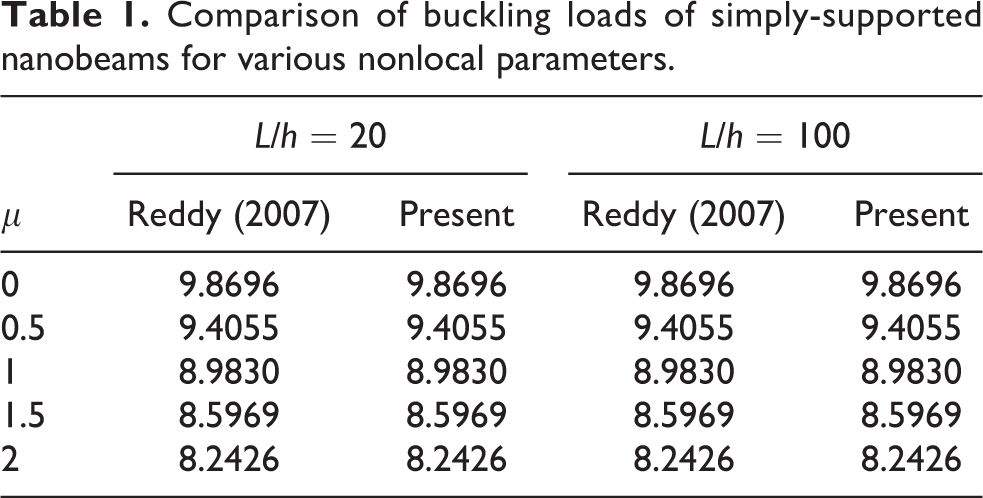
Comparison of buckling loads of simply-supported nanobeams for various nonlocal parameters.

In Figure 2, the influences of surface energy and flexoelectricity on critical buckling loads of piezoelectric nanobeams with respect to thickness value for S–S and C–C boundary conditions are examined. In this figure, NL refers to nonlocal piezoelectric nanobeam without surface and flexoelectric effects. NL–flexoelectric refers to a nonlocal flexoelectric nanobeam without surface effect. Also, NL–SE denote a nonlocal piezoelectric nanobeam without flexoelectric effect. It is observable from this figure that neglecting the surface effect leads to lower buckling loads. In fact, inclusion of surface effect enhances the stiffness of flexoelectric nanobeams and buckling loads increase. It is found that flexoelectricity effect leads to higher critical buckling loads, especially at smaller values of nanobeam thickness. Therefore, the maximum buckling load is observed for NL–SE–flexoelectric nanobeam, while nonlocal (NL) piezoelectric nanobeam has the minimum buckling load. For the nonlocal (NL) piezoelectric nanobeams, buckling load is not dependent on the value of nanobeam thickness. But, when the flexoelectric effect is involved, buckling load reduces as the value of thickness rises. So, flexoelectricity has an important size effect on buckling behavior of piezoelectric nanobeams.

Surface and flexoelectric effects on buckling load of a piezoelectric nanobeam with respect to thickness-to-side ratio (µ = 0.1). (a) S–S and (b) C–C.
Figure 3 illustrates the effects of flexoelectricity and nonlocality parameters on buckling loads of flexoelectric nanobeams with different edge conditions when h/L = 0.05. One can see that discarding the flexoelectric effect yields smaller critical buckling loads at a constant nonlocality. It is also found that the nonlocal flexoelectric nanobeam has lower critical buckling loads compared with local flexoelectric nanobeam (µ = 0 nm2), regardless of the type of boundary conditions. So, inclusion of nonlocal stress field parameter reduces the buckling loads of a flexoelectric nanobeam. Such observation is neglected in all previous analyzes on flexoelectric nanobeams. So, by ignoring the effect of nonlocality in analysis of flexoelectric nanobeams, the obtained results are overestimated. Hence, it can be concluded that the buckling behavior of flexoelectric nanobeams is sensitive to the nonlocal parameter.
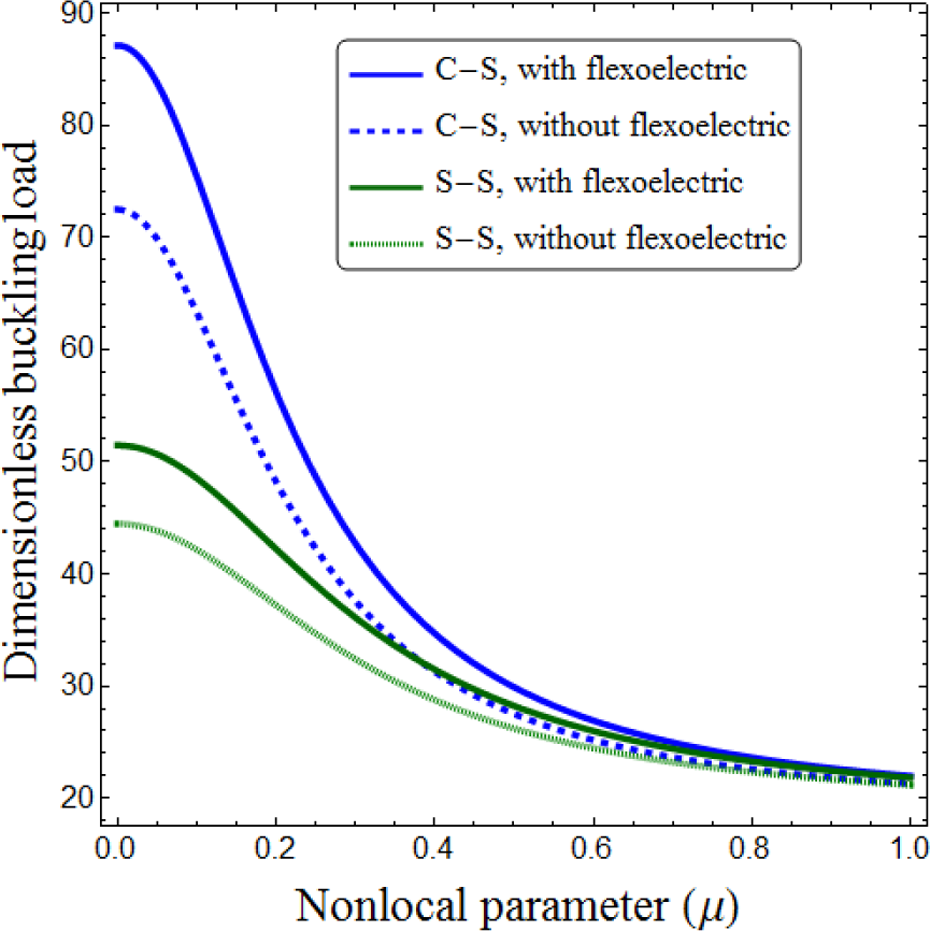
Flexoelectric effect on buckling load of a piezoelectric nanobeam with respect to nonlocal parameter (h/L = 0.05).
In Figures 4 and 5, the effects of Winkler (K w) and Pasternak (K p) foundation parameters on buckling loads of flexoelectric nanobeam with surface effect for different nonlocal parameters are plotted at h/L = 0.05. It is found that the presence of elastic medium has a significant effect on the buckling behavior flexoelectric nanobeams. In fact, elastic medium makes the flexoelectric nanobeam more rigid and buckling loads increase at a constant nonlocal parameter. Moreover, the buckling results of embedded flexoelectric nanobeam depend on the value of nonlocal parameter. It is observed that increasing the value of nonlocal parameter leads to reduction in dimensionless buckling loads of flexoelectric nanobeam at every magnitude of Winkler and Pasternak foundation parameters. This is due to stiffness reduction of flexoelectric nanobeam by considering the nonlocal stress field parameter.

Winkler foundation effect on buckling load of an S–S flexoelectric nanobeam with respect to nonlocal parameter (h/L = 0.05).
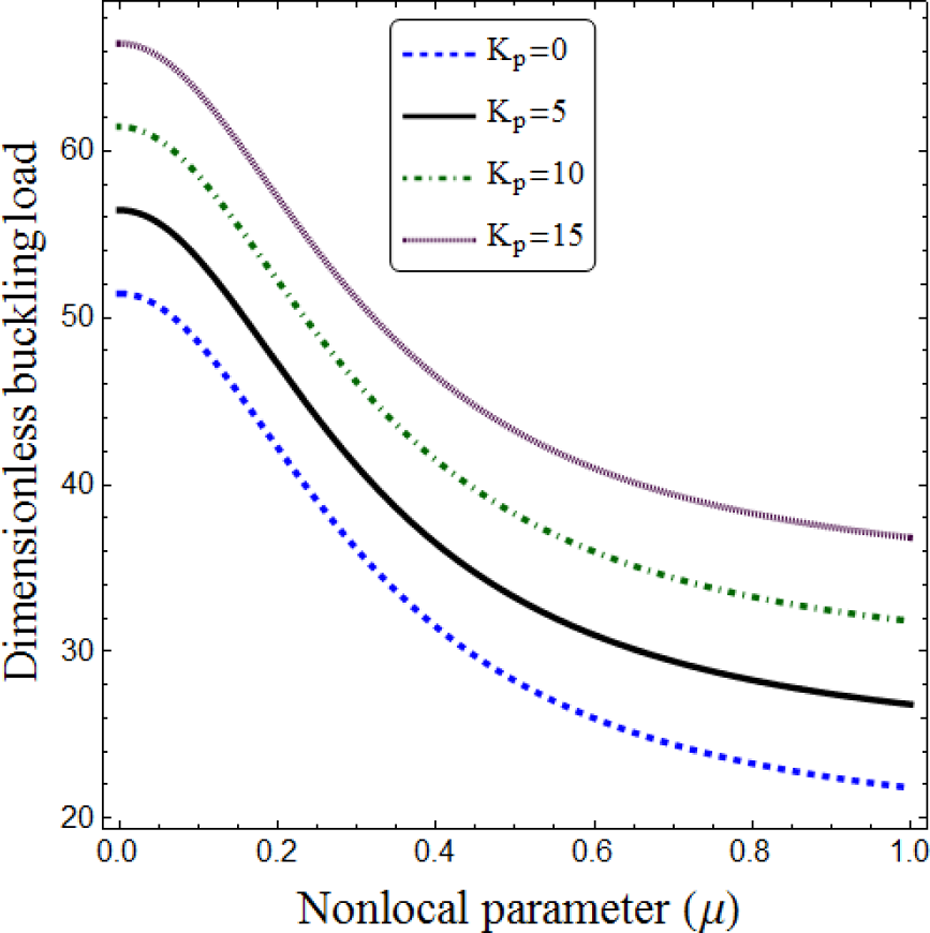
Pasternak foundation effect on buckling load of an S–S flexoelectric nanobeam with respect to nonlocal parameter (h/L = 0.05).
Another investigation on the effect of elastic medium, surface elasticity, and flexoelectricity on buckling load of flexoelectric nanobeams is presented in Figure 6 at h/L = 0.05, µ = 0.1. It is found that existence of elastic medium leads to larger buckling loads. In fact, buckling load of piezoelectric nanobeam increases linearly with the rise of Winkler or Pasternak parameters. Also, it is found that Pasternak layer has more significant impact on buckling loads of flexoelectric nanobeam than Winkler layer. But, these observations are dependent on the surface and flexoelectric effects. Considering both surface and flexoelectric effects leads to the largest buckling loads at a constant elastic foundation parameters. Neglecting flexoelectric or surface effects leads to lower buckling load at a fixed elastic foundation parameters.

Surface and flexoelectric effects on buckling load of an S–S flexoelectric nanobeam with respect to Winkler and Pasternak parameters (h/L = 0.05, µ = 0.1).
Figure 7 indicates magnetic field effect on buckling load of C–S and C–C flexoelectric nanobeams with respect to nonlocal parameter at h/L = 0.05, K w = 10, and K p = 5. It is found that magnetic field effect plays an important role in the buckling analysis of flexoelectric nanobeams for all ranges of nonlocal parameter. Increase of magnetic field intensity leads to larger buckling loads due to increment in stiffness of nanobeam. So, buckling loads are underestimated by neglecting magnetic field. These observations are valid for both C–S and C–C boundary conditions. Also, for a constant value of magnetic field intensity, nonlocal parameter shows a more considerable impact on buckling loads of C–C flexoelectric nanobeam compared with a C–S flexoelectric nanobeam.

Magnetic field effect on buckling load of C–S and C–C flexoelectric nanobeams with respect to nonlocal parameter (h/L = 0.05, K w = 10, K p = 5). (a) C–S and (b) C–C.
Figure 8 shows the boundary condition effect on buckling load of flexoelectric nanobeams with respect to magnetic field intensity at h/L = 0.05, K w = 10, K p = 5, µ = 0.1. The maximum and minimum buckling loads of flexoelectric nanobeam are obtained for C–C and S–S boundary conditions. In fact, stronger supports at ends make the flexoelectric nanobeam stiffer and buckling loads rise. For all boundary conditions, increasing magnetic field intensity leads to enlargement of dimensionless buckling load. However, effect of magnetic field on buckling loads is not sensible at small magnitudes of magnetic field intensity.
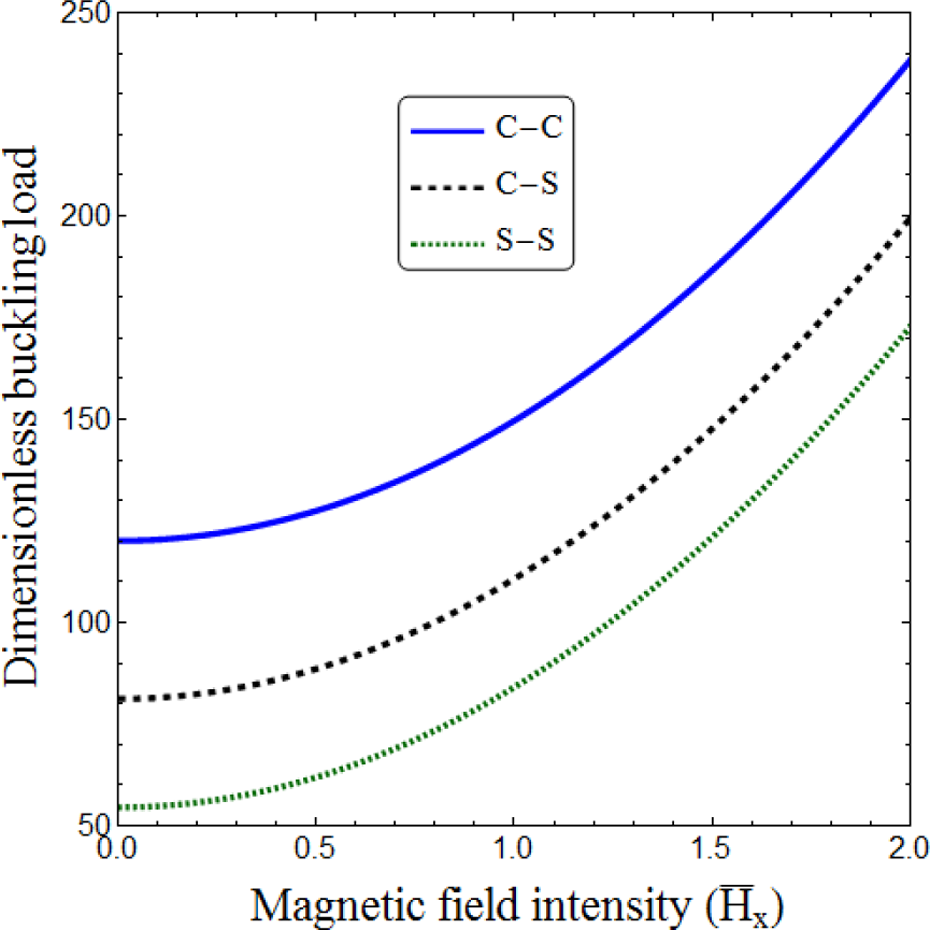
Boundary condition effect on buckling load of flexoelectric nanobeams with respect to magnetic field intensity (h/L = 0.05, K w = 10, K p = 5, µ = 0.1).
Conclusions
In the present article, a nonlocal flexoelectric nanobeam is developed incorporating surface effect. The model contains a nonlocal stress field parameter and a flexoelectric coefficient to capture the size effect. The governing differential equations and natural boundary edges were derived by exploiting the use of the Hamilton’s principle. Buckling loads of flexoelectric nanobeams are obtained implementing Galerkin’s method.
It was shown that the presence of nonlocality yields smaller buckling loads for flexoelectric beams. Also, flexoelectricity introduces an increasing influence on the buckling loads, especially at lower thicknesses. In fact, effect of flexoelectricity depends on the strain gradients and nonlocality. With increase of beam thickness, the strain gradients reduce and flexoelectricity can be negligible. Inclusion of surface effect enhances the stiffness of flexoelectric nanobeam and buckling loads increase. Also, it was found the buckling loads of flexoelectric nanobeam depend on the number of restraints at edges. So, stronger support at edges make the flexoelectric nanobeam stiffer and buckling loads increase. It was also seen that the elastic medium constants increases the rigidity of nanobeam. But, Pasternak layer shows a more increasing impact on critical buckling loads than Winkler layer.
Footnotes
Declaration of conflicting interests
The author(s) declared no potential conflicts of interest with respect to the research, authorship, and/or publication of this article.
Funding
The author(s) received no financial support for the research, authorship, and/or publication of this article.